REVIEW 3 major objections 6 minor 50 references
Application of renormalized RPA to polarized Fermi gases
T0 review · 3 major / 6 minor · reviewed 2026-08-14 · deepseek-v4-flash
Pith's one-line read This paper claims that renormalizing particle-particle RPA with self-consistently determined occupation numbers lowers the critical pairing polarization of a polarized Fermi gas, bringing the unitary-limit prediction from 0.834 to 0.543.
desk verdict A careful, self-disclosed r-RPA implementation that qualitatively lowers the critical polarization of a polarized Fermi gas, but the headline benchmark agreement with QMC rests partly on a Luttinger-theorem violation and should not be taken at face value. read the letter →
The pith
A machine-rendered reading of the paper's core claim, the machinery that carries it, and where it could break.
The reading
What carries the argument
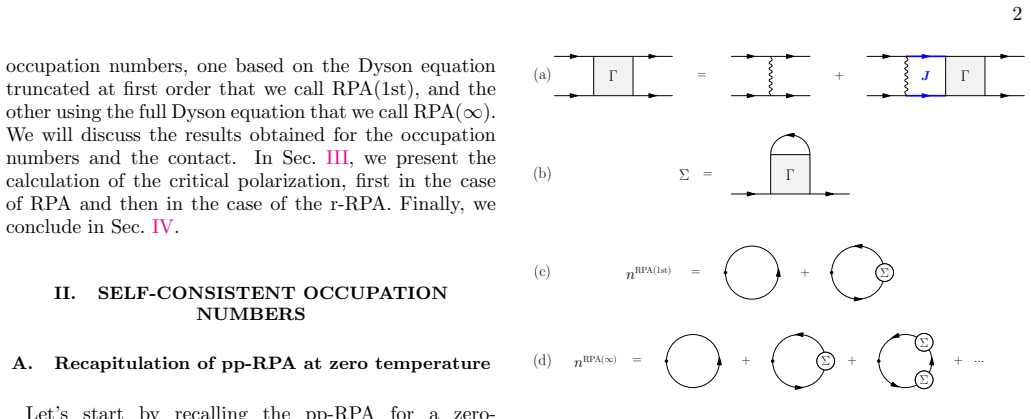
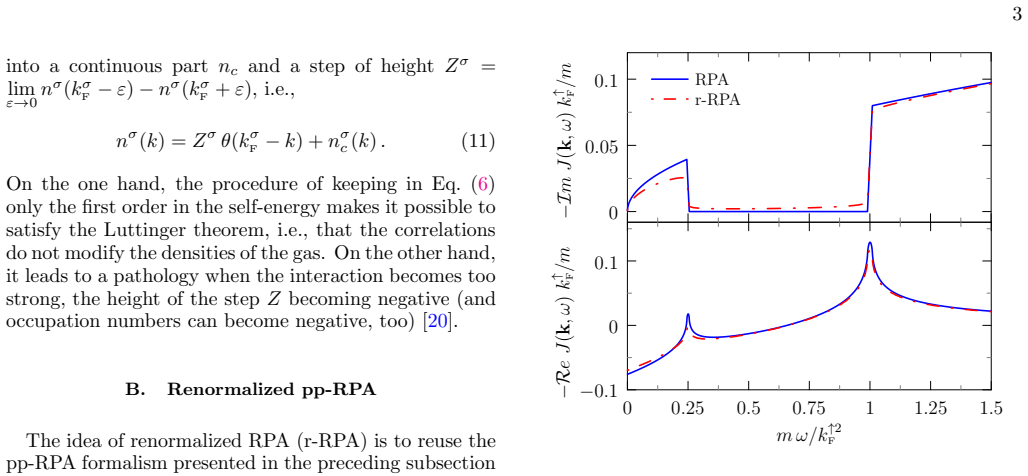
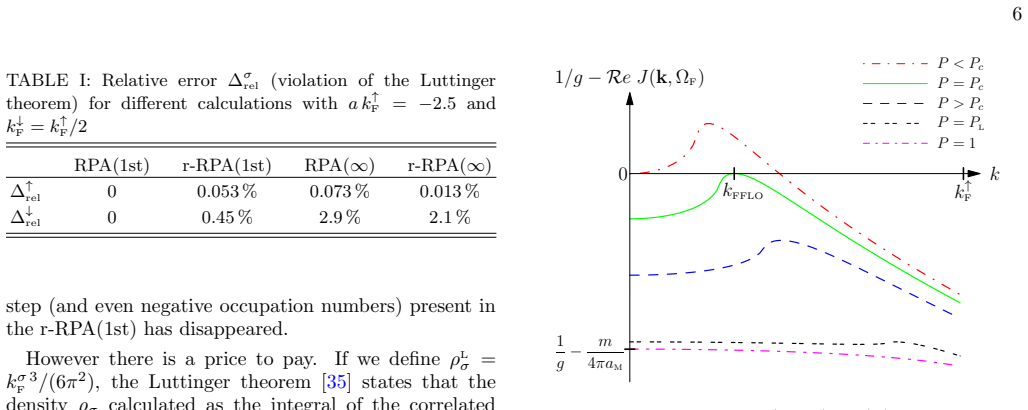
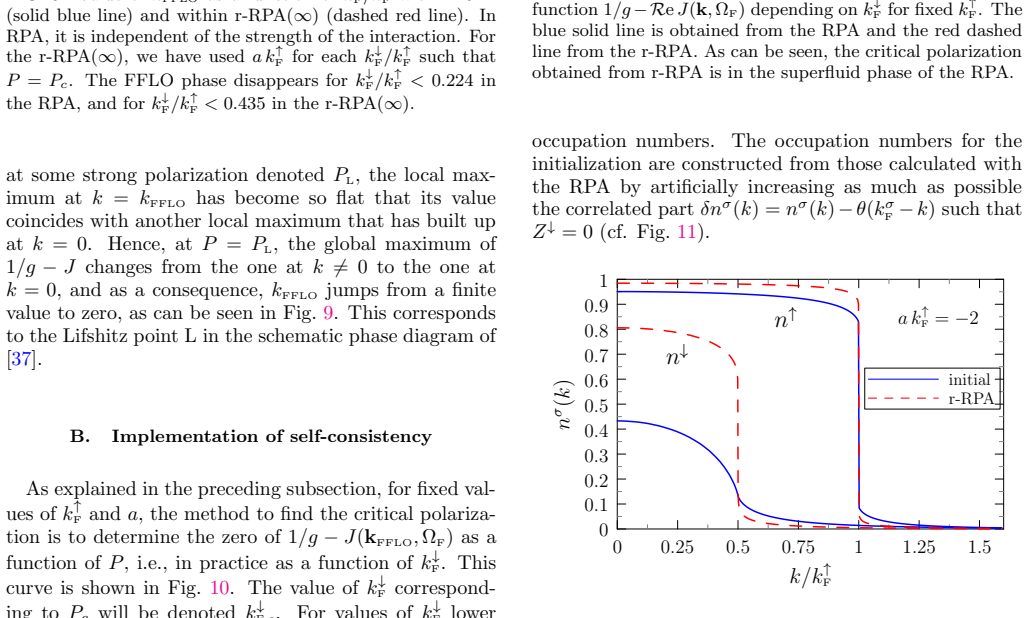
The central object is the renormalized particle-particle RPA (r-RPA): the in-medium $T$-matrix $\Gamma(k,\omega)=1/(1/g-J(k,\omega))$ is built with occupation numbers $n_\sigma(k)$ that are themselves computed from the dressed Green's function, either keeping the self-energy to first order (RPA(1st)) or resumming the Dyson equation (RPA($\infty$)), and iterated until convergence. The two-particle propagator $J(k,\omega)$ contains particle-particle and hole-hole terms (Eqs. 4 and 5); replacing the Heaviside Fermi steps by correlated occupation numbers reduces the peak of $\mathrm{Re}\, J$, which is what delays the appearance of the $T$-matrix pole. The onset of pairing is found by the Thouless criterion, $1/g-\mathrm{Re}\, J(k_{\mathrm{FFLO}},\Omega_F)=0$, with $k_{\mathrm{FFLO}}$ the wave vector maximizing this quantity (Eqs. 22 and 23); the quasi-particle step heights $Z_\sigma$ and the Tan contact $C=\lim_{k\to\infty} k^4 n_\sigma(k)$ are the diagnostics used to test the scheme.
What would settle it
Measure the onset of pairing in a uniform, flat-trapped imbalanced Fermi gas at unitarity as the polarization is lowered; if superfluidity (or phase separation) appears at a polarization above $P_c=0.543$, the self-consistent softening of the $T$-matrix singularity is overestimated, while a first-order transition found below the predicted pole would show the Thouless criterion misidentifies the boundary.
Extended reading notes
Core claim
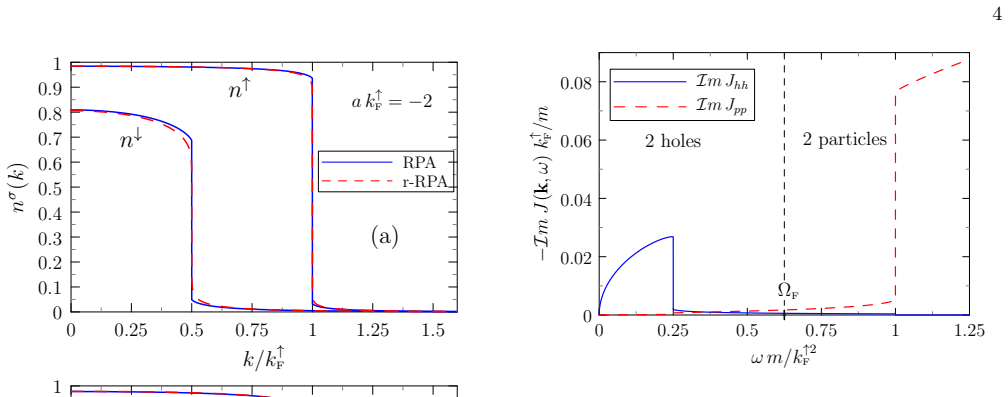
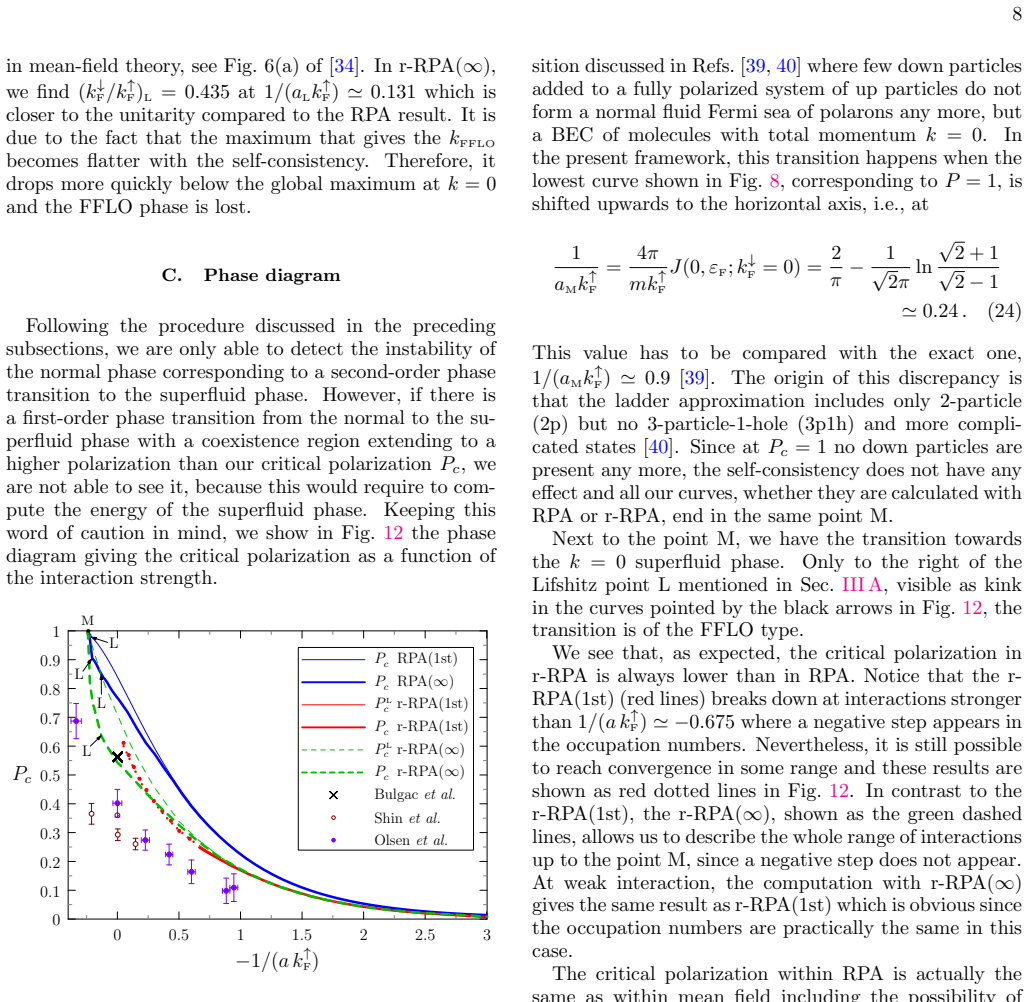
The central discovery is that the instability of the normal phase, located by the first pole of the in-medium $T$-matrix (Thouless criterion), depends sensitively on the occupation numbers used in the two-particle propagator. When the occupation numbers are no longer the bare Fermi steps but the correlated ones obtained from the Dyson equation and iterated to self-consistency, the logarithmic singularity in $\mathrm{Re}\, J(k,\omega)$ is softened, so the normal phase remains stable down to lower polarization. On the BCS side and around unitarity this lowers $P_c$ systematically; at unitarity it goes from $P_c=0.834$ in standard RPA to $P_c=0.543$ in the self-consistent version using the full Dyson equation, close to the 0.562 obtained from an energy-density functional fitted to quantum Monte Carlo data. The paper is careful to note that the low value is partly a consequence of the violation of the Luttinger theorem: imposing particle-number conservation would give $P_c=0.709$. The self-consistency also moves the Lifshitz point where the FFLO instability gives way to a $k=0$ pairing to higher polarization asymmetry, and it leaves the contact nearly unchanged.
Load-bearing premise
The critical polarization is located by the first pole of the $T$-matrix at the FFLO wave vector (Thouless criterion), which assumes the normal-to-superfluid transition is a second-order instability; if the true transition is first order with a coexistence region extending to higher polarization, the calculation cannot detect it and the quoted $P_c$ is not necessarily the physical phase boundary.
Editorial extensions
If this is right
- At unitarity, the r-RPA($\infty$) critical polarization $P_c=0.543$ is close to the quantum-Monte-Carlo-based value 0.562, a clear improvement over the RPA value 0.834.
- Under self-consistency the FFLO-type instability region shrinks: the Lifshitz point moves from $k_\downarrow/k_\uparrow=0.224$ (RPA) to 0.435 (r-RPA($\infty$)), so for stronger pairing the predicted instability switches to a $k=0$ superfluid instead of an oscillating order parameter.
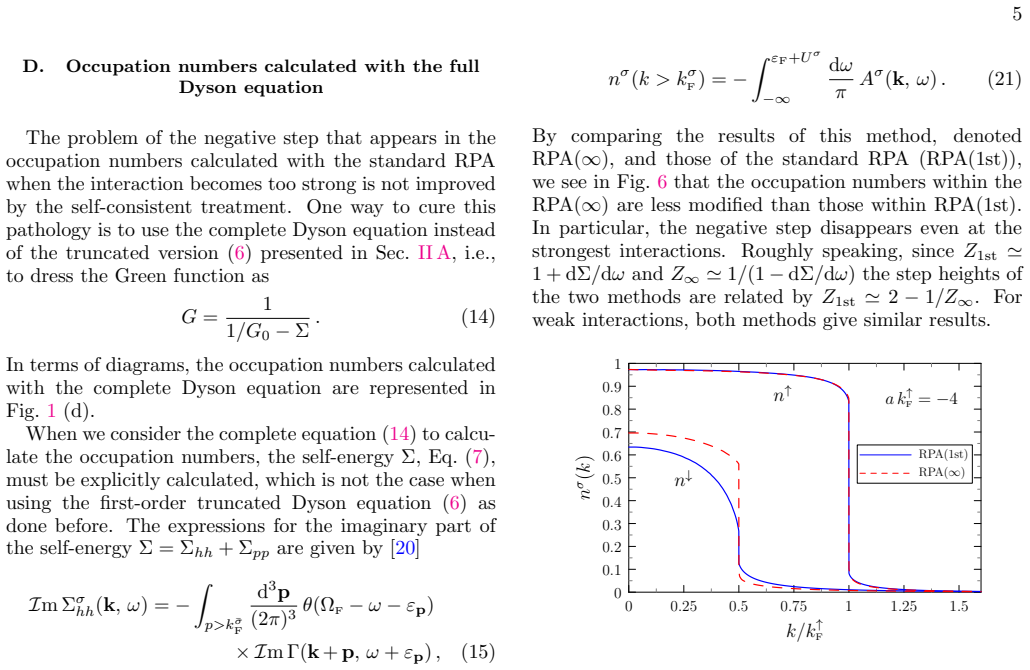
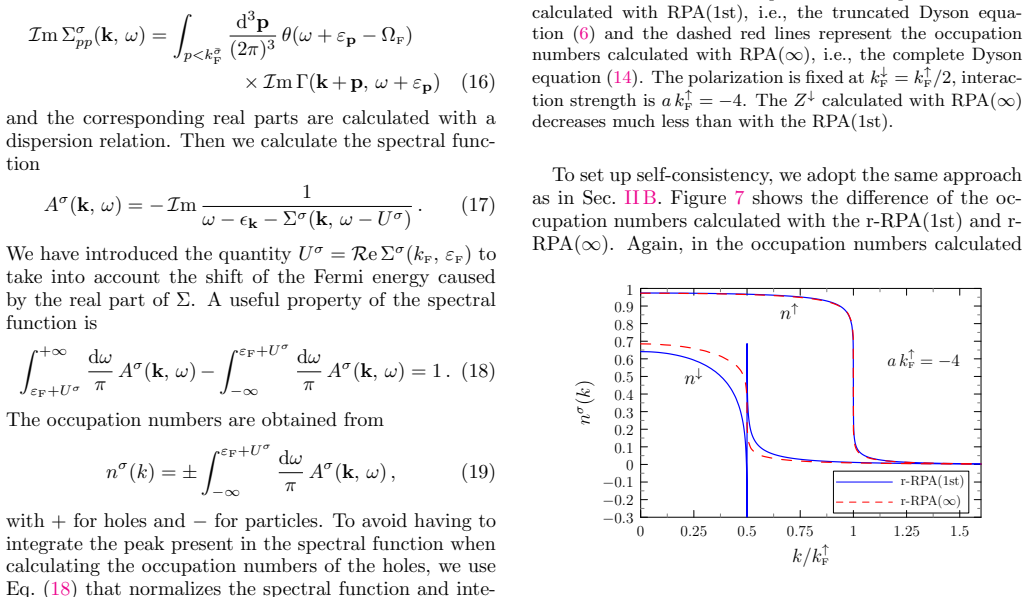
- The self-consistent treatment does not cure the negative-step pathology of the truncated Dyson equation; only the full Dyson equation keeps the occupation numbers physical, at the cost of violating the Luttinger theorem.
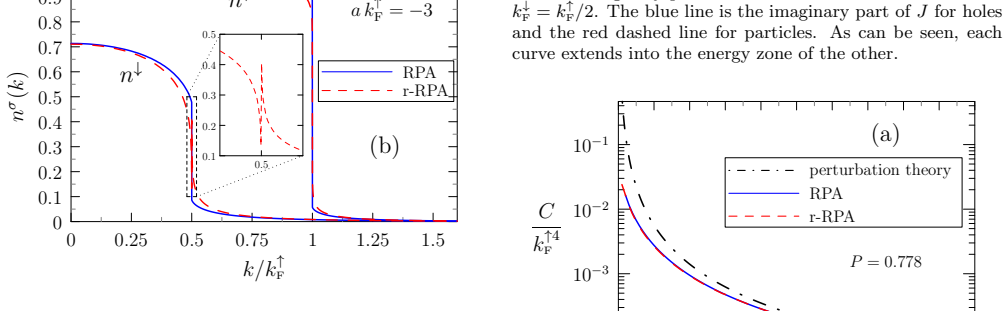
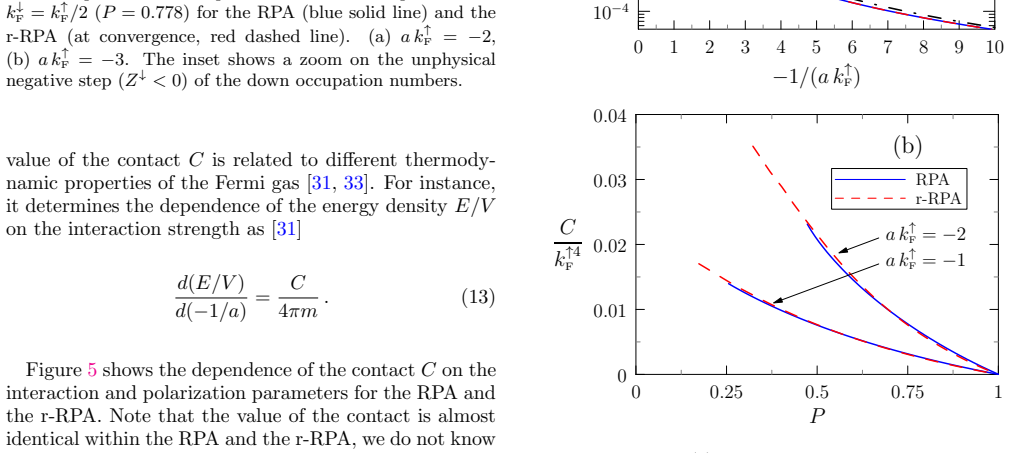
- Tan's contact is almost insensitive to the self-consistent treatment, indicating that the $P_c$ reduction is driven by the softened singularity of $J$, not by a change in the high-momentum tails.
Reading between the lines
- A variant that enforces the Luttinger theorem while using the full Dyson equation would be worth testing; the paper's bracketing values suggest the true improvement over RPA lies between $P_c=0.709$ and $P_c=0.543$ at unitarity.
- The same self-consistency loop could be transported to finite temperature, where the standard ladder approach is known to fail for polarized gases; it might reduce the overestimated critical temperature or polarization without the cost of fully self-consistent Green's-function methods.
- A flat-trap experiment mapping the onset of pairing versus polarization could test the sharpest signature here: the r-RPA($\infty$) prediction that the FFLO-type instability only exists for $k_\downarrow/k_\uparrow\gtrsim 0.435$.
Signed reviews
Editorial analysis
A structured set of objections, weighed in public.
Referee Report
Summary. The paper applies the renormalized particle-particle RPA (r-RPA) to a zero-temperature, spin-imbalanced Fermi gas in the normal phase, on the BCS side of the BCS-BEC crossover and around unitarity. The in-medium T matrix is built from ladder diagrams in which the step-function occupations of standard pp-RPA are replaced by correlated occupation numbers determined self-consistently. Two variants are used: occupations from the truncated Dyson equation [r-RPA(1st)], which satisfy the Luttinger theorem exactly but develop negative quasiparticle weights at strong coupling, and occupations from the resummed Dyson equation [r-RPA(∞)], which remain physical but violate the Luttinger theorem. The authors compute the correlated occupation numbers, the contact, and the critical polarization Pc via the Thouless criterion with the FFLO pairing momentum (Eqs. (22)-(23)). The central finding is that self-consistency lowers Pc relative to standard RPA: at unitarity, Pc = 0.834 (RPA), Pc = 0.543 (r-RPA(∞)), with a Luttinger-consistent estimate P_L^c = 0.709, compared with the ASLDA/QMC benchmark 0.562. The paper also discusses pathologies of the approach in detail: the overlapping two-particle/two-hole continua in the self-consistent J (Fig. 4), the negative-step problem in r-RPA(1st), the Luttinger violation in r-RPA(∞), and the caveat that the Thouless criterion cannot detect a first-order transition with a coexistence region.
Significance. If the central result holds, the r-RPA provides a cheap, physically motivated improvement over bare pp-RPA for imbalanced gases: self-consistently renormalized occupations soften the logarithmic singularity of Re J and thereby push the critical polarization in the right direction relative to independent ASLDA/QMC and experimental estimates. The paper's strengths are its transparency and the concreteness of the formalism: explicit integral expressions for the occupations (Eqs. (9)-(10), (15)-(21)), an unambiguous pole-search procedure, a falsifiable prediction for Pc(1/(a k↑_F)), and unusually direct acknowledgments of the method's failures, including the statement that the whole reduction of Pc in RPA(∞) is a Luttinger artifact, the polaron-to-molecule discrepancy (0.24 vs 0.9), and the warning about first-order transitions. The near-invariance of the contact under self-consistency is also informative.
major comments (3)
- [Sec. III C; Fig. 12; Conclusions] The paper's headline quantitative claim is that r-RPA(∞) yields Pc = 0.543 at unitarity, “a significant improvement” over RPA (0.834) and close to the ASLDA/QMC value 0.562. But the ordinate of Fig. 12 is the nominal polarization P = (ρ↑ − ρ↓)/(ρ↑ + ρ↓) with ρσ = kσ^3_F/(6π²), i.e., it is evaluated from the input Fermi momenta, not from the actual densities ρσ = ∫ d³k/(2π)³ nσ(k) of the correlated normal state. Table I shows that r-RPA(∞) already violates the Luttinger theorem by 2.1% for the minority spin at the moderate coupling 1/(a k↑_F) = −2.5, and the text states that the violation is “much worse” near the unitary critical point. Hence the physical polarization of the r-RPA(∞) solution at the pole is not 0.543. The paper's own Luttinger-consistent estimate, P_L^c = 0.709, implies that of the total reduction 0.834 − 0.543 = 0.291 only 0.125 survives, i.e., about 57% of the advertised reduction is a number-conservation artifact; the Conclusion's statement that the r-RPA critical polarization is “close to the one of Ref. [38]” holds only for the uncorrected value. I request that the authors either (i) quote Pc computed from the correlated densities at the pole, or (ii) present P_L^c = 0.709 as the meaningful r-RPA(∞) prediction and revise the abstract and Conclusions accordingly.
- [Sec. III C; Table I; Fig. 12] At unitarity neither r-RPA variant provides a fully physical normal state at the critical point. r-RPA(1st) is in the regime where the minority quasiparticle step Z↓ is negative (dotted red curves in Fig. 12; negative values of n↓ already appear at moderate coupling, cf. Fig. 3(b)), while r-RPA(∞) has a Luttinger violation that the authors say is “much worse” near the unitary critical point than the values in Table I. The manuscript never quantifies the violation, the density integrals, or Z at the critical point, even though all of these are computed in the course of the iterations. Since the unitarity value of Pc is the paper's central quantitative result, I ask for a table or explicit statement reporting Δσ_rel, ρσ = ∫ nσ(k) d³k/(2π)³, and Zσ at the unitary critical point for r-RPA(∞), together with a clear statement that the r-RPA(1st) unitarity value is only obtained in the negative-Z regime.
- [Sec. II B; Fig. 4; Sec. III A] The authors show that in the self-consistent calculation the two-particle continuum of Im Jpp leaks below Ω_F and the two-hole continuum of Im Jhh leaks above it, and they call this “a general problem of the r-RPA approach.” Since Re J is obtained from Im J by dispersion, the quantity Re J(kFFLO, Ω_F) entering the Thouless criterion (Eq. (23)) is polluted by these leaked contributions; the pole search in r-RPA therefore does not have the same spectral meaning as in standard RPA. The impact of this pollution on the quoted values of Pc is not assessed. A concrete test would be to recompute Pc with the leaked parts of Im J truncated at Ω_F and compare with the full result; if the difference is small, that should be stated explicitly.
minor comments (6)
- [Sec. II B] “writted” should be “written” in “the correlated occupation numbers writted in Eq. (11).”
- [Sec. III C] The definition “P_L^c = (k↑^3_F − k↓^3_F)/(k↑^3_F + k↓^3_F)” is formally identical to P of Eq. (1) evaluated at the same Fermi momenta; the authors should clarify that P_L^c is meant to be evaluated with effective Fermi momenta obtained from the correlated densities ρσ = ∫ nσ(k) d³k/(2π)³, since as written the two quantities are indistinguishable.
- [Secs. II B and III B] The numerical implementation (momentum grids, cutoffs, convergence criterion for the self-consistent iteration, and the tolerance used in the zero search of Eq. (23)) is not specified; these details are needed for reproducibility.
- [Sec. III B] The statement that the converged r-RPA result is independent of the initial occupation numbers is asserted but not demonstrated; a short convergence study would support this, particularly because a special initialization (Z↓ = 0) is needed near Pc.
- [Sec. II D] The relations Z1st ≃ 1 + dΣ/dω and Z∞ ≃ 1/(1 − dΣ/dω) are stated without derivation; a two-line derivation would clarify the relation between the two schemes.
- [Fig. 12 caption] Fig. 12 mixes theoretical curves for the second-order (Thouless) instability with experimental points for the first-order phase-separation boundary; the caption should state this distinction more prominently, as the body of Sec. III C does.
Circularity Check
No significant circularity: the critical polarization is a genuine pole-search output, and the benchmark comparisons are external to the calculation.
full rationale
The central new result, Pc, is obtained by iterating the dressed occupation numbers to convergence and then locating the first pole of the T matrix through Eq. (23), 1/g - Re J(kFFLO, Omega_F) = 0. This is a genuine fixed-point calculation: the input variables are k_F^up, k_F^down, and the scattering length a, and Pc is not used to define those inputs or imposed as a target. The comparison values used to judge the improvement (Bulgac et al., Shin et al., Olsen et al.) come from independent QMC-based functionals and experiments, not from quantities fitted in this paper. The authors do cite their own earlier work, notably Urban and Schuck (Ref. [20]) for the pp-RPA formalism and the review Ref. [34], but those references supply the base ladder formalism and do not contain the polarized-gas r-RPA critical polarization reported here; the r-RPA concept itself is attributed to external or collaborative work (Refs. [22,25,26]). The paper also explicitly discloses the limitation that r-RPA(infinity) violates the Luttinger theorem and reports the corrected estimate P_L^c = 0.709; that is a physical-correctness caveat about the meaning of Pc, not a circularity, and the qualitative lowering of Pc persists in r-RPA(1st), which satisfies the Luttinger theorem. No step in the derivation reduces by construction to a fitted parameter, a self-citation chain, or a definition of the predicted quantity.
Assumptions & free parameters
assumptions (4)
- domain assumption The ladder approximation with a regularized contact interaction describes pairing correlations in a dilute Fermi gas.
- domain assumption The normal-to-superfluid transition is identified with a pole in 1/g - Re J(k, Omega_F) via the Thouless criterion.
- ad hoc to paper Occupation numbers computed from the spectral function remain a valid input to the two-particle propagator even when negative steps or Luttinger theorem violations appear.
- standard math The contact interaction can be regularized by the scattering length using the standard subtraction in the particle-particle channel.
Cite this review
Pith. "Pith review of Application of renormalized RPA to polarized Fermi gases." pith.science (2026). https://pith.science/paper/DEAHUYL5
@misc{pith2026190800530,
  author       = {Pith},
  title        = {Pith review of: Application of renormalized RPA to polarized Fermi gases},
  year         = {2026},
  howpublished = {\url{https://pith.science/paper/DEAHUYL5}},
  note         = {Machine review of arXiv:1908.00530}
}
read the original abstract
We consider a spin imbalanced Fermi gas at zero temperature in the normal phase on the BCS side of the BCS-BEC crossover and around unitarity. We compute the critical polarization for pairing, the correlated occupation numbers and the contact in an extension of particle-particle RPA (also called non self-consistent \textit{T}-matrix approach or ladder approximation). The so-called renormalized RPA consists in computing the \textit{T} matrix with self-consistently determined occupation numbers. The occupation numbers are determined either by keeping the self-energy only to first order or by resumming the Dyson equation. In this way, the result for the critical polarization, strongly overestimated in standard RPA, is clearly improved. We also discuss some problems of this approach.
Figures
Figures from the paper (8 more)

Reference graph
Works this paper leans on
- [38]
-
[1]
Fulde and R
P. Fulde and R. A. Ferrell, Physical Review 135, A550 (1964)
1964
-
[2]
A. I. Larkin and Y. N. Ovchinnikov, Zh. Eksp. Teor. Fiz. 10 47, 1136 (1964)
work page 1964
-
[3]
G. B. Partridge, W. Li, R. I. Kamar, Y.-a. Liao, and R. G. Hulet, Nature 311, 503 (2006)
work page 2006
-
[4]
Y.-i. Shin, M. W. Zwierlein, C. H. Schunck, A. Schi- rotzek, and W. Ketterle, Phys. Rev. Lett. 97, 049901 (2006)
work page 2006
-
[5]
Y.-i. Shin, C. H. Schunck, A. Schirotzek, and W. Ket- terle, Nature 451, 689 (2008)
2008
-
[6]
Y.-i. Shin, A. Schirotzek, C. H. Schunck, and W. Ket- terle, Phys. Rev. Lett. 101, 070404 (2008)
work page 2008
-
[7]
B. A. Olsen, M. C. Revelle, J. A. Fry, D. E. Sheehy, and R. G. Hulet, Phys. Rev. A 92, 063616 (2015)
work page 2015
Show all 50 references
-
[8]
Stein, A
M. Stein, A. Sedrakian, X.-G. Huang, and J. W. Clark, Phys. Rev. C 90, 065804 (2014)
2014
-
[9]
M. G. Alford, K. Rajagopal, T. Schaefer, and A. Schmitt, Reviews of Modern Physics 80, 1455 (2008)
2008
-
[10]
Radzihovsky and D
L. Radzihovsky and D. E. Sheehy, Rep. Prog. Phys. 73, 076501 (2010)
2010
-
[11]
Chevy and C
F. Chevy and C. Mora, Reports on Progress in Physics 73, 112401 (2010)
2010
-
[12]
Gubbels and H
K. Gubbels and H. Stoof, Physics Reports 525, 255 (2013), ISSN 0370-1573, imbalanced Fermi Gases at Uni- tarity
2013
-
[13]
Nozi` eres and S
P. Nozi` eres and S. Schmitt-Rink, Journal of Low Tem- perature Physics 59, 195 (1985)
1985
-
[14]
Liu and H
X.-J. Liu and H. Hu, Europhys. Lett. 75, 364 (2006)
2006
-
[15]
M. M. Parish, A. Marchetti, F. M. andLamacraft, and B. D. Simons, Nat. Phys. 3, 124 (2007)
2007
-
[16]
Kashimura, R
T. Kashimura, R. Watanabe, and Y. Ohashi, Phys. Rev. A 86, 043622 (2012)
2012
-
[17]
Q. Chen, Y. He, C.-C. Chien, and K. Levin, Phys. Rev. B 75, 014521 (2007)
2007
-
[18]
He, C.-C
Y. He, C.-C. Chien, Q. Chen, and K. Levin, Phys. Rev. A 75, 021602 (2007)
2007
-
[19]
Pantel, D
P.-A. Pantel, D. Davesne, and M. Urban, Phys. Rev. A 90, 053629 (2014)
2014
-
[20]
Urban and P
M. Urban and P. Schuck, Phys. Rev. A90, 023632 (2014)
2014
-
[21]
Pieri, L
P. Pieri, L. Pisani, and G. C. Strinati, Phys. Rev. B 70, 094508 (2004)
2004
-
[22]
Dukelsky, G
J. Dukelsky, G. R¨ opke, and P. Schuck, Nucl. Phys. A 628, 17 (1998)
1998
-
[23]
Sch¨ afer and P
S. Sch¨ afer and P. Schuck, Phys. Rev. B59, 1712 (1999)
1999
-
[24]
J. G. Hirsch, A. Mariano, J. Dukelsky, and P. Schuck, Annals of Physics 296, 187 (2002)
2002
-
[25]
Catara, G
F. Catara, G. Piccitto, M. Sambataro, and N. Van Giai, Phys. Rev. B 54, 17536 (1996)
1996
-
[26]
D. S. Delion, P. Schuck, and J. Dukelsky, Phys. Rev. C 72, 064305 (2005)
2005
-
[27]
Perali, P
A. Perali, P. Pieri, G. C. Strinati, and C. Castellani, Phys. Rev. B 66, 024510 (2002)
2002
-
[28]
Fetter and J
A. Fetter and J. Walecka, Quantum Theory of Many- particle Systems (McGraw-Hill, New York, 1975)
1975
-
[29]
Blaizot and G
J.-P. Blaizot and G. Ripka, Quantum Theory of Finite Systems (MIT Press, 1986)
1986
-
[30]
Tan, Annals of Physics 323, 2952 (2008)
S. Tan, Annals of Physics 323, 2952 (2008)
2008
-
[31]
Tan, Annals of Physics 323, 2971 (2008)
S. Tan, Annals of Physics 323, 2971 (2008)
2008
-
[32]
Braaten and L
E. Braaten and L. Platter, Phys. Rev. Lett. 100, 205301 (2008)
2008
-
[33]
Tan, Annals of Physics 323, 2987 (2008)
S. Tan, Annals of Physics 323, 2987 (2008)
2008
-
[34]
Calvanese Strinati, P
G. Calvanese Strinati, P. Pieri, G. R¨ opke, P. Schuck, and M. Urban, Physics Reports 738, 1 (2018)
2018
-
[35]
J. M. Luttinger, Physical Review 119, 1153 (1960)
1960
-
[36]
D. J. Thouless, Annals of Physics 10, 553 (1960)
1960
-
[37]
D. T. Son and M. A. Stephanov, Phys. Rev. A74, 013614 (2006)
2006
-
[39]
N. V. Prokof’ev and B. V. Svistunov, Phys. Rev. B 77, 125101 (2008)
2008
-
[40]
M. Punk, P. T. Dumitrescu, and W. Zwerger, Phys. Rev. A 80, 053605 (2009)
2009
-
[41]
micro- phase separation
and leaves some room for a possible continuous (sec- ond order) transition towards the FFLO phase before phase separation happens, which corresponds qualita- tively to the scenario suggested in [38] for the case of unitarity. IV. CONCLUSIONS We have implemented a self-consiste...
-
[42]
Pao and S.-K
C.-H. Pao and S.-K. Yip, Journal of Physics: Conference Series 150, 032078 (2009)
2009
-
[43]
Pilati and S
S. Pilati and S. Giorgini, Phys. Rev. Lett. 100, 030401 (2008)
2008
-
[44]
Haussmann, Phys
R. Haussmann, Phys. Rev. B 94, 12975 (1994)
1994
-
[45]
Haussmann, W
R. Haussmann, W. Rantner, S. Cerrito, and W. Zwerger, Phys. Rev. A 75, 023610 (2007)
2007
-
[46]
Frank, J
B. Frank, J. Lang, and W. Zwerger, J. Exp. Theor. Phys. 125, 812 (2018)
2018
-
[47]
Pieri and G
P. Pieri and G. C. Strinati, Eur. Phys. J. B 90, 68 (2017)
2017
-
[48]
M. M. Forbes, E. Gubankova, W. V. Liu, and F. Wilczek, Phys. Rev. Lett. 94, 017001 (2005)
2005
-
[49]
P. F. Bedaque, H. Caldas, and G. Rupak, Phys. Rev. Lett. 91, 247002 (2003)
2003
-
[50]
W. V. Liu and F. Wilczek, Phys. Rev. Lett. 90, 047002 (2003)
2003
Reviewed August 14, 2026 · model on record in the stance chip above.
Discussion (0). Continue with ORCID to comment.