REVIEW 4 major objections 5 minor 40 references
Cost of institutional incentives for promoting cooperation in $2\times2$ games and collective risk games
T0 review · 4 major / 5 minor · reviewed 2026-08-07 · deepseek-v4-flash
Pith's one-line read This paper derives closed-form asymptotic costs for institutional incentives to promote cooperation, showing the expected reward cost is $N^2\theta H_N$ under neutral drift and either $N^2\theta/(N-1)$ or $N^2\theta$ under strong selection.
desk verdict Core asymptotic lemmas for incentive costs in composition-dependent games are correct and new; the finite-beta cost formula and 'phase transition' claims rest on an unvalidated starting-state assumption. read the letter →
The pith
A machine-rendered reading of the paper's core claim, the machinery that carries it, and where it could break.
The reading
What carries the argument
The carrying object is the absorbing Markov chain on states $S_0,\dots,S_N$ recording the number of cooperators, with tridiagonal transition matrix $W$ whose off-diagonal entries are Fermi probabilities $a_i=(1+e^{-\beta(\delta_i+\theta)})^{-1}$ and $c_i=(1+e^{\beta(\delta_i+\theta)})^{-1}$. The expected cost is written as $E(\theta)=N^2\sum_{j=1}^{N-1} \theta_j/(j(N-j))\,(f_D W^{-1}_{1,j}+f_C W^{-1}_{N-1,j})$, with starting weights $f_D=1/(1+r)$ and $f_C=r/(1+r)$, $r=e^{\beta(N-1)(\Delta+\theta)}$. The asymptotics come from simplifying $W$ before inversion: as $\beta\to 0$ it becomes the Cartan matrix, whose inverse is $2[\min(i,j)-ij/N]$, and as $\beta\to\infty$ it becomes a bidiagonal matrix whose inverse is the cumulative-sum matrix, supplied by the inverse formula for tridiagonal Toeplitz matrices (Lemma 1).
What would settle it
Run a forward simulation of the Fermi process for a finite population, say $N=10$, with a fixed reward incentive $\theta$ and starting from the all-defector state $S_0$ as the model section describes, record the total reward cost until absorption, and compare the mean with Eq (6) evaluated at $f_D=1/(1+r)$, $f_C=r/(1+r)$, $r=e^{\beta(N-1)(\Delta+\theta)}$; a systematic mismatch at finite $\beta$ would show the transient-start weights are the wrong entry distribution, while convergence to $N^2\theta H_N$ as $\beta\to 0$ would confirm Lemma 2.
Extended reading notes
Core claim
The central claim is that the expected institutional cost $E(\theta)$ for reward, punishment, and hybrid incentive schemes has well-defined closed-form limits even though the underlying $W$ matrix cannot be inverted in closed form for finite $\beta$. Lemma 2 states $\lim_{\beta\to 0} E_r(\theta) = N^2\theta H_N$, where $H_N=\sum_{i=1}^{N-1} 1/i$, for both the general $2\times2$ game and the collective risk game. Lemma 3 states, for reward incentives, $\lim_{\beta\to\infty} E_r(\theta) = N^2\theta/(N-1)$ when $\delta_j+\theta<0$ for all $j$, and $\lim_{\beta\to\infty} E_r(\theta) = N^2\theta$ when $\delta_j+\theta>0$ for all $j$; the appendix derives the corresponding punishment and hybrid factors. The proofs avoid inverting the $\beta$-dependent transition matrix by taking the limit of $W$ first, so that the neutral limit becomes the Cartan matrix with a known inverse and the strong-selection limit becomes a triangular matrix whose inverse is a cumulative-sum matrix.
Load-bearing premise
The load-bearing premise is the entry rule used to compute expected cost: the formulas place the population in the transient state $S_1$ (one cooperator) with probability $f_D$ and in $S_{N-1}$ (one defector) with probability $f_C$, even though the model section describes starting from the homogeneous absorbing states $S_0$ or $S_N$; if the intended entry distribution is different, the finite-$\beta$ cost curves, including the reported phase transitions, would change.
Editorial extensions
If this is right
- If the limit formulas are correct, an institution can compute the asymptotic reward-incentive budget from the population size, the per-capita incentive, and the harmonic number alone, with no inversion of the transition matrix.
- Under neutral drift the payoff structure drops out entirely: the expected reward cost is $N^2\theta H_N$ for every general $2\times2$ game and for the collective risk game, so game-agnostic budgeting is possible in the weak-selection regime.
- Under strong selection the limiting cost is governed by the sign of $\delta_j+\theta$: it is $N^2\theta/(N-1)$ when defection still pays everywhere and $N^2\theta$ when cooperation pays in every state, with the analogous dichotomy for punishment and hybrid incentives in the appendix.
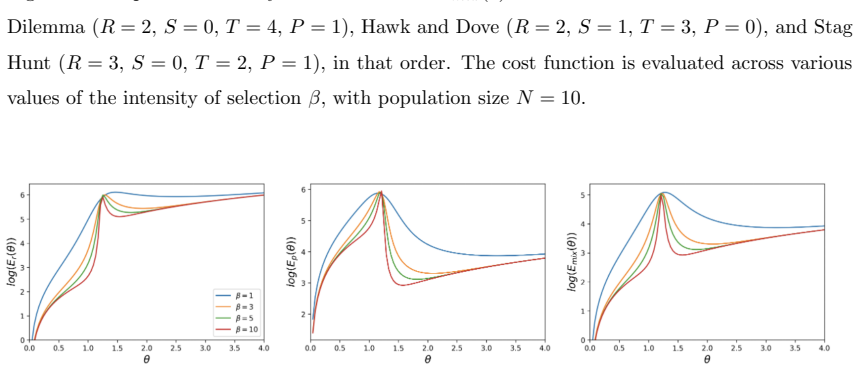
- The phase transitions in the Prisoner's Dilemma and collective risk game imply that the optimal per-capita incentive $\theta^*$ is not a smooth function of selection intensity, so an institution cannot safely extrapolate a weak-selection budget to strong selection.
- In the Stag Hunt game the cost rises to a peak and then declines to a plateau, indicating that once a cooperation threshold is crossed, additional incentive spending buys little extra cooperation.
Reading between the lines
- A natural test of the paper's finite-$\beta$ cost definition is to recompute $E(\theta)$ with the population starting directly from the absorbing homogeneous states $S_0$ and $S_N$; because the paper's transient-state weighting is not fully specified, the reported phase-transition curves would likely shift even though the two asymptotic limits, which are insensitive to the starting weights, would
- The sign-condition dichotomy in Lemma 3 should extend beyond $2\times2$ games to other $n$-player dilemmas whose average payoff difference $\delta_j$ keeps a uniform sign, making the strong-selection budget a general two-regime law rather than a special fact about the games studied here.
- Since the neutral limit is game-independent, the question of which social dilemma is most expensive to incentivise is decided by the finite-$\beta$ corrections, so computing the first-order term in $\beta$ around $N^2\theta H_N$ would identify where game structure first enters the budget.
- In the collective risk game, the amplification of the phase transition with the loss probability $r$ suggests a policy-relevant prediction: the per-capita incentive needed to sustain cooperation should depend nonmonotonically on perceived risk, with the sharpest transitions at high risk.
Editorial analysis
A structured set of objections, weighed in public.
Referee Report
Summary. The paper studies the expected cost of institutional reward, punishment, and hybrid incentives in finite, well-mixed populations playing general 2x2 games and the Collective Risk Game, under Fermi strategy update. It derives a Markov-chain expression for the expected incentive cost, obtains asymptotic limits for neutral drift (beta -> 0) and strong selection (beta -> infinity), and reports numerical simulations that show non-monotonic cost curves, which the authors call phase transitions, together with an optimization procedure. The neutral-drift limits and the strong-selection limits for reward and punishment incentives are algebraically consistent under the stated uniform-sign assumptions, but several load-bearing steps in the derivation of the finite-beta cost formula and in the hybrid-incentive asymptotic results need correction.
Significance. The contribution is a useful extension of the authors' earlier work on the Donation Game and Public Goods Game to games in which the cooperator-defector payoff difference depends on the population composition. The limiting formulas are explicit, contain no fitted constants, and follow from the model's transition matrix by standard matrix inversion, which are verifiable strengths. If the finite-beta model is properly justified, the paper provides a practical budgeting rule for institutions and a benchmark for numerical studies. However, the current text contains a sign error in the derivation of the cooperation frequency, an under-specified starting-state distribution in the finite-beta cost formula, and incorrect general-parameter hybrid strong-selection limits; these issues must be fixed before the results can be relied upon.
major comments (4)
- [Section 2.3, Eq. (4)] The displayed derivation of the cooperation frequency contains reciprocal errors. For the transition probabilities in Eq. (2), u_{i,i-1}/u_{i,i+1} = (1+e^{-beta(delta_i+theta)})/(1+e^{beta(delta_i+theta)}) = e^{-beta(delta_i+theta)}, whereas the paper writes (1+e^{beta(delta_i+theta)})/(1+e^{-beta(delta_i+theta)}) and concludes that rho_D,C/rho_C,D = e^{beta sum(delta_i+theta)}. The standard result is rho_D,C/rho_C,D = prod_i u_{i,i+1}/u_{i,i-1} = e^{beta sum(delta_i+theta)}, so the final expression is correct but the displayed first equality and the explicit formulas for rho_D,C and rho_C,D are inverted. Please correct the orientation of the ratio and the fixation-probability definitions so that the derivation is self-consistent.
- [Section 2.3, Eq. (6)] The expected cost formula weights the fundamental-matrix entries n_{1,j} and n_{N-1,j} by f_D and f_C, described as the long-run probabilities of starting at the absorbing states S0 and SN. The text does not derive these weights from a stated mutation-selection model. A fixation-probability ratio determines the stationary distribution over the absorbing states in a rare-mutation limit, but the entry distribution into the transient chain (S1 versus S_{N-1}) also requires specifying the mutation process, for example symmetric mutation rates and exactly one mutant per invasion attempt. As written, Eq. (6) is an additional modelling assumption, and all finite-beta cost curves in Figures 3-10 and the claimed phase transitions in Section 4 depend on it. Please state the rare-mutation model explicitly, or treat Eq. (6) as an assumption and provide a sensitivity check for the entry distribution.
- [Appendix, Lemma 5 (hybrid incentives)] The hybrid-incentive strong-selection limits are not correct for general a and b. From Eq. (12) and the limiting inverse of W, part 1 (delta_j+theta<0 for all j) has only the j=1 term contributing, giving lim E_mix = N^2 theta/(N-1) * min(1/a, (N-1)/b); part 2 has only the j=N-1 term contributing, giving lim E_mix = N^2 theta/(N-1) * min((N-1)/a, 1/b). The stated formulas N^2 theta/(a(N-1)) and N^2 theta/(b(N-1)) hold only when the corresponding minimum is attained by the reward or punishment branch, a condition that is neither stated nor implied. Please correct the lemma and its proof, or add the missing conditions on a and b.
- [Section 4 and Discussion] The term 'phase transition' is used for the non-monotonic dependence of E(theta) on beta or theta, but no quantitative criterion is given: there is no definition of the transition, no critical value, no scaling with N, and no order parameter. The claims that the cost functions 'exhibit a phase transition' are supported only by visual inspection of the plotted curves. If the phase transition is to be a main result, it needs a precise definition and quantitative characterization; otherwise the language should be softened to 'non-monotonic behaviour'.
minor comments (5)
- [Abstract and Section 2.3] There are typos: 'functons' should be 'functions', and 'cost of inference over all generations' should be 'cost of incentives over all generations'.
- [Section 2.3, Eq. (4)] In the sentence preceding Eq. (4), 'ui,i-1 and ui,i-1' should read 'ui,i-1 and ui,i+1'.
- [Figures 2 and A3/A4] The caption of Figure 2 says the strong-selection limit is 'in accordance to Lemma 2', but it should refer to Lemma 3; the same issue occurs in the captions of Figures A3 and A4.
- [Table 1] The abbreviations in the first column, such as 'PD (D)' and 'PD (C)', are not explained in the caption; a brief explanation of the notation (defective/cooperative versions) would improve readability.
- [Section 4.3, Algorithm 1] The pseudocode lists theta as an input to CostFunction, but the transition matrix W depends on theta through the payoffs; please clarify that the matrix is constructed for the current theta value being evaluated.
Circularity Check
No significant circularity: the asymptotic cost limits follow from the paper's own transition matrix via standard matrix inversions, and the central claims do not reduce to a fit or to a self-citation chain.
full rationale
The paper's central analytical results, Lemmas 2 through 5, are derived from the explicit transition matrix of the absorbing Markov chain, using the standard inverse of the tridiagonal fundamental matrix (Lemma 1, citing Huang and McColl [17]) and the known inverse of the Cartan matrix ([39]). The limiting formulas contain no fitted constants and are not defined in terms of the quantities they purport to predict. The finite-beta cost expression in Eq. (6) does rely on a heuristic entry distribution: the paper weights transient starts at S1 and S_{N-1} by f_D and f_C, which are the equilibrium frequencies of the two absorbing homogenous states. This is a modelling assumption, not a circular step; it is not itself derived from the cost function, and changing it would change the numerical curves, but the curves are not equivalent to the assumed weights by construction. Similarly, the phase-transition observations are numerical consequences of the stated model, not fitted inputs renamed as predictions. The self-citations to [5, 6, 7, 14] supply the incentive framework and earlier related results, but the new asymptotic limits are proven from the model equations in this paper, so those citations are not load-bearing in a circular sense. The paper also openly acknowledges limitations and intractability of a fully rigorous finite-beta optimisation, which further supports the assessment that the claimed limits are genuine derived results rather than restatements of assumptions.
Assumptions & free parameters
free parameters (3)
- θ (per-capita incentive cost) =
varied; optimization variable
- a, b (incentive delivery efficiencies) =
1 (normalized)
- ω (target cooperation fraction) =
user choice
assumptions (7)
- domain assumption Population dynamics follows Fermi's strategy update rule with intensity of selection β.
- domain assumption Small mutation rate justifies an absorbing Markov chain on the number of cooperators with absorbing states S0 and SN.
- domain assumption The institution operates a full-incentive scheme with complete information about population composition.
- ad hoc to paper Expected cost is computed with starting states S1 and S_{N−1} weighted by f_D = 1/(1+r) and f_C = r/(1+r), with r = e^{β(N−1)(Δ+θ)}.
- standard math Cartan matrix inverse formula (Wbar^{-1})_{i,j} = 2[min(i,j) - ij/N].
- standard math Analytical inversion of tridiagonal Toeplitz matrices (Lemma 1).
- ad hoc to paper In the strong selection limits, θ is assumed small (δ_j+θ<0 for all j) or large (δ_j+θ>0 for all j) so that the sign is uniform across all transient states.
Cite this review
Pith. "Pith review of Cost of institutional incentives for promoting cooperation in $2\times2$ games and collective risk games." pith.science (2026). https://pith.science/paper/DEEGUIPC
@misc{pith2026250602968,
  author       = {Pith},
  title        = {Pith review of: Cost of institutional incentives for promoting cooperation in $2\times2$ games and collective risk games},
  year         = {2026},
  howpublished = {\url{https://pith.science/paper/DEEGUIPC}},
  note         = {Machine review of arXiv:2506.02968}
}
abstract
Prosocial behaviours have been extensively studied across multiple disciplines. Cooperation, requiring a personal cost for collective benefits, is widespread in nature and human society, having been explained through mechanisms such as kin selection, direct and indirect reciprocity, and network reciprocity. Institutional incentives, which reward cooperation and punish anti-social behaviour, offer a promising approach to fostering cooperation in groups of self-interested individuals. Focusing on general $2\times2$ games and the collective risk game (which is a fundamental model for climate action), we analyse the associated cost of providing incentives under evolutionary dynamics governed by Fermi's rule, exploring the asymptotic behaviour of the incentive cost functons in the limits of neutral drift and strong selection. We also implement numerical simulations to study how parameters such as the intensity of selection affect the behaviour of the aforementioned cost functions.
Figures


Figures from the paper (7 more)




Reference graph
Works this paper leans on
-
[1]
Mathematical foundations of moral preferences
Valerio Capraro and Matjaˇ z Perc. Mathematical foundations of moral preferences. Journal of the Royal Society interface , 18(175):20200880, 2021
work page 2021
-
[2]
Valerio Capraro, Ismael Rodriguez-Lara, and Maria J Ruiz-Martos. Preferences for efficiency, rather than preferences for morality, drive cooperation in the one-shot stag-hunt game. Jour- nal of Behavioral and Experimental Economics , 86:101535, 2020
work page 2020
-
[3]
Cost-efficient interventions for pro- moting fairness in the ultimatum game
Theodor Cimpeanu, Cedric Perret, and The Anh Han. Cost-efficient interventions for pro- moting fairness in the ultimatum game. Knowledge-Based Systems, 233:107545, 2021
work page 2021
-
[4]
Hawks, doves, and international cooperation
Joe Clare. Hawks, doves, and international cooperation. Journal of Conflict Resolution , 58(7):1311–1337, 2014
work page 2014
-
[5]
M. H. Duong, C. M. Durbac, and T. A. Han. Cost optimisation of hybrid institutional incentives for promoting cooperation in finite populations. J. Math. Biol. , 87(77), 2023
work page 2023
-
[6]
M. H. Duong, C. M. Durbac, and T. A. Han. Cost optimisation of individual-based insti- tutional reward incentives for promoting cooperation in finite populations. Bull Math Biol , 86(115), 2024
work page 2024
-
[7]
Cost efficiency of institutional incentives for promoting cooperation in finite populations
Manh Hong Duong and The Anh Han. Cost efficiency of institutional incentives for promoting cooperation in finite populations. Proceedings of the Royal Society A , 477(2254):20210568, 2021
2021
-
[8]
Learning to resolve social dilemmas: a survey
Shaheen Fatima, Nicholas R Jennings, and Michael Wooldridge. Learning to resolve social dilemmas: a survey. Journal of Artificial Intelligence Research , 79:895–969, 2024
work page 2024
Show all 40 references
-
[9]
Evolution of commitment in the spatial public goods game through institutional incentives
Lucas S Flores and The Anh Han. Evolution of commitment in the spatial public goods game through institutional incentives. Applied Mathematics and Computation , 473:128646, 2024
2024
-
[10]
G´ ois, Fernando P
Ant´ onio R. G´ ois, Fernando P. Santos, Jorge M. Pacheco, and Francisco C. Santos. Reward and punishment in climate change dilemmas. Sci. Rep., 9(1):1–9, 2019
2019
-
[11]
The competitive advantage of sanctioning institutions
¨Ozg¨ ur G¨ urerk, Bernd Irlenbusch, and Bettina Rockenbach. The competitive advantage of sanctioning institutions. Science (New York, N.Y.) , 312:108–11, 05 2006. 34
2006
-
[12]
Evolutionary mechanisms that pro- mote cooperation may not promote social welfare
The Anh Han, Manh Hong Duong, and Matjaz Perc. Evolutionary mechanisms that pro- mote cooperation may not promote social welfare. Journal of the Royal Society Interface , 21(220):20240547, 2024
2024
-
[13]
Evolution of commitment and level of participation in public goods games
The Anh Han, Luis Moniz Pereira, and Tom Lenaerts. Evolution of commitment and level of participation in public goods games. Autonomous Agents and Multi-Agent Systems , 31(3):561–583, 2017
2017
-
[14]
Cost-effective external interference for promoting the evolution of cooperation
The Anh Han and Long Tran-Thanh. Cost-effective external interference for promoting the evolution of cooperation. Scientific reports, 8(1):1–9, 2018
2018
-
[15]
Rewarding endowments lead to a win-win in the evolution of public cooperation and the accumulation of common resources
Liwen Hu, Nanrong He, Qifeng Weng, Xiaojie Chen, and Matjaˇ z Perc. Rewarding endowments lead to a win-win in the evolution of public cooperation and the accumulation of common resources. Chaos, Solitons & Fractals , 134:109694, 2020
2020
-
[16]
Coevolutionary dynamics of population and institutional rewards in public goods games
Shijia Hua and Linjie Liu. Coevolutionary dynamics of population and institutional rewards in public goods games. Expert Systems With Applications , 237:121579, 2024
2024
-
[17]
Analytical inversion of general tridiagonal matrices
Y Huang and W F McColl. Analytical inversion of general tridiagonal matrices. Journal of Physics A: Mathematical and General , 30(22):7919, 1997
1997
-
[18]
Perspectives on the micro-macro distinction
Jim Kemeny. Perspectives on the micro-macro distinction. The Sociological Review , 24(4):731–752, 1976
1976
-
[19]
Effects of interconnections among corruption, institutional punishment, and economic factors on the evolution of cooperation
Linjie Liu and Xiaojie Chen. Effects of interconnections among corruption, institutional punishment, and economic factors on the evolution of cooperation. Applied Mathematics and Computation, 425:127069, 2022
2022
-
[20]
Evolution of trust in the n-player trust game with transformation incentive mechanism
Yuyuan Liu, Lichen Wang, Ruqiang Guo, Shijia Hua, Linjie Liu, Liang Zhang, and The Anh Han. Evolution of trust in the n-player trust game with transformation incentive mechanism. Journal of the Royal Society Interface , 22(224):20240726, 2025
2025
-
[21]
Hawks, doves, and peace: an experimental approach
Michaela Mattes and Jessica LP Weeks. Hawks, doves, and peace: an experimental approach. American Journal of Political Science , 63(1):53–66, 2019
2019
-
[22]
Martin A. Novak. Evolutionary Dynamics: Exploring the Equations of Life . Harvard Univer- sity Press, 2006
2006
-
[23]
Martin A. Nowak. Five rules for the evolution of cooperation. Science, 314(5805):1560–1563, 2006
2006
-
[24]
Jordan, David G
Matjaˇ z Perc, Jillian J. Jordan, David G. Rand, Zhen Wang, Stefano Boccaletti, and Attila Szolnoki. Statistical physics of human cooperation. Physics Reports, 687:1–51, 2017. 35
2017
-
[25]
More can be better: An analysis of single-mutant fixation probability functions under 2 × 2 games
Diogo L Pires and Mark Broom. More can be better: An analysis of single-mutant fixation probability functions under 2 × 2 games. Proceedings of the Royal Society A , 478(2267):20220577, 2022
2022
-
[26]
Rand and Martin A
David G. Rand and Martin A. Nowak. Human cooperation. Trends in cognitive sciences , 17(8):413–425, 2013
2013
-
[27]
The optimal control for promoting the cooperation in evolution game generated by prisoner’s dilemma
DONG Rui, CHEN Lin, et al. The optimal control for promoting the cooperation in evolution game generated by prisoner’s dilemma. Acta Mathematica Scientia , 38(1):73–92, 2018
2018
-
[28]
The take-it-or-leave- it option allows small penalties to overcome social dilemmas
Tatsuya Sasaki, ˚Ake Br¨ annstr¨ om, Ulf Dieckmann, and Karl Sigmund. The take-it-or-leave- it option allows small penalties to overcome social dilemmas. Proceedings of the National Academy of Sciences, 109(4):1165–1169, 2012
2012
-
[29]
The calculus of selfishness
Karl Sigmund. The calculus of selfishness. In The Calculus of Selfishness. Princeton University Press, 2010
2010
-
[30]
Social learning promotes institutions for governing the commons
Karl Sigmund, Hannelore De Silva, Arne Traulsen, and Christoph Hauert. Social learning promotes institutions for governing the commons. Nature, 466:7308, 2010
2010
-
[31]
Combination of institutional incentives for cooperative governance of risky commons
Weiwei Sun, Linjie Liu, Xiaojie Chen, Attila Szolnoki, and V ´ ıtor V Vasconcelos. Combination of institutional incentives for cooperative governance of risky commons. Iscience, 24(8), 2021
2021
-
[32]
Mutual trust and cooperation in the evolutionary hawks–doves game
Marco Tomassini, Enea Pestelacci, and Leslie Luthi. Mutual trust and cooperation in the evolutionary hawks–doves game. Biosystems, 99(1):50–59, 2010
2010
-
[33]
Arne Traulsen and Martin A. Nowak. Evolution of cooperation by multilevel selection. Pro- ceedings of the National Academy of Sciences , 103(29):10952–10955, 2006
2006
-
[34]
Van Lange, Bettina Rockenbach, and Toshio Yamagishi
Paul A.M. Van Lange, Bettina Rockenbach, and Toshio Yamagishi. Reward and punishment in social dilemmas . Oxford University Press, 2014
2014
-
[35]
Partial intervention promotes cooperation and social welfare in regional public goods game
Jianwei Wang, Wenhui Dai, Yanfeng Zheng, Fengyuan Yu, Wei Chen, and Wenshu Xu. Partial intervention promotes cooperation and social welfare in regional public goods game. Chaos, Solitons & Fractals, 184:114991, 2024
2024
-
[36]
Exploring optimal institutional incen- tives for public cooperation
Shengxian Wang, Xiaojie Chen, and Attila Szolnoki. Exploring optimal institutional incen- tives for public cooperation. Communications in Nonlinear Science and Numerical Simula- tion, 79:104914, 2019
2019
-
[37]
Decentralized incentives for general well-being in networked public goods game
Shengxian Wang, Xiaojie Chen, Zhilong Xiao, and Attila Szolnoki. Decentralized incentives for general well-being in networked public goods game. Applied Mathematics and Computa- tion, 431:127308, 2022. 36
2022
-
[38]
Optimization of institutional incentives for cooperation in structured populations
Shengxian Wang, Xiaojie Chen, Zhilong Xiao, Attila Szolnoki, and V ´ ıtor V Vasconcelos. Optimization of institutional incentives for cooperation in structured populations. Journal of the Royal Society Interface , 20(199):20220653, 2023
2023
-
[39]
Inverses of cartan matrices of lie algebras and lie superal- gebras
Yangjiang Wei and Yi Ming Zou. Inverses of cartan matrices of lie algebras and lie superal- gebras. Linear Algebra and its Applications , 521:283–298, 2017
2017
-
[40]
Reputation and reciprocity.Physics of Life Reviews , 2023
Chengyi Xia, Juan Wang, Matjaˇ z Perc, and Zhen Wang. Reputation and reciprocity.Physics of Life Reviews , 2023. 37
2023
Reviewed August 7, 2026 · model on record in the stance chip above.
Discussion (0). Sign in to comment.