Differential Equation Inductive Robustness Axiomatization
Pith reviewed 2026-06-26 19:19 UTC · model grok-4.3
The pith
Robust safety of polynomial differential equation systems reduces completely to polynomial invariant proofs on bounded time horizons.
A machine-rendered reading of the paper's core claim, the machinery that carries it, and where it could break.
Core claim
The axiomatization for robust safety is complete because safety properties of robust systems are uniformly reduced to a sound axiomatization of polynomial invariants, resulting in reliable logical proofs of correctness for dynamical systems with polynomial differential equations on bounded time horizons.
What carries the argument
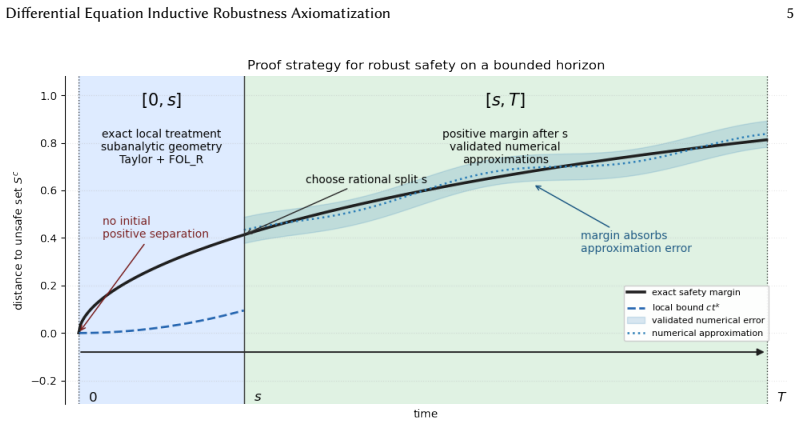
The uniform reduction from robust safety properties to the sound axiomatization of polynomial invariants, supported by subanalytic geometry to handle general semialgebraic sets.
If this is right
- Logical proofs of robust safety become available for general hybrid dynamical systems on bounded horizons.
- Approximate decidability follows: for any perturbation parameter delta the procedure either produces a symbolic proof or decides the system is not robustly safe at level delta.
- Inductive safety proofs extend beyond finite time horizons for hybrid systems.
Where Pith is reading between the lines
- The completeness result may allow automated tools to generate proofs for a wider class of initial and post conditions than previously possible.
- Similar reductions could be explored for other temporal properties such as reachability or liveness if analogous invariant axiomatizations exist.
- Practical implementations might combine the axiomatization with real-algebraic decision procedures to produce concrete proof certificates.
Load-bearing premise
The reduction from robust safety properties to polynomial invariant axioms remains valid for arbitrary bounded semialgebraic initial and post conditions even without positive separation at their topological boundaries.
What would settle it
A concrete polynomial differential equation system on a bounded time horizon whose robust safety holds for given semialgebraic sets without boundary separation yet cannot be proved by the axiomatization, or where the approximate decision procedure fails to output a proof or a correct negative verdict for some delta.
Figures
read the original abstract
This article establishes the completeness of an axiomatization for the robust safety of dynamical systems with polynomial differential equations on bounded time horizons. Safety properties of robust systems are uniformly reduced to a sound axiomatization of polynomial invariants, resulting in reliable logical proofs of correctness. Approximate decidability results are also established: there is a computable algorithm such that, given any perturbation parameter $\delta$, it either produces a symbolic proof of robust safety (hence correctly decides the dynamical system to be robustly safe), or correctly decides that the system is not robustly safe under a perturbation of level $\delta$. In contrast to earlier works, this article crucially leverages results from subanalytic geometry to retain a level of exactness, thereby establishing positive results of provability/decidability allowing for arbitrary bounded (semialgebraic) initial/post conditions even without positive separation at their (topological) boundaries. This enables the generation of proofs of inductive safety beyond finite time horizons for general hybrid dynamical systems.
Editorial analysis
A structured set of objections, weighed in public.
Referee Report
Summary. The paper claims to establish completeness of an axiomatization for robust safety of dynamical systems governed by polynomial differential equations on bounded time horizons. Robust safety properties are reduced to a sound axiomatization of polynomial invariants via results from subanalytic geometry; this reduction is asserted to hold for arbitrary bounded semialgebraic initial and post conditions even without positive separation at topological boundaries. Approximate decidability is also claimed: a computable procedure either produces a symbolic proof of robust safety or correctly identifies that the system fails to be robustly safe at a given perturbation level δ.
Significance. If the central reduction holds, the result would constitute a notable advance in the logical verification of hybrid systems by removing the positive-separation restriction present in prior work and by supplying both completeness and approximate decidability for general semialgebraic sets.
major comments (1)
- [reduction argument (main completeness theorem)] The reduction step that maps robust safety of polynomial flows to the polynomial-invariant axiomatization for arbitrary bounded semialgebraic sets (without positive boundary separation) is load-bearing for the completeness claim. The manuscript must explicitly verify that the image of the flow under a polynomial vector field, together with the δ-perturbation neighborhoods, remains inside the subanalytic category to which the invoked o-minimality or curve-selection results apply; otherwise the reduction fails for the general case stated in the abstract.
Simulated Author's Rebuttal
We thank the referee for the careful reading and for identifying the need for explicit verification in the central reduction argument. We address the major comment below.
read point-by-point responses
-
Referee: [reduction argument (main completeness theorem)] The reduction step that maps robust safety of polynomial flows to the polynomial-invariant axiomatization for arbitrary bounded semialgebraic sets (without positive boundary separation) is load-bearing for the completeness claim. The manuscript must explicitly verify that the image of the flow under a polynomial vector field, together with the δ-perturbation neighborhoods, remains inside the subanalytic category to which the invoked o-minimality or curve-selection results apply; otherwise the reduction fails for the general case stated in the abstract.
Authors: We agree that an explicit verification of subanalyticity preservation is required for rigor. Polynomial flows on bounded intervals are subanalytic (their graphs are subanalytic sets by the o-minimality of the subanalytic structure and the fact that solutions to polynomial ODEs admit subanalytic parametrizations). δ-perturbation neighborhoods of bounded semialgebraic sets are themselves semialgebraic, hence subanalytic. In the revised version we will add a short lemma (immediately before the statement of the main completeness theorem) that invokes the relevant closure properties from subanalytic geometry (e.g., van den Dries, “Tame topology and o-minimal structures”, Thm. 3.2.5 and Cor. 3.3.8) to confirm that both the flow image and the perturbed sets remain inside the subanalytic category, thereby licensing the curve-selection and o-minimality results used in the reduction. revision: yes
Circularity Check
Minor self-citation to prior dL axiomatization; central completeness relies on external subanalytic geometry benchmarks
full rationale
The derivation reduces robust safety properties of polynomial DEs to the existing sound axiomatization of polynomial invariants, then invokes subanalytic geometry results (o-minimality/curve selection) to handle arbitrary bounded semialgebraic sets without positive boundary separation. These geometry results are external mathematical facts, not derived within the paper or from author self-citations. Self-citations to the authors' prior differential dynamic logic work support the base invariant axiomatization but are not load-bearing for the new completeness claim on robust safety. No self-definitional reductions, fitted inputs renamed as predictions, or ansatzes smuggled via citation are present. The result is self-contained against external benchmarks.
Axiom & Free-Parameter Ledger
axioms (2)
- standard math Sound axiomatization of polynomial invariants
- domain assumption Results from subanalytic geometry for exact handling of semialgebraic sets without boundary separation
Reference graph
Works this paper leans on
-
[1]
Noah Abou El Wafa and André Platzer. 2026. Complete Robust Hybrid Systems. InIJCAR (LNCS), Armin Biere, Carsten Lutz, and Sara Negri (Eds.). Springer. , Vol. 1, No. 1, Article . Publication date: June 20yy. Differential Equation Inductive Robustness Axiomatization 29
2026
-
[2]
2015.Principles of Cyber-Physical Systems
Rajeev Alur. 2015.Principles of Cyber-Physical Systems. The MIT Press
2015
-
[3]
Bell, Jean-Charles Delvenne, Raphaël M
Paul C. Bell, Jean-Charles Delvenne, Raphaël M. Jungers, and Vincent D. Blondel. 2010. The continuous Skolem-Pisot problem.Theor. Comput. Sci.411, 40-42 (2010), 3625–3634. https://doi.org/10.1016/J.TCS.2010.06.005
-
[4]
Edward Bierstone and Pierre D. Milman. 1988. Semianalytic and subanalytic sets.Inst. Hautes Études Sci. Publ. Math. 67 (1988), 5–42. http://www.numdam.org/item?id=PMIHES_1988__67__5_0
1988
-
[5]
Manon Blanc and Olivier Bournez. 2024. Quantifiying the Robustness of Dynamical Systems. Relating Time and Space to Length and Precision. In32nd EACSL Annual Conference on Computer Science Logic, CSL 2024, February 19-23, 2024, Naples, Italy (LIPIcs, Vol. 288), Aniello Murano and Alexandra Silva (Eds.). Schloss Dagstuhl - Leibniz-Zentrum für Informatik, 1...
-
[6]
2013.Real Algebraic Geometry
Jacek Bochnak, Michel Coste, and Marie-Francoise Roy. 2013.Real Algebraic Geometry. Springer Science & Business Media
2013
-
[7]
Xin Chen, Erika Ábrahám, and Sriram Sankaranarayanan. 2013. Flow*: An Analyzer for Non-linear Hybrid Systems. InComputer Aided Verification - 25th International Conference, CA V 2013, Saint Petersburg, Russia, July 13-19, 2013. Proceedings (LNCS, Vol. 8044), Natasha Sharygina and Helmut Veith (Eds.). Springer, 258–263. https://doi.org/10.1007/ 978-3-642-3...
2013
-
[8]
Katherine Cordwell and André Platzer. 2019. Towards Physical Hybrid Systems. InAutomated Deduction - CADE 27 - 27th International Conference on Automated Deduction, Natal, Brazil, August 27-30, 2019, Proceedings (Lecture Notes in Computer Science, Vol. 11716), Pascal Fontaine (Ed.). Springer, 216–232. https://doi.org/10.1007/978-3-030-29436-6_13
-
[9]
2008.Ensembles sous-analytiques à la polonaise: avec une introduction aux fonctions
Sophia Denkowska, Jacek Stasica, and Maciej P Denkowski. 2008.Ensembles sous-analytiques à la polonaise: avec une introduction aux fonctions. Editions Hermann
2008
-
[10]
Peter Franek, Stefan Ratschan, and Piotr Zgliczynski. 2016. Quasi-decidability of a Fragment of the First-Order Theory of Real Numbers.Journal of Automated Reasoning57, 2 (Aug. 2016), 157–185. https://doi.org/10.1007/s10817-015-9351-3
-
[11]
Goran Frehse, Colas Le Guernic, Alexandre Donzé, Scott Cotton, Rajarshi Ray, Olivier Lebeltel, Rodolfo Ripado, Antoine Girard, Thao Dang, and Oded Maler. 2011. SpaceEx: Scalable Verification of Hybrid Systems. InComputer Aided Verification - 23rd International Conference, CA V 2011, Snowbird, UT, USA, July 14-20, 2011. Proceedings (LNCS, Vol. 6806), Ganes...
-
[12]
Nathan Fulton, Stefan Mitsch, Jan-David Quesel, Marcus Völp, and André Platzer. 2015. KeYmaera X: An Axiomatic Tactical Theorem Prover for Hybrid Systems. InAutomated Deduction - CADE-25 - 25th International Conference on Automated Deduction, Berlin, Germany, August 1-7, 2015, Proceedings (LNCS, Vol. 9195), Amy P. Felty and Aart Middeldorp (Eds.). Springe...
-
[13]
Sicun Gao, Jeremy Avigad, and Edmund M. Clarke. 2012. Delta-Decidability over the Reals. In2012 27th Annual IEEE Symposium on Logic in Computer Science. 305–314. https://doi.org/10.1109/LICS.2012.41
-
[14]
Sicun Gao, Soonho Kong, Wei Chen, and Edmund Clarke. 2014. Delta-Complete Analysis for Bounded Reachability of Hybrid Systems. arXiv:1404.7171 (Apr 2014). http://arxiv.org/abs/1404.7171 arXiv:1404.7171 [cs]
work page internal anchor Pith review Pith/arXiv arXiv 2014
-
[15]
Sicun Gao, Soonho Kong, and Edmund M. Clarke. 2013. dReal: An SMT Solver for Nonlinear Theories over the Reals. InAutomated Deduction – CADE-24, Maria Paola Bonacina (Ed.). Springer, Berlin, Heidelberg, 208–214. https: //doi.org/10.1007/978-3-642-38574-2_14
-
[16]
D.S. Graça, N. Zhong, and J. Buescu. 2009. Computability, noncomputability and undecidability of maximal intervals of IVPs.Trans. Amer. Math. Soc.361, 6 (Jan 2009), 2913–2927. https://doi.org/10.1090/S0002-9947-09-04929-0
-
[17]
T. H. Grönwall. 1919. Note on the Derivatives with Respect to a Parameter of the Solutions of a System of Differential Equations.Annals of Mathematics20, 4 (1919), 292–296. https://doi.org/10.2307/1967124
-
[18]
2002.Ordinary Differential Equations
Philip Hartman. 2002.Ordinary Differential Equations. Society for Industrial and Applied Mathematics. https: //doi.org/10.1137/1.9780898719222
-
[19]
Hubbard and Barbara Burke Hubbard
John H. Hubbard and Barbara Burke Hubbard. 2015.Vector Calculus, Linear Algebra, and Differential Forms: A Unified Approach (5th edition). Matrix Editions. 818 pages pages. https://hal.science/hal-01297648
2015
-
[20]
Michał Kosiba. 2025. The generalized Łojasiewicz inequality for definable and subanalytic multifunctions.J. Math. Anal. Appl.543, 2, Part 1 (2025), 128977. https://doi.org/10.1016/j.jmaa.2024.128977
-
[21]
Jiang Liu, Naijun Zhan, and Hengjun Zhao. 2011. Computing semi-algebraic invariants for polynomial dynamical systems. InProceedings of the 11th International Conference on Embedded Software, EMSOFT 2011, part of the Seventh Embedded Systems Week, ESWeek 2011, Taipei, Taiwan, October 9-14, 2011, Samarjit Chakraborty, Ahmed Jerraya, Sanjoy K. Baruah, and Se...
-
[22]
Anil Nerode and Wolf Kohn. 1992. Models for Hybrid Systems: Automata, Topologies, Controllability, Observability. InHybrid Systems. Berlin, 317–356. https://doi.org/10.1007/3-540-57318-6_35
-
[23]
André Platzer. 2008. Differential Dynamic Logic for Hybrid Systems.J. Autom. Reason.41, 2 (2008), 143–189. https://doi.org/10.1007/S10817-008-9103-8
-
[24]
André Platzer. 2012. The Complete Proof Theory of Hybrid Systems. InProceedings of the 27th Annual IEEE Symposium on Logic in Computer Science, LICS 2012, Dubrovnik, Croatia, June 25-28, 2012. IEEE Computer Society, 541–550. , Vol. 1, No. 1, Article . Publication date: June 20yy. 30 André Platzer and Long Qian https://doi.org/10.1109/LICS.2012.64
-
[25]
André Platzer. 2012. Logics of Dynamical Systems. InProceedings of the 27th Annual IEEE Symposium on Logic in Computer Science, LICS 2012, Dubrovnik, Croatia, June 25-28, 2012. IEEE Computer Society, 13–24. https://doi.org/10. 1109/LICS.2012.13
2012
-
[26]
André Platzer. 2017. A Complete Uniform Substitution Calculus for Differential Dynamic Logic.J. Autom. Reason.59, 2 (2017), 219–265. https://doi.org/10.1007/S10817-016-9385-1
-
[27]
2018.Logical Foundations of Cyber-Physical Systems
André Platzer. 2018.Logical Foundations of Cyber-Physical Systems. Springer. https://doi.org/10.1007/978-3-319-63588-0
-
[28]
André Platzer and Long Qian. 2025. Axiomatization of Compact Initial Value Problems: Open Properties.J. ACM72, 6, Article 41 (2025), 51 pages. https://doi.org/10.1145/3763228
-
[29]
André Platzer and Yong Kiam Tan. 2020. Differential Equation Invariance Axiomatization.J. ACM67, 1 (2020), 6:1–6:66. https://doi.org/10.1145/3380825
-
[30]
Stefan Ratschan. 2002. Quantified Constraints Under Perturbation.J. Symb. Comput.33, 4 (2002), 493–505. https: //doi.org/10.1006/JSCO.2001.0519
-
[31]
Stefan Ratschan. 2018. Converse Theorems for Safety and Barrier Certificates.IEEE Trans. Autom. Control.63, 8 (2018), 2628–2632. https://doi.org/10.1109/TAC.2018.2792325
-
[32]
Yong Kiam Tan and André Platzer. 2021. An axiomatic approach to existence and liveness for differential equations. Formal Aspects Comput.33, 4-5 (2021), 461–518. https://doi.org/10.1007/S00165-020-00525-0
-
[33]
1948.A Decision Method for Elementary Algebra and Geometry
Alfred Tarski. 1948.A Decision Method for Elementary Algebra and Geometry. The Rand Corporation, Santa Monica, Calif
1948
-
[34]
In: European Conference on Com- puter Vision
Klaus Weihrauch. 2000.Computable Analysis: An Introduction. Springer, Heidelberg. https://doi.org/10.1007/978-3- 642-56999-9 , Vol. 1, No. 1, Article . Publication date: June 20yy. Differential Equation Inductive Robustness Axiomatization 31 Appendix A dL Axiomatization The following sound axioms ofdLare used in this article. Theorem A.1 ([25, 29, 32]).Th...
discussion (0)
Sign in with ORCID, Apple, or X to comment. Anyone can read and Pith papers without signing in.