REVIEW 1 major objections 1 minor 138 references
The Close AGN Reference Survey (CARS). Long-term spectral variability study of the changing look AGN Mrk 1018
T0 review · 1 major / 1 minor · reviewed 2026-08-07 · deepseek-v4-flash
Pith's one-line read This paper argues that the changing-look AGN Mrk 1018 flipped its inner accretion flow from a geometrically-thin disk to an ADAF-dominated hot flow, with its warm corona disintegrating and an extended Fe Kα emitter still responding.
desk verdict Careful multi-epoch decomposition supports thin-disk-to-ADAF transition, but the Eddington-ratio axis of the softer-when-fainter claim needs a sensitivity analysis before the BHXRB analogy is quoted. read the letter →
The pith
A machine-rendered reading of the paper's core claim, the machinery that carries it, and where it could break.
The reading
What carries the argument
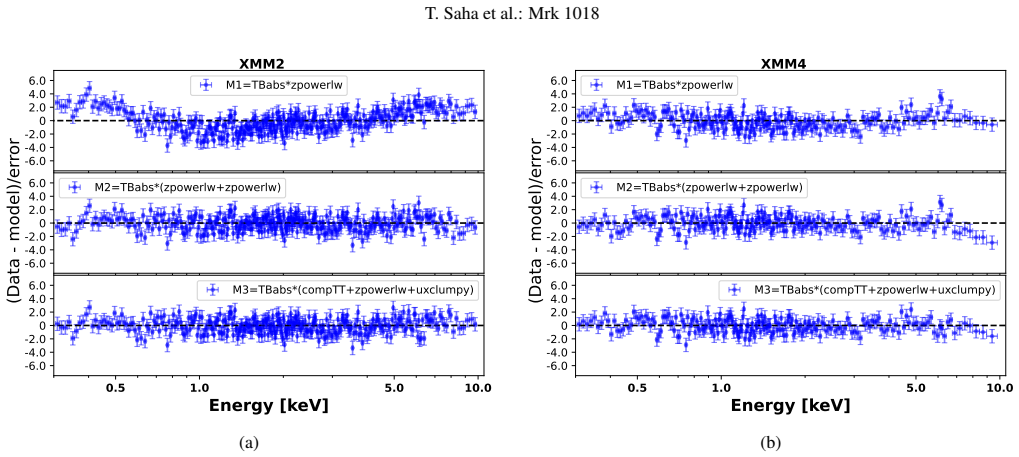
The load-bearing machinery is the three-component X-ray spectral model $M3 = \mathrm{TBabs}\times(\mathrm{compTT}+\mathrm{zpowerlw}+\mathrm{uxclumpy\_reflect})$, which separates the warm Comptonization soft excess, the hot-corona power law, and distant torus reflection with its Fe K$\alpha$ line. This decomposition lets the authors track each component's flux independently across XMM-Newton, Chandra, Suzaku, and Swift spectra. The broadband picture is carried by the agnsed thermal Comptonization disk model fitted jointly to optical/UV and X-ray data, and by a modified reverse sigmoid function that quantifies the long-term flux drop and its timescale. For the Fe K$\alpha$ response, a reverberation model of a bi-conical reprocessor computes the delayed line response to the ionizing continuum and returns an outer radius $R_{\rm out}\sim10$ pc for the line-emitting region. These components are what convert raw flux changes into the claimed accretion-state switch.
What would settle it
A decisive observation would be a decade-long, high-signal X-ray monitoring campaign on Mrk 1018 that tracks the Fe K$\alpha$ line flux: if the line has not continued declining toward the faint-state equilibrium value (roughly one sixth of its bright-state flux) within that time, the 10 pc extended-emitter interpretation is wrong. A complementary check is a sensitive faint-state radio-to-IR search for ADAF synchrotron emission, whose presence would directly contradict the assumption that the faint-state SED is complete without such components and would shift the Eddington ratios on which the state-switch claim depends.
Extended reading notes
Core claim
On the paper's own terms, the central claim is that the bright-to-faint transition of Mrk 1018 was a change in accretion state rather than a change in obscuration or a simple flux dimming. Spectral decomposition into a warm Comptonizing soft excess, a hot-corona power law, and torus reflection shows that each component dropped by a different factor—$R_{\rm UV}\sim24$ for the UV band, $R_{\rm HX}\sim8$ for 2–10 keV hard X-rays, $R_{\rm SX}\sim12$ for the soft excess, and $R_{\rm FeK\alpha}\sim3.4$ for the iron line—so the broadband spectrum hardened. In the faint state, with $\log\lambda_{\rm Edd}<-1.7$, the photon index $\Gamma$ anticorrelates with Eddington ratio ($\Gamma=(-0.45\pm0.09)\log\lambda_{\rm Edd}+(0.79\pm0.16)$), a 'softer-when-fainter' behavior like that in black hole X-ray binaries and low-luminosity AGN. The paper interprets this as the inner flow switching from a geometrically-thin, optically-thick disk to an ADAF-dominated hot flow: the warm corona disintegrates or becomes energetically negligible by 2021, while the hot X-ray-emitting flow becomes energetically dominant. The narrow Fe K$\alpha$ line has dropped by only half the factor of its ionizing continuum, which the authors attribute to an emitting region extending to roughly 10 pc that has not yet had time to respond.
Load-bearing premise
The interpretation rests on converting measured luminosities into Eddington ratios with one X-ray bolometric correction applied in both states and on modeling the faint state without the synchrotron, cyclotron, and bremsstrahlung emission an ADAF is expected to produce; if those unmodeled components contribute substantially to the X-ray flux, or if the bolometric correction differs in the faint state, the derived $\lambda_{\rm Edd}$ values, the $-1.7$ threshold, and the claimed 'softer-when-fainter' trend would shift.
Editorial extensions
If this is right
- Mrk 1018 becomes an observational precedent: a supermassive black hole whose long-term spectral transition is read as the same thin-disk-to-ADAF state switch invoked for stellar-mass black hole X-ray binaries.
- The disappearance of the soft X-ray excess by 2021 connects warm-corona disintegration to low Eddington ratio, supporting models in which the radiatively efficient inner flow and its warm corona vanish below $\lambda_{\rm Edd}\simeq0.02$.
- The Fe K$\alpha$ line should keep fading for roughly another decade, approaching the faint-state equilibrium set by the ionizing continuum drop.
- If the source re-brightens, the UV band should increase more strongly than the X-ray band, because the hot flow's increased covering fraction or additional ADAF emission would partially compensate the X-rays.
- The measured transition timescale ($t_{\rm sc}\sim1$ year) and the 30-year bright phase match the thermal and viscous timescales of a geometrically thick disk, supporting an intrinsic accretion-disk instability as the trigger.
Reading between the lines
- If the faint-state ADAF contributes significant synchrotron, cyclotron, or bremsstrahlung emission, the quoted Eddington ratios and the $\log\lambda_{\rm Edd}<-1.7$ threshold would shift; the paper itself flags this as a caveat.
- The same component decomposition could be applied to other recurrent changing-look AGN to test whether the warm-corona/ADAF switch is a universal sequence rather than a peculiarity of Mrk 1018.
- A testable extension is to monitor Mrk 1018's Fe K$\alpha$ flux over the next decade: if it does not decline toward the predicted faint-state value, the assumed 10 pc extent or the single-scattering reverberation model would need revision.
Editorial analysis
A structured set of objections, weighed in public.
Referee Report
Summary. The paper presents a long-term (2005–2021) multi-wavelength spectral variability study of the changing-look AGN Mrk 1018. Archival X-ray spectra from XMM-Newton, Chandra, Suzaku, and Swift are fitted with a physically motivated three-component model (warm Comptonization soft excess, hot-corona power law, and torus reflection), and broadband optical-to-X-ray SEDs are fitted with the agnsed model. The authors report that during the bright-to-faint transition the UV flux dropped by a factor of roughly 24, the 2–10 keV X-ray flux by roughly 8, and the soft excess disappeared by 2021. They identify a 'softer-when-fainter' trend in the hot-corona photon index versus Eddington ratio below log λ_Edd ≈ −1.7 and interpret the transition as a change from a geometrically thin disk plus warm corona to an ADAF-dominated hot flow. The Fe Kα line is found to have dropped by less than its driving continuum, which they model as delayed response from a parsec-scale reprocessor with an outer radius of about 10 pc, and they predict the line will take roughly another 9 years to reach equilibrium.
Significance. If the main conclusions hold, Mrk 1018 would be one of the best-documented cases of an accretion-state switch in a changing-look AGN, with measured component drop factors, a vanished soft excess, and a concrete, falsifiable prediction for future Fe Kα monitoring. The paper's strengths include the systematic use of Bayesian model comparison (BXA) across all high signal-to-noise spectra, explicit reporting of 90% posterior intervals, treatment of pileup in the bright Chandra observation via the readout streak, and several honest caveats about model limitations, such as the absence of ADAF-specific radiative processes in the SED model. The analysis is empirical rather than circular: the spectral decomposition and the variability ratios are fits to independent data, and the team's prior Mrk 1018 papers are used only to supply outburst history and host-galaxy constraints. The main risk is that the quantitative anchor of the BHXRB/LLAGN analogy—the Eddington-ratio scale in Fig. 7—depends on a bolometric correction that is calibrated for radiatively efficient AGN but is applied to a state that the paper itself argues may be ADAF-dominated.
major comments (1)
- [§4.5] The timescale argument that identifies the viscous timescale with t_bright uses α = 0.01 and H/R = 0.001–0.2 as illustrative parameters and reaches a range of 10–30 years versus a measured t_bright of roughly 30 years. This is reasonable as a plausibility argument, but it is presented with enough certainty in Section 5 that a reader could mistake an order-of-magnitude estimate for a constraint on the disk structure. I suggest adding one sentence clarifying that the quoted values are illustrative and that no unique disk model is being claimed.
minor comments (1)
- [§4.1] There is a duplicated article in 'Meanwhile, the the hot corona photon index Γ'; the second 'the' should be deleted.
Circularity Check
No significant circularity: the spectral decomposition, flux-drop factors, and Fe Kα response are empirical fits independent of the concluded ADAF transition.
full rationale
The central results are measured quantities from independent spectral decompositions: Γ is the power-law photon index from M3 fits; λEdd in Table 3 is computed from the observed 2–10 keV flux using the external Duras et al. (2020) bolometric correction; the drop factors and Fe Kα fluxes come from direct model fitting to the data. The 'softer-when-fainter' correlation (Eq. 2) is a fit to these measured values, not a quantity defined to equal the inputs. The ADAF/thin-disk interpretation is an external-model comparison (Esin et al. 1997; Noda & Done 2018) applied to the measured spectral changes. The paper explicitly cautions in §3.5 that agnsed is approximate in the faint ADAF-like state and may miss synchrotron/cyclotron/bremsstrahlung; this is a stated modeling caveat that could affect λEdd, but it is not an instance of the conclusion being built into the input. The Fe Kα reverberation analysis fits Rout to the observed line light curve and predicts a ~9 yr settling time from the fitted response; the 'not fully responded' statement follows directly from the measured RFe≈3.4 vs Rion≈6.8 mismatch. The internal λEdd differences between Tables 3 and 4 are model/systematic uncertainties in the Eddington-ratio scale, not a circular construction. Self-citations to Krumpe et al. (2017), Brogan et al. (2023), and McElroy et al. (2016) provide observational support (outburst light curves, standard-star calibration, black-hole mass) that is external to this paper's fitted values and does not assume the ADAF conclusion. No load-bearing step reduces by construction to its own inputs.
Assumptions & free parameters
free parameters (6)
- MRS X-ray drop factor R_HX =
7.9 ± 0.5
- MRS UV drop factor R_UVM2 =
28 ± 2
- Γ-λEdd slope =
-0.45 ± 0.09
- Γ-λEdd intercept =
0.79 ± 0.16
- Fe Kα reprocessor outer radius Rout =
10 +17/-6 pc
- XMM5 soft-excess frozen parameters (kBTe, τ) =
0.17 keV, 14 (frozen to XMM4 values)
assumptions (7)
- domain assumption Black hole mass MBH = 10^7.9 M_sun (McElroy et al. 2016) is adopted throughout.
- domain assumption The three-component X-ray model M3 (compTT + zpowerlw + uxclumpy) correctly isolates soft excess, hot corona, and torus reflection.
- ad hoc to paper The modified reverse sigmoid (MRS) functional form describes the long-term flux drop.
- domain assumption The Duras et al. (2020) bolometric correction applies in both bright and faint states.
- ad hoc to paper The Fe Kα reverberation geometry (biconical reprocessor, Rin=0.01 pc, θo=45°, single scattering) is adequate.
- domain assumption agnsed with a=0, kBTe=200 keV, hx=10 Rg describes the broadband SED.
- ad hoc to paper Timescale estimates use α=0.01 and H/R between 0.001 and 0.2 as illustrative disk parameters.
Cite this review
Pith. "Pith review of The Close AGN Reference Survey (CARS). Long-term spectral variability study of the changing look AGN Mrk 1018." pith.science (2026). https://pith.science/paper/DFDGFMGY
@misc{pith2026250603061,
  author       = {Pith},
  title        = {Pith review of: The Close AGN Reference Survey (CARS). Long-term spectral variability study of the changing look AGN Mrk 1018},
  year         = {2026},
  howpublished = {\url{https://pith.science/paper/DFDGFMGY}},
  note         = {Machine review of arXiv:2506.03061}
}
read the original abstract
Changing-look AGNs (CLAGN) are accreting supermassive black hole systems that undergo variations in optical spectral type, driven by major changes in accretion rate. Mrk 1018 has undergone two transitions, a brightening event in the 1980s and a transition back to a faint state over the course of 2-3 years in the early 2010s. We characterize the evolving physical properties of the source's inner accretion flow, particularly during the bright-to-faint transition, as well as the morphological properties of its parsec-scale circumnuclear gas. We model archival X-ray spectra from XMM-Newton, Chandra, Suzaku, and Swift, using physically-motivated models to characterize X-ray spectral variations and track Fe Kalpha line flux. We also quantify Mrk 1018's long-term multi-wavelength spectral variability from optical/UV to the X-rays. Over the duration of the bright-to-faint transition, the UV and hard X-ray flux fell by differing factors, roughly 24 and 8, respectively. The soft X-ray excess faded, and was not detected by 2021. In the faint state, when the Eddington ratio drops to log Lbol/LEdd < -1.7, the hot X-ray corona photon index shows a 'softer-when-fainter' trend, similar to that seen in some black hole X-ray binaries and samples of low-luminosity AGNs. Finally, the Fe Kalpha line flux has dropped by only half the factor of the drop in the X-ray continuum. The transition from the bright state to the faint state is consistent with the inner accretion flow transitioning from a geometrically-thin disk to an ADAF-dominated state, with the warm corona disintegrating or becoming energetically negligible, while the X-ray-emitting hot flow becoming energetically dominant. Meanwhile, narrow Fe Kalpha emission has not yet fully responded to the drop in its driving continuum, likely because its emitter extends up to roughly 10 pc.
Figures


Figures from the paper (8 more)


Reference graph
Works this paper leans on
-
[1]
, " * write output.state after.block = add.period write newline
ENTRY address archiveprefix author booktitle chapter edition editor howpublished institution eprint journal key month note number organization pages publisher school series title type volume year label extra.label sort.label short.list INTEGERS output.state before.all mid.sentence after.sentence after.block FUNCTION init.state.consts #0 'before.all := #1 ...
-
[2]
write newline
" write newline "" before.all 'output.state := FUNCTION n.dashify 't := "" t empty not t #1 #1 substring "-" = t #1 #2 substring "--" = not "--" * t #2 global.max substring 't := t #1 #1 substring "-" = "-" * t #2 global.max substring 't := while if t #1 #1 substring * t #2 global.max substring 't := if while FUNCTION word.in bbl.in " " * FUNCTION format....
-
[3]
Arnaud , K. A. 1996, in Astronomical Society of the Pacific Conference Series, Vol. 101, Astronomical Data Analysis Software and Systems V, ed. G. H. Jacoby & J. Barnes , 17
1996
-
[4]
M., Lim , P
Astropy Collaboration , Price-Whelan , A. M., Lim , P. L., et al. 2022, , 935, 167
2022
-
[5]
Balbus , S. A. & Hawley , J. F. 1991, , 376, 214
1991
-
[6]
R., Sudhakar , V., Fairfax , D., et al
Ballantyne , D. R., Sudhakar , V., Fairfax , D., et al. 2024, , 530, 1603
2024
-
[7]
A., et al
Balokovi \'c , M., Brightman , M., Harrison , F. A., et al. 2018, , 854, 42
2018
-
[8]
C., Denney , K
Bentz , M. C., Denney , K. D., Grier , C. J., et al. 2013, , 767, 149
2013
Show all 138 references
-
[9]
2008, , 389, L52
Bianchi , S., La Franca , F., Matt , G., et al. 2008, , 389, L52
2008
-
[10]
2016, , 588, A70
Boissay , R., Ricci , C., & Paltani , S. 2016, , 588, A70
2016
-
[11]
G., Gandhi , P., Balokovi \'c , M., et al
Boorman , P. G., Gandhi , P., Balokovi \'c , M., et al. 2018, , 477, 3775
2018
-
[12]
2023, , 677, A116
Brogan , R., Krumpe , M., Homan , D., et al. 2023, , 677, A116
2023
-
[13]
Buchner , J., Brightman , M., Nandra , K., Nikutta , R., & Bauer , F. E. 2019, , 629, A16
2019
-
[14]
2014, , 564, A125
Buchner , J., Georgakakis , A., Nandra , K., et al. 2014, , 564, A125
2014
-
[15]
N., Hill , J
Burrows , D. N., Hill , J. E., Nousek , J. A., et al. 2005, , 120, 165
2005
-
[16]
1979, , 228, 939
Cash , W. 1979, , 228, 939
1979
-
[17]
D., Rudy , R
Cohen , R. D., Rudy , R. J., Puetter , R. C., Ake , T. B., & Foltz , C. B. 1986, , 311, 135
1986
-
[18]
D., De Rosa , G., Croxall , K., et al
Denney , K. D., De Rosa , G., Croxall , K., et al. 2014, , 796, 134
2014
-
[19]
& Begelman , M
Dexter , J. & Begelman , M. C. 2019, , 483, L17
2019
-
[20]
2020, , 636, A73
Duras , F., Bongiorno , A., Ricci , F., et al. 2020, , 636, A73
2020
-
[21]
A., McClintock , J
Esin , A. A., McClintock , J. E., & Narayan , R. 1997, , 489, 865
1997
-
[22]
C., Iwasawa , K., Reynolds , C
Fabian , A. C., Iwasawa , K., Reynolds , C. S., & Young , A. J. 2000, , 112, 1145
2000
-
[23]
C., Rees , M
Fabian , A. C., Rees , M. J., Stella , L., & White , N. E. 1989, , 238, 729
1989
-
[24]
P., & Bridges , M
Feroz , F., Hobson , M. P., & Bridges , M. 2009, , 398, 1601
2009
-
[25]
Frank , J., King , A., & Raine , D. J. 2002, Accretion Power in Astrophysics: Third Edition
2002
-
[26]
J., et al
Gabriel , C., Denby , M., Fyfe , D. J., et al. 2004, in Astronomical Society of the Pacific Conference Series, Vol. 314, Astronomical Data Analysis Software and Systems (ADASS) XIII, ed. F. Ochsenbein , M. G. Allen , & D. Egret , 759
2004
-
[27]
P., Bautz , M
Garmire , G. P., Bautz , M. W., Ford , P. G., Nousek , J. A., & Ricker , George R., J. 2003, in Society of Photo-Optical Instrumentation Engineers (SPIE) Conference Series, Vol. 4851, X-Ray and Gamma-Ray Telescopes and Instruments for Astronomy., ed. J. E. Truemper & H. D. Tan...
2003
-
[28]
Gaskell , C. M. & Sparke , L. S. 1986, , 305, 175
1986
-
[29]
Gaspari , M., Ruszkowski , M., & Oh , S. P. 2013, , 432, 3401
2013
-
[30]
2017, , 466, 677
Gaspari , M., Temi , P., & Brighenti , F. 2017, , 466, 677
2017
-
[31]
2020, Nature Astronomy, 4, 10
Gaspari , M., Tombesi , F., & Cappi , M. 2020, Nature Astronomy, 4, 10
2020
-
[32]
2004, , 611, 1005
Gehrels , N., Chincarini , G., Giommi , P., et al. 2004, , 611, 1005
2004
-
[33]
2022, , 937, 31
Ghosh , R., Laha , S., Deshmukh , K., et al. 2022, , 937, 31
2022
-
[34]
& Cao , X
Gu , M. & Cao , X. 2009, , 399, 349
2009
-
[35]
& Maraschi , L
Haardt , F. & Maraschi , L. 1991, , 380, L51
1991
-
[36]
& Maraschi , L
Haardt , F. & Maraschi , L. 1993, , 413, 507
1993
-
[37]
1994, , 432, L95
Haardt , F., Maraschi , L., & Ghisellini , G. 1994, , 432, L95
1994
-
[38]
& Done , C
Hagen , S. & Done , C. 2023, , 521, 251
2023
-
[39]
D., et al
Hagen , S., Done , C., Silverman , J. D., et al. 2024, , 534, 2803
2024
-
[40]
R., Millman, K
Harris, C. R., Millman, K. J., van der Walt, S. J., et al. 2020, Nature, 585, 357
2020
-
[41]
2023, , 672, A167
Homan , D., Krumpe , M., Markowitz , A., et al. 2023, , 672, A167
2023
-
[42]
H \"o nig , S. F. 2019, , 884, 171
2019
-
[43]
H \"o nig , S. F. & Kishimoto , M. 2017, , 838, L20
2017
-
[44]
F., Kishimoto , M., Tristram , K
H \"o nig , S. F., Kishimoto , M., Tristram , K. R. W., et al. 2013, , 771, 87
2013
-
[45]
Hunter, J. D. 2007, Computing in Science & Engineering, 9, 90
2007
-
[46]
R., et al
Husemann , B., Urrutia , T., Tremblay , G. R., et al. 2016, , 593, L9
2016
-
[47]
2020, , 644, L5
Hutsem \'e kers , D., Ag \' s Gonz \'a lez , B., Marin , F., & Sluse , D. 2020, , 644, L5
2020
-
[48]
2009, , 692, 608
Ikeda , S., Awaki , H., & Terashima , Y. 2009, , 692, 608
2009
-
[49]
& Done , C
Ingram , A. & Done , C. 2011, , 415, 2323
2011
-
[50]
& Taniguchi , Y
Iwasawa , K. & Taniguchi , Y. 1993, , 413, L15
1993
-
[51]
2021, , 507, 687
Jana , A., Kumari , N., Nandi , P., et al. 2021, , 507, 687
2021
-
[52]
2001, , 365, L1
Jansen , F., Lumb , D., Altieri , B., et al. 2001, , 365, L1
2001
-
[53]
X., & Wang , T
Jiang , P., Wang , J. X., & Wang , T. G. 2006, , 644, 725
2006
-
[54]
N., Maoz , D., et al
Kaspi , S., Brandt , W. N., Maoz , D., et al. 2007, , 659, 997
2007
-
[55]
L., et al
Kollatschny , W., Grupe , D., Parker , M. L., et al. 2023, , 670, A103
2023
-
[56]
1997, , 487, 555
Korista , K., Ferland , G., & Baldwin , J. 1997, , 487, 555
1997
-
[57]
T., Alloin , D., Barr , P., et al
Korista , K. T., Alloin , D., Barr , P., et al. 1995, , 97, 285
1995
-
[58]
Korista , K. T. & Goad , M. R. 2000, , 536, 284
2000
-
[59]
2007, , 59, 23
Koyama , K., Tsunemi , H., Dotani , T., et al. 2007, , 59, 23
2007
-
[60]
G., Krumpe , M., et al
Krishnan , S., Markowitz , A. G., Krumpe , M., et al. 2024, , 691, A102
2024
-
[61]
R., et al
Krumpe , M., Husemann , B., Tremblay , G. R., et al. 2017, , 607, L9
2017
-
[62]
& Done , C
Kubota , A. & Done , C. 2018, , 480, 1247
2018
-
[63]
M., Cales , S., Moran , E
LaMassa , S. M., Cales , S., Moran , E. C., et al. 2015, , 800, 144
2015
-
[64]
M., Yaqoob , T., & Kilgard , R
LaMassa , S. M., Yaqoob , T., & Kilgard , R. 2017, , 840, 11
2017
-
[65]
& Netzer , H
Laor , A. & Netzer , H. 1989, , 238, 897
1989
-
[66]
C., et al
Li , R., Ricci , C., Ho , L. C., et al. 2024, , 975, 140
2024
-
[67]
& Xie , F.-G
Li , S.-L. & Xie , F.-G. 2017, , 471, 2848
2017
-
[68]
Lightman , A. P. & Eardley , D. M. 1974, , 187, L1
1974
-
[69]
2025, , 276, 51
Lu , K.-X., Li , Y.-R., Wu , Q., et al. 2025, , 276, 51
2025
-
[70]
2010, , 512, A34
Lusso , E., Comastri , A., Vignali , C., et al. 2010, , 512, A34
2010
-
[71]
2021, , 506, 4188
Lyu , B., Yan , Z., Yu , W., & Wu , Q. 2021, , 506, 4188
2021
-
[72]
M., et al
Mannucci , F., Basile , F., Poggianti , B. M., et al. 2001, , 326, 745
2001
-
[73]
2022, , 935, 114
Marchesi , S., Zhao , X., Torres-Alb \`a , N., et al. 2022, , 935, 114
2022
-
[74]
& Edelson , R
Markowitz , A. & Edelson , R. 2004, , 617, 939
2004
-
[75]
2024, , 684, A101
Markowitz , A., Krumpe , M., Homan , D., et al. 2024, , 684, A101
2024
-
[76]
G., Krumpe , M., & Nikutta , R
Markowitz , A. G., Krumpe , M., & Nikutta , R. 2014, , 439, 1403
2014
-
[77]
O., Breeveld , A., Much , R., et al
Mason , K. O., Breeveld , A., Much , R., et al. 2001, , 365, L36
2001
-
[78]
E., Husemann , B., Croom , S
McElroy , R. E., Husemann , B., Croom , S. M., et al. 2016, , 593, L8
2016
-
[79]
S., et al
Mehdipour , M., Branduardi-Raymont , G., Kaastra , J. S., et al. 2011, , 534, A39
2011
-
[80]
& Yi , I
Narayan , R. & Yi , I. 1995, , 452, 710
1995
-
[81]
& Done , C
Noda , H. & Done , C. 2018, , 480, 3898
2018
-
[82]
2023, , 943, 63
Noda , H., Mineta , T., Minezaki , T., et al. 2023, , 943, 63
2023
-
[83]
Osterbrock , D. E. 1981, , 249, 462
1981
-
[84]
Osterbrock , D. E. & Koski , A. T. 1976, , 176, 61P
1976
-
[85]
L., O'Brien , P
Page , K. L., O'Brien , P. T., Reeves , J. N., & Turner , M. J. L. 2004, , 347, 316
2004
-
[86]
O., et al
Palit , B., R \'o \.z a \'n ska , A., Petrucci , P. O., et al. 2024, , 690, A308
2024
-
[87]
R., Bautista , M
Palmeri , P., Mendoza , C., Kallman , T. R., Bautista , M. A., & Mel \'e ndez , M. 2003, , 410, 359
2003
-
[88]
2020, pandas-dev/pandas: Pandas
pandas development team, T. 2020, pandas-dev/pandas: Pandas
2020
-
[89]
M., Wanders , I., Horne , K., et al
Peterson , B. M., Wanders , I., Horne , K., et al. 1998, , 110, 660
1998
-
[90]
O., Paltani , S., Malzac , J., et al
Petrucci , P. O., Paltani , S., Malzac , J., et al. 2013, , 549, A73
2013
-
[91]
1998, , 501, L37
Ptak , A., Yaqoob , T., Mushotzky , R., Serlemitsos , P., & Griffiths , R. 1998, , 501, L37
1998
-
[92]
2020, , 898, L1
Ricci , C., Kara , E., Loewenstein , M., et al. 2020, , 898, L1
2020
-
[93]
& Trakhtenbrot , B
Ricci , C. & Trakhtenbrot , B. 2023, Nature Astronomy, 7, 1282
2023
-
[94]
J., et al
Ricci , C., Trakhtenbrot , B., Koss , M. J., et al. 2017, , 549, 488
2017
-
[95]
2014 a , , 567, A142
Ricci , C., Ueda , Y., Ichikawa , K., et al. 2014 a , , 567, A142
2014
-
[96]
2014 b , , 441, 3622
Ricci , C., Ueda , Y., Paltani , S., et al. 2014 b , , 441, 3622
2014
-
[97]
J., Anderson , S
Ruan , J. J., Anderson , S. F., Eracleous , M., et al. 2019, , 883, 76
2019
-
[98]
2023, Submitted to A&A, under review, arXiv:2309.08956
Saha , T., Markowitz , A., Homan , D., et al. 2023, Submitted to A&A, under review, arXiv:2309.08956
2023 arXiv
-
[99]
J., Finkbeiner , D
Schlegel , D. J., Finkbeiner , D. P., & Davis , M. 1998, , 500, 525
1998
-
[100]
2025, , 697, A78
Sengupta , D., Torres-Alb \`a , N., Pizzetti , A., et al. 2025, , 697, A78
2025
-
[101]
2021, , 654, A32
Serafinelli , R., Braito , V., Severgnini , P., et al. 2021, , 654, A32
2021
-
[102]
Shakura , N. I. & Sunyaev , R. A. 1973, , 24, 337
1973
-
[103]
J., Prieto , J
Shappee , B. J., Prieto , J. L., Grupe , D., et al. 2014, , 788, 48
2014
-
[104]
C., Feng , H., & Cui , C
She , R., Ho , L. C., Feng , H., & Cui , C. 2018, , 859, 152
2018
-
[105]
W., Wang , J
Shu , X. W., Wang , J. X., Yaqoob , T., Jiang , P., & Zhou , Y. Y. 2012, , 744, L21
2012
-
[106]
W., Yaqoob , T., & Wang , J
Shu , X. W., Yaqoob , T., & Wang , J. X. 2010, , 187, 581
2010
-
[107]
2004, in American Institute of Physics Conference Series, Vol
Skilling , J. 2004, in American Institute of Physics Conference Series, Vol. 735, Bayesian Inference and Maximum Entropy Methods in Science and Engineering: 24th International Workshop on Bayesian Inference and Maximum Entropy Methods in Science and Engineering, ed. R. Fischer...
2004
-
[108]
2020, , 641, A167
Sniegowska , M., Czerny , B., Bon , E., & Bon , N. 2020, , 641, A167
2020
-
[109]
A., Papadakis , I
Sobolewska , M. A., Papadakis , I. E., Done , C., & Malzac , J. 2011, , 417, 280
2011
-
[110]
1982, , 200, 115
So tan , A. 1982, , 200, 115
1982
-
[111]
& Miller , J
Szuszkiewicz , E. & Miller , J. C. 2001, , 328, 36
2001
-
[112]
2007, , 59, 35
Takahashi , T., Abe , K., Endo , M., et al. 2007, , 59, 35
2007
-
[113]
1979, , 234, L9
Tananbaum , H., Avni , Y., Branduardi , G., et al. 1979, , 234, L9
1979
-
[114]
1994, , 434, 570
Titarchuk , L. 1994, , 434, 570
1994
-
[115]
L., et al
Trakhtenbrot , B., Arcavi , I., MacLeod , C. L., et al. 2019, , 883, 94
2019
-
[116]
& Dewangan , G
Tripathi , P. & Dewangan , G. C. 2022, , 930, 117
2022
-
[117]
M., Peterson , B
Uttley , P., Edelson , R., McHardy , I. M., Peterson , B. M., & Markowitz , A. 2003, , 584, L53
2003
-
[118]
& Mchardy , I
Uttley , P. & Mchardy , I. M. 2004, Progress of Theoretical Physics Supplement, 155, 170
2004
-
[119]
A., Ferland , G
Verner , D. A., Ferland , G. J., Korista , K. T., & Yakovlev , D. G. 1996, , 465, 487
1996
-
[120]
A., & Cignoni , M
Veronese , S., Vignali , C., Severgnini , P., Matzeu , G. A., & Cignoni , M. 2024, , 683, A131
2024
-
[121]
E., et al
Virtanen, P., Gommers, R., Oliphant, T. E., et al. 2020, Nature Methods, 17, 261
2020
-
[122]
2025, , 981, 129
Wang , S., Woo , J.-H., Gallo , E., et al. 2025, , 981, 129
2025
-
[123]
C., Hester , J
Weisskopf , M. C., Hester , J. J., Tennant , A. F., et al. 2000, , 536, L81
2000
-
[124]
2010, in P roceedings of the 9th P ython in S cience C onference, ed
W es M c K inney. 2010, in P roceedings of the 9th P ython in S cience C onference, ed. S t\'efan van der W alt & J arrod M illman, 56 -- 61
2010
-
[125]
White , R. J. & Peterson , B. M. 1994, , 106, 879
1994
-
[126]
Willingale , R., Starling , R. L. C., Beardmore , A. P., Tanvir , N. R., & O'Brien , P. T. 2013, , 431, 394
2013
-
[127]
2000, , 542, 914
Wilms , J., Allen , A., & McCray , R. 2000, , 542, 914
2000
-
[128]
2023, , 950, 106
Wu , J., Wu , Q., Xue , H., Lei , W., & Lyu , B. 2023, , 950, 106
2023
-
[129]
& Gu , M
Wu , Q. & Gu , M. 2008, , 682, 212
2008
-
[130]
2024, , 973, L25
Xrism Collaboration , Audard , M., Awaki , H., et al. 2024, , 973, L25
2024
-
[131]
2015, , 447, 1692
Yang , Q.-X., Xie , F.-G., Yuan , F., et al. 2015, , 447, 1692
2015
-
[132]
2012, , 423, 3360
Yaqoob , T. 2012, , 423, 3360
2012
-
[133]
& Murphy , K
Yaqoob , T. & Murphy , K. D. 2011, , 412, 277
2011
-
[134]
& Padmanabhan , U
Yaqoob , T. & Padmanabhan , U. 2004, , 604, 63
2004
-
[135]
Younes , G., Porquet , D., Sabra , B., & Reeves , J. N. 2011, , 530, A149
2011
-
[136]
A., Johnson , W
Zdziarski , A. A., Johnson , W. N., & Magdziarz , P. 1996, , 283, 193
1996
-
[137]
2024, , 966, 85
Zeltyn , G., Trakhtenbrot , B., Eracleous , M., et al. 2024, , 966, 85
2024
-
[138]
M., & Cackett , E
Zoghbi , A., Miller , J. M., & Cackett , E. 2019, , 884, 26
2019
Reviewed August 7, 2026 · model on record in the stance chip above.
Discussion (0). Continue with ORCID to comment.