Quaternion Nondecimated Wavelet Descriptors for Multiclass Breast Histology Classification
Pith reviewed 2026-07-03 03:02 UTC · model grok-4.3
The pith
Encoding RGB histology images as quaternion fields and applying nondecimated wavelet transforms yields balanced four-class breast tissue classification on the BACH dataset.
A machine-rendered reading of the paper's core claim, the machinery that carries it, and where it could break.
Core claim
Quaternion nondecimated wavelet descriptors derived from pure quaternion encodings of RGB images capture color-coupled multiscale geometry that supports balanced multiclass recognition of breast histology into normal, benign, in situ, and invasive categories, with the SVM drawing on directional, phase-concentration, and anisotropy properties rather than global color statistics alone.
What carries the argument
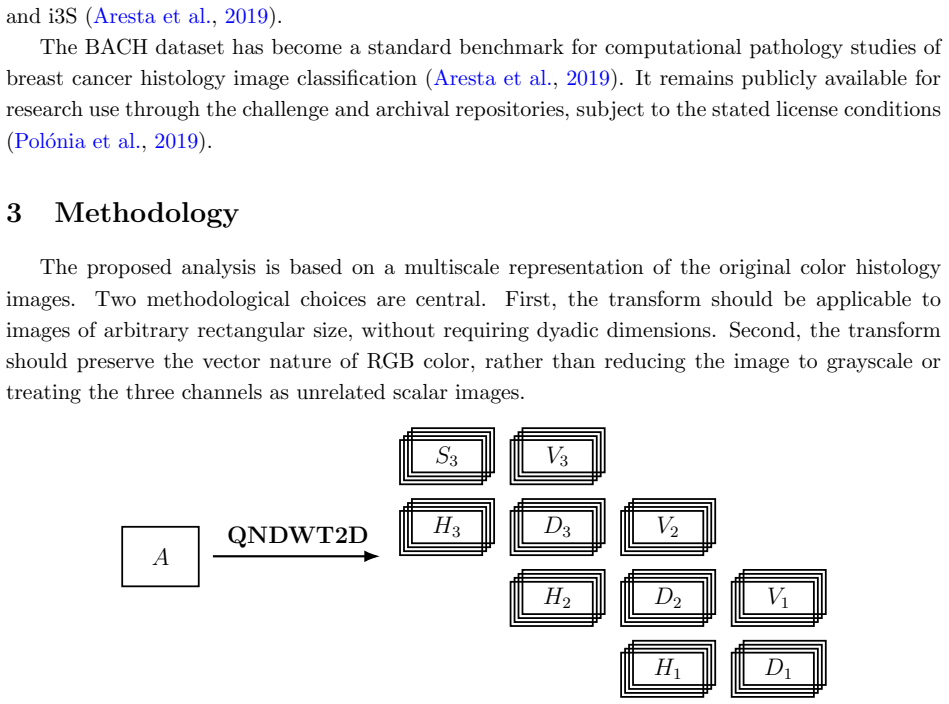
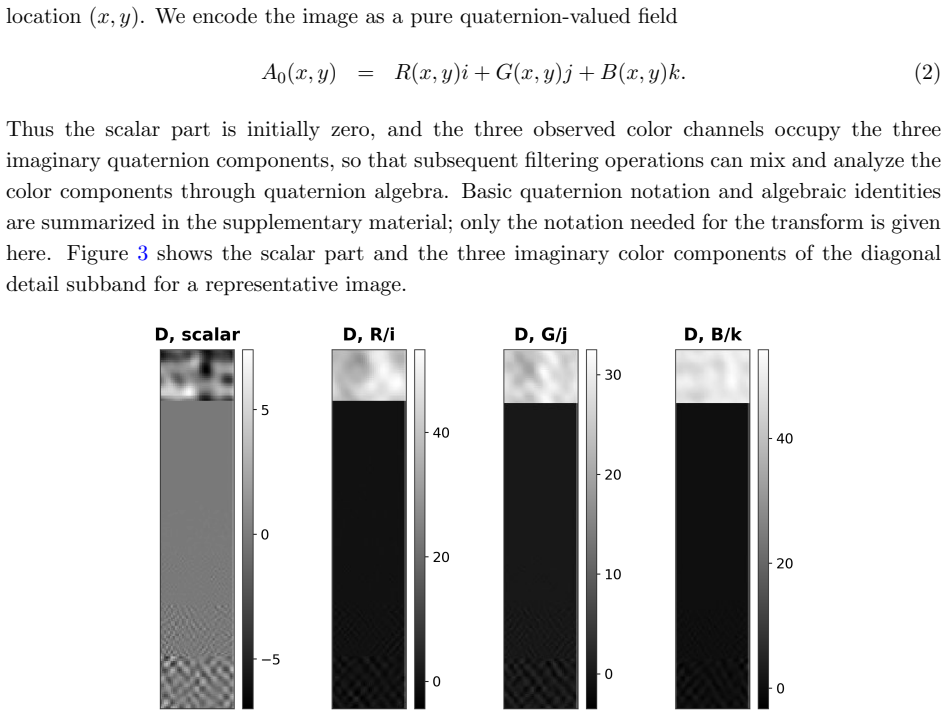
The quaternion nondecimated wavelet transform in two dimensions (QNDWT2D) applied to pure quaternion fields, which generates multiscale, directional, color-coupled coefficient maps on the original image grid.
If this is right
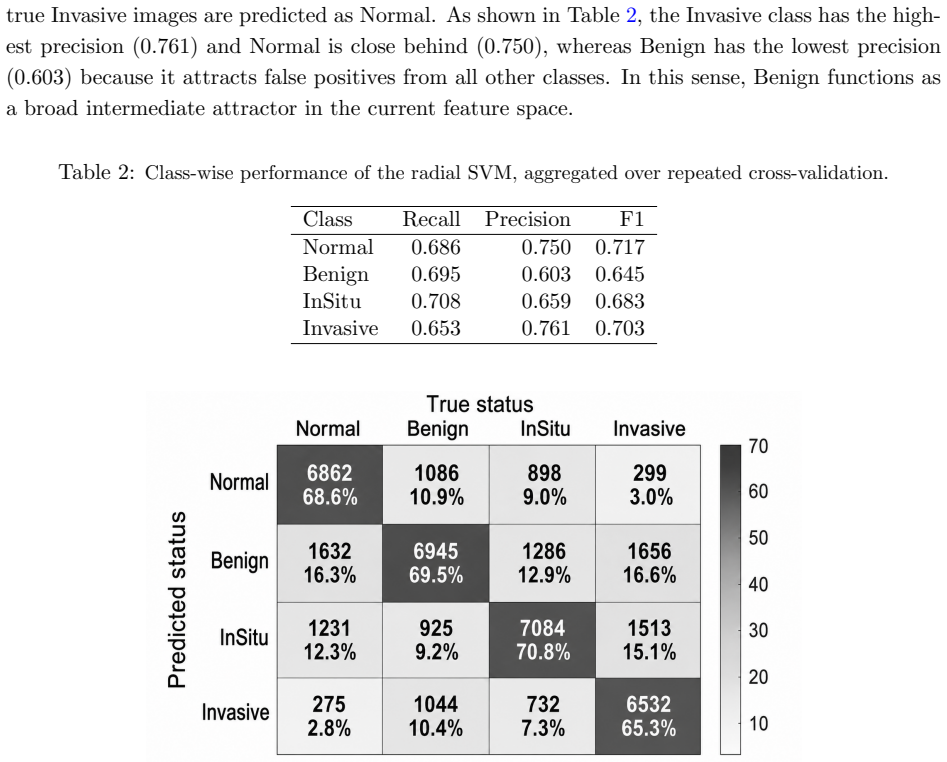
- Errors concentrate among adjacent categories while normal and invasive classes are rarely reversed.
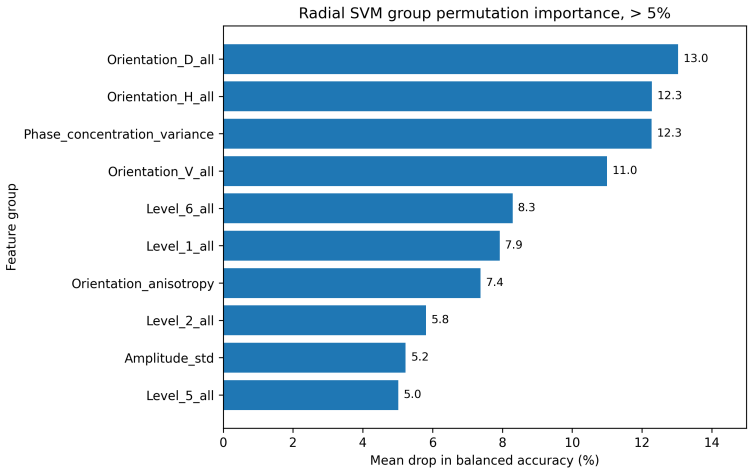
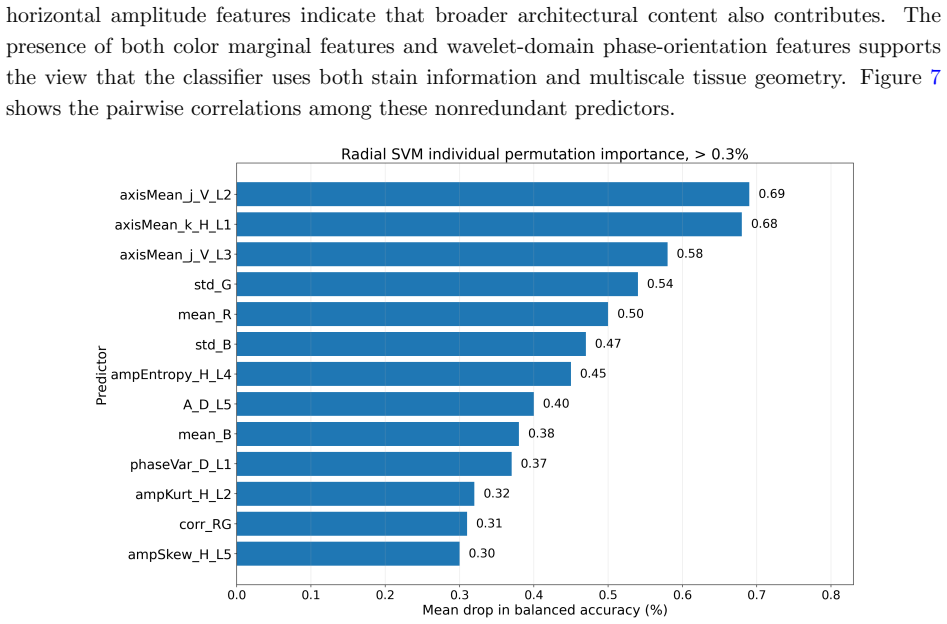
- Permutation importance ranks directional, phase-concentration, anisotropy, scale, and amplitude-variability groups as contributory.
- The method supplies a reproducible baseline that uses no pretrained networks or external databases.
- Each feature family is explicitly tied to a histopathological property such as stain balance or glandular organization.
Where Pith is reading between the lines
- The same quaternion-wavelet pipeline could be tested on other chromatic medical images where color coupling matters, such as dermatology or ophthalmology slides.
- The explicit link between feature groups and tissue properties offers a route to model explanations that align with pathologist language.
- Extending the descriptors to three-dimensional volumes or time-series histology would test whether the scale-decay and anisotropy components generalize beyond two-dimensional sections.
Load-bearing premise
Encoding RGB images as pure quaternion fields, applying QNDWT2D, and extracting the listed feature families preserves the diagnostic information in color, texture, orientation, and tissue architecture without material loss or artifact introduction.
What would settle it
A drop in balanced accuracy or a shift in error patterns when the quaternion phase-concentration or directional-anisotropy feature groups are ablated, or when the same descriptors are applied to an independent histology collection with different staining protocols.
Figures
read the original abstract
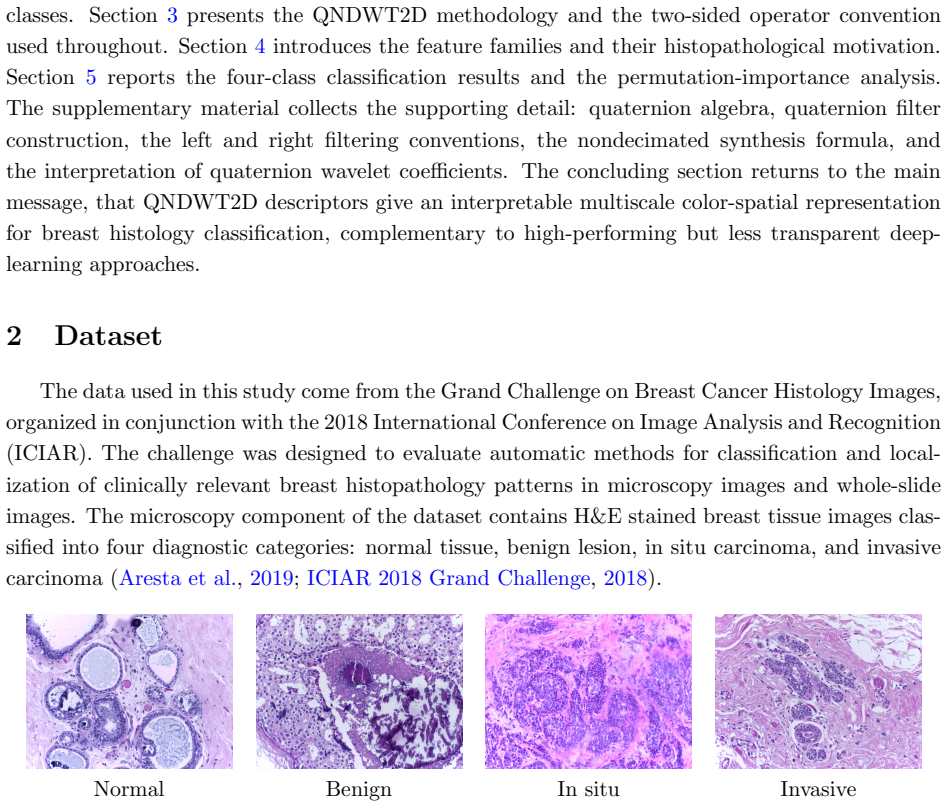
Breast histology images carry diagnostic information in color, texture, orientation, and tissue architecture across a range of scales. In H&E microscopy this information is inherently chromatic and is not fully recovered when the red, green, and blue (RGB) channels are reduced to grayscale or transformed as independent scalar images. We propose an interpretable quaternion nondecimated wavelet framework for breast histology classification. Each RGB image is encoded as a pure quaternion field, and a quaternion nondecimated wavelet transform in two dimensions (QNDWT2D) produces multiscale, directional, color-coupled coefficient fields on the original image grid, keeping color as a single vector quantity rather than three separate channels. From these coefficients we build interpretable feature families summarizing stain balance, wavelet energy, amplitude heterogeneity, quaternion phase concentration, color-axis geometry, directional anisotropy, orientation entropy, and scale-dependent energy decay, each tied to a histopathological property such as nuclear density or glandular organization. We evaluate the descriptors on the BreAst Cancer Histology (BACH) challenge, a balanced four-class set of normal, benign, in situ, and invasive tissue, using a radial-kernel support vector machine (SVM) with repeated nested cross-validation. The descriptors yield balanced recognition across classes, with errors concentrated among adjacent categories while normal and invasive are rarely reversed. Permutation importance shows that directional, phase-concentration, anisotropy, scale, and amplitude-variability groups all contribute, indicating that the classifier draws on genuine quaternion and multiscale geometry rather than global color alone. The framework uses no pretrained networks, learned filters, or external databases, offering a reproducible, interpretable baseline for computational pathology.
Editorial analysis
A structured set of objections, weighed in public.
Referee Report
Summary. The paper proposes encoding RGB breast histology images as pure quaternion fields, applying a quaternion nondecimated wavelet transform (QNDWT2D) to produce multiscale directional color-coupled coefficients, and extracting interpretable feature families (stain balance, wavelet energy, phase concentration, anisotropy, etc.) for four-class classification (normal, benign, in situ, invasive) on the BACH dataset via radial SVM with repeated nested cross-validation. It reports balanced recognition with errors mainly between adjacent classes and uses permutation importance to argue that directional, phase, anisotropy, scale, and amplitude groups reflect genuine quaternion multiscale geometry rather than global color.
Significance. If the quaternion coupling demonstrably improves over per-channel scalar wavelets while preserving interpretability and reproducibility without pretrained networks, the work supplies a useful baseline for computational pathology that ties features directly to histopathological properties such as nuclear density and glandular organization.
major comments (2)
- [Abstract / Permutation importance analysis] Abstract and results on permutation importance: the claim that the SVM 'draws on genuine quaternion and multiscale geometry rather than global color alone' is load-bearing for the central interpretation yet rests on an untested assumption; no ablation replaces QNDWT2D with three independent scalar NDWT2D runs on R/G/B (or decorrelated channels) while retaining identical feature families, SVM, and CV protocol. Equivalent performance from the scalar baseline would falsify the quaternion-specific contribution.
- [Evaluation section] Evaluation protocol: the abstract states repeated nested cross-validation but provides neither exact SVM radial-kernel hyperparameters (C, gamma), full per-fold confusion matrices, nor error bars on accuracy/F1; these omissions leave the 'balanced recognition' claim defensible but unverifiable at the level required for the reported class-wise error patterns.
minor comments (2)
- [Methods] Notation for quaternion encoding (pure quaternion field construction from RGB) and the precise definition of each feature family (e.g., 'phase concentration', 'color-axis geometry') should be given explicitly with equations in the methods section.
- [Figures/Tables] Figure captions and tables should include the number of repetitions in the nested CV and the precise train/test split sizes used on BACH.
Simulated Author's Rebuttal
We thank the referee for the careful reading and the two major comments, which highlight opportunities to strengthen the evidence for the quaternion contribution and to improve reproducibility. We address each point below and will revise the manuscript accordingly.
read point-by-point responses
-
Referee: [Abstract / Permutation importance analysis] Abstract and results on permutation importance: the claim that the SVM 'draws on genuine quaternion and multiscale geometry rather than global color alone' is load-bearing for the central interpretation yet rests on an untested assumption; no ablation replaces QNDWT2D with three independent scalar NDWT2D runs on R/G/B (or decorrelated channels) while retaining identical feature families, SVM, and CV protocol. Equivalent performance from the scalar baseline would falsify the quaternion-specific contribution.
Authors: We agree that the current permutation-importance analysis alone does not fully isolate the benefit of quaternion coupling from possible gains due to the multiscale directional features themselves. An explicit ablation that applies three independent scalar NDWT2D transforms to the R, G, and B channels (or to decorrelated channels) while keeping the identical feature families, radial SVM, and repeated nested CV protocol would directly test whether the quaternion formulation adds value. We will conduct this ablation on the BACH dataset and report the comparative accuracies, F1 scores, and confusion matrices in the revised manuscript. revision: yes
-
Referee: [Evaluation section] Evaluation protocol: the abstract states repeated nested cross-validation but provides neither exact SVM radial-kernel hyperparameters (C, gamma), full per-fold confusion matrices, nor error bars on accuracy/F1; these omissions leave the 'balanced recognition' claim defensible but unverifiable at the level required for the reported class-wise error patterns.
Authors: We acknowledge that the current manuscript does not report the exact radial-kernel hyperparameters selected by the inner loop of the nested CV, the full set of per-fold confusion matrices, or error bars on the performance metrics. In the revision we will add these details: the optimal (C, gamma) pairs, the complete per-fold confusion matrices (or their averages), and standard-error bars on accuracy and macro-F1 obtained across the outer CV repetitions. revision: yes
Circularity Check
No significant circularity; feature construction and evaluation remain independent
full rationale
The paper encodes RGB images as quaternion fields, applies QNDWT2D to obtain coefficient fields, and constructs explicit feature families (stain balance, energy, phase concentration, anisotropy, etc.) directly from those coefficients. These descriptors are then fed to an SVM and assessed via repeated nested cross-validation on the external BACH dataset. No equation reduces a reported performance metric or importance ranking to a fitted parameter by construction, and no self-citation is shown to supply a uniqueness theorem or ansatz that the central claims rest upon. The derivation chain is therefore self-contained against the external benchmark.
Axiom & Free-Parameter Ledger
free parameters (1)
- SVM radial kernel hyperparameters
axioms (2)
- standard math Quaternion multiplication and conjugation rules support a well-defined nondecimated wavelet transform in 2D
- domain assumption The listed feature families (energy, phase concentration, anisotropy, etc.) correspond to histopathological properties
Reference graph
Works this paper leans on
-
[1]
Proceedings of the Royal Irish Academy , year =
Hamilton, William Rowan , title =. Proceedings of the Royal Irish Academy , year =
-
[2]
Journal of Mathematical Imaging and Vision , volume =
Bayro-Corrochano, Eduardo , title =. Journal of Mathematical Imaging and Vision , volume =
-
[3]
, title =
Chan, Wei Lu and Choi, Hyeokho and Baraniuk, Richard G. , title =. IEEE Transactions on Image Processing , volume =. 2008 , doi =
2008
-
[4]
Hypercomplex Spectral Signal Representations for the Processing and Analysis of Images , school =
B. Hypercomplex Spectral Signal Representations for the Processing and Analysis of Images , school =
-
[5]
Fletcher, Peter , title =
-
[6]
, title =
Fletcher, Peter and Sangwine, Stephen J. , title =. Signal Processing , volume =. 2017 , doi =
2017
-
[7]
Quaternionic Wavelets for Texture Classification , journal =
Soulard, Rapha. Quaternionic Wavelets for Texture Classification , journal =. 2011 , doi =
2011
-
[8]
International Journal of Electronics and Communications (AE
Gai, Shan and Yang, Guowei and Zhang, Sheng , title =. International Journal of Electronics and Communications (AE. 2013 , doi =
2013
-
[9]
Mathematical Problems in Engineering , volume =
Yin, Ming and Liu, Wei and Shui, Jun and Wu, Jiangmin , title =. Mathematical Problems in Engineering , volume =. 2012 , doi =
2012
-
[10]
Neurocomputing , volume =
Sigillo, Luigi and Grassucci, Eleonora and Uncini, Aurelio and Comminiello, Danilo , title =. Neurocomputing , volume =. 2025 , doi =
2025
-
[11]
and Boucheron, Laura E
Gurcan, Metin N. and Boucheron, Laura E. and Can, Ahmet and Madabhushi, Anant and Rajpoot, Nasir M. and Yener, B. Histopathological Image Analysis: A Review , journal =. 2009 , doi =
2009
-
[12]
Veta, Mitko and Pluim, Josien P. W. and van Diest, Paul J. and Viergever, Max A. , title =. IEEE Transactions on Biomedical Engineering , volume =. 2014 , doi =
2014
-
[13]
and Oliveira, Luiz S
Spanhol, Fabio A. and Oliveira, Luiz S. and Petitjean, Cl. A Dataset for Breast Cancer Histopathological Image Classification , journal =. 2016 , doi =
2016
-
[14]
BACH: Grand Challenge on Breast Cancer Histology Images , booktitle =
Aresta, Guilherme and Ara. BACH: Grand Challenge on Breast Cancer Histology Images , booktitle =. 2019 , doi =
2019
-
[15]
Litjens, Geert and Kooi, Thijs and Bejnordi, Babak Ehteshami and Setio, Arnaud Arindra Adiyoso and Ciompi, Francesco and Ghafoorian, Mohsen and van der Laak, Jeroen A. W. M. and van Ginneken, Bram and S. A Survey on Deep Learning in Medical Image Analysis , journal =. 2017 , doi =
2017
-
[16]
Computational and Structural Biotechnology Journal , volume =
Komura, Daisuke and Ishikawa, Shumpei , title =. Computational and Structural Biotechnology Journal , volume =. 2018 , doi =
2018
-
[17]
, title =
Donoho, David L. , title =. IEEE Transactions on Information Theory , volume =
-
[18]
Medical Image Analysis , volume =
Aresta, Guilherme and Ara. Medical Image Analysis , volume =. 2019 , doi =
2019
-
[19]
Dataset: Grand Challenge on Breast Cancer Histology Images , year =
-
[20]
2019 , publisher =
Pol. 2019 , publisher =
2019
-
[21]
2018 , howpublished =
Vesal, Sulaiman and Ravikumar, Nishant and Davari, AmirAbbas and Ellmann, Stephan and Maier, Andreas , title =. 2018 , howpublished =
2018
-
[22]
International Conference on Image Analysis and Recognition , pages=
Classification of Breast Cancer Histology Images Using Transfer Learning , author=. International Conference on Image Analysis and Recognition , pages=. 2018 , organization=
2018
-
[23]
2018 , howpublished =
Nazeri, Kamyar and Aminpour, Azad and Ebrahimi, Mehran , title =. 2018 , howpublished =
2018
-
[24]
International Conference on Image Analysis and Recognition , pages=
Two-Stage Convolutional Neural Network for Breast Cancer Histology Image Classification , author=. International Conference on Image Analysis and Recognition , pages=. 2018 , organization=
2018
-
[25]
Medical Image Analysis , volume=
BACH: Grand challenge on breast cancer histology images , author=. Medical Image Analysis , volume=. 2019 , publisher=
2019
-
[26]
PLOS ONE , volume=
Classification of breast cancer histology images using convolutional neural networks , author=. PLOS ONE , volume=. 2017 , publisher=
2017
-
[27]
Computers in Biology and Medicine , volume=
Automatic classification of tissue malignancy for breast carcinoma diagnosis , author=. Computers in Biology and Medicine , volume=. 2018 , publisher=
2018
-
[28]
International Conference on Image Analysis and Recognition , pages=
Ensemble Network for Region Identification in Breast Histopathology Slides , author=. International Conference on Image Analysis and Recognition , pages=. 2018 , organization=
2018
-
[29]
1992 , doi =
Daubechies, Ingrid , title =. 1992 , doi =
1992
-
[30]
A Theory for Multiresolution Signal Decomposition: The Wavelet Representation , journal =
Mallat, St. A Theory for Multiresolution Signal Decomposition: The Wavelet Representation , journal =. 1989 , doi =
1989
-
[31]
and Silverman, Bernard W
Nason, Guy P. and Silverman, Bernard W. , title =. Wavelets and Statistics , editor =. 1995 , doi =
1995
-
[32]
, title =
Starck, Jean-Luc and Murtagh, Fionn and Fadili, Jalal M. , title =
-
[33]
and Shanmugam, K
Haralick, Robert M. and Shanmugam, K. and Dinstein, Its'hak , title =. IEEE Transactions on Systems, Man, and Cybernetics , volume =. 1973 , doi =
1973
-
[34]
IEEE Transactions on Image Processing , volume =
Unser, Michael , title =. IEEE Transactions on Image Processing , volume =. 1995 , doi =
1995
-
[35]
, title =
Shannon, Claude E. , title =. The Bell System Technical Journal , volume =. 1948 , doi =
1948
-
[36]
, title =
Fisher, Nicholas I. , title =. 1993 , doi =
1993
-
[37]
and Jupp, Peter E
Mardia, Kanti V. and Jupp, Peter E. , title =. 2000 , doi =
2000
-
[38]
and Johnston, Dennis A
Ruifrok, Arnout C. and Johnston, Dennis A. , title =. Analytical and Quantitative Cytology and Histology , volume =. 2001 , pmid =
2001
-
[39]
Machine Learning , volume =
Cortes, Corinna and Vapnik, Vladimir , title =. Machine Learning , volume =. 1995 , doi =
1995
-
[40]
Learning with Kernels: Support Vector Machines, Regularization, Optimization, and Beyond , publisher =
Sch. Learning with Kernels: Support Vector Machines, Regularization, Optimization, and Beyond , publisher =. 2002 , isbn =
2002
-
[41]
IEEE Transactions on Neural Networks , volume =
Hsu, Chih-Wei and Lin, Chih-Jen , title =. IEEE Transactions on Neural Networks , volume =. 2002 , doi =
2002
-
[42]
and Talbot, Nicola L
Cawley, Gavin C. and Talbot, Nicola L. C. , title =. Journal of Machine Learning Research , volume =
-
[43]
Machine Learning , volume =
Breiman, Leo , title =. Machine Learning , volume =. 2001 , doi =
2001
-
[44]
Permutation Importance: A Corrected Feature Importance Measure , journal =
Altmann, Andr. Permutation Importance: A Corrected Feature Importance Measure , journal =. 2010 , doi =
2010
-
[45]
Analytical Cellular Pathology , volume =
Hwang, Hae-Gil and Choi, Hyun-Ju and Lee, Byeong-Il and Yoon, Hye-Kyoung and Nam, Sang-Hee and Choi, Heung-Kook , title =. Analytical Cellular Pathology , volume =. 2005 , doi =
2005
-
[46]
Frontiers in Oncology , volume =
Chaddad, Ahmad and Daniel, Paul and Niazi, Tamim , title =. Frontiers in Oncology , volume =. 2018 , doi =
2018
-
[47]
Laboratory Investigation , volume =
Lu, Cheng and Romo-Bucheli, David and Wang, Xiangxue and Janowczyk, Andrew and Ganesan, Shridar and Gilmore, Hannah and Rimm, David and Madabhushi, Anant , title =. Laboratory Investigation , volume =. 2018 , doi =
2018
discussion (0)
Sign in with ORCID, Apple, or X to comment. Anyone can read and Pith papers without signing in.