REVIEW 4 major objections 6 minor 81 references
The Sagittarius stellar stream embedded in a fermionic dark matter halo
T0 review · 4 major / 6 minor · reviewed 2026-08-07 · deepseek-v4-flash
Pith's one-line read Spherical halos built from a quantum-statistical fermionic dark matter model reproduce only the trailing arm of the Sagittarius stream, failing on the leading tail across all allowed mass profiles.
desk verdict Useful first test of fermionic RAR halos against the Sgr stream, with a clean negative result that is slightly overgeneralized beyond the sparse parameter coverage. read the letter →
The pith
A machine-rendered reading of the paper's core claim, the machinery that carries it, and where it could break.
The reading
What carries the argument
The central object is the Ruffini-Argüelles-Rueda (RAR) model: a spherical, self-gravitating system of neutral fermions in thermodynamic equilibrium, described by a Fermi-Dirac distribution function with a cutoff, and solved through the Einstein equations in spherical symmetry. The physics of fermion degeneracy creates a dense compact core at the center, while particle escape gives a finite halo whose outer tail is polytropic for a 56 keV particle mass and power-law-like for a 20 keV mass. The tidal debris is generated with a spray algorithm that ejects $10^{5}$ stars from the two Lagrange points, using the Gajda–Lokas tidal radius prescription, and the halo parameters are fixed by fitting the enclosed mass profiles to three values at 12, 40, and 80 kpc taken from Gibbons et al. (2014). The comparison dataset is the 6D phase-space track of the stream from Vasiliev et al. (2021) and the analytic proper-motion and velocity curves of Ibata et al. (2020).
What would settle it
Measure the Milky Way's enclosed mass at 12, 40, and 80 kiloparsecs independently of the Sagittarius stream—using other stellar streams, globular clusters, or Gaia astrometry—and check whether the values in Gibbons et al. (2014) that anchor all four halos are correct; alternatively, construct a spherical fermionic halo with an enclosed-mass profile inside the observational error bars that reproduces the leading arm's distance trend and proper motions. If such a profile exists, the paper's central claim fails.
Extended reading notes
Core claim
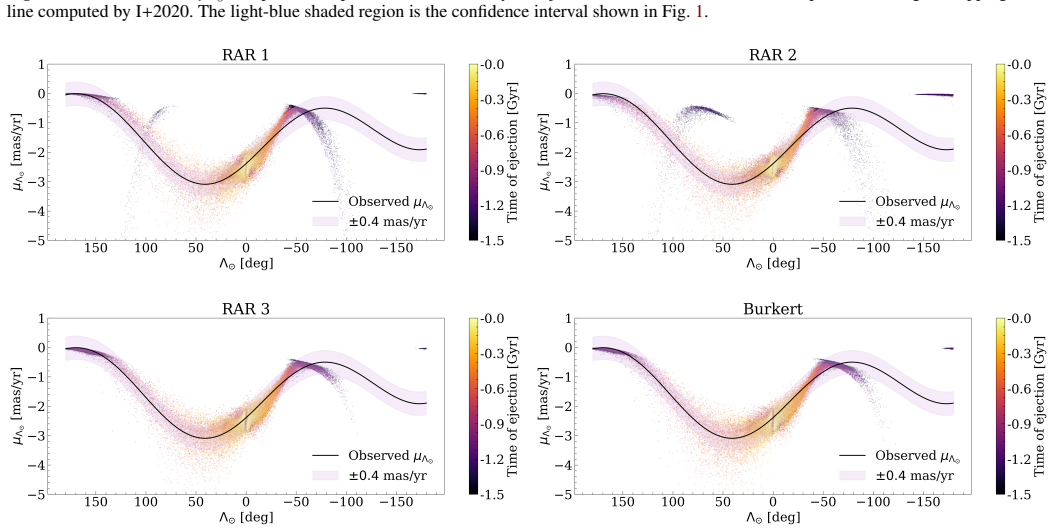
Across four dark matter halo models—three fermionic RAR halos (RAR 1, RAR 2 at 56 keV, RAR 3 at 20 keV) and one Burkert profile—the paper finds that none can reproduce the observed leading arm of the Sagittarius stream, while all four reproduce the trailing arm. The failing leading tail sits closer to the Galactic center than the data, its proper motions and line-of-sight velocities deviate from the observed fits, and the predicted heliocentric opening angle between the arms is too large. The result holds whether the fermionic halo develops a polytropic outer tail or a power-law-like tail similar to Burkert, and across the range of enclosed Milky Way masses allowed by apocenter-based constraints. The authors read this as a firm limitation on applying the first-principles fermionic halo model to the outer Milky Way, and conclude that reproducing the full stream requires going beyond spherical symmetry, for example by adding the Large Magellanic Cloud as a perturber.
Load-bearing premise
The load-bearing premise is that the three values for how much dark matter the Milky Way contains inside 12, 40, and 80 kiloparsecs, taken from Gibbons et al. (2014), correctly bracket the allowed mass in the region where the Sagittarius stream moves; if that mass range is wrong or too narrow, the leading-tail failure does not follow.
Editorial extensions
If this is right
- The trailing arm of the Sagittarius stream is reproduced by all four spherical halo models, so it is a robust probe of the Milky Way's total enclosed mass in the 10–80 kpc region.
- The leading arm, in contrast, rejects every spherical halo tested, which means that no spherically symmetric dark matter distribution can simultaneously satisfy the stream's distance, proper-motion, and velocity data.
- Power-law-like halo tails (RAR 3 and Burkert) come slightly closer to the leading-arm data than polytropic tails, pointing toward higher enclosed masses in the 30–60 kpc range as a partial remedy.
- A first-principles fermionic halo that reproduces the whole stream must abandon spherical symmetry and incorporate the gravitational influence of the Large Magellanic Cloud, as phenomenological models already do.
Reading between the lines
- A direct extension would be to rerun this spray algorithm with a mildly triaxial or oblate version of the RAR profile, or with an added LMC perturber, to see whether the leading tail can be recovered while keeping the trailing-arm fit intact.
- The pattern of failure suggests the leading tail of Sagittarius is a sharper discriminator of halo asphericity than the Galactic rotation curve, which these same fermionic models fit well; streams may therefore be the better observable for pinning down the halo shape.
- If a non-spherical version of the RAR model succeeds, it would simultaneously keep the dense fermion-core explanation of the Galactic center and resolve the stream discrepancy, linking the central and outer halo with one particle mass.
Editorial analysis
A structured set of objections, weighed in public.
Referee Report
Summary. The paper constructs Milky Way and Sagittarius dwarf models with dark matter halos described by the Ruffini-Argüelles-Rueda (RAR) fermionic model, a first-principles core-halo profile derived from quantum statistical mechanics. It generates Sgr tidal debris with a spray algorithm using roughly 10^5 particles, including the self-gravity of the progenitor, and compares the resulting streams with the full 6D observational dataset of Ibata et al. (2020) and Vasiliev et al. (2021). Four host halo models are tested: three RAR halos (RAR 1 and RAR 2 with m = 56 keV and polytropic tails; RAR 3 with m = 20 keV and a power-law-like tail) and a Burkert halo, with the latter three fitted to enclosed-mass values from Gibbons et al. (2014). The main finding is that all four models reproduce the trailing arm in phase space but fail to match the distance trend, proper motions, and line-of-sight velocities of the leading tail, leading the authors to conclude that spherical fermionic halos require further sophistication such as LMC perturbations or triaxiality.
Significance. If the result holds, this is a valuable first application of a first-principles fermionic dark matter model to the Sagittarius stream, complementing previous phenomenological halo studies. The paper makes a genuinely falsifiable prediction: for the tested RAR configurations, the leading tail discrepancy persists while the trailing arm is broadly consistent. Its strengths include the use of full 6D data, the comparison of two physically distinct halo-tail families, the inclusion of the progenitor's self-gravity, and the independent RAR 1 model, which was not fitted to Sgr stream data yet also fails on the leading tail. The central claim, however, is stated more broadly than the evidence: the paper tests only four discrete models, not the full observationally allowed mass window, and several of those models are fitted to stream-derived mass constraints.
major comments (4)
- [Abstract and Sec. 6; Sec. 3.1] The headline conclusion that 'within the observationally allowed span of enclosed masses where the stream moves, neither the power-law-like nor the polytropic behaviour of the fermionic halo models can answer for the observed trend of the leading tail' is stronger than the sampling supports. Only three RAR models and one Burkert model are simulated (Table 4), and the three RAR models are three discrete points in the four-dimensional parameter space (theta0, W0, beta0, m), selected to pass through the specific mass triples in Table 3. The paper itself notes that CPU time precludes a Monte Carlo scan (Sec. 3.1), so the data demonstrate a null result for these four models, not for the full 2-sigma allowed mass window of Gibbons et al. (2014). I request either a softened conclusion ('for the four tested models') or an explicit sparse exploration of the allowed M(r) window, such as bracketing models at the lower and upper 2-sigma bounds of M(12), M(40), and M(80), to substantiate the universality claim.
- [Sec. 3.1, Table 3, Sec. 5] The independence of the test is weaker than presented for RAR 2, RAR 3, and the Burkert model. These halos are fitted to the enclosed masses M(12), M(40), and M(80) that Gibbons et al. (2014) derived from the same Sgr apocenter distances used to define the stream morphology in Table 7, so the agreement of these models with the observed leading-arm apocenter is partly by construction. The main negative result, namely the leading-arm distance trend and proper-motion discrepancies, is not a fitting target, and RAR 1 is an independent configuration that also fails, so the conclusion is not circular in its central part. Still, the paper should identify for each model which quantities are independent predictions and which are inherited from the fitting targets, so the reader can gauge the strength of the test.
- [Sec. 5, Figs. 7-8, Table 7] The quantitative support for the negative result lacks uncertainty estimates. The Gaussian fits to the mock stream tails in Fig. 8 and the resulting apocentric distances in Table 7 are quoted without error bars, and the choice of ejection-time cuts (t > -2 Gyr for the leading tail and t < -2 Gyr for the trailing tail) is not varied. Because the central claim is a null result that depends on the size of the discrepancy relative to the model's internal scatter, the authors should provide at least a bootstrap estimate over the ~10^5 ejected stars or a sensitivity test with respect to the time cuts. Without this, a reader cannot assess whether, for example, the RAR 3 and Burkert leading tails are discrepant at a robust level or only at a level comparable to the realization noise.
- [Sec. 5, Table 7] The statement in Sec. 5 that the four models 'agree very well with the observations' for the trailing arm is stronger than the quantitative summary in Table 7. The predicted trailing apocentric distances are a_T = 62-76 kpc, whereas the observed values quoted in the paper are a_T = 102.5 +/- 2.5 kpc (Belokurov et al. 2014) and 98.95 +/- 1.3 kpc (Hernitschek et al. 2017), i.e., the models are low by roughly 25-35%. The proper-motion and distance tracks may agree in shape over the plotted longitude range, but calling this 'reproducing the trailing arm' obscures a large apocenter mismatch; please either quantify the sense in which the trailing arm is reproduced or qualify the claim.
minor comments (6)
- [Abstract] The abstract reads 'with∼ 105 particles'; this should be 'with ~10^5 particles'.
- [Table 3 note] The note says RAR 1 'fulfills the specific values at four different radii,' but RAR 1 was not fitted to these values; please distinguish fitted constraints (RAR 2, RAR 3, Burkert) from a posteriori values of an independently chosen model (RAR 1).
- [Sec. 3.1] The sentence 'These selected masses ... belong to 2 sigma mass dispersion interval' should specify whether this is a marginal 2-sigma interval for each mass or a joint 2-sigma region, since the three mass points are correlated through the same stream model.
- [Sec. 2, Table 6] Table 6 reports model circular velocities at the Sun of 199.4-215.0 km/s, while Sec. 2 adopts a fixed solar azimuthal velocity of 255.2 km/s and calls v_c(R_sun) model dependent; please clarify whether the table entries are total circular velocities and how the fixed solar motion remains consistent with the models.
- [Sec. 6 and Abstract] The phrase 'answer for the observed trend' should be 'account for the observed trend' in both places.
- [References] The reference list entry 'GRA VITY Collaboration' should be 'GRAVITY Collaboration'.
Circularity Check
Partially fitted potential inputs; the leading-tail negative result is independent, so circularity is partial rather than total.
-
fitted input called prediction
[Sec. 3.1 (Table 3 and differential-evolution fits), compared in Sec. 5]
"The DM models RAR 2 and RAR 3 are asked to fulfill (within 2σ dispersion) with selected accumulated total mass values as inferred in Gibbons et al. (2014) from the observed apocentric distances of the leading and trailing arms of the stream and their opening angle ... To find the best values of the free parameters in the RAR and Burkert models, we used a differential evolution algorithm to fit the predicted enclosed mass to the values in Table 3."
RAR 2, RAR 3, and Burkert are constructed by fitting M(12 kpc), M(40 kpc), and M(80 kpc) to values that Gibbons et al. inferred from the same Sgr stream's apocentric distances and opening angle. The resulting Galactic potentials therefore encode the stream's own large-scale radial-mass information before any simulation is run. When the simulations then reproduce trailing-arm features and the overall orbit, this agreement is partly inherited from the fitted input, not independently predicted. The leading-tail discrepancy, however, is not part of the fitting target, and RAR 1 (fixed by independent rotation-curve/S-star data) also fails; hence the central negative result retains independent content.
full rationale
The core circularity concern is confined to the three stream-fitted mass models. The paper is transparent about the fitting: RAR 2, RAR 3, and the Burkert profile are adjusted with differential evolution to enclosed-mass constraints at 12, 40, and 80 kpc that ultimately derive from the Sgr stream apocenters, so their later agreement with the trailing arm is partly built in. This is a genuine fitted-input-called-prediction element and prevents a score of 0. The main conclusion is nevertheless not circular in its decisive part: the leading-tail mismatch is not a fitting target, and the same qualitative failure occurs for RAR 1, whose parameters were adopted from independent Milky Way rotation-curve and S-cluster analyses rather than from the Sgr stream. The RAR model itself is borrowed from the authors' prior work, but here it is used as a theory to be tested against external 6D stream data, not assumed true to derive the result; prior self-citations are contextual and not load-bearing for the Sgr leading-tail claim. The paper also honestly discloses that CPU time prevented Monte Carlo sampling; the phrase within the observationally allowed span of enclosed masses is therefore broader than the four discrete simulated models support. That is a claim-strength limitation, not circularity.
Assumptions & free parameters
free parameters (24)
- RAR 1 fermion mass m =
56 keV
- RAR 1 degeneracy parameter theta0 =
37.766
- RAR 1 cutoff parameter W0 =
66.341
- RAR 1 temperature parameter beta0 =
1.198e-5
- RAR 2 fermion mass m =
56 keV
- RAR 2 degeneracy parameter theta0 =
37.416
- RAR 2 cutoff parameter W0 =
65.745
- RAR 2 temperature parameter beta0 =
1.208e-5
- RAR 3 fermion mass m =
20 keV
- RAR 3 degeneracy parameter theta0 =
34.417
- RAR 3 cutoff parameter W0 =
68.835
- RAR 3 temperature parameter beta0 =
1.274e-7
- Sgr56 fermion mass m =
56 keV
- Sgr56 degeneracy parameter theta0 =
31.611
- Sgr56 cutoff parameter W0 =
56.065
- Sgr56 temperature parameter beta0 =
2.436e-8
- Sgr20 fermion mass m =
20 keV
- Sgr20 degeneracy parameter theta0 =
25.919
- Sgr20 cutoff parameter W0 =
52.236
- Sgr20 temperature parameter beta0 =
2.312e-9
- Burkert central density rho0 =
2.197e7 M_sun/kpc^3
- Burkert scale radius r0 =
10.087 kpc
- Progenitor initial Galactocentric distance per model =
24.57, 25.64, 25.88, 25.3 kpc
- Backward integration time per model =
-3.0, -3.22, -2.7, -2.75 Gyr
assumptions (6)
- domain assumption The RAR fermionic distribution function, derived from a maximum entropy production principle, is a valid description of galactic dark matter halos for both host and satellite.
- domain assumption The Milky Way and Sgr dark matter halos are spherically symmetric for the purpose of stream generation.
- domain assumption The enclosed mass constraints from Gibbons et al. (2014) in Table 3 define the observationally allowed mass range in the 10-60 kpc radial window.
- domain assumption A time-independent combined potential with a constant-mass progenitor and no LMC is sufficient to generate a realistic Sgr stream for comparison.
- domain assumption The Gajda and Lokas (2016) tidal radius formula, with p(r) computed from the DM component only, is accurate for locating the Lagrange points.
- standard math The TOV equilibrium and Fermi-Dirac equation of state used in the RAR model are solved correctly.
Cite this review
Pith. "Pith review of The Sagittarius stellar stream embedded in a fermionic dark matter halo." pith.science (2026). https://pith.science/paper/DFUP6IR7
@misc{pith2026250515550,
  author       = {Pith},
  title        = {Pith review of: The Sagittarius stellar stream embedded in a fermionic dark matter halo},
  year         = {2026},
  howpublished = {\url{https://pith.science/paper/DFUP6IR7}},
  note         = {Machine review of arXiv:2505.15550}
}
abstract
Stellar streams are essential tracers of the gravitational potential of the Milky Way, with key implications to the problem of dark matter (DM) model distributions, either within or beyond phenomenological $\Lambda$CDM halos. For the first time in the literature, a DM halo model based on first physical principles such as quantum statistical mechanics and thermodynamics is used to try to reproduce the 6D observations of the Sagittarius (Sgr) stream. We model both DM haloes, the one of Sgr dwarf and the one of its host with a spherical self-gravitating system of neutral fermions which accounts for the effects of particles escape and fermion degeneracy, the latter causing a high-density core at the center of the halo. Full baryonic components for each galaxy are also considered. We use a spray algorithm with $\sim 10^{5}$ particles to generate the Sgr tidal debris, which evolves in the gravitational potential of the host-progenitor system, to compare with the full phase-space data of the stream. We repeat this kind of simulations for different parameter setups of the fermionic model including the particle mass, with special attention to test different DM halo morphologies allowed by the physics. We find that across the different families of fermionic halo models, they can only reproduce the trailing arm of the Sgr stream. Within the observationally allowed span of enclosed masses where the stream moves, neither the power-law like, nor the polytropic behaviour of the fermionic halo models can answer for the observed trend of the leading tail. A conclusion which is shared by former analysis using other type of spherically symmetric haloes. We conclude that further model sophistications such as abandoning spherical symmetry and including the Large Magellanic Cloud perturber are needed for a proper modelisation of the overall Milky Way potential within this kind of first principle halo models.
Figures


Figures from the paper (8 more)



Reference graph
Works this paper leans on
-
[1]
2020, , 635, L3
Antoja , T., Ramos , P., Mateu , C., et al. 2020, , 635, L3
2020
-
[2]
Arg \"u elles , C. R., Becerra-Vergara , E. A., Rueda , J. A., & Ruffini , R. 2023 a , Universe, 9, 197
work page 2023
-
[3]
R., Boshkayev , K., Krut , A., et al
Arg \"u elles , C. R., Boshkayev , K., Krut , A., et al. 2023 b , , 523, 2209
work page 2023
-
[4]
Arg \"u elles , C. R. & Collazo , S. 2023, Universe, 9, 372
2023
-
[5]
Arg \"u elles , C. R., D \' az , M. I., Krut , A., & Yunis , R. 2021, , 502, 4227
work page 2021
-
[6]
Arg \"u elles , C. R., Mestre , M. F., Becerra-Vergara , E. A., et al. 2022, , 511, L35
work page 2022
- [7]
-
[8]
2018, Physics of the Dark Universe, 21, 82
Argüelles, C., Krut, A., Rueda, J., & Ruffini, R. 2018, Physics of the Dark Universe, 21, 82
work page 2018
Show all 81 references
-
[9]
2019, Physics of the Dark Universe, 24, 100278
Argüelles, C., Krut, A., Rueda, J., & Ruffini, R. 2019, Physics of the Dark Universe, 24, 100278
2019
-
[10]
A., Arg\"uelles , C
Becerra-Vergara , E. A., Arg\"uelles , C. R., Krut , A., Rueda , J. A., & Ruffini , R. 2020, A&A, 641, A34
2020
-
[11]
A., Arg \"u elles , C
Becerra-Vergara , E. A., Arg \"u elles , C. R., Krut , A., Rueda , J. A., & Ruffini , R. 2021, , 505, L64
2021
-
[12]
W., Irwin, M
Belokurov, V., Evans, N. W., Irwin, M. J., et al. 2007, The Astrophysical Journal, 658, 337
2007
-
[13]
E., Evans , N
Belokurov , V., Koposov , S. E., Evans , N. W., et al. 2014, , 437, 116
2014
-
[14]
& Hogg , D
Bonaca , A. & Hogg , D. W. 2018, , 867, 101
2018
-
[15]
& Price-Whelan , A
Bonaca , A. & Price-Whelan , A. M. 2024, arXiv e-prints, arXiv:2405.19410
2024 arXiv
-
[16]
Bowden , A., Belokurov , V., & Evans , N. W. 2015, , 449, 1391
2015
-
[17]
1995, , 447, L25
Burkert , A. 1995, , 447, L25
1995
-
[18]
2004, Physica A Statistical Mechanics and its Applications, 332, 89
Chavanis , P.-H. 2004, Physica A Statistical Mechanics and its Applications, 332, 89
2004
-
[19]
P., Ro s kar , R., Valluri , M., et al
Debattista , V. P., Ro s kar , R., Valluri , M., et al. 2013, , 434, 2971
2013
-
[20]
& Widrow , L
Deg , N. & Widrow , L. 2013, , 428, 912
2013
-
[21]
Dierickx , M. I. P. & Loeb , A. 2017, , 836, 92
2017
-
[22]
I., Majewski, S
Dinescu, D. I., Majewski, S. R., Girard, T. M., et al. 2002, The Astrophysical Journal, 575, L67
2002
-
[23]
A., Huang, S., & Weinberg, M
Fardal, M. A., Huang, S., & Weinberg, M. D. 2015, Monthly Notices of the Royal Astronomical Society, 452, 301
2015
-
[24]
A., van der Marel , R
Fardal , M. A., van der Marel , R. P., Law , D. R., et al. 2019, , 483, 4724
2019
-
[25]
& Lokas , E
Gajda , G. & Lokas , E. L. 2016, , 819, 20
2016
-
[26]
Gibbons, S. L. J., Belokurov, V., & Evans, N. W. 2014, Monthly Notices of the Royal Astronomical Society, 445, 3788
2014
-
[27]
, Amorim, A
GRAVITY Collaboration , Abuter, R. , Amorim, A. , et al. 2018, A&A, 615, L15
2018
-
[28]
Grillmair, C. J. & Dionatos, O. 2006, The Astrophysical Journal, 643, L17
2006
-
[29]
M., Sheffield , A
Hawkins , K., Price-Whelan , A. M., Sheffield , A. A., et al. 2023, , 948, 123
2023
-
[30]
2004, , 610, L97
Helmi , A. 2004, , 610, L97
2004
-
[31]
2017, , 850, 96
Hernitschek , N., Sesar , B., Rix , H.-W., et al. 2017, , 850, 96
2017
-
[32]
Huxor , A. P. & Grebel , E. K. 2015, , 453, 2653
2015
-
[33]
2020, The Astrophysical Journal, 891, L19
Ibata, R., Bellazzini, M., Thomas, G., et al. 2020, The Astrophysical Journal, 891, L19
2020
-
[34]
F., Irwin , M., Totten , E., & Quinn , T
Ibata , R., Lewis , G. F., Irwin , M., Totten , E., & Quinn , T. 2001, , 551, 294
2001
-
[35]
2024, The Astrophysical Journal, 967, 89
Ibata , R., Malhan , K., Tenachi , W., et al. 2024, The Astrophysical Journal, 967, 89
2024
-
[36]
A., Gilmore , G., & Irwin , M
Ibata , R. A., Gilmore , G., & Irwin , M. J. 1994, , 370, 194
1994
-
[37]
A., Wyse , R
Ibata , R. A., Wyse , R. F. G., Gilmore , G., Irwin , M. J., & Suntzeff , N. B. 1997, , 113, 634
1997
-
[38]
V., Law , D
Johnston , K. V., Law , D. R., & Majewski , S. R. 2005, , 619, 800
2005
-
[39]
E., Belokurov , V., & Evans , N
Koposov , S. E., Belokurov , V., & Evans , N. W. 2013, , 766, 79
2013
-
[40]
E., Belokurov, V., Evans, N
Koposov, S. E., Belokurov, V., Evans, N. W., et al. 2012, The Astrophysical Journal, 750, 80
2012
-
[41]
E., Belokurov , V., Li , T
Koposov , S. E., Belokurov , V., Li , T. S., et al. 2019, , 485, 4726
2019
-
[42]
R., Chavanis , P
Krut , A., Arg \"u elles , C. R., Chavanis , P. H., Rueda , J. A., & Ruffini , R. 2023, , 945, 1
2023
-
[43]
K \"u pper , A. H. W., Lane , R. R., & Heggie , D. C. 2012, , 420, 2700
2012
-
[44]
R., Johnston , K
Law , D. R., Johnston , K. V., & Majewski , S. R. 2005, The Astrophysical Journal, 619, 807
2005
-
[45]
Law, D. R. & Majewski, S. R. 2010, The Astrophysical Journal, 714, 229
2010
-
[46]
R., Majewski , S
Law , D. R., Majewski , S. R., & Johnston , K. V. 2009, , 703, L67
2009
-
[47]
S., Koposov , S
Li , T. S., Koposov , S. E., Zucker , D. B., et al. 2019, , 490, 3508
2019
-
[48]
2017, , 468, 97
Luque , E., Pieres , A., Santiago , B., et al. 2017, , 468, 97
2017
-
[49]
R., Kunkel , W
Majewski , S. R., Kunkel , W. E., Law , D. R., et al. 2004, , 128, 245
2004
-
[50]
R., Siegel , M
Majewski , S. R., Siegel , M. H., Kunkel , W. E., et al. 1999, , 118, 1709
1999
-
[51]
R., Skrutskie, M
Majewski, S. R., Skrutskie, M. F., Weinberg, M. D., & Ostheimer, J. C. 2003, The Astrophysical Journal, 599, 1082
2003
-
[52]
& Ibata, R
Malhan, K. & Ibata, R. A. 2018, Monthly Notices of the Royal Astronomical Society, 477, 4063
2018
-
[53]
W., & Morrison, H
Mateo, M., Olszewski, E. W., & Morrison, H. L. 1998, The Astrophysical Journal, 508, L55
1998
-
[54]
2023, Monthly Notices of the Royal Astronomical Society, 520, 5225
Mateu , C. 2023, Monthly Notices of the Royal Astronomical Society, 520, 5225
2023
-
[55]
F., Arg \"u elles , C
Mestre , M. F., Arg \"u elles , C. R., Carpintero , D. D., Crespi , V., & Krut , A. 2024, , 689, A194
2024
-
[56]
K., Alonso-Garc \' a , J., Lucas , P
Minniti , D., Saito , R. K., Alonso-Garc \' a , J., Lucas , P. W., & Hempel , M. 2011, , 733, L43
2011
-
[57]
& Nagai , R
Miyamoto , M. & Nagai , R. 1975, , 27, 533
1975
-
[58]
J., Yanny , B., Cole , N., et al
Newberg , H. J., Yanny , B., Cole , N., et al. 2007, , 668, 221
2007
-
[59]
J., Yanny , B., Grebel , E
Newberg , H. J., Yanny , B., Grebel , E. K., et al. 2003, , 596, L191
2003
-
[60]
J., Yanny , B., Rockosi , C., et al
Newberg , H. J., Yanny , B., Rockosi , C., et al. 2002, , 569, 245
2002
-
[61]
R., Vieyro , F
Pelle , J., Arg \"u elles , C. R., Vieyro , F. L., et al. 2024, , 534, 1217
2024
-
[62]
2017, A&A, 598, A66
Pouliasis , E., Di Matteo , P., & Haywood , M. 2017, A&A, 598, A66
2017
-
[63]
2020, , 638, A104
Ramos , P., Mateu , C., Antoja , T., et al. 2020, , 638, A104
2020
-
[64]
J., Menten , K
Reid , M. J., Menten , K. M., Brunthaler , A., et al. 2014, , 783, 130
2014
-
[65]
H., Lora, V., Matos, T., & Sánchez-Salcedo, F
Robles, V. H., Lora, V., Matos, T., & Sánchez-Salcedo, F. J. 2015, The Astrophysical Journal, 810, 99
2015
-
[66]
R., & Rueda , J
Ruffini , R., Arg \"u elles , C. R., & Rueda , J. A. 2015, , 451, 622
2015
-
[67]
E., Drew , J
Sale , S. E., Drew , J. E., Knigge , C., et al. 2010, , 402, 713
2010
-
[68]
2010, , 403, 1829
Sch \"o nrich , R., Binney , J., & Dehnen , W. 2010, , 403, 1829
2010
-
[69]
T., Bell , E
Slater , C. T., Bell , E. F., Schlafly , E. F., et al. 2013, , 762, 6
2013
-
[70]
2013, Publications of the Astronomical Society of Japan, 65, 118
Sofue, Y. 2013, Publications of the Astronomical Society of Japan, 65, 118
2013
-
[71]
2005, , 364, 1105
Springel , V. 2005, , 364, 1105
2005
-
[72]
Totten, E. J. & Irwin, M. J. 1998, Monthly Notices of the Royal Astronomical Society, 294, 1
1998
-
[73]
Varghese, A., Ibata, R., & Lewis, G. F. 2011, Monthly Notices of the Royal Astronomical Society, 417, 198
2011
-
[74]
& Belokurov, V
Vasiliev, E. & Belokurov, V. 2020, Monthly Notices of the Royal Astronomical Society, 497, 4162
2020
-
[75]
2021, , 501, 2279
Vasiliev , E., Belokurov , V., & Erkal , D. 2021, , 501, 2279
2021
-
[76]
E., et al
Virtanen, P., Gommers, R., Oliphant, T. E., et al. 2020, Nature Methods, 17, 261
2020
-
[77]
G., Mateo, M., Olszewski, E
Walker, M. G., Mateo, M., Olszewski, E. W., et al. 2009, The Astrophysical Journal, 704, 1274
2009
-
[78]
2022, , 940, L3
Wang , H.-F., Hammer , F., Yang , Y.-B., & Wang , J.-L. 2022, , 940, L3
2022
-
[79]
J., Johnson , J
Yanny , B., Newberg , H. J., Johnson , J. A., et al. 2009, , 700, 1282
2009
-
[80]
, " * write output.state after.block = add.period write newline
ENTRY address archiveprefix author booktitle chapter edition editor howpublished institution eprint journal key month note number organization pages publisher school series title type volume year label extra.label sort.label short.list INTEGERS output.state before.all mid.sent...
-
[81]
write newline
" write newline "" before.all 'output.state := FUNCTION n.dashify 't := "" t empty not t #1 #1 substring "-" = t #1 #2 substring "--" = not "--" * t #2 global.max substring 't := t #1 #1 substring "-" = "-" * t #2 global.max substring 't := while if t #1 #1 substring * t #2 gl...
Reviewed August 7, 2026 · model on record in the stance chip above.
Discussion (0). Sign in to comment.