REVIEW 4 major objections 4 minor 2 cited by
A Fuzzy Edge Detector Driven Telegraph Total Variation Model For Image Despeckling
T0 review · 4 major / 4 minor · reviewed 2026-08-14 · deepseek-v4-flash
Pith's one-line read A fuzzy edge indicator drives a telegraph total variation despeckling model that beats five existing PDE filters on natural and SAR images, and whose regularized form has a unique weak solution.
desk verdict A useful engineering hybrid with a real theorem, but the theorem doesn't cover the implemented scheme and the variational derivation needs fixing. read the letter →
The pith
A machine-rendered reading of the paper's core claim, the machinery that carries it, and where it could break.
The reading
What carries the argument
The load-bearing object is the fuzzy edge indicator $\theta(I)=1-F(I)$, where $F$ is the intuitionistic fuzzy divergence (IFD) obtained by matching each pixel neighborhood against a set of edge templates; $\theta$ is small near edges, close to 1 in homogeneous regions, and it replaces the gradient-only coefficient in the total variation term. In the well-posedness proof the operative object is the regularized coefficient $g_w = \theta(G_\xi*w)/(1+|\nabla G_\xi*w|)$. Its uniform lower bound $\delta/(1+C(G_\xi,\|I_0\|_{H^1}))$ and time-derivative bound make the linearized problem amenable to Galerkin energy estimates, and Schauder's fixed-point theorem yields a fixed point of $w\mapsto I_w$. Uniqueness is shown by testing the difference of two solutions with a time-integrated test function and applying Gronwall's lemma on short time intervals.
What would settle it
Compute $\theta(I)=1-F(I)$ on the actual test images at the noise levels used in the experiments and check whether $\delta\le\theta\le 1$ and $|\theta(x)-\theta(y)|\le C_\theta|x-y|$ hold for some positive $\delta$; alternatively, solve equation (4) and scheme (28) on the same image and compare. If $\theta$ touches zero or the discrete scheme diverges from the regularized PDE, Theorem 4.1 no longer applies to the implemented despeckling filter.
Extended reading notes
Core claim
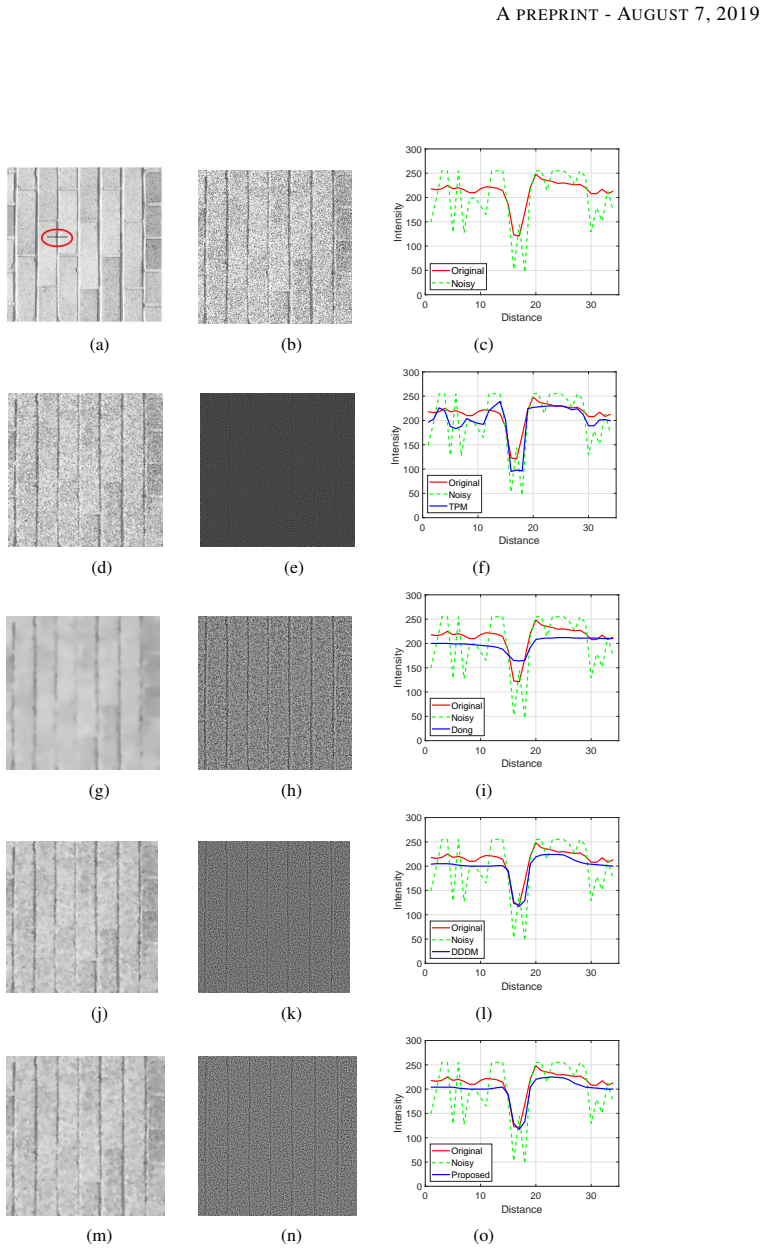
The paper's central claim is that the telegraph total variation equation $I_{tt}+\gamma I_t = \mathrm{div}(\theta(I)\nabla I/|\nabla I|) - \lambda(1-I_0/I)$, with $\theta(I)=1-F(I)$ computed from intuitionistic fuzzy divergence, suppresses multiplicative speckle noise while preserving edges better than the compared diffusion and variational models. The reported experiments show higher PSNR and MSSIM, lower speckle index and BRISQUE, and cleaner ratio images for noise looks $L=1,3,5,10,33$, with better edge contrast in line profiles, contours, and 3D surfaces on natural and real SAR images. The theoretical result is Theorem 4.1: the regularized equation (4), where $\theta(I)$ is replaced by $\theta(G_\xi*I)/(1+|\nabla G_\xi*I|)$, admits one and only one weak solution under assumptions A.1 and A.2. The authors present this as the first use of a fuzzy edge detector inside a telegraph total variation framework for multiplicative noise removal.
Load-bearing premise
The load-bearing premise is that the fuzzy divergence edge detector satisfies Assumption A.2, namely $\delta\le\theta\le 1$ and Lipschitz continuity, and that the regularized coefficient in equation (4) faithfully represents the discrete $\theta$ computed by template matching in the numerical scheme (28); the paper demonstrates neither for the implemented filter.
Editorial extensions
If this is right
- At the reported noise levels ($L=1$ to $33$), the model attains the highest PSNR and MSSIM and the lowest speckle index among the five compared PDE-based models on the tested natural images.
- On the single-look real SAR image, the model attains the lowest speckle index and BRISQUE, indicating stronger speckle suppression without reference ground truth.
- Because the energy functional remains convex and the regularized PDE is well-posed, the fuzzy edge indicator can be combined with the existing total-variation fidelity term without losing the guarantee of a unique weak solution.
- The telegraph (hyperbolic) structure keeps edge profiles sharper than parabolic diffusion alone, which the paper states as the reason for adopting this framework.
Reading between the lines
- The existence proof covers the regularized equation (4), not the explicit finite-difference scheme (28); showing that the discrete iterates converge to the weak solution would require an additional stability and consistency analysis, which the paper leaves implicit.
- The IFD edge measure $F$ is defined from fixed templates, so the edge indicator is not rotation- or scale-invariant by construction; enriching the template set or learning templates is a natural testable extension.
- A direct empirical check of Assumption A.2 on real noisy images would reveal whether the theoretical theorem governs the actual experiments, since the paper does not report such measurements.
- The same construction could be applied to other multiplicative-noise fidelities or to texture-preserving regularization, a direction the conclusion identifies as future work.
Signed reviews
Editorial analysis
A structured set of objections, weighed in public.
Referee Report
Summary. The manuscript proposes a despeckling model that combines a telegraph total variation diffusion term with a fuzzy edge indicator θ(I)=1−F(I), where F is an intuitionistic fuzzy divergence measure defined in Section 2.3. Starting from the energy functional (1), the authors derive the Euler-Lagrange equation (2) and the evolutionary telegraph total variation model (3), prove existence and uniqueness of a weak solution for the regularized version (4)–(6) under Assumptions A.1–A.2 (Theorem 4.1), and give an explicit finite-difference scheme (28) with a relative-error stopping criterion. Experiments compare the proposed method against five existing PDE-based despeckling models on five natural/synthetic images at looks 1, 3, 5, 10, and 33 and on a real single-look SAR image, using PSNR, MSSIM, SI, and BRISQUE metrics.
Significance. The idea of coupling a fuzzy edge detector with a hyperbolic telegraph total variation equation for multiplicative speckle removal is reasonable and relatively unexplored, and the experimental section is extensive and consistently favorable to the proposed method across images and metrics. The paper also makes a serious attempt at a well-posedness analysis with explicit assumptions and a Schauder fixed-point argument. However, the theoretical and numerical parts are not connected: Theorem 4.1 covers a regularized coefficient that is not what is implemented in (28), and the key regularity and positivity assumption A.2 is never verified for the proposed IFD-based edge indicator. These gaps directly affect the central claim that the proposed model is mathematically justified, although they do not by themselves disprove the empirical results. With substantial revision, the contribution could be publishable.
major comments (4)
- [§3.1, Eqs. (1)–(2)] The Euler-Lagrange equation (2) is not the first variation of the energy (1): since the edge indicator θ depends explicitly on I, the variation of ∫_Ω θ(I)|∇I| dx contains the additional term θ'(I)|∇I|, which is absent from (2). Consequently the gradient flow (3) is not the descent equation associated with the stated energy, and the claim in Section 3.2 that the associated variational problem has a unique minimizer is not supported by the derivation. The authors should either correct the Euler-Lagrange equation and re-derive the evolution model, or reformulate θ as a coefficient that is fixed during the minimization, for example by computing θ from a pre-smoothed version of the observed image.
- [§3.2, energy (1)] The assertion in Section 3.2 that “the energy functional (1) is globally convex” is unsupported and in general false. With a nonconstant θ(I), the term ∫_Ω θ(I)|∇I| dx is not necessarily convex in I, and the fidelity term ∫_Ω (I + I0 log(1/I)) dx is strictly convex only under a restricted range condition, as the discussion of the AA model in Section 2.2 indicates. The cited convexity result in [16] applies to a coefficient α(x) that is independent of the unknown I. This bullet point should be removed or replaced by a precise convexity statement with proof.
- [§4, Assumption A.2 vs. §2.3] Assumption A.2 is never verified for the proposed fuzzy indicator θ(I)=1−F(I). In the IFD construction of Section 2.3, F can exceed 1: for a template with μ_P=1 and μ_Q=0, the divergence expression gives F=2−2e^{−1}>1, so θ=1−F can be negative. Thus the lower bound δ≤θ≤1 in A.2, which is used in the proof of Theorem 4.1 to control the coefficient g_w from below (see Eq. (10) and estimate (12)), is not established. The authors need either to prove A.2 for their θ, or to modify the definition of θ so that it provably lies in [δ,1] and is Lipschitz.
- [§5, Eq. (28) vs. Eq. (4)] The numerical scheme (28) does not discretize the regularized equation (4) for which Theorem 4.1 is proved. In (4) the diffusion coefficient is θ(G_ξ*I)/(1+|∇G_ξ*I|), whereas in (28) the coefficient is θ(I^n_{i,j})=1−F(I^n_{i,j}), using the nonlocal max/min template divergence F of Section 2.3; no Gaussian convolution G_ξ*I or denominator 1+|∇G_ξ*I| appears, and no value of ξ is reported. Unless a consistency argument is supplied showing that the discrete scheme is a convergent approximation of (4), the existence-uniqueness theorem does not cover the implemented filter, and the experiments in Section 6 cannot be presented as validating the model analyzed in Section 4.
minor comments (4)
- [§6, Figs. 2–4 and Tables 1–3] The baseline method is called “TPM” in the caption of Fig. 2 but “TDM” in Tables 1–3; please unify the notation.
- [§6.1] The statement that “different parameters of considered models are optimized manually” means that the comparison partly reflects tuning effort; a sensitivity analysis or an automatic parameter-selection rule would make the empirical comparison more robust.
- [§6.2, Tables 1–2] The quantitative results appear to be single realizations: no standard deviations or number of noise realizations are reported, so the statistical significance of the observed improvements is unclear.
- [§4.3 and §2.3] There are minor typographical issues, e.g., “in the sence of distribution” in Section 4.3 and the inconsistent spelling “Attanassov” versus “Atanassov” in Section 2.3.
Circularity Check
No significant circularity; theorem-experiment mismatch and parameter tuning are rigor/fairness issues, not circular derivation.
full rationale
The paper's central claims are (i) that the proposed telegraph total variation model with fuzzy edge indicator outperforms five baseline methods in despeckling benchmarks and (ii) that the regularized version (4)-(6) admits a unique weak solution. Neither claim reduces to its own inputs. The numerical comparisons in Section 6.3 are against independently corrupted test images using PSNR, MSSIM, SI, and BRISQUE; these metrics are not fitted into the model to produce the reported output. The manually optimized parameters in Section 6.1 affect the experimental comparison but are not fitted inputs renamed as predictions, so they are a fairness concern rather than circularity. The existence and uniqueness proof in Section 4 is an in-paper Schauder fixed-point argument that assumes A.1-A.2 and does not assume the conclusion; the cited Evans textbook is external, and the authors' self-citations [21]-[24] appear only in related work and numerical background, not as the load-bearing justification for well-posedness or superiority. The significant gaps are correctness/rigor defects, not circular ones: Assumption A.2 is never verified for the actual fuzzy indicator theta(I)=1-F(I), the Euler-Lagrange equation (2) omits the theta'(I) contribution, and the discretized filter (28) uses theta(I^n_{i,j}) without the Gaussian-regularized denominator of the analyzed model (4). These defects disconnect the theorem from the implementation, but they do not make the derivation equivalent to its inputs. No prediction in the paper is forced by construction, and no self-citation chain supplies the central result. Therefore no significant circularity is found.
Assumptions & free parameters
free parameters (4)
- damping coefficient γ =
not reported
- fidelity weight λ =
not reported
- stopping threshold ε =
10^-4 or smaller
- Gaussian scale ξ in Gξ =
not reported
assumptions (5)
- domain assumption Initial image I0 lies in H2(Ω) and satisfies 0<α≤I0≤β with finite α, β (Assumption A.1).
- ad hoc to paper The fuzzy edge indicator θ satisfies δ≤θ≤1 and is Lipschitz with constant Cθ (Assumption A.2).
- ad hoc to paper The regularized equation (4), with θ(Gξ*I)/(1+|∇Gξ*I|), is a valid continuous surrogate for the discrete fuzzy edge model implemented in (28).
- ad hoc to paper The energy functional (1) is globally convex in I.
- standard math Compact Sobolev embedding and the Schauder fixed point theorem are applicable.
Cite this review
Pith. "Pith review of A Fuzzy Edge Detector Driven Telegraph Total Variation Model For Image Despeckling." pith.science (2026). https://pith.science/paper/DGKV2ZPN
@misc{pith2026190801134,
  author       = {Pith},
  title        = {Pith review of: A Fuzzy Edge Detector Driven Telegraph Total Variation Model For Image Despeckling},
  year         = {2026},
  howpublished = {\url{https://pith.science/paper/DGKV2ZPN}},
  note         = {Machine review of arXiv:1908.01134}
}
read the original abstract
Speckle noise suppression is a challenging and crucial pre-processing stage for higher-level image analysis. In this work, a new attempt has been made using telegraph total variation equation and fuzzy set theory for speckle noise suppression. The intuitionistic fuzzy divergence (IFD) function has been used to distinguish between edges and noise. To the best of the author's knowledge, most of the studies on multiplicative speckle noise removal process focus on only diffusion-based filters, and little attention has been paid to the study of fuzzy set theory. The proposed approach enjoy the benefits of both telegraph total variation equation and fuzzy edge detector, which is not only robust to noise but also preserves image structural details. Moreover, we establish the existence and uniqueness of a weak solution of the regularized version of the proposed model using Schauder fixed point theorem. With the proposed model, despeckling is carried out on natural and Synthetic Aperture Radar (SAR) images. The experimental results of the proposed model are reported, which found better in terms of noise suppression and detail/edge preservation, with respect to the existing approaches.
Figures


Figures from the paper (1 more)

Forward citations
Cited by 2 Pith papers
-
Well-posedness study of a non-linear hyperbolic-parabolic coupled system applied to image speckle reduction
A telegraph-diffusion model coupled to an edge-variable reaction-diffusion equation is proven to have a unique weak solution, and it modestly improves despeckling metrics over two comparison models on three test images.
-
A Gray Level Indicator-Based Regularized Telegraph Diffusion Equation Applied to Image Despeckling
A gray level indicator based telegraph diffusion model for speckle noise removal is proposed, with a well-posedness proof and modest numerical gains over one baseline on three test images.
Reference graph
Works this paper leans on
-
[16]
In: Abstract and Applied Analysis , vol
Dong, G., Guo, Z., Wu, B.: A convex adaptive total variat ion model based on the gray level indicator for multi- plicative noise removal. In: Abstract and Applied Analysis , vol. 2013. Hindawi Publishing Corporation (2013)
2013
-
[1]
Adam, Sobolev spaces, in: Pure and Applied Mathematic s Series of Monographs and Textbooks, V ol
R. Adam, Sobolev spaces, in: Pure and Applied Mathematic s Series of Monographs and Textbooks, V ol. 65, Academic Press, Inc., New Y ork, San Francisco, London„ 1975
1975
-
[2]
https://earth.esa.int/handbooks/asar/CNTR1-4.html
Agency, E.S.: Esa earth online. https://earth.esa.int/handbooks/asar/CNTR1-4.html
-
[3]
In: 2001 IEEE International Conference on Acoustics, Speech, and Signal Processing
Aja, S., Alberola, C., Ruiz, A.: Fuzzy anisotropic diffu sion for speckle filtering. In: 2001 IEEE International Conference on Acoustics, Speech, and Signal Processing. Pr oceedings (Cat. No. 01CH37221), vol. 2, pp. 1261-
work page 2001
-
[4]
IEEE Geoscience and remote sensing magazine 1(3), 6 -35 (2013)
Argenti, F., Lapini, A., Bianchi, T., Alparone, L.: A tut orial on speckle reduction in synthetic aperture radar images. IEEE Geoscience and remote sensing magazine 1(3), 6 -35 (2013)
2013
-
[5]
Atanassov, K.T.: Intuitionistic fuzzy sets: past, pres ent and future. In: EUSFLA T Conf., pp. 12-19 (2003)
work page 2003
-
[6]
SIAM Journal on Applied Mathe- matics 68(4), 925-946 (2008)
Aubert, G., Aujol, J.F.: A variational approach to remov ing multiplicative noise. SIAM Journal on Applied Mathe- matics 68(4), 925-946 (2008)
2008
-
[7]
Aubert, G., Kornprobst, P .: Mathematical problems in im age processing: partial differential equations and the calculus of variations, vol. 147. Springer Science & Business Media (2006)
work page 2006
Show all 43 references
-
[8]
Biomedical Signal Processing and Control 23, 93 -103 (2016)
Babu, J.J.J., Sudha, G.F.: Adaptive speckle reduction i n ultrasound images using fuzzy logic on coefficient of variation. Biomedical Signal Processing and Control 23, 93 -103 (2016)
2016
-
[9]
In: International Work-Conference on Artificial Neural Networks, pp
Becerikli, Y ., Karan, T.M.: A new fuzzy approach for edge detection. In: International Work-Conference on Artificial Neural Networks, pp. 943-951. Springer (2005)
2005
-
[10]
Biomedical Signal Processing and Control 13, 89-10 1 (2014))
Binaee, K., Hasanzadeh, R.P .: An ultrasound image enha ncement method using local gradient based fuzzy simi- larity. Biomedical Signal Processing and Control 13, 89-10 1 (2014))
2014
-
[11]
IEEE Transactions on Sonics and ultrasonics 25(1), 1-6 (1978)
Burckhardt, C.B.: Speckle in ultrasound b-mode scans. IEEE Transactions on Sonics and ultrasonics 25(1), 1-6 (1978)
1978
-
[12]
Nonlinear Analysis: Real World Applications 11(1), 253-26 1 (2010)
Cao, Y ., Yin, J., Liu, Q., Li, M.: A class of nonlinear par abolic-hyperbolic equations applied to image restoration . Nonlinear Analysis: Real World Applications 11(1), 253-26 1 (2010)
2010
-
[13]
Applied soft computing 8(2), 919-927 (2008)
Chaira, T., Ray, A.: A new measure using intuitionistic fuzzy set theory and its application to edge detection. Applied soft computing 8(2), 919-927 (2008)
2008
-
[14]
Pattern Recognition Letters 24(12), 1837-1844 (2003)
Chaira, T., Ray, A.K.: Segmentation using fuzzy diverg ence. Pattern Recognition Letters 24(12), 1837-1844 (2003)
2003
-
[15]
In: Geoscience and Remote Sensing Symposium , 1990
Dewaele, P ., Wambacq, P ., Oosterlinck, A., Marchand, J .L.: Comparison of some speckle reduction techniques for sar images. In: Geoscience and Remote Sensing Symposium , 1990. IGARSS’90.’Remote Sensing Science for the Nineties’., 10th Annual International, pp. 2417-2422. IEEE (1990)
1990
-
[17]
Evans, L.: Partial Differential Equations, in: Gradua te Studies in Mathematics, vol. 19. American Mathematical Society, Providence, Rhode Island (1998)
1998
-
[18]
Gonzalez, R.C., Woods, R.E.: Digital image processing (2002)
2002
-
[19]
In: Inter- national Workshop on Fuzzy Logic in Artificial Intelligence , pp
Ho, K.H., Ohnishi, N.: Fedge fuzzy edge detection by fuz zy categorization and classification of edges. In: Inter- national Workshop on Fuzzy Logic in Artificial Intelligence , pp. 182-196. Springer (1995)
1995
-
[20]
In: 2009 First International Workshop on Education Technology and Comput er Science, vol
Hua, C., Jinwen, T.: Speckle reduction of synthetic ape rture radar images based on fuzzy logic. In: 2009 First International Workshop on Education Technology and Comput er Science, vol. 1, pp. 933-937. IEEE (2009)
2009
-
[21]
In: Information Systems Design and Intelligent Applications, pp
Jain, S.K., Ray, R.K.: Edge detectors based telegraph t otal variational model for image filtering. In: Information Systems Design and Intelligent Applications, pp. 119-126. Springer (2016)
2016
-
[22]
IETE Technical Review pp
Jain, S.K., Ray, R.K.: Non-linear diffusion models for despeckling of images: achievements and future chal- lenges. IETE Technical Review pp. 1-17 (2019)
2019
-
[23]
Computers & Mathematics with Applications 70(3), 191-211 (2015)
Jain, S.K., Ray, R.K., Bhavsar, A.: Iterative solvers f or image denoising with diffusion models: A comparative study. Computers & Mathematics with Applications 70(3), 191-211 (2015)
2015
-
[24]
Circuits, Systems, and Signal Proces sing pp
Jain, S.K., Ray, R.K., Bhavsar, A.: A nonlinear coupled diffusion system for image despeckling and application to ultrasound images. Circuits, Systems, and Signal Proces sing pp. 1-30 (2018)
2018
-
[25]
IEEE Trans - actions on Information Technology in Biomedicine 4(4), 298 -305 (2000) 18 A PREPRINT - A UGUST 7, 2019
Jin, J.S.,Wang, Y ., Hiller, J.: An adaptive nonlinear d iffusion algorithm for filtering medical images. IEEE Trans - actions on Information Technology in Biomedicine 4(4), 298 -305 (2000) 18 A PREPRINT - A UGUST 7, 2019
2000
-
[26]
Journal of Math- ematical Imaging and Vision 39(1), 62-74 (2011)
Jin, Z., Y ang, X.: A variational model to remove the mult iplicative noise in ultrasound images. Journal of Math- ematical Imaging and Vision 39(1), 62-74 (2011)
2011
-
[27]
https://photojournal.jpl.nasa.gov/catalog/PIA01763
JPL: Space radar image of kilauea. https://photojournal.jpl.nasa.gov/catalog/PIA01763
-
[28]
Klir, G.J., Y uan, B.: Fuzzy sets and fuzzy logic: theory and applications, vol. 574. Prentice Hall PTR New Jersey (1995)
1995
-
[29]
Nonlinear Analysis: Real World Applications 14(5), 2046-2058 (2013)
Liu, Q., Li, X., Gao, T.: A nondivergence p-laplace equa tion in a removing multiplicative noise model. Nonlinear Analysis: Real World Applications 14(5), 2046-2058 (2013)
2013
-
[30]
IEEE Transac- tions on Image Processing 21(12), 4695-4708 (2012 )
Mittal, A., Moorthy, A.K., Bovik, A.C.: No-reference i mage quality assessment in the spatial domain. IEEE Transac- tions on Image Processing 21(12), 4695-4708 (2012 )
2012
-
[31]
Multimedia Tools and Applications pp
Nadeem, M., Hussain, A., Munir, A.: Fuzzy logic based co mputational model for speckle noise removal in ultrasound images. Multimedia Tools and Applications pp. 1 -18 (2019)
2019
-
[32]
In: Interna - tional Conference on Swarm, Evolutionary, and Memetic Comp uting, pp
Prasath, V .S., Delhibabu, R.: Image restoration with f uzzy coefficient driven anisotropic diffusion. In: Interna - tional Conference on Swarm, Evolutionary, and Memetic Comp uting, pp. 145-155. Springer (2014)
2014
-
[33]
In: Image Analysis and Processing, 2007
Ratner, V ., Zeevi, Y .Y .: Image enhancement using elastic manifolds. In: Image Analysis and Processing, 2007. ICIAP 2007. 14th International Conference on, pp. 769-774. IEEE (2007)
2007
-
[34]
In: Geometric Level Set Methods in Imaging, Vision, and Graphics, pp
Rudin, L., Lions, P .L., Osher, S.: Multiplicative deno ising and deblurring: Theory and algorithms. In: Geometric Level Set Methods in Imaging, Vision, and Graphics, pp. 103- 119. Springer (2003)
2003
-
[35]
Journal of Mathe- matical Imaging and Vision pp
Shan, X., Sun, J., Guo, Z.: Multiplicative noise remova l based on the smooth diffusion equation. Journal of Mathe- matical Imaging and Vision pp. 1-17 (2019)
2019
-
[36]
https://directory.eoportal.org/web/eoportal/satellite-missions/k/kompsat-5
eoPortal: Sharing Earth Observation Resources: Komps at-5. https://directory.eoportal.org/web/eoportal/satellite-missions/k/kompsat-5
-
[37]
In: Proceeding of the 7th World Multicon- ference on Systemics, Cyebernetics and Informat ics, pp
Song, J., Tizhoosh, H.: Fuzzy anisotropic diffusion: a rule-based approach. In: Proceeding of the 7th World Multicon- ference on Systemics, Cyebernetics and Informat ics, pp. 241-246 (2003)
2003
-
[38]
Boundary V alue Problems 2016(1), 187 (2016)
Sun, J., Y ang, J., Sun, L.: A class of hyperbolic-parabo lic coupled systems applied to image restoration. Boundary V alue Problems 2016(1), 187 (2016)
2016
-
[39]
Fuzzy sets and systems 114(3), 505-518 (2000)
Szmidt, E., Kacprzyk, J.: Distances between intuition istic fuzzy sets. Fuzzy sets and systems 114(3), 505-518 (2000)
2000
-
[40]
Image Processing, IEEE Transactions on 1 3(4), 600-612 (2004)
Wang, Z., Bovik, A.C., Sheikh, H.R., Simoncelli, E.P .: Image quality assessment: from error visibility to struc- tural similarity. Image Processing, IEEE Transactions on 1 3(4), 600-612 (2004)
2004
-
[41]
IEEE Transactions on image processing 11(11), 1260-1270 (2002)
Y u, Y ., Acton, S.T.: Speckle reducing anisotropic diff usion. IEEE Transactions on image processing 11(11), 1260-1270 (2002)
2002
-
[42]
IEEE Tra nsactions on Image Processing 24(1), 249-260 (2015)
Zhou, Z., Guo, Z., Dong, G., Sun, J., Zhang, D., Wu, B.: A d oubly degenerate diffusion model based on the gray level indicator for multiplicative noise removal. IEEE Tra nsactions on Image Processing 24(1), 249-260 (2015)
2015
-
[43]
Journal of Nonlinear Science 28(2), 443-470 (2018 ) 19
Zhou, Z., Guo, Z., Zhang, D., Wu, B.: A nonlinear diffusi on equation-based model for ultrasound speckle noise removal. Journal of Nonlinear Science 28(2), 443-470 (2018 ) 19
2018
Reviewed August 14, 2026 · model on record in the stance chip above.
Discussion (0). Continue with ORCID to comment.