Secure RSMA-based Visible Light Networks under Spatial Correlation
Pith reviewed 2026-06-28 13:51 UTC · model grok-4.3
The pith
A channel similarity reduction clustering strategy overcomes the secrecy performance ceiling caused by high spatial correlation in RSMA-based visible light networks.
A machine-rendered reading of the paper's core claim, the machinery that carries it, and where it could break.
Core claim
The authors establish that the proposed channel similarity reduction clustering strategy significantly outperforms existing baselines, effectively overcoming the secrecy performance ceiling caused by high spatial correlation.
What carries the argument
The channel similarity reduction (CSR) clustering strategy, which groups users to minimize channel similarity and restores the system's degrees of freedom lost to spatial correlation.
If this is right
- The CCCP and SDR algorithms produce effective solutions to the non-convex secrecy sum rate maximization problem.
- Minimizing channel similarity through clustering restores degrees of freedom and raises achievable secrecy sum rate under high spatial correlation.
- The CSR-clustering strategy removes the performance ceiling that high spatial correlation otherwise imposes.
- Performance advantages hold across various levels of channel similarity in numerical evaluations.
Where Pith is reading between the lines
- Similar clustering based on channel similarity could extend to other multi-user visible light or RF systems facing correlation-induced secrecy limits.
- Testing the approach on hardware prototypes would check whether numerical gains translate to real VLC deployments.
- Incorporating external eavesdroppers into the model could show whether the clustering retains its advantage or requires adjustment.
Load-bearing premise
The non-convex optimization problem can be reliably solved via CCCP and SDR without the solutions deviating substantially from the true optimum, and the channel similarity metric fully captures the secrecy impact of spatial correlation.
What would settle it
If exhaustive search on small instances shows the CCCP or SDR solutions achieve substantially lower secrecy sum rate than the true optimum, or if measured high-correlation VLC channels show no SSR gain from the clustering, the central performance claims would not hold.
Figures
read the original abstract
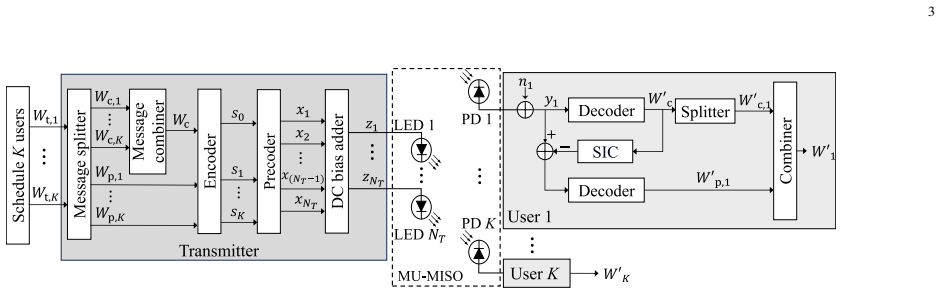
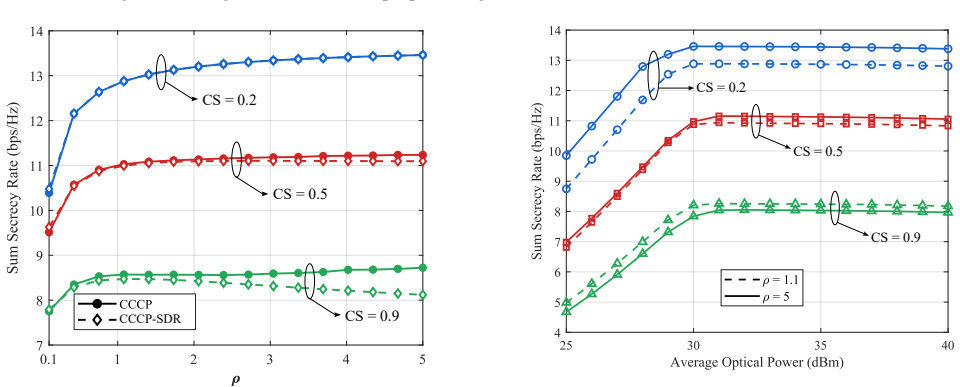
This paper investigates the secrecy sum rate (SSR) of rate-splitting multiple access (RSMA)-based visible light communication (VLC) systems considering internal eavesdropping, where legitimate users may intercept private data intended for others. We formulate an optimization problem to maximize the SSR of the system, which is inherently non-convex due to the complex coupling of the objective function and constraints. To this end, two different approaches based on the convex-concave procedure (CCCP) and semidefinite relaxation (SDR) are leveraged to solve the non-convex parameterized problem. A central focus of this work is the investigation of channel similarity (CS), which serves as a metric for quantifying spatial correlation, and its impact on SSR performance. To mitigate the performance degradation caused by high spatial correlation, we propose a channel similarity reduction (CSR) clustering strategy that proactively minimizes CS to restore the system's degrees of freedom (DoF). Numerical results are provided to demonstrate the performance of the two proposed algorithms under various levels of CS. More importantly, the findings reveal that our proposed CSR-clustering strategy significantly outperforms existing baselines, effectively overcoming the secrecy performance ceiling caused by high spatial correlation.
Editorial analysis
A structured set of objections, weighed in public.
Referee Report
Summary. The paper studies secrecy sum rate (SSR) maximization in RSMA-based VLC systems with internal eavesdropping and spatial correlation. It formulates a non-convex SSR optimization problem, solves it with CCCP and SDR, introduces a channel similarity reduction (CSR) clustering strategy to counteract high spatial correlation, and reports numerical results claiming that CSR-clustering significantly outperforms baselines and overcomes the secrecy performance ceiling.
Significance. If the numerical gains are shown to be robust to solver artifacts, the work would offer a concrete clustering method for restoring DoF in correlated VLC channels, which is relevant for secure indoor networks. The combination of RSMA with explicit spatial-correlation handling is a timely direction, but the significance hinges on whether the reported SSR improvements reflect true system behavior rather than properties of the local solvers.
major comments (2)
- [Optimization and solution approach] The non-convex SSR maximization (formulated after the system model) is solved exclusively via CCCP and SDR; no duality gap bounds, small-instance exhaustive-search comparisons, or convergence analysis to global optimality are supplied. Because the central claim—that CSR-clustering yields higher SSR than baselines under high CS—rests entirely on these numerical values, the absence of optimality-gap control is load-bearing.
- [Channel similarity and clustering strategy] The channel-similarity metric used to drive CSR clustering is asserted to fully capture the secrecy impact of spatial correlation, yet the paper provides no sensitivity study showing that alternative correlation measures (e.g., mutual information or chordal distance) produce materially different clustering decisions or SSR rankings.
minor comments (2)
- [Abstract] The abstract states that “two different approaches based on CCCP and SDR” are used, but the text does not clarify whether both are applied to the same clustering formulation or whether one is reserved for the clustered case.
- [Numerical results] Figure captions and axis labels for the SSR-versus-CS curves should explicitly state the number of Monte-Carlo realizations and whether error bars represent standard deviation or 95 % confidence intervals.
Simulated Author's Rebuttal
We thank the referee for the constructive feedback. We address each major comment below and outline revisions to strengthen the manuscript.
read point-by-point responses
-
Referee: [Optimization and solution approach] The non-convex SSR maximization (formulated after the system model) is solved exclusively via CCCP and SDR; no duality gap bounds, small-instance exhaustive-search comparisons, or convergence analysis to global optimality are supplied. Because the central claim—that CSR-clustering yields higher SSR than baselines under high CS—rests entirely on these numerical values, the absence of optimality-gap control is load-bearing.
Authors: We acknowledge that the absence of global optimality guarantees is a limitation for the central numerical claims. Deriving tight duality gap bounds for this problem is intractable given the non-convex structure. However, we will add a convergence analysis for the CCCP procedure and exhaustive-search validation on small-scale instances (e.g., 2-3 users) in the revision. Relative SSR gains of CSR clustering remain consistent across random initializations and both solvers, indicating that the reported improvements are not artifacts of a single local solution. revision: partial
-
Referee: [Channel similarity and clustering strategy] The channel-similarity metric used to drive CSR clustering is asserted to fully capture the secrecy impact of spatial correlation, yet the paper provides no sensitivity study showing that alternative correlation measures (e.g., mutual information or chordal distance) produce materially different clustering decisions or SSR rankings.
Authors: The chosen channel similarity metric is derived directly from the VLC channel model and its effect on the secrecy rate expressions under RSMA. To address the concern, we will include a sensitivity study in the revised manuscript comparing clustering decisions and SSR rankings under chordal distance and mutual-information-based alternatives, confirming that CSR clustering yields comparable or superior performance. revision: yes
Circularity Check
No circularity: optimization solved by standard methods; performance evaluated via external numerical simulation.
full rationale
The paper formulates a non-convex SSR maximization problem, applies standard CCCP and SDR solvers, defines channel similarity as an input metric, and proposes CSR clustering whose efficacy is assessed through numerical results against baselines. No equations, fitted parameters, or self-citations are shown to reduce any claimed performance gain to a definitional identity or input by construction. The derivation chain remains self-contained against the simulation benchmarks.
Axiom & Free-Parameter Ledger
Reference graph
Works this paper leans on
-
[1]
On the energy efficiency of RSMA-based VLC systems with confidential private messages,
T. K. Nguyen, T. V . Pham, C. T. Nguyen, and A. T. Pham, “On the energy efficiency of RSMA-based VLC systems with confidential private messages,” in2024 IEEE Wireless Communications and Networking Conference (WCNC), 2024, pp. 1–6
2024
-
[2]
Visible light communication: Concepts, applications and challenges,
L. E. M. Matheuset al., “Visible light communication: Concepts, applications and challenges,”IEEE Commun. Surveys Tuts., vol. 21, no. 4, pp. 3204–3237, 2019
2019
-
[3]
A survey of non-orthogonal multiple access for 5G,
L. Daiet al., “A survey of non-orthogonal multiple access for 5G,”IEEE Commun. Surveys Tuts., vol. 20, no. 3, pp. 2294–2323, 2018
2018
-
[4]
Multiple access design for ultra-dense VLC networks: Orthogonal vs non-orthogonal,
S. Feng, R. Zhang, W. Xu, and L. Hanzo, “Multiple access design for ultra-dense VLC networks: Orthogonal vs non-orthogonal,”IEEE Trans. Commun., vol. 67, no. 3, pp. 2218–2232, 2019
2019
-
[5]
Rate-splitting multiple access: Fundamentals, survey, and future research trends,
Y . Maoet al., “Rate-splitting multiple access: Fundamentals, survey, and future research trends,”IEEE Commun. Surveys Tuts., vol. 24, no. 4, pp. 2073–2126, 2022
2073
-
[6]
Rate splitting for MIMO wireless networks: a promising PHY-layer strategy for LTE evolution,
B. Clerckxet al., “Rate splitting for MIMO wireless networks: a promising PHY-layer strategy for LTE evolution,”IEEE Commun. Mag., vol. 54, no. 5, pp. 98–105, 2016
2016
-
[7]
Interference channels,
A. Carleial, “Interference channels,”IEEE Trans. Inf. Theory, vol. 24, no. 1, pp. 60–70, 1978
1978
-
[8]
A new achievable rate region for the interference channel,
T. Han and K. Kobayashi, “A new achievable rate region for the interference channel,”IEEE Trans. Inf. Theory, vol. 27, no. 1, pp. 49–60, 1981
1981
-
[9]
Rate-splitting multiple access for downlink communication systems: bridging, generalizing, and outperforming SDMA and NOMA,
Y . Maoet al., “Rate-splitting multiple access for downlink communication systems: bridging, generalizing, and outperforming SDMA and NOMA,” EURASIP J. Wireless Commun. Netw., vol. 2018, no. 1, p. 133, 2018
2018
-
[10]
Physical layer security for visible light communi- cation systems: A survey,
M. A. Arfaouiet al., “Physical layer security for visible light communi- cation systems: A survey,”IEEE Commun. Surveys Tuts., vol. 22, no. 3, pp. 1887–1908, 2020
1908
-
[11]
Max–min secrecy rate and secrecy energy efficiency optimization for RIS-aided VLC systems: RSMA versus NOMA,
O. Maraqa, S. Aboagye, M. H. Khoshafa, and T. M. N. Ngatched, “Max–min secrecy rate and secrecy energy efficiency optimization for RIS-aided VLC systems: RSMA versus NOMA,”IEEE Open J. Veh. Technol., vol. 6, pp. 1303–1316, 2025
2025
-
[12]
Secrecy energy efficiency maximization in IRS-assisted VLC MISO networks with RSMA: A DS-PPO approach,
Y . Guoet al., “Secrecy energy efficiency maximization in IRS-assisted VLC MISO networks with RSMA: A DS-PPO approach,”IEEE Trans. Wireless Commun., vol. 24, no. 8, pp. 6475–6489, 2025
2025
-
[13]
Energy efficient visible light communications relying on amorphous cells,
R. Zhang, H. Claussen, H. Haas, and L. Hanzo, “Energy efficient visible light communications relying on amorphous cells,”IEEE Journal on Selected Areas in Communications, vol. 34, no. 4, pp. 894–906, 2016
2016
-
[14]
Joint LED selection and precoding optimization for multiple-user multiple-cell VLC systems,
Y . Yanget al., “Joint LED selection and precoding optimization for multiple-user multiple-cell VLC systems,”IEEE Internet Things J., vol. 9, no. 8, pp. 6003–6017, 2022
2022
-
[15]
Efficient user-centric AP clustering through stable UE- AP matching for indoor VLC systems,
Y . Suet al., “Efficient user-centric AP clustering through stable UE- AP matching for indoor VLC systems,”IEEE Wireless Commun. Lett., vol. 13, no. 7, pp. 1903–1907, 2024
1903
-
[16]
User-centric networking for indoor visible light communication systems: A spectral clustering-based approach,
——, “User-centric networking for indoor visible light communication systems: A spectral clustering-based approach,”IEEE Trans. Ind. Infor- mat., vol. 21, no. 3, pp. 2600–2609, 2025
2025
-
[17]
Energy-efficient TDMA-NOMA for RIS-assisted ultra- dense VLC networks,
A. Ihsanet al., “Energy-efficient TDMA-NOMA for RIS-assisted ultra- dense VLC networks,”IEEE Trans. Green Commun. Netw., vol. 9, no. 3, pp. 1239–1253, 2025
2025
-
[18]
Design of an adaptive hybrid downlink NOMA-TDMA for visible light communication systems,
T. A. Hoang, C. T. Nguyen, and T. V . Pham, “Design of an adaptive hybrid downlink NOMA-TDMA for visible light communication systems,” IEEE Wirel. Commun. Lett., vol. 15, pp. 585–589, 2026
2026
-
[19]
User grouping for hybrid VLC/RF networks with NOMA: A coalitional game approach,
V . K. Papanikolaou, P. D. Diamantoulakis, and G. K. Karagiannidis, “User grouping for hybrid VLC/RF networks with NOMA: A coalitional game approach,”IEEE Access, vol. 7, pp. 103 299–103 309, 2019
2019
-
[20]
Elite user clustering-based indoor heterogeneous VLC interference management and sub-channel allocation strategy,
H. Liu, Z. Lin, Y . Chen, and P. Xin, “Elite user clustering-based indoor heterogeneous VLC interference management and sub-channel allocation strategy,”IEEE Access, vol. 8, pp. 43 582–43 591, 2020
2020
-
[21]
User-centric access scheme based on interference management for indoor VLC-WIFI heterogeneous networks,
H. Liu, X. Pu, Y . Chen, J. Yang, and J. Chen, “User-centric access scheme based on interference management for indoor VLC-WIFI heterogeneous networks,”IEEE Photonics Journal, vol. 12, no. 4, pp. 1–12, 2020
2020
-
[22]
User-centric visible light communications for energy-efficient scalable video streaming,
X. Li, Y . Huo, R. Zhang, and L. Hanzo, “User-centric visible light communications for energy-efficient scalable video streaming,”IEEE Trans. Green Commun. Netw., vol. 1, no. 1, pp. 59–73, 2017
2017
-
[23]
New algorithms for energy-efficient VLC networks with user-centric cell formation,
M. Obeed, A. M. Salhab, S. A. Zummo, and M.-S. Alouini, “New algorithms for energy-efficient VLC networks with user-centric cell formation,”IEEE Trans. Green Commun. Netw., vol. 3, no. 1, pp. 108– 121, 2019
2019
-
[24]
Fundamental analysis for visible- light communication system using LED lights,
T. Komine and M. Nakagawa, “Fundamental analysis for visible- light communication system using LED lights,”IEEE Trans. Consum. Electron., vol. 50, no. 1, pp. 100–107, 2004
2004
-
[25]
High data rate multiple input multiple output (MIMO) optical wireless communications using white LED lighting,
L. Zenget al., “High data rate multiple input multiple output (MIMO) optical wireless communications using white LED lighting,”IEEE J. Sel. Areas Commun., vol. 27, no. 9, pp. 1654–1662, 2009
2009
-
[26]
Energy- efficient precoding designs for multi-user visible light communication systems with confidential messages,
S. T. Duong, T. V . Pham, C. T. Nguyen, and A. T. Pham, “Energy- efficient precoding designs for multi-user visible light communication systems with confidential messages,”IEEE Trans. Green Commun. Netw., vol. 5, no. 4, pp. 1974–1987, 2021
1974
-
[27]
Energy efficiency of rate-splitting multiple access, and performance benefits over SDMA and NOMA,
Y . Mao, B. Clerckx, and V . O. Li, “Energy efficiency of rate-splitting multiple access, and performance benefits over SDMA and NOMA,” in 2018 15th International Symposium on Wireless Communication Systems (ISWCS), 2018, pp. 1–5
2018
-
[28]
The concave-convex procedure (CCCP),
A. L. Yuille and A. Rangarajan, “The concave-convex procedure (CCCP),” Neural Comput., vol. 15, no. 4, pp. 915–936, 2003
2003
-
[29]
DC programming: Overview,
R. Horst and N. V . Thoai, “DC programming: Overview,”J. Optim. Theory Appl., vol. 103, no. 1, pp. 1–43, 1999
1999
-
[30]
CVX: Matlab software for disciplined convex programming, version 2.1,
M. Grant and S. Boyd, “CVX: Matlab software for disciplined convex programming, version 2.1,” Mar 2014. [Online]. Available: http://cvxr.com/cvx
2014
-
[31]
Nesterov and A
Y . Nesterov and A. Nemirovskii,Interior-point polynomial algorithms in convex programming, ser. Studies in Applied Mathematics. SIAM, 1994, no. 13
1994
-
[32]
Artificial noise-based beamforming for the MISO VLC wiretap channel,
M. A. Arfaouiet al., “Artificial noise-based beamforming for the MISO VLC wiretap channel,”IEEE Trans. Commun., vol. 67, no. 4, pp. 2866– 2879, 2018
2018
-
[33]
A comprehensive review on NSGA-II for multi-objective combinatorial optimization problems,
S. Verma, M. Pant, and V . Snasel, “A comprehensive review on NSGA-II for multi-objective combinatorial optimization problems,”IEEE Access, vol. 9, pp. 57 757–57 791, 2021
2021
-
[34]
Fractional frequency reuse in DCO-OFDM-based optical attocell networks,
C. Chen, S. Videv, D. Tsonev, and H. Haas, “Fractional frequency reuse in DCO-OFDM-based optical attocell networks,”Journal of Lightwave Technology, vol. 33, no. 19, pp. 3986–4000, 2015
2015
-
[35]
Performance enhancement of indoor cellular visible light communication through cell size and wavelength reuse pattern,
R. A. Elsayedet al., “Performance enhancement of indoor cellular visible light communication through cell size and wavelength reuse pattern,” Wireless Pers. Commun., vol. 133, pp. 151–179, 2023
2023
-
[36]
Multi-objective optimization using genetic algorithms: A tutorial,
A. Konaket al., “Multi-objective optimization using genetic algorithms: A tutorial,”Reliab. Eng. Syst. Saf., vol. 91, no. 9, pp. 992–1007, 2006
2006
-
[37]
Genetic local search for multi-objective combinatorial optimization,
A. Jaszkiewicz, “Genetic local search for multi-objective combinatorial optimization,”Eur. J. Oper. Res., vol. 137, no. 1, pp. 50–71, 2002. [Online]. Available: https://www.sciencedirect.com/science/article/pii/ S0377221701001047
2002
-
[38]
A review of multi-objective optimization: Methods and its applications,
N. Gunantara, “A review of multi-objective optimization: Methods and its applications,”Cogent Eng., vol. 5, no. 1, p. 1502242, 2018
2018
-
[39]
Constrained multi-objective optimization problems: Methodologies, algorithms and applications,
Y . Haoet al., “Constrained multi-objective optimization problems: Methodologies, algorithms and applications,”Knowl.-Based Syst., vol. 299, p. 111998, 2024
2024
-
[40]
A fast and elitist multiobjective genetic algorithm: NSGA- II,
K. Debet al., “A fast and elitist multiobjective genetic algorithm: NSGA- II,”IEEE Trans. Evol. Comput., vol. 6, no. 2, pp. 182–197, 2002
2002
discussion (0)
Sign in with ORCID, Apple, or X to comment. Anyone can read and Pith papers without signing in.