REVIEW 5 major objections 6 minor 1 cited by
Pulsar scattering as a probe for structures in the interstellar medium
T0 review · 5 major / 6 minor · reviewed 2026-08-07 · deepseek-v4-flash
Pith's one-line read Pulsar scattering time measurements, after subtracting a smooth Galactic model, reveal a previously unknown 50-pc superbubble at 2.3 kpc in the Sagittarius Arm.
desk verdict A promising residual-based method for finding ISM structures in pulsar scattering, but the G38 discovery claim needs a proper significance test before it can be believed. read the letter →
The pith
A machine-rendered reading of the paper's core claim, the machinery that carries it, and where it could break.
The reading
What carries the argument
The analysis is carried by the reduced scattering intensity, $\tilde\tau = \tau\,d/\mathrm{DM}^2 \sim \langle\Delta n_e^2\rangle/\langle n_e\rangle^2$, which removes the leading dependence on pulsar distance and on mean electron density. A smooth model of $\log\tilde\tau$ as a piecewise-linear function of distance and a power law in latitude is fitted to the 473-pulsar sample; the residual, $\tilde\tau_s = \tilde\tau - \tilde\tau_g$, isolates the imprint of individual foreground structures. Pairwise correlations of $\tilde\tau_s$ then place a scale limit on the dominant scattering screens.
What would settle it
Measure very long baseline interferometry parallaxes for J1853+0505, J1853+0545, J1855+0422, J1856+0404, and J1857+0526; if any lies closer than about 2.3 kpc, it cannot be behind G38 and the claimed foreground bubble loses its support.
Extended reading notes
Core claim
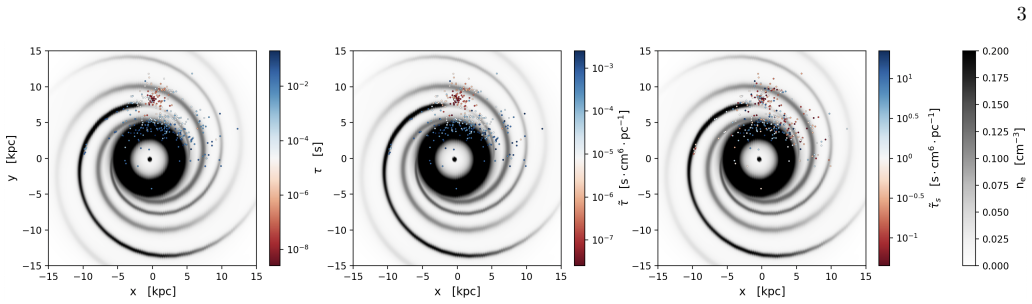
The central claim is that a residual map of pulsar reduced scattering intensity uncovers a new Galactic structure. After fitting $\log\tilde\tau = A|b|^a + B\,d\,H(8.3-d) + 2.66\,H(d-8.3) + C$ and subtracting it from the data, the fluctuation field $\tilde\tau_s$ shows a coherent excess near $l = 37^\circ$–$38.5^\circ$, $b = 0.5^\circ$–$2.5^\circ$, produced by five pulsars. These pulsars lie behind the H II region G37.643+1.193 at $2.3 \pm 0.4$ kpc and behind a neutral-hydrogen filament with kinematic distance $2.39 \pm 0.35$ kpc. The authors identify the combined structure as a superbubble, G38, roughly 50 pc across in the Sagittarius Arm, and they further argue that the Vela supernova remnant, not the whole Gum Nebula, is the dominant local scattering structure.
Load-bearing premise
The whole G38 identification rests on distances for five pulsars that come from electron-density models; if the bubble's own electrons bias those distances, the pulsars could be misplaced and the apparent coherent scattering excess could be an artifact.
Editorial extensions
If this is right
- Pulsar scattering residuals become a new way to find and locate Galactic ISM structures without relying on emission surveys.
- The same subtraction method, applied to larger future datasets, should reveal more superbubbles and H II regions along the inner Galactic plane.
- The Vela result implies that only the supernova remnant part of the Gum Nebula strongly enhances scattering, so models treating the whole region as a scattering screen overpredict its influence.
- The correlation analysis indicates that scattering is dominated by structures smaller than 0.15 kpc, setting a resolution target for future scattering experiments.
Reading between the lines
- An independent check would come from measuring the five pulsars' parallaxes; the method would gain much stronger support if the distances place them all beyond 2.3 kpc.
- The same residual approach could be applied to extragalactic sources with scattering time measurements, such as fast radio bursts, extending the probe to the circumgalactic medium.
- If scattering screens are truly sub-0.15 kpc, then electron-density models that attribute scattering to large superbubbles may be misassigning the physical location of the screens.
Editorial analysis
A structured set of objections, weighed in public.
Referee Report
Summary. The paper analyzes 473 pulsar scattering-time measurements to construct a smooth model of the reduced scattering intensity as a function of Galactic latitude and distance (Eq. 1 and 2). Subtracting this smooth model yields a fluctuation scattering intensity map, from which the authors identify two coherent structures: the Vela supernova remnant within the Gum Nebula, and a newly claimed distant superbubble G38 at 2.3 kpc with a size of ~50 pc, supported by five pulsars with enhanced residuals and by an H II region and HI4PI kinematic distance association. The paper also computes a spatial correlation function of the residuals to argue that pulsar scattering is dominated by structures smaller than 0.15 kpc.
Significance. If the G38 detection is statistically robust, the paper would demonstrate that large pulsar-scattering datasets can discover and locate previously unknown ISM structures, adding a new probe to the multiwavelength ISM toolbox. The Vela SNR detection serves as a useful positive control, since that structure's influence on scattering is independently known. However, the central discovery claim is not yet supported by a significance test or a treatment of distance-systematic errors, so the current significance is prospective rather than established. The paper also makes a quantitative claim about the dominance of small-scale scattering structures that is stronger than the correlation statistic supports.
major comments (5)
- [3.3, Table 2] The G38 detection rests on five pulsars whose log tau_s residuals are enhanced by 0.36 to 2.30 dex relative to the smooth model, but no significance test or false-alarm estimate is reported. The table omits uncertainties on tau, DM, and distance, and the MCMC posteriors for A, a, B, C in Appendix A are not propagated into log tau_s. Because the patch is selected after inspecting the residual maps, the look-elsewhere effect is not accounted for. A null test (for example, bootstrap resampling of the residuals or shuffling the pulsar positions) is required to show that a coherent five-pulsar excess of this magnitude is unlikely to arise by chance. The independent H II region association is suggestive but does not replace this test, since random alignment with one of many cataloged H II regions is not quantified.
- [2.1 and 3.3] The pulsar distances are adopted from DM-based models, and the argument that the five pulsars lie behind G37.643+1.193 uses these same distances. If G38 is a real electron-density enhancement, it contributes to the DM and can bias the YMW16 distance estimates, meaning the pulsars may not actually be placed behind the claimed structure. This is a potential circularity in the localization. The authors should re-derive the pulsar distances with a model that includes G38, or use independent distance estimates (e.g., parallax, HI absorption) for the five pulsars, and verify that the enhanced residuals persist.
- [2.2.1, Eq. (2)] The residual is defined by subtracting the authors' own smooth fit, and both the functional form and the break at 8.3 kpc are chosen from the same data. Consequently, the statement that scattering is dominated by small-scale structures is partly a built-in consequence of the smooth model rather than an independent finding. The robustness of the residual maps should be tested against alternative smooth models (e.g., no break, different break location, or different b-dependence), and the posterior uncertainties of the fitted parameters should be included in the significance of the residuals.
- [2.2.2, Fig. 3] The claim that the results rule out the dominance of pulsar scattering by structures larger than 0.15 kpc is not supported by the presented statistic. The correlation coefficient in the smallest separation bin is only about 0.3, with large scatter, and the bin width is set by the sparsity of close pulsar pairs. The abstract states that the correlation is "dominated by structures smaller than 0.15 kpc," which is a stronger statement than the data warrant. A quantitative comparison of the observed correlation function with simulated scattering screens of different characteristic sizes is needed.
- [3.3, Fig. 5] The interpolated map is produced with the gdatav4 method from only five pulsars in the G38 region after excluding sparse areas. The apparent coherence of the G38 patch may be partly an artifact of the interpolation scheme. The authors should show the raw residual values and the interpolation grid, and quantify how the patch changes if the interpolation method or the exclusion criterion is varied.
minor comments (6)
- [2.2.1] In the text following Eq. (1), the phrase "for a pulsar closer to the Galactic center" is imprecise because d < 8.3 kpc does not imply proximity to the Galactic center for all longitudes; a phrase such as "at smaller distance from the Sun" or "toward the inner Galaxy" would be clearer.
- [2.2.2] The sentence "The current grouping with a bin size of 0.15 kpc already represents the practical limit given the sparsity of close pulsar pairs" is vague; the paper should specify how the bin size was chosen and how many pairs are in the smallest bin.
- [3.3] The interpolation method "gdatav4" is not defined or cited; the authors should either describe the algorithm or provide a reference, and explain why this particular interpolation was chosen.
- [Abstract and 2.2.2] The abstract says the correlation is "dominated by structures smaller than 0.15 kpc," while Section 2.2.2 says the result "rules out the dominance of pulsar scattering by structures larger than 0.15 kpc"; these statements should be reconciled, with the weaker of the two formulations adopted.
- [Table 2] The column headers "log tau" and "log tau_s" should make the units (s cm^6 pc^-1) and the base of the logarithm explicit, and the reference list in the table should follow the journal's formatting style consistently.
- [3.2] The statement that the Vela supernova remnant's influence was "confirmed by H-alpha data" is imprecise; the comparison in Fig. 4 is visual, and the known identification of Vela from prior literature should be clearly separated from any new confirmation presented here.
Circularity Check
Residual-based small-scale dominance claim is partly circular; central G38 detection independently corroborated.
-
fitted input called prediction
[Section 2.2.1-2.2.2 (Eqs. 2-3) and Section 4]
"The fluctuation scattering intensity can be obtained through difference calculations: log ˜τs = log ˜τ −log ˜τg. ... Nevertheless, our result rules out the dominance of pulsar scattering by structures larger than 0.15 kpc."
The residual field log tau_s is defined by subtracting the smooth model log tau_g (Eq. 2), which was fitted to the same 473 pulsars to absorb the large-scale dependence on |b| and d. The correlation-coefficient test is then applied to this residual field, so the conclusion that scattering is dominated by structures smaller than 0.15 kpc is in part a consequence of the subtraction: large-scale trends represented by the fitted smooth model are removed by construction before any correlation is measured. The residual correlation can only reveal structure not already captured by the fitted function, so this particular conclusion is not an independent empirical test of large-scale dominance.
full rationale
The central discovery claim, the distant superbubble G38, is not circular: the five-pulsar residual excess is identified from the residual map, but its existence, distance, and size are corroborated by the independently cataloged H II region G37.643+1.193 (RRL distance 2.3 +/- 0.4 kpc) and by HI4PI kinematics giving 2.39 +/- 0.35 kpc. Those external data are not products of the paper's fitted smooth model, so the G38 detection has independent content despite lacking a formal significance test. Similarly, the Vela SNR association is supported by the known scattering screen distance from Xu et al. (2023) and by the dust/H-alpha morphology. The one substantial circular element is the small-scale-dominance conclusion: the paper fits a smooth function of Galactic latitude and distance, subtracts it to form log tau_s, and then measures the correlation length of that residual. Any large-scale trend absorbed by the fitted smooth model is removed before the correlation is computed, so the claim that structures larger than 0.15 kpc do not dominate is partly predetermined by the subtraction step. The remaining l-dependent structure can still be probed, so the circularity is partial, not total. Self-citations to He & Shi (2024) for the dataset and for the definition of reduced scattering intensity are normal provenance citations to data compiled from the ATNF catalog and are not load-bearing circular arguments.
Assumptions & free parameters
free parameters (4)
- A =
-1.99 (+0.086/-0.093)
- a =
0.156 +/- 0.006
- B =
0.321 +/- 0.002
- C =
-3.79 (+0.092/-0.085)
assumptions (5)
- domain assumption Multiple-frequency scattering times can be standardized with the scaling tau proportional to nu^-4
- domain assumption Pulsar distances from the ATNF catalogue and YMW16 electron density model are sufficiently accurate for a 3D map
- domain assumption The smooth model in Eq. (1) adequately describes the large-scale Galactic scattering distribution, so residuals represent discrete structures
- ad hoc to paper The break at d = 8.3 kpc is the appropriate location for the flattening of scattering strength
- domain assumption Kinematic distances from the Reid et al. Galactic rotation model and RRL distances place G38 at 2.3 kpc
invented entities (1)
-
G38 superbubble at 2.3 kpc, roughly 50 pc across
independent evidence
Cite this review
Pith. "Pith review of Pulsar scattering as a probe for structures in the interstellar medium." pith.science (2026). https://pith.science/paper/DHB35DZS
@misc{pith2026250209158,
  author       = {Pith},
  title        = {Pith review of: Pulsar scattering as a probe for structures in the interstellar medium},
  year         = {2026},
  howpublished = {\url{https://pith.science/paper/DHB35DZS}},
  note         = {Machine review of arXiv:2502.09158}
}
read the original abstract
Due to the inhomogeneity of electron number density, radio waves emitted by pulsars undergo scattering as they pass through the interstellar medium (ISM). However, a connection between large-scale pulsar scattering data and the structure of the Galactic ISM has yet to be established. In this paper, we explore the capability of pulsar scattering time data in discovering structures in the ISM. Using a large dataset of scattering time measurements for 473 pulsars, we fit the pulsar reduced scattering intensity as a function of Galactic latitude and distance, constructing a smooth model of the Galactic pulsar scattering distribution. By comparing this smooth distribution with observational data, we identify two ISM structures responsible for pulsar scattering, one is associated with the Vela supernova remnant region within the Gum Nebula, while the other is a newly discovered structure -- a distant superbubble, G38, located at a distance of 2.3 kpc with a size of ~50 pc. Analysis of the correlation coefficient of the pulsar scattering distribution shows that the correlation is dominated by structures smaller than 0.15 kpc -- the closest separation approachable by the current dataset. As measurements of the pulsar scattering time continue to increase in the future, they can potentially become an independent tool for exploring structures in the ISM.
Figures


Figures from the paper (3 more)


Forward citations
Cited by 1 Pith paper
-
FAST Pulsar Database: II. Scattering profiles of 149 Pulsars
Pulse-broadening timescales and scattering spectral indices are measured for 122 pulsars from FAST observations, 93 of them for the first time.
Reference graph
Works this paper leans on
-
[1]
Alexander, J. K., Brandt, J. C., Maran, S. P., & Stecher, T. P. 1971, ApJ, 167, 487, doi: 10.1086/151045
-
[2]
Anderson, L. D., Bania, T. M., Balser, D. S., et al. 2014, ApJS, 212, 1, doi: 10.1088/0067-0049/212/1/1
-
[3]
Armstrong, J. W. 1984, Nature, 307, 527, doi: 10.1038/307527a0
-
[4]
Backer, D. C. 1974, ApJ, 190, 667, doi: 10.1086/152924
-
[5]
H., van Lieshout, R., & Pen, U.-L
Baker, D., Brisken, W., van Kerkwijk, M. H., van Lieshout, R., & Pen, U.-L. 2023, MNRAS, 525, 211, doi: 10.1093/mnras/stad2318
-
[6]
Beuermann, K. P. 1973, Ap&SS, 20, 27, doi: 10.1007/BF00645581
-
[7]
Lorimer, D. R. 2004, ApJ, 605, 759, doi: 10.1086/382680
doi:10.1086/382680 2004
-
[8]
Brisken, W. F., Macquart, J. P., Gao, J. J., et al. 2010, ApJ, 708, 232, doi: 10.1088/0004-637X/708/1/232
Show all 65 references
-
[9]
C., Kondo, J., & McCluskey, G
Bruhweiler, F. C., Kondo, J., & McCluskey, G. E., J. 1979, ApJL, 229, L39, doi: 10.1086/182926
1979 doi
-
[10]
Cane, H. V. 1973, PASA, 2, 197, doi: 10.1017/S1323358000013540
1973 doi
-
[11]
M., Bhat, N
Cordes, J. M., Bhat, N. D. R., Hankins, T. H., McLaughlin, M. A., & Kern, J. 2004, ApJ, 612, 375, doi: 10.1086/422495
2004 doi
-
[12]
M., & Lazio, T
Cordes, J. M., & Lazio, T. J. W. 2002, arXiv e-prints, astro, doi: 10.48550/arXiv.astro-ph/0207156 —. 2003, arXiv e-prints, astro, doi: 10.48550/arXiv.astro-ph/0301598 12 Figure B1. Distribution of pulsar fluctuation scattering intensity ( ˜τs) in the Galaxy in comparison with...
-
[13]
M., Rickett, B
Cordes, J. M., Rickett, B. J., Stinebring, D. R., & Coles, W. A. 2006, ApJ, 637, 346, doi: 10.1086/498332
2006 doi
-
[14]
1969, Nature, 221, 729, doi: 10.1038/221729b0
Davidson, K., & Terzian, Y. 1969, Nature, 221, 729, doi: 10.1038/221729b0
1969 doi
-
[15]
H., & Topasna, G
Dennison, B., Simonetti, J. H., & Topasna, G. A. 1999, in American Astronomical Society Meeting Abstracts, Vol. 195, American Astronomical Society Meeting Abstracts, 53.09
1999
-
[16]
Anantharamaiah, K. R. 1992, MNRAS, 258, 19P, doi: 10.1093/mnras/258.1.19P
1992 doi
-
[17]
R., Stewart, R
Duncan, A. R., Stewart, R. T., Haynes, R. F., & Jones, K. L. 1996, MNRAS, 280, 252, doi: 10.1093/mnras/280.1.252
1996 doi
-
[18]
1998, in IAU Colloq
Egger, R. 1998, in IAU Colloq. 166: The Local Bubble and Beyond, ed. D. Breitschwerdt, M. J. Freyberg, & J. Truemper, Vol. 506, 287–296, doi: 10.1007/BFb0104735
1998 doi
-
[19]
Ellis, G. R. A. 1972, PASA, 2, 158, doi: 10.1017/S1323358000013412
1972 doi
-
[20]
Finkbeiner, D. P. 2003, ApJS, 146, 407, doi: 10.1086/374411 13
2003 doi
-
[21]
2001, PASP, 113, 1326, doi: 10.1086/323969
Buren, D. 2001, PASP, 113, 1326, doi: 10.1086/323969
2001 doi
-
[22]
Gum, C. S. 1952, The Observatory, 72, 151
1952
-
[23]
L., Wang, C., Wang, P
Han, J. L., Wang, C., Wang, P. F., et al. 2021, Research in Astronomy and Astrophysics, 21, 107, doi: 10.1088/1674-4527/21/5/107
2021 doi
-
[24]
2024, MNRAS, 527, 5183, doi: 10.1093/mnras/stad3561 HI4PI Collaboration, Ben Bekhti, N., Fl¨ oer, L., et al
He, Q., & Shi, X. 2024, MNRAS, 527, 5183, doi: 10.1093/mnras/stad3561 HI4PI Collaboration, Ben Bekhti, N., Fl¨ oer, L., et al. 2016, A&A, 594, A116, doi: 10.1051/0004-6361/201629178
2024 doi
-
[25]
S., Stinebring, D
Hill, A. S., Stinebring, D. R., Asplund, C. T., et al. 2005, ApJL, 619, L171, doi: 10.1086/428347
2005 doi
-
[26]
S., Stinebring, D
Hill, A. S., Stinebring, D. R., Barnor, H. A., Berwick, D. E., & Webber, A. B. 2003, ApJ, 599, 457, doi: 10.1086/379191
2003 doi
-
[27]
2022, Science China Physics, Mechanics, and Astronomy, 65, 129703, doi: 10.1007/s11433-022-2039-8
Hou, L., Han, J., Hong, T., Gao, X., & Wang, C. 2022, Science China Physics, Mechanics, and Astronomy, 65, 129703, doi: 10.1007/s11433-022-2039-8
2022 doi
-
[28]
1998, MNRAS, 297, 108, doi: 10.1046/j.1365-8711.1998.01461.x
Johnston, S., Nicastro, L., & Koribalski, B. 1998, MNRAS, 297, 108, doi: 10.1046/j.1365-8711.1998.01461.x
1998
-
[29]
Kalberla, P. M. W., McClure-Griffiths, N. M., Pisano, D. J., et al. 2010, A&A, 521, A17, doi: 10.1051/0004-6361/200913979
2010 doi
-
[30]
Kerp, J., Kalberla, P. M. W., Ben Bekhti, N., et al. 2016, A&A, 589, A120, doi: 10.1051/0004-6361/201526395
2016 doi
-
[31]
L., et al
Lallement, R., Babusiaux, C., Vergely, J. L., et al. 2019, A&A, 625, A135, doi: 10.1051/0004-6361/201834695
2019 doi
- [32]
-
[33]
1970, Ap&SS, 6, 287, doi: 10.1007/BF00651229
Lerche, I. 1970, Ap&SS, 6, 287, doi: 10.1007/BF00651229
1970 doi
-
[34]
G., Manchester, R
Lyne, A. G., Manchester, R. N., & Taylor, J. H. 1985, MNRAS, 213, 613, doi: 10.1093/mnras/213.3.613
1985 doi
-
[35]
N., Hobbs, G
Manchester, R. N., Hobbs, G. B., Teoh, A., & Hobbs, M. 2005, AJ, 129, 1993, doi: 10.1086/428488
2005 doi
- [36]
- [37]
-
[38]
W., Zhu, H., Stinebring, D
McKee, J. W., Zhu, H., Stinebring, D. R., & Cordes, J. M. 2022, ApJ, 927, 99, doi: 10.3847/1538-4357/ac460b
2022 doi
-
[39]
2001, A&A, 370, 586, doi: 10.1051/0004-6361:20010274
Mitra, D., & Ramachandran, R. 2001, A&A, 370, 586, doi: 10.1051/0004-6361:20010274
2001 doi
-
[40]
R., Anantharamaiah, K
Mohan, N. R., Anantharamaiah, K. R., & Goss, W. M. 2002, ApJ, 574, 701, doi: 10.1086/341004
2002 doi
-
[41]
1983, MNRAS, 202, 495, doi: 10.1093/mnras/202.2.495
Morini, M. 1983, MNRAS, 202, 495, doi: 10.1093/mnras/202.2.495
1983 doi
-
[42]
2023, in AGU Fall Meeting Abstracts, Vol
Ocker, S., Cordes, J., & Chatterjee, S. 2023, in AGU Fall Meeting Abstracts, Vol. 2023, SH43D–319
2023
-
[43]
K., Anderson, L
Ocker, S. K., Anderson, L. D., Lazio, T. J. W., Cordes, J. M., & Ravi, V. 2024a, ApJ, 974, 10, doi: 10.3847/1538-4357/ad6a51
-
[44]
K., Cordes, J
Ocker, S. K., Cordes, J. M., Chatterjee, S., et al. 2024b, MNRAS, 527, 7568, doi: 10.1093/mnras/stad3683
-
[45]
S., Karastergiou, A., Posselt, B., et al
Oswald, L. S., Karastergiou, A., Posselt, B., et al. 2021, MNRAS, 504, 1115, doi: 10.1093/mnras/stab980
2021 doi
-
[46]
2014, MNRAS, 442, 3338, doi: 10.1093/mnras/stu1020 Planck Collaboration, Aghanim, N., Akrami, Y., et al
Pen, U.-L., & Levin, Y. 2014, MNRAS, 442, 3338, doi: 10.1093/mnras/stu1020 Planck Collaboration, Aghanim, N., Akrami, Y., et al. 2020a, A&A, 641, A1, doi: 10.1051/0004-6361/201833880 Planck Collaboration, Akrami, Y., Arg¨ ueso, F., et al. 2020b, A&A, 641, A2, doi: 10.1051/0004...
2014 doi
-
[47]
Prentice, A. J. R., & Ter Haar, D. 1969, Nature, 222, 964, doi: 10.1038/222964a0
1969 doi
-
[48]
T., Balser, D
Quireza, C., Rood, R. T., Balser, D. S., & Bania, T. M. 2006, ApJS, 165, 338, doi: 10.1086/503901
2006 doi
-
[49]
J., Dame, T
Reid, M. J., Dame, T. M., Menten, K. M., & Brunthaler, A. 2016, ApJ, 823, 77, doi: 10.3847/0004-637X/823/2/77
2016 doi
-
[50]
J., Menten, K
Reid, M. J., Menten, K. M., Brunthaler, A., et al. 2014, ApJ, 783, 130, doi: 10.1088/0004-637X/783/2/130 —. 2019, ApJ, 885, 131, doi: 10.3847/1538-4357/ab4a11
2014 doi
- [51]
-
[52]
Rickett, B. J. 1970, MNRAS, 150, 67, doi: 10.1093/mnras/150.1.67 —. 1975, ApJ, 197, 185, doi: 10.1086/153501
1970 doi
-
[53]
Scheuer, P. A. G. 1968, Nature, 218, 920, doi: 10.1038/218920a0
1968 doi
-
[54]
2021, MNRAS, 508, 125, doi: 10.1093/mnras/stab2522
Shi, X. 2021, MNRAS, 508, 125, doi: 10.1093/mnras/stab2522
2021 doi
-
[55]
Spangler, S. R. 1991, ApJ, 376, 540, doi: 10.1086/170303
1991 doi
-
[56]
R., McLaughlin, M
Stinebring, D. R., McLaughlin, M. A., Cordes, J. M., et al. 2001, ApJL, 549, L97, doi: 10.1086/319133
2001 doi
-
[57]
R., Smirnova, T
Stinebring, D. R., Smirnova, T. V., Hankins, T. H., et al. 2000, ApJ, 539, 300, doi: 10.1086/309201
2000 doi
- [58]
-
[59]
Sutton, J. M. 1971, MNRAS, 155, 51, doi: 10.1093/mnras/155.1.51
1971 doi
- [60]
-
[61]
A., Melrose, D
Walker, M. A., Melrose, D. B., Stinebring, D. R., & Zhang, C. M. 2004, MNRAS, 354, 43, doi: 10.1111/j.1365-2966.2004.08159.x
2004
-
[62]
A., Tuntsov, A
Walker, M. A., Tuntsov, A. V., Bignall, H., et al. 2017, ApJ, 843, 15, doi: 10.3847/1538-4357/aa705c 14
2017 doi
-
[63]
2023, MNRAS, 526, 1246, doi: 10.1093/mnras/stad2837
Xu, Y., Shi, X., Lee, K., et al. 2023, MNRAS, 526, 1246, doi: 10.1093/mnras/stad2837
2023 doi
-
[64]
N., et al
Yao, J., Zhu, W., Manchester, R. N., et al. 2021, Nature Astronomy, 5, 788, doi: 10.1038/s41550-021-01360-w
2021 doi
-
[65]
M., Manchester, R
Yao, J. M., Manchester, R. N., & Wang, N. 2017, ApJ, 835, 29, doi: 10.3847/1538-4357/835/1/29
2017 doi
Reviewed August 7, 2026 · model on record in the stance chip above.
Discussion (0). Sign in to comment.