REVIEW 3 major objections 4 minor 23 references
Helmholtz-Hodge decompositions in the nonlocal framework. Well-posedness analysis and applications
T0 review · 3 major / 4 minor · reviewed 2026-08-14 · deepseek-v4-flash
Pith's one-line read Every two-point vector field in the nonlocal framework decomposes orthogonally into a nonlocal gradient, a nonlocal curl, and a residual in the intersection of both nonlocal kernels, with uniqueness under volume Dirichlet or Neumann…
desk verdict A worthwhile but currently under-proved nonlocal Hodge decomposition: the existence of the vector potential w rests on a circular coercivity argument and a misidentified kernel. read the letter →
The pith
A machine-rendered reading of the paper's core claim, the machinery that carries it, and where it could break.
The reading
What carries the argument
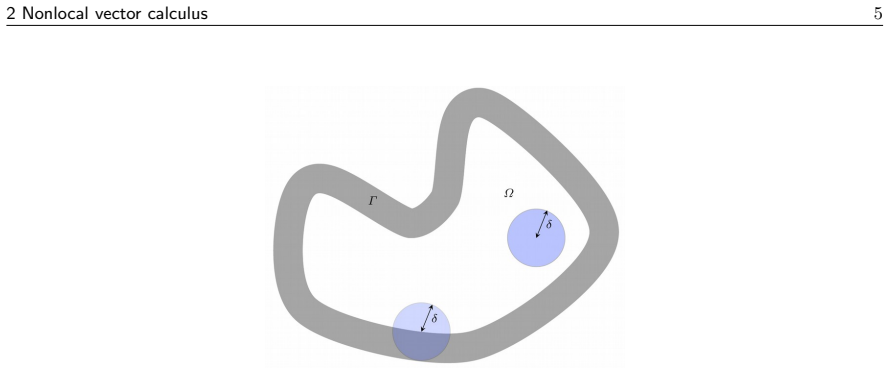
The engine is the nonlocal vector calculus built on an antisymmetric kernel $\alpha(x,y)$: the nonlocal divergence $D_\alpha$, its negative adjoint $G_\alpha$, nonlocal curl $C_\alpha$ and adjoint $C_\alpha^*$, together with the nonlocal boundary $\Gamma=\{y\notin\Omega: \alpha(x,y)\neq0\}$ and volume constraints on $\Gamma$. The decomposition is driven by two solvable equations: the nonlocal Poisson equation $L_\alpha\phi=D_\alpha u$ for the potential, and the nonlocal curl-curl equation $C_\alpha C_\alpha^* w=C_\alpha u$ for the vector potential. The proof of existence for $w$ uses the bilinear form $B(w,v)=\langle C_\alpha^*w,C_\alpha^*v\rangle$ and Lax-Milgram on the quotient $L^2(\mathbb{R}^3)/\operatorname{Ker}(C_\alpha^*)$, with $\operatorname{Ker}(C_\alpha^*)=\operatorname{span}\{\alpha\}$. The paper also uses the identity $C_\alpha C_\alpha^* w = D_{\alpha,2}D_{\alpha,2}^* w - D_{\alpha,0}D_{\alpha,0}^* w$, the nonlocal counterpart of the vector Laplacian identity, and the equivalence of the $w$-equation with a peridynamic equilibrium system whose micromodulus has $F_0=\rho$.
What would settle it
Compute, for a concrete antisymmetric kernel like $\alpha(x,y)=\frac{y-x}{|y-x|}\mathbf{1}_{B_\delta(x)}$ and a domain $\Omega$, the quantity $\inf_{w\notin \operatorname{Ker} C_\alpha^*} \frac{\langle C_\alpha^*w,C_\alpha^*w\rangle}{\|w\|^2_{L^2/\operatorname{Ker} C_\alpha^*}}$; if this infimum is zero, the Lax-Milgram step in Theorem 3.1 only produces a solution in an abstract completion, and the claimed $w\in L^2(\Omega)$ can fail for some $u$.
Extended reading notes
Core claim
On the paper's own terms, the discovery is a pair of existence and uniqueness theorems for a three-term orthogonal decomposition of two-point vector fields using the nonlocal operators $D_\alpha$, $G_\alpha=-D_\alpha^*$, $C_\alpha$, and $C_\alpha^*$. Theorem 3.1 states that for every $u\in L^2(\Omega\times\Omega)$ there exist $\phi\in L^2(\Omega)$ and $w\in L^2(\Omega)$ with $u=G_\alpha\phi+C_\alpha^*w+h$ and $h\in \operatorname{Ker}(D_\alpha)\cap\operatorname{Ker}(C_\alpha)$, that the three terms are mutually orthogonal in $L^2(\Omega\times\Omega)$, and that $\phi$ is unique under the volume Dirichlet condition $\phi=0$ on $\Gamma$, or unique up to a constant under the volume Neumann condition. Theorem 3.2 obtains uniqueness of all three components when the nonlocal normal flux of the gradient part and the nonlocal tangential flux of the curl part match those of $u$. The paper also shows that the scaled nonlocal operator $\kappa C_\alpha C_\alpha^* w$ converges as the horizon $\delta\to0$ to $\nabla\times(\nabla\times w)-\Delta w$, so the classical curl-curl operator is recovered only when $w$ is harmonic; and it connects the equation for $w$ to the linearized bond-based peridynamic system with $F_0=\rho$, thereby extending known well-posedness results.
Load-bearing premise
The proof that the curl-like component $w$ actually exists as a square-integrable function depends on a coercivity estimate that the paper obtains only by defining the norm through the bilinear form, so the argument may produce only an abstract generalized object rather than the claimed function.
Editorial extensions
If this is right
- If Theorem 3.1 holds as stated, nonlocal models inherit an orthogonal decomposition tool: any two-point field can be split into a curl-free part, a divergence-free part, and a nonlocal harmonic residual, which is exactly the structure used to analyze flows and stresses in classical continuum mechanics.
- The volume-constrained uniqueness results provide boundary conditions under which inverse or identification problems for nonlocal models are well posed, since the decomposition components are determined by the data.
- The convergence-to-local analysis implies that the nonlocal curl-curl operator does not reduce to the classical one uniformly; applications that need the classical limit must either restrict to harmonic vector potentials or modify the operator.
- The link to peridynamics with $F_0=\rho$ means the existence theory for the $w$-equation covers a regime not handled by earlier well-posedness results, so linearized bond-based peridynamic problems in that regime are well posed.
Reading between the lines
- If the coercivity gap in Step 2 of Theorem 3.1 is repaired, the decomposition becomes a constructive recipe: compute $\phi$ from a nonlocal Poisson problem, compute $w$ from a nonlocal curl-curl problem, and read off $h$ by subtraction; this suggests a straightforward finite-element or meshfree implementation.
- The family of two-point extensions of a one-point function, such as $u(x,y)=v(x)\psi(x-y)$, could yield multiple decompositions of the same field and may be useful for multiscale analysis or for choosing a representation matched to the interaction kernel.
- The harmonic-like residual $h(x,y)=y-x$ shows that nonlocal kernels can support nontrivial harmonics that vanish from local intuition; understanding their span could give a nonlocal analogue of cohomology for interaction kernels.
- A numerical check of the infimum of $B(w,w)/\|w\|^2$ over quotient space for specific kernels would settle whether the claimed $L^2$ existence is genuine or only a generalized-solution statement.
Signed reviews
Editorial analysis
A structured set of objections, weighed in public.
Referee Report
Summary. The paper proposes nonlocal analogues of Helmholtz–Hodge decompositions for two-point vector fields u in L2(Ω×Ω). The main results, Theorem 3.1 and Theorem 3.2, claim that u can be written as u = Gαφ + C*αw + h, with φ and w in L2(Ω) and h in Ker(Dα) ∩ Ker(Cα), under Dirichlet or Neumann volume constraints, or under nonlocal normal/tangential flux conditions. The proof strategy is the classical two-step one: first solve a nonlocal Poisson problem Lαφ = Dαu, then solve Cα(C*αw) = Cαu by a Lax–Milgram argument, and define h as the remainder. The paper also contains a worked example (Section 3.2), a δ→0 convergence analysis for Cα(C*α) (Section 3.3), and a discussion of the connection to peridynamic well-posedness (Section 3.4).
Significance. The topic is timely: a nonlocal Hodge decomposition with boundary conditions would be a useful tool in peridynamics and nonlocal calculus, and the paper contains a number of useful elements, including a concrete two-point example, a local-limit computation, and a connection to existing well-posedness results. The paper also makes a serious attempt to treat nonlocal boundary conditions. However, the central existence proof is not rigorous: the coercivity of the bilinear form B is asserted by defining the norm through B itself, which is circular and does not yield a solution in L2. In addition, the identification of the kernel of C*α is incorrect, and Proposition 3.1 contains a logical error. These issues block the claimed decomposition as stated. The underlying idea may be salvageable by reformulating the theorem in terms of an abstract energy space or by proving a genuine coercivity estimate, but that work is not present in the manuscript.
major comments (3)
- [Section 3.1, Step 2 (around Eq. (19))] The existence of w in L2(Ω) is not proved. The authors define Vα = L2(Rn)/Ker(C*α) and then assert coercivity of B(w,w) := ⟨C*αw, C*αw⟩ by setting ||w||_*² := B(w,w). This makes coercivity true by definition, but Lax–Milgram then only produces a solution in the abstract completion of Vα with respect to the norm ||·||_*, not an element of L2(Rn) or L2(Ω). To obtain w ∈ L2(Ω), one needs a genuine lower bound B(w,w) ≥ c dist(w, Ker C*α)²_{L2}, equivalently closed range of C*α; no such estimate is given. Moreover, Eq. (18) pairs elements of the quotient Vα with the L2 inner product, which is not well-defined for equivalence classes; one would need to work with a concrete complement of Ker(C*α). Because of this gap, equation (17) is not established for arbitrary u, and the residual h = u - Gαφ - C*αw is not shown to lie in L2(Ω×Ω), let alone in Ker(Dα) ∩ Ker(Cα). Theorem 3.2, whose proof invokes 'similar arguments as in Theorem 3.1', inherits the same gap.
- [Section 3.1, Step 2, kernel of C*α] The statement 'KC*α = span{α}' is not correct, and it is also dimensionally inconsistent: α(x,y) is a two-point vector, while KC*α is claimed to be a subspace of one-point functions. For the prototype kernel α(x,y) = (y-x)/|y-x| χ_{Bδ(x)}, every affine function w(x) = λx + b with λ ∈ R and b ∈ R3 satisfies C*αw(x,y) = α(x,y) × (w(y)-w(x)) = 0 on Ω×Ω. Thus the kernel contains at least the four-dimensional space of affine functions, not 'span{α}'. This matters because the quotient space Vα and the claimed uniqueness of w both depend on a correct description of Ker(C*α).
- [Proposition 3.1] The proof of Proposition 3.1 does not establish the stated equivalence. From ker(Aα) ⊂ ker(C*α) one obtains Rng(Aα) ⊃ Rng(Cα), which is the sufficiency direction: every v = Cαf lies in the range of Aα. The necessity direction, namely that every v for which Aαw = v is well-posed must be of the form Cαf, does not follow from the displayed inclusion. The proposition is also false as stated: if Aα is the identity operator, then Aαw = v is well-posed for every v ∈ L2(Ω), but not every v is in the range of Cα (which is typically a proper subspace). This proposition is not used in the proof of Theorem 3.1, but it is a claimed result and should be corrected or removed.
minor comments (4)
- [Section 2, Eq. (13)] The condition 'α(x,y) ≥ 0' is not meaningful for a vector-valued kernel; presumably the intended condition is |α| ≥ 0 on Bδ(x), or a componentwise assumption with a sign convention.
- [Section 3.3, Eq. (7) and surrounding text] The sentence '∇ × (∇ × r) = ∇(∇ · r) + ∇²r, where the latter represents the vector Laplacian' contains a sign error: with the standard vector Laplacian Δr = ∇(∇·r) − ∇×(∇×r), the displayed identity should be ∇×(∇×r) = ∇(∇·r) − Δr.
- [Section 3.1, Step 2] The sentence 'its rank is equal to the one of KC*α = span{α}' is unclear; 'rank' of an operator and a kernel are different objects, and the equality conflates a two-point kernel with a space of one-point functions. This should be rewritten with precise functional-analytic notation.
- [Section 3.4, Remark 3.2] The claim that 'Theorems 3.1 and 3.2 lift previous restrictions mentioned in [21]' is not substantiated: given the gap in Theorem 3.1, no well-posedness conclusion is available, and the remark should be revised to state only what follows from the corrected proof.
Circularity Check
Existence of w in Theorem 3.1 rests on coercivity by definition: ||w||_*^2 := B(w,w), so Lax-Milgram yields only a completion element, not a function in L2.
-
self definitional
[Section 3.1, proof of Theorem 3.1, Step 2 (around Eq. (19))]
"Then on this function spaceVα, we have the coercivity of B: B(w, w) =⟨(C∗αw), (C∗αw)⟩L2(Rn×Rn)≥‖ w‖2∗ with‖w‖2∗ :=B(w, w)."
Coercivity is asserted by defining the norm through the bilinear form itself: ||w||_*^2 := B(w,w). The inequality B(w,w) ≥ ||w||_*^2 is then an equality by definition, not a genuine lower bound. Lax-Milgram applied on Vα = L2(Rn)/Ker(C*α) with this norm only produces a solution in the abstract completion of Vα with respect to B, not necessarily a function in L2(Ω). To obtain w ∈ L2(Ω), one needs the nontrivial estimate B(w,w) ≥ c dist(w, Ker C*α)^2_{L2}, equivalently closed range of C*α, which is not proved. Thus the claimed L2 existence of w reduces to the missing coercivity estimate. Moreover, the asserted identification Ker(C*α) = span{α} is inconsistent with constant and affine functions being in the kernel, so the quotient space is not correctly characterized.
full rationale
The paper's main decomposition theorem is otherwise largely self-contained: it builds on the nonlocal vector calculus of Du, Gunzburger, Lehoucq and Zhou, whose duality relations are cited as external prior results with no author overlap that would create a self-citation chain. There are no fitted parameters or predictions; the decomposition is an operator-level construction. However, the proof of Theorem 3.1 contains a load-bearing circular step. In Step 2, the bilinear form B(w,w) = ||C*_α w||^2 is declared coercive on Vα by setting ||w||_*^2 := B(w,w). This makes coercivity true by definition, but Lax-Milgram then yields only an element of the B-completion of the quotient space, not an L2 function. The paper itself appears to acknowledge the missing external support in Remark 3.2, where it states that the well-posedness results of [18] cannot be used to obtain unique solutions to (17). Since the central claim that w ∈ L2(Ω) exists depends on an unproved equivalence between the B-norm and the L2 quotient norm, the derivation is partially circular: the output regularity is effectively assumed through the definition of the norm. The kernel identification Ker(C*_α) = span{α} is also suspect, reinforcing that the quotient construction does not deliver the claimed L2 solution. No other steps exhibit circularity: the convergence analysis in Section 3.3 is an honest limiting computation, and the connections to peridynamics in Section 3.4 explicitly avoid importing uniqueness results. Overall score 6 reflects that the central existence proof reduces by construction at one essential point, while the rest of the paper has independent mathematical content.
Assumptions & free parameters
assumptions (3)
- domain assumption Nonlocal operators defined as in Du et al. [8] with antisymmetric kernel α ∈ L², and boundary operators N_α, T_α satisfy the nonlocal Gauss theorem (11) and integration by parts (12).
- ad hoc to paper The bilinear form B(w,v) = ⟨C*_α w, C*_α v⟩ is coercive on the quotient space L²(R³)/Ker(C*_α) with respect to a norm equivalent to the L² quotient norm, so that Lax-Milgram yields a solution w in L²(R³).
- ad hoc to paper ker(C_α(C*_α)) ⊂ ker(C*_α) for the specific operator, or equivalently that the range of C_α(C*_α) equals the range of C_α.
Cite this review
Pith. "Pith review of Helmholtz-Hodge decompositions in the nonlocal framework. Well-posedness analysis and applications." pith.science (2026). https://pith.science/paper/DI5U5NIC
@misc{pith2026190808624,
  author       = {Pith},
  title        = {Pith review of: Helmholtz-Hodge decompositions in the nonlocal framework. Well-posedness analysis and applications},
  year         = {2026},
  howpublished = {\url{https://pith.science/paper/DI5U5NIC}},
  note         = {Machine review of arXiv:1908.08624}
}
read the original abstract
Nonlocal operators that have appeared in a variety of physical models satisfy identities and enjoy a range of properties similar to their classical counterparts. In this paper we obtain Helmholtz-Hodge type decompositions for two-point vector fields in three components that have zero nonlocal curls, zero nonlocal divergence, and a third component which is (nonlocally) curl-free and divergence-free. The results obtained incorporate different nonlocal boundary conditions, thus being applicable in a variety of settings.
Figures
Reference graph
Works this paper leans on
-
[18]
The bond-based peridynamic system with Dirichlet-type volume constraint
Tadele Mengesha and Qiang Du. The bond-based peridynamic system with Dirichlet-type volume constraint. Proc. Roy. Soc. Edinburgh Sect. A , 144(1):161–186, 2014
work page 2014
-
[1]
https://mcaim.math.lsa.umich.edu/events/women-in-mathematics-of-materials-workshop/
WIMM workshop, university of michigan, 2018. https://mcaim.math.lsa.umich.edu/events/women-in-mathematics-of-materials-workshop/
work page 2018
-
[2]
B. Aksoylu and T. Mengesha. Results on non-local boundary-value problems. Numerical Func- tional Analysis and Optimization , 31:1301–1317, 2010
work page 2010
-
[3]
The Helmholtz-Hodge decomposition: a survey
Harsh Bhatia, Gregory Norgard, Valerio Pascucci, and Peer-Timo Bremer. The Helmholtz-Hodge decomposition: a survey. IEEE Transactions on visualization and computer graphics, 19(8):1386– 1404, 2013
work page 2013
-
[4]
Entropy dissipation of Fokker-Planck equations on graphs
Shui-Nee Chow, Wuchen Li, and Haomin Zhou. Entropy dissipation of Fokker-Planck equations on graphs. arXiv preprint arXiv:1701.04841 , 2017
arXiv 2017
-
[5]
M. D’Elia and M. Gunzburger. The fractional laplacian operator on bounded domains as a special case of the nonlocal diffusion operator. Computers and Mathematics with applications , 66:1245–1260, 2013
work page 2013
-
[6]
Q. Du, M. Gunzburger, R. Lehoucq, and K. Zhou. Analysis and approximation of nonlocal diffusion problems with volume constraints. SIAM Review, 54(4):667–696, 2012
work page 2012
-
[7]
Q. Du, M. Gunzburger, R. Lehoucq, and K. Zhou. Analysis of the volume-constrained peridy- namic navier equation of linear elasticity. Journal of Elasticity , 113:193–217, 2013
work page 2013
Show all 23 references
-
[8]
Q. Du, M. Gunzburger, R. B. Lehoucq, and K. Zhou. A nonlocal vector calculus, nonlocal volume–constrained problems, and nonlocal balance laws. Mathematical Models and Methods in Applied Sciences, 23(03):493–540, 2013
2013
-
[9]
Du and K
Q. Du and K. Zhou. Mathematical analysis for the peridynamic non-local continuum theory. ESAIM: Mathematical Modelling and Numerical Analysis , 45:217–234, 2011
2011
-
[10]
Emmrich and O
E. Emmrich and O. Weckner. On the well-posedness of the linear peridynamic model and its convergence towards the navier equation of linear elasticity. Communications in Mathematical Sciences, 5:851–864, 2007
2007
-
[11]
Emmrich and O
E. Emmrich and O. Weckner. The peridynamic equation and its spatial discretization. Mathe- matical Modelling and Analysis , 12:17–27, 2007
2007
-
[12]
Differentiability and integrability properties for solutions to nonlocal equations
Mikil Foss and Petronela Radu. Differentiability and integrability properties for solutions to nonlocal equations. In New Trends in Differential Equations, Control Theory and Optimization: Proceedings of the 8th Congress of Romanian Mathematicians , pages 105–119. World Scientific, 2016
2016
-
[13]
Foss and Petronela Radu
Mikil D. Foss and Petronela Radu. Bridging Local and Nonlocal Models: Convergence and Reg- ularity, pages 1243–1263. Springer International Publishing, Cham, 2019. 4 Acknowledgements. 17
2019
-
[14]
Foss, Petronela Radu, and Cory Wright
Mikil D. Foss, Petronela Radu, and Cory Wright. Existence and regularity of minimizers for nonlocal energy functionals. Differential Integral Equations, 31(11/12):807–832, 11 2018
2018
-
[15]
Gunzburger and R
M. Gunzburger and R. B. Lehoucq. A nonlocal vector calculus with application to nonlocal boundary value problems. Multiscale Modeling and Simulation , 8:1581–1598, 2010
2010
-
[16]
Lee and Q
H. Lee and Q. Du. Nonlocal gradient operators with a nonspherical interaction neighborhood and their applications. Technical Report arXiv:1903.06025, ArXiV, 2019
1903 arXiv
-
[17]
Parks M.D
M.L. Parks M.D. Gunzburger, P. Seleson and R.B. Lehoucq. Peridynamics as an upscaling of molecular dynamics. Multiscale Modeling and Simulation , (8):204–227, 2009
2009
-
[19]
A nonlocal biharmonic operator and its connection with the classical analogue
Petronela Radu, Daniel Toundykov, and Jeremy Trageser. A nonlocal biharmonic operator and its connection with the classical analogue. Archive for Rational Mechanics and Analysis, 223(2):845– 880, 2017
2017
-
[20]
A doubly nonlocal Laplace operator and its connection to the classical Laplacian
Petronela Radu and Kelsey Wells. A doubly nonlocal Laplace operator and its connection to the classical Laplacian. J. Integral Equations Applications , 2019. Advance publication
2019
-
[21]
S.A. Silling. Reformulation of elasticity theory for discontinuities and long-range forces. Journal of the Mechanics and Physics of Solids , 48:175–209, 2000
2000
-
[22]
Peridynamic theory of solid mechanics
SA Silling and RB Lehoucq. Peridynamic theory of solid mechanics. Advances in applied me- chanics, 44:73–168, 2010
2010
-
[23]
Zhou and Q
K. Zhou and Q. Du. Mathematical and numerical analysis of linear peridynamic models with non-local boundary. SIAM Journal on Numerical Analysis , 48:1759–1780, 2010
2010
Reviewed August 14, 2026 · model on record in the stance chip above.
Discussion (0). Continue with ORCID to comment.