REVIEW 3 major objections 3 minor 108 references
Physically-Feasible Reactive Synthesis for Terrain-Adaptive Locomotion
T0 review · 3 major / 3 minor · reviewed 2026-08-04 · deepseek-v4-flash
Pith's one-line read The paper claims that a legged robot can navigate unforeseen terrain with formal safety by making every symbolic locomotion transition pass a mixed-integer convex feasibility check before the strategy advances.
desk verdict Solid deployment extension of the authors' own IROS paper, with real hardware evidence and a useful online pipeline—but the 'physically feasible' certificate is only as strong as the simplified convex model, and the paper itself admits NMPC does the compensating. read the letter →
The pith
A machine-rendered reading of the paper's core claim, the machinery that carries it, and where it could break.
The reading
What carries the argument
The central objects are the 'skill' and its feasibility certificate. A skill is a symbolic transition with preconditions and postconditions, tied to a locomotion gait (contact sequence and timing). The MICP certificate is the load-bearing mechanism: it uses a single-rigid-body model with position, orientation, and end-effector states, binary variables to select foothold polygons and (in the gait-free case) contact phases, and convex relaxations of dynamics (double-integrator angular update), torque limits (fixed Jacobian at nominal joint pose), friction cones, and a 3D kinematic box around nominal foot positions. Gait-fixed MICP is the fast checker used for offline skill enumeration and onli
What would settle it
Take a hardware leaping transition that the MICP certified (for instance, crossing a 30 cm gap onto a 0.12 m step) and log joint torques, base angular acceleration, and end-effector positions during execution. If measured joint torques exceed the τ_max used in Eq. (14), or the foot leaves the 3D kinematic box of Eq. (16) by more than the tracking error, while the robot still succeeds, the certificate conditions are not necessary; if the robot fails despite all MICP constraints holding in the predicted trajectory, they are not sufficient. Either result would undermine the transfer claim.
Extended reading notes
Core claim
On its own terms, the paper's central discovery is that long-horizon terrain-adaptive locomotion can be synthesized as a formally correct reactive strategy in which every abstract action has a continuous-domain witness. The witness is the MICP: one formulation with a fixed gait checks whether a given skill—a symbolic transition tied to a locomotion gait—can be realized on predefined terrain; a second formulation with free contact sequencing and timing searches over gaits when the fixed-gait library is insufficient. The GR(1) specification encodes skill preconditions and postconditions, and the strategy is built only from transitions that have passed the check. In execution, the MICP is re-so
Load-bearing premise
Feasibility certificates from the simplified MICP—double-integrator angular dynamics, fixed-Jacobian torque limits, point contacts, and a 3D kinematic box around nominal footholds—transfer to the real full-body robot, with the tracking controller rather than a formal certificate closing the gap.
Editorial extensions
If this is right
- Every transition in the synthesized strategy carries an MICP feasibility certificate, so the symbolic controller never commands a skill that is physically infeasible for the terrain in the abstract cell.
- Because repair only calls the expensive gait-free MICP after symbolic suggestions, offline synthesis cuts the number of costly solves by 71.6–97.6% relative to checking all possible skills.
- Online, the robot does not advance its symbolic state until the MICP with live terrain polygons finds a solution, and pose re-targeting keeps the final condition kinematically feasible under the real terrain.
- Delay-aware coordination appends new MICP trajectories to the tracking controller when solve times are short, and lets the robot stop and wait when solve times exceed the trajectory horizon, preserving continuity across transitions.
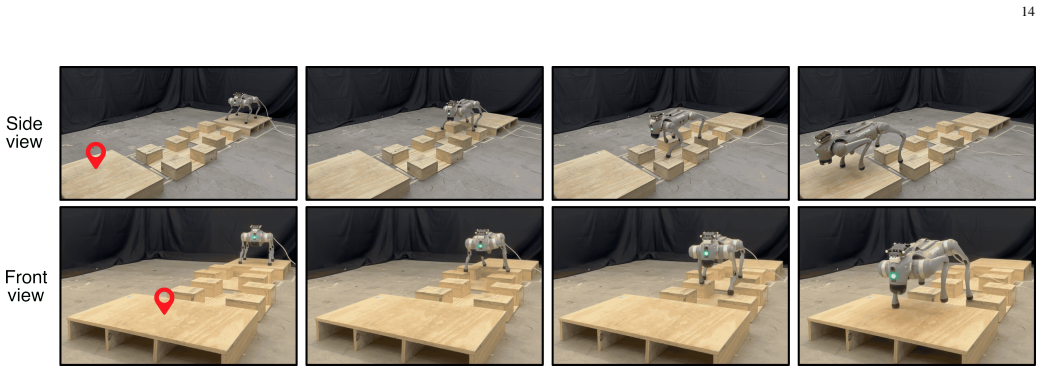
- On hardware, the framework executed trotting, leaping, rebar traversal, and a runtime detour; a heuristic footstep planner benchmark failed on extreme sparse rebar, supporting the paper's claim that feasibility-aware synthesis provides a safety advantage.
Reading between the lines
- The MICP's certificate is for the simplified model, and the paper acknowledges the tracking layer (NMPC plus whole-body control) is what absorbs model mismatch in practice; if that mismatch is large for very agile motions, the formal guarantee is about the abstraction, not the full-order robot.
- The paper states in Section XI that terrain classes are hand-defined and that synthesis returns the first feasible gait rather than the best one; extending the certificate to score margins (friction, kinematics, torque) or using learned terrain classification would deepen the guarantee.
- Runtime repair reuses skills that already exist in the library, which is why the reported obstacle-detour resynthesis is 0.05s; a genuinely novel gait would still require the much slower gait-free MICP, so 'runtime repair' is best read as fast re-planning over a known skill set plus occasional offline-level new-gait generation.
- The abstraction granularity and terrain classification are part of the guarantee: a cell mislabeled as obstacle versus steppable changes which skills get certified, so in deployments the perception/classification pipeline becomes part of the safety case.
Editorial analysis
A structured set of objections, weighed in public.
Referee Report
Summary. The paper proposes a hierarchical planning framework for quadrupedal locomotion that combines GR(1) reactive synthesis with mixed-integer convex programming (MICP). Offline, symbolic skills corresponding to locomotion gaits are certified by gait-fixed MICP; symbolic repair, supported by gait-free MICP, adds missing skills when the specification is unrealizable. Online, gait-fixed MICP is re-solved with perceived terrain, runtime repair handles unseen terrain or goals, and a delay-aware coordination mechanism hands reference trajectories to an MPC-WBC tracking stack. The approach is evaluated in Gazebo simulations on two quadruped platforms and in hardware experiments on Unitree Go2 and SkyMul Chotu, including stepping stones, gaps, rebar mats, runtime obstacle response, and a yaw-orientation extension, with benchmarks against a heuristic footstep planner and a pure MIP planner.
Significance. If the claims are properly qualified, this is a useful systems contribution: it demonstrates that a reactive-synthesis/MICP hierarchy can be executed online and on hardware, including agile leaping gaits, and that runtime symbolic repair can handle unexpected terrain. The hardware experiments, the delay-aware coordination between strategy automaton and low-level tracking, the pose re-targeting, and the yaw extension are concrete, externally validated additions beyond the authors' prior conference work. The paper also ships code and videos, which strengthens reproducibility. The main reservation is that the phrase "physically feasible" is used for certificates obtained from a substantially simplified convex model, and the paper itself acknowledges that the NMPC compensates for those simplifications; this gap needs to be addressed before the central claim can be accepted as stated.
major comments (3)
- [§VI-A and §X-B] The central claim in §I that each symbolic transition is "validated through an MICP to ensure the physical feasibility of the locomotion process" is stronger than what the MICP actually certifies. Eq. (3) replaces the Euler equation with a double integrator for orientation, decoupling angular acceleration from contact forces; Eq. (14) enforces torque limits through a fixed Jacobian J_j(q_ref^j) at a nominal joint pose, ignoring inertial, Coriolis, and gravitational joint torques; and Eq. (16) imposes the kinematic box using the reference orientation θ_ref, not the optimized orientation. For leaping and gap-crossing transitions, these are precisely the effects that determine whether the real robot can execute the motion. The paper itself notes in §X-B that "NMPC effectively adjusts the base position to compensate for model simplifications at the MICP level." Thus the formal guarantee is c
- [§X-D] The heuristic-baseline comparison is confounded by a speed mismatch. The text states that the heuristic planner's parameters "are tuned to achieve successful traversal at a speed of 0.1 m/s," and then it is "tasked with the same goal at 0.2 m/s to match our planner's effective gait speed." The observed failure of the baseline could therefore be due to control or foothold parameters being mistuned for the higher speed, rather than to the lack of terrain-geometry/gait-feasibility reasoning that the paper claims to demonstrate. To support the safety advantage, the baseline should be tuned at the test speed, or the comparison should include a matched-speed successful baseline, or an ablation that adds terrain reasoning to the heuristic planner. Without one of these, the benchmark overstates the conclusion.
- [§IX-C, Tables III–IV] The quantitative support for the scalability/efficiency claims is incomplete in this standalone manuscript. The offline repair statistics (93.4% handled pairs, 71.6–97.6% reduction in gait-free MICP calls, mean 27.23 s per new gait) are quoted from [24] rather than reproduced, and the online solve times in Table III and Table IV are reported as averages without standard deviations, medians, or the number of transitions they were computed over. Since these numbers support the paper's central practical claims and the reader cannot assess variability across terrain configurations, I ask for at least run counts and dispersion measures, and for the offline statistics to be reproduced or clearly marked as inherited from [24] with the same experimental conditions.
minor comments (3)
- [Eq. (3)] The discretized dynamics block in Eq. (3) is written in an unusual form, with m\ddot r[i] and \ddot θ[i] appearing on the left together with next-state variables. Clarify the indexing convention (explicit vs. semi-implicit Euler) so that the time indices in the acceleration, force, and state equations are unambiguous.
- [Fig. 3] The figure has two boxes labeled "(b) MICP Planner" and the caption text mixes the offline, online, and runtime repair flows. Renaming one of these (e.g., "Online MICP") would make the architecture easier to follow.
- [Table II] The footnote and table report q_ref^j and B_pref^j only for the front-left leg (j=0). State explicitly that the other legs are obtained by symmetry, or list the per-leg reference values, since the MICP uses all four legs.
Circularity Check
No significant circularity: the MICP feasibility check is a compositional soundness assumption, and the self-citations to prior [24] are acknowledged and non-load-bearing for the paper's new online and hardware results.
full rationale
The derivation chain is not circular. The paper defines symbolic skills by pre/post states and a gait, uses gait-fixed MICP (Sec. VI-A, Eqs. 1-16) to check whether a concrete trajectory satisfying the simplified dynamics, contact, friction, actuation, and kinematics constraints exists, and encodes only MICP-feasible skills into the GR(1) specification (Sec. VI-B, Eqs. 17-20). The synthesized strategy is correct by construction with respect to that specification, and any chosen transition has an MICP solution by construction; this is a compositional soundness argument, not a reduction of output to input. The offline synthesis statistics are 'previously reported in [24]' (Sec. IX-C), and the high-level manager is 'Similar to [24]' (Sec. VI-C), which is a same-author citation, but the paper's new online execution, delay-aware coordination, runtime repair, hardware experiments, and benchmarks against a heuristic planner and a pure MIP planner are external evidence and do not reduce to that citation. The limitation acknowledged in Sec. X-B that 'NMPC effectively adjusts the base position to compensate for model simplifications at the MICP level' is a soundness/correctness caveat about the simplified convex model, not a circular step; it weakens the strength of the physical-feasibility certificate but does not make the derivation equivalent to its inputs. No fitted parameter is renamed as a prediction, and no uniqueness or ansatz is imported via self-citation. Hence score 0.
Assumptions & free parameters
free parameters (8)
- Cell size for terrain abstraction =
0.8 m (unstructured), 0.6 m (rebar simulation), 0.45 m (rebar hardware)
- Terrain classification thresholds (gap ratio, rebar sparsity buckets) =
Gap: area ratio below unspecified threshold; rebar: dense 0.05-0.15 m, sparse 0.15-0.35 m, extreme sparse above 0.35 m,
- MICP tracking and regularization weights =
Table I: (1000,1000,1000) for r, theta, p_j; (10,10,10) for r_ddot, theta_ddot; (0.5,0.5,0.5) for p_j_ddot; (0.1,0.1,0.1
- Predefined locomotion gait set and durations =
2 s and 3 s trots; 1.5 s leap; 2.25 s static walk; 1 s cyclic trot in pure MIP baseline
- Foot kinematic deviation bound p_max_j =
(0.15, 0.10, 0.15) m
- Swing foot clearance h_swing =
User-defined, not quantified
- Pose retargeting threshold =
Not quantified
- Mocap noise values during aerial phase =
Higher noise assigned, values not reported
assumptions (7)
- domain assumption The single-rigid-body model with double integrator replacing the Euler equation, a fixed Jacobian at nominal pose, and a 3D foot box with reference orientation adequately represents physical feasibility for all skills including leaping.
- domain assumption Terrain and request inputs do not change during execution of a symbolic transition.
- domain assumption Online terrain segmentation provides accurate convex polygons with known plane parameters and consistent terrain states.
- domain assumption Offline homogeneous, predefined terrain polygons are representative enough for skill selection, with online re-solving covering the discrepancy.
- ad hoc to paper A manual, expert-defined terrain abstraction maps physical terrain to a small set of symbolic types with chosen thresholds.
- standard math GR(1) reactive synthesis and convex mixed-integer programming are sound for the abstractions used.
- domain assumption Input validity assumptions hold at runtime: exactly one robot cell, one request cell, and consistent terrain inputs.
Cite this review
Pith. "Pith review of Physically-Feasible Reactive Synthesis for Terrain-Adaptive Locomotion." pith.science (2026). https://pith.science/paper/DIU4UKCS
@misc{pith2026250923185,
  author       = {Pith},
  title        = {Pith review of: Physically-Feasible Reactive Synthesis for Terrain-Adaptive Locomotion},
  year         = {2026},
  howpublished = {\url{https://pith.science/paper/DIU4UKCS}},
  note         = {Machine review of arXiv:2509.23185}
}
read the original abstract
We present an integrated planning framework for quadrupedal locomotion over dynamically changing, unforeseen terrains. Existing methods often depend on heuristics for real-time foothold selection-limiting robustness and adaptability-or rely on computationally intensive trajectory optimization across complex terrains and long horizons. In contrast, our approach combines reactive synthesis for generating correct-by-construction symbolic-level controllers with mixed-integer convex programming (MICP) for dynamic and physically feasible footstep planning during each symbolic transition. To reduce the reliance on costly MICP solves and accommodate specifications that may be violated due to physical infeasibility, we adopt a symbolic repair mechanism that selectively generates only the required symbolic transitions. During execution, real-time MICP replanning based on actual terrain data, combined with runtime symbolic repair and delay-aware coordination, enables seamless bridging between offline synthesis and online operation. Through extensive simulation and hardware experiments, we validate the framework's ability to identify missing locomotion skills and respond effectively in safety-critical environments, including scattered stepping stones and rebar scenarios.
Figures


Figures from the paper (13 more)




Reference graph
Works this paper leans on
-
[24]
Physically-feasible reactive synthesis for terrain-adaptive locomotion via trajectory opti- mization and symbolic repair,
Z. Zhou, Q. Meng, H. Kress-Gazit, and Y . Zhao, “Physically-feasible reactive synthesis for terrain-adaptive locomotion via trajectory opti- mization and symbolic repair,” in2025 IEEE/RSJ International Con- ference on Intelligent Robots and Systems (IROS). IEEE, 2025
2025
-
[1]
Dynamic locomotion in the mit cheetah 3 through convex model-predictive control,
J. Di Carlo, P. M. Wensing, B. Katz, G. Bledt, and S. Kim, “Dynamic locomotion in the mit cheetah 3 through convex model-predictive control,” in2018 IEEE/RSJ international conference on intelligent robots and systems (IROS). IEEE, 2018, pp. 1–9
2018
-
[2]
Highly dynamic quadruped locomotion via whole-body impulse control and model predictive control,
D. Kim, J. Di Carlo, B. Katz, G. Bledt, and S. Kim, “Highly dynamic quadruped locomotion via whole-body impulse control and model predictive control,”arXiv preprint arXiv:1909.06586, 2019
arXiv 1909
-
[3]
Momentum- aware trajectory optimization and control for agile quadrupedal loco- motion,
Z. Zhou, B. Wingo, N. Boyd, S. Hutchinson, and Y . Zhao, “Momentum- aware trajectory optimization and control for agile quadrupedal loco- motion,”IEEE Robotics and Automation Letters, vol. 7, no. 3, pp. 7755–7762, 2022
2022
-
[4]
Robust rough-terrain locomotion with a quadrupedal robot,
P. Fankhauser, M. Bjelonic, C. D. Bellicoso, T. Miki, and M. Hutter, “Robust rough-terrain locomotion with a quadrupedal robot,” in2018 IEEE International Conference on Robotics and Automation (ICRA). IEEE, 2018, pp. 5761–5768
2018
-
[5]
Per- ceptive locomotion through nonlinear model-predictive control,
R. Grandia, F. Jenelten, S. Yang, F. Farshidian, and M. Hutter, “Per- ceptive locomotion through nonlinear model-predictive control,”IEEE Transactions on Robotics, 2023
2023
-
[6]
Online planning for au- tonomous running jumps over obstacles in high-speed quadrupeds,
H.-W. Park, P. M. Wensing, and S. Kim, “Online planning for au- tonomous running jumps over obstacles in high-speed quadrupeds,” in Robotics: Science and Systems, 2015
2015
-
[7]
Vision aided dynamic exploration of unstructured terrain with a small-scale quadruped robot,
D. Kim, D. Carballo, J. Di Carlo, B. Katz, G. Bledt, B. Lim, and S. Kim, “Vision aided dynamic exploration of unstructured terrain with a small-scale quadruped robot,” inIEEE International Conference on Robotics and Automation. IEEE, 2020, pp. 2464–2470
2020
Show all 108 references
-
[8]
Autonomous navigation for quadrupedal robots with optimized jumping through constrained obstacles,
S. Gilroy, D. Lau, L. Yang, E. Izaguirre, K. Biermayer, A. Xiao, M. Sun, A. Agrawal, J. Zeng, Z. Liet al., “Autonomous navigation for quadrupedal robots with optimized jumping through constrained obstacles,” in2021 IEEE 17th International Conference on Automation Science and E...
2021
-
[9]
Fast global motion planning for dynamic legged robots,
J. Norby and A. M. Johnson, “Fast global motion planning for dynamic legged robots,” in2020 IEEE/RSJ International Conference on Intelligent Robots and Systems. IEEE, 2020, pp. 3829–3836
2020
-
[10]
Rapid and reliable quadruped motion planning with omnidirectional jumping,
M. Chignoli, S. Morozov, and S. Kim, “Rapid and reliable quadruped motion planning with omnidirectional jumping,” inInternational Con- ference on Robotics and Automation. IEEE, 2022, pp. 6621–6627
2022
-
[11]
Reactive task and mo- tion planning for robust whole-body dynamic locomotion in constrained environments,
Y . Zhao, Y . Li, L. Sentis, U. Topcu, and J. Liu, “Reactive task and mo- tion planning for robust whole-body dynamic locomotion in constrained environments,”The International Journal of Robotics Research, p. 02783649221077714, 2022
2022
-
[12]
Integrated task and motion planning for safe legged navigation in partially observable environments,
A. Shamsah, Z. Gu, J. Warnke, S. Hutchinson, and Y . Zhao, “Integrated task and motion planning for safe legged navigation in partially observable environments,”IEEE Transactions on Robotics, 2023
2023
-
[13]
Mixed-integer convex optimization for planning aggressive motions of legged robots over rough terrain,
A. K. Valenzuela, “Mixed-integer convex optimization for planning aggressive motions of legged robots over rough terrain,” Ph.D. disser- tation, Massachusetts Institute of Technology, 2016
2016
-
[14]
Simultaneous contact-rich grasping and locomotion via distributed optimization enabling free-climbing for multi-limbed robots,
Y . Shirai, X. Lin, A. Schperberg, Y . Tanaka, H. Kato, V . Vichathorn, and D. Hong, “Simultaneous contact-rich grasping and locomotion via distributed optimization enabling free-climbing for multi-limbed robots,” in2022 IEEE/RSJ International Conference on Intelligent Robots ...
2022
-
[15]
Footstep planning on uneven terrain with mixed-integer convex optimization,
R. Deits and R. Tedrake, “Footstep planning on uneven terrain with mixed-integer convex optimization,” in2014 IEEE-RAS international conference on humanoid robots. IEEE, 2014, pp. 279–286
2014
-
[16]
Global inverse kinematics via mixed- integer convex optimization,
H. Dai, G. Izatt, and R. Tedrake, “Global inverse kinematics via mixed- integer convex optimization,”The International Journal of Robotics Research, vol. 38, no. 12-13, pp. 1420–1441, 2019
2019
-
[17]
Kinodynamic motion planning for multi-legged robot jumping via mixed-integer convex program,
Y . Ding, C. Li, and H.-W. Park, “Kinodynamic motion planning for multi-legged robot jumping via mixed-integer convex program,” in 2020 IEEE/RSJ International Conference on Intelligent Robots and Systems (IROS). IEEE, 2020, pp. 3998–4005
2020
-
[18]
3d hopping in discontinuous terrain using impulse planning with mixed-integer strategies,
N. Fey, R. J. Frei, and P. M. Wensing, “3d hopping in discontinuous terrain using impulse planning with mixed-integer strategies,”IEEE Robotics and Automation Letters, 2024
2024
-
[19]
A convex model of humanoid momentum dynamics for multi-contact motion generation,
B. Ponton, A. Herzog, S. Schaal, and L. Righetti, “A convex model of humanoid momentum dynamics for multi-contact motion generation,” in2016 IEEE-RAS 16th International Conference on Humanoid Robots (Humanoids). IEEE, 2016, pp. 842–849
2016
-
[20]
Real-time footstep planning and control of the solo quadruped robot in 3d environments,
F. Risbourg, T. Corb `eres, P.-A. L ´eziart, T. Flayols, N. Mansard, and S. Tonneau, “Real-time footstep planning and control of the solo quadruped robot in 3d environments,” inIEEE/RSJ International Con- ference on Intelligent Robots and Systems, 2022, pp. 12 950–12 956
2022
-
[21]
Bipedal walking on constrained footholds with mpc footstep control,
B. Acosta and M. Posa, “Bipedal walking on constrained footholds with mpc footstep control,” in2023 IEEE-RAS 22nd International Conference on Humanoid Robots. IEEE, 2023, pp. 1–8
2023
-
[22]
Simultaneous contact, gait, and motion planning for robust multilegged locomotion via mixed-integer convex optimization,
B. Aceituno-Cabezas, C. Mastalli, H. Dai, M. Focchi, A. Radulescu, D. G. Caldwell, J. Cappelletto, J. C. Grieco, G. Fern ´andez-L´opez, and C. Semini, “Simultaneous contact, gait, and motion planning for robust multilegged locomotion via mixed-integer convex optimization,”IEEE...
2017
-
[23]
Synthe- sis of reactive (1) designs,
R. Bloem, B. Jobstmann, N. Piterman, A. Pnueli, and Y . Saar, “Synthe- sis of reactive (1) designs,”Journal of Computer and System Sciences, vol. 78, no. 3, pp. 911–938, 2012
2012
-
[25]
Navigation planning for legged robots in challenging terrain,
M. Wermelinger, P. Fankhauser, R. Diethelm, P. Kr ¨usi, R. Siegwart, and M. Hutter, “Navigation planning for legged robots in challenging terrain,” in2016 IEEE/RSJ International Conference on Intelligent Robots and Systems (IROS). IEEE, 2016, pp. 1184–1189
2016
-
[26]
A kinody- namic steering-method for legged multi-contact locomotion,
P. Fernbach, S. Tonneau, A. Del Prete, and M. Ta ¨ıx, “A kinody- namic steering-method for legged multi-contact locomotion,” in2017 IEEE/RSJ International Conference on Intelligent Robots and Systems (IROS). IEEE, 2017, pp. 3701–3707
2017
-
[27]
Walking in narrow spaces: Safety-critical locomotion control for quadrupedal robots with duality-based optimization,
Q. Liao, Z. Li, A. Thirugnanam, J. Zeng, and K. Sreenath, “Walking in narrow spaces: Safety-critical locomotion control for quadrupedal robots with duality-based optimization,” in2023 IEEE/RSJ Interna- tional Conference on Intelligent Robots and Systems (IROS). IEEE, 2023, pp....
2023
-
[28]
Gpf-bg: A hierarchical vision-based planning framework for safe 18 quadrupedal navigation,
S. Feng, Z. Zhou, J. S. Smith, M. Asselmeier, Y . Zhao, and P. A. Vela, “Gpf-bg: A hierarchical vision-based planning framework for safe 18 quadrupedal navigation,” in2023 IEEE International Conference on Robotics and Automation (ICRA). IEEE, 2023, pp. 1968–1975
2023
-
[29]
A control architecture for quadruped locomotion over rough terrain,
J. Z. Kolter, M. P. Rodgers, and A. Y . Ng, “A control architecture for quadruped locomotion over rough terrain,” in2008 IEEE International Conference on Robotics and Automation. IEEE, 2008, pp. 811–818
2008
-
[30]
Fast, robust quadruped locomotion over challenging terrain,
M. Kalakrishnan, J. Buchli, P. Pastor, M. Mistry, and S. Schaal, “Fast, robust quadruped locomotion over challenging terrain,” in2010 IEEE International Conference on Robotics and Automation. IEEE, 2010, pp. 2665–2670
2010
-
[31]
Path planning with force-based foothold adaptation and virtual model control for torque controlled quadruped robots,
A. Winkler, I. Havoutis, S. Bazeille, J. Ortiz, M. Focchi, R. Dillmann, D. Caldwell, and C. Semini, “Path planning with force-based foothold adaptation and virtual model control for torque controlled quadruped robots,” in2014 IEEE International Conference on Robotics and Autom...
2014
-
[32]
On-line and on-board planning and perception for quadrupedal locomotion,
C. Mastalli, I. Havoutis, A. W. Winkler, D. G. Caldwell, and C. Sem- ini, “On-line and on-board planning and perception for quadrupedal locomotion,” in2015 IEEE International Conference on Technologies for Practical Robot Applications (TePRA). IEEE, 2015, pp. 1–7
2015
-
[33]
Footstep planning for autonomous walking over rough ter- rain,
R. J. Griffin, G. Wiedebach, S. McCrory, S. Bertrand, I. Lee, and J. Pratt, “Footstep planning for autonomous walking over rough ter- rain,” in2019 IEEE-RAS 19th international conference on humanoid robots (humanoids). IEEE, 2019, pp. 9–16
2019
-
[34]
Sl1m: Sparse l1-norm minimization for contact planning on uneven terrain,
S. Tonneau, D. Song, P. Fernbach, N. Mansard, M. Ta ¨ıx, and A. Del Prete, “Sl1m: Sparse l1-norm minimization for contact planning on uneven terrain,” in2020 IEEE International Conference on Robotics and Automation (ICRA). IEEE, 2020, pp. 6604–6610
2020
-
[35]
Accelerating signal-temporal-logic-based task and motion planning of bipedal navigation using benders decomposition,
J. Ren, X. Lin, R. Mineyev, K. M. Feigh, S. Coogan, and Y . Zhao, “Accelerating signal-temporal-logic-based task and motion planning of bipedal navigation using benders decomposition,”arXiv preprint arXiv:2508.13407, 2025
2025 arXiv
-
[36]
Non-gaited humanoid lo- comotion planning,
K. Hauser, T. Bretl, and J.-C. Latombe, “Non-gaited humanoid lo- comotion planning,” in5th IEEE-RAS International Conference on Humanoid Robots, 2005.IEEE, 2005, pp. 7–12
2005
-
[37]
Motion planning of multi-limbed robots subject to equilib- rium constraints: The free-climbing robot problem,
T. Bretl, “Motion planning of multi-limbed robots subject to equilib- rium constraints: The free-climbing robot problem,”The International Journal of Robotics Research, vol. 25, no. 4, pp. 317–342, 2006
2006
-
[38]
An efficient acyclic contact planner for multiped robots,
S. Tonneau, A. Del Prete, J. Pettr ´e, C. Park, D. Manocha, and N. Mansard, “An efficient acyclic contact planner for multiped robots,” IEEE Transactions on Robotics, vol. 34, no. 3, pp. 586–601, 2018
2018
-
[39]
Perceptive locomotion in rough terrain–online foothold optimization,
F. Jenelten, T. Miki, A. E. Vijayan, M. Bjelonic, and M. Hutter, “Perceptive locomotion in rough terrain–online foothold optimization,” IEEE Robotics and Automation Letters, vol. 5, no. 4, pp. 5370–5376, 2020
2020
-
[40]
Vision-aided dynamic quadrupedal locomotion on discrete terrain using motion libraries,
A. Agrawal, S. Chen, A. Rai, and K. Sreenath, “Vision-aided dynamic quadrupedal locomotion on discrete terrain using motion libraries,” in 2022 International Conference on Robotics and Automation (ICRA). IEEE, 2022, pp. 4708–4714
2022
-
[41]
Fast and continuous foothold adaptation for dynamic locomotion through cnns,
O. A. V . Magana, V . Barasuol, M. Camurri, L. Franceschi, M. Focchi, M. Pontil, D. G. Caldwell, and C. Semini, “Fast and continuous foothold adaptation for dynamic locomotion through cnns,”IEEE Robotics and Automation Letters, vol. 4, no. 2, pp. 2140–2147, 2019
2019
-
[42]
Mpc-based controller with terrain insight for dynamic legged locomotion,
O. Villarreal, V . Barasuol, P. M. Wensing, D. G. Caldwell, and C. Sem- ini, “Mpc-based controller with terrain insight for dynamic legged locomotion,” in2020 IEEE International Conference on Robotics and Automation (ICRA). IEEE, 2020, pp. 2436–2442
2020
-
[43]
Visual-locomotion: Learning to walk on complex terrains with vision,
W. Yu, D. Jain, A. Escontrela, A. Iscen, P. Xu, E. Coumans, S. Ha, J. Tan, and T. Zhang, “Visual-locomotion: Learning to walk on complex terrains with vision,” in5th Annual Conference on Robot Learning, 2021
2021
-
[44]
Rloc: Terrain-aware legged locomotion using reinforcement learning and optimal control,
S. Gangapurwala, M. Geisert, R. Orsolino, M. Fallon, and I. Havoutis, “Rloc: Terrain-aware legged locomotion using reinforcement learning and optimal control,”IEEE Transactions on Robotics, vol. 38, no. 5, pp. 2908–2927, 2022
2022
-
[45]
Learn to teach: Sample-efficient privileged learning for humanoid locomotion over real-world uneven terrain,
F. Wu, X. Nal, J. Jang, W. Zhu, Z. Gu, A. Wu, and Y . Zhao, “Learn to teach: Sample-efficient privileged learning for humanoid locomotion over real-world uneven terrain,”IEEE Robotics and Automation Letters, 2025
2025
-
[46]
Rl- augmented adaptive model predictive control for bipedal locomotion over challenging terrain,
J. Kamohara, F. Wu, C. Wamorkar, S. Hutchinson, and Y . Zhao, “Rl- augmented adaptive model predictive control for bipedal locomotion over challenging terrain,” 2025
2025
-
[47]
Multi-layered safety for legged robots via control barrier functions and model predictive control,
R. Grandia, A. J. Taylor, A. D. Ames, and M. Hutter, “Multi-layered safety for legged robots via control barrier functions and model predictive control,” in2021 IEEE International Conference on Robotics and Automation (ICRA). IEEE, 2021, pp. 8352–8358
2021
-
[48]
Tamols: Terrain- aware motion optimization for legged systems,
F. Jenelten, R. Grandia, F. Farshidian, and M. Hutter, “Tamols: Terrain- aware motion optimization for legged systems,”IEEE Transactions on Robotics, vol. 38, no. 6, pp. 3395–3413, 2022
2022
-
[49]
Bipedal safe navigation over uncertain rough terrain: Unifying terrain mapping and locomotion stability,
K. Muenprasitivej, J. Jiang, A. Shamsah, S. Coogan, and Y . Zhao, “Bipedal safe navigation over uncertain rough terrain: Unifying terrain mapping and locomotion stability,” in2024 IEEE/RSJ International Conference on Intelligent Robots and Systems (IROS). IEEE, 2024, pp. 11 264–11 271
2024
-
[50]
Terrain-aware model predictive control of heterogeneous bipedal and aerial robot coordination for search and rescue tasks,
A. Shamsah, J. Jiang, Z. Yoon, S. Coogan, and Y . Zhao, “Terrain-aware model predictive control of heterogeneous bipedal and aerial robot coordination for search and rescue tasks,” in2025 IEEE International Conference on Robotics and Automation (ICRA). IEEE, 2025, pp. 12 352–12 358
2025
-
[51]
Probabilistically-safe bipedal navigation over uncertain terrain via conformal prediction and contraction analysis,
K. Muenprasitivej, Y . Zhao, and G. Chou, “Probabilistically-safe bipedal navigation over uncertain terrain via conformal prediction and contraction analysis,” 2025
2025
-
[52]
Learning a contact-adaptive controller for robust, efficient legged locomotion,
X. Da, Z. Xie, D. Hoeller, B. Boots, A. Anandkumar, Y . Zhu, B. Babich, and A. Garg, “Learning a contact-adaptive controller for robust, efficient legged locomotion,” inConference on Robot Learning. PMLR, 2021, pp. 883–894
2021
-
[53]
Fast and efficient locomotion via learned gait transitions,
Y . Yang, T. Zhang, E. Coumans, J. Tan, and B. Boots, “Fast and efficient locomotion via learned gait transitions,” inConference on Robot Learning. PMLR, 2022, pp. 773–783
2022
-
[54]
Glide: Generalizable quadrupedal locomotion in diverse environments with a centroidal model,
Z. Xie, X. Da, B. Babich, A. Garg, and M. v. de Panne, “Glide: Generalizable quadrupedal locomotion in diverse environments with a centroidal model,” inInternational Workshop on the Algorithmic Foundations of Robotics. Springer, 2022, pp. 523–539
2022
-
[55]
Learning to jump from pixels,
G. B. Margolis, T. Chen, K. Paigwar, X. Fu, D. Kim, S. b. Kim, and P. Agrawal, “Learning to jump from pixels,” inProceedings of the 5th Conference on Robot Learning. PMLR, 2022, pp. 1025–1034
2022
-
[56]
Learning generic and dynamic locomotion of humanoids across discrete terrains,
S. Yu, N. Perera, D. Marew, and D. Kim, “Learning generic and dynamic locomotion of humanoids across discrete terrains,”arXiv preprint arXiv:2405.17227, 2024
2024 arXiv
-
[57]
Online gait transitions and disturbance recovery for legged robots via the feasible impulse set,
C. Boussema, M. J. Powell, G. Bledt, A. J. Ijspeert, P. M. Wensing, and S. Kim, “Online gait transitions and disturbance recovery for legged robots via the feasible impulse set,”IEEE Robotics and automation letters, vol. 4, no. 2, pp. 1611–1618, 2019
2019
-
[58]
When and where to step: Terrain-aware real-time footstep location and timing optimization for bipedal robots,
K. Wang, Z. J. Hu, P. Tisnikar, O. Helander, D. Chappell, and P. Kormushev, “When and where to step: Terrain-aware real-time footstep location and timing optimization for bipedal robots,”arXiv preprint arXiv:2302.07345, 2023
2023 arXiv
-
[59]
Free gait generation of quadruped robots via impulse-based feasibility analysis,
H. Sun, J. Yang, Y . Jia, and C. Wang, “Free gait generation of quadruped robots via impulse-based feasibility analysis,”IEEE/ASME Transactions on Mechatronics, 2023
2023
-
[60]
A direct method for trajectory op- timization of rigid bodies through contact,
M. Posa, C. Cantu, and R. Tedrake, “A direct method for trajectory op- timization of rigid bodies through contact,”The International Journal of Robotics Research, vol. 33, no. 1, pp. 69–81, 2014
2014
-
[61]
Discovery of complex behaviors through contact-invariant optimization,
I. Mordatch, E. Todorov, and Z. Popovi ´c, “Discovery of complex behaviors through contact-invariant optimization,”ACM Transactions on Graphics (ToG), vol. 31, no. 4, pp. 1–8, 2012
2012
-
[62]
Robust trajectory optimization over uncertain terrain with stochastic complementarity,
L. Drnach and Y . Zhao, “Robust trajectory optimization over uncertain terrain with stochastic complementarity,”IEEE Robotics and Automa- tion Letters, vol. 6, no. 2, pp. 1168–1175, 2021
2021
-
[63]
Real-time multi-contact model predictive control via admm,
A. Aydinoglu and M. Posa, “Real-time multi-contact model predictive control via admm,” in2022 International Conference on Robotics and Automation (ICRA). IEEE, 2022, pp. 3414–3421
2022
-
[64]
Fast contact-implicit model predic- tive control,
S. Le Cleac’h, T. A. Howell, S. Yang, C.-Y . Lee, J. Zhang, A. Bishop, M. Schwager, and Z. Manchester, “Fast contact-implicit model predic- tive control,”IEEE Transactions on Robotics, 2024
2024
-
[65]
Mediating between contact feasibility and robustness of trajectory optimization through chance complementarity constraints,
L. Drnach, J. Z. Zhang, and Y . Zhao, “Mediating between contact feasibility and robustness of trajectory optimization through chance complementarity constraints,”Frontiers in Robotics and AI, vol. 8, p. 785925, 2022
2022
-
[66]
Locomotion generation for quadruped robots on challenging terrains via quadratic programming,
X. Jiang, W. Chi, Y . Zheng, S. Zhang, Y . Ling, J. Xu, and Z. Zhang, “Locomotion generation for quadruped robots on challenging terrains via quadratic programming,”Autonomous Robots, vol. 47, no. 1, pp. 51–76, 2023
2023
-
[67]
Integrated task and motion planning,
C. R. Garrett, R. Chitnis, R. Holladay, B. Kim, T. Silver, L. P. Kaelbling, and T. Lozano-P´erez, “Integrated task and motion planning,” Annual review of control, robotics, and autonomous systems, vol. 4, no. 1, pp. 265–293, 2021
2021
-
[68]
A survey of optimization-based task and motion planning: From classical to learning approaches,
Z. Zhao, S. Cheng, Y . Ding, Z. Zhou, S. Zhang, D. Xu, and Y . Zhao, “A survey of optimization-based task and motion planning: From classical to learning approaches,”IEEE/ASME Transactions on Mechatronics, 2024
2024
-
[69]
Logic-geometric programming: An optimization-based approach to combined task and motion planning
M. Toussaint, “Logic-geometric programming: An optimization-based approach to combined task and motion planning.” inIJCAI, 2015, pp. 1930–1936. 19
2015
-
[70]
Differentiable physics and stable modes for tool-use and manipulation planning,
M. A. Toussaint, K. R. Allen, K. A. Smith, and J. B. Tenenbaum, “Differentiable physics and stable modes for tool-use and manipulation planning,” 2018
2018
-
[71]
Object-centric task and motion planning in dynamic environments,
T. Migimatsu and J. Bohg, “Object-centric task and motion planning in dynamic environments,”IEEE Robotics and Automation Letters, vol. 5, no. 2, pp. 844–851, 2020
2020
-
[72]
Sydebo: Symbolic-decision- embedded bilevel optimization for long-horizon manipulation in dy- namic environments,
Z. Zhao, Z. Zhou, M. Park, and Y . Zhao, “Sydebo: Symbolic-decision- embedded bilevel optimization for long-horizon manipulation in dy- namic environments,”IEEE Access, vol. 9, pp. 128 817–128 826, 2021
2021
-
[73]
Versatile multicontact planning and control for legged loco-manipulation,
J.-P. Sleiman, F. Farshidian, and M. Hutter, “Versatile multicontact planning and control for legged loco-manipulation,”Science Robotics, vol. 8, no. 81, p. eadg5014, 2023
2023
-
[74]
Hybrid sampling/optimization-based planning for agile jumping robots on chal- lenging terrains,
Y . Ding, M. Zhang, C. Li, H.-W. Park, and K. Hauser, “Hybrid sampling/optimization-based planning for agile jumping robots on chal- lenging terrains,” in2021 IEEE International Conference on Robotics and Automation (ICRA). IEEE, 2021, pp. 2839–2845
2021
-
[75]
Lto: lazy trajectory optimization with graph-search planning for high dof robots in cluttered environments,
Y . Shirai, X. Lin, A. Mehta, and D. Hong, “Lto: lazy trajectory optimization with graph-search planning for high dof robots in cluttered environments,” in2021 IEEE International Conference on Robotics and Automation (ICRA). IEEE, 2021, pp. 7533–7539
2021
-
[76]
Combined sampling and optimization based planning for legged-wheeled robots,
E. Jelavic, F. Farshidian, and M. Hutter, “Combined sampling and optimization based planning for legged-wheeled robots,” in2021 IEEE International Conference on Robotics and Automation (ICRA). IEEE, 2021, pp. 8366–8372
2021
-
[77]
Monte carlo tree search gait planner for non-gaited legged system control,
L. Amatucci, J.-H. Kim, J. Hwangbo, and H.-W. Park, “Monte carlo tree search gait planner for non-gaited legged system control,” in2022 International Conference on Robotics and Automation (ICRA). IEEE, 2022, pp. 4701–4707
2022
-
[78]
Trajectotree: Trajectory optimization meets tree search for planning multi-contact dexterous manipulation,
C. Chen, P. Culbertson, M. Lepert, M. Schwager, and J. Bohg, “Trajectotree: Trajectory optimization meets tree search for planning multi-contact dexterous manipulation,” in2021 IEEE/RSJ International Conference on Intelligent Robots and Systems (IROS). IEEE, 2021, pp. 8262–8268
2021
-
[79]
Simul- taneous trajectory optimization and contact selection for multi-modal manipulation planning,
M. Zhang, D. K. Jha, A. U. Raghunathan, and K. Hauser, “Simul- taneous trajectory optimization and contact selection for multi-modal manipulation planning,”arXiv preprint arXiv:2306.06465, 2023
2023 arXiv
-
[80]
Efficient object manipulation planning with monte carlo tree search,
H. Zhu, A. Meduri, and L. Righetti, “Efficient object manipulation planning with monte carlo tree search,” in2023 IEEE/RSJ International Conference on Intelligent Robots and Systems (IROS). IEEE, 2023, pp. 10 628–10 635
2023
-
[81]
Hierar- chical experience-informed navigation for multi-modal quadrupedal re- bar grid traversal,
M. Asselmeier, J. Ivanova, Z. Zhou, P. A. Vela, and Y . Zhao, “Hierar- chical experience-informed navigation for multi-modal quadrupedal re- bar grid traversal,” in2024 IEEE International Conference on Robotics and Automation (ICRA). IEEE, 2024, pp. 8065–8072
2024
-
[82]
Synthesis for robots: Guarantees and feedback for robot behavior,
H. Kress-Gazit, M. Lahijanian, and V . Raman, “Synthesis for robots: Guarantees and feedback for robot behavior,”Annual Review of Con- trol, Robotics, and Autonomous Systems, vol. 1, pp. 211–236, 2018
2018
-
[83]
Temporal logic guided locomotion planning and control in cluttered environ- ments,
S. Kulgod, W. Chen, J. Huang, Y . Zhao, and N. Atanasov, “Temporal logic guided locomotion planning and control in cluttered environ- ments,” inAmerican Control Conference. IEEE, 2020, pp. 5425–5432
2020
-
[84]
Reactive task allocation and planning for quadrupedal and wheeled robot teaming,
Z. Zhou, D. J. Lee, Y . Yoshinaga, S. Balakirsky, D. Guo, and Y . Zhao, “Reactive task allocation and planning for quadrupedal and wheeled robot teaming,” inIEEE International Conference on Automation Science and Engineering. IEEE, 2022, pp. 2110–2117
2022
-
[85]
Abstraction-based planning for uncertainty-aware legged navigation,
J. Jiang, S. Coogan, and Y . Zhao, “Abstraction-based planning for uncertainty-aware legged navigation,”IEEE Open Journal of Control Systems, 2023
2023
-
[86]
Reactive locomotion decision-making and robust motion planning for real-time perturbation recovery,
Z. Gu, N. Boyd, and Y . Zhao, “Reactive locomotion decision-making and robust motion planning for real-time perturbation recovery,” in 2022 International Conference on Robotics and Automation (ICRA). IEEE, 2022, pp. 1896–1902
2022
-
[87]
On the synthesis of a reactive module,
A. Pnueli and R. Rosner, “On the synthesis of a reactive module,” inProceedings of the 16th ACM SIGPLAN-SIGACT symposium on Principles of programming languages, 1989, pp. 179–190
1989
-
[88]
Temporal-logic- based reactive mission and motion planning,
H. Kress-Gazit, G. E. Fainekos, and G. J. Pappas, “Temporal-logic- based reactive mission and motion planning,”IEEE transactions on robotics, vol. 25, no. 6, pp. 1370–1381, 2009
2009
-
[89]
Dynamics-based reactive synthesis and automated revisions for high-level robot control,
J. A. DeCastro, R. Ehlers, M. Rungger, A. Balkan, P. Tabuada, and H. Kress-Gazit, “Dynamics-based reactive synthesis and automated revisions for high-level robot control,”arXiv preprint arXiv:1410.6375, 2014
2014 arXiv
-
[90]
Translating temporal logic to controller specifications,
G. E. Fainekos, S. G. Loizou, and G. J. Pappas, “Translating temporal logic to controller specifications,” inProceedings of the 45th IEEE Conference on Decision and Control. IEEE, 2006, pp. 899–904
2006
-
[91]
Sampling-based motion planning with temporal goals,
A. Bhatia, L. E. Kavraki, and M. Y . Vardi, “Sampling-based motion planning with temporal goals,” in2010 IEEE International Conference on Robotics and Automation. IEEE, 2010, pp. 2689–2696
2010
-
[92]
Synthesis of reactive switching protocols from temporal logic specifications,
J. Liu, N. Ozay, U. Topcu, and R. M. Murray, “Synthesis of reactive switching protocols from temporal logic specifications,”IEEE Trans- actions on Automatic Control, vol. 58, no. 7, pp. 1771–1785, 2013
2013
-
[93]
Iterative temporal motion planning for hybrid systems in par- tially unknown environments,
M. R. Maly, M. Lahijanian, L. E. Kavraki, H. Kress-Gazit, and M. Y . Vardi, “Iterative temporal motion planning for hybrid systems in par- tially unknown environments,” inProceedings of the 16th international conference on Hybrid systems: computation and control, 2013, pp. 353–362
2013
-
[94]
Finding missing skills for high-level behaviors,
A. Pacheck, S. Moarref, and H. Kress-Gazit, “Finding missing skills for high-level behaviors,” in2020 IEEE International Conference on Robotics and Automation (ICRA). IEEE, 2020, pp. 10 335–10 341
2020
-
[95]
Physically feasible repair of reactive, linear temporal logic-based, high-level tasks,
A. Pacheck and H. Kress-Gazit, “Physically feasible repair of reactive, linear temporal logic-based, high-level tasks,”IEEE Transactions on Robotics, 2023
2023
-
[96]
Automated Robot Recovery from Assumption Violations of High-Level Specifications,
Q. Meng and H. Kress-Gazit, “Automated Robot Recovery from Assumption Violations of High-Level Specifications,” in2024 IEEE 20th International Conference on Automation Science and Engineering (CASE). IEEE, Aug. 2024, pp. 4154–4161
2024
-
[97]
Slugs: Extensible GR(1) synthesis,
R. Ehlers and V . Raman, “Slugs: Extensible GR(1) synthesis,” in International Conference on Computer Aided Verification. Springer, 2016, pp. 333–339
2016
-
[98]
Baier and J.-P
C. Baier and J.-P. Katoen,Principles of model checking. MIT press, 2008
2008
-
[99]
Whole-body motion planning with centroidal dynamics and full kinematics,
H. Dai, A. Valenzuela, and R. Tedrake, “Whole-body motion planning with centroidal dynamics and full kinematics,” in2014 IEEE-RAS International Conference on Humanoid Robots. IEEE, 2014, pp. 295– 302
2014
-
[100]
The mit humanoid robot: Design, motion planning, and control for acrobatic behaviors,
M. Chignoli, D. Kim, E. Stanger-Jones, and S. Kim, “The mit humanoid robot: Design, motion planning, and control for acrobatic behaviors,” in2020 IEEE-RAS 20th International Conference on Hu- manoid Robots (Humanoids). IEEE, 2021, pp. 1–8
2021
-
[101]
A unified mpc framework for whole-body dynamic locomotion and manipula- tion,
J.-P. Sleiman, F. Farshidian, M. V . Minniti, and M. Hutter, “A unified mpc framework for whole-body dynamic locomotion and manipula- tion,”IEEE Robotics and Automation Letters, vol. 6, no. 3, pp. 4688– 4695, 2021
2021
-
[102]
OCS2: An open source library for optimal control of switched systems,
F. Farshidianet al., “OCS2: An open source library for optimal control of switched systems,” [Online]. Available: https://github.com/ leggedrobotics/ocs2
-
[103]
An efficiently solvable quadratic program for stabilizing dynamic locomotion,
S. Kuindersma, F. Permenter, and R. Tedrake, “An efficiently solvable quadratic program for stabilizing dynamic locomotion,” in2014 IEEE International Conference on Robotics and Automation (ICRA). IEEE, 2014, pp. 2589–2594
2014
-
[104]
Generation of dynamic humanoid behaviors through task-space control with conic optimization,
P. M. Wensing and D. E. Orin, “Generation of dynamic humanoid behaviors through task-space control with conic optimization,” in2013 IEEE International Conference on Robotics and Automation. IEEE, 2013, pp. 3103–3109
2013
-
[105]
Mit cheetah 3: Design and control of a robust, dynamic quadruped robot,
G. Bledt, M. J. Powell, B. Katz, J. Di Carlo, P. M. Wensing, and S. Kim, “Mit cheetah 3: Design and control of a robust, dynamic quadruped robot,” in2018 IEEE/RSJ International Conference on Intelligent Robots and Systems (IROS). IEEE, 2018, pp. 2245–2252
2018
-
[106]
Shortest paths in graphs of convex sets,
T. Marcucci, J. Umenberger, P. Parrilo, and R. Tedrake, “Shortest paths in graphs of convex sets,”SIAM Journal on Optimization, vol. 34, no. 1, pp. 507–532, 2024
2024
-
[107]
Accelerate hybrid model predictive control using generalized benders decomposition,
X. Lin, “Accelerate hybrid model predictive control using generalized benders decomposition,”arXiv preprint arXiv:2406.00780, 2024
2024
-
[108]
Elevation mapping for locomotion and navigation using gpu,
T. Miki, L. Wellhausen, R. Grandia, F. Jenelten, T. Homberger, and M. Hutter, “Elevation mapping for locomotion and navigation using gpu,” in2022 IEEE/RSJ International Conference on Intelligent Robots and Systems (IROS). IEEE, 2022, pp. 2273–2280
2022
Reviewed August 4, 2026 · model on record in the stance chip above.
Discussion (0). Sign in to comment.