REVIEW 3 major objections 5 minor 60 references
Investigating Phosphorus Abundances in a Sample of APOGEE-2 Bulge Globular Clusters
T0 review · 3 major / 5 minor · reviewed 2026-08-04 · deepseek-v4-flash
Pith's one-line read This paper claims that moderately phosphorus-enhanced stars appear in two of seven bulge globular clusters, and that these stars are also nitrogen-rich, suggesting they are second-generation cluster stars.
desk verdict Plausible but fragile detection of P-enhanced stars in two bulge GCs; the headline counts don't reproduce from their own Table 1. read the letter →
The pith
A machine-rendered reading of the paper's core claim, the machinery that carries it, and where it could break.
The reading
What carries the argument
The analysis rests on spectrum synthesis of the P I 16482.932 Å line in the H-band, which is blended with CO molecular lines. The authors re-derive C, N, O abundances to model the CO blending, and they check the weaker P I 15711.622 Å line where available. The key interpretive tool is the observed P-N correlation, used to connect P-enhancement to the multiple-population phenomenon in globular clusters.
What would settle it
Obtain higher signal-to-noise spectra of the Ton 1 and NGC 6316 stars and measure [P/Fe] from an independent phosphorus line, or re-analyze with a fully consistent non-LTE treatment; if the excesses drop below +0.5 for most stars, the claim of P-rich stars in these clusters is overturned.
Extended reading notes
Core claim
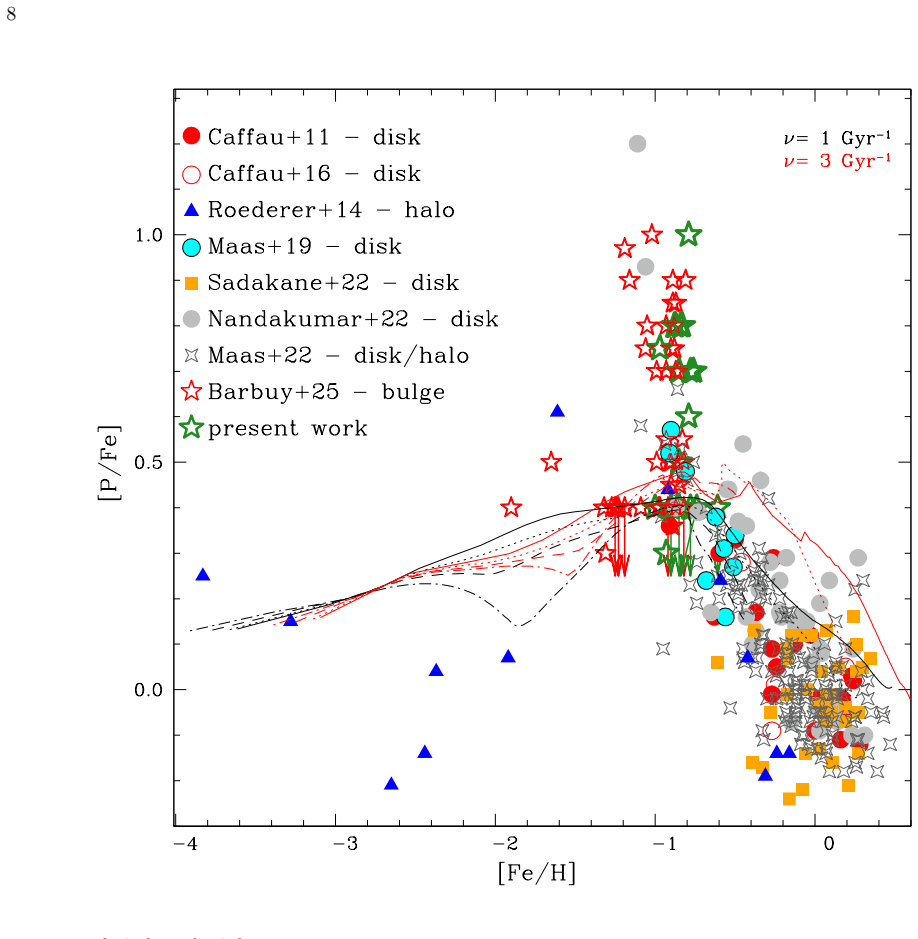
Using H-band spectra from the APOGEE-2 survey, the authors measure [P/Fe] from the P I 16482.932 Å line in stars of seven bulge globular clusters with metallicities near [Fe/H] ~ -1. They find that more than half of the analyzed stars in Tonantzintla 1 (7 of 12) and NGC 6316 (6 of 10) show moderate phosphorus enhancement in the range +0.5 < [P/Fe] < +1.0, while the other five clusters show no such enhancement. All P-rich stars in this sample also are nitrogen-rich, consistent with the pattern expected for second-generation stars in globular clusters, though no robust correlations with other second-generation indicators such as Al or Mg are found.
Load-bearing premise
The detection of moderate phosphorus enhancement rests on a single P I line whose strength changes by up to 0.3 dex with a 100 K change in stellar temperature, so stars with [P/Fe] between 0.5 and 0.8 could be ordinary if the CO blending is misjudged.
Editorial extensions
If this is right
- If P-rich stars are indeed second-generation cluster stars, then some fraction of field P-rich stars could have been ejected from globular clusters.
- The presence of P enrichment in two old clusters argues against nova or AGB polluters as the source, favoring massive stars as the main producers of P in these environments.
- The absence of P-rich stars in five clusters of similar metallicity suggests the phenomenon is not universal and may depend on cluster mass or formation history.
- Confirmation of the P-N connection would give a new chemical tag for identifying second-generation stars in integrated-light or low-resolution studies.
Reading between the lines
- If the P-N correlation survives larger samples, P could serve as a cleaner tracer of pollution from massive stars than N alone, which is affected by multiple processes.
- The fact that not all N-rich stars are P-rich suggests a threshold or a distinct sub-population among second-generation stars; quantifying the P/N ratio may separate nucleosynthetic origins.
- A direct test: search for P-enhanced stars in the field with orbits consistent with disrupted bulge clusters; if found, it would confirm the ejection scenario.
- The parameter sensitivity of the P I line (up to 0.3 dex for 100 K) implies that some of the claimed moderate enhancements could be due to systematic temperature errors; measuring P in stars with T_eff < 4000 K where CO blending is stronger requires careful treatment.
Editorial analysis
A structured set of objections, weighed in public.
Referee Report
Summary. The paper derives phosphorus abundances for stars in seven bulge globular clusters (Ton 1, NGC 6316, Ton 2, HP 1, NGC 6522, NGC 6558, UKS 1) using APOGEE-2 H-band spectra and spectral synthesis with TURBOSPECTRUM. The analysis relies on the P I 16482.932 Å line, corrected for CO blending using revised C, N, and O abundances, and on the shallower 15711.622 Å line as a consistency check. The authors report moderate P enhancement ([P/Fe] >~ +0.5) in two clusters, Ton 1 (7 of 12 stars) and NGC 6316 (6 of 10 stars), and find that all P-rich stars also tend to be N-rich, which they interpret as a possible second-generation globular-cluster origin. No P enhancement is found in the other five clusters. Results are compared with literature samples and with the authors' own chemical evolution models, with the conclusion that the origin of P-rich stars remains open.
Significance. If the detection is robust, this is the first evidence of P-moderately enhanced stars in multiple bulge globular clusters and strengthens the connection between the P-rich phenomenon and globular-cluster multiple populations. The non-detections in five similar clusters also provide constraints on the nucleosynthetic sources. The study makes use of public APOGEE-2 data and includes a careful revision of CNO abundances, explicit cross-checks between two stellar-parameter sets, and a dedicated uncertainty appendix. However, the central claim rests on a single P I line with no NLTE corrections, and the quoted P-rich threshold of 0.5 dex is comparable to the estimated parameter-induced uncertainties (up to 0.3 dex). The counts of P-rich stars in Table 1 are not reproducible as stated, so the significance of the detection and of the P-N correlation is currently not established to the standard implied by the abstract.
major comments (3)
- [Table 1 and §3] The stated numbers of P-rich stars do not follow from the table. For NGC 6316, the text claims 6 P-rich stars ([P/Fe]>0.5), but only 4 of the 10 rows (2M17163864-2809385, 2M17163330-2808396, 2M17164482-2808302, 2M17163903-2807212) have [P/Fe]>0.5 under either the literature or the ASPCAP parameter set. For Ton 1, the '7 of 12' count matches only the ASPCAP parameter set, while the text says the photometric/literature parameters are adopted. Please specify the adopted parameter set, list final per-star [P/Fe] values with that set, report per-star uncertainties, and recompute the counts; the current presentation makes the central detection irreproducible.
- [§3 and Appendix A] The [P/Fe]>0.5 threshold is close to the derived uncertainty. Appendix A reports that ΔTeff=100 K can shift [P/Fe] by up to 0.3 dex for stars near Teff~3900 K, with a total uncertainty of 0.25 dex for the example star. Several stars classified as P-rich cross the threshold between the two parameter sets, e.g., Ton1 2M17342921-3904514 (+0.60 vs +0.25), Ton1 2M17343521-3903091 (+0.80 vs +0.40), and Ton1 2M17342541-3902338 (+0.40 vs +0.80). Because the conclusion that 'all P-rich stars tend to also be N-rich' depends on this classification, the paper should quantify the robustness of the P-rich/N-rich correlation to these parameter-induced shifts, or restrict the claim to stars that remain P-rich under both parameter sets.
- [Appendix A and §5] The single P I 16482.932 Å line is blended with CO and no NLTE corrections are available; this is explicitly acknowledged as a vulnerability. Given this, the abstract and conclusions currently present the detection as a definite result. I recommend softening the claim (e.g., 'tentative' or 'moderate' enhancement) and propagating the systematic error budget from the CO/CNO revision and the choice of stellar parameters into the quoted [P/Fe] values and into the cluster-level counts. This is load-bearing because the paper's novel contribution is the detection itself; without propagated systematics, the significance of the 0.5–0.8 dex enhancements is not established.
minor comments (5)
- [Table 1] The column header in the table reads '(19)' for the [P/Fe] column; this should be '(10)'.
- [Abstract] The cluster name 'NGC 6316_' includes a stray underscore in the abstract; please remove it.
- [§5] The sentence 'In five of them, namely NGC 6522, NGC 6558, UKS 1, and Ton 2, (and possibly HP 1)' lists four clusters by name plus HP 1, so the phrasing is ambiguous; please revise to make the total count clear.
- [Appendix A] In the sentence 'higher P abundances are found for stars with T eff ¿ 4000 K', the symbol '¿' should be '>'.
- [References and text] There are minor typographical issues, e.g., an extra bracket after 'Roberti et al. 2025)]' in §4.2 and 'it is still matter or debate' in §5 should read 'matter of debate'.
Circularity Check
No circularity: the P abundances are measured from spectra, not derived from the claims they support.
full rationale
Score 0. The paper's central result is an observed abundance ratio derived from APOGEE-2 spectra via TURBOSPECTRUM spectral synthesis, using atomic data from the APOGEE collaboration and solar abundances from Asplund et al. (2021). The [P/Fe] values are not fitted to the conclusion: no parameter is adjusted to force the claimed P-rich detections, and the comparison with Barbuy et al. (2025) chemical evolution models is explicitly illustrative, with the models themselves not reproducing the P-excess (the paper states the models 'predict a maximum [P/Fe]=+0.45' and 'still leave unexplained the P-excess'). Self-citations to Fernández-Trincado et al. for cluster stellar parameters and to earlier P-rich star papers supply input parameters and context, but the detection claim depends on the line synthesis, not on those citations. Appendix A's admission that the single P I 16482.932 Å line is a vulnerability and that ΔTeff=100 K can shift [P/Fe] by up to 0.3 dex is an uncertainty/robustness limitation, not a circularity: the abundance is still measured from the spectrum. The P-N correlation is an empirical comparison of independently derived abundances, and the claimed 'detection' is a threshold applied to measured values rather than a prediction forced by construction.
Assumptions & free parameters
free parameters (1)
- P-rich threshold =
+0.5 dex
assumptions (4)
- domain assumption LTE is valid for the P I lines; no NLTE corrections are available
- domain assumption The adopted P I oscillator strengths (log gf = -0.510, -0.273) from the APOGEE-2 collaboration are correct
- domain assumption The revised C, N, O abundances properly model the CO/CN molecular blending of the P I 16482.932 A line
- domain assumption The sample stars are genuine members of the target globular clusters
Cite this review
Pith. "Pith review of Investigating Phosphorus Abundances in a Sample of APOGEE-2 Bulge Globular Clusters." pith.science (2026). https://pith.science/paper/DJ6EK5YU
@misc{pith2026250911207,
  author       = {Pith},
  title        = {Pith review of: Investigating Phosphorus Abundances in a Sample of APOGEE-2 Bulge Globular Clusters},
  year         = {2026},
  howpublished = {\url{https://pith.science/paper/DJ6EK5YU}},
  note         = {Machine review of arXiv:2509.11207}
}
read the original abstract
Phosphorus enhanced (P-rich; [P/Fe] > 0.8) giants have been found among mildly metal-poor fiels stars, but in only one star in a globular cluster (GC), M4 (NGC 6121). Also, in a sample of bulge spheroid stars, some of them showed a moderate P-enhancement in the range +0.5 < [P/Fe] < +1.0. In this paper we derive the P abundance of moderately metal-poor ([Fe/H] ~-1) GC stars, aiming to check if the phenomenon could be related to the unusual multiple stellar populations found in most GCs. Here we present the detection of P-moderately enhanced stars among two out of seven bulge GCs (Tonantzintla 1, and NGC 6316_, with metallicities similar to those of the bulge field P-rich stars. Using H-band high-resolution (R~22,500) spectra from the APOGEE-2 survey, we present the first high-resolution abundance analysis of [P/Fe] from the PI 16482.932 A line in a sample of selected bulge GCs. We find that all P-rich stars tend to also be N-rich, that hints at the origin of P-rich stars as second-generation stars in GCs. However no other correlations of P and other elements are found, that are usually indicators of second-generation stars. Further studies with larger samples and comparisons with field stars will be needed before any firm conclusions are drawn.
Figures


Figures from the paper (2 more)


Reference graph
Works this paper leans on
-
[1]
2022, ApJS, 259, 35, doi: 10.3847/1538-4365/ac4414
Abdurro’uf, Accetta, K., Aerts, C., et al. 2022, ApJS, 259, 35, doi: 10.3847/1538-4365/ac4414
-
[2]
Ahumada, R., Allende Prieto, C., Almeida, A., et al. 2020, ApJS, 249, 3, doi: 10.3847/1538-4365/ab929e 12 Figure 5.PI lines and CO lines in star Ton1: 2M17343616-3903344 for stellar parameters from Fern´ andez-Trincado et al. (2021c) and ASPCAP parameters, with T eff = 3890 K and 3982 K, respectively. CO lines intensity changes more dramatically in the te...
-
[3]
1998, A&A, 330, 1109, doi: 10.48550/arXiv.astro-ph/9710157
Alvarez, R., & Plez, B. 1998, A&A, 330, 1109, doi: 10.48550/arXiv.astro-ph/9710157
-
[4]
2020, MNRAS, 491, 972, doi: 10.1093/mnras/stz2952
Andrassy, R., Herwig, F., Woodward, P., & Ritter, C. 2020, MNRAS, 491, 972, doi: 10.1093/mnras/stz2952
-
[5]
Asplund, M., Amarsi, A. M., & Grevesse, N. 2021, A&A, 653, A141, doi: 10.1051/0004-6361/202140445
-
[6]
2018, ARA&A, 56, 223, doi: 10.1146/annurev-astro-081817-051826
Barbuy, B., Chiappini, C., & Gerhard, O. 2018, ARA&A, 56, 223, doi: 10.1146/annurev-astro-081817-051826
-
[7]
Barbuy, B., Ernandes, H., Souza, S. O., et al. 2021, A&A, 648, A16, doi: 10.1051/0004-6361/202039761
-
[8]
Barbuy, B., Fria¸ ca, A. C. S., Ernandes, H., et al. 2023, MNRAS, 526, 2365, doi: 10.1093/mnras/stad2888 —. 2024, A&A, 691, A296, doi: 10.1051/0004-6361/202452235
Show all 60 references
- [9]
-
[10]
2018, MNRAS, 478, 1520, doi: 10.1093/mnras/sty1057
Baumgardt, H., & Hilker, M. 2018, MNRAS, 478, 1520, doi: 10.1093/mnras/sty1057
2018 doi
-
[11]
2021, MNRAS, 505, 5957, doi: 10.1093/mnras/stab1474
Baumgardt, H., & Vasiliev, E. 2021, MNRAS, 505, 5957, doi: 10.1093/mnras/stab1474
2021 doi
-
[12]
L., Oelkers, R
Beaton, R. L., Oelkers, R. J., Hayes, C. R., et al. 2021, AJ, 162, 302, doi: 10.3847/1538-3881/ac260c 13
2021 doi
-
[13]
2024, MNRAS, 528, 3198, doi: 10.1093/mnras/stad3920
Belokurov, V., & Kravtsov, A. 2024, MNRAS, 528, 3198, doi: 10.1093/mnras/stad3920
2024 doi
-
[14]
Bica, E., Ortolani, S., Barbuy, B., & Oliveira, R. A. P. 2024, A&A, 687, A201, doi: 10.1051/0004-6361/202346377
2024 doi
-
[15]
R., Bershady, M
Blanton, M. R., Bershady, M. A., Abolfathi, B., et al. 2017, AJ, 154, 28, doi: 10.3847/1538-3881/aa7567
2017 doi
-
[16]
S., & Vaughan, Jr., A
Bowen, I. S., & Vaughan, Jr., A. H. 1973, ApOpt, 12, 1430, doi: 10.1364/AO.12.001430
1973 doi
-
[17]
A., et al
Brauner, M., Masseron, T., Garc ´ ıa-Hern´ andez, D. A., et al. 2023, A&A, 673, A123, doi: 10.1051/0004-6361/202346048
2023 doi
-
[18]
A., & Lugaro, M
Brauner, M., Pignatari, M., Masseron, T., Garc ´ ıa-Hern´ andez, D. A., & Lugaro, M. 2024, A&A, 690, A262, doi: 10.1051/0004-6361/202451327
2024 doi
-
[19]
2016, A&A, 585, A16, doi: 10.1051/0004-6361/201527272
Caffau, E., Andrievsky, S., Korotin, S., et al. 2016, A&A, 585, A16, doi: 10.1051/0004-6361/201527272
2016 doi
-
[20]
2011, A&A, 532, A98, doi: 10.1051/0004-6361/201117313
Caffau, E., Bonifacio, P., Faraggiana, R., & Steffen, M. 2011, A&A, 532, A98, doi: 10.1051/0004-6361/201117313
2011 doi
-
[21]
M., Cautun, M., Deason, A
Callingham, T. M., Cautun, M., Deason, A. J., et al. 2022, MNRAS, 513, 4107, doi: 10.1093/mnras/stac1145
2022 doi
-
[22]
2019, MNRAS, 482, 4372, doi: 10.1093/mnras/sty2967 da Silva, P., Barbuy, B., Ernandes, H., et al
Cescutti, G., & Molaro, P. 2019, MNRAS, 482, 4372, doi: 10.1093/mnras/sty2967 da Silva, P., Barbuy, B., Ernandes, H., et al. 2024, A&A, 687, A66, doi: 10.1051/0004-6361/202449342
2019 doi
-
[23]
2023, ApJ, 942, 104, doi: 10.3847/1538-4357/aca9ce Fern´ andez-Trincado, J
Pallanca, C. 2023, ApJ, 942, 104, doi: 10.3847/1538-4357/aca9ce Fern´ andez-Trincado, J. G., Zamora, O., Souto, D., et al. 2019, A&A, 627, A178, doi: 10.1051/0004-6361/201834391 Fern´ andez-Trincado, J. G., Minniti, D., Beers, T. C., et al. 2020, A&A, 643, A145, doi: 10.1051/0...
2023 doi
-
[24]
Forbes, D. A. 2020, MNRAS, 493, 847, doi: 10.1093/mnras/staa245
2020 doi
-
[25]
2025, arXiv e-prints, arXiv:2502.18607, doi: 10.48550/arXiv.2502.18607 Garc ´ ıa P´ erez, A
Frelijj, H., Gonz´ alez-D ´ ıaz, D., Geisler, D., et al. 2025, arXiv e-prints, arXiv:2502.18607, doi: 10.48550/arXiv.2502.18607 Garc ´ ıa P´ erez, A. E., Allende Prieto, C., Holtzman, J. A., et al. 2016, AJ, 151, 144, doi: 10.3847/0004-6256/151/6/144
2025 doi
-
[26]
E., et al
Geisler, D., Villanova, S., O’Connell, J. E., et al. 2021, A&A, 652, A157, doi: 10.1051/0004-6361/202140436
2021 doi
-
[27]
2025, arXiv e-prints, arXiv:2508.09970, doi: 10.48550/arXiv.2508.09970 Gonz´ alez-D ´ ıaz, D., Fern´ andez-Trincado, J
Geisler, D., Mu˜ noz, C., Villanova, S., et al. 2025, arXiv e-prints, arXiv:2508.09970, doi: 10.48550/arXiv.2508.09970 Gonz´ alez-D ´ ıaz, D., Fern´ andez-Trincado, J. G., Villanova, S., et al. 2023, MNRAS, 526, 6274, doi: 10.1093/mnras/stad3178
2025 doi
-
[28]
E., Siegmund, W
Gunn, J. E., Siegmund, W. A., Mannery, E. J., et al. 2006, AJ, 131, 2332, doi: 10.1086/500975
2006 doi
-
[29]
2008, A&A, 486, 951, doi: 10.1051/0004-6361:200809724
Gustafsson, B., Edvardsson, B., Eriksson, K., et al. 2008, A&A, 486, 951, doi: 10.1051/0004-6361:200809724
2008 doi
-
[30]
Henao, L., Villanova, S., Geisler, D., & Fern´ andez-Trincado, J. G. 2025, A&A, 696, A154, doi: 10.1051/0004-6361/202451793
2025 doi
-
[31]
Doherty, C. L. 2016, ApJ, 818, 98, doi: 10.3847/0004-637X/818/1/98
2016 doi
-
[32]
I., & Lattanzio, J
Karakas, A. I., & Lattanzio, J. C. 2014, PASA, 31, e030, doi: 10.1017/pasa.2014.21
2014 doi
-
[33]
2023, Annual Review of Nuclear and Particle Science, 73, 315, doi: 10.1146/annurev-nucl-102422-080857
Lugaro, M., Pignatari, M., Reifarth, R., & Wiescher, M. 2023, Annual Review of Nuclear and Particle Science, 73, 315, doi: 10.1146/annurev-nucl-102422-080857
2023 doi
-
[34]
G., Cescutti, G., & Pilachowski, C
Maas, Z. G., Cescutti, G., & Pilachowski, C. A. 2019, AJ, 158, 219, doi: 10.3847/1538-3881/ab4a1a
2019 doi
-
[35]
G., Hawkins, K., Hinkel, N
Maas, Z. G., Hawkins, K., Hinkel, N. R., et al. 2022, AJ, 164, 61, doi: 10.3847/1538-3881/ac77f8
2022 doi
-
[36]
R., Schiavon, R
Majewski, S. R., Schiavon, R. P., Frinchaboy, P. M., et al. 2017, AJ, 154, 94, doi: 10.3847/1538-3881/aa784d
2017 doi
-
[37]
H., & Helmi, A
Massari, D., Koppelman, H. H., & Helmi, A. 2019, A&A, 630, L4, doi: 10.1051/0004-6361/201936135
2019 doi
-
[38]
A., Santove˜ na, R., et al
Masseron, T., Garc ´ ıa-Hern´ andez, D. A., Santove˜ na, R., et al. 2020a, Nature Communications, 11, 3759, doi: 10.1038/s41467-020-17649-9
-
[39]
2020b, ApJL, 904, L1, doi: 10.3847/2041-8213/abc6ac
Manchado, A. 2020b, ApJL, 904, L1, doi: 10.3847/2041-8213/abc6ac
-
[40]
G., et al
Minniti, D., Matsunaga, N., Fern´ andez-Trincado, J. G., et al. 2024, A&A, 683, A150, doi: 10.1051/0004-6361/202348100
2024 doi
-
[41]
2022, A&A, 668, A88, doi: 10.1051/0004-6361/202244724
Nandakumar, G., Ryde, N., Montelius, M., et al. 2022, A&A, 668, A88, doi: 10.1051/0004-6361/202244724
2022 doi
-
[42]
A., & Mead, H
Nelder, J. A., & Mead, H. 1965, The Computer Journal, 7, 308–313, doi: 10.1093/comjnl/7.4.308
1965 doi
-
[43]
2025, arXiv e-prints, arXiv:2507.06863, doi: 10.48550/arXiv.2507.06863 14
Nepal, S., Chiappini, C., P´ erez-Villegas, A., et al. 2025, arXiv e-prints, arXiv:2507.06863, doi: 10.48550/arXiv.2507.06863 14
2025 doi
-
[44]
L., Holtzman, J
Nidever, D. L., Holtzman, J. A., Allende Prieto, C., et al. 2015, AJ, 150, 173, doi: 10.1088/0004-6256/150/6/173 P´ erez-Villegas, A., Barbuy, B., Kerber, L. O., et al. 2020, MNRAS, 491, 3251, doi: 10.1093/mnras/stz3162
2015 doi
-
[45]
2016, ApJS, 225, 24, doi: 10.3847/0067-0049/225/2/24
Pignatari, M., Herwig, F., Hirschi, R., et al. 2016, ApJS, 225, 24, doi: 10.3847/0067-0049/225/2/24
2016 doi
-
[46]
2012, Turbospectrum: Code for spectral synthesis, Astrophysics Source Code Library, record ascl:1205.004
Plez, B. 2012, Turbospectrum: Code for spectral synthesis, Astrophysics Source Code Library, record ascl:1205.004
2012
-
[47]
Queiroz, A. B. A., Chiappini, C., Perez-Villegas, A., et al. 2021, A&A, 656, A156, doi: 10.1051/0004-6361/202039030
2021 doi
-
[48]
C., et al
Razera, R., Barbuy, B., Moura, T. C., et al. 2022, MNRAS, 517, 4590, doi: 10.1093/mnras/stac2136
2022 doi
-
[49]
2018, MNRAS, 474, L1, doi: 10.1093/mnrasl/slx126
Ritter, C., Andrassy, R., Cˆ ot´ e, B., et al. 2018, MNRAS, 474, L1, doi: 10.1093/mnrasl/slx126
2018 doi
-
[50]
E., et al
Roberti, L., Pignatari, M., Brinkman, H. E., et al. 2025, A&A, 698, A216, doi: 10.1051/0004-6361/202554461
2025 doi
-
[51]
2014, ApJ, 797, 69, doi: 10.1088/0004-637X/797/1/69
Frebel, A., & Toller, E. 2014, ApJ, 797, 69, doi: 10.1088/0004-637X/797/1/69
2014 doi
-
[52]
2022, PASJ, 74, 298, doi: 10.1093/pasj/psab125
Sadakane, K., & Nishimura, M. 2022, PASJ, 74, 298, doi: 10.1093/pasj/psab125
2022 doi
-
[53]
A., Beaton, R
Santana, F. A., Beaton, R. L., Covey, K. R., et al. 2021, AJ, 162, 303, doi: 10.3847/1538-3881/ac2cbc
2021 doi
-
[54]
P., Phillips, S
Schiavon, R. P., Phillips, S. G., Myers, N., et al. 2024, MNRAS, 528, 1393, doi: 10.1093/mnras/stad3020
2024 doi
- [55]
-
[56]
V., Bizyaev, D., Cunha, K., et al
Smith, V. V., Bizyaev, D., Cunha, K., et al. 2021, AJ, 161, 254, doi: 10.3847/1538-3881/abefdc
2021 doi
-
[57]
O., Libralato, M., Nardiello, D., et al
Souza, S. O., Libralato, M., Nardiello, D., et al. 2024a, A&A, 690, A37, doi: 10.1051/0004-6361/202450795
-
[58]
O., Valentini, M., Chiappini, C., et al
Souza, S. O., Valentini, M., Chiappini, C., et al. 2024b, ApJL, 977, L33, doi: 10.3847/2041-8213/ad91af
-
[59]
C., Hearty, F
Wilson, J. C., Hearty, F. R., Skrutskie, M. F., et al. 2019, PASP, 131, 055001, doi: 10.1088/1538-3873/ab0075
2019 doi
-
[60]
2008, ApJ, 686, 448, doi: 10.1086/591266
Yoshida, T., Suzuki, T., Chiba, S., et al. 2008, ApJ, 686, 448, doi: 10.1086/591266
2008 doi
Reviewed August 4, 2026 · model on record in the stance chip above.
Discussion (0). Continue with ORCID to comment.