Nonlinear topological laser based on multipole insulators
Pith reviewed 2026-07-01 03:56 UTC · model grok-4.3
The pith
In this nonlinear laser on a higher-order topological insulator, the stable lasing mode after long evolution is fixed by the model's topological properties.
A machine-rendered reading of the paper's core claim, the machinery that carries it, and where it could break.
Core claim
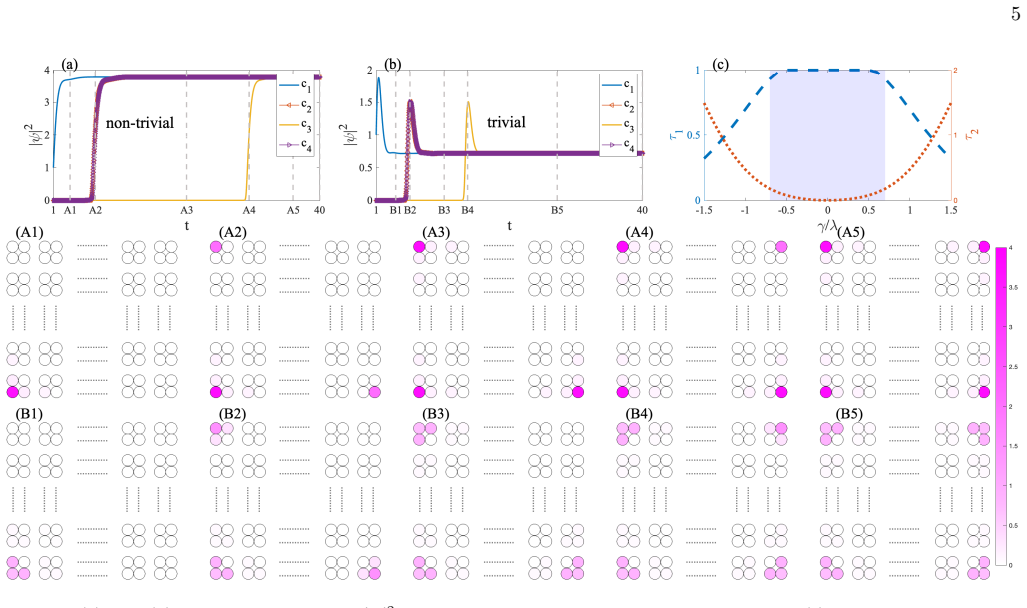
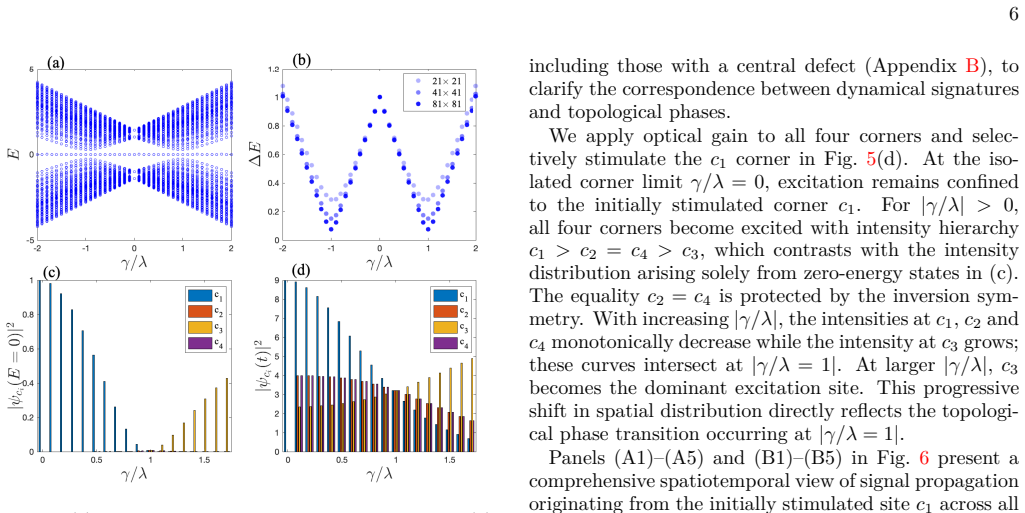
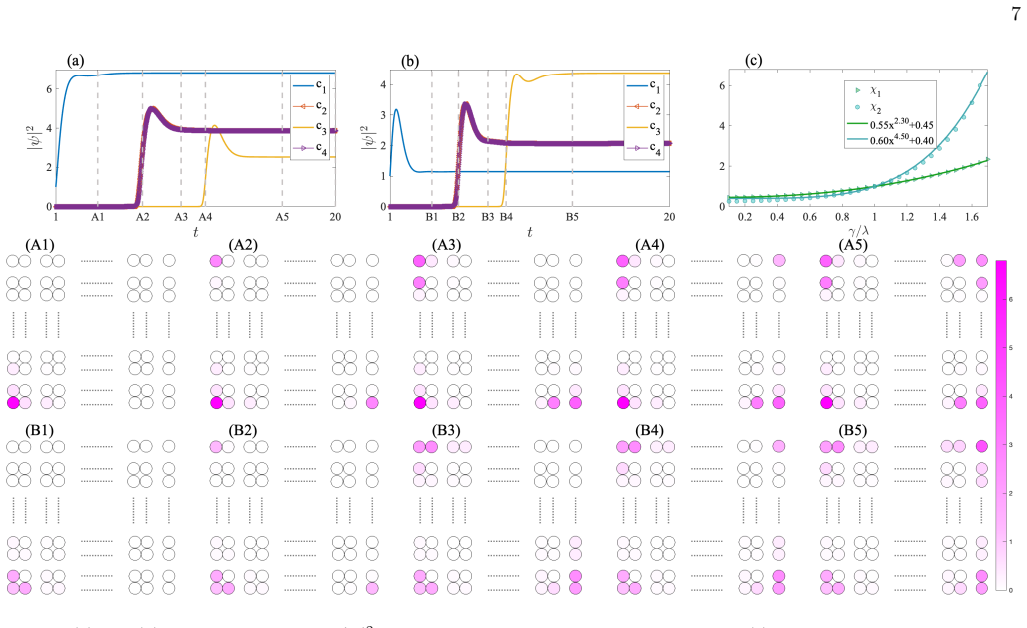
When selective gain is applied to a nonlinear system governed by the BBH Hamiltonian, the stable light excitation reached after long-time evolution is predominantly determined by the topological properties of the model Hamiltonian. The corner decay ratio τ1 and edge-to-corner ratio τ2, which quantify localization and spatial extent, exhibit abrupt changes with the hopping parameter γ/λ that mark topological phase transitions, while the inter-corner transfer ratio χ tracks coherent dynamics between corners. Modulating lattice site parity shifts the localization positions of the corner states.
What carries the argument
The Benalcazar-Bernevig-Hughes (BBH) model with its quantized quadrupole moments that protect corner and edge states; the diagnostic ratios τ1, τ2, and χ extracted from the long-time lasing dynamics to read out localization and phase boundaries.
If this is right
- Topological phase transitions become detectable from the steady-state laser intensity pattern via jumps in the diagnostic ratios.
- Corner-state positions can be moved on demand by switching lattice site parity without redesigning the gain.
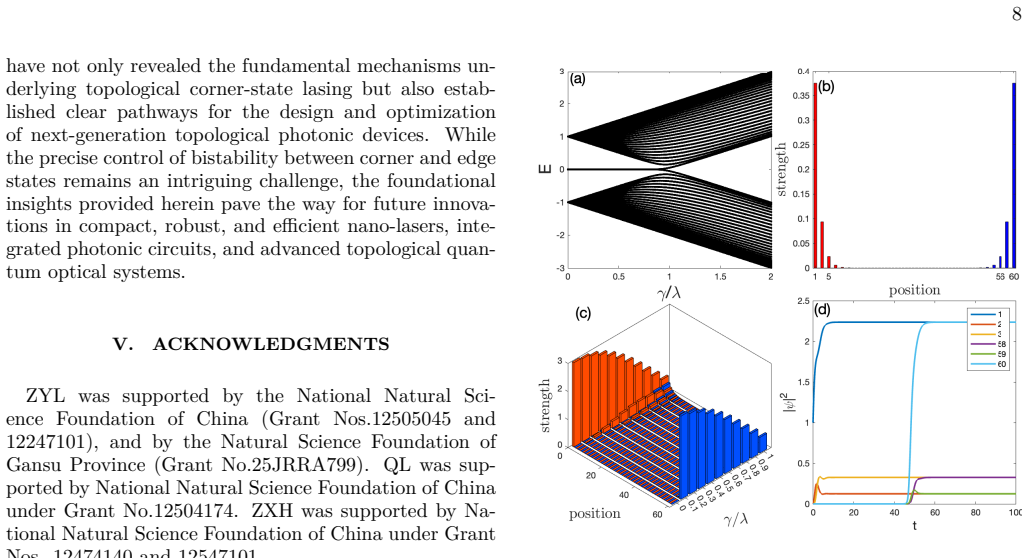
- The difficulty of reaching bistability limits simultaneous use of corner and edge lasing modes in one device.
- Dynamical evolution under nonlinearity supplies a practical readout of topological invariants when equilibrium measurements are unavailable.
Where Pith is reading between the lines
- The same diagnostic ratios could be measured in experiments on photonic or acoustic lattices to confirm topology without needing to compute invariants directly.
- If the gain profile must remain weak to preserve topology, device power may be limited compared with conventional lasers.
- Extending the approach to three-dimensional higher-order insulators would require new ratios that track hinge or surface states.
- The reported challenge in achieving bistability suggests that topological protection alone does not guarantee multi-mode stability under nonlinearity.
Load-bearing premise
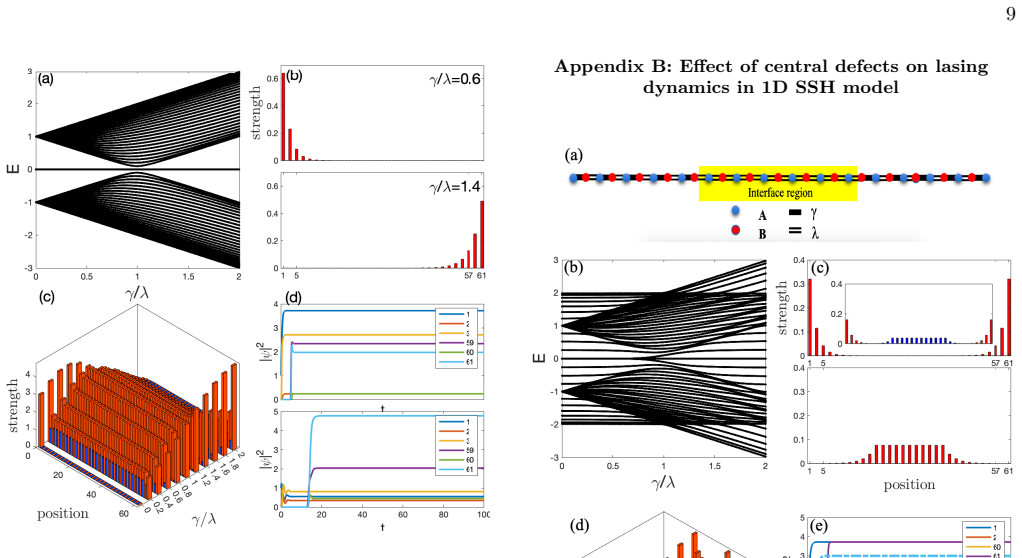
Selective gain can be applied to keep the lasing mode strictly inside the chosen topological corner or edge states without the nonlinearity or the gain profile itself changing the topological classification or adding competing non-topological modes.
What would settle it
A long-time simulation or experiment in which the stable lasing mode appears away from the topological corner or edge locations despite the applied gain profile, or in which τ1 and τ2 fail to jump at the γ/λ value where the quadrupole moment changes, would falsify the claim.
Figures

read the original abstract
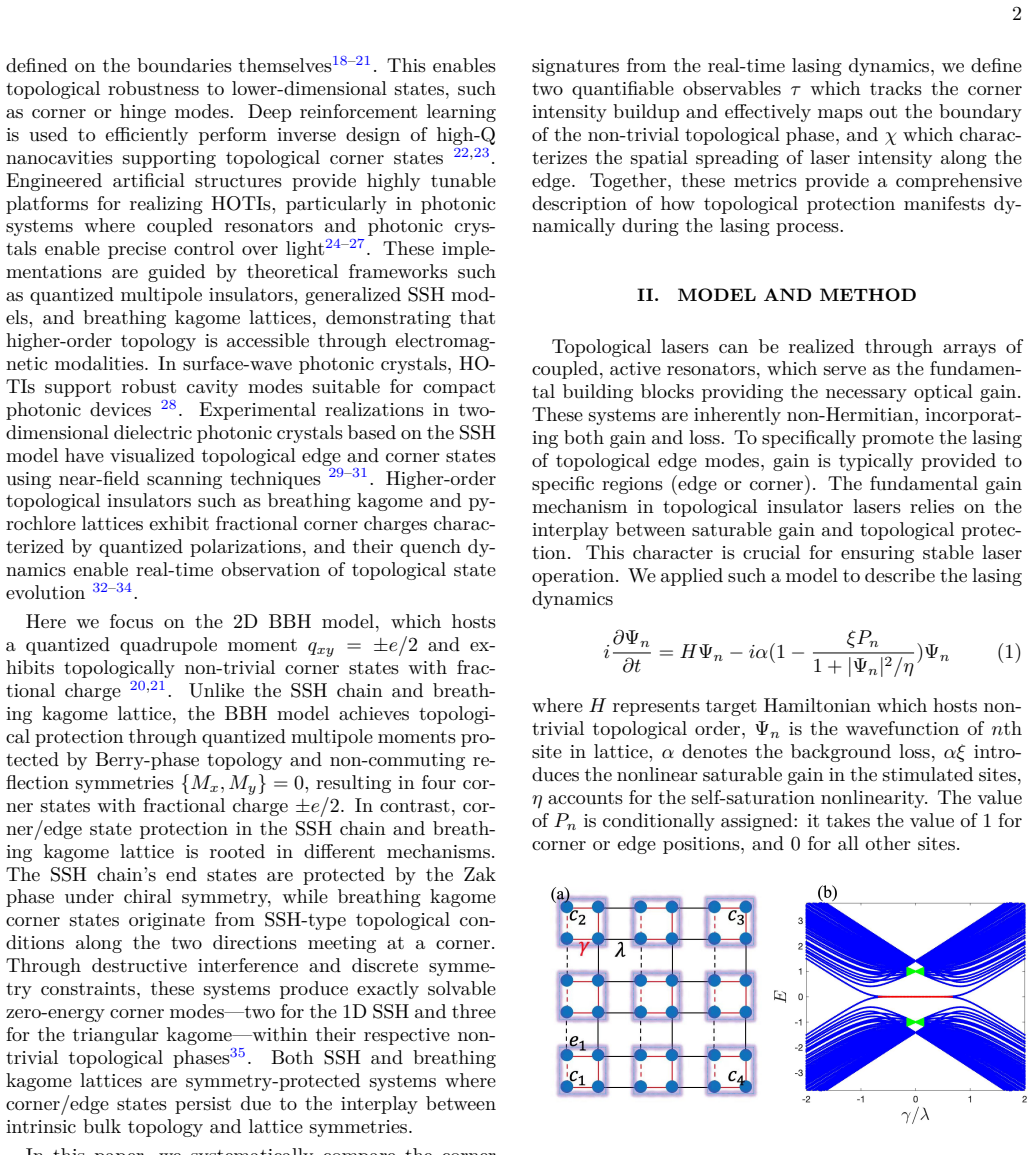
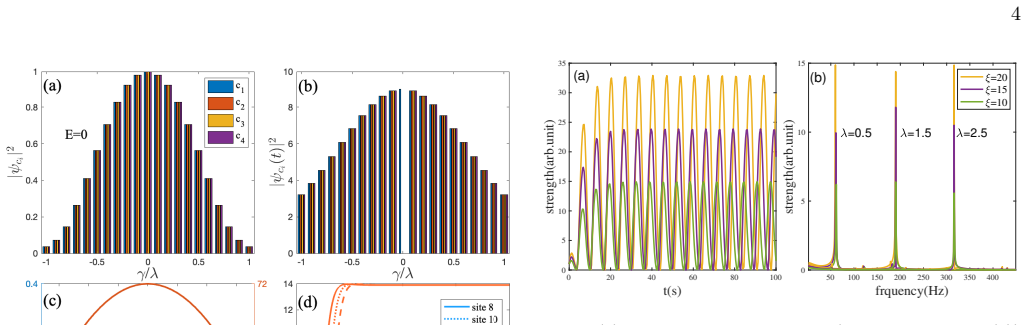
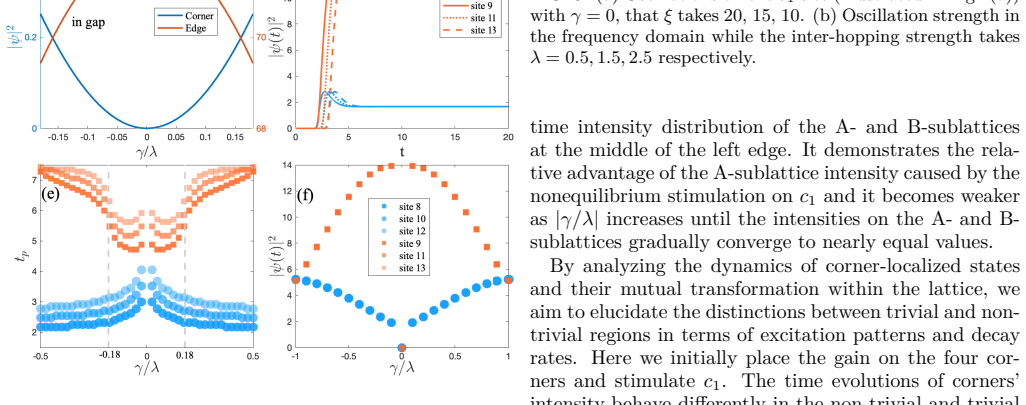
Two-dimensional higher-order topological insulators (HOTIs), characterized by distinctive one-dimensional edge states and zero-dimensional corner states, provide an ideal platform for developing higher-order topological lasers. In this work, we systematically investigate the two-dimensional Benalcazar-Bernevig-Hughes (BBH) model, which hosts quantized quadrupole moments and topologically protected corner and edge states. By confining the lasing mode to selected topological corner or edge states under controlled gain, we demonstrate that the stable light excitation achieved after long-time evolution is predominantly determined by the topological properties of the model Hamiltonian. To characterize the system's topological features, we introduce several diagnostic ratios: the corner decay ratio $\tau_{1}$ and edge-to-corner ratio $\tau_{2}$ quantify the localization degree and spatial extent of corner states, respectively, while the inter-corner transfer ratio $\chi$ measures the intensity transfer efficiency mediated by coherent edge-state dynamics. The abrupt changes in $\tau_{1}$ and $\tau_{2}$ as functions of the hopping parameter $\gamma/\lambda$ directly reveal topological phase transitions, providing a comprehensive toolkit for extracting topological signatures from the system's dynamical evolution. Additionally, modulating the lattice site parity enables flexible tuning of corner state localization positions, offering insights for device engineering. Our calculations reveal that achieving bistability between corner states and edge states is relatively challenging.
Editorial analysis
A structured set of objections, weighed in public.
Referee Report
Summary. The manuscript studies nonlinear lasing in the 2D BBH higher-order topological insulator. It claims that selective gain applied to corner or edge states leads to stable long-time excitations whose localization is dictated by the linear topological properties of the BBH Hamiltonian rather than by the gain profile or nonlinearity. Diagnostic ratios τ₁ (corner decay), τ₂ (edge-to-corner), and χ (inter-corner transfer) are defined from the simulated fields and shown to exhibit abrupt jumps at the γ/λ topological transition; parity modulation is used to tune corner localization, and corner-edge bistability is reported as difficult to achieve.
Significance. If the central claim is substantiated, the work supplies a concrete link between linear HOTI topology and nonlinear laser dynamics together with field-derived, parameter-free diagnostics (τ₁, τ₂, χ) that directly expose phase boundaries. These elements would constitute a useful addition to the topological-laser literature. The absence of ad-hoc fitting parameters in the reported ratios is a positive feature.
major comments (2)
- [section describing the gain implementation and invariant evaluation] The manuscript does not state whether the quadrupole invariant is recomputed after the imaginary on-site gain terms are added. Because the central claim requires that the linear BBH topology (rather than the gain profile) selects the stable mode, this omission is load-bearing; the phase boundary could shift once gain is present.
- [results on long-time evolution and phase diagram] No comparison is provided of the same gain profile applied inside the trivial phase. Without this control, it remains possible that the observed localization is selected by the spatial structure of the gain rather than by the linear topological classification.
Simulated Author's Rebuttal
We thank the referee for the careful reading and constructive comments on our manuscript. We address each major comment below and will revise the manuscript to incorporate the requested clarifications and controls.
read point-by-point responses
-
Referee: [section describing the gain implementation and invariant evaluation] The manuscript does not state whether the quadrupole invariant is recomputed after the imaginary on-site gain terms are added. Because the central claim requires that the linear BBH topology (rather than the gain profile) selects the stable mode, this omission is load-bearing; the phase boundary could shift once gain is present.
Authors: The referee is correct that the manuscript does not explicitly state whether the quadrupole invariant is recomputed once the imaginary gain terms are included. We will revise the manuscript to include a direct evaluation of the quadrupole invariant with the gain terms present. For the weak gain amplitudes used in the simulations, this calculation shows that the invariant remains quantized and identical to the linear (gain-free) case, confirming that the topology is not altered by the gain profile in the regime studied. The revised text will be added to the section on gain implementation and invariant evaluation. revision: yes
-
Referee: [results on long-time evolution and phase diagram] No comparison is provided of the same gain profile applied inside the trivial phase. Without this control, it remains possible that the observed localization is selected by the spatial structure of the gain rather than by the linear topological classification.
Authors: We agree that an explicit control simulation applying the identical gain profile inside the trivial phase would strengthen the central claim. Although the existing results already demonstrate that the diagnostic ratios τ₁, τ₂, and χ change abruptly only when γ/λ crosses the topological transition, we will add in the revised manuscript a direct side-by-side comparison of the same gain profiles in both the topological and trivial phases. These additional simulations will show that stable, topologically localized lasing modes do not emerge in the trivial regime, thereby confirming that the linear BBH topology, rather than the gain structure, selects the stable excitations. revision: yes
Circularity Check
No significant circularity; derivation is self-contained
full rationale
The paper applies the established BBH Hamiltonian (with its known quadrupole topology and corner/edge states) to a standard nonlinear evolution equation under selective gain. The introduced ratios τ1, τ2, and χ are defined directly from the post-evolution field intensities and are used only as post-hoc diagnostics that track the known linear phase boundary; they are not fitted parameters later relabeled as predictions. No self-citation load-bearing steps, uniqueness theorems imported from the same authors, or ansatzes smuggled via prior work appear in the provided text. The central claim that long-time stable excitation follows the linear topology therefore rests on independent simulation of a non-circular model rather than on any definitional reduction.
Axiom & Free-Parameter Ledger
axioms (2)
- domain assumption The two-dimensional BBH model hosts quantized quadrupole moments and topologically protected corner and edge states
- domain assumption Controlled gain can be applied selectively to topological states without destroying their topological character
Reference graph
Works this paper leans on
-
[2]
Two-photon Rabi splitting in a coupled system of a nanocavity and exciton complexes , author=. Phys. Rev. Lett. , volume=. 2018 , publisher=. doi:10.1063/5.0042975 , url=
-
[3]
Topological photonics , author=. Nat. Photon. , volume=. 2014 , publisher=. doi:10.1038/nphoton.2014.248 , url =
-
[4]
Topological photonics , author=. Rev. Mod. Phys. , volume=. 2019 , publisher=. doi:10.1103/RevModPhys.91.015006 , url =
-
[5]
Robust topologically protected transport in photonic crystals at telecommunication wavelengths , author=. Nat. Nanotechnol. , volume=. 2019 , publisher=. doi:10.1038/s41565-018-0297-6 , url =
-
[6]
Multipolar lasing modes from topological corner states , author=. Nat. Commun. , volume=. 2020 , publisher=. doi:10.1038/s41467-020-19609-9 , url =
-
[7]
Higher-order topological insulators , author=. Sci. Adv. , volume=. 2018 , publisher=. doi:10.1126/sciadv.aat0346 , url =
-
[8]
Higher-order topological insulators and superconductors protected by inversion symmetry , author=. Phys. Rev. B , volume=. 2018 , publisher=. doi:10.1103/PhysRevB.97.205136 , url =
-
[9]
Nonlinear non-Hermitian higher-order topological laser , author =. Phys. Rev. Res. , volume =. 2022 , month =. doi:10.1103/PhysRevResearch.4.013195 , url =
-
[10]
Higher-Order Topological Insulators and Semimetals on the Breathing Kagome and Pyrochlore Lattices , author =. Phys. Rev. Lett. , volume =. 2018 , month =. doi:10.1103/PhysRevLett.120.026801 , url =
-
[11]
Nonlinearity-induced transition in the nonlinear Su-Schrieffer-Heeger model and a nonlinear higher-order topological system , author =. Phys. Rev. B , volume =. 2021 , month =. doi:10.1103/PhysRevB.104.235420 , url =
-
[12]
Benalcazar and B
Wladimir A. Benalcazar and B. Andrei Bernevig and Taylor L. Hughes , title =. Science , volume =. 2017 , doi =
2017
-
[13]
Electric multipole moments, topological multipole moment pumping, and chiral hinge states in crystalline insulators , author =. Phys. Rev. B , volume =. 2017 , month =. doi:10.1103/PhysRevB.96.245115 , url =
-
[14]
Bandres and Yaakov Lumer and Mikael C
Gal Harari and Miguel A. Bandres and Yaakov Lumer and Mikael C. Rechtsman and Y. D. Chong and Mercedeh Khajavikhan and Demetrios N. Christodoulides and Mordechai Segev , title =. Science , volume =. 2018 , doi =
2018
-
[15]
Bandres and Steffen Wittek and Gal Harari and Midya Parto and Jinhan Ren and Mordechai Segev and Demetrios N
Miguel A. Bandres and Steffen Wittek and Gal Harari and Midya Parto and Jinhan Ren and Mordechai Segev and Demetrios N. Christodoulides and Mercedeh Khajavikhan , title =. Science , volume =. 2018 , doi =
2018
-
[16]
Visualization of Higher-Order Topological Insulating Phases in Two-Dimensional Dielectric Photonic Crystals , author =. Phys. Rev. Lett. , volume =. 2019 , month =. doi:10.1103/PhysRevLett.122.233903 , url =
-
[17]
Nonlinear second-order photonic topological insulators , author=. Nat. Phys. , volume =. 2021 , doi =
2021
-
[18]
Malzard, Simon and Schomerus, Henning , title =. 2018 , month =. doi:10.1088/1367-2630/aac9e0 , url =
-
[19]
Inverse design of high-Q topological corner states nanocavities based on deep reinforcement learning , author=. Opt. Commun. , volume=. 2025 , publisher=. doi:10.1016/j.optcom.2024.131402 , url =
-
[20]
AI-Assisted Topological Photonic Crystals: Design Methods, Applications, Challenges and Opportunities , author=. Laser Photon. Rev. , pages=. 2026 , publisher=. doi:10.1002/lpor.71350 , url =
-
[21]
Topological nanorainbow laser , author=. Sci. Adv. , volume=. 2025 , publisher=. doi:10.1126/sciadv.ady6039 , url =
-
[22]
Wu, Bo and Ding, Jinting and Yan, Wenchao and Jia, Yuechen and Yu, Haohai and Ni, Xiang and Chen, Feng , title=. Nature Communications , year=. doi:10.1038/s41467-025-68173-7 , url=
-
[23]
Universal sign control of coupling in tight-binding lattices , author=. Phys. Rev. Lett. , volume=. 2016 , publisher=. doi:10.1103/PhysRevLett.116.213901 , url =
-
[24]
Topological bulk lasing modes using an imaginary gauge field , author =. Phys. Rev. Res. , volume =. 2021 , month =. doi:10.1103/PhysRevResearch.3.033042 , url =
-
[25]
Lattice models with exactly solvable topological hinge and corner states , author =. Phys. Rev. B , volume =. 2018 , month =. doi:10.1103/PhysRevB.97.241405 , url =
-
[26]
Corner modes of the breathing kagome lattice: Origin and robustness , author =. Phys. Rev. B , volume =. 2022 , month =. doi:10.1103/PhysRevB.105.085411 , url =
-
[27]
Nature , volume=
Exciton-polariton topological insulator , author=. Nature , volume=. 2021 , doi =
2021
-
[28]
Second-order photonic topological insulator with corner states , author =. Phys. Rev. B , volume =. 2018 , month =. doi:10.1103/PhysRevB.98.205147 , url =
-
[29]
Zhang, Weixuan and Xie, Xin and Hao, Huiming and Dang, Jianchen and Xiao, Shan and Shi, Shushu and Ni, Haiqiao and Niu, Zhichuan and Wang, Can and Jin, Kuijuan and Zhang, Xiangdong and Xu, Xiulai , title=. Light Sci. Appl. , year=. doi:10.1038/s41377-020-00352-1 , url=
-
[30]
Zhang, Li and Yang, Yihao and Lin, Zhi-Kang and Qin, Pengfei and Chen, Qiaolu and Gao, Fei and Li, Erping and Jiang, Jian-Hua and Zhang, Baile and Chen, Hongsheng , title =. Adv. Sci. , volume =. doi:https://doi.org/10.1002/advs.201902724 , url =
-
[31]
Wang, Zheng and Chong, Yidong and Joannopoulos, J. D. and Solja. Observation of unidirectional backscattering-immune topological electromagnetic states , journal=. 2009 , month=. doi:10.1038/nature08293 , url=
-
[32]
and Malzard, Simon and El-Ganainy, Ramy and Schomerus, Henning and Feng, Liang , title=
Zhao, Han and Miao, Pei and Teimourpour, Mohammad H. and Malzard, Simon and El-Ganainy, Ramy and Schomerus, Henning and Feng, Liang , title=. Nat. Commun. , year=. doi:10.1038/s41467-018-03434-2 , url=
-
[33]
Edge-Mode Lasing in 1D Topological Active Arrays , author =. Phys. Rev. Lett. , volume =. 2018 , month =. doi:10.1103/PhysRevLett.120.113901 , url =
-
[34]
St-Jean, P. and Goblot, V. and Galopin, E. and Lema. Lasing in topological edge states of a one-dimensionallattice , journal=. 2017 , month=. doi:10.1038/s41566-017-0006-2 , url=
-
[35]
Nonreciprocal lasing in topological cavities of arbitrary geometries , author=. Science , volume=. 2017 , publisher=. doi:10.1126/science.aao4551 , url=
-
[36]
Topological photonic crystal nanocavity laser , author=. Commun. Phys. , year=. doi:10.1038/s42005-018-0083-7 , url=
-
[37]
Two-Dimensional Second-Order Topological Insulator in Graphdiyne , author =. Phys. Rev. Lett. , volume =. 2019 , month =. doi:10.1103/PhysRevLett.123.256402 , url =
-
[38]
Colloquium: Topological insulators , author =. Rev. Mod. Phys. , volume =. 2010 , month =. doi:10.1103/RevModPhys.82.3045 , url =
-
[39]
Topological insulators and superconductors , author =. Rev. Mod. Phys. , volume =. 2011 , month =. doi:10.1103/RevModPhys.83.1057 , url =
-
[40]
Colloquium: Topological band theory , author =. Rev. Mod. Phys. , volume =. 2016 , month =. doi:10.1103/RevModPhys.88.021004 , url =
-
[41]
Shen , title =
S.-Q. Shen , title =
-
[42]
Reflection-Symmetric Second-Order Topological Insulators and Superconductors , author =. Phys. Rev. Lett. , volume =. 2017 , month =. doi:10.1103/PhysRevLett.119.246401 , url =
-
[43]
Song, Zhida and Fang, Zhong and Fang, Chen , journal =. (d. 2017 , month =. doi:10.1103/PhysRevLett.119.246402 , url =
-
[44]
Two-Dimensional Topological Polariton Laser , author =. Phys. Rev. Lett. , volume =. 2019 , month =. doi:10.1103/PhysRevLett.122.083902 , url =
discussion (0)
Sign in with ORCID, Apple, or X to comment. Anyone can read and Pith papers without signing in.