High temporal resolution THz streaking of high brightness relativistic electron beams
Pith reviewed 2026-05-21 00:39 UTC · model grok-4.3
The pith
Horn-coupled THz waveguides enable systematic characterization of relativistic electron beam streaking for ultrafast diagnostics.
A machine-rendered reading of the paper's core claim, the machinery that carries it, and where it could break.
Core claim
Horn-coupled waveguide geometries for THz streaking allow comparative measurement of streaking strength, dispersion, transmission, and temporal fidelity; analytical models and simulations show the dependence of streaking power on waveguide dimensions and drive frequency; experimental characterization with relativistic electron beams from an RF photoinjector over ranges of THz field strength, beam energy, and bunch duration establishes general design principles and performance limits for these structures in ultrafast electron beam diagnostics.
What carries the argument
Horn-coupled waveguide geometries that couple THz fields into the electron beam path to induce streaking while controlling dispersion and transmission.
If this is right
- Streaking power scales predictably with waveguide dimensions and drive frequency according to the analytical models.
- Dispersion and transmission losses set concrete upper bounds on temporal resolution achievable in a given geometry.
- The same structures can be applied across a practical range of beam energies and bunch durations without redesign.
- Performance limits identified in the study directly inform the choice of THz field strength for a target diagnostic resolution.
Where Pith is reading between the lines
- These design rules could be used to adapt the structures for integration into operating accelerator beamlines for continuous monitoring.
- The scaling relations may extend to non-relativistic beams or different frequency bands if the same electromagnetic assumptions hold.
- Improved temporal fidelity could enable new classes of pump-probe experiments that resolve sub-picosecond dynamics in beam-driven sources.
Load-bearing premise
Electron beam parameters such as energy, duration, and transverse size remain stable and accurately known across different THz field strengths and waveguide configurations, allowing streaking signals to be attributed to the structures themselves.
What would settle it
Streaking signals that change substantially when beam energy or duration varies slightly while the waveguide and THz drive remain fixed would show that beam instability rather than waveguide properties dominate the results.
Figures




read the original abstract
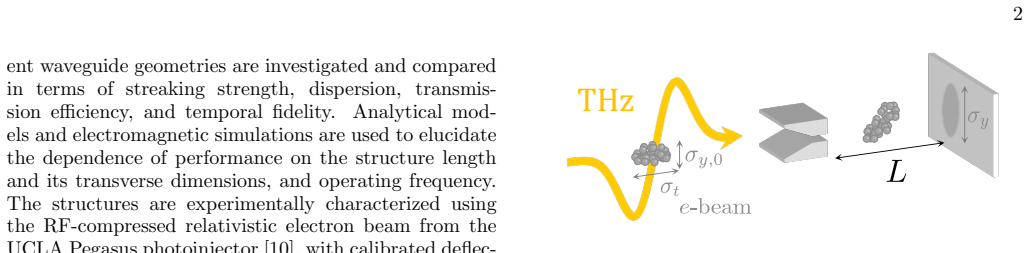
We report a systematic experimental study of terahertz (THz) streaking structures for ultrafast characterization of relativistic, high-brightness electron beams. Horn-coupled waveguide geometries are investigated, enabling a comparative characterization of streaking strength, dispersion, transmission, and temporal fidelity. Analytical models and electromagnetic simulations are used to describe the dependence of streaking power on the waveguide dimensions and the drive frequency. Experimentally, the structures are characterized using compressed electron beam from an RF photoinjector over a range of THz field strengths, beam energies, and bunch durations. These results establish general design principles and performance limits for THz streaking structures applicable to ultrafast electron beam diagnostics.
Editorial analysis
A structured set of objections, weighed in public.
Referee Report
Summary. The paper reports a systematic experimental study of horn-coupled THz waveguide streaking structures for ultrafast characterization of relativistic high-brightness electron beams from an RF photoinjector. Analytical models and electromagnetic simulations describe streaking power dependence on waveguide dimensions and drive frequency. Experiments characterize streaking strength, dispersion, transmission, and temporal fidelity over ranges of THz field strengths, beam energies, and bunch durations, establishing general design principles and performance limits for such diagnostics.
Significance. If the central attribution of streaking signals holds, the work supplies valuable experimental benchmarks and comparative data on waveguide geometries that can guide design of high-temporal-resolution beam diagnostics in accelerator physics. The combination of direct measurements with supporting simulations is a strength, though the load-bearing assumption of beam-parameter stability requires explicit verification to support the general-design-principles claim.
major comments (1)
- [Experimental characterization] Experimental characterization section: the manuscript does not report independent diagnostics (e.g., repeated energy-spectrometer shots, transverse-emittance scans, or bunch-length measurements) performed at each combination of THz field strength and waveguide configuration. Without a quantitative stability budget demonstrating that injector jitter is much smaller than the observed streaking effect, the isolation of structure performance from possible RF-photoinjector variations remains insecure; this directly undermines the mapping from data to the claimed general design principles.
minor comments (1)
- [Abstract] The abstract states the range of conditions tested but does not include quantitative metrics of experiment-simulation agreement or error bars; adding these would improve clarity.
Simulated Author's Rebuttal
We thank the referee for their careful and constructive review of our manuscript. We have addressed the major comment on experimental characterization by agreeing to strengthen the presentation of beam stability in the revised version.
read point-by-point responses
-
Referee: [Experimental characterization] Experimental characterization section: the manuscript does not report independent diagnostics (e.g., repeated energy-spectrometer shots, transverse-emittance scans, or bunch-length measurements) performed at each combination of THz field strength and waveguide configuration. Without a quantitative stability budget demonstrating that injector jitter is much smaller than the observed streaking effect, the isolation of structure performance from possible RF-photoinjector variations remains insecure; this directly undermines the mapping from data to the claimed general design principles.
Authors: We agree that an explicit stability budget is necessary to robustly support the claimed general design principles. The current manuscript does not include such a quantitative analysis or the requested independent diagnostics at each configuration. In the revised manuscript we will add a dedicated subsection to the Experimental characterization section that presents shot-to-shot variations from the existing data sets (including repeated measurements at fixed THz and waveguide settings) together with a stability budget demonstrating that injector jitter remains substantially smaller than the observed streaking signals. This addition will directly address the concern and strengthen the isolation of structure performance. revision: yes
Circularity Check
No significant circularity; central results from direct experimental measurements and independent analytical/EM models
full rationale
The paper reports systematic experimental characterization of horn-coupled THz waveguide streaking structures using real compressed electron beams from an RF photoinjector, with variations in field strength, energy, and bunch duration. Analytical models and electromagnetic simulations are invoked to describe streaking power dependence on waveguide dimensions and drive frequency, but these are presented as first-principles descriptions rather than reductions to parameters fitted from the same dataset. No self-definitional equations, fitted-input predictions, or load-bearing self-citations appear in the derivation chain; the mapping from observed streaking signals to design principles rests on external beam diagnostics and is self-contained against independent benchmarks.
Axiom & Free-Parameter Ledger
axioms (2)
- standard math Standard electromagnetic boundary conditions and mode propagation apply inside the horn-coupled waveguides at the chosen THz frequencies.
- domain assumption The electron beam parameters delivered by the RF photoinjector are stable and independently measurable across the tested range of THz field strengths.
Lean theorems connected to this paper
-
IndisputableMonolith/Cost/FunctionalEquation.leanwashburn_uniqueness_aczel unclear?
unclearRelation between the paper passage and the cited Recognition theorem.
S = d(Δy′)/dt ≈ ωeV⊥,eff / Eb (Eq. 1); Ld = π/k0 |1/β − 1/βph| (Eq. 3); V⊥,eff = Emax L (1−β/βph) sinc(πL/2Ld) ηloss (Eq. 4)
-
IndisputableMonolith/Foundation/RealityFromDistinction.leanreality_from_one_distinction unclear?
unclearRelation between the paper passage and the cited Recognition theorem.
horn-coupled rectangular waveguide and parallel-plate waveguide structures... analytical models and electromagnetic simulations
What do these tags mean?
- matches
- The paper's claim is directly supported by a theorem in the formal canon.
- supports
- The theorem supports part of the paper's argument, but the paper may add assumptions or extra steps.
- extends
- The paper goes beyond the formal theorem; the theorem is a base layer rather than the whole result.
- uses
- The paper appears to rely on the theorem as machinery.
- contradicts
- The paper's claim conflicts with a theorem or certificate in the canon.
- unclear
- Pith found a possible connection, but the passage is too broad, indirect, or ambiguous to say the theorem truly supports the claim.
Reference graph
Works this paper leans on
-
[1]
D. Filippetto, P. Musumeci, R. Li, B. J. Siwick, M. Otto, M. Centurion, and J. Nunes, Reviews of modern physics 94, 045004 (2022)
work page 2022
-
[2]
S. Weathersby, G. Brown, M. Centurion, T. Chase, R. Coffee, J. Corbett, J. Eichner, J. Frisch, A. Fry, M. G¨ uhr,et al., Review of Scientific Instruments86 11 (2015)
work page 2015
-
[3]
F. Qi, Z. Ma, L. Zhao, Y. Cheng, W. Jiang, C. Lu, T. Jiang, D. Qian, Z. Wang, W. Zhang,et al., Physi- cal review letters124, 134803 (2020)
work page 2020
-
[4]
P. Emma, R. Akre, J. Arthur, R. Bionta, C. Bostedt, J. Bozek, A. Brachmann, P. Bucksbaum, R. Coffee, F.-J. Decker,et al., nature photonics4, 641 (2010)
work page 2010
- [5]
-
[6]
F. Hartemann, W. Brown, D. Gibson, S. Anderson, A. Tremaine, P. Springer, A. Wootton, . f. E. Har- touni, and C. Barty, Physical Review Special Top- ics—Accelerators and Beams8, 100702 (2005)
work page 2005
- [7]
-
[8]
P. Piot, C. Behrens, C. Gerth, M. Dohlus, F. Lemery, D. Mihalcea, P. Stoltz, and M. Vogt, Physical Review Letters108, 034801 (2012)
work page 2012
-
[9]
D. Alesini, G. Di Pirro, L. Ficcadenti, A. Mostacci, L. Palumbo, J. Rosenzweig, and C. Vaccarezza, Nuclear Instruments and Methods in Physics Research Section A: Accelerators, Spectrometers, Detectors and Associated Equipment568, 488 (2006)
work page 2006
- [10]
-
[11]
R. Akre, D. Dowell, P. Emma, J. Frisch, S. Gile- vich, G. Hays, P. Hering, R. Iverson, C. Limborg- Deprey, H. Loos,et al., Physical Review Special Top- ics—Accelerators and Beams11, 030703 (2008)
work page 2008
-
[12]
C. Behrens, F.-J. Decker, Y. Ding, V. A. Dolgashev, J. Frisch, Z. Huang, P. Krejcik, H. Loos, A. Lutman, T. Maxwell,et al., Nature communications5, 3762 (2014)
work page 2014
- [14]
-
[15]
R. Li, M. Hoffmann, E. Nanni, S. Glenzer, M. Koz- ina, A. Lindenberg, B. Ofori-Okai, A. Reid, X. Shen, S. Weathersby,et al., Physical Review Accelerators and Beams22, 012803 (2019)
work page 2019
-
[16]
L. Zhao, Z. Wang, C. Lu, R. Wang, C. Hu, P. Wang, J. Qi, T. Jiang, S. Liu, Z. Ma,et al., Physical Review X 8, 021061 (2018)
work page 2018
-
[17]
M. A. Othman, A. E. Gabriel, E. C. Snively, M. E. Koz- ina, X. Shen, F. Ji, S. Lewis, S. Weathersby, P. Vasireddy, D. Luo,et al., Applied Physics Letters122(2023)
work page 2023
-
[18]
E. Snively, M. Othman, M. Kozina, B. Ofori-Okai, S. Weathersby, S. Park, X. Shen, X. Wang, M. Hoffmann, R. Li,et al., Physical review letters124, 054801 (2020)
work page 2020
-
[19]
E. A. Nanni, W. R. Huang, K.-H. Hong, K. Ravi, A. Fal- lahi, G. Moriena, R. Dwayne Miller, and F. X. K¨ artner, Nature communications6, 8486 (2015)
work page 2015
- [20]
-
[21]
M. T. Hibberd, A. L. Healy, D. S. Lake, V. Georgiadis, E. J. Smith, O. J. Finlay, T. H. Pacey, J. K. Jones, Y. Saveliev, D. A. Walsh,et al., Nature Photonics14, 755 (2020)
work page 2020
- [22]
-
[23]
H. Xu, L. Yan, Y. Du, W. Huang, Q. Tian, R. Li, Y. Liang, S. Gu, J. Shi, and C. Tang, Nature Photonics 15, 426 (2021)
work page 2021
-
[24]
H. Tang, L. Zhao, P. Zhu, X. Zou, J. Qi, Y. Cheng, J. Qiu, X. Hu, W. Song, D. Xiang,et al., Physical Review Letters 127, 074801 (2021)
work page 2021
-
[25]
J. Fabia´ nska, G. Kassier, and T. Feurer, Scientific re- ports4, 5645 (2014)
work page 2014
- [26]
-
[27]
I. H. Baek, H. W. Kim, H. S. Bark, K.-H. Jang, S. Park, J. Shin, Y. C. Kim, M. Kim, K. Y. Oang, K. Lee,et al., Nature communications12, 6851 (2021)
work page 2021
- [28]
-
[29]
D. Alesini, A. Battisti, M. Ferrario, L. Foggetta, V. Lollo, L. Ficcadenti, V. Pettinacci, S. Custodio, E. Pirez, P. Musumeci,et al., Physical Review Special Top- ics—Accelerators and Beams18, 092001 (2015)
work page 2015
- [30]
-
[31]
V. Georgiadis, A. Healy, M. Hibberd, G. Burt, S. Jami- son, and D. Graham, Applied Physics Letters118 (2021)
work page 2021
-
[32]
D. S. Lake, M. T. Hibberd, C. T. Shaw, V. Georgiadis, O. J. Finlay, D. M. Graham, G. M. Burt, R. B. Appleby, and S. P. Jamison, in2022 47th International Conference on Infrared, Millimeter and Terahertz Waves (IRMMW- THz)(IEEE, 2022) pp. 1–2
work page 2022
-
[33]
Zangwill,Modern electrodynamics(Cambridge Uni- versity Press, 2013)
A. Zangwill,Modern electrodynamics(Cambridge Uni- versity Press, 2013)
work page 2013
-
[34]
W. L. Stutzman and G. A. Thiele,Antenna theory and design(John Wiley & Sons, 2012)
work page 2012
-
[35]
X. Wu, D. Kong, S. Hao, Y. Zeng, X. Yu, B. Zhang, M. Dai, S. Liu, J. Wang, Z. Ren,et al., Advanced Mate- rials35, 2208947 (2023)
work page 2023
-
[36]
T. Kroh, T. Rohwer, D. Zhang, U. Demirbas, H. Cankaya, M. Hemmer, Y. Hua, L. E. Zapata, M. Pergament, F. X. K¨ artner,et al., Optics Express30, 24186 (2022)
work page 2022
-
[37]
J. Hebling, A. Stepanov, G. Alm´ asi, B. Bartal, and J. Kuhl, Applied Physics B78, 593 (2004)
work page 2004
-
[38]
J. Hebling, G. Almasi, I. Z. Kozma, and J. Kuhl, Optics express10, 1161 (2002)
work page 2002
- [39]
-
[40]
L. P´ alfalvi, J. Hebling, J. Kuhl, A. Peter, and K. Polg´ ar, Journal of applied physics97(2005)
work page 2005
-
[41]
M. Nakamura, S. Higuchi, S. Takekawa, K. Terabe, Y. Furukawa, and K. Kitamura, Japanese journal of ap- plied physics41, L49 (2002)
work page 2002
-
[42]
A. Buz´ ady, R. G´ alos, G. Makkai, X. Wu, G. T´ oth, L. Kov´ acs, G. Alm´ asi, J. Hebling, and L. P´ alfalvi, Op- tical Materials Express10, 998 (2020)
work page 2020
- [43]
- [44]
- [45]
-
[46]
L. Guiramand, J. Nkeck, X. Ropagnol, T. Ozaki, and 12 F. Blanchard, Photonics Research10, 340 (2022)
work page 2022
-
[47]
A. E. Gabriel, M. A. Othman, P. L. Kramer, H. Miura, M. C. Hoffmann, and E. A. Nanni, Optics Express33, 37084 (2025)
work page 2025
-
[48]
E. Prat, Z. Geng, C. Kittel, A. Malyzhenkov, F. Mar- cellini, S. Reiche, T. Schietinger, and P. Craievich, Ad- vanced Photonics7, 026002 (2025)
work page 2025
-
[49]
N. Wiener,Extrapolation, interpolation, and smoothing of stationary time series: with engineering applications (The MIT press, 1949)
work page 1949
-
[50]
Nyquist, Transactions of the American Institute of Electrical Engineers47, 617 (1928)
H. Nyquist, Transactions of the American Institute of Electrical Engineers47, 617 (1928)
work page 1928
-
[51]
L. Zhao, Z. Wang, H. Tang, R. Wang, Y. Cheng, C. Lu, T. Jiang, P. Zhu, L. Hu, W. Song,et al., Physical review letters122, 144801 (2019)
work page 2019
-
[52]
K. Iwaszczuk, A. Andryieuski, A. Lavrinenko, X.-C. Zhang, and P. U. Jepsen, Optics express20, 8344 (2012)
work page 2012
-
[53]
D. Rohrbach, B. J. Kang, E. Zyaee, and T. Feurer, Sci- entific reports13, 15228 (2023)
work page 2023
-
[54]
X. He, J. Zheng, D. Su, J. Ying, L. Liu, H. Xuan, J. Ma, P. Yuan, N. H. Matlis, F. X. Kartner,et al., Acs Photon- ics12, 3064 (2025)
work page 2025
discussion (0)
Sign in with ORCID, Apple, or X to comment. Anyone can read and Pith papers without signing in.