REVIEW 3 major objections 7 minor 37 references
Tungsten erosion and scrape-off layer transport modelling in L-mode helium plasma discharges in ASDEX Upgrade
T0 review · 3 major / 7 minor · reviewed 2026-08-07 · deepseek-v4-flash
Pith's one-line read In helium tokamak plasma, He2+ governs tungsten divertor erosion, and a standard fluid sheath boundary condition inflates the tungsten source about 20-fold.
desk verdict Solid applied modeling paper with a genuinely useful analytical erosion model and an important SOLPS boundary-condition finding, but the quantitative erosion match is a multi-parameter fit and T_i uncertainty could shift the central relative claims. read the letter →
The pith
A machine-rendered reading of the paper's core claim, the machinery that carries it, and where it could break.
The reading
What carries the argument
The argument is carried by two quantitative objects. The first is the He2+ fraction $f_{\mathrm{He}^{2+}}$ and the sheath impact energy formula $E_{\mathrm{wall}} = 2T_i + Ze|V_{\mathrm{sh}}| \sim 2T_i + 3ZeT_e$, combined with He-W sputtering yields: because the yield rises steeply with energy below about 65 eV, the doubly charged ion's extra sheath acceleration outweighs its halved particle flux, so erosion increases with $f_{\mathrm{He}^{2+}}$. The second is the magnetic pre-sheath velocity boundary condition in the fluid code, comparing the collective fluid velocity with the single-species ion sound speed; switching between them changes the predicted tungsten source by a factor of about 20 through self-sputtering, with the species-dependent condition matching the kinetic Monte-Carlo result.
What would settle it
Take a repeat discharge with the same settings as #36687, measure the divertor ion temperature and O6+ density simultaneously, and compare ERO2.0's predicted erosion thickness against post-mortem marker measurements: if measured O6+ is below about 1% and erosion is still 50-100 nm, the model chain is missing something; if O6+ is a few percent and erosion matches, the impurity explanation is confirmed.
Extended reading notes
Core claim
On the paper's own terms, the central discovery is that divertor tungsten erosion in attached L-mode helium plasmas is carried overwhelmingly by He2+ ions, even where the He+ and He2+ fluxes are comparable, and that standard fluid simulations with a collective sheath velocity boundary condition overestimate the tungsten source by roughly a factor of 20 relative to kinetic modelling. The overestimate is traced to tungsten self-sputtering: when W ions are forced to leave at the collective helium sound speed, they strike the targets with inflated energy, whereas species-specific Bohm speeds and kinetic tracing give much lower self-sputtering. The same kinetic model, however, underpredicts the net erosion measured on exposed tungsten samples by more than an order of magnitude unless the plasma contains a few percent of highly charged oxygen, suggesting that extrinsic impurities rather than helium sputtering are the dominant measured erosion driver.
Load-bearing premise
Everything hinges on the unvalidated SOLPS-ITER ion temperature and on the constant extrapolation of plasma parameters from the simulation grid to wall surfaces; if those near-wall values are wrong, the predicted erosion rates and the inferred role of impurities change substantially.
Editorial extensions
If this is right
- Erosion estimates for helium plasmas must track He+ and He2+ separately; assuming a fully singly charged plasma underestimates the tungsten source by more than an order of magnitude in the conditions studied.
- Fluid impurity simulations that default to perfect entrainment at the target can overstate heavy-impurity self-sputtering by about 20 times; the single-species sound-speed condition is the closer match to kinetic results.
- Net erosion of marker samples in the strike-point region can only be reproduced when a few percent of high-charge oxygen is included, so measured erosion in such discharges points to extrinsic impurities as a major contributor.
- The two codes disagree on tungsten migration: kinetic tracing moves W toward the X-point through the $\nabla B$ drift, while the no-drift fluid version needs a 100-fold lower anomalous diffusivity to produce similar profiles.
Reading between the lines
- The temperature crossover of the erosion ranking is a general consequence of the sputtering-yield curve shape, so in hotter divertor conditions (above about 65 eV for He on W at normal incidence) the ranking could invert and He+ might dominate; this is an extrapolation of the analytical model, not a claim the paper makes for other devices.
- The sheath boundary-condition sensitivity likely applies to any heavy impurity in fluid edge codes, including tungsten in deuterium-tritium plasmas, not only helium; a re-run with hydrogenic main ions would be a direct test.
- Coupling kinetic-code tungsten sources into the fluid code with species-dependent Bohm speed would be a practical recipe for divertor impurity studies while avoiding the artificial self-sputtering inflation.
- Spectroscopic measurement of the charge-state distribution of tungsten ions arriving at the targets could discriminate between the fluid and kinetic transport models, since the fluid model predicts a distribution peaked at higher charge states than the kinetic one.
Signed reviews
Editorial analysis
A structured set of objections, weighed in public.
Referee Report
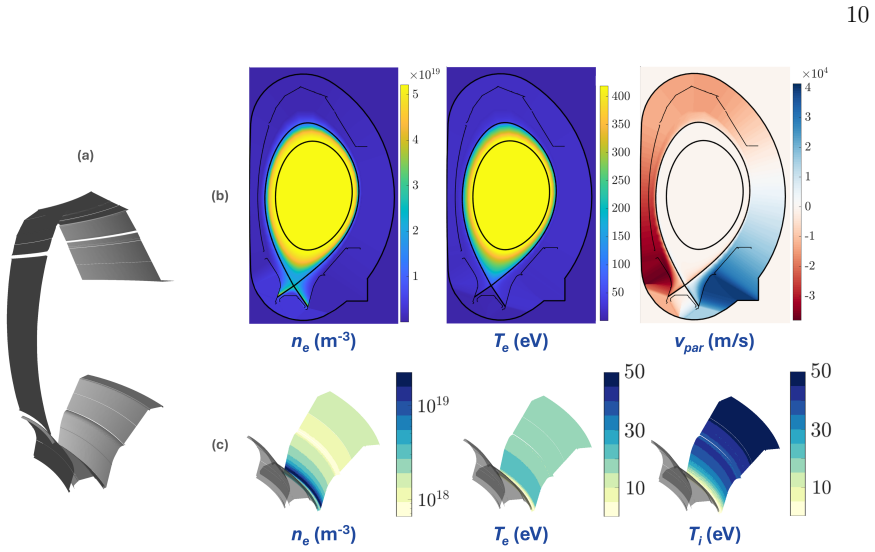
Summary. This manuscript models tungsten erosion and scrape-off-layer transport in the L-mode helium discharge #36687 at ASDEX Upgrade, combining a simplified analytical sputtering model, SOLPS-ITER plasma background and impurity simulations, and ERO2.0 kinetic impurity tracing. The SOLPS-ITER background is benchmarked against outboard midplane and outer divertor diagnostics. The authors report that the divertor ion flux near the strike point is approximately 50% He+ and 50% He2+, with He2+ dominating farther into the scrape-off layer. An analytical model predicts that for Te=Ti below about 65 eV, erosion increases with He2+ fraction; ERO2.0 with the SOLPS background confirms that the mixed-fraction case is closer to the full-He2+ case than to the full-He+ case. Net erosion predicted by ERO2.0 is more than an order of magnitude below the 50–100 nm measured post-mortem, and agreement is recovered only by combining elevated temperatures (factor 2) with a fitted O6+ concentration of a few percent. In the final section, SOLPS-ITER simulations with tungsten show that the choice of sheath boundary condition (collective fluid velocity vs species-dependent sound speed) changes the gross tungsten source by about a factor 20, mainly through self-sputtering, and that ERO2.0 transports more tungsten towards the X-point, an effect that can be partly compensated by reducing the anomalous diffusivity D_W.
Significance. The paper addresses a relevant gap in quantitative plasma-wall interaction modelling for helium plasmas, where the ion charge state is not directly measurable. If the results hold, the analytical crossover criterion and the ERO2.0/SOLPS comparison are useful contributions to the community. Strengths include the benchmarking of SOLPS-ITER against outboard midplane and outer divertor data, an analytical model that is parameter-free in the sense of depending only on standard sputtering data and the SOLPS-derived saturation current, an explicit sensitivity analysis over Te, Ti, incidence angle, and oxygen concentration, and a clear quantification of the effect of sheath boundary conditions on the tungsten source in Table 1. The main caveat is that the apparent agreement with experimental erosion in Fig. 8 is obtained by fitting the unmeasured oxygen concentration after applying temperature multipliers, and the ion temperature field is not independently validated; the paper would be strengthened by presenting the He2+ versus He+ dominance and the boundary-condition factor as functions of the Ti/Te uncertainty.
major comments (3)
- [§4.3, Figs. 6–8] The quantitative comparison with post-mortem erosion is not a prediction: the baseline ERO2.0 result (a few nm) is more than an order of magnitude below the measured 50–100 nm, and the agreement in Fig. 8 is obtained only after applying an ad hoc factor 2 to both Te and Ti and treating the O6+ concentration as a free parameter in the range 0.1–3%. Because the final profile is produced by this fitted combination, the statement in the conclusions that the model could be considered general overreaches. Please state explicitly that the Fig. 8 agreement is a fit, and provide the resulting uncertainty band on the inferred oxygen concentration and on the predicted eroded depth.
- [§4.3 and §3] The central claim that He2+ dominates even where the two helium ion species are roughly equal in density depends on the simulated Te and Ti remaining below the ~65 eV crossover of the analytical model. The paper states in Sec. 4.3 that Ti is not directly validated, and Fig. 6 shows that a factor 2–3 increase in Ti changes net erosion by orders of magnitude. Under a hotter Ti, the sputtering yields for He+ and He2+ converge, so the relative contribution could reverse. Please add a sensitivity scan of the ERO2.0 He2+ versus He+ erosion ratio over the plausible Ti range, or provide an independent constraint on Ti near the strike point.
- [§5.1–5.2, Table 1] The factor of about 20 between the collective and species-dependent sheath boundary conditions (90.08 vs 5.08×10^19 W/s) is computed at the baseline low-temperature background. Since the difference is attributed mainly to W self-sputtering, which is steeply energy-dependent, the factor may itself be sensitive to the same Te/Ti uncertainty identified in Sec. 4.3. The manuscript should either show the ratio as a function of background temperature or explicitly qualify the 20-fold statement as conditional on the SOLPS background.
minor comments (7)
- [Fig. 6] The 'notch around 0.2 m' is described as a geometry artifact; it should be masked or removed from the published figure to avoid confusion.
- [Fig. 3] The color scale and level curves are difficult to read because the panel labels repeat; consider a single shared color bar and larger labels.
- [Eq. (2)] The text says that |V_sh| is often approximated as 3Te, but the full logarithmic expression is also given; please define the symbols me, mp, and A, and clarify when the 3Te approximation is used.
- [§5.1] The 'jett' bundling model is not defined; a one-sentence description of the bundling method would help readers understand the 24 bundled tungsten species.
- [§4.2] The incidence-angle distribution obtained from the sheath tracing module is described but not shown; a plot or a quantitative statement of the distribution width would support the choice of 80°.
- [§5.2, Table 1] The analytical model values in Table 1 should be compared only against the ERO2.0 quantity Γ_TOT − Γ_SELF, as the text correctly notes that self-sputtering is absent from the analytical model; the table caption should state this explicitly.
- [§5.3] The conclusion that lowering D_W in ERO2.0 reproduces the SOLPS W density pattern is based on W density, while the abstract mentions 'W influx in core'; please clarify whether the comparison is on density or on flux.
Circularity Check
The central He2+-dominance and boundary-condition results are independent outputs, but the post-mortem agreement is obtained by scanning oxygen concentration and temperature factors until the measured erosion is matched, making that specific agreement a fitted calibration rather than a prediction.
-
fitted input called prediction
[Section 4.3, parameter scan for Fig. 8]
"since the O content in plasma is the most uncertain parameter in these discharges, it has been decided to fix reasonable Te and Ti factors with respect to LP data in figure 1.b and consider O as a free parameter. A factor 2 to both temperatures has thus been assumed, while O concentration in its high charge state has been varied in the range 0.1−3.0%. ... A reasonable agreement with experimental data can now already be found assuming an O content of a few percent, which could give an indication about the presence of light impurities in AUG discharges."
The oxygen concentration is not constrained by an independent measurement; it is scanned until the ERO2.0 net erosion matches the post-mortem 50-100 nm eroded thickness, after also multiplying Te and Ti by a factor of 2. The resulting agreement is therefore produced by construction from the fitted parameter, and presenting it as an indication of oxygen presence inverts the direction of inference. The paper honestly labels O as a free parameter, and this fitted match is not load-bearing for the separate He2+-dominance or boundary-condition conclusions, so it is a minor, non-central circularity.
full rationale
The main derivation chain is not circular. SOLPS-ITER is validated against independent experimental data (OMP IDA/Thomson profiles and divertor Langmuir-probe j_sat profiles in Fig. 1), and the He+/He2+ split is an output of the multi-ion fluid simulation rather than a prescribed input. The analytical model in Eqs. (2)-(3) combines that split, the sheath-energy expression, and tabulated Eckstein/SDTrimSP sputtering yields to obtain the T~65 eV crossover and the He2+-dominance conclusion; ERO2.0 then uses the same SOLPS background but independent kinetic sputtering and transport physics, so the agreement between ERO2.0 and the analytical model is a genuine cross-check. The boundary-condition comparison in Table 1 is also an unforced output: two stated sheath-velocity options give 5.08e19 versus 90.08e19 W atoms/s, while ERO2.0 independently yields 3.51e19, and the factor-of-20 conclusion follows from the simulations rather than from any fitted parameter. The only element approaching circularity is the post-mortem erosion match in Sec. 4.3, where O6+ concentration, together with a Te/Ti multiplication factor, is varied until the measured eroded thickness is reproduced; the paper is transparent about treating O as free, and it does not base the central He2+ or boundary-condition claims on that fit. Unvalidated Ti is a legitimate correctness risk, but it is not a circularity. Self-citations are to code descriptions, databases, and prior AUG helium studies; none is used as a uniqueness proof or to forbid alternatives. Score 3 reflects the one fitted post-mortem agreement while recognizing that the central claims are self-contained.
Assumptions & free parameters
free parameters (6)
- Oxygen concentration n_O/n_e =
few % (scanned 0.1-10%)
- Ion incidence angle =
80° baseline, scanned 72-84°; also 0-80° in analytical model
- Anomalous transport coefficients D_n, chi_e, chi_i =
profiles shown in Fig 1a
- Te and Ti multiplication factors =
combined factor 2 used for final match
- W anomalous diffusivity D_W =
0.01-1.0 m2/s
- Residual W bundle density in SOLPS =
1e8 m-3
assumptions (6)
- domain assumption Eckstein/SDTrimSP sputtering yields for He on W are correct and applicable
- standard math Standard sheath potential drop formula (Eq 2) with Ze|V_sh|
- domain assumption Test particle approximation in ERO2.0: eroded W does not affect background plasma or other W particles
- domain assumption Constant extrapolation of SOLPS plasma parameters to wall surfaces where grid is not in contact
- domain assumption No drifts in SOLPS-ITER simulations
- domain assumption Fluid approximation for W in SOLPS-ITER (density large enough to act as fluid)
Cite this review
Pith. "Pith review of Tungsten erosion and scrape-off layer transport modelling in L-mode helium plasma discharges in ASDEX Upgrade." pith.science (2026). https://pith.science/paper/DKKHW5UI
@misc{pith2026250603883,
  author       = {Pith},
  title        = {Pith review of: Tungsten erosion and scrape-off layer transport modelling in L-mode helium plasma discharges in ASDEX Upgrade},
  year         = {2026},
  howpublished = {\url{https://pith.science/paper/DKKHW5UI}},
  note         = {Machine review of arXiv:2506.03883}
}
read the original abstract
Due to its unavoidable presence in thermonuclear DT plasmas and to its peculiar effects on materials, investigating the role of helium (He) in plasma-wall interaction (PWI) in current tokamaks is fundamental. In this work, PWI in L-mode He plasma discharges in ASDEX Upgrade (AUG) is modelled by exploiting simplified analytical approaches and two state-of-the-art codes. SOLPS-ITER is employed both to provide a suitable background plasma for erosion simulations and to interpret diagnostics measurements in terms of He+/2+ fraction. In particular, a 50-50% concentration of the two He ions is found in the proximity of the strike-points, while He2+ represents the dominant population farther in the scrape-off layer (SOL). The role of He ion fraction on AUG tungsten divertor erosion is first estimated by means of a simple analytical model and, afterwards, by exploiting ERO2.0, showing the major impact of He2+ in common AUG plasma temperatures. ERO2.0 findings are also compared with experimental erosion data in the strike-point region, showing the possible impact of extrinsic impurities on divertor erosion. Finally, the multi-fluid and kinetic approaches employed in this work to simulate W erosion and migration are compared, including W also in SOLPS-ITER modelling. The impact of target boundary conditions on the W source in SOLPS-ITER is investigated, in order to find a good agreement with ERO2.0 estimation. Then, W migration in the two codes is compared, showing a stronger W transport towards the X-point in ERO2.0 compared to present SOLPS-ITER simulations with no drifts. Similar W influx in core could be achieved by reducing anomalous diffusivity in ERO2.0.
Figures


Figures from the paper (6 more)


Reference graph
Works this paper leans on
-
[1]
Roth J, Tsitrone E, Loarte A, Loarer T, Counsell G, Neu R, Philipps V, Brezinsek S, Lehnen M, Coad Pet al.2009Journal of nuclear materials3901–9
-
[2]
B2.5 plasma mesh is in black and EIRENE neutral mesh in gray
Smirnov R, Krasheninnikov S, Pigarov A Y and Rognlien T 2015Physics of Plasmas 22 REFERENCES25 1 1.5 2 2.5 -1 -0.5 0 0.5 1 1 1.5 2 2.5 -1 -0.5 0 0.5 1 1.00 1.25 1.50 1.75 2.00 2.25 2.50 -1.0 -0.5 0.0 0.5 1.0 #36687 4.2 s AUG #36687 (a) (b) Z (m) R (m) R (m) LP AUG #36687 Figure A1: SOLPS-ITER simulation geometry. B2.5 plasma mesh is in black and EIRENE ne...
-
[3]
Loarer T 2009Journal of Nuclear Materials39020–28
-
[4]
Hakola A, Brezinsek S, Douai D, Balden M, Bobkov V, Carralero D, Greuner H, Elgeti S, Kallenbach A, Krieger Ket al.2017Nuclear fusion57066015
-
[5]
Baldwin M and Doerner R 2010Journal of Nuclear Materials404165–173
-
[6]
Tsitrone E, Pegourie B, Gunn J, Bernard E, Bruno V, Corre Y, Delpech L, Diez M, Douai D, Ekedahl Aet al.2022Nuclear Fusion62076028
-
[7]
Reinhart M, Brezinsek S, Kirschner A, Coenen J, Schwarz-Selinger T, Schmid K, Hakola A, Van Der Meiden H, Dejarnac R, Tsitrone Eet al.2022Nuclear Fusion 62042013
-
[8]
Romanelli F 2024Nuclear Fusion
Show all 37 references
-
[9]
elsevier.com/retrieve/pii/S0022311514006965
Wiesen S, Reiter D, Kotov V, Baelmans M, Dekeyser W, Kukushkin A, Lisgo S, Pitts R, Rozhansky V, Saibene G, Veselova I and Voskoboynikov S 2015Journal of Nuclear Materials463480–484 ISSN 00223115 URLhttps://linkinghub. elsevier.com/retrieve/pii/S0022311514006965
-
[10]
BONNIN X, DEKEYSER W, PITTS R, COSTER D, VOSKOBOYNIKOV S and WIESEN S 2016Plasma and Fusion Research111403102–1403102 ISSN 1880-6821 URLhttp://dx.doi.org/10.1585/pfr.11.1403102
-
[11]
Romazanov J, Borodin D, Kirschner A, Brezinsek S, Silburn S, Huber A, Huber V, Bufferand H, Firdaouss M, Br¨ ommel D, Steinbusch B, Gibbon P, Lasa A, Borodkina REFERENCES26 I, Eksaeva A and Linsmeier C 2017Physica ScriptaT170014018 ISSN 1402-4896 URLhttp://dx.doi.org/10.1088/1...
-
[12]
Fischer R, Fuchs C, Kurzan B, Suttrop W, Wolfrum E and Team A U 2010Fusion science and technology58675–684
-
[13]
Tonello E 2023Modelling of boundary plasmas in linear devices and tokamaksPhd thesis Politecnico di Milano available athttps://hdl.handle.net/10589/196383
-
[14]
Philadelphia, Pennsylvania)
Stangeby P Cet al.2000The plasma boundary of magnetic fusion devicesvol 224 (Institute of Physics Pub. Philadelphia, Pennsylvania)
-
[15]
Behrisch R 2007Sputtering by particle bombardment: Experiments and computer calculations from threshold to MeV energies(Springer Science & Business Media)
-
[16]
Mutzke A, Toussaint U v, Eckstein W, Dohmen R and Schmid K 2024
2024
-
[17]
Romazanov J, Brezinsek S, Baumann C, Rode S, Kirschner A, Wang E, Effenberg F, Borodin D V, Navarro-Gonzalez M, Xie Het al.2024Nuclear Fusion
-
[18]
Rode S, Romazanov J, Reiser D, Brezinsek S, Linsmeier C and Pukhov A 2022 Contributions to Plasma Physics62e202100172
2022
-
[19]
Romazanov J, Brezinsek S, Pitts R, Kirschner A, Eksaeva A, Borodin D, Veshchev E, Neverov V, Kukushkin A, Alekseev Aet al.2021Nuclear materials and energy 26100904
-
[20]
Rode S, Brezinsek S, Groth M, Kirschner A, Matveev D, Moser L, Pitts R, Romazanov J, Terra A, Wauters Tet al.2024Nuclear Fusion64086032
-
[21]
Hakola A, Balden M, Baruzzo M, Bisson R, Brezinsek S, Dittmar T, Douai D, Dunne M, Garzotti L, Groth Met al.2024Nuclear Fusion64096022
-
[22]
Rasi´ nski M, Brezinsek S, Kreter A, Dittmar T, Krieger K, Balden M, de Marne P, Dux R, Faitsch M, Hakola Aet al.2023Nuclear Materials and Energy37101539
-
[23]
Vuoriheimo T, Hakola A, Likonen J, Krieger K, Balden M, Radovi´ c I B, Provatas G, Siketi´ c Z, Nizi´ c K I, Rasinski Met al.2024Nuclear materials and energy41 101766
-
[24]
Eksaeva A, Borodin D, Romazanov J, Kirschner A, Kreter A, G¨ oths B, Rasinski M, Unterberg B, Brezinsek S, Linsmeier Cet al.2021Nuclear Materials and Energy 27100987
-
[25]
Hakola A, Airila M I, Mellet N, Groth M, Karhunen J, Kurki-Suonio T, Makkonen T, Sillanp¨ a¨ a H, Meisl G, Oberkofler Met al.2017Nuclear Materials and Energy 12423–428
-
[26]
Di Genova S, Gallo A, Fedorczak N, Yang H, Ciraolo G, Romazanov J, Marandet Y, Bufferand H, Guillemaut C, Gunn Jet al.2021Nuclear Fusion61106019
-
[27]
Kallenbach A, Dux R, Mayer M, Neu R, P¨ utterich T, Bobkov V, Fuchs J, Eich T, Giannone L, Gruber Oet al.2009Nuclear Fusion49045007 REFERENCES27
-
[28]
Dux R, Janzer A, P¨ utterich T, Team A Uet al.2011Nuclear Fusion51053002
-
[29]
Klepper C C, Unterberg E A, Marandet Y, Curreli D, Grosjean A, Harris J H, Johnson C A, Gallo A, Goniche M, Guillemaut Cet al.2022Plasma Physics and Controlled Fusion64104008
-
[30]
Dufresne R, Del Zanna G and Badnell N 2021Monthly Notices of the Royal Astronomical Society5031976–1986
1986
-
[31]
Bonnin X and Coster D 2011Journal of Nuclear Materials415S488–S491 ISSN 0022-3115 URLhttp://dx.doi.org/10.1016/j.jnucmat.2010.10.041
2010 doi
-
[32]
Gao S, Liu X, Deng G, Ming T, Li G, Zhang X, Tao Y and Gao X 2021AIP Advances11ISSN 2158-3226 URLhttp://dx.doi.org/10.1063/5.0037381
-
[33]
Eckstein W, Garcia-Rosales C, Roth J and Ottenberger W 1993 Sputtering Data Tech. Rep. IPP 9/82 Max-Planck-Institut f¨ ur Plasmaphysik Garching
1993
-
[34]
Di Genova S, Ciraolo G, Gallo A, Romazanov J, Fedorczak N, Bufferand H, Tamain P, Rivals N, Marandet Y, Brezinsek Set al.2023Nuclear Materials and Energy34 101340
-
[35]
Kumpulainen H, Groth M, Brezinsek S, Casson F, Corrigan G, Frassinetti L, Harting D, Romazanov Jet al.2024Plasma Physics and Controlled Fusion66 055007
-
[36]
Zito A, Wischmeier M, Carralero D, Manz P, P´ erez I P, Passoni M, Team A U et al.2021Plasma Physics and Controlled Fusion63075003
-
[37]
Alberti G, Tonello E, Carminati P, Uccello A, Bonnin X, Romazanov J, Brezinsek S and Passoni M 2023Nuclear Fusion63026020 ISSN 1741-4326 URLhttp: //dx.doi.org/10.1088/1741-4326/acacaf
Reviewed August 7, 2026 · model on record in the stance chip above.
Discussion (0). Continue with ORCID to comment.