A generalized linear matrix method for normal modes in collisionless stellar disks
Pith reviewed 2026-07-01 04:53 UTC · model grok-4.3
The pith
The linear matrix method for normal modes in collisionless stellar disks is extended to distribution functions with sharp edges at zero angular momentum by adding boundary-integral terms without increasing matrix size.
A machine-rendered reading of the paper's core claim, the machinery that carries it, and where it could break.
Core claim
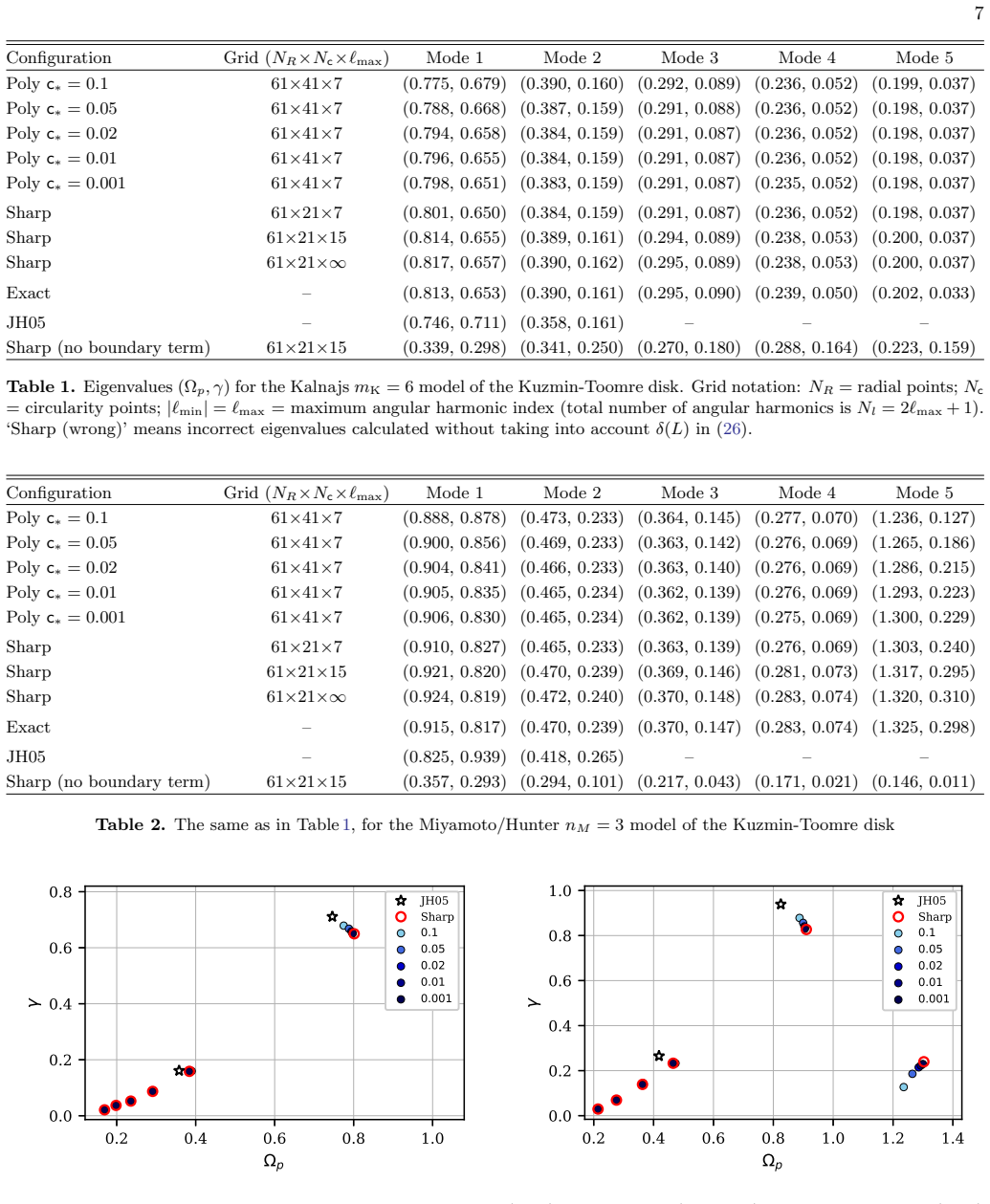
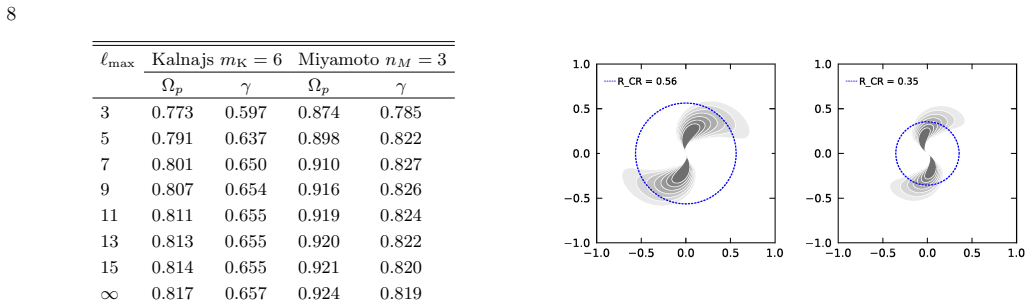
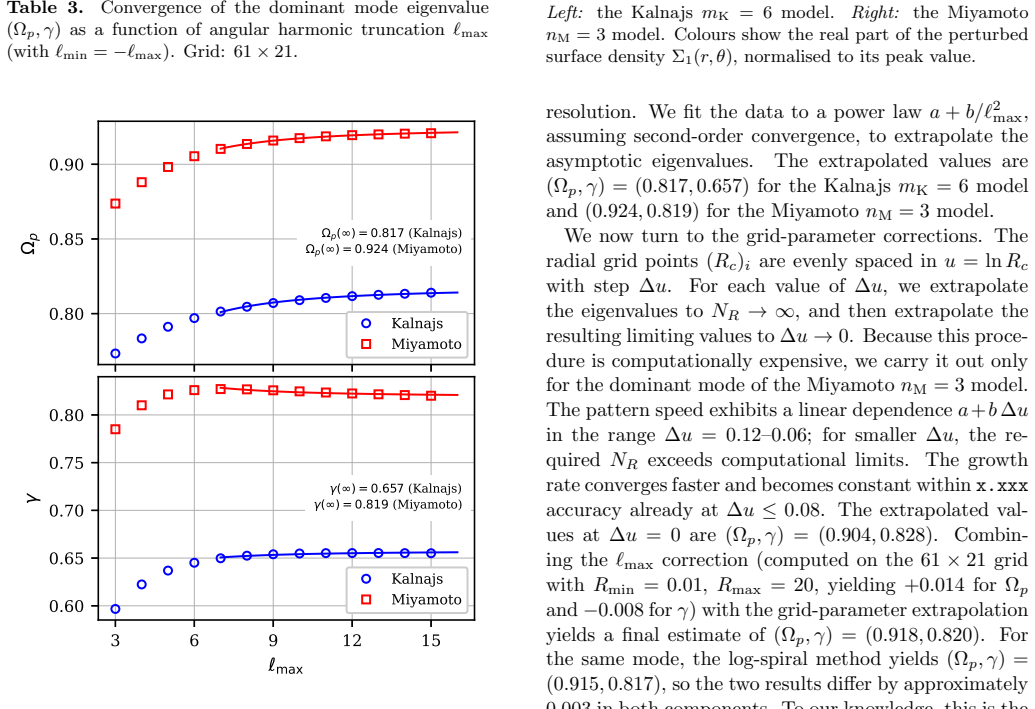
We generalize the linear matrix method for computing normal modes in collisionless stellar disks to distribution functions with sharp edges at zero angular momentum (L=0). The generalization adds boundary-integral terms to the matrix equation without increasing its size. We validate the method by computing m=2 modes for two Kuzmin--Toomre disk models (Miyamoto n_M=3 and Kalnajs m_K=6 families) and comparing the eigenvalues with those obtained from an independent nonlinear matrix method based on logarithmic-spiral expansions. A systematic convergence study over grid resolution and harmonic truncation yields eigenvalues accurate to ~0.003 in both pattern speed and growth rate. Unlike the nonli
What carries the argument
Addition of boundary-integral terms to the matrix equation in the linear matrix method, enabling treatment of sharp L=0 edges in distribution functions.
If this is right
- The method computes m=2 normal modes for Miyamoto n_M=3 and Kalnajs m_K=6 Kuzmin-Toomre disks with ~0.003 accuracy in pattern speed and growth rate.
- Gravitational softening is incorporated naturally into the eigenmode calculations.
- The approach works for distribution functions with abrupt L=0 cutoffs without enlarging the matrix or adding parameters.
- Systematic tests confirm convergence with grid resolution and harmonic truncation.
Where Pith is reading between the lines
- This generalization could support stability analyses of galactic disks whose distribution functions have more realistic angular-momentum cutoffs.
- The open Julia GPU implementation may enable direct comparisons between linear eigenmodes and N-body simulations of softened disks.
- The boundary-term technique might extend to other azimuthal numbers m or to disks in non-axisymmetric potentials.
Load-bearing premise
The boundary-integral terms can be added to the existing matrix formulation while preserving numerical stability and without requiring changes to matrix size or additional fitting parameters for the tested Kuzmin-Toomre families.
What would settle it
If eigenvalues for the Miyamoto n_M=3 and Kalnajs m_K=6 models deviate by more than ~0.003 from the independent nonlinear method or if the augmented matrix shows instability at higher grid resolutions, the generalization fails.
Figures
read the original abstract
We generalize the linear matrix method for computing normal modes in collisionless stellar disks to distribution functions with sharp edges at zero angular momentum ($L=0$). The generalization adds boundary-integral terms to the matrix equation without increasing its size. We validate the method by computing $m=2$ modes for two Kuzmin--Toomre disk models (Miyamoto $n_{\rm M}=3$ and Kalnajs $m_{\rm K}=6$ families) and comparing the eigenvalues with those obtained from an independent nonlinear matrix method based on logarithmic-spiral expansions. A systematic convergence study over grid resolution and harmonic truncation yields eigenvalues accurate to ${\sim}\,0.003$ in both pattern speed and growth rate. Unlike the nonlinear method, the linear method naturally incorporates gravitational softening, enabling the computation of eigenmodes for softened disk models. The implementation in Julia with GPU acceleration is openly available.
Editorial analysis
A structured set of objections, weighed in public.
Referee Report
Summary. The paper generalizes the linear matrix method for normal modes in collisionless stellar disks to distribution functions with sharp edges at L=0 by adding boundary-integral terms to the matrix equation without increasing matrix size. Validation consists of computing m=2 modes for two Kuzmin-Toomre families (Miyamoto n_M=3 and Kalnajs m_K=6) and comparing eigenvalues to those from an independent nonlinear logarithmic-spiral matrix method, together with a grid/harmonic convergence study reaching ~0.003 accuracy in pattern speed and growth rate. The linear formulation additionally incorporates gravitational softening.
Significance. If the central claim holds, the work supplies a numerically stable extension of an established method to a common class of disk models without enlarging the matrix or introducing fitting parameters. Credit is due for the external validation against an independent nonlinear method, the systematic convergence study, and the open Julia/GPU implementation that permits direct inspection of the boundary terms and matrix conditioning.
minor comments (1)
- The abstract states accuracy to ~0.003 but does not specify whether this is absolute or relative error; a brief clarification in §4 or the caption of the relevant convergence table would help readers interpret the quoted figure.
Simulated Author's Rebuttal
We thank the referee for their positive assessment of the manuscript, the recognition of the method's numerical stability and external validation, and the recommendation to accept.
Circularity Check
No significant circularity; derivation self-contained with external validation
full rationale
The paper's central generalization consists of adding explicit boundary-integral terms to an existing linear matrix formulation for distribution functions with L=0 edges. This step is presented as a direct mathematical extension rather than a redefinition or fit. Validation proceeds by direct numerical comparison of eigenvalues (pattern speed and growth rate) against an independent nonlinear logarithmic-spiral matrix method on two Kuzmin-Toomre families, plus grid/harmonic convergence tests reaching ~0.003 accuracy. The open Julia/GPU code further permits external inspection of the term implementation. No load-bearing step reduces by construction to a fitted parameter, self-citation chain, or renamed input; the comparison method is described as independent and the result is externally falsifiable. This satisfies the criteria for a self-contained derivation.
Axiom & Free-Parameter Ledger
axioms (2)
- domain assumption Linear perturbation theory is valid for collisionless stellar disks near equilibrium.
- domain assumption Boundary integrals correctly capture the contribution from the sharp L=0 edge without altering the matrix dimension.
Reference graph
Works this paper leans on
-
[1]
Athanassoula , E., & Sellwood , J. A. 1986, , 221, 213, 10.1093/mnras/221.2.213
-
[2]
2008, Galactic Dynamics: Second Edition (Princeton University Press)
Binney , J., & Tremaine , S. 2008, Galactic Dynamics: Second Edition (Princeton University Press). https://doi.org/10.1515/9781400828722
-
[3]
De Rijcke , S., Fouvry , J. B., & Dehnen , W. 2019, , 485, 150, 10.1093/mnras/stz309
-
[4]
Earn , D. J. D., & Sellwood , J. A. 1995, , 451, 533, 10.1086/176241
-
[5]
S., Ryzhik, I
Gradshteyn, I. S., Ryzhik, I. M., Zwillinger, D., & Moll, V. 2015, Table of integrals, series, and products; 8th ed. (Amsterdam: Academic Press). http://drhuang.com/science/mathematics/book/Table
2015
-
[6]
1959, Annales d'Astrophysique, 22, 126
Henon , M. 1959, Annales d'Astrophysique, 22, 126
1959
-
[7]
1971, , 168, 343, 10.1086/151091
Hohl , F. 1971, , 168, 343, 10.1086/151091
-
[8]
1992, in Astrophysical Disks, ed
Hunter , C. 1992, in Astrophysical Disks, ed. S. F. Dermott , J. H. Hunter , Jr., & R. E. Wilson , Vol. 675, 22--30, 10.1111/j.1749-6632.1992.tb56786.x
-
[9]
Jalali , M. A., & Hunter , C. 2005, , 630, 804, 10.1086/432370
-
[10]
Kalnajs , A. J. 1971, , 166, 275, 10.1086/150957
-
[11]
1976, , 205, 751, 10.1086/154331
---. 1976, , 205, 751, 10.1086/154331
-
[12]
1977, , 212, 637, 10.1086/155086
---. 1977, , 212, 637, 10.1086/155086
-
[13]
Kalnajs , A. J. 1978, in IAU Symposium, Vol. 77, Structure and Properties of Nearby Galaxies, ed. E. M. Berkhuijsen & R. Wielebinski , 113
1978
-
[14]
Kuzmin , G. G. 1956, Astr. Zh., 23, 27
1956
-
[15]
Landau, H. J., & Pollak, H. O. 1962, Bell Syst. Tech. J., 41, 1295, 10.1002/j.1538-7305.1962.tb03279.x
-
[16]
Lin , C. C., & Shu , F. H. 1964, , 140, 646, 10.1086/147955
-
[17]
Miller , R. H., Prendergast , K. H., & Quirk , W. J. 1970, , 161, 903, 10.1086/150593
-
[18]
1971, , 23, 21, 10.1093/pasj/23.1.21
Miyamoto , M. 1971, , 23, 21, 10.1093/pasj/23.1.21
-
[19]
Ostriker , J. P., & Peebles , P. J. E. 1973, , 186, 467, 10.1086/152513
-
[20]
Pichon , C., & Cannon , R. C. 1997, , 291, 616, 10.1093/mnras/291.4.616
-
[21]
1996, , 282, 1143, 10.1093/mnras/282.4.1143
Pichon , C., & Lynden-Bell , D. 1996, , 282, 1143, 10.1093/mnras/282.4.1143
-
[22]
Polyachenko , E. V. 2004, , 348, 345, 10.1111/j.1365-2966.2004.07390.x
-
[23]
Significance testing of O-C data
---. 2005, , 357, 559, 10.1111/j.1365-2966.2005.08660.x
-
[24]
2013, Astronomy Letters, 39, 72, 10.1134/S1063773713020072
---. 2013, Astronomy Letters, 39, 72, 10.1134/S1063773713020072
-
[25]
Polyachenko , E. V., & Just , A. 2015, , 446, 1203, 10.1093/mnras/stu2171
-
[26]
Polyachenko, E. V., & Shukhman, I. G. 2026, PME-GPU: a GPU linear matrix code for normal modes in collisionless stellar discs , v1.0, Zenodo, 10.5281/zenodo.20526417
-
[27]
Polyachenko , V. L., & Polyachenko , E. V. 1997, Journal of Experimental and Theoretical Physics, 85, 417, 10.1134/1.558290
-
[28]
L., Polyachenko , E
Polyachenko , V. L., Polyachenko , E. V., & Strel'nikov , A. V. 1997, Astronomy Letters, 23, 525
1997
-
[29]
Sellwood , J. A., & Athanassoula , E. 1986, , 221, 195, 10.1093/mnras/221.2.195
-
[30]
1983, SIAM Rev., 25, 379, 10.1137/1025078
Slepian, D. 1983, SIAM Rev., 25, 379, 10.1137/1025078
-
[31]
1963, , 138, 385, 10.1086/147653
Toomre , A. 1963, , 138, 385, 10.1086/147653
-
[32]
1964, , 139, 1217, 10.1086/147861
---. 1964, , 139, 1217, 10.1086/147861
-
[33]
Zang , T. A. 1976, PhD thesis, Massachusetts Institute of Technology
1976
-
[34]
Zang , T. A., & Hohl , F. 1978, , 226, 521, 10.1086/156636
discussion (0)
Sign in with ORCID, Apple, or X to comment. Anyone can read and Pith papers without signing in.