An Integrated Techno-Economic Framework for Optimal Microgrid Design: An Australian Case Study
Pith reviewed 2026-06-28 09:02 UTC · model grok-4.3
The pith
Integrated framework links simulation, dispatch and costing to compare hydrogen and battery microgrids for an Australian community.
A machine-rendered reading of the paper's core claim, the machinery that carries it, and where it could break.
Core claim
The integrated techno-economic framework links time-series simulation, dispatch-based operation and lifecycle costing to evaluate hybrid microgrid configurations comprising photovoltaic and wind generation, battery storage, diesel backup, grid exchange and an optional hydrogen subsystem, with systematic sensitivity analysis across financial, technical and policy drivers demonstrating nonlinear shifts in optimal design for a 1000-household Australian case study.
What carries the argument
Integrated techno-economic framework that connects time-series simulation, dispatch optimization and net present cost calculations to assess and compare microgrid configurations under multiple sensitivities.
If this is right
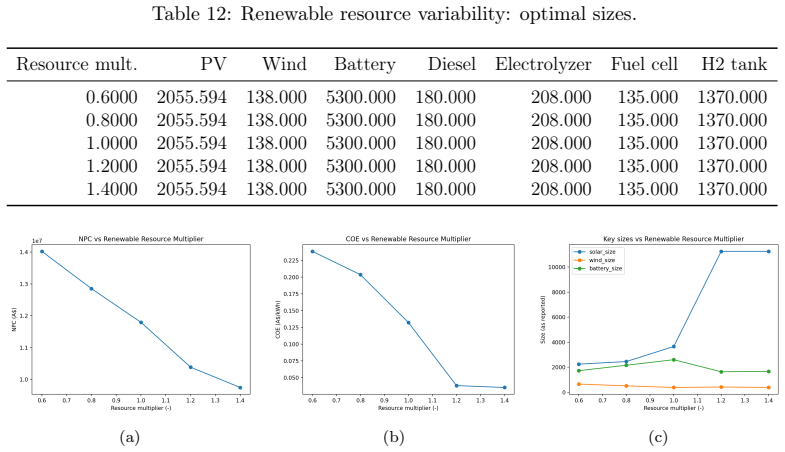
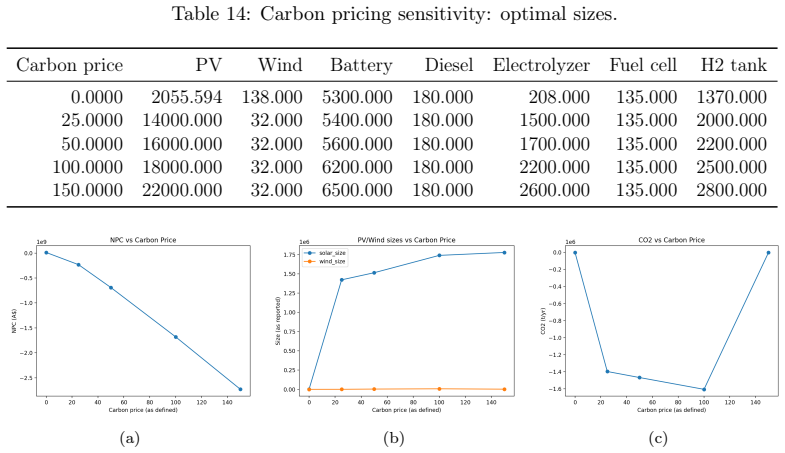
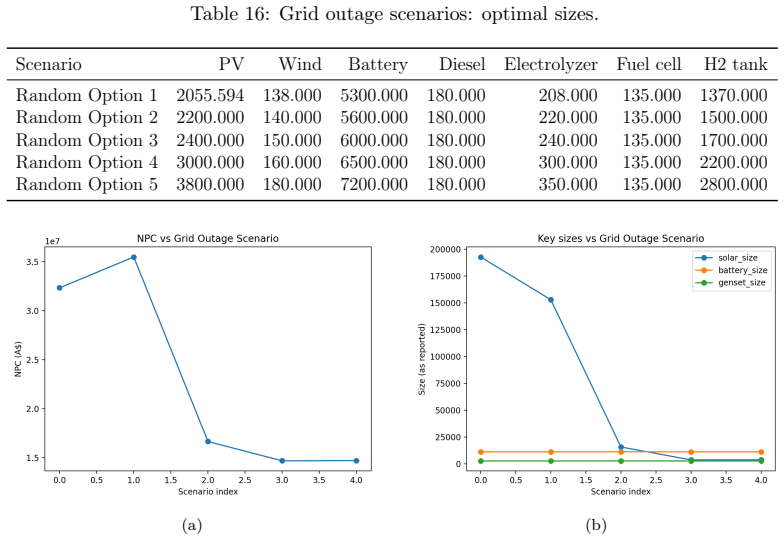
- Several sensitivity dimensions induce nonlinear shifts in the optimal microgrid design.
- Breakpoints appear where capital-intensive renewable-storage expansion becomes economically preferable.
- Hydrogen-enabled and battery-centric solutions can be compared transparently on the same indicators.
- The framework supplies planning guidance for resilient, low-emission community microgrids under Australian operating conditions.
Where Pith is reading between the lines
- The same linkage of simulation, dispatch and costing could be reused to test microgrid designs in other regions with comparable renewable resources and grid reliability.
- Policy makers could use the sensitivity breakpoints to set carbon-price thresholds that favor higher renewable penetration.
- Adding more detailed modeling of grid outage statistics might further strengthen the robustness assessment for remote sites.
- The no-hydrogen attribution case implies that excluding the hydrogen path may understate resilience value during extended outages.
Load-bearing premise
The time-series simulation and dispatch-based operation models accurately capture real-world performance and interactions of the hybrid components under the tested conditions.
What would settle it
Field measurements from a deployed microgrid matching the Rockhampton load and resource profile that show actual net present cost or emissions differing substantially from the framework's predicted values.
Figures
read the original abstract
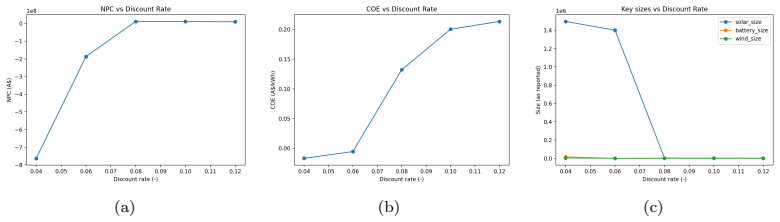
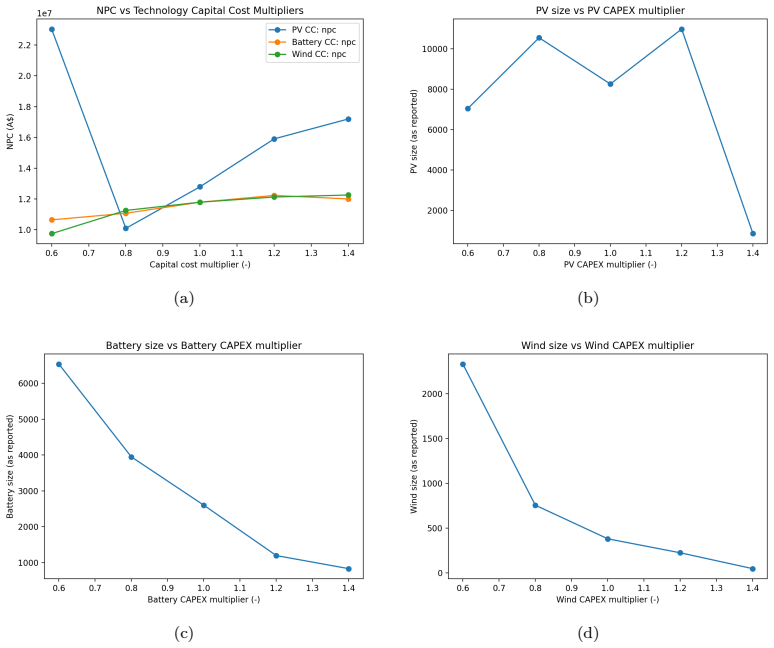
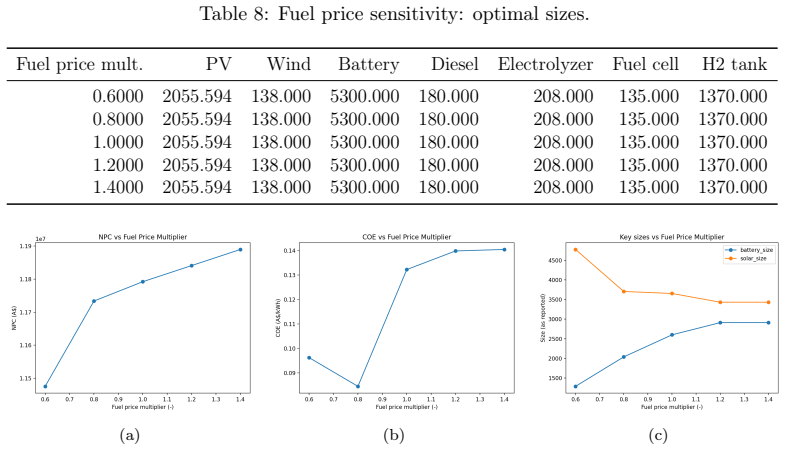
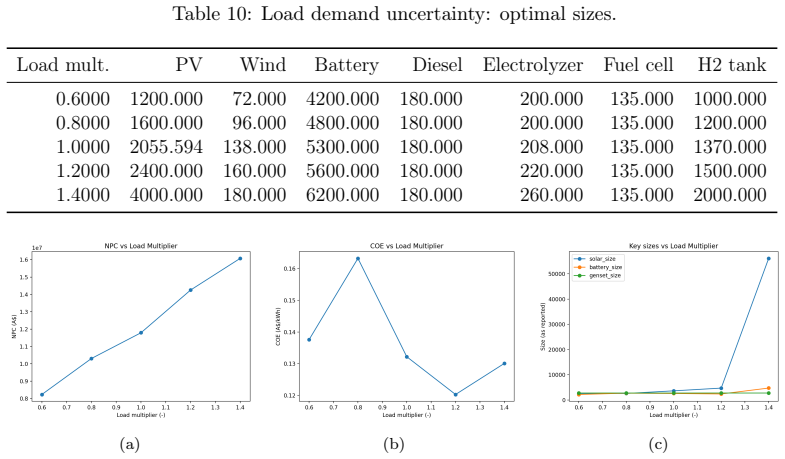
Reliable and affordable electricity supply remains a challenge for remote and regional communities, motivating the deployment of renewable-based microgrids supported by flexible storage and advanced planning methods. This paper proposes an integrated techno-economic framework for optimal microgrid design and robustness assessment, and applies it to a 1000-household residential community in Rockhampton, Queensland (Australia). The framework links time-series simulation, dispatch-based operation, and lifecycle costing to evaluate hybrid configurations comprising photovoltaic and wind generation, battery storage, diesel backup, grid exchange, and an optional hydrogen subsystem (electrolyzer--hydrogen storage--fuel cell). Key indicators include net present cost (NPC), cost of energy (COE), renewable penetration, energy purchased/sold, and emissions-related outcomes. To avoid conclusions that depend on a single set of assumptions, the study performs systematic sensitivity analysis across financial, technical and policy drivers: discount rate, technology capital costs, fuel price, load uncertainty, renewable resource variability, carbon pricing/emissions cost, and grid outage duration, supplemented by a no-hydrogen attribution case. The results demonstrate that several sensitivity dimensions induce nonlinear shifts in the optimal design, including breakpoints where capital-intensive renewable--storage expansion becomes economically preferable. The proposed framework enables transparent comparison of hydrogen-enabled and battery-centric solutions and provides planning guidance for resilient, low-emission community microgrids under Australian operating conditions.
Editorial analysis
A structured set of objections, weighed in public.
Referee Report
Summary. The manuscript proposes an integrated techno-economic framework that links time-series simulation, dispatch-based operation, and lifecycle costing to optimize hybrid microgrid designs (PV/wind/battery/diesel/grid exchange with optional hydrogen subsystem) for a 1000-household residential community in Rockhampton, Queensland. Key outputs are net present cost (NPC), cost of energy (COE), renewable penetration, energy exchange, and emissions metrics, evaluated under systematic sensitivity analysis on discount rate, capital costs, fuel price, load uncertainty, resource variability, carbon pricing, grid outage duration, and a no-hydrogen case. The central claim is that the framework enables transparent hydrogen-versus-battery comparisons and supplies planning guidance for resilient, low-emission Australian community microgrids.
Significance. If the underlying models prove accurate, the work supplies actionable, scenario-robust guidance for microgrid planners by identifying nonlinear design breakpoints and quantifying trade-offs between hydrogen and battery storage under Australian conditions.
major comments (2)
- [Abstract / framework linkage] Abstract and framework description: The linkage of time-series simulation, dispatch-based operation, and lifecycle costing is asserted, yet no specification is given for dispatch assumptions (perfect foresight vs. rolling horizon, ramp-rate limits, hydrogen round-trip efficiency curves). These assumptions are load-bearing for the hydrogen-enabled versus battery-centric comparison and the resulting planning guidance.
- [Methods] Methods / validation: No validation of the time-series simulation or dispatch models against measured data, no benchmark comparison to established microgrid test cases, and no sensitivity of the models themselves to structural assumptions (e.g., efficiency curves) is reported. Parameter sensitivity alone does not test whether the dispatch logic systematically over- or under-estimates renewable penetration or hydrogen losses.
minor comments (1)
- [Abstract] Abstract: The phrase 'systematic sensitivity analysis across financial, technical and policy drivers' would benefit from an explicit list or table reference to the exact parameter ranges and scenario counts.
Simulated Author's Rebuttal
We thank the referee for their thorough review and constructive feedback on our manuscript. We address each of the major comments below and outline the revisions we will make to strengthen the paper.
read point-by-point responses
-
Referee: [Abstract / framework linkage] Abstract and framework description: The linkage of time-series simulation, dispatch-based operation, and lifecycle costing is asserted, yet no specification is given for dispatch assumptions (perfect foresight vs. rolling horizon, ramp-rate limits, hydrogen round-trip efficiency curves). These assumptions are load-bearing for the hydrogen-enabled versus battery-centric comparison and the resulting planning guidance.
Authors: We agree that explicit specification of the dispatch assumptions is necessary for transparency, particularly given their importance to the hydrogen versus battery comparisons. Although the methods section of the manuscript outlines the overall framework, we will revise the abstract and expand the methods to clearly state that the dispatch optimization employs a perfect-foresight linear programming approach over hourly time steps. Hydrogen round-trip efficiency is modeled using a fixed 65% value based on literature values for the electrolyzer-fuel cell chain, with no ramp-rate constraints applied due to the hourly resolution. These details will be added, along with a note on the assumption of perfect foresight as a limitation. revision: yes
-
Referee: [Methods] Methods / validation: No validation of the time-series simulation or dispatch models against measured data, no benchmark comparison to established microgrid test cases, and no sensitivity of the models themselves to structural assumptions (e.g., efficiency curves) is reported. Parameter sensitivity alone does not test whether the dispatch logic systematically over- or under-estimates renewable penetration or hydrogen losses.
Authors: The study is a modeling exercise using synthetic load data and typical meteorological year resource profiles, so direct validation against measured microgrid data is not feasible within the current scope. We will, however, add a dedicated limitations subsection that discusses the structural assumptions, including the fixed efficiency curves, and conduct additional sensitivity analyses on the hydrogen efficiency parameter to assess its impact on renewable penetration and losses. We will also include comparisons to results from established tools like HOMER for the base case to provide benchmarking. revision: partial
- Empirical validation of the time-series simulation and dispatch models against real measured data from an operational microgrid, as no such dataset is available for the Rockhampton case study community.
Circularity Check
No circularity: framework applies standard simulation and optimization to external inputs
full rationale
The paper describes an integrated techno-economic framework that links time-series simulation, dispatch-based operation, and lifecycle costing to evaluate microgrid configurations. Sensitivity analysis varies external parameters (discount rate, capital costs, fuel price, load uncertainty, renewable variability, carbon pricing, grid outage duration) across scenarios, with no indication that any output is fitted to data and then relabeled as a prediction. No self-citations are invoked as load-bearing premises, no uniqueness theorems are imported, and no ansatz or renaming of known results occurs. The derivation chain consists of applying established modeling steps to given inputs and reporting the resulting indicators, rendering it self-contained against external benchmarks.
Axiom & Free-Parameter Ledger
free parameters (3)
- discount rate
- technology capital costs
- fuel price
axioms (1)
- domain assumption Standard assumptions in lifecycle costing, time-series simulation, and dispatch optimization hold for the listed microgrid components.
Reference graph
Works this paper leans on
-
[1]
Y. Guo, C. Zhao, Islanding-aware robust energy management for micro- grids, IEEE Transactions on Smart Grid 9 (2018) 1301–1309
2018
-
[2]
X. Li, J. Zhu, Y. Wang, Z. Li, C. Wang, L. Guo, Enhanced dynamic stability control for low-inertia hybrid ac/dc microgrid with distributed energy storage systems, IEEE Access 7 (2019) 91234–91242
2019
-
[3]
Y. Liu, Y. Li, H. B. Gooi, H. Xin, J. Pan, Distributed optimal tie-line power flow control for multiple interconnected ac microgrids, IEEE Transactions on Power Systems 34 (2019) 1869–1880
2019
-
[4]
X. Gong, F. Dong, M. A. Mohamed, O. M. Abdalla, Z. M. Ali, A secured energy management architecture for smart hybrid microgrids considering pem-fuel cell and electric vehicles, Ieee Access 8 (2020) 47807–47823
2020
-
[5]
M. Atef, T. Khatib, M. F. Abdullah, M. F. Romlie, Optimization of a hybrid solar pv and gas turbine generator system using the loss of load probability index, Clean Technologies 2 (2020) 16
2020
-
[6]
Q. Li, Z. Cheng, M. Yan, Y. Wang, X. Dong, Research on the hybrid wind–solar–energy storage ac/dc microgrid system and its stability during smooth state transitions, Energies 16 (2023) 7930
2023
-
[7]
Hatziargyriou, H
N. Hatziargyriou, H. Asano, R. Iravani, C. Marnay, Microgrids, IEEE Power and Energy Magazine 5 (2007) 78–94
2007
-
[8]
Y. Gui, B. Wei, M. Li, J. M. Guerrero, J. C. Vasquez, Passivity-based coordinated control for islanded ac microgrid, Applied Energy 229 (2018) 551–561. 26
2018
-
[9]
Ejuh Che, K
E. Ejuh Che, K. Roland Abeng, C. D. Iweh, G. J. Tsekouras, A. Fopah- Lele, The impact of integrating variable renewable energy sources into grid-connected power systems: challenges, mitigation strategies, and prospects, Energies 18 (2025) 689
2025
-
[10]
L. Che, M. Shahidehpour, A. Abusorrah, A. Alabdulwahab, X. Zhang, Optimal interconnection planning of community microgrids with re- newable energy sources, IEEE Transactions on Smart Grid 8 (2017) 1054–1063
2017
-
[11]
G. R. Goyal, S. Vadhera, Solution to uncertainty of renewable energy sources and peak hour demand in smart grid system, Measurement: Sensors 33 (2024) 101129
2024
-
[12]
M. Atef, M. Abdullah, T. Khatib, M. Romlie, Utilization of artificial neural networks to improve the accuracy of a hybrid power system model, in: 2019 IEEE Student Conference on Research and Development (SCOReD), IEEE, 2019, pp. 284–288
2019
-
[13]
J. He, X. Wu, X. Wu, Y. Xu, J. M. Guerrero, Small-signal stability analysis and optimal parameters design of microgrid clusters, IEEE Access 7 (2019) 36896–36909
2019
-
[14]
R. Hao, Q. Ai, T. Guan, Y. Cheng, D. Wei, Decentralized price incentive energy interaction management for interconnected microgrids, Electric Power Systems Research 172 (2019) 114–128
2019
-
[15]
M. Atef, M. Uddin, M. M. Rana, M. R. Sarkar, G. Shafiullah, Data- driven optimization framework for microgrid energy management, in: Intelligent Data-Driven Modelling and Optimization in Power and Energy Applications, CRC Press, 2024, pp. 169–188
2024
-
[16]
Elkhatib, T
R. Elkhatib, T. Kaoutari, H. Louahlia, Green hydrogen energy source for a residential fuel cell micro-combined heat and power, Applied Thermal Engineering 248 (2024) 123194
2024
-
[17]
D. Das, I. Chakraborty, A. K. Bohre, P. Kumar, R. Agarwala, Sustainable integration of green hydrogen in renewable energy systems for residential and ev applications, International Journal of Energy Research (2024). 27
2024
-
[20]
S. J. Navas, G. C. González, F. Pino, Hybrid power-heat microgrid solution using hydrogen as an energy vector for residential houses in spain. a case study, Energy Conversion and Management 263 (2022) 115724
2022
-
[21]
Uddin, H
M. Uddin, H. Mo, D. Dong, S. Elsawah, Techno-economic potential of multi-energy community microgrid: The perspective of australia, Renewable Energy 219 (2023) 119544
2023
-
[22]
G. Ali, N. Javaid, S. Rehman, M. Butt, I. Khan, A comprehensive review on energy management strategy of microgrids, Energies 16 (2023) 1207
2023
-
[23]
Singh, V
H. Singh, V. Sharma, M. Niazi, A comprehensive review on sustain- able energy management systems for optimal operation of microgrids, Renewable and Sustainable Energy Reviews 173 (2023) 113152
2023
-
[24]
Mohammadi, A
A. Mohammadi, A. Kumar, R. Singh, Enhancing microgrid stability and energy management: Techniques, challenges, and future directions, Energies 16 (2023) 4672
2023
-
[25]
S. T. Meraj, S. S. Yu, M. S. Rahman, K. Hasan, M. H. Lipu, H. Trinh, Energy management schemes, challenges and impacts of emerging inverter technology for renewable energy integration towards grid decarbonization, Journal of Cleaner Production 405 (2023) 137002
2023
-
[26]
Ahmad, M
F. Ahmad, M. T. Iqbal, S. Rehman, Applications of energy storage systems in enhancing energy management and access in microgrids: A review, Journal of Energy Storage 69 (2023) 107807
2023
-
[27]
X. Liu, T. Zhao, H. Deng, P. Wang, J. Liu, F. Blaabjerg, Microgrid energy management with energy storage systems: A review, CSEE Journal of Power and Energy Systems (2022). 28
2022
-
[28]
Alvarez, M
J. Alvarez, M. Sanchez, P. Torres, S. Rehman, State-of-the-art review on energy management and control of networked microgrids, Energies 16 (2023) 5378
2023
-
[29]
L. P. Van, K. Do Chi, T. N. Duc, Review of hydrogen technologies based microgrid: Energy management systems, challenges and future recommendations, International Journal of Hydrogen Energy 48 (2023) 14127–14148
2023
-
[30]
Naseri, S
N. Naseri, S. El Hani, M. Machmoum, E. Elbouchikhi, A. Daghouri, Energy management strategy for a net zero emission islanded photovoltaic microgrid-based green hydrogen system, Energies 17 (2024) 2111
2024
-
[31]
Enaloui, S
R. Enaloui, S. Sharifi, B. Faridpak, A. Hammad, M. Al-Hussein, P. Musilek, Techno-economic assessment of a solar-powered green hydro- gen storage concept based on reversible solid oxide cells for residential micro-grid: A case study in calgary, Energy 319 (2025) 134981
2025
-
[32]
H. Raj, S. Jaiswal, A. Maheshwari, A review of energy management strategy and forecasting techniques in multi microgrids, International Journal of Ambient Energy 46 (2025) 2507808
2025
-
[33]
Agha Kassab, F
F. Agha Kassab, F. Locment, M. Sechilariu, B. Celik, R. Rodriguez, A comprehensive review of sizing and energy management strategies for optimal planning of microgrids with pv and other renewable integration, Applied Sciences 14 (2024) 10479
2024
-
[34]
J. A. Rodriguez-Gil, E. Mojica-Nava, D. Vargas-Medina, M. F. Arevalo- Castiblanco, C. A. Cortes, S. Rivera, J. Cortes-Romero, Energy man- agement system in networked microgrids: An overview, Energy Systems (2024) 1–32
2024
-
[35]
Uddin, H
M. Uddin, H. Mo, D. Dong, S. Elsawah, J. Zhu, J. M. Guerrero, Micro- grids: A review, outstanding issues and future trends, Energy Strategy Reviews 49 (2023) 101127
2023
-
[36]
M. Atef, S. Alahakoon, P. Wolfs, T. Khatib, U. Mumtahina, M. Uddin, Techno-economic energy planning of residential microgrids: An australian case study, in: 2025 IEEE PES 35th Australasian Universities Power Engineering Conference (AUPEC), IEEE, 2025, pp. 1–5. 29
2025
-
[37]
M. Atef, S. Alahakoon, P. Wolfs, T. Khatib, U. Mumtahina, M. Uddin, Real-time energy management of residential microgrids: An australian case study, in: 2025 IEEE PES 35th Australasian Universities Power Engineering Conference (AUPEC), IEEE, 2025, pp. 1–5
2025
-
[38]
M. E. González-Niño, O. H. Sierra-Herrera, W. A. Pineda-Muñoz, N. Muñoz-Galeano, J. M. López-Lezama, Exploring technology trends and future directions for optimized energy management in microgrids, Information 16 (2025) 183
2025
-
[39]
A. R. Abbasi, D. Baleanu, Recent developments of energy management strategies in microgrids: An updated and comprehensive review and classification, Energy Conversion and Management 297 (2023) 117723
2023
-
[40]
B. Modu, M. P. Abdullah, A. L. Bukar, M. F. Hamza, A systematic review of hybrid renewable energy systems with hydrogen storage: Sizing, optimization, and energy management strategy, International Journal of Hydrogen Energy (2023)
2023
-
[41]
D. M. Sackey, M. Amoah, A. B. Jehuri, D.-G. Owusu-Manu, A. Acapkovi, Techno-economic analysis of a microgrid design for a commercial health facility in ghana-case study of zipline sefwi-wiawso, Scientific African 19 (2023) e01552
2023
-
[42]
M. A. Ahmed, G. Abbas, T. A. Jumani, N. Rashid, A. A. Bhutto, S. M. Eldin, Techno-economic optimal planning of an industrial microgrid considering integrated energy resources, Frontiers in Energy Research 11 (2023) 1145888
2023
-
[43]
M. Atef, S. Alahakoon, P. Wolfs, U. Mumtahina, T. Khatib, M. Ud- din, Energy management in microgrids: Commercial, industrial, and residential perspectives, Energies 19 (2026) 419
2026
-
[44]
F. Wang, J. Zhao, L. Chen, Review of energy management systems in microgrids: Classification, strategies, and future challenges, Journal of Energy Storage 80 (2024) 108765
2024
-
[45]
Fernandez, N
L. Fernandez, N. Patel, D. Kumar, Energy management strategies for active distribution networks and microgrids: A comprehensive survey, Renewable and Sustainable Energy Reviews 181 (2025) 113701. 30
2025
-
[46]
Zheng, M
Z. Zheng, M. Shafique, X. Luo, S. Wang, A systematic review towards integrative energy management of smart grids and urban energy systems, Renewable and Sustainable Energy Reviews 189 (2024) 114023
2024
-
[47]
Ferahtia, A
S. Ferahtia, A. Houari, T. Cioara, M. Bouznit, H. Rezk, A. Djerioui, Recent advances on energy management and control of direct current microgrid for smart cities and industry: A survey, Applied Energy 368 (2024) 123501
2024
-
[48]
Z. M. Ali, M. Calasan, S. H. A. Aleem, F. Jurado, F. H. Gandoman, Applications of energy storage systems in enhancing energy management and access in microgrids: A review, Energies 16 (2023) 5930
2023
-
[49]
Sadeghian, A
O. Sadeghian, A. M. Shotorbani, S. Ghassemzadeh, B. Mohammadi- Ivatloo, Energy management of hybrid fuel cell and renewable energy based systems-a review, International Journal of Hydrogen Energy 107 (2025) 135–163
2025
-
[50]
M. Atef, S. Alahakoon, U. Mumtahina, P. Wolfs, T. Khatib, M. Uddin, A review of microgrid energy management systems: methods, challenges, and future directions, International Journal of Ambient Energy 47 (2026) 2595117
2026
-
[51]
X. Chen, P. Wu, J. Yang, A comprehensive review on dc microgrid control and energy management strategies, International Journal of Electrical Power & Energy Systems 155 (2025) 109350
2025
-
[52]
S. E. Eyimaya, N. Altin, Review of energy management systems in microgrids, Applied Sciences 14 (2024) 1249
2024
-
[53]
Sadeghian, A
O. Sadeghian, A. M. Shotorbani, S. Ghassemzadeh, B. Mohammadi- Ivatloo, Energy management of hybrid fuel cell and renewable energy based systems-a review, International Journal of Hydrogen Energy (2024)
2024
-
[54]
M. U. Safder, M. J. Sanjari, A. Hamza, R. Garmabdari, M. A. Hos- sain, J. Lu, Enhancing microgrid stability and energy management: Techniques, challenges, and future directions, Energies 16 (2023) 6417. 31
2023
-
[55]
L. Han, M. Chen, X. Zhang, A review of hierarchical energy management system in networked microgrids for sustainable operation, International Journal of Electrical Power & Energy Systems 153 (2024) 109218
2024
-
[56]
L. Xu, W. Li, M. Khan, Energy management system in networked microgrids: An overview, Renewable Energy 222 (2024) 1489–1507
2024
-
[57]
Agha Kassab, R
F. Agha Kassab, R. Rodriguez, B. Celik, F. Locment, M. Sechilariu, A comprehensive review of sizing and energy management strategies for optimal planning of microgrids with pv and other renewable integration, Applied Sciences 14 (2024) 10479
2024
-
[58]
Abbas, S
N. Abbas, S. Shah, A. Malik, Review of hydrogen technologies-based microgrid energy management systems, challenges and future directions, International Journal of Hydrogen Energy 48 (2023) 25467–25487
2023
-
[59]
URL:https://www.dcceew.gov.au/sites/defa ult/files/documents/national-hydrogen-strategy-2024.pdf , accessed: 2026-03-29
DepartmentofClimateChange, Energy, theEnvironmentandWater(DC- CEEW), National Hydrogen Strategy 2024, Technical Report, Australian Government, 2024. URL:https://www.dcceew.gov.au/sites/defa ult/files/documents/national-hydrogen-strategy-2024.pdf , accessed: 2026-03-29
2024
-
[60]
URL:https://www.dcceew.gov.au/en ergy/publications/australias-national-hydrogen-strategy , accessed: 2026-03-29
Department of Climate Change, Energy, the Environment and Water (DCCEEW), Australia’s National Hydrogen Strategy, DCCEEW (Energy publications webpage), 2024. URL:https://www.dcceew.gov.au/en ergy/publications/australias-national-hydrogen-strategy , accessed: 2026-03-29
2024
-
[61]
URL:https: //www.dcceew.gov.au/energy/hydrogen, accessed: 2026-03-29
Department of Climate Change, Energy, the Environment and Water (DCCEEW), Growing Australia’s hydrogen industry, DCCEEW (Hy- drogen webpage; last updated 30 January 2026), 2026. URL:https: //www.dcceew.gov.au/energy/hydrogen, accessed: 2026-03-29
2026
-
[62]
37, assent 13 Sep 2022), 2022
Parliament of Australia, Climate Change Bill 2022, Bills & Legislation (Bill details page; Act no. 37, assent 13 Sep 2022), 2022. URL:https: //www.aph.gov.au/Parliamentary_Business/Bills_Legislation/ Bills_Search_Results/Result?bId=r6885, accessed: 2026-03-29
2022
-
[63]
URL:https: 32 //www.legislation.gov.au/C2022A00037/latest/text , accessed: 2026-03-29
Australian Government, Climate Change Act 2022, Federal Register of Legislation (latest compilation shown on page), 2022. URL:https: 32 //www.legislation.gov.au/C2022A00037/latest/text , accessed: 2026-03-29
2022
-
[64]
A. Ali, M. Khan, S. Rehman, Energy management of hybrid fuel cell and renewable energy based systems: A review, International Journal of Hydrogen Energy 49 (2024) 563–589
2024
-
[65]
Australian Renewable Energy Agency (ARENA), Regional Microgrids Program, ARENA funding webpage (program announced 25 Aug 2023),
2023
-
[66]
URL: https://arena.gov.au/funding/rmp/, accessed: 2026-03- 29
2026
-
[67]
Australian Renewable Energy Agency (ARENA), Empowering First Nations communities with ARENA backed microgrids, ARENA news,
-
[68]
URL: https://arena.gov.au/news/empowering-first-nat ions-communities-with-arena-backed-microgrids/ , accessed: 2026-03-29
2026
-
[69]
Arévalo, D
P. Arévalo, D. Ochoa-Correa, E. Villa-Ávila, V. Iñiguez-Morán, P. Astudillo-Salinas, Systematic review of hierarchical and multi-agent optimization strategies for p2p energy management and electric machines in microgrids, Applied Sciences 15 (2025) 4817
2025
-
[70]
The Hon Chris Bowen MP, New National Hydrogen Strategy sets up Australia as renewable superpower, Media release, Ministers for the Department of Climate Change, Energy, the Environment and Water,
-
[71]
URL: https://minister.dcceew.gov.au/bowen/media-relea ses/new-national-hydrogen-strategy-sets-australia-renewab le-superpower, accessed: 2026-03-29
2026
-
[72]
URL:https://www.ce fc.com.au/, accessed: 2026-03-29
Clean Energy Finance Corporation (CEFC), Clean Energy Finance Corporation (CEFC) — Home, Website, 2026. URL:https://www.ce fc.com.au/, accessed: 2026-03-29. 33
2026
discussion (0)
Sign in with ORCID, Apple, or X to comment. Anyone can read and Pith papers without signing in.