The natural extension of the (-β)-transformation
Pith reviewed 2026-06-26 06:49 UTC · model grok-4.3
The pith
A concrete construction is given for the natural extension of the (−β)-transformation when β exceeds the golden mean.
A machine-rendered reading of the paper's core claim, the machinery that carries it, and where it could break.
Core claim
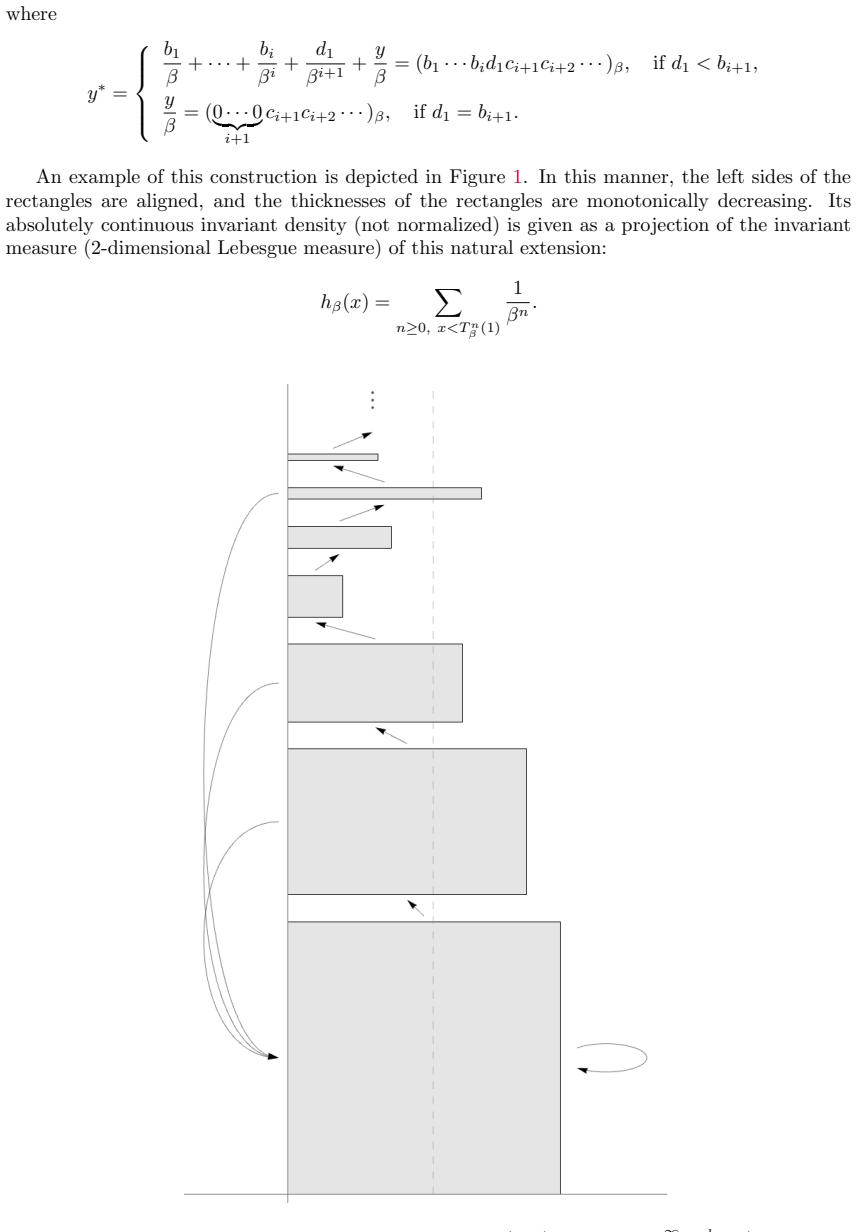
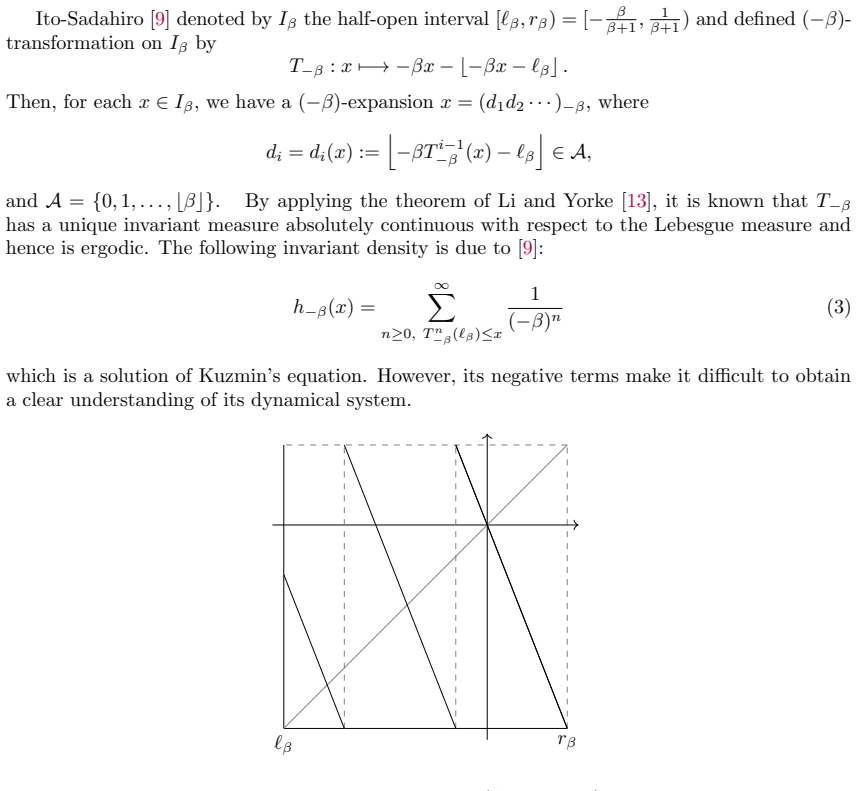
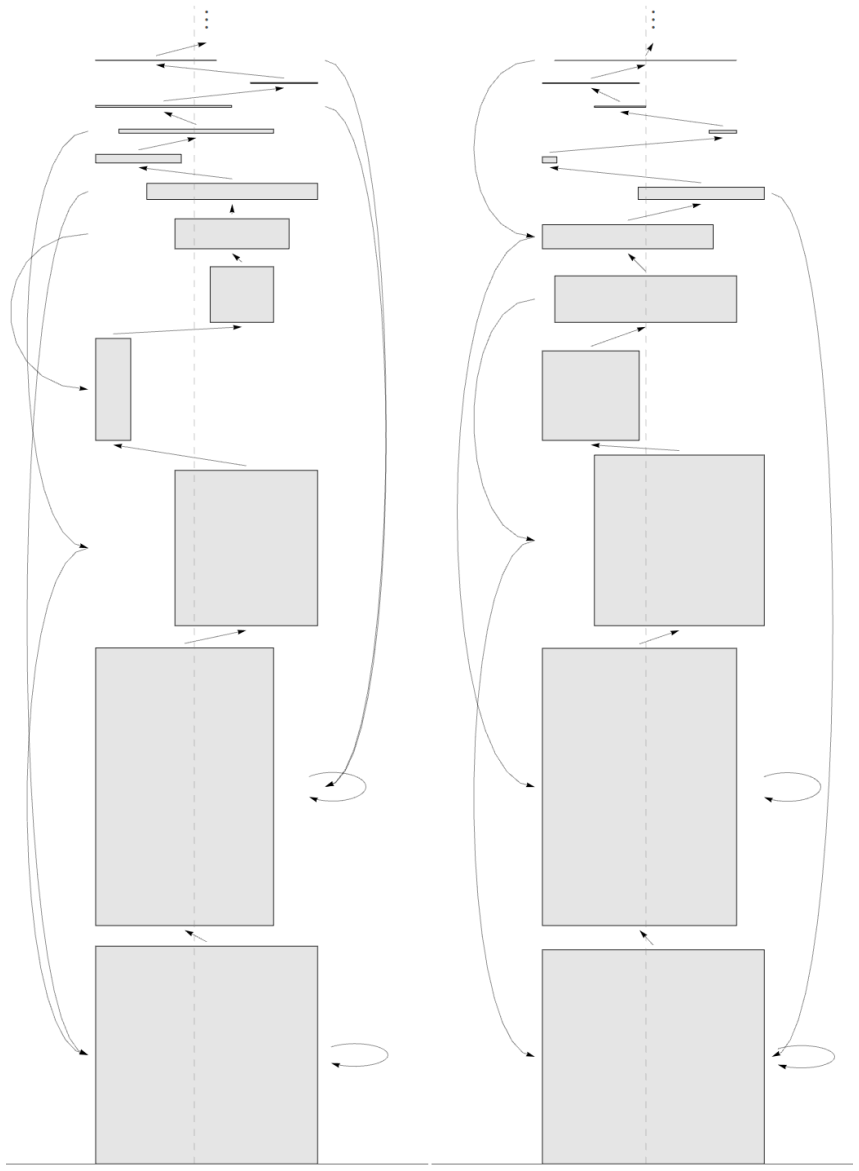
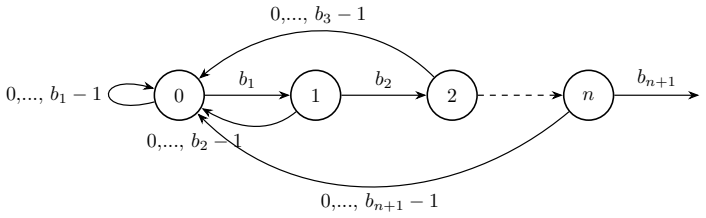
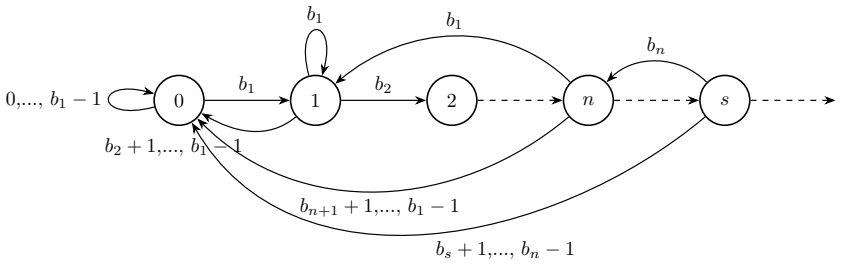
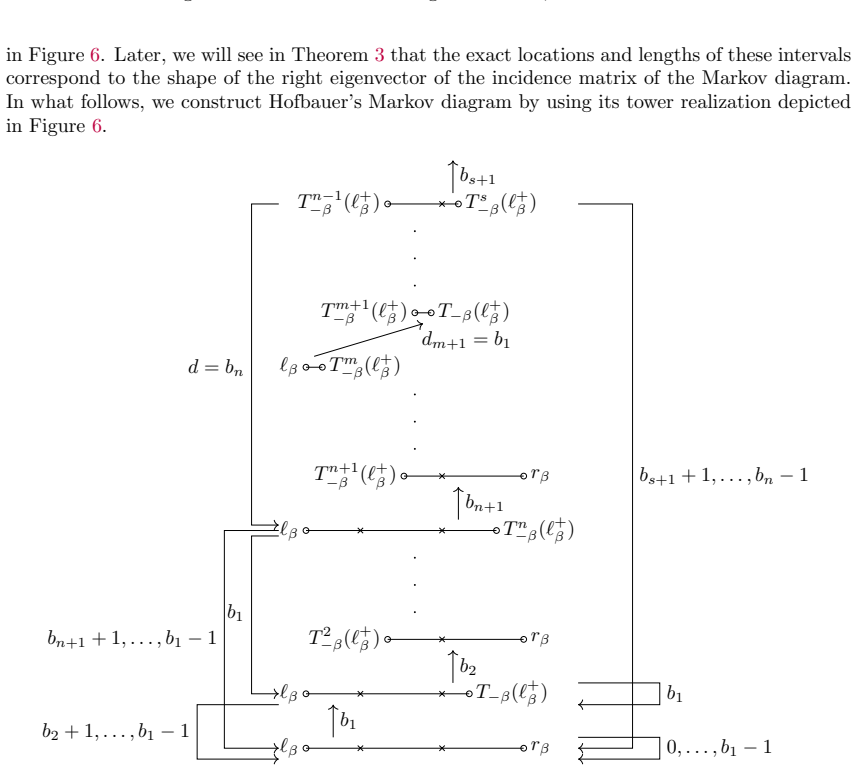
We give a concrete construction of a natural extension of (−β)-transformation when β is greater than the golden mean. Our construction relies on its Markov diagram and the eigenvectors of the associated countable Markov shifts. Its positive recurrence can be shown by path counting using a special property of the diagram. Our down-to-earth construction elucidates the result of Bruin-Kalle by examples.
What carries the argument
The Markov diagram of the (−β)-transformation and the eigenvectors of the associated countable Markov shifts, which together produce the natural extension and support the path-counting proof of positive recurrence.
If this is right
- The construction supplies concrete examples that illustrate the earlier abstract result of Bruin-Kalle.
- Positive recurrence of the countable Markov shift follows directly from combinatorial path counting on the diagram.
- The method applies precisely when β exceeds the golden mean.
- The eigenvectors yield an explicit description of the natural extension.
Where Pith is reading between the lines
- The same diagram-plus-eigenvector technique might produce natural extensions for other interval maps with negative slopes.
- Explicit recurrence rates obtained from path counts could be used to compute entropy or mixing rates for these systems.
- The special combinatorial property of the diagram may characterize a broader class of beta-transformations that admit countable Markov models.
Load-bearing premise
The Markov diagram for the (−β)-transformation exists and admits a special combinatorial property that allows path counting to establish positive recurrence of the associated countable Markov shift.
What would settle it
A β larger than the golden mean for which the path-counting argument fails to produce a finite invariant measure on the countable Markov shift would falsify the construction.
Figures
read the original abstract
We give a concrete construction of a natural extension of $(-\beta)$-transformation when $\beta$ is greater than the golden mean. Our construction relies on its Markov diagram and the eigenvectors of the associated countable Markov shifts. Its positive recurrence can be shown by path counting using a special property of the diagram. Our down-to-earth construction elucidates the result of Bruin-Kalle \cite{BruinKalle} by examples.
Editorial analysis
A structured set of objections, weighed in public.
Referee Report
Summary. The paper constructs an explicit natural extension for the (−β)-transformation when β exceeds the golden mean. The construction proceeds from the Markov diagram of the map, extracts the eigenvectors of the associated countable Markov shift, and establishes positive recurrence of the shift by a path-counting argument that exploits a special combinatorial property of the diagram. The resulting object is offered as a concrete, example-driven elucidation of the abstract existence result of Bruin–Kalle.
Significance. If the construction and the path-counting argument hold, the paper supplies an explicit, verifiable model that makes the natural extension of these maps directly accessible for further dynamical and ergodic analysis. The reliance on standard Markov-diagram techniques together with an elementary counting proof of positive recurrence constitutes a clear methodological strength and supplies the first concrete illustrations of the Bruin–Kalle theorem.
minor comments (3)
- The abstract and introduction refer to “the associated countable Markov shifts” without an early, self-contained definition of the precise shift space or its transition matrix; a short preliminary section or diagram would improve readability.
- Notation for the eigenvectors (left and right) and the special combinatorial property of the diagram is introduced only after the construction begins; a consolidated notation table or paragraph at the start of §3 would help.
- The citation to Bruin–Kalle is used to frame the contribution, but the precise statement being elucidated is not quoted; adding a one-sentence restatement of their main theorem would clarify the relation.
Simulated Author's Rebuttal
We thank the referee for the positive report, the accurate summary of our contribution, and the recommendation to accept. No revisions are required.
Circularity Check
No significant circularity detected
full rationale
The paper presents a concrete construction of the natural extension for the (−β)-transformation (β > golden mean) that relies on the existence of a Markov diagram, eigenvectors of the associated countable Markov shift, and positive recurrence established via path counting on a combinatorial property of the diagram. These steps are described as standard techniques in symbolic dynamics and are not shown to reduce by the paper's own equations to fitted parameters, self-definitions, or a load-bearing self-citation chain. The citation to Bruin-Kalle is external and used only to position the work as providing explicit examples, with no indication that the central claim is forced by prior author work or internal renaming. The derivation is therefore self-contained against external benchmarks in ergodic theory and symbolic dynamics.
Axiom & Free-Parameter Ledger
axioms (1)
- domain assumption Markov diagrams and their associated countable Markov shifts are well-defined for the (−β)-transformation when β exceeds the golden mean.
Reference graph
Works this paper leans on
-
[1]
Akiyama and H
S. Akiyama and H. Kaneko , TITLE =. Adv. Math. , FJOURNAL =. 2021 , PAGES =
2021
-
[2]
Bertrand, Daniel , TITLE =. Ramanujan J. , FJOURNAL =. 1997 , NUMBER =. doi:10.1023/A:1009749608672 , URL =
-
[3]
Natural extensions for piecewise affine maps via
Bruin, Henk and Kalle, Charlene , journal =. Natural extensions for piecewise affine maps via. 2014 , issn =. doi:10.1007/s00605-014-0644-0 , fjournal =
-
[4]
Ergodic theory of numbers , year =
Dajani, Karma and Kraaikamp, Cor , publisher =. Ergodic theory of numbers , year =
-
[5]
Dajani, K. and Kraaikamp, C. and Solomyak, B. , journal =. The natural extension of the. 1996 , issn =. doi:10.1007/BF00058946 , fjournal =
-
[6]
Dubickas, Art\=uras , TITLE =. J. Number Theory , FJOURNAL =. 2006 , NUMBER =. doi:10.1016/j.jnt.2005.07.004 , URL =
-
[7]
Hofbauer, Franz , TITLE =. Israel J. Math. , FJOURNAL =. 1979 , NUMBER =. doi:10.1007/BF02760884 , URL =
-
[8]
Hofbauer, Franz , TITLE =. Ergodic Theory Dynam. Systems , FJOURNAL =. 1981 , NUMBER =. doi:10.1017/s0143385700009202 , URL =
-
[9]
Hofbauer, Franz , TITLE =. Israel J. Math. , FJOURNAL =. 1981 , NUMBER =. doi:10.1007/BF02761854 , URL =
-
[10]
Hofbauer, Franz , TITLE =. Probab. Theory Relat. Fields , FJOURNAL =. 1986 , NUMBER =. doi:10.1007/BF00334191 , URL =
-
[11]
Acta Math
Hofbauer, Franz , TITLE =. Acta Math. Univ. Comenian. (N.S.) , FJOURNAL =. 2012 , NUMBER =
2012
-
[12]
Beta-expansions with negative bases , year =
Ito, Shunji and Sadahiro, Taizo , journal =. Beta-expansions with negative bases , year =. doi:10.1515/INTEG.2009.023 , fjournal =
-
[13]
Ito and Y
Sh. Ito and Y. Takahashi , TITLE=. J. Math. Soc. Japan , VOLUME=. 1974 , number=
1974
-
[14]
Kalle, Charlene , TITLE =. Ergodic Theory Dynam. Systems , FJOURNAL =. 2014 , NUMBER =. doi:10.1017/etds.2012.127 , URL =
-
[15]
Kitchens, Bruce P. , publisher =. Symbolic dynamics , year =. doi:10.1007/978-3-642-58822-8 , keywords =
-
[16]
, TITLE =
Kowalski, Zbigniew S. , TITLE =. Bull. Acad. Polon. Sci. S\'er. Sci. Math. , FJOURNAL =. 1979 , NUMBER =
1979
-
[17]
Dynamical properties of the negative beta-transformation , year =
Liao, Lingmin and Steiner, Wolfgang , journal =. Dynamical properties of the negative beta-transformation , year =. doi:10.1017/S0143385711000514 , fjournal =
-
[18]
Nesterenko, Yu.\ V. , TITLE =. Mat. Sb. , FJOURNAL =. 1996 , NUMBER =. doi:10.1070/SM1996v187n09ABEH000158 , URL =
-
[19]
Parry, W. , journal =. On the. 1960 , issn =. doi:10.1007/BF02020954 , fjournal =
-
[20]
Viana, M. and Oliveira, K. , date-added =. Foundations of ergodic theory , url =. 2016 , bdsk-url-1 =. doi:10.1017/CBO9781316422601 , isbn =
-
[21]
Elsner, Carsten and Kaneko, Masanobu and Tachiya, Yohei , TITLE =. J. Ramanujan Math. Soc. , FJOURNAL =. 2020 , NUMBER =
2020
-
[22]
Representations for real numbers and their ergodic properties , url =
R. Representations for real numbers and their ergodic properties , url =. Acta Math. Acad. Sci. Hungar. , pages =. 1957 , bdsk-url-1 =. doi:10.1007/BF02020331 , fjournal =
-
[23]
Steiner, W. , TITLE =. Acta Math. Hungar. , FJOURNAL =. 2013 , NUMBER =. doi:10.1007/s10474-012-0252-1 , URL =
-
[24]
Pytheas , date-added =
Fogg, N. Pytheas , date-added =. Substitutions in dynamics, arithmetics and combinatorics , volume =
-
[25]
, fjournal =
Perron, O. , fjournal =. Grundlagen f\"ur eine. Math. Ann. , number =
-
[26]
1982 , PAGES =
Walters, Peter , TITLE =. 1982 , PAGES =
1982
-
[27]
Aaronson, Jon , TITLE =. 1997 , PAGES =. doi:10.1090/surv/050 , URL =
-
[28]
Li and J
T-Y. Li and J. Yorke , fjournal =. Ergodic transformations from an interval into itself , volume =. Trans. Amer. Math. Soc. , number =
discussion (0)
Sign in with ORCID, Apple, or X to comment. Anyone can read and Pith papers without signing in.