Phase Transition of a Semiflexible Membrane in Two Dimensions
Pith reviewed 2026-06-28 12:57 UTC · model grok-4.3
The pith
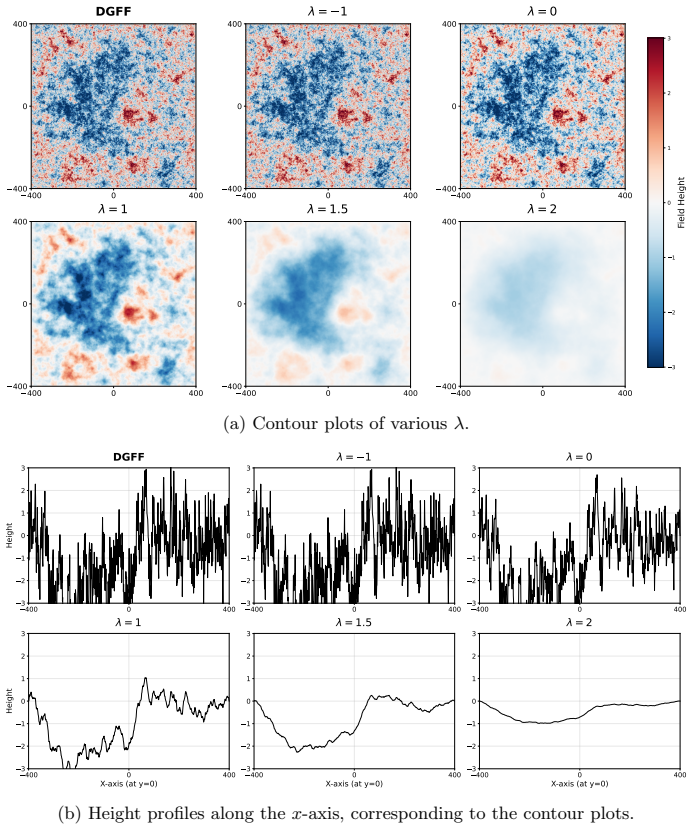
The bulk covariance of a two-dimensional semiflexible membrane follows the discrete Gaussian free field for λ less than zero, the rescaled membrane model for λ greater than two, and exhibits distance-independent leading asymptotics for λ be
A machine-rendered reading of the paper's core claim, the machinery that carries it, and where it could break.
Core claim
The covariance in the bulk of the interpolated model agrees with the discrete Gaussian free field when λ is less than zero and with the rescaled membrane model when λ exceeds two. For λ in the closed interval from zero to two, when the lattice distance between points satisfies ||x-y|| much less than N to the power λ over two, the leading asymptotic no longer resolves the exact separation and the coefficient of the leading logarithm is determined explicitly.
What carries the argument
The interpolated Hamiltonian sum over x of (||∇φ_x||² + N^λ |Δφ_x|²), whose bulk covariance is extracted by direct comparison to the discrete Gaussian free field and membrane model limits in three regimes of λ.
If this is right
- For λ less than zero the gradient term dominates and the model is indistinguishable from the discrete Gaussian free field at leading order.
- For λ greater than two the curvature term dominates and the covariance is a rescaled version of the membrane model.
- In the window λ from zero to two the microscopic covariance acquires a universal logarithmic form whose coefficient is independent of separation.
- The transition points λ equals zero and λ equals two mark the boundaries between the three asymptotic regimes.
Where Pith is reading between the lines
- The same interpolation technique could be applied to other lattice fields whose Hamiltonians contain competing lower- and higher-order difference operators.
- The distance-independent microscopic regime suggests that local observables in this window may be governed by a single effective constant rather than a distance-dependent kernel.
- Extensions to three dimensions or to models with additional nonlinear terms would test whether the same critical values of λ continue to separate the regimes.
Load-bearing premise
The finite-volume model defined by the interpolated Hamiltonian possesses a well-defined bulk covariance whose leading asymptotics can be read off by comparison to the discrete Gaussian free field and membrane model without further regularity or boundary adjustments that would change the stated regimes.
What would settle it
A direct computation or simulation of the bulk covariance for a fixed λ in [0,2] at separations much smaller than N^{λ/2} that shows continued dependence on the exact distance between points would contradict the claimed regime.
Figures
read the original abstract
We study a two-dimensional semiflexible membrane model whose formal Hamiltonian is given by $H[\phi]=\sum_x \bigl(\|\nabla \phi_x\|^2 +N^\lambda |\Delta \phi_x|^2\bigr)$, interpolating between the discrete Gaussian free field (DGFF) and the membrane model (MM). We analyze its finite-volume covariance in the bulk as $N\to\infty$, and identify distinct regimes depending on the parameter $\lambda$. For $\lambda<0$, the covariance of the model agrees with that of the DGFF up to a negligible error, while for $\lambda>2$, it agrees with the rescaled MM covariance up to a negligible error. In the intermediate regime $\lambda\in[0,2]$, we identify a different crossover behavior: in the microscopic range $\|x-y\|\ll N^{\lambda/2}$, the leading asymptotics no longer resolve the precise distance between the two points. In this microscopic regime, we further determine the leading logarithmic coefficient of the bulk covariance. These results provide a unified description of the crossover from gradient-dominated to curvature-dominated behavior in this class of models.
Editorial analysis
A structured set of objections, weighed in public.
Referee Report
Summary. The manuscript analyzes the bulk covariance of a two-dimensional semiflexible membrane model whose Hamiltonian interpolates between the discrete Gaussian free field (DGFF) and the membrane model (MM) via the parameter λ in the term N^λ |Δφ_x|^2. It establishes three regimes as N→∞: for λ<0 the covariance agrees with the DGFF up to negligible error; for λ>2 it agrees with the rescaled MM covariance; and for λ∈[0,2] a microscopic crossover occurs in which, for ||x-y|| ≪ N^{λ/2}, the leading asymptotics become independent of the precise distance between x and y, with the leading logarithmic coefficient of the bulk covariance explicitly determined. The results are obtained by comparison to the known DGFF and MM limits.
Significance. If the stated asymptotics hold, the work supplies a complete and unified phase diagram for the crossover between gradient-dominated and curvature-dominated Gaussian fields, including an explicit microscopic regime and the leading log coefficient therein. This is a substantive contribution to the theory of discrete Gaussian fields and membrane models. The parameter-free character of the regime boundaries and the direct comparison method are strengths.
minor comments (2)
- The abstract and introduction would benefit from a brief statement of the precise form of the finite-volume measure and the boundary conditions used to define the bulk covariance.
- Notation for the rescaled MM covariance in the λ>2 regime should be introduced explicitly in §2 before the statement of the main theorems.
Simulated Author's Rebuttal
We thank the referee for their careful reading of the manuscript, for the accurate summary of our results, and for the positive recommendation to accept. The referee's assessment correctly identifies the three regimes and the microscopic crossover behavior we establish.
Circularity Check
No significant circularity detected
full rationale
The paper derives asymptotic regimes for the bulk covariance of an interpolated quadratic Hamiltonian directly from the model definition, comparing to known DGFF and MM limits in distinct scaling windows without any fitted parameters, self-definitional reductions, or load-bearing self-citations. The claimed crossover for λ ∈ [0,2] and the distance-independent logarithmic coefficient are presented as consequences of the scaling analysis of the covariance, not as inputs renamed as outputs. No equations reduce the stated results to tautologies or prior author work by construction.
Axiom & Free-Parameter Ledger
Reference graph
Works this paper leans on
-
[1]
Extreme local extrema of two-dimensional discrete Gaussian free field
Marek Biskup and Oren Louidor. “Extreme local extrema of two-dimensional discrete Gaussian free field”. In:Communications in Mathematical Physics 345.1 (2016), pp. 271–304.doi:10.1007/s00220-015-2565-8. 35
-
[2]
Entropic repulsion and the maximum of the two-dimensional harmonic crystal
Erwin Bolthausen, Jean-Dominique Deuschel, and Giambattista Giacomin. “Entropic repulsion and the maximum of the two-dimensional harmonic crystal”. In:The Annals of Probability29.4 (2001), pp. 1670–1692.doi: 10.1214/aop/1015345767
-
[3]
Convergence in law of the maximum of the two-dimensional discrete Gaussian free field
Maury Bramson, Jian Ding, and Ofer Zeitouni. “Convergence in law of the maximum of the two-dimensional discrete Gaussian free field”. In: Communications on Pure and Applied Mathematics69.1 (2016), pp. 62– 123.doi:10.1002/cpa.21621
-
[4]
Scaling limit of semiflexible polymers: a phase transition
Alessandra Cipriani, Biltu Dan, and Rajat Subhra Hazra. “Scaling limit of semiflexible polymers: a phase transition”. In:Communications in Mathe- matical Physics377.2 (2020), pp. 1505–1544.doi:10.1007/s00220-020- 03762-9
-
[5]
The scal- ing limit of the (∇+ ∆)-model
Alessandra Cipriani, Biltu Dan, and Rajat Subhra Hazra. “The scal- ing limit of the (∇+ ∆)-model”. In:Journal of Statistical Physics182.2 (2021), p. 39.doi:10.1007/s10955-021-02717-1
-
[6]
Extremes of the discrete two-dimensional Gaussian free field
Oliver Daviaud. “Extremes of the discrete two-dimensional Gaussian free field”. In:The Annals of Probability34.3 (2006), pp. 962–986.doi:10. 1214/009117906000000061. [7]NIST Digital Library of Mathematical Functions. Release 1.2.6 of 2026- 03-15. F. W. J. Olver, A. B. Olde Daalhuis, D. W. Lozier, B. I. Schneider, R. F. Boisvert, C. W. Clark, B. R. Miller,...
2006
-
[7]
Cambridge University Press, 2017
Sacha Friedli and Yvan Velenik.Statistical mechanics of lattice systems: a concrete mathematical introduction. Cambridge University Press, 2017. doi:10.1017/9781316882603
-
[8]
Gaussian estimates for Markov chains and random walks on groups
Waldemar Hebisch and Laurent Saloff-Coste. “Gaussian estimates for Markov chains and random walks on groups”. In:The Annals of Probability(1993), pp. 673–709
1993
-
[9]
Entropic repulsion for a Gaussian membrane model in the critical and supercritical dimensions
Noemi Kurt. “Entropic repulsion for a Gaussian membrane model in the critical and supercritical dimensions”. PhD thesis. Universit¨ at Z¨ urich, In- stitut f¨ ur Mathematik, 2008
2008
-
[10]
Maximum and entropic repulsion for a Gaussian membrane model in the critical dimension
Noemi Kurt. “Maximum and entropic repulsion for a Gaussian membrane model in the critical dimension”. In:The Annals of Probability37.2 (2009), pp. 687–725.doi:10.1214/08-aop417
-
[11]
Lawler.Intersections of random walks
Gregory F. Lawler.Intersections of random walks. Birkh¨ auser/Springer, 2013.isbn: 978-1-4614-5971-2.doi:10.1007/978-1-4614-5972-9
-
[12]
Asymptotic behaviour of the lat- tice Green function
Emmanuel Michta and Gordon Slade. “Asymptotic behaviour of the lat- tice Green function”. In:ALEA, Latin American Journal of Probability and Mathematical Statistics19 (2022), pp. 957–981.doi:10.30757/ALEA. v19-38. 36
-
[13]
Estimates for the Green’s function of the discrete bilaplacian in dimensions 2 and 3
Stefan M¨ uller and Florian Schweiger. “Estimates for the Green’s function of the discrete bilaplacian in dimensions 2 and 3”. In:Vietnam Journal of Mathematics47.1 (2019), pp. 133–181.doi:10.1007/s10013-018-0325- 8
-
[14]
Phase transition in tensionless surfaces
Juan J. Ruiz-Lorenzo et al. “Phase transition in tensionless surfaces”. In: Biophysical Chemistry115.2-3 (2005), pp. 187–193.doi:10.1016/j.bpc. 2004.12.025
-
[15]
Entropic repulsion for a Gaussian lattice field with certain finite range interaction
Hironobu Sakagawa. “Entropic repulsion for a Gaussian lattice field with certain finite range interaction”. In:Journal of Mathematical Physics44.7 (2003), pp. 2939–2951.doi:10.1063/1.1581354
-
[16]
The maximum of the four-dimensional membrane model
Florian Schweiger. “The maximum of the four-dimensional membrane model”. In:The Annals of Probability48.2 (2020), pp. 714–741.doi: 10.1214/19-aop1372. 37
discussion (0)
Sign in with ORCID, Apple, or X to comment. Anyone can read and Pith papers without signing in.