REVIEW 3 major objections 3 minor 27 references
Novel Excitations near Quantum Criticality in Geometrically Frustrated Antiferromagnet CsFeCl$_{3}$
T0 review · 3 major / 3 minor · reviewed 2026-08-14 · deepseek-v4-flash
Pith's one-line read Pressure-tuned neutron scattering in the triangular-lattice antiferromagnet CsFeCl3 shows that, near the quantum critical point, the single disordered-state mode evolves continuously into gapless and gapped modes that each carry…
desk verdict Solid pressure-dependent neutron study of CsFeCl3 with a plausible but not fully proven claim that LT-hybridization is essential; the fitting-based counterfactual needs a re-fit check. read the letter →
The pith
A machine-rendered reading of the paper's core claim, the machinery that carries it, and where it could break.
The reading
What carries the argument
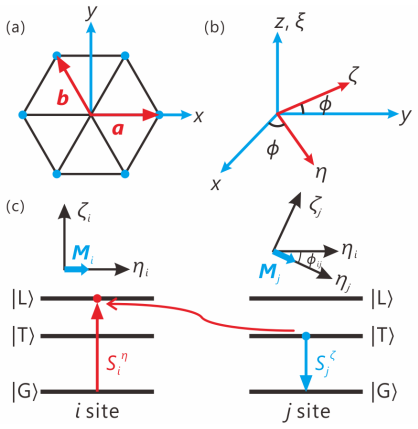
The extended spin-wave theory (ESW), equivalent to harmonic bond-operator theory, which introduces Bose operators for the local excited states $|L\rangle$ and $|T\rangle$ built on the mean-field ground state $|G\rangle = u|0\rangle + \frac{v}{\sqrt{2}}(|1\rangle + |-1\rangle)$ of a spin-1 easy-plane antiferromagnet. The load-bearing term is the off-diagonal interaction $J_{ab}\sin\varphi_{ij}\,(S^\eta_i S^\zeta_j - S^\zeta_i S^\eta_j)$, which induces hopping and pair-creation processes that turn a $|T\rangle$ boson into an $|L\rangle$ boson; it exists only in noncollinear states. With this term, the theory reproduces the continuous softening of the single mode and its split into gapless and gapped branches; without it, the calculated spectrum jumps discontinuously and fails to match the measured evolution.
What would settle it
A polarization-resolved inelastic neutron scattering measurement at 1.4 GPa that finds the low-energy gapless mode purely transverse and the high-energy gapped mode purely longitudinal would directly contradict the claimed LT hybridization; alternatively, independently measured $D(p)$, $J_c(p)$, and $J_{ab}(p)$ that fail to reproduce the observed gapless/gapped energies and line shapes at 1.1–1.4 GPa would falsify the parameterization.
Extended reading notes
Core claim
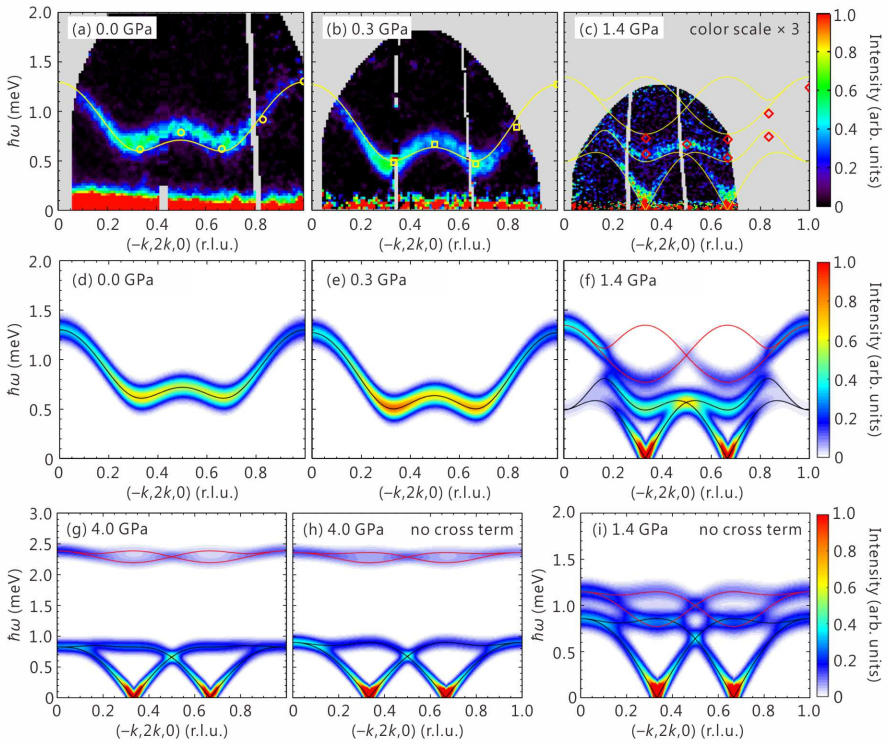
The central discovery is that in a noncollinear 120-degree antiferromagnet close to a pressure-driven quantum critical point, the usual separation of magnetic excitations into transverse (Nambu–Goldstone-like) and longitudinal (amplitude-like) modes breaks down. The exchange term proportional to $\sin\varphi_{ij}$, where $\varphi_{ij}$ is the angle between neighboring ordered moments, is nonzero only because the structure is noncollinear, and it converts a transverse local excitation into a longitudinal one (and vice versa) in one-magnon processes. As a result, both the gapless low-energy branch and the gapped high-energy branch contain strong longitudinal and transverse fluctuations, and the high-energy branch is identified as the remnant of the disordered phase's single mode. If the hybridization term is omitted from the calculation, the calculated spectra no longer evolve continuously through the critical pressure and disagree with the measured ones.
Load-bearing premise
The assignment of the observed high-energy mode and the continuous spectral evolution depend on the fitted linear pressure dependences $\mathrm{D}(p)=2.345+0.365p$, $J_c(p)=-0.5-0.14p$, and $J_{ab}(p)=0.0312-0.0015p$ (meV), which are adjusted to the data rather than measured independently.
Editorial extensions
If this is right
- Just above the critical pressure, the gapped high-energy mode is the descendant of the disordered phase's single mode, not a separate longitudinal branch.
- Near the critical point both observed branches are mixed longitudinal/transverse excitations, so a polarization-resolved measurement should find no branch that is purely transverse or purely longitudinal.
- The LT-hybridization renormalizes the spectrum near the critical point and is required to reproduce the continuous, second-order-like evolution of the neutron intensity across the transition.
- The same mechanism is expected to shape the magnon spectrum of other noncollinear magnets near quantum criticality, and it becomes negligible only well away from the critical pressure.
Reading between the lines
- The paper's linear pressure parametrization implies a quantitative prediction that could be checked independently: measuring the single-ion anisotropy $D(p)$ and exchanges $J_c(p)$ and $J_{ab}(p)$ by other techniques (for example high-field magnetization or Raman scattering) should reproduce the fitted values and the critical pressure $p_c\approx0.85$ GPa.
- One testable extension is to track the polarization character of the two branches as a function of pressure: well above $p_c$ the hybridization should fade, turning the high-energy mode back into an almost purely longitudinal (amplitude) mode, and the measured crossover would map the strength of the LT coupling.
- The same hybridization argument could be applied to other noncollinear orders with one-magnon longitudinal fluctuations—cycloids, all-in/all-out structures, or skyrmion lattices—where the analogous $\sin\varphi_{ij}$ coupling should produce similar mode mixing near a quantum critical point.
Signed reviews
Editorial analysis
A structured set of objections, weighed in public.
Referee Report
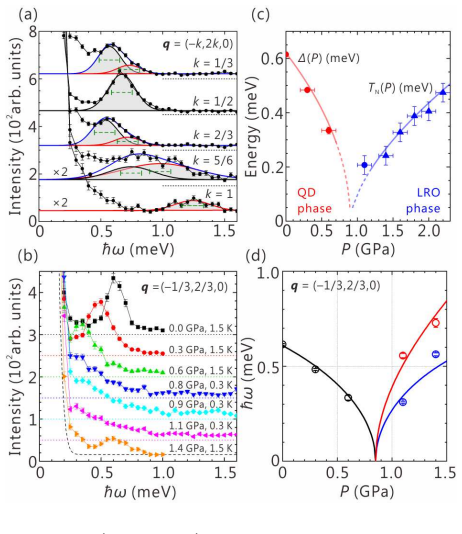
Summary. The manuscript reports neutron scattering experiments on the triangular-lattice S=1 easy-plane antiferromagnet CsFeCl3 under pressure, covering the quantum-disordered phase at low pressure, the near-critical regime near 0.8-1.1 GPa, and the noncollinear 120-degree ordered phase at 1.4 GPa. The data show a single dispersive mode at 0 and 0.3 GPa that softens with pressure, an unresolved broad response near the critical pressure, and a split spectrum at 1.4 GPa with a gapless mode and a gapped mode near 0.55 meV. Using extended spin-wave theory with linear pressure dependences for the single-ion anisotropy D and the exchanges Jc and Jab, the authors reproduce the observed spectra and argue that the noncollinear spin structure hybridizes longitudinal (|L>) and transverse (|T>) single-site excitations through the sin(phi_ij) cross term in Eq. (2). They conclude that this LT-hybridization is essential for the continuous evolution of the spectrum through the quantum critical point and leads to novel excitations carrying both longitudinal and transverse fluctuations.
Significance. If the central claim is correct, the paper provides a rare experimental realization of longitudinal-transverse (amplitude-phase) mode hybridization at the one-magnon level in a noncollinear frustrated magnet. The pressure-dependent gap and the appearance of a gapped mode above the critical pressure are valuable benchmarks for the S=1 easy-plane triangular antiferromagnet. The theoretical mechanism, the sin(phi_ij) cross term in Eq. (2), is general and falsifiable, and the supplementary material gives a clear derivation of the hybridization processes. The authors are also transparent about their fitting procedure and background-subtraction assumptions. The main strengths are the new high-pressure neutron data set, the combination of chopper and triple-axis spectrometers, and the explicit calculation of the hybridization terms. The principal weakness is that the quantitative and necessity claims rest on parameters fitted to the same spectra and on a counterfactual that does not re-fit the no-hybridization model.
major comments (3)
- [Main text, Eq. (1) and Supplementary Eqs. (S14)-(S16)] The pressure dependences D(p)=2.345+0.365p, Jc(p)=-0.5-0.14p, and Jab(p)=0.0312-0.0015p are introduced by comparing the ESW calculation with the experimental spectra, and the same spectra are then presented as reproduced by the calculation. This is a fitting loop rather than an independent validation, and the paper does not report uncertainties, covariances, or a fit to a subset of the data. The mode assignment at 1.4 GPa (gapless vs. gapped, and the identification of the 0.55 meV mode as the remnant of the disordered single mode) depends on these parameters, so the agreement in Figs. 2(a)-2(c) and Fig. 3(d) does not by itself establish the assignment. I request a goodness-of-fit analysis with confidence intervals and, if possible, a cross-check in which parameters are fitted to one observable (e.g., the gap data) and used to predict the full dispersions.
- [Main text, Figs. 2(h)-2(i); Supplementary Fig. S3(h)-S3(k)] The counterfactual that supports the statement that 'the LT-hybridization cannot be ignored' is computed by dropping the sin(phi_ij) cross term in Eq. (2) while holding D(p), Jc(p), and Jab(p) fixed at the values fitted to the full model. Because the hybridization produces strong level repulsion near the quantum critical point, a no-hybridization model with re-optimized parameters could in principle place the gapped mode near 0.55 meV and reproduce the two-mode spectrum at 1.4 GPa; parameter shifts could compensate for the removed repulsion. The paper does not report such a re-fitted comparison or a quantitative argument why compensation is impossible. As written, the comparison shows that the data are consistent with the full model, but it does not establish that the hybridization term is necessary. A re-fitted no-hybridization calculation, or a substantial softening of the necessity claim, is needed.
- [Main text, Fig. 3(b) and the paragraph beginning 'The pressure evolution of the energy gap'] The abstract and discussion claim that the neutron spectrum 'continuously evolves' through the critical pressure, but the data at 0.8, 0.9, and 1.1 GPa do not resolve a distinct gap; the authors state that 'the gap position cannot be identified' and only broad scattering below 1.0 meV is observed. The continuous evolution is therefore an inference from the ESW calculation combined with the 0.0-0.6 GPa and 1.4 GPa endpoints, not a directly observed progression of sharp modes through p_c. I ask that the claim be explicitly qualified, and that the linewidths, resolution, and possible alternative interpretations at the near-critical pressures be quantified and discussed.
minor comments (3)
- [Materials and Methods, Fig. S1] The subtraction of the 100 K spectra as pure background from the pressure cell and cryostat is introduced with the phrase 'we presume'; since all base-temperature spectra in Figs. 2(a)-2(c) rely on this subtraction, an empty-cell measurement or an additional argument that the flat excitations near 0.9 and 1.5 meV are nonmagnetic would strengthen the analysis.
- [Main text, Fig. 3(c)] The phase diagram combines transition temperatures and gap data from the present work and from a previous study; please specify which symbols come from which measurement and state the criterion used to locate the critical pressure at 0.85 GPa.
- [Main text, Fig. 2] The labels in the calculated spectra panels (d)-(i) are small and the difference between the black and red dispersion curves is hard to see in print; enlarging the panels and clarifying the caption would improve readability.
Circularity Check
Spectral agreement is a refit of the same data, and the LT-hybridization counterfactual holds the full-model fitted parameters fixed, so the claimed necessity is partially forced rather than independently tested.
-
fitted input called prediction
[Main text, paragraph beginning 'The spin interactions and anisotropy are parametrized...' (after Eq. 2, Figs. 2 and 3d); same parameterization in Supplementary Eqs. S14-S16]
"The spin interactions and anisotropy are parametrized by comparing the experiment and calculation, and they are represented as a function of the pressure by the linear-interpolation as follow: Jc (meV) = −0.5 − 0.14 × p, Jab (meV) = 0.0312 − 0.0015 × p, and D (meV) = 2.345 + 0.365 × p, where the p (GPa) is the value of pressure. The data are reasonably reproduced by the calculation within the linear pressure dependence in Jc, Jab, and D."
The parameters Jc, Jab, and D are explicitly obtained by comparing experiment and calculation, and the same data are then shown as 'reproduced' by the calculated dispersions and INS spectra. This is a restatement of the fit, not an independent prediction: the agreement of the solid curves with the measured gaps and spectra is guaranteed to the extent that the linear parameterization is flexible. The later conclusion that the calculation 'reveals' novel LT-hybridized excitations therefore leans on fitted agreement rather than on an external test of the model.
-
fitted input called prediction
[Main text, paragraph beginning 'To understand effects of the LT-hybridization...' (Figs. 2h-2i); Supplementary 'Evolution of Calculated Neutron Spectra by Pressure' (Figs. S3h-S3k)]
"To understand effects of the LT-hybridization, we demonstrate the INS spectra after dropping the cross term in Eq. (2). ... When the hybridization terms are dropped, the formulation is not valid any more and we fail in reproducing the continuous evolution of the INS spectra through the critical pressure."
The no-hybridization counterfactual drops the sin(phi_ij) cross term while keeping D(p), Jc(p), and Jab(p) fixed at the values fitted to the full model. Since the cross term causes level repulsion, removing it necessarily shifts the mode energies, so the fixed parameters are not optimal for the restricted model. No re-optimization of the no-hybridization model or goodness-of-fit comparison is reported. Thus 'we fail in reproducing the continuous evolution' is forced by holding full-model parameters fixed; it does not show that a refitted no-hybridization model would fail. The conclusion that LT-hybridization 'cannot be ignored and is inevitable' therefore reduces, at this step, to a property of the fitted parameter set rather than an independent test.
full rationale
The formal ESW derivation is self-contained: the sin(phi_ij) term in Eq. (2) mathematically couples longitudinal |L> and transverse |T> bosons in noncollinear states, and the level-repulsion argument follows from the Hamiltonian. No uniqueness theorem or load-bearing self-citation is invoked, and the prior work by Matsumoto and collaborators (Refs. 17-18) is used as a methodological framework rather than as evidence for the new claim. The circularity is confined to the empirical validation chain. The parameters D(p), Jc(p), and Jab(p) are declared to be obtained by comparing experiment and calculation, so the subsequent 'reproduction' of the spectra and the pressure-dependent gaps is a fitted outcome, not a predictive success. More importantly, the central assertion that LT-hybridization is essential for the continuous spectral evolution through the QCP is tested only by dropping the cross term while holding the full-model fitted parameters fixed; no refit of the restricted model is attempted. Because removing a term that causes level repulsion will necessarily alter the spectra for fixed parameters, the counterfactual does not establish that the data are inconsistent with a re-optimized no-hybridization model. The novel-excitation claim therefore has substantial independent theoretical content, but its experimental demonstration is partially circular in the sense that the 'failure' of the no-hybridization model is constructed by the fixed fit rather than demonstrated by the data. This warrants a partial-circularity score of 6, not a higher score, because the level-repulsion mechanism itself is an independent consequence of the model and the measured spectra do show a two-mode structure at 1.4 GPa.
Assumptions & free parameters
free parameters (3)
- D(p) = 2.345 + 0.365p meV =
2.345 + 0.365p
- Jc(p) = -0.5 - 0.14p meV =
-0.5 - 0.14p
- Jab(p) = 0.0312 - 0.0015p meV =
0.0312 - 0.0015p
assumptions (5)
- domain assumption The spin Hamiltonian H = sum_i D(Sz_i)^2 + Jc sum_chain S_i.S_j + Jab sum_plane S_i.S_j (Eq. 1) is a complete description of CsFeCl3.
- domain assumption The magnetic order is a 120-degree noncollinear structure in the ab plane with moments confined to the plane by strong easy-plane anisotropy.
- domain assumption The extended spin-wave theory, based on local mean-field states |G>, |L>, and |T>, is valid near the quantum critical point.
- ad hoc to paper The linear pressure dependence of D, Jc, and Jab (Eqs. S14-S16) holds over the full pressure range 0 to 4 GPa.
- ad hoc to paper The 100 K high-temperature data are entirely background from the pressure cell and cryostat and can be subtracted from base-temperature spectra.
Cite this review
Pith. "Pith review of Novel Excitations near Quantum Criticality in Geometrically Frustrated Antiferromagnet CsFeCl$_{3}$." pith.science (2026). https://pith.science/paper/DL5GPHEV
@misc{pith2026190808403,
  author       = {Pith},
  title        = {Pith review of: Novel Excitations near Quantum Criticality in Geometrically Frustrated Antiferromagnet CsFeCl$_3$},
  year         = {2026},
  howpublished = {\url{https://pith.science/paper/DL5GPHEV}},
  note         = {Machine review of arXiv:1908.08403}
}
read the original abstract
Investigation of materials that exhibit quantum phase transition provides valuable insights into fundamental problems in physics. We present neutron scattering under pressure in a triangular-lattice antiferromagnet which has a quantum disorder in the low-pressure phase and a noncollinear structure in the high-pressure phase. The neutron spectrum continuously evolves through the critical pressure; a single mode in the disordered state becomes soft with the pressure, and it splits into gapless and gapped modes in the ordered phase. Extended spin-wave theory reveals that the longitudinal and transverse fluctuations of spins are hybridized in the modes because of the noncollinearity, and novel magnetic excitations are formed. We report a new hybridization of the phase and amplitude fluctuations of the order parameter in a spontaneously symmetry-broken state.
Figures

Figures from the paper (1 more)
Reference graph
Works this paper leans on
- [1]
-
[2]
Matsunaga, et al., Science 345, 1145 (2014)
R. Matsunaga, et al., Science 345, 1145 (2014)
work page 2014
-
[3]
J. P . Pouget, B. Hennion, C. Escribefilippini, M. Sato, Phys. Rev. B 43, 8421 (1991)
work page 1991
- [4]
-
[5]
B. Lake, D. A. Tennant, S. E. Nagler, Phys. Rev. Lett. 85, 832 (2000)
work page 2000
-
[6]
A. Zheludev, K. Kakurai, T. Masuda, K. Uchinokura, K. Naka jima, Phys. Rev. Lett. 89, 197205 (2002)
work page 2002
- [7]
- [8]
Show all 27 references
-
[9]
Merchant, et al., Nat
P . Merchant, et al., Nat. Phys. 10, 373 (2014)
2014
-
[10]
Jain, et al., Nat
A. Jain, et al., Nat. Phys. 13, 633 (2017)
2017
-
[11]
Hong, et al., Nat
T. Hong, et al., Nat. Phys. 13, 638 (2017)
2017
-
[12]
Ito, et al., Nat
S. Ito, et al., Nat. Commun. 8, 235 (2017)
2017
-
[13]
Han, et al., Nature 492, 406 (2012)
T.-H. Han, et al., Nature 492, 406 (2012)
2012
-
[14]
F˚ ak, et al., Phys
B. F˚ ak, et al., Phys. Rev. Lett. 109, 037208 (2012)
2012
-
[15]
J. A. Paddison, et al., Nat. Phys. 13, 117 (2017)
2017
-
[16]
Kohne, E
A. Kohne, E. Kemnitz, H. J. Mattausch, A. Simon, Z. Kristallogr .203, 316 (1993)
1993
-
[17]
Matsumoto, M
M. Matsumoto, M. Koga, J. Phys. Soc. Jpn. 76, 073709 (2007)
2007
-
[18]
Matsumoto, J
M. Matsumoto, J. Phys. Soc. Jpn. 83, 084704 (2014). 11
2014
-
[19]
Mourigal, W
M. Mourigal, W. Fuhrman, A. Chernyshev, M. Zhitomirsky, Phys. Rev. B 88, 094407 (2013)
2013
-
[20]
Y oshizawa, W
H. Y oshizawa, W. Kozukue, K. Hirakawa, J. Phys. Soc. Jpn. 49, 144 (1980)
1980
-
[21]
Kurita, H
N. Kurita, H. Tanaka, Phys. Rev. B 94, 104409 (2016)
2016
-
[22]
Hayashida, et al., Phys
S. Hayashida, et al., Phys. Rev. B 97, 140405 (2018)
2018
-
[23]
Shiina, H
R. Shiina, H. Shiba, P . Thalmeier, A. Takahashi, O. Sakai , J. Phys. Soc. Jpn. 72, 1216 (2003)
2003
-
[24]
Sachdev, R
S. Sachdev, R. N. Bhatt, Phys. Rev. B 41, 9323 (1990)
1990
-
[25]
Sommer, M
T. Sommer, M. V ojta, K. W. Becker, Eur . Phys. J. B23, 329 (2001)
2001
-
[26]
Matsumoto, B
M. Matsumoto, B. Normand, T. M. Rice, M. Sigrist, Phys. Rev. Lett. 89, 077203 (2002)
2002
-
[27]
Matsumoto, B
M. Matsumoto, B. Normand, T. M. Rice, M. Sigrist, Phys. Rev. B 69, 054423 (2004). Acknowledgements We are grateful to D. Kawana, T. Asami, R. Sugiura, A. A. Aczel , S. Asai, and S. Hasegawa for supporting the neutron scattering experiments. Prof. M. Ta kigawa is greately appre...
2004
Reviewed August 14, 2026 · model on record in the stance chip above.
Discussion (0). Continue with ORCID to comment.