Ba Isotope Ratio in CEMP-s and CEMP-rs Stars as a Signature of s-Process and i-Process
Pith reviewed 2026-06-25 22:26 UTC · model grok-4.3
The pith
Barium odd-isotope fractions reach 0.65 in one CEMP-rs star but only 0.23 in two CEMP-s stars.
A machine-rendered reading of the paper's core claim, the machinery that carries it, and where it could break.
Core claim
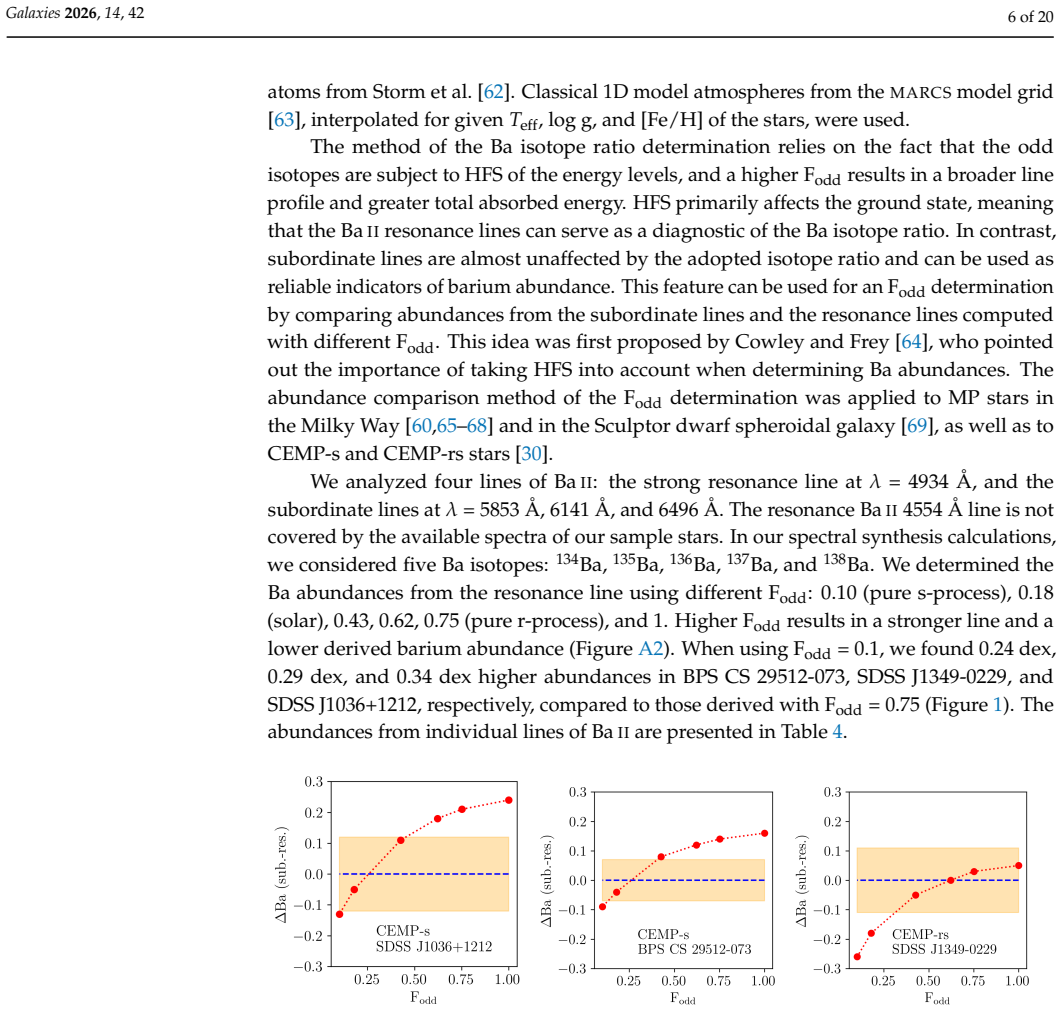
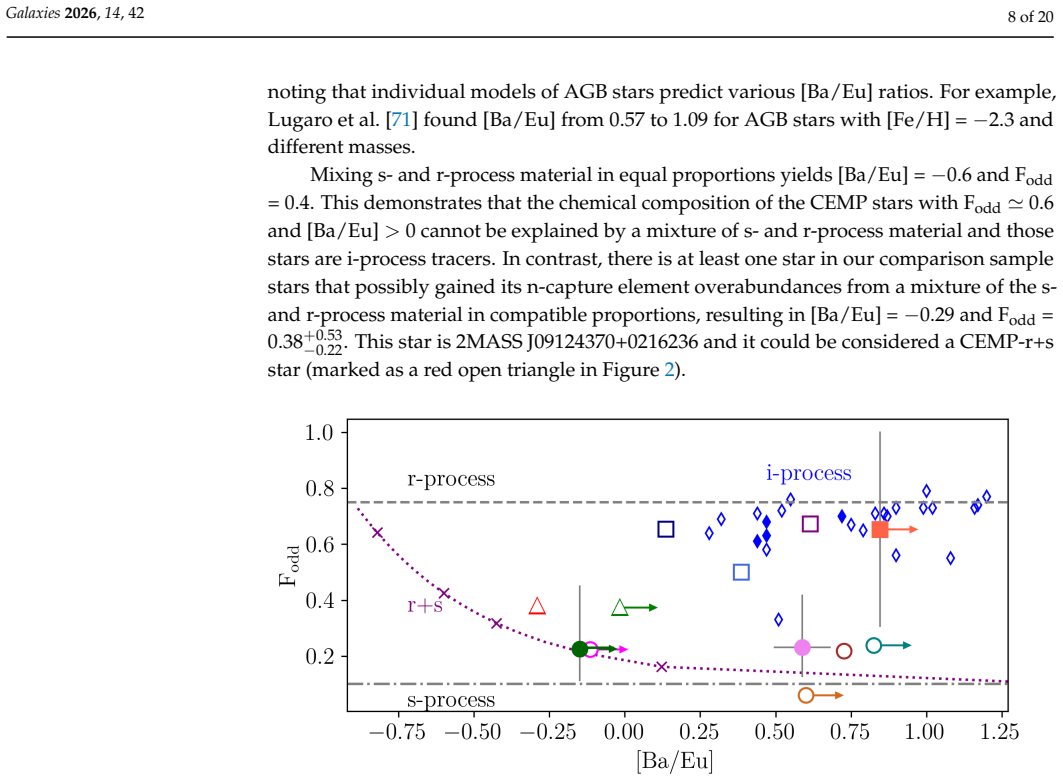
F_odd equals 0.65 with large uncertainties in the CEMP-rs star SDSS J1349-0229, while the CEMP-s stars BPS CS 29512-073 and SDSS J1036+1212 both give F_odd equal to 0.23; these distinct values are taken to indicate that the odd-isotope fraction traces the relative importance of s-process and i-process nucleosynthesis.
What carries the argument
The odd-isotope fraction F_odd of barium, extracted from NLTE synthetic spectra of Ba II lines.
If this is right
- Barium isotope ratios can be used to classify the dominant neutron-capture process in individual CEMP stars.
- NLTE analysis must be extended to many more elements before firm limits can be placed on i-process yields.
- The provided line-list generator allows observers to test different F_odd values directly against spectra.
Where Pith is reading between the lines
- If the pattern holds, i-process sites must produce a distinctly higher odd-Ba fraction than the main s-process.
- Binary mass-transfer models for CEMP-rs stars may need to incorporate an i-process component whose efficiency varies with companion mass or metallicity.
- Repeating the measurement at higher spectral resolution could shrink the error bars and test whether the current values are resolution-limited.
Load-bearing premise
NLTE modeling and the adopted Ba II line data produce isotope fractions that reflect the stars' nucleosynthetic history rather than being dominated by uncertainties in stellar parameters or atomic data.
What would settle it
A larger sample of CEMP-s and CEMP-rs stars in which the two groups show overlapping F_odd distributions would remove the claimed distinction.
Figures
read the original abstract
We present a spectroscopic analysis of three carbon-enhanced metal-poor (CEMP) stars of type CEMP-s and CEMP-rs and determine their non-local thermodynamic equilibrium (NLTE) abundances of Ba and the fractions of the odd Ba isotopes (F$_{\rm odd}$). We found F$_{\rm odd}$ = 0.65$_{-0.34}^{+0.35}$ in SDSS J1349-0229, which is known in the literature as a CEMP-rs star, while the other two stars, BPS CS 29512-073 and SDSS J1036+1212, exhibit lower F$_{\rm odd}$ = 0.23$_{-0.10}^{+0.19}$ and 0.23$_{-0.11}^{+0.22}$, respectively, and they are known in the literature as CEMP-s stars. The present result supports our earlier finding about distinct F$_{\rm odd}$ in CEMP-s and CEMP-rs stars. For obtaining observational constraints on i-process nucleosynthesis, further NLTE abundance determinations for many chemical elements are required. We provide a tool for generating the lists of Ba II lines for a given F$_{\rm odd}$ and it is available on GitHub https://github.com/sitamih/ba_linelist.
Editorial analysis
A structured set of objections, weighed in public.
Referee Report
Summary. The manuscript reports NLTE spectroscopic measurements of barium odd-isotope fractions (F_odd) in three CEMP stars. It finds F_odd = 0.65_{-0.34}^{+0.35} for the CEMP-rs star SDSS J1349-0229 and F_odd = 0.23 with smaller uncertainties (~0.1-0.2) for the two CEMP-s stars BPS CS 29512-073 and SDSS J1036+1212. These values are interpreted as supporting distinct nucleosynthetic origins (i-process vs. s-process), extending prior work by the authors, and a GitHub tool is provided for generating Ba II line lists at given F_odd.
Significance. If the reported distinction in F_odd survives detailed scrutiny of the error budget, the result would supply a direct observational diagnostic separating i-process and s-process contributions in CEMP stars. The open GitHub tool for line-list generation is a clear strength that aids reproducibility and future work.
major comments (2)
- [Abstract / results for SDSS J1349-0229] Abstract and results presentation: the central claim of 'distinct F_odd' in CEMP-rs vs. CEMP-s stars is load-bearing, yet the quoted values overlap (CEMP-rs range 0.31-1.00; CEMP-s range ~0.13-0.42). The difference of 0.42 is only ~1.2 sigma given the combined uncertainties; no quantitative statistical test (e.g., significance of the difference or posterior overlap) is described.
- [Methods / abundance analysis section] The error budget on F_odd (NLTE modeling, stellar parameters, Ba II atomic data) must be shown to be complete and not dominated by systematics, because the weakest assumption is that these uncertainties accurately reflect nucleosynthetic origin rather than analysis artifacts. Explicit propagation or sensitivity tests are required to support the quoted asymmetric errors.
minor comments (1)
- The GitHub link is useful; ensure the repository contains versioned code, example inputs, and a README that reproduces the line lists used in the paper.
Simulated Author's Rebuttal
We thank the referee for the detailed and constructive report. We address each major comment below and will revise the manuscript to incorporate additional statistical discussion and explicit error analysis.
read point-by-point responses
-
Referee: [Abstract / results for SDSS J1349-0229] Abstract and results presentation: the central claim of 'distinct F_odd' in CEMP-rs vs. CEMP-s stars is load-bearing, yet the quoted values overlap (CEMP-rs range 0.31-1.00; CEMP-s range ~0.13-0.42). The difference of 0.42 is only ~1.2 sigma given the combined uncertainties; no quantitative statistical test (e.g., significance of the difference or posterior overlap) is described.
Authors: We agree that the F_odd values overlap within the quoted uncertainties and that the difference between the central values is only approximately 1.2 sigma. The central values remain consistent with theoretical expectations (F_odd ~0.1-0.3 for s-process and higher for i-process), but we acknowledge that a quantitative test of the difference is needed. In the revised manuscript we will add an explicit assessment, such as the posterior overlap probability or a simple two-sample comparison, to quantify the statistical support for distinct origins. revision: yes
-
Referee: [Methods / abundance analysis section] The error budget on F_odd (NLTE modeling, stellar parameters, Ba II atomic data) must be shown to be complete and not dominated by systematics, because the weakest assumption is that these uncertainties accurately reflect nucleosynthetic origin rather than analysis artifacts. Explicit propagation or sensitivity tests are required to support the quoted asymmetric errors.
Authors: We agree that the error budget requires explicit demonstration that it is not dominated by unaccounted systematics. The current asymmetric uncertainties were derived from our NLTE fits, but the revised methods section will include dedicated sensitivity tests: we will vary T_eff, log g, microturbulence, and Ba II atomic data within their literature uncertainties, re-derive F_odd for each case, and show the resulting range. This will confirm that the quoted errors capture the dominant contributions and are not artifacts of the analysis. revision: yes
Circularity Check
No circularity: direct spectroscopic derivation of F_odd from observed spectra
full rationale
The paper performs NLTE spectroscopic analysis on three CEMP stars to extract Ba abundances and odd-isotope fractions F_odd directly from Ba II line profiles in the observed spectra. No equations or fitting procedures are described that reduce the reported F_odd values (0.65, 0.23, 0.23) to quantities previously fitted or assumed by the same authors. The statement that the results 'support our earlier finding' is contextual commentary on consistency with prior work and does not serve as a load-bearing premise for the new measurements. The provided GitHub tool for generating line lists is a utility, not part of the derivation chain. The analysis is self-contained against external benchmarks (stellar spectra and atomic data), satisfying the criteria for an honest non-finding of circularity.
Axiom & Free-Parameter Ledger
axioms (1)
- domain assumption NLTE effects are correctly modeled for the Ba II lines used to derive F_odd
Reference graph
Works this paper leans on
-
[1]
Synthesis of the Elements in Stars
Burbidge, E.M.; Burbidge, G.R.; Fowler, W.A.; Hoyle, F. Synthesis of the Elements in Stars. Reviews of Modern Physics1957,29, 547–650. https://doi.org/10.1103/RevModPhys.29.547
-
[2]
Production of 14C and neutrons in red giants.ApJ1977,212, 149–158
Cowan, J.J.; Rose, W.K. Production of 14C and neutrons in red giants.ApJ1977,212, 149–158. https://doi.org/10.1086/155030
-
[3]
Evolution and Nucleosynthesis in Low-Mass Asymptotic Giant Branch Stars
Gallino, R.; Arlandini, C.; Busso, M.; Lugaro, M.; Travaglio, C.; Straniero, O.; Chieffi, A.; Limongi, M. Evolution and Nucleosynthesis in Low-Mass Asymptotic Giant Branch Stars. II. Neutron Capture and the S-Process.ApJ1998,497, 388–403. https://doi.org/10.1086/305437
-
[4]
Evolution of Asymptotic Giant Branch Stars.ARA&A2005,43, 435–479
Herwig, F. Evolution of Asymptotic Giant Branch Stars.ARA&A2005,43, 435–479. https: //doi.org/10.1146/annurev.astro.43.072103.150600
-
[5]
Herwig, F.; Pignatari, M.; Woodward, P .R.; Porter, D.H.; Rockefeller, G.; Fryer, C.L.; Bennett, M.; Hirschi, R. Convective-reactive Proton-12C Combustion in Sakurai’s Object (V4334 Sagittarii) and Implications for the Evolution and Yields from the First Generations of Stars.ApJ2011, 727, 89, [arXiv:astro-ph.SR/1002.2241]. https://doi.org/10.1088/0004-637...
-
[6]
Cristallo, S.; Karinkuzhi, D.; Goswami, A.; Piersanti, L.; Gobrecht, D. Constraints of the Physics of Low-mass AGB Stars from CH and CEMP Stars.ApJ2016,833, 181, [arXiv:astro- ph.SR/1610.05475]. https://doi.org/10.3847/1538-4357/833/2/181
-
[7]
The intermediate neutron capture process
Choplin, A.; Siess, L.; Goriely, S. The intermediate neutron capture process. III. The i-process in AGB stars of different masses and metallicities without overshoot.A&A2022,667, A155, [arXiv:astro-ph.SR/2209.10303]. https://doi.org/10.1051/0004-6361/202244360
-
[8]
The intermediate neutron capture process
Choplin, A.; Siess, L.; Goriely, S.; Martinet, S. The intermediate neutron capture process. V . The i-process in AGB stars with overshoot.A&A2024,684, A206, [arXiv:astro-ph.SR/2402.10284]. https://doi.org/10.1051/0004-6361/202348957
-
[9]
Denissenkov, P .A.; Herwig, F.; Woodward, P .; Andrassy, R.; Pignatari, M.; Jones, S. The i- process yields of rapidly accreting white dwarfs from multicycle He-shell flash stellar evolution models with mixing parametrizations from 3D hydrodynamics simulations.MNRAS2019, 488, 4258–4270, [arXiv:astro-ph.SR/1809.03666]. https://doi.org/10.1093/mnras/stz1921
-
[10]
Chemical evolution with rotating massive star yields II
Prantzos, N.; Abia, C.; Cristallo, S.; Limongi, M.; Chieffi, A. Chemical evolution with rotating massive star yields II. A new assessment of the solar s- and r-process components.MNRAS2020, 491, 1832–1850, [arXiv:astro-ph.GA/1911.02545]. https://doi.org/10.1093/mnras/stz3154
-
[11]
The Incidence of Binaries among Very Metal-poor Carbon Stars.AJ 2001,122, 1545–1560
Preston, G.W.; Sneden, C. The Incidence of Binaries among Very Metal-poor Carbon Stars.AJ 2001,122, 1545–1560. https://doi.org/10.1086/322082
doi:10.1086/322082 2001
-
[12]
Lucatello, S.; Tsangarides, S.; Beers, T.C.; Carretta, E.; Gratton, R.G.; Ryan, S.G. The Binary Frequency Among Carbon-enhanced, s-Process-rich, Metal-poor Stars.ApJ2005,625, 825–832, [arXiv:astro-ph/astro-ph/0412422]. https://doi.org/10.1086/428104
-
[13]
Binarity in carbon-enhanced metal-poor stars.MNRAS2014,441, 1217–1229, [arXiv:astro-ph.SR/1404.0385]
Starkenburg, E.; Shetrone, M.D.; McConnachie, A.W.; Venn, K.A. Binarity in carbon-enhanced metal-poor stars.MNRAS2014,441, 1217–1229, [arXiv:astro-ph.SR/1404.0385]. https://doi. org/10.1093/mnras/stu623. https://doi.org/ Galaxies2026,14, 42 10 of 20
-
[14]
The Discovery and Analysis of Very Metal-Poor Stars in the Galaxy
Beers, T.C.; Christlieb, N. The Discovery and Analysis of Very Metal-Poor Stars in the Galaxy. ARA&A2005,43, 531–580. https://doi.org/10.1146/annurev.astro.42.053102.134057
-
[15]
The Hamburg/ESO R-process enhanced star survey (HERES)
Jonsell, K.; Barklem, P .S.; Gustafsson, B.; Christlieb, N.; Hill, V .; Beers, T.C.; Holmberg, J. The Hamburg/ESO R-process enhanced star survey (HERES). III. HE 0338-3945 and the formation of the r + s stars.A&A2006,451, 651–670, [arXiv:astro-ph/astro-ph/0601476]. https://doi.org/ 10.1051/0004-6361:20054470
-
[16]
Abate, C.; Stancliffe, R.J.; Liu, Z.W. How plausible are the proposed formation scenarios of CEMP-r/s stars?A&A2016,587, A50, [arXiv:astro-ph.SR/1601.00976]. https://doi.org/10.105 1/0004-6361/201527864
-
[17]
Abundances and kinematics of carbon-enhanced metal-poor stars in the Galactic halo
Hansen, C.J.; Hansen, T.T.; Koch, A.; Beers, T.C.; Nordström, B.; Placco, V .M.; Andersen, J. Abundances and kinematics of carbon-enhanced metal-poor stars in the Galactic halo. A new classification scheme based on Sr and Ba.A&A2019,623, A128, [arXiv:astro-ph.SR/1901.05968]. https://doi.org/10.1051/0004-6361/201834601
-
[18]
Karinkuzhi, D.; Van Eck, S.; Goriely, S.; Siess, L.; Jorissen, A.; Merle, T.; Escorza, A.; Masseron, T. Low-mass low-metallicity AGB stars as an efficient i-process site explaining CEMP-rs stars.A&A 2021,645, A61, [arXiv:astro-ph.SR/2010.13620]. https://doi.org/10.1051/0004-6361/202038891
-
[19]
Spectroscopic study of CEMP-(s & r/s) stars
Goswami, P .P .; Rathour, R.S.; Goswami, A. Spectroscopic study of CEMP-(s & r/s) stars. Revisiting classification criteria and formation scenarios, highlighting i-process nucleosynthesis. A&A2021,649, A49, [arXiv:astro-ph.SR/2101.09518]. https://doi.org/10.1051/0004-6361/2020 38258
-
[20]
The chemical composition of HD 196944: a carbon and s-process rich, very metal-poor star.A&A1998,337, 216–222
Zacs, L.; Nissen, P .E.; Schuster, W.J. The chemical composition of HD 196944: a carbon and s-process rich, very metal-poor star.A&A1998,337, 216–222
-
[21]
Discovery of three lead-rich stars.Nature2001, 412, 793–795
Van Eck, S.; Goriely, S.; Jorissen, A.; Plez, B. Discovery of three lead-rich stars.Nature2001, 412, 793–795. https://doi.org/10.1038/35090514
-
[22]
Aoki, W.; Ryan, S.G.; Norris, J.E.; Beers, T.C.; Ando, H.; Tsangarides, S. A Subaru/High Dispersion Spectrograph Study of Lead (Pb) Abundances in Eight s-Process Element-rich, Metal- poor Stars.ApJ2002,580, 1149–1158, [arXiv:astro-ph/astro-ph/0208020]. https://doi.org/10.1 086/343885
-
[23]
Chemical abundances in 43 metal-poor stars.A&A2005,440, 321–343, [arXiv:astro-ph/astro-ph/0505118]
Jonsell, K.; Edvardsson, B.; Gustafsson, B.; Magain, P .; Nissen, P .E.; Asplund, M. Chemical abundances in 43 metal-poor stars.A&A2005,440, 321–343, [arXiv:astro-ph/astro-ph/0505118]. https://doi.org/10.1051/0004-6361:20052797
-
[24]
Masseron, T.; Johnson, J.A.; Plez, B.; van Eck, S.; Primas, F.; Goriely, S.; Jorissen, A. A holistic approach to carbon-enhanced metal-poor stars.A&A2010,509, A93, [arXiv:astro- ph.SR/0901.4737]. https://doi.org/10.1051/0004-6361/200911744
-
[25]
A Search for Stars of Very Low Metal Abundance
Roederer, I.U.; Preston, G.W.; Thompson, I.B.; Shectman, S.A.; Sneden, C.; Burley, G.S.; Kelson, D.D. A Search for Stars of Very Low Metal Abundance. VI. Detailed Abundances of 313 Metal- poor Stars.AJ2014,147, 136, [arXiv:astro-ph.SR/1403.6853]. https://doi.org/10.1088/0004-625 6/147/6/136
-
[26]
Placco, V .M.; Beers, T.C.; Ivans, I.I.; Filler, D.; Imig, J.A.; Roederer, I.U.; Abate, C.; Hansen, T.; Cowan, J.J.; Frebel, A.; et al. Hubble Space Telescope Near-Ultraviolet Spectroscopy of Bright CEMP-s Stars.ApJ2015,812, 109, [arXiv:astro-ph.SR/1508.05872]. https://doi.org/10.1088/00 04-637X/812/2/109
-
[27]
Mittal, S.; Roederer, I.U. New Stellar Parameters, Metallicities, and Elemental Abundance Ratios for 311 Metal-poor Stars.AJ2025,169, 172, [arXiv:astro-ph.SR/2502.15915]. https: //doi.org/10.3847/1538-3881/adadf0
-
[28]
Roederer, I.U.; Placco, V .M.; Karakas, A.I.; Den Hartog, E.A.; Beers, T.C. Abundances of Rarely Detected s-process Elements Derived from the Ultraviolet Spectrum of the s-process- enhanced Metal-poor Star HD 196944.ApJ2025,995, 2, [arXiv:astro-ph.SR/2510.11922]. https: //doi.org/10.3847/1538-4357/ae12e7
-
[29]
Carbon-enhanced metal-poor stars: a window on AGB nucleosynthesis and binary evolution
Abate, C.; Pols, O.R.; Izzard, R.G.; Karakas, A.I. Carbon-enhanced metal-poor stars: a window on AGB nucleosynthesis and binary evolution. II. Statistical analysis of a sample of 67 CEMP-s stars.A&A2015,581, A22, [arXiv:astro-ph.SR/1507.04662]. https://doi.org/10.1051/0004-636 1/201525876. https://doi.org/ Galaxies2026,14, 42 11 of 20
-
[30]
Sitnova, T.M.; Mashonkina, L.I.; Romanovskaya, A.M.; Giribaldi, R.E.; Choplin, A. Distinct barium isotope ratios in CEMP-s and CEMP-rs stars.A&A2025,704, A103, [arXiv:astro- ph.SR/2510.16275]. https://doi.org/10.1051/0004-6361/202557031
-
[31]
From the s-Process to the i-Process: A New Perspective on the Chemical Enrichment of Extrinsic Stars.Galaxies2024,12, 89
Van Eck, S.; Giribaldi, R.; Merle, T.; Lambotte, A.; Karinkuzhi, D.; Goriely, S.; Choplin, A.; Storm, N.; Gerber, J.; Siess, L.; et al. From the s-Process to the i-Process: A New Perspective on the Chemical Enrichment of Extrinsic Stars.Galaxies2024,12, 89. https://doi.org/10.3390/ galaxies12060089
-
[32]
Choplin, A.; Goriely, S.; Siess, L.; Martinet, S. Synthesis of actinides and short-lived radionu- clides during i-process nucleosynthesis in AGB stars.European Physical Journal A2025,61, 68, [arXiv:astro-ph.SR/2504.08058]. https://doi.org/10.1140/epja/s10050-025-01522-8
-
[33]
Three carbon-enhanced metal-poor dwarf stars from the SDSS
Behara, N.T.; Bonifacio, P .; Ludwig, H.G.; Sbordone, L.; González Hernández, J.I.; Caffau, E. Three carbon-enhanced metal-poor dwarf stars from the SDSS. Chemical abundances from CO5BOLD 3D hydrodynamical model atmospheres.A&A2010,513, A72, [arXiv:astro- ph.SR/1002.1670]. https://doi.org/10.1051/0004-6361/200913213
-
[34]
Allen, D.M.; Ryan, S.G.; Rossi, S.; Beers, T.C.; Tsangarides, S.A. Elemental abundances and classification of carbon-enhanced metal-poor stars.A&A2012,548, A34, [arXiv:astro- ph.SR/1210.5009]. https://doi.org/10.1051/0004-6361/201015615
-
[35]
Riyas, A.M.; Karinkuzhi, D.; Van Eck, S.; Choplin, A.; Goriely, S.; Siess, L.; Keerthy, M.V .; Jorissen, A.; Merle, T. Abundance of Heavy r-process Elements in CEMP-rs Stars: The Role of the i-process.ApJ2026,997, 44, [arXiv:astro-ph.SR/2510.13339]. https://doi.org/10.3847/1538 -4357/ae12a0
-
[36]
Mucciarelli, A.; Bellazzini, M.; Massari, D. Exploiting the Gaia EDR3 photometry to derive stellar temperatures.A&A2021,653, A90, [arXiv:astro-ph.SR/2106.03882]. https://doi.org/10 .1051/0004-6361/202140979
-
[37]
A 3D Dust Map Based on Gaia, Pan-STARRS 1, and 2MASS.ApJ2019,887, 93, [arXiv:astro-ph.GA/1905.02734]
Green, G.M.; Schlafly, E.; Zucker, C.; Speagle, J.S.; Finkbeiner, D. A 3D Dust Map Based on Gaia, Pan-STARRS 1, and 2MASS.ApJ2019,887, 93, [arXiv:astro-ph.GA/1905.02734]. https://doi.org/10.3847/1538-4357/ab5362
-
[38]
Casagrande, L.; VandenBerg, D.A. On the use of Gaia magnitudes and new tables of bolometric corrections.MNRAS2018,479, L102–L107, [arXiv:astro-ph.SR/1806.01953]. https://doi.org/10 .1093/mnrasl/sly104
-
[39]
Lindegren, L.; Bastian, U.; Biermann, M.; Bombrun, A.; de Torres, A.; Gerlach, E.; Geyer, R.; Hernández, J.; Hilger, T.; Hobbs, D.; et al. Gaia Early Data Release 3. Parallax bias versus magnitude, colour, and position.A&A2021,649, A4, [arXiv:astro-ph.IM/2012.01742]. https://doi.org/10.1051/0004-6361/202039653
-
[40]
Estimating Distances from Parallaxes.P ASP2015,127, 994, [arXiv:astro- ph.IM/1507.02105]
Bailer-Jones, C.A.L. Estimating Distances from Parallaxes.P ASP2015,127, 994, [arXiv:astro- ph.IM/1507.02105]. https://doi.org/10.1086/683116
-
[41]
Mashonkina, L.; Gehren, T.; Shi, J.R.; Korn, A.J.; Grupp, F. A non-LTE study of neutral and singly-ionized iron line spectra in 1D models of the Sun and selected late-type stars.A&A2011, 528, A87, [arXiv:astro-ph.SR/1101.4570]. https://doi.org/10.1051/0004-6361/201015336
-
[42]
Mashonkina, L.; Pakhomov, Y.; Sitnova, T.; Smogorzhevskii, A.; Jablonka, P .; Hill, V . 1D non-LTE corrections for chemical abundance analyses of very metal-poor stars.MNRAS2023, 524, 3526–3536, [arXiv:astro-ph.SR/2307.04523]. https://doi.org/10.1093/mnras/stad2114
-
[43]
Mashonkina, L.; Sitnova, T.; Yakovleva, S.A.; Belyaev, A.K. Influence of inelastic collisions with hydrogen atoms on the non-local thermodynamic equilibrium line formation for Fe I and Fe II in the 1D model atmospheres of late-type stars.A&A2019,631, A43, [arXiv:astro- ph.SR/1908.02478]. https://doi.org/10.1051/0004-6361/201935753
-
[44]
Systematic Non-LTE Study of the -2.6 < [Fe/H] < 0.2 F and G dwarfs in the Solar Neighborhood
Sitnova, T.; Zhao, G.; Mashonkina, L.; Chen, Y.; Liu, F.; Pakhomov, Y.; Tan, K.; Bolte, M.; Alexeeva, S.; Grupp, F.; et al. Systematic Non-LTE Study of the -2.6 < [Fe/H] < 0.2 F and G dwarfs in the Solar Neighborhood. I. Stellar Atmosphere Parameters.ApJ2015,808, 148, [arXiv:astro-ph.SR/1506.01621]. https://doi.org/10.1088/0004-637X/808/2/148
-
[45]
An absolutely calibrated Te f f scale from the infrared flux method
Casagrande, L.; Ramírez, I.; Meléndez, J.; Bessell, M.; Asplund, M. An absolutely calibrated Te f f scale from the infrared flux method. Dwarfs and subgiants.A&A2010,512, A54, [arXiv:astro- ph.SR/1001.3142]. https://doi.org/10.1051/0004-6361/200913204. https://doi.org/ Galaxies2026,14, 42 12 of 20
-
[46]
Frebel, A.; Casey, A.R.; Jacobson, H.R.; Yu, Q. Deriving Stellar Effective Temperatures of Metal-poor Stars with the Excitation Potential Method.ApJ2013,769, 57, [arXiv:astro- ph.GA/1304.2396]. https://doi.org/10.1088/0004-637X/769/1/57
-
[47]
VALD: The Vienna Atomic Line Data Base.A&AS1995,112, 525
Piskunov, N.E.; Kupka, F.; Ryabchikova, T.A.; Weiss, W.W.; Jeffery, C.S. VALD: The Vienna Atomic Line Data Base.A&AS1995,112, 525
-
[48]
Pakhomov, Y.V .; Ryabchikova, T.A.; Piskunov, N.E. Hyperfine Splitting in the VALD Database of Spectral-line Parameters.Astronomy Reports2019,63, 1010–1021, [arXiv:astro-ph.IM/1911.03189]. https://doi.org/10.1134/S1063772919120047
-
[49]
Critical Evaluation of Transition Probabilities for Ba I and Ba II.Atomic Data1969,1, 1–+
Miles, B.M.; Wiese, W.L. Critical Evaluation of Transition Probabilities for Ba I and Ba II.Atomic Data1969,1, 1–+. (MW), https://doi.org/10.1016/S0092-640X(69)80019-7
-
[50]
De Munshi, D.; Dutta, T.; Rebhi, R.; Mukherjee, M. Precision measurement of branching fractions of 138Ba+ : Testing many-body theories below the 1% level.Phys. Rev. A2015,91, 040501, [arXiv:physics.atom-ph/1411.5041]. https://doi.org/10.1103/PhysRevA.91.040501
-
[51]
Dutta, T.; de Munshi, D.; Yum, D.; Rebhi, R.; Mukherjee, M. An exacting transition probability measurement - a direct test of atomic many-body theories.Scientific Reports2016,6, 29772, [arXiv:physics.atom-ph/1604.01488]. https://doi.org/10.1038/srep29772
-
[52]
Lawler, J.E.; Wickliffe, M.E.; den Hartog, E.A.; Sneden, C. Improved Laboratory Transition Parameters forEu II and Application to the Solar Europium Elemental and Isotopic Composition. Astrophys. J.2001,563, 1075–1088. (LWHS), https://doi.org/10.1086/323407
doi:10.1086/323407 2001
-
[53]
Wendt, K.; Ahmad, S.A.; Buchinger, F.; Mueller, A.C.; Neugart, R.; Otten, E.W. Relativistic J-dependence of the isotope shift in the 6s-6p doublet of Ba II.Zeitschrift fur Physik A Hadrons and Nuclei1984,318, 125–129. https://doi.org/10.1007/BF01413460
-
[54]
Hühnermann, H.; Möller, W.; Alkhazov, G.; Panteleev, V . .Inst. Phys. Conf. Ser.1992, 132, 209–211
1992
-
[55]
How accurate are the “muonic” quadrupole moments in Eu?Physical Review Letters1993,70, 541–543
Möller, W.; Hühnermann, H.; Alkhazov, G.; Panteleev, V . How accurate are the “muonic” quadrupole moments in Eu?Physical Review Letters1993,70, 541–543. https://doi.org/10.1103/ PhysRevLett.70.541
-
[56]
Mea- surements of Hyperfine Structure of Stable and Instable Eu+ in a Paul Trap.Laser physics1998, 8, 657–663
Revalde, G.; Enders, K.; Stachowska, E.; Marx, G.; Zolch, C.; Dembcynski, J.; Werth, G. Mea- surements of Hyperfine Structure of Stable and Instable Eu+ in a Paul Trap.Laser physics1998, 8, 657–663
-
[57]
Software for NLTE Spectrum Fitting
Tsymbal, V .; Ryabchikova, T.; Sitnova, T. Software for NLTE Spectrum Fitting. In Proceedings of the Physics of Magnetic Stars; Kudryavtsev, D.O.; Romanyuk, I.I.; Yakunin, I.A., Eds., 2019, Vol. 518,Astronomical Society of the Pacific Conference Series, pp. 247–252
2019
-
[58]
BinMag: Widget for comparing stellar observed with theoretical spectra, 2018, [1805.015]
Kochukhov, O. BinMag: Widget for comparing stellar observed with theoretical spectra, 2018, [1805.015]
2018
-
[59]
9, University of London, [arXiv:0805.0554]
Butler, K.; Giddings, J.Newsletter on the analysis of astronomical spectra1985,No. 9, University of London, [arXiv:0805.0554]
-
[60]
Mashonkina, L.I.; Belyaev, A.K. Even-to-Odd Barium Isotope Ratio in Selected Galactic Halo Stars.Astronomy Letters2019,45, 341–352, [arXiv:astro-ph.SR/1906.10600]. https://doi.org/10 .1134/S1063773719060033
arXiv 1906
-
[61]
Barium and europium abundances in cool dwarf stars and nucle- osynthesis of heavy elements.A&A2000,364, 249–264
Mashonkina, L.; Gehren, T. Barium and europium abundances in cool dwarf stars and nucle- osynthesis of heavy elements.A&A2000,364, 249–264
-
[62]
Storm, N.; Barklem, P .S.; Yakovleva, S.A.; Belyaev, A.K.; Palmeri, P .; Quinet, P .; Lodders, K.; Bergemann, M.; Hoppe, R. 3D NLTE modelling of Y and Eu. Centre-to-limb variation and solar abundances.A&A2024,683, A200, [arXiv:astro-ph.SR/2401.13450]. https://doi.org/10.1051/ 0004-6361/202348971
-
[63]
A grid of MARCS model atmospheres for late-type stars
Gustafsson, B.; Edvardsson, B.; Eriksson, K.; Jørgensen, U.G.; Nordlund, Å.; Plez, B. A grid of MARCS model atmospheres for late-type stars. I. Methods and general properties.A&A2008, 486, 951–970, [0805.0554]. https://doi.org/10.1051/0004-6361:200809724
-
[64]
Cowley, C.R.; Frey, M. Hyperfine Structure in the Barium Resonance Line: Curves of Growth for Solar and r-Process Isotopic Mixtures.ApJ1989,346, 1030. https://doi.org/10.1086/168085
-
[65]
Barium abundances in cool dwarf stars as a constraint to s- and r-process nucleosynthesis.A&A1999,343, 519–530
Mashonkina, L.; Gehren, T.; Bikmaev, I. Barium abundances in cool dwarf stars as a constraint to s- and r-process nucleosynthesis.A&A1999,343, 519–530. https://doi.org/ Galaxies2026,14, 42 13 of 20
-
[66]
Mashonkina, L.; Zhao, G. Barium even-to-odd isotope abundance ratios in thick disk and thin disk stars.A&A2006,456, 313–321, [arXiv:astro-ph/astro-ph/0604198]. https://doi.org/10.105 1/0004-6361:20054749
-
[67]
Mashonkina, L.; Zhao, G.; Gehren, T.; Aoki, W.; Bergemann, M.; Noguchi, K.; Shi, J.R.; Takada- Hidai, M.; Zhang, H.W. Non-LTE line formation for heavy elements in four very metal-poor stars.A&A2008,478, 529–541, [arXiv:astro-ph/0711.4454]. https://doi.org/10.1051/0004-6361: 20078060
-
[68]
Sitnova, T.M.; Lombardo, L.; Mashonkina, L.I.; Rizzuti, F.; Cescutti, G.; Hansen, C.J.; Bonifacio, P .; Caffau, E.; Koch-Hansen, A.; Meynet, G.; et al. Unlocking the mystery of strontium synthesis in the early Galaxy through analysis of barium isotopes in very metal-poor stars.A&A2025, 699, A262, [arXiv:astro-ph.SR/2506.10193]. https://doi.org/10.1051/000...
-
[69]
Jablonka, P .; North, P .; Mashonkina, L.; Hill, V .; Revaz, Y.; Shetrone, M.; Starkenburg, E.; Irwin, M.; Tolstoy, E.; Battaglia, G.; et al. The early days of the Sculptor dwarf spheroidal galaxy.A&A 2015,583, A67, [arXiv:astro-ph.GA/1506.08636]. https://doi.org/10.1051/0004-6361/20152566 1
-
[70]
Lodders, K. Relative Atomic Solar System Abundances, Mass Fractions, and Atomic Masses of the Elements and Their Isotopes, Composition of the Solar Photosphere, and Compositions of the Major Chondritic Meteorite Groups.Space Sci. Rev.2021,217, 44. https://doi.org/10.1007/ s11214-021-00825-8
2021
-
[71]
Lugaro, M.; Karakas, A.I.; Stancliffe, R.J.; Rijs, C. The s-process in Asymptotic Giant Branch Stars of Low Metallicity and the Composition of Carbon-enhanced Metal-poor Stars.ApJ2012, 747, 2, [arXiv:astro-ph.SR/1112.2757]. https://doi.org/10.1088/0004-637X/747/1/2. Appendix A Appendix A.1 Figure A1.The H α line profiles in the observed spectra (circles) ...
discussion (0)
Sign in with ORCID, Apple, or X to comment. Anyone can read and Pith papers without signing in.