REVIEW 3 major objections 5 minor 4 references
MGPBD: A Multigrid Accelerated Global XPBD Solver
T0 review · 3 major / 5 minor · reviewed 2026-08-15 · deepseek-v4-flash
Pith's one-line read Solving XPBD's dual-space system with an AMG-preconditioned CG solver removes the low-frequency stalling that breaks high-resolution deformable simulation.
desk verdict A solid dual-space AMG solver for XPBD; the lazy-setup trick is new and useful, though its validation is thinner than the performance claims. read the letter →
The pith
A machine-rendered reading of the paper's core claim, the machinery that carries it, and where it could break.
The reading
What carries the argument
The load-bearing object is the global dual-space linear system whose unknowns are the Lagrange multipliers of the constraints, assembled each frame as $A = \nabla C M^{-1}\nabla C^T + \tilde{\alpha}$. The argument runs through three construction choices: unsmoothed aggregation (UA) builds the interpolation operator without the smoothing pass of smoothed aggregation, keeping coarse-grid matrices sparse; the near-kernel components that seed the hierarchy are generated by roughly 20 Gauss-Seidel sweeps on the homogeneous equation $Ax = 0$, repeated six times; and a lazy setup strategy reuses the prolongators for many frames because the matrix structure is fixed when the mesh topology is static and the entry values change slowly. The solving phase wraps one V-cycle inside a preconditioned conjugate-gradient loop, with $\omega$-Jacobi as the smoother for soft bodies and Chebyshev for cloth.
What would settle it
Run MGPBD with setup interval 20 on a scene with large inter-frame rotations or violent collisions, such as a stiff beam twisted 180 degrees within a few frames or cloth smashing into a sphere, and compare the relative dual-residual curve against a run that rebuilds the AMG hierarchy every frame; if the lazy-setup curve flattens or diverges while the fresh-setup curve converges, the reusability premise fails.
Extended reading notes
Core claim
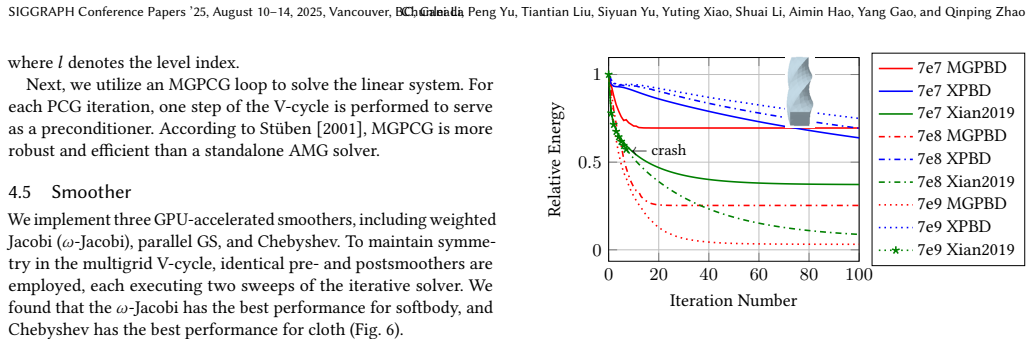
The paper's central claim is that the stalling of XPBD comes from its diagonal-only local update, which discards the off-diagonal coupling between constraints, and that solving the full Schur-complement system $A = \nabla C M^{-1}\nabla C^T + \tilde{\alpha}$ in the dual space with a multigrid-preconditioned conjugate-gradient loop removes both low- and high-frequency residual errors. The proposed MGPBD solver assembles $A$ each iteration, runs a V-cycle of unsmoothed-aggregation AMG as the preconditioner, and updates positions via $\Delta x = M^{-1}\nabla C^T \Delta \lambda$. Its central evidence is the residual power-spectral-density plot showing that two MGPBD iterations flatten the low- and high-frequency spikes that remain after 300 XPBD iterations, together with convergence curves in which XPBD stalls or crashes at 850K tetrahedra while MGPBD keeps decreasing the relative dual residual.
Load-bearing premise
The load-bearing premise is the paper's Section 4.2 claim that prolongators stay accurate across many frames because the dual-system entries change little unless constraint gradients or the angles between them change substantially.
Editorial extensions
If this is right
- Under the same time budget, MGPBD keeps decreasing the relative dual residual in high-stiffness, high-resolution scenarios where XPBD stalls; at 850K tetrahedra XPBD diverges while MGPBD stays stable.
- High stiffness and large time steps become usable together: MGPBD keeps a beam with stiffness $10^{12}$ stiff at time steps of 10, 20, and 30 ms, whereas XPBD shows resolution-dependent softness.
- The AMG hierarchy amortizes: lazy setup cuts the setup share of runtime from about two-thirds to about 2%, so per-frame cost is dominated by the V-cycle solve rather than hierarchy construction.
- Time per iteration scales roughly linearly with resolution ($R^2 = 0.9978$), unlike direct solvers, which makes million-element models feasible, including a 1.667M-tet human muscle at 40.6 seconds per frame with 20 iterations per frame.
- MGPBD can be blended into existing XPBD pipelines: it takes the same inputs and outputs as XPBD and can mix with off-the-shelf implementations for the parts that still need classic XPBD sweeps.
Reading between the lines
- Editorial inference: the lazy-setup result implies the AMG hierarchy could in principle be built once per scene or even once per stiffness regime when the topology is static and motion is mild; the practical limit is the rate of change of constraint gradients, not the frame count itself.
- Editorial inference: because the system lives in the dual constraint space, the method inherits XPBD's insensitivity to stiffness-to-weight ratio; the same UA-AMG preconditioning could be tested on other dual-space or primal-dual dynamics solvers to see whether the convergence advantage transfers.
- Editorial inference: the near-kernel technique suggests a general cheap bootstrap for aggregation AMG: run any simple relaxation on the homogeneous equation and use the results as near-nullspace vectors; how few sweeps suffice probably depends on the smoother and material, and that trade-off is not characterized in the paper.
- The paper's own limitation note, that explicit matrix assembly blocks dynamic topology and the global system adds oscillation that needs damping, points to the clearest next test: whether the convergence gain survives tearing, fracturing, or severe collisions that force frequent hierarchy rebuilds.
Signed reviews
Editorial analysis
A structured set of objections, weighed in public.
Referee Report
Summary. The paper presents MGPBD, a global dual-space XPBD solver that replaces the per-constraint Gauss-Seidel update of XPBD with a PCG solve preconditioned by an unsmoothed aggregation algebraic multigrid (UA-AMG) hierarchy. The global system is the Schur-complement system in Eq. (3). The contributions are (i) a lazy setup strategy that reuses the AMG prolongators for many frames with only occasional rebuilds, based on the claim that the system matrix changes slowly; (ii) a cheap near-kernel construction obtained by a few Gauss-Seidel sweeps on the homogeneous equation, repeated six times; and (iii) a GPU implementation in CUDA/Taichi. Experiments compare convergence and runtime against XPBD, AMGX, AMGCL, and PARDISO on tetrahedral soft bodies, cloth, muscle, beam, ball, and collision scenes, with reported speedups of two to three orders of magnitude over the third-party solvers.
Significance. If the results hold, MGPBD would be a practical remedy for the well-known stalling of XPBD on high-resolution and high-stiffness problems, and it would be the first AMG-based solver applied in the dual space of XPBD. The claim that two MGPBD iterations remove both low- and high-frequency residual spikes that 300 XPBD iterations cannot (Fig. 2) is strong and falsifiable. The paper ships code, uses standard AMG machinery, and includes comparisons against external libraries, which are real strengths. However, the efficiency claims rest on several empirically validated assumptions, most notably the lazy setup premise, and on comparisons whose reporting is incomplete. The near-kernel simplification is an interesting practical contribution, but its robustness and the fairness of the baseline comparisons need to be established before the headline numbers can be taken at face value.
major comments (3)
- [Sec. 4.2, Fig. 5] The lazy setup premise is the load-bearing component of the efficiency claim (setup cost drops from roughly two-thirds of runtime to 2%), yet it is validated only on the 270K-tet bunny squash scenario. The cloth (Fig. 14) and muscle (Figs. 1 and 11) experiments use setup interval 20 without any sensitivity test. For cloth distance constraints, the off-diagonal entry A_ij is proportional to the cosine of the angle between two edges sharing a vertex, so draping and stretching can rotate those angles substantially; for ARAP muscle constraints, matrix entries scale with the deformation gradient, which can change by large factors. Since stale prolongators degrade the Galerkin coarse operators and increase V-cycle counts, the paper should report residual-versus-frame or total-frame-time data for setup intervals 1, 20, and 100 on cloth and muscle cases. Without that, the generality of the 2% setup overhead claim is unsupported.
- [Sec. 5.2, Fig. 10] The comparison against AMGX, AMGCL, and PARDISO in Fig. 10(b) reports only per-iteration time (Ours: 0.54s; AMGX: 3.85s; AMGCL: 1.63s; PARDISO: 91.98s). Unless the number of iterations to reach the same residual tolerance is reported, these numbers do not support the 'two or three orders of magnitude improvements' claim. A direct solver such as PARDISO performs a factorization whose cost is amortized over one solve, so comparing its single-call time to one MGPBD iteration is not an equal-footing comparison. The authors should provide total wall-clock time (including setup and all iterations) to reach the same relative dual residual for all solvers.
- [Sec. 4.5 and Sec. 4.3] The smoother's omega_opt depends on lambda_min(D^{-1}A), approximated by a user-defined estimate (e.g., 0.1), and the paper states that this approximation 'boosts performance by 24%' in the 850K-tet bunny case. The near-kernel construction uses 20 GS sweeps repeated six times from a random initial vector. These are free parameters, and the smoother is the dominant cost of the V-cycle (85% of an iteration). The paper should provide a sensitivity analysis for the lambda_min estimate and for the near-kernel sweep count/random seed, or explicitly state which values were used in each experiment. Without this, the reproducibility and robustness of the convergence results are not fully established.
minor comments (5)
- [General] There are several typos and formatting errors: 'Comparision' in Sec. 5.1, 'interleved' in Sec. 4.1, 'aross' in the Fig. 5 caption, and 'comapred' in the Fig. 8 caption.
- [Sec. 4.2] The formulas for A_ii and A_ij contain garbled symbols (e.g., '˝') and undefined notation for m^{-1}_{s_v}; the mathematical typesetting should be fixed.
- [Fig. 2] The caption and surrounding text say the red subgraph shows dual residuals before solving and the green subgraphs after solving, but the figure layout is described as 'from left to right' in a way that is hard to follow; please add clear labels directly in the figure.
- [Sec. 5.2, Fig. 9] The text says 'Fig. 9 shows the time taken to achieve a 10^{-2} relative dual residual,' but the y-axis is labeled 'Time Per Iteration (ms).' This is misleading: the linear scaling claim (R^2 = 0.9978) applies to per-iteration cost, not end-to-end time, unless the iteration count is shown to be resolution-independent. Please clarify the caption and, if appropriate, also plot total time to the tolerance.
- [Sec. 4.3] The justification that six near-kernel vectors are used 'because the solid motion consists of six rigid body modes' is heuristic in the dual space, where the unknowns are Lagrange multipliers rather than positions. Please either provide a dual-space derivation or soften the claim.
Circularity Check
No circular derivation: the AMG hierarchy and near-kernel are built from the system matrix itself, and the central claim is tested against external baselines.
full rationale
The paper's derivation chain is self-contained. The global dual system (Eq. 3) is the standard Schur complement of the XPBD Newton system; the AMG setup (Sec. 4.1) uses standard strength-of-connection filtering, aggregation, and Galerkin projection computed from the matrix A itself, not from a target result. The near-kernel components (Sec. 4.3) are generated by a few sweeps of GS on the homogeneous equation Ax=0, a conventional AMG bootstrap heuristic; no fitted constant is fed back into the derivation as a 'prediction.' The lazy setup strategy (Sec. 4.2) is an empirical approximation validated in Fig. 5, not a circular definition. Performance claims are compared against external baselines (XPBD, AMGX, AMGCL, PARDISO) and multiple scenes. Self-citations to Xian et al. 2019 and Ruan et al. 2024, which include co-author Tiantian Liu, appear only for background positioning and to motivate unsmoothed aggregation; the sparsity advantage is independently demonstrated in Fig. 4. No step reduces by construction to its own input.
Assumptions & free parameters
free parameters (5)
- strength threshold theta_s =
0.1
- lazy setup interval =
20 frames
- near-kernel GS sweeps =
20 sweeps, 6 random starts
- lambda_min estimate for omega-Jacobi =
0.1
- relaxation factor omega (line 11) =
0.1 softbody / 0.25 cloth or backtracking
assumptions (4)
- domain assumption The dual-space XPBD linear system A Delta_lambda = b (Eq. 3) is the correct root system for solving the constraint dynamics.
- domain assumption A is symmetric positive definite so PCG and the power method apply.
- domain assumption Rigid body modes are the relevant near-nullspace for the dual system.
- ad hoc to paper The system matrix A changes slowly enough that prolongators remain effective for up to 100 frames.
Cite this review
Pith. "Pith review of MGPBD: A Multigrid Accelerated Global XPBD Solver." pith.science (2026). https://pith.science/paper/DLYUWNSM
@misc{pith2026250513390,
  author       = {Pith},
  title        = {Pith review of: MGPBD: A Multigrid Accelerated Global XPBD Solver},
  year         = {2026},
  howpublished = {\url{https://pith.science/paper/DLYUWNSM}},
  note         = {Machine review of arXiv:2505.13390}
}
read the original abstract
We introduce a novel Unsmoothed Aggregation (UA) Algebraic Multigrid (AMG) method combined with Preconditioned Conjugate Gradient (PCG) to overcome the limitations of Extended Position-Based Dynamics (XPBD) in high-resolution and high-stiffness simulations. While XPBD excels in simulating deformable objects due to its speed and simplicity, its nonlinear Gauss-Seidel (GS) solver often struggles with low-frequency errors, leading to instability and stalling issues, especially in high-resolution, high-stiffness simulations. Our multigrid approach addresses these issues efficiently by leveraging AMG. To reduce the computational overhead of traditional AMG, where prolongator construction can consume up to two-thirds of the runtime, we propose a lazy setup strategy that reuses prolongators across iterations based on matrix structure and physical significance. Furthermore, we introduce a simplified method for constructing near-kernel components by applying a few sweeps of iterative methods to the homogeneous equation, achieving convergence rates comparable to adaptive smoothed aggregation (adaptive-SA) at a lower computational cost. Experimental results demonstrate that our method significantly improves convergence rates and numerical stability, enabling efficient and stable high-resolution simulations of deformable objects.
Figures


Figures from the paper (12 more)




Reference graph
Works this paper leans on
-
[4]
Subspace-Preconditioned GPU Projective Dynamics with Contact for Cloth Simulation. In SIGGRAPH Asia. Association for Computing Machinery, New York, NY, USA, 1:1–1:12. https://doi.org/10.1145/3610548.3618157 Xuan Li, Minchen Li, and Chenfanfu Jiang. 2022. Energetically consistent inelasticity for optimization time integration. ACM Trans. Graph. 41, 4, Arti...
arXiv 2020
-
[2007]
Efficient simulation of inextensible cloth. ACM Trans. Graph. 26, 3 (July 2007), 49–es. doi:10.1145/1276377.1276438 Yuanming Hu. 2020. The Taichi programming language. InACM SIGGRAPH 2020 Courses (Virtual Event, USA) (SIGGRAPH ’20). Association for Computing Machinery, New York, NY, USA, Article 21, 50 pages. doi:10.1145/3388769.3407493 Krishna Murthy Jat...
arXiv 2007
-
[2021]
International Conference on Learning Representations (ICLR) (2021)
gradSim: Differentiable simulation for system identification and visuomotor control. International Conference on Learning Representations (ICLR) (2021). https: //openreview.net/forum?id=c_E8kFWfhp0 Theodore Kim. 2020. A Finite Element Formulation of Baraff-Witkin Cloth. Computer Graphics Forum 39, 8 (2020), 171–179. doi:10.1111/cgf.14111 arXiv:https://onl...
-
[2023]
Primal Extended Position Based Dynamics for Hyperelasticity. In Proceedings of the 16th ACM SIGGRAPH Conference on Motion, Interaction and Games (Rennes, France) (MIG ’23) . Association for Computing Machinery, New York, NY, USA, Article 21, 10 pages. doi:10.1145/3623264.3624437 Yizhou Chen, Yushan Han, Jingyu Chen, Zhan Zhang, Alex Mcadams, and Joseph Te...
Reviewed August 15, 2026 · model on record in the stance chip above.
Discussion (0). Continue with ORCID to comment.