Similarity-Based Prediction for Digital Twins: Panel Data, Theory, and Applications
Pith reviewed 2026-07-02 17:42 UTC · model grok-4.3
The pith
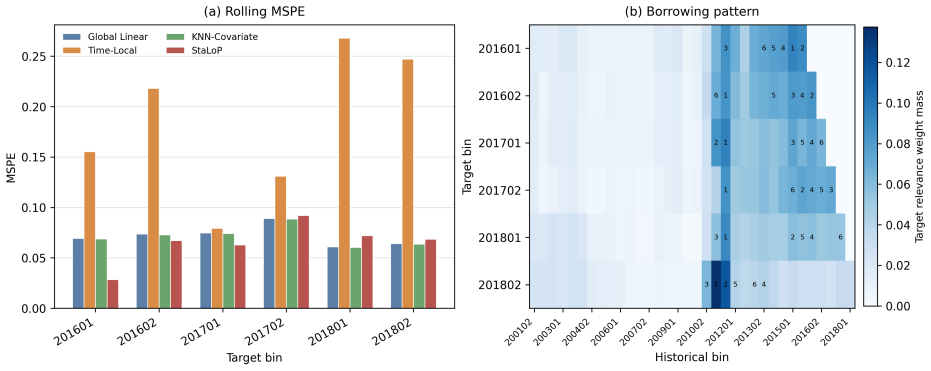
StaLoP predicts sequential panel data by weighting historical panels according to similarity in target-local state vectors rather than temporal proximity.
A machine-rendered reading of the paper's core claim, the machinery that carries it, and where it could break.
Core claim
StaLoP is a nonparametric framework that uses target-local state vectors to compute empirical discrepancy scores between historical and target panels, derives relevance weights from these scores, and incorporates them with covariate localization to produce predictions. This yields improved out-of-sample performance when input-output patterns recur at non-adjacent times. The method comes with bias-variance characterizations, asymptotic normality results, simultaneous prediction bands, and a target-local GDF-corrected MSPE for selection.
What carries the argument
Target-local state vectors and empirical discrepancy scores that determine relevance weights for historical panels.
If this is right
- Improved out-of-sample prediction when similar input-output patterns appear at nonadjacent times.
- Bias-variance characterization, asymptotic normality, and simultaneous prediction bands.
- A target-local-GDF-corrected MSPE criterion for panel and model selection.
- Demonstrated gains in applications including sequence prediction, simulator calibration, variable selection, and county-to-county migration forecasting.
Where Pith is reading between the lines
- The weighting scheme could be tested in other sequential forecasting domains where temporal proximity is a poor proxy for relevance.
- It may interact with high-dimensional covariate selection methods to further reduce prediction error in large panels.
- Real-time updating systems could incorporate the discrepancy scores as an online diagnostic for when to downweight recent data.
Load-bearing premise
Empirical discrepancy scores computed on target-local state vectors reliably identify panels whose input-output relationships are relevant for predicting the target panel.
What would settle it
A dataset in which panels assigned high relevance weights by the discrepancy scores nevertheless produce worse target predictions than temporally proximate panels or low-weight panels.
Figures
read the original abstract
Prediction from sequential panel data is central to digital-twin modeling, where new panels arrive over time and the predictive system is updated sequentially. Existing methods often rely on temporal proximity, which can fail when similar input-output patterns recur at nonadjacent times or when recent panels differ from the target panel. We propose State-Local Prediction (StaLoP), a nonparametric dynamic panel prediction framework that utilizes information through target-local predictive compatibility. StaLoP represents panels using target-local state vectors, compares historical and target panels via empirical discrepancy scores to determine relevance weights for the target point, and combines these weights with covariate localization. Theoretical results, including bias-variance characterization, asymptotic normality, simultaneous prediction bands, and a target-local-GDF-corrected MSPE criterion for panel and model selection, are developed. Extensive simulations validate the performance of StaLoP and support its theoretical properties. Applications to sequence prediction, simulator calibration, variable selection, and county-to-county migration-flow forecasting demonstrate improved out-of-sample prediction and provide scientific insights into the underlying applications.
Editorial analysis
A structured set of objections, weighed in public.
Referee Report
Summary. The manuscript proposes State-Local Prediction (StaLoP), a nonparametric framework for sequential panel data prediction in digital twin applications. Panels are represented by target-local state vectors, and relevance weights are determined via empirical discrepancy scores between historical and target panels. These weights are combined with covariate localization for prediction. The paper provides theoretical results on bias-variance trade-off, asymptotic normality, simultaneous prediction bands, and a corrected MSPE criterion using target-local GDF for selection. Simulations and applications to sequence prediction, simulator calibration, variable selection, and migration forecasting are presented to demonstrate improved out-of-sample performance.
Significance. If the theoretical characterizations hold and the empirical discrepancy reliably captures relevant similarity, StaLoP could provide a useful alternative to temporal-proximity based methods for panel prediction, particularly when similar patterns recur non-locally. The development of simultaneous bands and selection criterion adds practical value. The applications suggest utility in real-world forecasting tasks.
major comments (2)
- [Abstract and §2] Abstract and §2: The central assumption that empirical discrepancy scores on target-local state vectors identify panels with similar input-output relationships is stated but not accompanied by a formal condition or theorem guaranteeing that state-vector proximity implies response surface proximity (e.g., when unobserved factors affect the map). This is load-bearing for the bias-variance claim.
- [§4 (Theory)] §4 (Theory): The bias-variance characterization and asymptotic normality results treat the relevance weights as approximately correct; without an explicit condition on the state vectors, the results may not hold in general when the chosen state vectors fail to capture functional similarity, requiring either a sufficient condition or a counterexample.
minor comments (2)
- [§5 (Simulations)] §5 (Simulations): Clarify how the target-local state vectors are constructed in the simulation settings; the description is high-level and the performance claims would be easier to assess with explicit construction details.
- [Applications section] Applications section: The migration-flow forecasting example would benefit from a direct comparison table against a temporal-proximity baseline to quantify the gain from the discrepancy-based weighting.
Simulated Author's Rebuttal
We thank the referee for the careful reading and constructive comments. We address each major comment below, clarifying the role of the state-vector assumption while agreeing to strengthen the presentation with additional formal conditions as suggested.
read point-by-point responses
-
Referee: [Abstract and §2] Abstract and §2: The central assumption that empirical discrepancy scores on target-local state vectors identify panels with similar input-output relationships is stated but not accompanied by a formal condition or theorem guaranteeing that state-vector proximity implies response surface proximity (e.g., when unobserved factors affect the map). This is load-bearing for the bias-variance claim.
Authors: The manuscript states this modeling premise in §2 as the foundation for defining relevance via target-local states, which is standard in digital-twin settings where states are chosen from domain knowledge. The bias-variance results in §4 are derived conditionally on the weights induced by the discrepancy measure; mismatch due to inadequate states appears directly in the bias term. We agree a sufficient condition linking state proximity to response proximity would clarify the framework. In revision we will add a remark in §2 stating a Lipschitz-type condition on the conditional response surface with respect to state-vector distance, under which small empirical discrepancy implies small bias contribution. revision: partial
-
Referee: [§4 (Theory)] §4 (Theory): The bias-variance characterization and asymptotic normality results treat the relevance weights as approximately correct; without an explicit condition on the state vectors, the results may not hold in general when the chosen state vectors fail to capture functional similarity, requiring either a sufficient condition or a counterexample.
Authors: The characterizations treat the weights as data-driven functions of the observed discrepancies and quantify the resulting approximation error; any failure of the states to capture similarity increases the bias component already present in the decomposition. The asymptotic normality likewise holds under the stated regularity conditions on the weights. To meet the referee's request we will insert an explicit sufficient condition (Lipschitz continuity of the response map in the state metric) into the revised §4 and briefly note the consequence when the condition fails, thereby making the scope of the results transparent. revision: yes
Circularity Check
No circularity: StaLoP is a new construction with independent theoretical derivations
full rationale
The abstract and description present StaLoP as a nonparametric method that defines target-local state vectors, computes empirical discrepancy scores for relevance weights, and combines them with covariate localization to form predictions. Bias-variance characterizations, asymptotic normality, and MSPE criteria are stated as developed results from this construction rather than re-expressions of fitted inputs. No quoted step reduces a claimed prediction to a parameter fitted on the same data by definition, nor does any load-bearing premise collapse to a self-citation chain. The method is self-contained against external benchmarks with no evidence of self-definitional or fitted-input-called-prediction patterns.
Axiom & Free-Parameter Ledger
Reference graph
Works this paper leans on
-
[1]
The Review of Economic Studies , year =
Arellano, Manuel and Bond, Stephen , title =. The Review of Economic Studies , year =
- [2]
-
[3]
Journal of Econometrics , year =
Blundell, Richard and Bond, Stephen , title =. Journal of Econometrics , year =
-
[4]
Journal of the American Statistical Association , year =
Cai, Zongwu and Fan, Jianqing and Li, Runze , title =. Journal of the American Statistical Association , year =
- [5]
-
[6]
Tony and Pu, Hongming , title =
Cai, T. Tony and Pu, Hongming , title =. 2024 , eprint =
work page 2024
-
[7]
The Annals of Statistics , year =
Cheng, Ming-Yen and Honda, Toshio and Li, Jialiang , title =. The Annals of Statistics , year =
-
[8]
The Annals of Statistics , year =
Chernozhukov, Victor and Chetverikov, Denis and Kato, Kengo , title =. The Annals of Statistics , year =
-
[9]
Cleveland, William S. and Devlin, Susan J. , title =. Journal of the American Statistical Association , year =
-
[10]
Journal of the American Statistical Association , year =
Currin, Carla and Mitchell, Toby and Morris, Max and Ylvisaker, Donald , title =. Journal of the American Statistical Association , year =
-
[11]
The Annals of Statistics , year =
Dahlhaus, Rainer , title =. The Annals of Statistics , year =
-
[12]
and Sugihara, George , title =
Deyle, Ethan R. and Sugihara, George , title =. PLOS ONE , year =
-
[13]
The Annals of Statistics , year =
Fan, Jianqing , title =. The Annals of Statistics , year =
-
[14]
Journal of the Royal Statistical Society: Series B (Methodological) , year =
Fan, Jianqing and Gijbels, Irene , title =. Journal of the Royal Statistical Society: Series B (Methodological) , year =
-
[15]
Local Polynomial Modelling and Its Applications , publisher =
Fan, Jianqing and Gijbels, Ir. Local Polynomial Modelling and Its Applications , publisher =
-
[16]
The Annals of Statistics , year =
Fan, Jianqing and Zhang, Wenyang , title =. The Annals of Statistics , year =
-
[17]
Feng, Sanying and Li, Gaorong and Peng, Heng and Tong, Tiejun , title =. Statistica Sinica , year =
-
[18]
Journal of the Royal Statistical Society: Series B (Methodological) , year =
Hastie, Trevor and Tibshirani, Robert , title =. Journal of the Royal Statistical Society: Series B (Methodological) , year =
-
[19]
Hausman, Jerry A. and Taylor, William E. , title =. Econometrica , year =
-
[20]
He, Xuming and Zhu, Zhongyi and Fung, Wing Kam , title =. Biometrika , year =
-
[21]
Henderson, Daniel J. and Carroll, Raymond J. and Li, Qi , title =. Journal of Econometrics , year =
-
[22]
Hoover, Donald R. and Rice, John A. and Wu, Colin O. and Yang, Li-Ping , title =. Biometrika , year =
-
[23]
Huang, Jianhua Z. and Wu, Colin O. and Zhou, Lan , title =. Biometrika , year =
-
[24]
Joseph, V. Roshan , title =. Journal of the American Statistical Association , year =
-
[25]
and O'Hagan, Anthony , title =
Kennedy, Marc C. and O'Hagan, Anthony , title =. Journal of the Royal Statistical Society: Series B (Statistical Methodology) , year =
-
[26]
The Econometrics Journal , year =
Li, Degui and Chen, Jia and Gao, Jiti , title =. The Econometrics Journal , year =
- [27]
- [28]
-
[29]
Lin, Xihong and Wang, Naisyin and Welsh, Alan H. and Carroll, Raymond J. , title =. Biometrika , year =
-
[30]
Lin, D. Y. and Ying, Z. , title =. Journal of the American Statistical Association , year =
-
[31]
Journal of the American Statistical Association , year =
Liu, Yaowu and Xie, Jun , title =. Journal of the American Statistical Association , year =
- [32]
- [33]
-
[34]
Foundational Research Gaps and Future Directions for Digital Twins , publisher =. 2024 , doi =
work page 2024
-
[35]
Proceedings of the 39th International Conference on Machine Learning , series =
Pathak, Reese and Ma, Cong and Wainwright, Martin , title =. Proceedings of the 39th International Conference on Machine Learning , series =. 2022 , publisher =
work page 2022
- [36]
-
[37]
Plumlee, Matthew and Joseph, V. Roshan , title =. Statistica Sinica , year =
-
[38]
Rasmussen, Carl Edward and Williams, Christopher K. I. , title =
-
[39]
Sacks, Jerome and Welch, William J. and Mitchell, Toby J. and Wynn, Henry P. , title =. Statistical Science , year =
-
[40]
Santner, Thomas J. and Williams, Brian J. and Notz, William I. , title =. 2018 , doi =
work page 2018
- [41]
-
[42]
Su, Liangjun and Ullah, Aman , title =. Economics Letters , year =
- [43]
-
[44]
Dynamical Systems and Turbulence, Warwick 1980 , editor =
Takens, Floris , title =. Dynamical Systems and Turbulence, Warwick 1980 , editor =. 1981 , doi =
work page 1980
-
[45]
The Annals of Statistics , year =
Vogt, Michael , title =. The Annals of Statistics , year =
-
[46]
Journal of Time Series Analysis , year =
Yakowitz, Sidney , title =. Journal of Time Series Analysis , year =
-
[47]
Journal of the American Statistical Association , year =
Ye, Jianming , title =. Journal of the American Statistical Association , year =
-
[48]
The Annals of Statistics , year =
Zhang, Wenyang and Fan, Jianqing and Sun, Yan , title =. The Annals of Statistics , year =
-
[49]
Zhang, Xiaoke and Park, Byeong U. and Wang, Jane-Ling , title =. Journal of the American Statistical Association , year =
-
[50]
The Annals of Statistics , year =
Zhang, Ting and Wu, Wei Biao , title =. The Annals of Statistics , year =
-
[51]
The Annals of Statistics , year =
Zhou, Zhou and Wu, Wei Biao , title =. The Annals of Statistics , year =
-
[52]
Local polynomial modelling and its applications: monographs on statistics and applied probability 66 , author=. 1996 , publisher=
work page 1996
discussion (0)
Sign in with ORCID, Apple, or X to comment. Anyone can read and Pith papers without signing in.