REVIEW 2 major objections 2 minor 22 references
Mitigating the photocurrent persistence of single ZnO nanowires for low noise photodetection applications
T0 review · 2 major / 2 minor · reviewed 2026-05-24 · grok-4.3
Pith's one-line read A gate voltage sequence restores ZnO nanowire photodetectors to low dark current by reversing photocurrent persistence.
desk verdict The paper reports a two-step photocurrent rise in ZnO nanowires and a gate voltage reset method to cut persistence, but the reset's repeatability and noise impact lack supporting cycle data. read the letter →
The pith
A machine-rendered reading of the paper's core claim, the machinery that carries it, and where it could break.
The reading
What carries the argument
Gate voltage sequence that reverses surface oxygen chemisorption to eliminate photocurrent persistence.
What would settle it
After the gate voltage sequence is applied, the dark current fails to return to its original low value or the photocurrent persistence reappears in the next illumination cycle.
Extended reading notes
Core claim
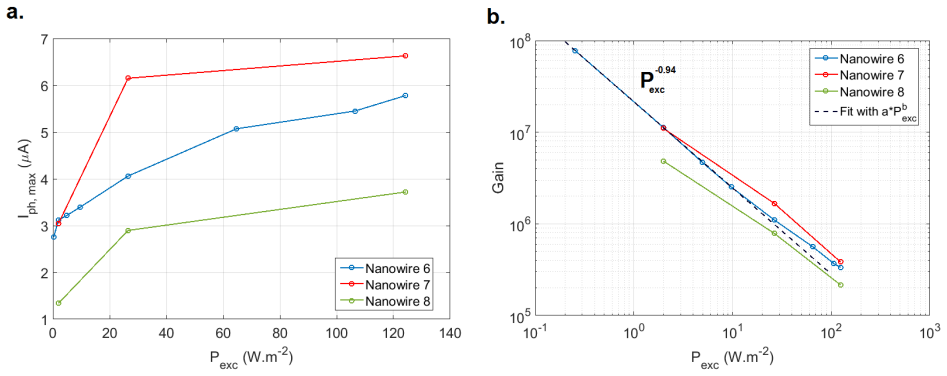
Single ZnO nanowire photodetectors reach a photoconductive gain of 7.8 × 10^7 through oxygen chemisorption on the surface; the same process produces photocurrent that can last several hours. Current transients measured in different atmospheres and temperatures establish the surface mechanism and reveal a previously unseen two-step rise in photocurrent. Knowledge of these response steps allows an applied gate voltage sequence to reverse the chemisorption, restoring the device to its initial state with very low dark current.
Load-bearing premise
The photocurrent persistence arises from reversible oxygen chemisorption that the gate voltage sequence can fully undo without adding noise or damaging the device.
Editorial extensions
If this is right
- The detector can be reset in seconds rather than waiting hours for natural decay.
- The high gain of 7.8 × 10^7 becomes available for repeated measurements without long recovery intervals.
- Low dark current is maintained after each reset, preserving low-noise operation.
- The approach moves single-nanowire ZnO photodetectors closer to commercial use in integrated optics.
Reading between the lines
- Voltage-reset protocols of this kind may apply to other surface-dominated nanowire photodetectors.
- The two-step transient could be exploited to separate fast initial response from the slower persistent component.
- Embedding the reset sequence in a feedback circuit might allow continuous low-noise operation in an array.
Editorial analysis
A structured set of objections, weighed in public.
Referee Report
Summary. The paper reports experimental measurements of photocurrent transients in single ZnO nanowire photodetectors with ohmic contacts under varying atmospheres (oxygen, air, vacuum, argon) and temperatures. It attributes high photoconductive gain (maximum G = 7.8 × 10^7) and photocurrent persistence (up to hours) to reversible surface oxygen chemisorption, notes a previously unreported two-step rise transient, and proposes a gate-voltage sequence to reset the device to its initial low-dark-current state.
Significance. If the proposed reset sequence is shown to be repeatable without added noise or degradation, the work would be significant for advancing ZnO nanowire photodetectors toward practical low-noise applications by directly addressing the persistence limitation through a mechanism-based electrical protocol.
major comments (2)
- [Abstract] Abstract: The reported maximum gain of 7.8 × 10^7 and the claim that the gate-voltage sequence restores the initial state with very low dark current are presented without error bars, number of devices tested, or any cycle-to-cycle statistics; these omissions directly affect the load-bearing claim that the method advances the devices toward commercial use.
- [Abstract and discussion of reset method] The manuscript states that the reset is established 'from a knowledge of the photocurrent response mechanisms' but supplies no quantitative post-reset metrics (noise spectral density, dark-current stability over multiple cycles, or long-term repeatability under the tested atmospheres and temperatures) to confirm that oxygen chemisorption is fully reversed without introducing instability.
minor comments (2)
- [Abstract] The abstract claims the two-step photocurrent rise is reported 'for the first time' without citing prior literature on ZnO nanowire transients for context.
- [Abstract] No mention is made of how many nanowires or devices were measured to support the atmosphere- and temperature-dependent trends.
Simulated Author's Rebuttal
We thank the referee for the careful review and constructive feedback on our manuscript. We address the major comments point by point below and outline the revisions we will make to strengthen the presentation of our results.
read point-by-point responses
-
Referee: [Abstract] Abstract: The reported maximum gain of 7.8 × 10^7 and the claim that the gate-voltage sequence restores the initial state with very low dark current are presented without error bars, number of devices tested, or any cycle-to-cycle statistics; these omissions directly affect the load-bearing claim that the method advances the devices toward commercial use.
Authors: We agree that the abstract would benefit from additional statistical context. In the revised manuscript we will report that the maximum gain value was obtained from measurements on multiple nanowires (typically 5–8 devices per atmosphere/temperature condition) and will include representative error bars derived from repeated measurements on the same device. Cycle-to-cycle statistics for the gate-voltage reset sequence will be added as a new panel or supplementary figure showing dark-current return values over at least five consecutive cycles. revision: yes
-
Referee: [Abstract and discussion of reset method] The manuscript states that the reset is established 'from a knowledge of the photocurrent response mechanisms' but supplies no quantitative post-reset metrics (noise spectral density, dark-current stability over multiple cycles, or long-term repeatability under the tested atmospheres and temperatures) to confirm that oxygen chemisorption is fully reversed without introducing instability.
Authors: The reset protocol was designed directly from the oxygen-chemisorption mechanism established by the atmosphere- and temperature-dependent transients. We acknowledge that the current manuscript does not provide post-reset noise spectral density or multi-cycle repeatability data. In revision we will add these quantitative metrics: noise spectral density measured before and after reset, dark-current stability over ≥10 cycles, and repeatability under oxygen, air, vacuum and argon at the temperatures already studied in the work. revision: yes
Circularity Check
No circularity; purely experimental observations and method proposal
full rationale
The manuscript reports transient current measurements in varied atmospheres and temperatures, identifies oxygen chemisorption as the cause of photoconductive gain and persistence, and describes an empirical gate-voltage reset sequence. No equations, derivations, fitted parameters, or predictions appear that reduce to inputs by construction. No self-citation chains or uniqueness theorems are invoked to justify any result. The central claim rests on direct experimental data rather than any self-referential reduction.
Assumptions & free parameters
assumptions (1)
- domain assumption Oxygen chemisorption on the nanowire surface is responsible for the high photoconductive gain and the observed photocurrent persistence.
Cite this review
Pith. "Pith review of Mitigating the photocurrent persistence of single ZnO nanowires for low noise photodetection applications." pith.science (2026). https://pith.science/paper/DMEKWBNT
@misc{pith2026190711393,
  author       = {Pith},
  title        = {Pith review of: Mitigating the photocurrent persistence of single ZnO nanowires for low noise photodetection applications},
  year         = {2026},
  howpublished = {\url{https://pith.science/paper/DMEKWBNT}},
  note         = {Machine review of arXiv:1907.11393}
}
abstract
In this work, we investigate the optoelectronic properties of zinc oxide (ZnO) nanowires, which are good candidates for applications based on integrated optics. Single ZnO nanowire photodetectors were fabricated with ohmic contacts. By taking current transient measurements in different atmospheres (oxygen, air, vacuum and argon), and at various temperatures, we point out the importance of surface effects on the electrical behaviour. Results confirm that oxygen chemisorption is responsible for the existence of a high photoconductive gain in these devices, and for the first time a two step process in the photocurrent rise transient is reported. A maximum gain of $G=7.8 \times 10^{7}$ is achieved. However, under certain conditions, the persistence of the photocurrent can last up to several hours and as such may prevent the device from operating at useful rates. From a knowledge of the photocurrent response mechanisms, we establish a method to restore the photodetector to its initial state, with very low dark current, by applying an appropriate gate voltage sequence. This advances the state of the art for these detectors towards commercial applications.
Figures


Figures from the paper (6 more)



Lean theorems connected to this paper
-
IndisputableMonolith/Cost/FunctionalEquation.leanwashburn_uniqueness_aczel unclear?
unclearRelation between the paper passage and the cited Recognition theorem.
oxygen chemisorption is responsible for the existence of a high photoconductive gain... two step process in the photocurrent rise transient... appropriate gate voltage sequence
-
IndisputableMonolith/Foundation/AbsoluteFloorClosure.leanabsolute_floor_iff_bare_distinguishability unclear?
unclearRelation between the paper passage and the cited Recognition theorem.
activation energy of Ea = 115 meV... surface depletion... chemisorbed O2- molecules
What do these tags mean?
- matches
- The paper's claim is directly supported by a theorem in the formal canon.
- supports
- The theorem supports part of the paper's argument, but the paper may add assumptions or extra steps.
- extends
- The paper goes beyond the formal theorem; the theorem is a base layer rather than the whole result.
- uses
- The paper appears to rely on the theorem as machinery.
- contradicts
- The paper's claim conflicts with a theorem or certificate in the canon.
- unclear
- Pith found a possible connection, but the passage is too broad, indirect, or ambiguous to say the theorem truly supports the claim.
Reference graph
Works this paper leans on
-
[1]
Hsu C L and Chang S J 2014Small 10 4562–4585
-
[2]
Raza S R A, Lee Y T, Chang Y G, Jeon P J, Kim J H, Ha R, Choi H J and Im S 2013Physical chemistry chemical physics : PCCP15 2660–2664
-
[3]
Wan Q, Li Q H, Chen Y J, Wang T H, He X L, Li J P and Lin C L 2004Applied Physics Letter84 3654
-
[4]
Law J B and Thong J T L 2006Applied Physics Letters88 133114
-
[5]
Bao J, Zimmler M A, Capasso F, Wang X and Ren Z F 2006Nano Letters 6 1719–1722
-
[6]
Law M, Greene L E, Johnson J C, Saykally R and Yang P 2005Nature Materials 4 455–459
-
[7]
Soci C, Zhang A, Xiang B, Dayeh S A, Aplin D P R, Park J, Bao X Y, Lo Y H and Wang D 2007Nano Letters 7 1003–1009
-
[8]
Prades J D, Hernandez-Ramirez F, Jimenez-Diaz R, Manzanares M, Andreu T, Cirera A, Romano- Rodriguez A and Morante J R 2008Nanotechnology 19 465501
Show all 22 references
-
[9]
Bercu B, Geng W, Simonetti O, Kostcheev S, Sartel C, Sallet V, Lérondel G, Molinari M, Giraudet L and Couteau C 2013IOP SCIENCE Nanotechnology24 415202
-
[10]
Geng W, Kostcheev S, Sartel C, Sallet V, Molinari M, Simonetti O, Lérondel G, Giraudet L and Couteau C 2013Physica Status Solidi (C)10 1292–1296
-
[11]
Riesz F, Serényi M, Németh-Sallay M and Szentpáli B 1994physica status solidi (a)143 K53–K56
-
[12]
Schlenker E, Bakin A, Weimann T, Hinze P, Weber D H, Gölzhäuser A, Wehmann H H and Waag A 2008 Nanotechnology 19 365707
2008
-
[13]
thesis UTT, Troyes
Geng W 2015Coupling of Nanostructures for Integrated Nanophotonics DevicesPh.D. thesis UTT, Troyes
-
[14]
He J, Lao C, Chen L, Davidovic D and Wang Z 2005Journal of the American Chemical Society 127 16376–16377
-
[15]
Wang L and Giles N C 2003Journal of Applied Physics94 973–978
-
[16]
Saleh B E A and Teich M C 2001Fundamentals of Photonics - Chapter Semiconductor Photon Detectors (Wiley)
-
[17]
Comini E 2006Analytica Chimica Acta568 28–40 11
-
[18]
Li Q H, Gao T, Wang Y G and Wang T H 2005Applied Physics Letters86 1–3
-
[19]
Liu L, Mei Z, Tang A, Azarov A, Kuznetsov A, Xue Q K and Du X 2016Physical Review B93 235305
-
[20]
Linsebigler A L, Lu G and Yates J T 1995Chemical Reviews 95 735–758
-
[21]
Lagowski J, Sproles E S and Gatos H C 1977Journal of Applied Physics48 3566–3575
-
[22]
Geng W, Manceau M, Rahbany N, Sallet V, Vittorio M D, Carbone L, Glorieux Q, Bramati A and Couteau C 2016Scientific Reports 6 19721 12
Reviewed May 24, 2026 · model on record in the stance chip above.
Discussion (0). Sign in to comment.