Designing for Interconnected Islamic Learning: A Qualitative Study of Muslim Women's Experiences with Qur'an, Hadith, and Seerah Apps
Pith reviewed 2026-06-26 16:15 UTC · model grok-4.3
The pith
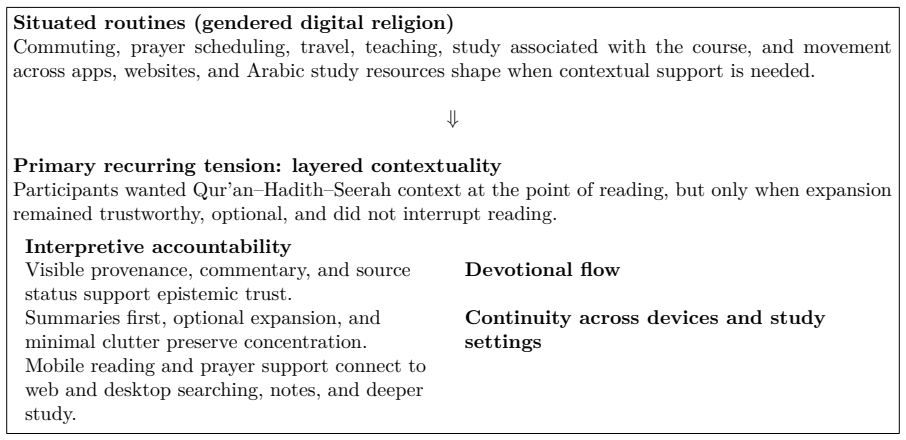
Muslim women want Qur'an-Hadith-Seerah context in apps only when it stays optional, trustworthy, and non-disruptive to reading.
A machine-rendered reading of the paper's core claim, the machinery that carries it, and where it could break.
Core claim
Interpreting the interviews through gendered digital religion, epistemic trust, and seamless learning, we identify five themes concerning contextual understanding, authenticity, interface clutter, study modes, and guidance features. We introduce layered contextuality as an HCI account of this domain: contextual expansion must be balanced with interpretive accountability, devotional flow, and continuity across devices and study intensities.
What carries the argument
layered contextuality: the design requirement that contextual expansions remain optional, trustworthy, and non-interruptive while supporting continuity across sources and study intensities.
If this is right
- Apps must keep contextual links optional rather than automatic to avoid interrupting devotional reading.
- Authenticity signals and source transparency are required before users will accept expansions across Qur'an, Hadith, and Seerah.
- Different study modes should allow users to adjust the depth of context without changing the core reading interface.
- Designs need to maintain continuity when users switch between devices or shift between light and intensive study sessions.
- Guidance features should surface only when they align with user-controlled levels of contextual expansion.
Where Pith is reading between the lines
- The same tension between desired connection and preserved flow may appear in other religious or scholarly reading domains that rely on multiple canonical sources.
- Testing prototypes that implement layered contextuality with the same participant group could reveal whether the themes translate into measurable improvements in perceived trust and flow.
- Designers working on cross-source learning tools outside Islamic contexts could adapt the balance of optionality and accountability as a starting pattern.
Load-bearing premise
Five semi-structured interviews with women from one online Islamic learning community suffice to identify generalizable themes about design needs for contextual understanding and authenticity.
What would settle it
A follow-up study with a larger and more diverse sample of Muslim users that finds most prefer either fully separate apps or fully automatic integration without optional layers would undermine the need for layered contextuality.
Figures
read the original abstract
Islamic learning often depends on reading the Qur'an, Hadith, and Seerah together, yet digital tools typically separate these sources across apps, screens, and search pathways. We examine this as a human-computer interaction problem through five semi-structured interviews with Muslim women recruited from an online Islamic learning community. Participants described a recurring tension: they wanted Qur'an-Hadith-Seerah context at the point of reading, but only when contextual expansion remained trustworthy, optional, and did not interrupt reading. Interpreting the interviews through gendered digital religion, epistemic trust, and seamless learning, we identify five themes concerning contextual understanding, authenticity, interface clutter, study modes, and guidance features. We introduce layered contextuality as an HCI account of this domain: contextual expansion must be balanced with interpretive accountability, devotional flow, and continuity across devices and study intensities.
Editorial analysis
A structured set of objections, weighed in public.
Referee Report
Summary. The manuscript reports a qualitative HCI study based on five semi-structured interviews with Muslim women from a single online Islamic learning community. Participants reported wanting integrated Qur'an-Hadith-Seerah context at the point of reading, but only when such expansions remained trustworthy, optional, and non-interruptive of devotional flow. The authors derive five themes (contextual understanding, authenticity, interface clutter, study modes, guidance features) via interpretation through gendered digital religion, epistemic trust, and seamless learning lenses, and introduce the concept of 'layered contextuality' as an HCI account balancing interpretive accountability, flow, and cross-device continuity.
Significance. If the themes prove robust, the work offers a targeted contribution to HCI in digital religion by surfacing design tensions specific to interconnected sacred-text apps. The 'layered contextuality' framing provides a potentially useful lens for future app development and could be tested against broader user groups or other religious learning contexts.
major comments (2)
- [Methods] Methods section (participant recruitment and sample description): The central claim that the five themes and 'layered contextuality' constitute a reliable HCI account of the domain rests on data from only five interviews drawn from one online community. This small, homogeneous sample leaves open whether the reported tension and priorities generalize or instead reflect the specific recruitment pool, directly affecting the load-bearing support for the new concept.
- [Abstract and Findings] Abstract and Findings sections: The manuscript provides no description of the thematic analysis process (e.g., coding procedures, theme validation, or how interpretations were reached and checked). Because the five themes and 'layered contextuality' are derived directly from these interpretations, the absence of analytic transparency is load-bearing for the reliability of the reported results.
minor comments (1)
- [Abstract] Abstract: The claim of identifying five themes would benefit from a brief parenthetical note on sample limitations to set reader expectations.
Simulated Author's Rebuttal
We thank the referee for their constructive comments, which identify key areas for strengthening the methodological transparency and positioning of our qualitative findings. We respond to each major comment below, indicating planned revisions where appropriate.
read point-by-point responses
-
Referee: [Methods] Methods section (participant recruitment and sample description): The central claim that the five themes and 'layered contextuality' constitute a reliable HCI account of the domain rests on data from only five interviews drawn from one online community. This small, homogeneous sample leaves open whether the reported tension and priorities generalize or instead reflect the specific recruitment pool, directly affecting the load-bearing support for the new concept.
Authors: We agree that the sample of five participants from a single online community represents a limitation for claims of broader generalizability. In line with qualitative HCI traditions for exploring under-researched domains, our study prioritizes depth over breadth to surface design tensions in interconnected sacred-text apps. All five participants independently raised consistent priorities around optional, trustworthy context. We will revise the Methods and Discussion sections to explicitly state the sample constraints, avoid overgeneralization, and frame 'layered contextuality' as an initial conceptual lens derived from this specific group, intended for future validation with more diverse participants and communities. revision: partial
-
Referee: [Abstract and Findings] Abstract and Findings sections: The manuscript provides no description of the thematic analysis process (e.g., coding procedures, theme validation, or how interpretations were reached and checked). Because the five themes and 'layered contextuality' are derived directly from these interpretations, the absence of analytic transparency is load-bearing for the reliability of the reported results.
Authors: We concur that a detailed account of the thematic analysis process is necessary for analytic transparency. The current manuscript omits this description. We will add a dedicated subsection to the Methods section outlining the coding procedures (e.g., inductive thematic analysis steps), how themes were iteratively developed and checked by the research team, and any steps taken to ensure interpretive rigor. revision: yes
Circularity Check
No circularity: qualitative thematic analysis stands on direct interview interpretation
full rationale
The paper conducts a qualitative HCI study via five semi-structured interviews, derives five themes and the concept of layered contextuality through thematic interpretation grounded in gendered digital religion, epistemic trust, and seamless learning frameworks. No equations, parameters, predictions, or derivations exist. Claims do not reduce to self-citations, fitted inputs, or self-definitional loops; the analysis is self-contained against the interview transcripts without external reduction.
Axiom & Free-Parameter Ledger
axioms (1)
- domain assumption Thematic analysis of semi-structured interviews can reliably identify design-relevant themes in user experiences with religious apps.
invented entities (1)
-
layered contextuality
no independent evidence
Reference graph
Works this paper leans on
-
[1]
Braun, Virginia and Clarke, Victoria , title =. Qualitative Research in Psychology , year =. doi:10.1191/1478088706qp063oa , url =
-
[2]
doi:10.4324/9780203084861 , url =
Digital Religion: Understanding Religious Practice in New Media Worlds , year =. doi:10.4324/9780203084861 , url =
-
[3]
, title =
Bunt, Gary R. , title =. 2009 , publisher =
2009
-
[4]
Solahudin, Dindin and Fakhruroji, Moch , title =. Religions , year =. doi:10.3390/rel11010019 , url =
-
[5]
Mubin, Omar and Alsharbi, Bayan M. and Novoa, Mauricio , title =. HCI International 2020 -- Late Breaking Posters , series =. 2020 , pages =. doi:10.1007/978-3-030-60703-6_37 , url =
-
[6]
Theorising and Implementing Mobile Learning , year =
Kearney, Matthew and Burden, Kevin and Schuck, Sandy , title =. Theorising and Implementing Mobile Learning , year =. doi:10.1007/978-981-15-8277-6_4 , url =
-
[7]
International Journal of Inclusive Education , year =
Hardaker, Glenn and Sabki, Aishah Ahmad and Iqbal, Javed , title =. International Journal of Inclusive Education , year =. doi:10.1080/13603116.2017.1296030 , url =
-
[8]
Anthropological Perspectives on the Religious Uses of Mobile Apps , year =
Sijapati, Megan Adamson , title =. Anthropological Perspectives on the Religious Uses of Mobile Apps , year =. doi:10.1007/978-3-030-26376-8_2 , url =
-
[9]
International Journal of Interactive Mobile Technologies , year =
Okuboyejo, Senanu and Koyejo, Ooreofe , title =. International Journal of Interactive Mobile Technologies , year =. doi:10.3991/ijim.v15i15.22345 , url =
-
[10]
doi: 10.1080/10447318.2025.2530058
Kabir, Mohsinul and Kabir, Mohammad Ridwan and Islam, Riasat , title =. International Journal of Human-Computer Interaction , year =. doi:10.1080/10447318.2025.2595545 , url =
-
[11]
Women's Studies International Forum , year =
Midden, Eva and Ponzanesi, Sandra , title =. Women's Studies International Forum , year =. doi:10.1016/j.wsif.2013.07.012 , url =
-
[12]
Warren, Saskia , title =. Geoforum , year =. doi:10.1016/j.geoforum.2018.10.010 , url =
-
[13]
Nisa, Eva F. , title =. The Oxford Handbook of Digital Religion , year =. doi:10.1093/oxfordhb/9780197549803.013.33 , url =
-
[14]
Saeed, Abdullah and Akbar, Ali , title =. Religions , year =. doi:10.3390/rel12070527 , url =
-
[15]
Feminist Media Studies , year =
Nas, Alparslan , title =. Feminist Media Studies , year =. doi:10.1080/14680777.2021.1878547 , url =
-
[16]
Media, Religion and Gender: Key Insights and Future Challenges , booktitle =
L. Media, Religion and Gender: Key Insights and Future Challenges , booktitle =. 2013 , publisher =. doi:10.4324/9780203521748-13 , url =
-
[17]
Proceedings of the SIGCHI Conference on Human Factors in Computing Systems , year =
Bardzell, Shaowen , title =. Proceedings of the SIGCHI Conference on Human Factors in Computing Systems , year =. doi:10.1145/1753326.1753521 , url =
-
[18]
Proceedings of the SIGCHI Conference on Human Factors in Computing Systems , year =
Bardzell, Shaowen and Bardzell, Jeffrey , title =. Proceedings of the SIGCHI Conference on Human Factors in Computing Systems , year =. doi:10.1145/1978942.1979041 , url =
-
[19]
Fogg, B. J. and Tseng, Hsiang , title =. Proceedings of the SIGCHI Conference on Human Factors in Computing Systems , year =. doi:10.1145/302979.303001 , url =
-
[20]
CHI '06 Extended Abstracts on Human Factors in Computing Systems , year =
Sengers, Phoebe and McCarthy, John and Dourish, Paul , title =. CHI '06 Extended Abstracts on Human Factors in Computing Systems , year =. doi:10.1145/1125451.1125762 , url =
-
[21]
Extended Abstracts of the 2020 CHI Conference on Human Factors in Computing Systems , year =
Mustafa, Maryam and Lazem, Shaimaa and Alabdulqader, Ebtisam and Toyama, Kentaro and Sultana, Sharifa and Ibtasam, Samia and Anderson, Richard and Ahmed, Syed Ishtiaque , title =. Extended Abstracts of the 2020 CHI Conference on Human Factors in Computing Systems , year =. doi:10.1145/3334480.3375151 , url =
-
[22]
and Ahmed, Syed Ishtiaque and Anderson, Richard , title =
Ibtasam, Samia and Razaq, Lubna and Ayub, Maryam and Webster, Jennifer R. and Ahmed, Syed Ishtiaque and Anderson, Richard , title =. Proceedings of the ACM on Human-Computer Interaction , year =. doi:10.1145/3359148 , url =
-
[23]
Proceedings of the ACM on Human-Computer Interaction , year =
Rifat, Mohammad Rashidujjaman and Toriq, Toha and Ahmed, Syed Ishtiaque , title =. Proceedings of the ACM on Human-Computer Interaction , year =. doi:10.1145/3415199 , url =
-
[24]
Designing Interactive Systems Conference , year =
Alshehri, Taghreed and Kirkham, Reuben and Dombrowski, Lynn and Olivier, Patrick , title =. Designing Interactive Systems Conference , year =. doi:10.1145/3532106.3533512 , url =
-
[25]
Design Sensibilities - Designing for Cultural Sensitivity , booktitle =
H. Design Sensibilities - Designing for Cultural Sensitivity , booktitle =. 2020 , pages =. doi:10.1145/3419249.3420100 , url =
-
[26]
and Wolf, Sara and Hoefer, Michael and Maas, Franzisca , title =
Markum, Robert B. and Wolf, Sara and Hoefer, Michael and Maas, Franzisca , title =. Designing Interactive Systems Conference , year =. doi:10.1145/3563703.3591463 , url =
-
[27]
Brudy, Frederik and Holz, Christian and R. Cross-Device Taxonomy: Survey, Opportunities and Challenges of Interactions Spanning Across Multiple Devices , booktitle =. 2019 , pages =. doi:10.1145/3290605.3300792 , url =
-
[28]
Kallio, Hannele and Pietil. Systematic methodological review: developing a framework for a qualitative semi-structured interview guide , journal =. 2016 , volume =. doi:10.1111/jan.13031 , url =
-
[29]
and Guassora, Ann Dorrit , title =
Malterud, Kirsti and Siersma, Volkert D. and Guassora, Ann Dorrit , title =. Qualitative Health Research , year =. doi:10.1177/1049732315617444 , url =
-
[30]
Qualitative Research in Sport, Exercise and Health , volume =
Braun, Virginia and Clarke, Victoria , title =. Qualitative Research in Sport, Exercise and Health , year =. doi:10.1080/2159676X.2019.1628806 , url =
-
[31]
Qualitative Research in Sport, Exercise and Health , year =
Braun, Virginia and Clarke, Victoria , title =. Qualitative Research in Sport, Exercise and Health , year =. doi:10.1080/2159676X.2019.1704846 , url =
-
[32]
Human--Computer Interaction , year =
Crabtree, Andy , title =. Human--Computer Interaction , year =. doi:10.1080/07370024.2025.2475743 , url =
-
[33]
Fogg, B. J. , title =. CHI '03 Extended Abstracts on Human Factors in Computing Systems , year =. doi:10.1145/765891.765951 , url =
-
[34]
Riegelsberger, Jens and Sasse, M. Angela and McCarthy, John D. , title =. International Journal of Human-Computer Studies , year =. doi:10.1016/j.ijhcs.2005.01.001 , url =
-
[35]
Wong, J. H. D. and Baars, M. and Davis, D. and Van Der Zee, T. and Houben, G.-J. and Paas, F. , title =. International Journal of Human--Computer Interaction , year =. doi:10.1080/10447318.2018.1543084 , url =
-
[36]
Supporting reflection in technology-enhanced learning , journal =
Kori, Kairit and Pedaste, Margus and Leijen,. Supporting reflection in technology-enhanced learning , journal =. 2014 , volume =. doi:10.1016/j.edurev.2013.11.003 , url =
-
[37]
Calis, Recep , title =. Religions , year =. doi:10.3390/rel13020188 , url =
-
[38]
Ramle, Intan and Huda, Miftachul , title =. Religions , year =. doi:10.3390/rel13020092 , url =
-
[39]
England, Kim V. L. , title =. The Professional Geographer , year =. doi:10.1111/j.0033-0124.1994.00080.x , url =
-
[40]
Finlay, Linda , title =. Qualitative Research , year =. doi:10.1177/146879410200200205 , url =
-
[41]
Berger, Roni , title =. Qualitative Research , year =. doi:10.1177/1468794112468475 , url =
discussion (0)
Sign in with ORCID, Apple, or X to comment. Anyone can read and Pith papers without signing in.