Mitigating adjoint chaos in wall turbulence
Pith reviewed 2026-06-25 21:05 UTC · model grok-4.3
The pith
A linear eddy-viscosity closure allows direct computation of the mean domain of dependence for wall-stress measurements in turbulent flows.
A machine-rendered reading of the paper's core claim, the machinery that carries it, and where it could break.
Core claim
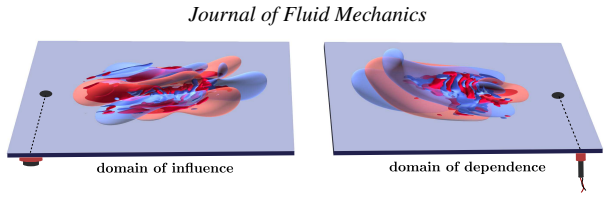
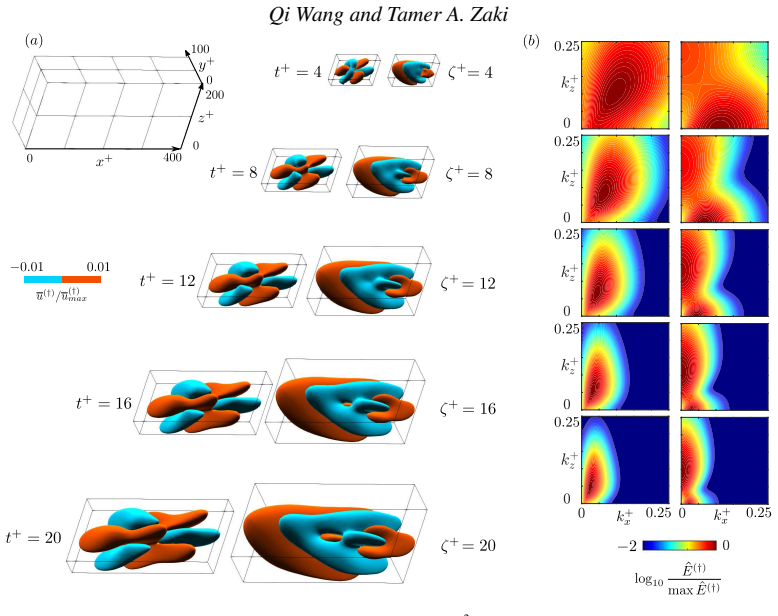
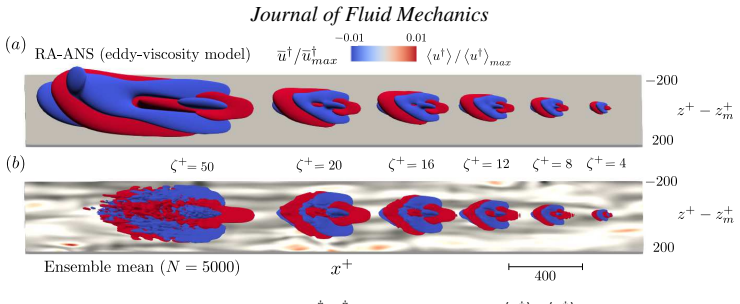
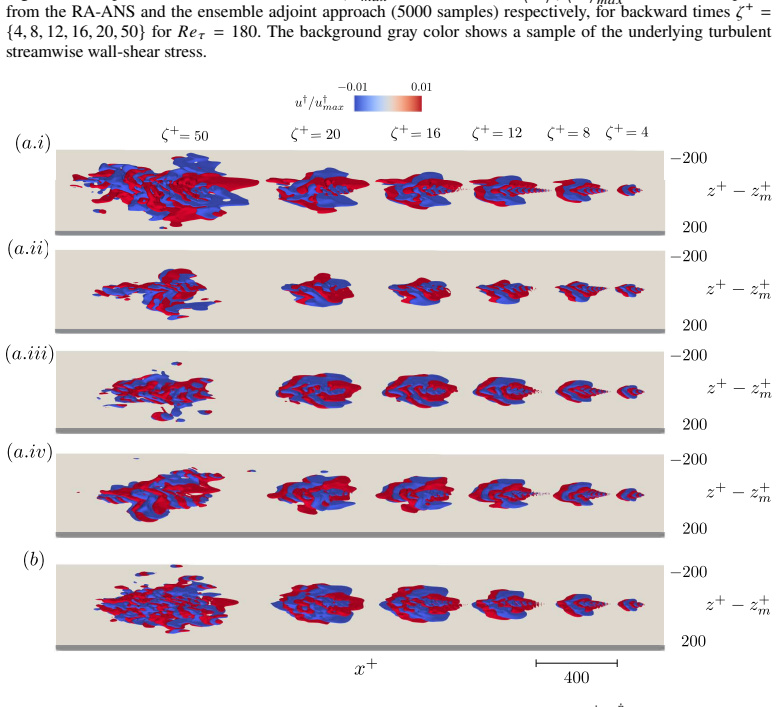
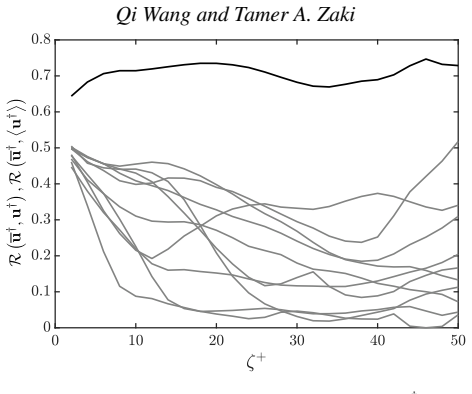
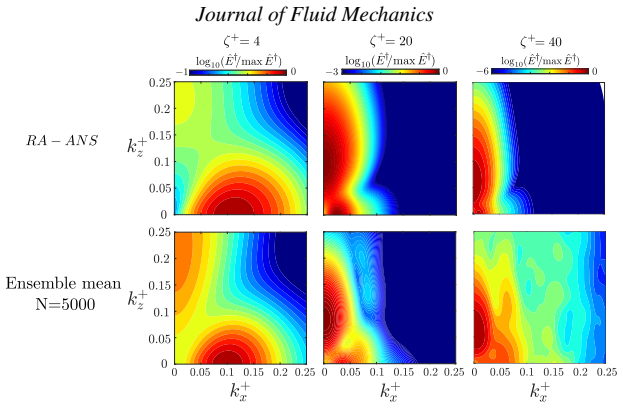
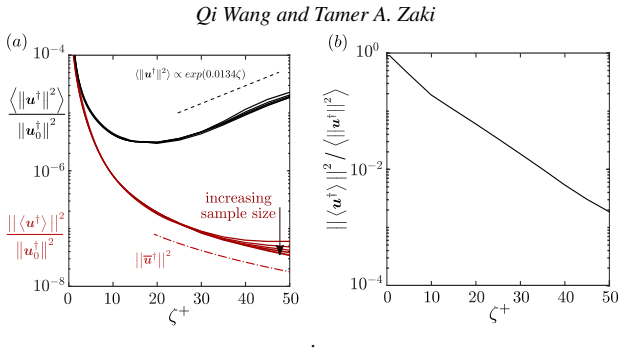
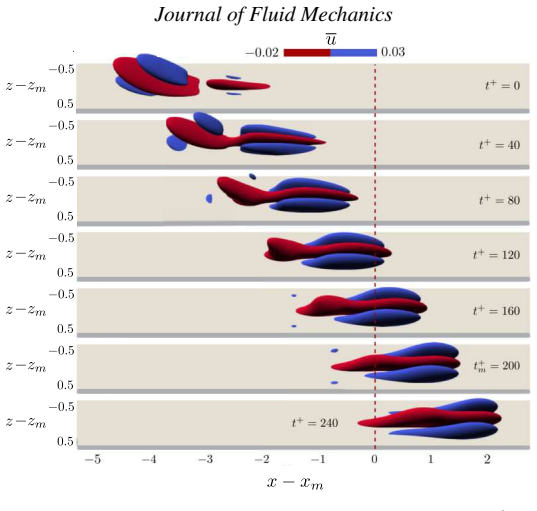
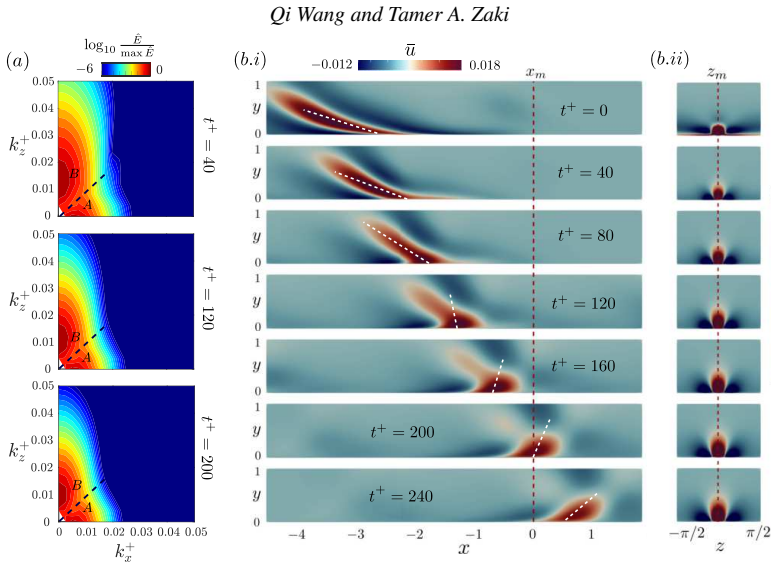
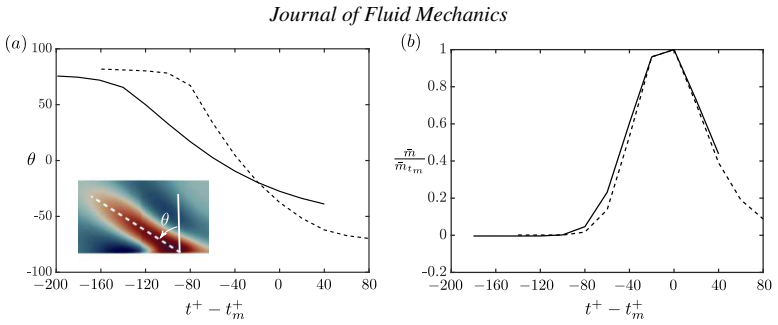
In channel turbulence the energy of each adjoint realization grows exponentially in backward time according to the Lyapunov exponent, yet the ensemble average must decay. Adding a linear eddy-viscosity closure to the ensemble-averaged adjoint equations damps this growth and yields a mean domain of dependence whose energy decay agrees with the ensemble average. The resulting DOD of a wall-stress measurement and the DOI of a wall-stress perturbation both exhibit universal behaviors when scaled appropriately across Reynolds numbers, but their spatio-temporal structures differ qualitatively owing to the time-asymmetry of the governing equations. The DOD consists of an Orr-mechanism component wit
What carries the argument
linear eddy-viscosity closure model inserted into the ensemble-averaged adjoint equations to recover the mean decay of adjoint energy
If this is right
- The mean DOD of wall-stress sensors can be obtained by solving a single closed equation system instead of averaging many chaotic realizations.
- Both DOD and DOI fields collapse onto universal curves when nondimensionalized appropriately, independent of Reynolds number.
- The sensitivity field has a two-part structure consisting of Orr reorientation and expanding streaks.
- DOD and DOI structures differ because the Navier-Stokes equations lack time-reversal symmetry.
- The closure enables practical estimation of past events from surface data without prohibitive computational cost.
Where Pith is reading between the lines
- Similar closures might be tested in other chaotic systems where adjoint methods suffer from exponential growth.
- Universal scaling could guide optimal sensor placement in turbulent boundary layers or pipes.
- Combining the mean DOD with forward simulations may improve data-assimilation accuracy in wall-bounded flows.
- The time-asymmetry between DOD and DOI suggests that control strategies based on adjoint information must account for this distinction.
Load-bearing premise
A linear eddy-viscosity term suffices to close the ensemble-averaged adjoint equations and reproduce the observed decay of mean adjoint energy.
What would settle it
An ensemble of adjoint simulations at a Reynolds number not used in model calibration whose averaged energy fails to follow the decay predicted by the closed equations.
Figures
read the original abstract
Estimating past events in wall turbulence based solely on surface measurements and first principles is an ill-posed problem that is complicated by chaos. The sensitivity of a measurement to the earlier flow state is described by the adjoint Navier-Stokes equations, which are solved in reverse time starting from the measurement kernel at the sensing position and time. The resulting adjoint field is the spatio-temporal domain of dependence (DOD) of the sensor, which is a dual to the concept of the domain of influence (DOI) of an actuator in the linearized forward equations. In channel turbulence, the energy of each adjoint realization grows exponentially in backward time according to the Lyapunov exponent, even though the energy of the ensemble average should decay. We introduce a linear eddy-viscosity closure model in the ensemble-averaged adjoint equations, and directly compute the mean DOD and compare our prediction to the ensemble average. Furthermore, we demonstrate that the DOD of a wall-stress measurement and the DOI resulting from a wall-stress perturbation exhibit respective universal behaviors across Reynolds numbers. However, their spatio-temporal structures differ qualitatively, due to the time-asymmetry of the governing equations. The DOD field has a two-part structure: one component is associated with the Orr mechanism, characterized by rapid reorientation under mean shear, and the other is related to self-similar expanding streaky structures. These two components jointly define the sensitivity of the wall-stress measurement to past flow events.
Editorial analysis
A structured set of objections, weighed in public.
Referee Report
Summary. The manuscript introduces a linear eddy-viscosity closure for the ensemble-averaged adjoint Navier-Stokes equations in channel flow to counteract the exponential growth (via the Lyapunov exponent) of individual adjoint realizations while preserving the expected decay of the ensemble-mean energy. Using this closure, the authors compute the mean domain of dependence (DOD) for wall-stress measurements, compare it directly to ensemble averages, and report that both the DOD of wall-stress measurements and the domain of influence (DOI) from wall-stress perturbations exhibit universal scaling across Reynolds numbers, although their spatio-temporal structures differ qualitatively due to time asymmetry. The DOD is decomposed into an Orr-mechanism component (rapid reorientation under mean shear) and a self-similar streaky component.
Significance. If the closure is shown to reproduce ensemble statistics without post-hoc fitting, the work supplies a practical route to ensemble-averaged adjoint sensitivities in chaotic wall turbulence, bypassing the need for prohibitively large ensembles. The reported universality of DOD and DOI across Reynolds numbers, together with the explicit identification of the two structural components, would be a substantive contribution to the literature on adjoint-based estimation and control in high-Re turbulence.
major comments (3)
- [Abstract, §3] Abstract and §3 (model formulation): the central claim that the linear eddy-viscosity closure reproduces the correct ensemble-mean adjoint energy decay rests on a direct comparison whose quantitative accuracy is not reported (no L2 error norms, correlation coefficients, or decay-rate discrepancies are supplied). Without these metrics it is impossible to judge whether the closure is load-bearing or merely qualitatively plausible.
- [§3] §3 (closure definition) and validation section: the eddy-viscosity coefficient is introduced to enforce the expected decay of mean adjoint energy; it is not shown whether this coefficient is derived from first principles, taken from forward turbulence statistics, or adjusted to match the same ensemble used for the DOD comparison. If the latter, the universality statements across Reynolds numbers become circular.
- [Validation section] Validation against ensemble: the skeptic concern that a strictly local linear gradient-diffusion term may miss non-local correlations arising from the time-reversed Orr mechanism and streak dynamics is not addressed by any auxiliary test (e.g., comparison of triple-moment statistics or sensitivity to kernel width). This assumption is load-bearing for the claim that the closed mean DOD matches the true ensemble average.
minor comments (2)
- [§3] Notation for the eddy viscosity u_t is introduced without an explicit statement of whether it is constant, spatially varying, or Reynolds-number dependent; a short clarifying sentence would remove ambiguity.
- [Figures] Figure captions for the DOD/DOI visualizations should state the precise Reynolds numbers and the number of ensemble members used for the reference average.
Simulated Author's Rebuttal
We thank the referee for the constructive comments, which help clarify the presentation of the closure and its validation. We respond to each major comment below.
read point-by-point responses
-
Referee: [Abstract, §3] Abstract and §3 (model formulation): the central claim that the linear eddy-viscosity closure reproduces the correct ensemble-mean adjoint energy decay rests on a direct comparison whose quantitative accuracy is not reported (no L2 error norms, correlation coefficients, or decay-rate discrepancies are supplied). Without these metrics it is impossible to judge whether the closure is load-bearing or merely qualitatively plausible.
Authors: We agree that quantitative metrics would strengthen the assessment of the closure. In the revised manuscript we will add L2 error norms, Pearson correlation coefficients, and explicit decay-rate comparisons between the closed model and the ensemble-averaged adjoint energy in the validation section. revision: yes
-
Referee: [§3] §3 (closure definition) and validation section: the eddy-viscosity coefficient is introduced to enforce the expected decay of mean adjoint energy; it is not shown whether this coefficient is derived from first principles, taken from forward turbulence statistics, or adjusted to match the same ensemble used for the DOD comparison. If the latter, the universality statements across Reynolds numbers become circular.
Authors: The coefficient is obtained from the forward turbulence statistics: it is the mean eddy-viscosity profile extracted directly from the DNS of the forward channel flow (computed via the standard definition u_t = -’u’v’ / (dU/dy) averaged over the ensemble and time). This profile is independent of the adjoint realizations and is not tuned to the adjoint ensemble. We will revise §3 to state this derivation explicitly and to confirm that the same forward-derived profile is used at all Reynolds numbers, removing any possibility of circularity in the universality claims. revision: yes
-
Referee: [Validation section] Validation against ensemble: the skeptic concern that a strictly local linear gradient-diffusion term may miss non-local correlations arising from the time-reversed Orr mechanism and streak dynamics is not addressed by any auxiliary test (e.g., comparison of triple-moment statistics or sensitivity to kernel width). This assumption is load-bearing for the claim that the closed mean DOD matches the true ensemble average.
Authors: The primary validation is the direct, quantitative match between the closed mean DOD and the ensemble-averaged DOD; because the ensemble average already incorporates all non-local correlations, agreement with it indicates that the net effect of those correlations is captured by the local closure for the quantities of interest. We will add a concise paragraph in the validation section acknowledging the local nature of the model and noting that the observed agreement supports its adequacy for mean DOD computation, while recognizing that higher-order statistics are not reproduced. We do not plan to add triple-moment or kernel-width tests, as they lie outside the scope of the mean-field closure. revision: partial
Circularity Check
No circularity: closure introduced and validated against independent ensemble average
full rationale
The abstract states that a linear eddy-viscosity closure is introduced into the ensemble-averaged adjoint equations, after which the mean DOD is computed and compared to the ensemble average. No quote or equation in the provided text shows the viscosity coefficient being fitted to the same ensemble data used for validation, nor does any step reduce the claimed prediction to a self-definition or self-citation chain. The comparison therefore functions as an external check rather than a tautology, and the derivation chain remains self-contained against the ensemble benchmark.
Axiom & Free-Parameter Ledger
axioms (1)
- domain assumption Individual adjoint realizations grow exponentially backward in time according to the Lyapunov exponent while the ensemble average must decay.
Reference graph
Works this paper leans on
-
[1]
In Proceedings of the Summer Program\/ , p
Blonigan, P , Chen, R , Wang, Q & Larsson, J 2012 Towards adjoint sensitivity analysis of statistics in turbulent flow simulation. In Proceedings of the Summer Program\/ , p. 229 . Center for Turbulence Research, Stanford Univ
2012
-
[2]
Cess, RD 1958 A survey of the literature on heat transfer in turbulent tube flow . Res. Rep pp. 8--0529
1958
-
[3]
AIAA Journal 57 (10), 4514--4526
Chandramoorthy, Nisha , Fernandez, Pablo , Talnikar, Chaitanya & Wang, Qiqi 2019 Feasibility analysis of ensemble sensitivity computation in turbulent flows . AIAA Journal 57 (10), 4514--4526
2019
-
[4]
SIAM Journal on Numerical Analysis 55 (6), 3030--3046
Chater, Mario , Ni, Angxiu , Blonigan, Patrick J & Wang, Qiqi 2017 Least squares shadowing method for sensitivity analysis of differential equations . SIAM Journal on Numerical Analysis 55 (6), 3030--3046
2017
-
[5]
Cossu, Carlo , Pujals, Gregory & Depardon, Sebastien 2009 Optimal transient growth and very large--scale structures in turbulent boundary layers . J. Fluid Mech. 619 , 79--94
2009
-
[6]
Courant & Hilbert 1963 Methods of mathematical physics, vol. ii. partial differential equations
1963
-
[7]
Physica D: Nonlinear Phenomena 25 (1-3), 233--260
Deissler, Robert J 1987 Spatially growing waves, intermittency, and convective chaos in an open-flow system . Physica D: Nonlinear Phenomena 25 (1-3), 233--260
1987
-
[8]
Del Alamo, Juan C & Jimenez, Javier 2006 Linear energy amplification in turbulent channels . J. Fluid Mech. 559 , 205--213
2006
-
[9]
Journal of Fluid Mechanics 895 , A23
Encinar, Miguel P & Jim \'e nez, Javier 2020 Momentum transfer by linearised eddies in turbulent channel flows . Journal of Fluid Mechanics 895 , A23
2020
-
[10]
Nonlinearity 17 (5), 1867
Eyink, GL , Haine, TWN & Lea, DJ 2004 Ruelle's linear response formula, ensemble adjoint schemes and L \'e vy flights . Nonlinearity 17 (5), 1867
2004
-
[11]
AIAA Journal 59 (6), 2001--2013
Garai, Anirban & Murman, Scott M 2021 Stabilization of the adjoint for turbulent flows . AIAA Journal 59 (6), 2001--2013
2021
-
[12]
Journal of Atmospheric Sciences 52 (8), 1084--1095
Hamba, Fujihiro 1995 An analysis of nonlocal scalar transport in the convective boundary layer using the green's function . Journal of Atmospheric Sciences 52 (8), 1084--1095
1995
-
[13]
Physics of Fluids 16 (5), 1493--1508
Hamba, Fujihiro 2004 Nonlocal expression for scalar flux in turbulent shear flow . Physics of Fluids 16 (5), 1493--1508
2004
-
[14]
arXiv preprint arXiv:2602.14016
Ke, Hongyi , You, Zejian & Wang, Qi 2026 Preconditioned adjoint data assimilation for two-dimensional decaying isotropic turbulence . arXiv preprint arXiv:2602.14016
arXiv 2026
-
[15]
Atmospheric environment 41 (3), 465--479
Keats, Andrew , Yee, Eugene & Lien, Fue-Sang 2007 Bayesian inference for source determination with applications to a complex urban environment . Atmospheric environment 41 (3), 465--479
2007
-
[16]
Kubo, Ryogo 1957 Statistical-mechanical theory of irreversible processes. i. general theory and simple applications to magnetic and conduction problems . Journal of the physical society of Japan 12 (6), 570--586
1957
-
[17]
Journal of Fluid Mechanics 98 (2), 243--251
Landahl, M rten T 1980 A note on an algebraic instability of inviscid parallel shear flows . Journal of Fluid Mechanics 98 (2), 243--251
1980
-
[18]
, Zaki, Tamer A
Liu, Jessie , Sch\"afer, Florian , Bryngelson, Spencer H. , Zaki, Tamer A. & Mani, Ali 2024 a\/ Adjoint-based computation of nonlocal eddy viscosity in turbulent channel flow . Phys. Rev. Fluids 9 , 094606
2024
-
[19]
Physical Review Fluids 9 (3), 033901
Liu, Tao , Semin, Beno \^ t , Godoy-Diana, Ramiro & Wesfreid, Jos \'e Eduardo 2024 b\/ Lift-up and streak waviness drive the self-sustained process in wall-bounded transition to turbulence . Physical Review Fluids 9 (3), 033901
2024
-
[20]
In The chaos avant-garde: Memories of the early days of chaos theory\/ , pp
Lorenz, Edward 2000 The butterfly effect . In The chaos avant-garde: Memories of the early days of chaos theory\/ , pp. 91--94 . World Scientific
2000
-
[21]
Journal of Fluid Mechanics 1 (5), 521--539
Malkus, WVR 1956 Outline of a theory of turbulent shear flow . Journal of Fluid Mechanics 1 (5), 521--539
1956
-
[22]
Journal of Fluid Mechanics 955 , A1
Markeviciute, Vilda K & Kerswell, Rich R 2023 Improved assessment of the statistical stability of turbulent flows using extended orr--sommerfeld stability analysis . Journal of Fluid Mechanics 955 , A1
2023
-
[23]
Water Resources Research 37 (6), 1657--1668
Neupauer, Roseanna M & Wilson, John L 2001 Adjoint-derived location and travel time probabilities for a multidimensional groundwater system . Water Resources Research 37 (6), 1657--1668
2001
-
[24]
Ni, Angxiu & Wang, Qiqi 2017 Sensitivity analysis on chaotic dynamical systems by non-intrusive least squares shadowing (nilss) . J. Comput. Phys. 347 , 56--77
2017
-
[25]
Nikitin, Nikolay 2018 Characteristics of the leading L yapunov vector in a turbulent channel flow . J. Fluid Mech. 849 , 942--967
2018
-
[26]
Journal of Computational Physics 195 (1), 49--89
Protas, Bartosz , Bewley, Thomas R & Hagen, Greg 2004 A computational framework for the regularization of adjoint analysis in multiscale pde systems . Journal of Computational Physics 195 (1), 49--89
2004
-
[27]
Atmospheric environment 32 (17), 3039--3050
Pudykiewicz, Janusz A 1998 Application of adjoint tracer transport equations for evaluating source parameters . Atmospheric environment 32 (17), 3039--3050
1998
-
[28]
Pujals, Gregory , Garc \' a-Villalba, Manuel , Cossu, Carlo & Depardon, Sebastien 2009 A note on optimal transient growth in turbulent channel flows . Phys. Fluids 21 (1)
2009
-
[29]
Vadarevu, Sabarish B , Symon, Sean , Illingworth, Simon J & Marusic, Ivan 2019 Coherent structures in the linearized impulse response of turbulent channel flow . J. Fluid Mech. 863 , 1190--1203
2019
-
[30]
Journal of Fluid Mechanics 1008 , A26
Wang, Mengze & Zaki, Tamer A 2025 a\/ Variational data assimilation in wall turbulence: from outer observations to wall stress and pressure . Journal of Fluid Mechanics 1008 , A26
2025
-
[31]
SIAM Journal on Numerical Analysis 52 (1), 156--170
Wang, Qiqi 2014 Convergence of the least squares shadowing method for computing derivative of ergodic averages . SIAM Journal on Numerical Analysis 52 (1), 156--170
2014
-
[32]
2019 Spatial reconstruction of steady scalar sources from remote measurements in turbulent flow
Wang, Qi , Hasegawa, Yosuke & Zaki, Tamer A. 2019 Spatial reconstruction of steady scalar sources from remote measurements in turbulent flow . J. Fluid Mech. 870 , 316–352
2019
-
[33]
Wang, Qiqi , Hu, Rui & Blonigan, Patrick 2014 Least squares shadowing sensitivity analysis of chaotic limit cycle oscillations . J. Comput. Phys. 267 , 210--224
2014
-
[34]
2022 What is observable from wall data in turbulent channel flow? J
Wang, Qi , Wang, Mengze & Zaki, Tamer A. 2022 What is observable from wall data in turbulent channel flow? J. Fluid Mech. 941 , A48
2022
-
[35]
Wang, Qi & You, Zejian 2026 Localization of sources in weakly nonlinear fluid systems using linear and quadratic sensitivity analysis . Phys. Rev. Fluids
2026
-
[36]
Wang, Qi & Zaki, Tamer A 2025 b\/ Domain of dependence for wall-pressure measurements in high-speed boundary layers . J. Fluid Mech. 1009 , A67
2025
-
[37]
Xiang, Tianrui , Eyink, Gregory L & Zaki, Tamer A 2025 The origin of vorticity in viscous incompressible flows . J. Fluid Mech. 1011 , A33
2025
-
[38]
Aerospace 10 (3), 230
Xu, Shenren , Zhao, Jiazi , Wu, Hangkong , Zhang, Sen , M \"u ller, Jens-Dominik , Huang, Huang , Rahmati, Mohammad & Wang, Dingxi 2023 A review of solution stabilization techniques for rans cfd solvers . Aerospace 10 (3), 230
2023
-
[39]
Yuan, Zelong , Wang, Yunpeng , Wang, Xiaoning & Wang, Jianchun 2023 Adjoint-based variational optimal mixed models for large-eddy simulation of turbulence . arXiv:2301.08423
arXiv 2023
-
[40]
2025 Turbulence from an observer perspective
Zaki, Tamer A. 2025 Turbulence from an observer perspective . Annu. Rev. Fluid Mech. 57 , 311--334
2025
-
[41]
& Wang, Mengze 2021 From limited observations to the state of turbulence: Fundamental difficulties of flow reconstruction
Zaki, Tamer A. & Wang, Mengze 2021 From limited observations to the state of turbulence: Fundamental difficulties of flow reconstruction . Phys. Rev. Fluids 6 , 100501
2021
-
[42]
International Journal of Heat and Fluid Flow 106 , 109331
Zhu, Wenkai , Chen, Xianliang & Fu, Lin 2024 Resolvent analyses of incompressible turbulent channel, pipe and boundary-layer flows . International Journal of Heat and Fluid Flow 106 , 109331
2024
discussion (0)
Sign in with ORCID, Apple, or X to comment. Anyone can read and Pith papers without signing in.