REVIEW 4 major objections 5 minor 2 cited by
ADOBI: Adaptive Diffusion Bridge For Blind Inverse Problems with Application to MRI Reconstruction
T0 review · 4 major / 5 minor · reviewed 2026-08-12 · deepseek-v4-flash
Pith's one-line read Adaptive diffusion bridge beats MRI baselines in 10 steps, even when coil maps are unknown.
desk verdict Algorithm 2 never uses its own image-consistency update, so the described method is not measurement-consistent; major revision needed. read the letter →
The pith
A machine-rendered reading of the paper's core claim, the machinery that carries it, and where it could break.
The reading
What carries the argument
The central object is the pretrained diffusion bridge $R_\theta$, which maps a degraded image $z$ (zero-filled or GRAPPA) to a clean image $x_0$ through the interpolation $x_t = (1-\alpha_t)x_0 + \alpha_t z + \sigma_t \epsilon$, trained to output the posterior mean $\mathbb{E}[x_0|x_t]$. The mechanism that makes the method work for blind problems is the alternating update: Eq.\ (15) applies a data-consistency gradient to the image estimate using the current coil sensitivities, and Eq.\ (16) re-estimates those sensitivities by minimizing the same data-fidelity term plus a Tikhonov penalty anchored at the ESPIRiT initialization. This joint image-operator refinement is what distinguishes ADOBI from CDDB, which can only apply the data-consistency step when the operator is known.
What would settle it
Run ADOBI on a set of slices with intentionally corrupted initial coil sensitivity maps, for example by shifting or scaling the ESPIRiT maps, and check whether the adaptive CSM update still drives the data-fidelity term to zero and preserves PSNR; a large drop would indicate the method relies on a good initialization rather than on the bridge dynamics. A more direct test is to compute a distribution-distance metric, such as FID or MMD, between the edited intermediate states produced after Eq. (11) and the states the bridge saw during training, and to check whether that distance grows with the number of steps and correlates with the reported performance drop.
Extended reading notes
Core claim
ADOBI's central claim is that measurement consistency can be enforced in a blind inverse problem by jointly optimizing the image and the unknown forward model during diffusion-bridge inference. At each of its few sampling steps, the method first obtains an MMSE estimate $x_{0|t}$ from the pretrained bridge, then takes one gradient step on the data-fidelity term $\|y - P F S_t(x_{0|t})\|_2^2$ with respect to the image, and then refines the coil sensitivity maps $S_t$ by solving a Tikhonov-regularized least-squares problem that keeps the updated maps close to the ESPIRiT initialization. These two alternating updates make the bridge's samples track the observed k-space measurements even though the forward model was not known at training time. On fastMRI brain data at $4\times$ and $8\times$ acceleration, this adaptive scheme reports the best PSNR, SSIM, and LPIPS among the compared methods with only 10 function evaluations, and the gain is largest when the backbone is initialized with GRAPPA reconstructions rather than zero-filled images. The paper also positions ADOBI as the first measurement-consistent diffusion bridge for blind inverse problems and the first image-domain diffusion bridge for parallel MRI.
Load-bearing premise
The pretrained bridge was trained on intermediate states that are convex combinations of a clean image and a fixed initialization, but at inference the data-consistency step rewrites those states using adaptively updated coil sensitivities; if these edited states drift outside the training distribution, the bridge's MMSE estimate degrades and the reported gains shrink.
Editorial extensions
If this is right
- With only 10 sampling steps, ADOBI outperforms diffusion-model baselines DPS and DDS, which require 1000 and 100 steps respectively, while also improving over the non-adaptive bridges I2SB and CDDB.
- The adaptive forward-model calibration brings reconstruction quality close to that obtained with ground-truth coil sensitivities, while adding only about 0.7 seconds per image in the reported runtime.
- Using GRAPPA as the bridge's initialization distribution yields consistently better reconstructions than zero-filled initialization, for both ADOBI and CDDB.
- The stochastic (SDE) formulation of the bridge gives better reconstruction than the deterministic (ODE) version, preserving fine structure during the 10-step process.
- The method also provides uncertainty quantification by computing pixel-wise variance across stochastic samples, which the paper reports correlates with reconstruction error in ill-posed regions.
Reading between the lines
- The alternating update idea is not MRI-specific: any blind inverse problem with a parametric forward model and a differentiable data-fidelity term could use the same two-step refinement inside a diffusion bridge, so blind deblurring or joint reconstruction plus field-map estimation in MRI are natural next targets.
- Training the backbone on the edited intermediate states, rather than only on the clean interpolation, should close the distribution-shift gap and would quantify how much the current method leaves on the table; this is a concrete experiment the paper does not run.
- The variance maps produced by stochastic sampling could be calibrated against error to yield a quantitative confidence signal for clinical workflows, but the paper only demonstrates correlation visually, so establishing a calibration curve is an open step.
- The method's reliance on a high-quality initialization suggests that integrating the CSM update with a more flexible prior, such as a learned sensitivity prior, could extend ADOBI to settings where ESPIRiT initial maps are unreliable.
Editorial analysis
A structured set of objections, weighed in public.
Referee Report
Summary. The paper proposes ADOBI, an adaptive diffusion bridge method for blind inverse problems, applied to parallel MRI reconstruction. The forward model (coil sensitivity maps) is unknown, and ADOBI alternates between a data-consistency gradient step on the image estimate and a regularized update of the CSMs, using a pretrained diffusion bridge backbone that maps zero-filled or GRAPPA initializations to clean images. Experiments on fastMRI brain data at 4x and 8x acceleration, with and without noise, report state-of-the-art PSNR, SSIM, and LPIPS with 10 sampling steps, along with ablations on initialization, calibration, stochastic perturbation, and runtime.
Significance. If the method works as described, it is a useful contribution: it extends measurement-consistent diffusion bridges to blind inverse problems, achieves strong empirical performance with few sampling steps, and provides uncertainty quantification. The paper includes several ablation studies (Tables 3-5, Table 7, Fig. 8) that support the importance of calibration and initialization. However, the internal inconsistency in Algorithm 2 and the omission of key implementation details prevent the results from being attributed to the described method, and the paper cannot currently be reproduced.
major comments (4)
- [§3.2, Algorithm 2] The image update step is dead code: line 4 computes x'_0|t via Eq. (15), but the resampling step in line 7 uses x0|t, not x'_0|t. As written, the data-consistency image gradient never influences the trajectory, so the method reduces to CSM-adaptive CDDB without the image-domain measurement-consistency mechanism that the paper's central claim rests on. The pseudocode must be corrected to pass x'_0|t to Resample, or the text must explain how the update affects sampling; otherwise the reported improvements over CDDB cannot be attributed to the described algorithm.
- [§3.2.2, Eq. (16)] The CSM update is not specified sufficiently for replication: the text says a gradient descent algorithm iteratively minimizes Eq. (16), but the step size, number of inner iterations, initialization of S_t at each outer iteration, and the value of λ are never given. Since Table 4's claimed benefit of calibration depends on this inner loop, the method cannot be reproduced, and the alternating updates' convergence is not analyzed.
- [§8.6, Fig. 8; Tables 1-2] The hyperparameters γ and λ are not reported in the final experiments. Figure 8 shows that γ is tuned on a 4x task, but the paper does not state whether this tuning is performed on a validation split or on the test set, nor what values of γ (and λ) are used for the 8x and noisy settings. The authors must specify the validation protocol and the exact hyperparameter values for all reported configurations.
- [§3.1-3.2, Eqs. (13)-(16)] The diffusion bridge backbone is trained on states xt obtained from a fixed initialization distribution (zero-filled or GRAPPA). At inference, the resampling states are edited by data-consistency gradients (once Algorithm 2 is corrected to use x'_0|t) and depend on adaptively updated CSMs. The paper does not analyze whether these edited states remain on the distribution seen during training; if they drift, the MMSE estimate x0|t degrades. Provide an analysis or at least empirical diagnostics (e.g., distance between edited states and the training distribution) to justify the method's validity.
minor comments (5)
- [Throughout] There are several typos and grammatical errors: 'from from' in the introduction, 'curial' for 'crucial', 'fine-turn' for 'fine-tune' in the appendix, 'a adaptive' for 'an adaptive' in the conclusion, and 'the object function' for 'the objective function' in §2.3.
- [§4.3.1] The list of ADOBI variants is duplicated: 'ADOBI w/o Calibration' appears twice, and the third variant is run together as 'ADOBIGroundtruth CSMs'.
- [Table 1] In the 8x ADOBI (ZF) row, LPIPS is reported as 0.125 ± 0.0200 with an extra decimal place; the other entries use two decimal places.
- [§2.3, Eq. (11)] The notation for β_t is introduced as β_t = (α_{t-1}/α_t), but the same symbol is used earlier for the DDPM noise schedule; the relationship between α_t in Eq. (9) and the DDPM α_t should be clarified.
- [Figures 9-10] The caption says that the particular worst-case result is boxed in orange, but it is not immediately clear how to read the rows when each row corresponds to a different method's worst-case slice; please clarify the visualization.
Circularity Check
No load-bearing circular reduction; minor self-citations in background do not drive the central claim.
full rationale
ADOBI's reconstruction claim is not circular. The diffusion-bridge backbone is trained with the MMSE objective in Eq. (14) on paired images and measurements, then evaluated on a separate held-out test set described in Section 4.1 (4,912 training images, 470 testing images). The reported PSNR, SSIM, and LPIPS values are therefore external, held-out measurements rather than quantities reconstructed from their own fitted inputs. The image and CSM updates in Eqs. (15)-(16) fit only the observed k-space data y and the ESPIRiT-based initial S_inital; they never use the ground-truth image or ground-truth CSMs during inference, so no fitted parameter is being renamed as a prediction. The step-size gamma tuned in Appendix 8.6 is a conventional hyperparameter choice, not a fit of the reported test metric. The self-citations in the paper ([17], [47], [48], [49], [53]) appear in background and related-work contexts, supporting general statements that model-based deep learning and joint image/CSM estimation are useful. None of these citations is used as a uniqueness theorem, as a justification for forbidding alternative approaches, or as the derivation of ADOBI's adaptive mechanism. Thus, although the paper cites the authors' own prior work several times, none of those citations is load-bearing for the central claim of measurement-consistent blind diffusion-bridge reconstruction. One internal-consistency concern should be flagged explicitly, though it is not a circularity: in Algorithm 2, line 4 computes the data-consistent estimate x'_0|t, but line 7 calls Resample(x0|t, xt, ...) using the unedited x0|t rather than x'_0|t. As written, the image-domain data-consistency gradient may not influence the sampling trajectory, which would weaken the stated mechanism of measurement consistency. This is a specification or correctness issue, not a self-referential derivation, and it does not change the circularity score. The absence of any reduction of the reported results to the method's own inputs gives ADOBI a low circularity score of 2, reflecting only the presence of minor, non-load-bearing self-citations.
Assumptions & free parameters
free parameters (5)
- Gradient step size gamma =
2.4 (chosen after ablation, Fig 8)
- CSM Tikhonov weight lambda =
Not reported
- Number of resampling steps T =
10 for main results, 5-10 claimed
- Diffusion schedule {alpha_t, sigma_t} =
Inherited from I2SB/DDS (1000 steps)
- CSM inner-loop iterations and step size =
Not reported
assumptions (5)
- domain assumption The PMRI forward model is y = P F S x + e with unknown coil sensitivity maps S (Eq 2)
- domain assumption ESPIRiT provides a sufficiently accurate initial CSM estimate to serve as prior center in Eq (16)
- standard math The MMSE-trained network Rtheta with loss (14) provides a valid posterior mean estimate at every step
- domain assumption Paired (x,y) training data from fastMRI is representative of the test distribution
- ad hoc to paper Alternating gradient updates on x0|t and St converge to a useful fixed point without diverging
Cite this review
Pith. "Pith review of ADOBI: Adaptive Diffusion Bridge For Blind Inverse Problems with Application to MRI Reconstruction." pith.science (2026). https://pith.science/paper/DMQ65KX5
@misc{pith2026241116535,
  author       = {Pith},
  title        = {Pith review of: ADOBI: Adaptive Diffusion Bridge For Blind Inverse Problems with Application to MRI Reconstruction},
  year         = {2026},
  howpublished = {\url{https://pith.science/paper/DMQ65KX5}},
  note         = {Machine review of arXiv:2411.16535}
}
read the original abstract
Diffusion bridges (DB) have emerged as a promising alternative to diffusion models for imaging inverse problems, achieving faster sampling by directly bridging low- and high-quality image distributions. While incorporating measurement consistency has been shown to improve performance, existing DB methods fail to maintain this consistency in blind inverse problems, where the forward model is unknown. To address this limitation, we introduce ADOBI (Adaptive Diffusion Bridge for Inverse Problems), a novel framework that adaptively calibrates the unknown forward model to enforce measurement consistency throughout sampling iterations. Our adaptation strategy allows ADOBI to achieve high-quality parallel magnetic resonance imaging (PMRI) reconstruction in only 5-10 steps. Our numerical results show that ADOBI consistently delivers state-of-the-art performance, and further advances the Pareto frontier for the perception-distortion trade-off.
Figures


Figures from the paper (8 more)




Forward citations
Cited by 2 Pith papers
-
Solving Blind Inverse Problems: Adaptive Diffusion Models for Motion-corrected Sparse-view 4DCT
A diffusion-based method that jointly reconstructs motion-corrected sparse-view 4DCT images and estimates respiratory motion, outperforming three baselines on XCAT phantoms.
-
Self-Consistent Nested Diffusion Bridge for Accelerated MRI Reconstruction
A nested bidirectional diffusion bridge with a self-consistency loss and contourlet embedding improves magnitude-image MRI reconstruction over prior diffusion baselines.
Reference graph
Works this paper leans on
-
[1]
M. Akcakaya, M. Doneva, and C. Prieto, Eds., Magnetic Resonance Image Reconstruction: Theory, Methods, and Applications, ser. Advances in Magnetic Resonance Technology and Applications. Elsevier, 2022, vol. 7
work page 2022
-
[2]
Convolutional neural networks for inverse problems in imaging: A review,
M. T. McCann, K. H. Jin, and M. Unser, “Convolutional neural networks for inverse problems in imaging: A review,” IEEE Signal Process. Mag., vol. 34, no. 6, pp. 85–95, 2017
work page 2017
-
[3]
Deep learning techniques for inverse problems in imaging,
G. Ongie, A. Jalal, C. A. Metzler, R. G. Baraniuk, A. G. Dimakis, and R. Willett, “Deep learning techniques for inverse problems in imaging,” IEEE J. Sel. Areas Inf. Theory, vol. 1, no. 1, pp. 39–56, May 2020
work page 2020
-
[4]
Physics-driven machine learning for computational imaging,
B. Wen, S. Ravishankar, Z. Zhao, R. Giryes, and J. C. Ye, “Physics-driven machine learning for computational imaging,” IEEE Signal Process. Mag., vol. 40, no. 1, pp. 28–30, 2023
work page 2023
-
[5]
Accelerating magnetic resonance imaging via deep learning,
S. Wang, Z. Su, L. Ying, X. Peng, S. Zhu, F. Liang, D. Feng, and D. Liang, “Accelerating magnetic resonance imaging via deep learning,” in Proc. Int. Symp. Biomedical Imaging (ISBI), April 2016, pp. 514–517
work page 2016
-
[6]
Deep convolutional neural network for inverse problems in imaging,
K. H. Jin, M. T. McCann, E. Froustey, and M. Unser, “Deep convolutional neural network for inverse problems in imaging,” IEEE Trans. Image Process., vol. 26, no. 9, pp. 4509–4522, Sep. 2017
work page 2017
-
[7]
A deep convolutional neural network using directional wavelets for low-dose x-ray CT reconstruction,
E. Kang, J. Min, and J. C. Ye, “A deep convolutional neural network using directional wavelets for low-dose x-ray CT reconstruction,” Med. Phys., vol. 44, no. 10, pp. e360–e375, 2017
work page 2017
-
[8]
Low-dose CT with a residual encoder-decoder convolutional neural network,
H. Chen, Y. Zhang, M. K. Kalra, F. Lin, Y. Chen, P. Liao, J. Zhou, and G. Wang, “Low-dose CT with a residual encoder-decoder convolutional neural network,” IEEE Trans. Med. Imag., vol. 36, no. 12, pp. 2524–2535, Dec. 2017
work page 2017
Show all 57 references
-
[9]
Projected distribution loss for image enhancement,
M. Delbracio, H. Talebei, and P. Milanfar, “Projected distribution loss for image enhancement,” in 2021 Int. Conf. on Comput. Photography (ICCP), 2021, pp. 1–12
2021
-
[10]
Algorithm unrolling: Interpretable, efficient deep learning for signal and image processing,
V. Monga, Y. Li, and Y. C. Eldar, “Algorithm unrolling: Interpretable, efficient deep learning for signal and image processing,” IEEE Signal Process. Mag., vol. 38, no. 2, pp. 18–44, Mar. 2021
2021
-
[11]
Compressed sensing using generative priors,
A. Bora, A. Jalal, E. Price, and A. G. Dimakis, “Compressed sensing using generative priors,” in Int. Conf. Mach. Learn., Aug. 2017, pp. 537–546
2017
-
[12]
Plug-and-play methods for integrating physical and learned models in computational imaging,
U. S. Kamilov, C. A. Bouman, G. T. Buzzard, and B. Wohlberg, “Plug-and-play methods for integrating physical and learned models in computational imaging,” IEEE Signal Process. Mag., vol. 40, no. 1, pp. 85–97, Jan. 2023
2023
-
[13]
The Little Engine That Could: Regularization by Denoising (RED),
Y. Romano, M. Elad, and P. Milanfar, “The Little Engine That Could: Regularization by Denoising (RED),” SIAM J. Imaging Sci., vol. 10, no. 4, pp. 1804–1844, Jan. 2017
2017
-
[14]
ISTA-Net: Interpretable optimization-inspired deep network for image compressive sensing,
J. Zhang and B. Ghanem, “ISTA-Net: Interpretable optimization-inspired deep network for image compressive sensing,” in Proc. IEEE conf. comput. vis. and pattern recognit., 2018, pp. 1828–1837
2018
-
[15]
Model- based learning for accelerated, limited-view 3-D photoacoustic tomography,
A. Hauptmann, F. Lucka, M. Betcke, N. Huynh, J. Adler, B. Cox, P. Beard, S. Ourselin, and S. Arridge, “Model- based learning for accelerated, limited-view 3-D photoacoustic tomography,” IEEE Trans. Med. Imag., vol. 37, no. 6, pp. 1382–1393, 2018
2018
-
[16]
Deep equilibrium architectures for inverse problems in imaging,
D. Gilton, G. Ongie, and R. Willett, “Deep equilibrium architectures for inverse problems in imaging,” IEEE Trans. Comput. Imag., vol. 7, pp. 1123–1133, 2021
2021
-
[17]
A Restoration Network as an Implicit prior,
Y. Hu, M. Delbracio, P. Milanfar, and U. Kamilov, “A Restoration Network as an Implicit prior,” in Proc. Int. Conf. on Learn. Represent. (ICLR), 2024. 12
2024
-
[18]
Deep J-Sense: Accelerated MRI reconstruction via unrolled alternating optimization,
M. Arvinte, S. Vishwanath, A. H. Tewfik, and J. I. Tamir, “Deep J-Sense: Accelerated MRI reconstruction via unrolled alternating optimization,” arXiv:2103.02087 [cs, eess], Apr. 2021
2021 arXiv
-
[19]
Joint deep model-based MR image and coil sensitivity reconstruction network (joint-icnet) for fast MRI,
Y. Jun, H. Shin, T. Eo, and D. Hwang, “Joint deep model-based MR image and coil sensitivity reconstruction network (joint-icnet) for fast MRI,” in Proc. IEEE Conf. Comput. Vis. Pattern Recognit., Nashville, USA, 2021, pp. 5270–5279
2021
-
[20]
End-to-end variational networks for accelerated MRI reconstruction,
A. Sriram, J. Zbontar, T. Murrell, A. Defazio, C. L. Zitnick, N. Yakubova, F. Knoll, and P. Johnson, “End-to-end variational networks for accelerated MRI reconstruction,” in Proc. Medical Image Computing and Computer- Assisted Intervention, Lima, Peru, 2020, pp. 64–73
2020
-
[21]
Diffusion models in vision: A survey,
F.-A. Croitoru, V. Hondru, R. T. Ionescu, and M. Shah, “Diffusion models in vision: A survey,” IEEE Transac- tions on Pattern Analysis and Machine Intelligence, vol. 45, no. 9, pp. 10 850–10 869, 2023
2023
-
[22]
Denoising diffusion probabilistic models,
J. Ho, A. Jain, and P. Abbeel, “Denoising diffusion probabilistic models,” Proc. Advances in Neural Information Processing Systems (NeurIPS), vol. 33, pp. 6840–6851, 2020
2020
-
[23]
Score-based generative modeling through stochastic differential equations,
Y. Song, J. S., D. P. K., A. K., S. E., and B. P., “Score-based generative modeling through stochastic differential equations,” in Proc. Int. Conf. on Learn. Represent. (ICLR), 2021
2021
-
[24]
Deblurring via stochastic refinement,
J. Whang, M. Delbracio, H. Talebi, C. Saharia, A. G. Dimakis, and P. Milanfar, “Deblurring via stochastic refinement,” in Proc. IEEE Conf. Comput. Vis. and Pattern Recognit. (CVPR), 2022, pp. 16 293–16 303
2022
-
[25]
Multiscale structure guided diffusion for image deblurring,
M. Ren, M. Delbracio, H. Talebi, G. Gerig, and P. Milanfar, “Multiscale structure guided diffusion for image deblurring,” in Proc. IEEE Int. Conf. Comp. Vis. (ICCV), 2023, pp. 10 721–10 733
2023
-
[26]
Measurement-conditioned denoising diffusion probabilistic model for under-sampled medical image reconstruction,
Y. Xie and Q. Li, “Measurement-conditioned denoising diffusion probabilistic model for under-sampled medical image reconstruction,” in Proc. Medical Image Computing and Computer-Assisted Intervention. Springer, 2022, pp. 655–664
2022
-
[27]
Come-closer-diffuse-faster: Accelerating conditional diffusion models for inverse problems through stochastic contraction,
H. Chung, B. Sim, and J. C. Ye, “Come-closer-diffuse-faster: Accelerating conditional diffusion models for inverse problems through stochastic contraction,” in Proc. IEEE Conf. Comput. Vis. and Pattern Recognit. (CVPR), 2022, pp. 12 413–12 422
2022
-
[28]
Diffusion posterior sampling for general noisy inverse problems,
H. Chung, J. Kim, M. T. Mccann, M. L. K., and J. C. Ye, “Diffusion posterior sampling for general noisy inverse problems,” in Proc. Int. Conf. on Learn. Represent. (ICLR), 2023
2023
-
[29]
Denoising diffusion models for plug-and-play image restoration,
Y. Zhu, K. Zhang, J. Liang, J. Cao, B. Wen, R. Timofte, and L. Van G., “Denoising diffusion models for plug-and-play image restoration,” in Proc. IEEE Conf. Comput. Vis. and Pattern Recognit. (CVPR), 2023, pp. 1219–1229
2023
-
[30]
Zero-shot image restoration using denoising diffusion null-space model,
Y. Wang, J. Yu, and J. Zhang, “Zero-shot image restoration using denoising diffusion null-space model,” in Proc. Int. Conf. on Learn. Represent. (ICLR), 2023
2023
-
[31]
Score-based diffusion models as principled priors for inverse imaging,
B. T. Feng, J. Smith, M. Rubinstein, H. Chang, K. L. Bouman, and W. Freeman, “Score-based diffusion models as principled priors for inverse imaging,” in Proc. IEEE Int. Conf. Comp. Vis. (ICCV), 2023, pp. 10 520–10 531
2023
-
[32]
Principled probabilistic imaging using diffusion models as plug-and-play priors,
Z. Wu, Y. Sun, Y. Chen, B. Zhang, Y. Yue, and K. L. Bouman, “Principled probabilistic imaging using diffusion models as plug-and-play priors,” arXiv preprint arXiv:2405.18782, 2024
2024 arXiv
-
[33]
Solving inverse problems with latent diffusion models via hard data consistency,
B. Song, S. M. Kwon, Z. Zhang, X. Hu, Q. Qu, and L. Shen, “Solving inverse problems with latent diffusion models via hard data consistency,” in Proc. Int. Conf. on Learn. Represent. (ICLR), 2024
2024
-
[34]
Parallel diffusion models of operator and image for blind inverse problems,
H. Chung, J. Kim, S. Kim, and J. C. Ye, “Parallel diffusion models of operator and image for blind inverse problems,” in Proc. IEEE Conf. Comput. Vis. and Pattern Recognit. (CVPR), 2023, pp. 6059–6069
2023
-
[35]
Gibbsddrm: A partially collapsed gibbs sampler for solving blind inverse problems with denoising diffusion restoration,
N. Murata, K. Saito, C.-H. Lai, Y. Takida, T. Uesaka, Y. Mitsufuji, and S. Ermon, “Gibbsddrm: A partially collapsed gibbs sampler for solving blind inverse problems with denoising diffusion restoration,” in Proc. Int. Conf. Machine Learning (ICML). PMLR, 2023, pp. 25 501–25 522
2023
-
[36]
Blind inversion using latent diffusion priors,
W. Bai, S. Chen, W. Chen, and H. Sun, “Blind inversion using latent diffusion priors,” arXiv preprint arXiv:2407.01027, 2024. 13
2024 arXiv
-
[37]
Generalized autocalibrating partially parallel acquisitions (GRAPPA),
M. A. Griswold, P. M. Jakob, R. M. Heidemann, M. Nittka, V. Jellus, J. Wang, B. Kiefer, and A. Haase, “Generalized autocalibrating partially parallel acquisitions (GRAPPA),” Magn. Reson. Med., vol. 47, no. 6, pp. 1202–1210, Jun. 2002
2002
-
[38]
ESPIRiT- an eigenvalue approach to autocalibrating parallel MRI: Where SENSE meets GRAPPA,
M. Uecker, P. Lai, M. J. Murphy, P. Virtue, M. Elad, J. M. Pauly, S. S. Vasanawala, and M. Lustig, “ESPIRiT- an eigenvalue approach to autocalibrating parallel MRI: Where SENSE meets GRAPPA,” Magn. Reson. Med., vol. 71, no. 3, pp. 990–1001, Mar. 2014
2014
-
[39]
I2sb: image-to-image schr¨ odinger bridge,
G. Liu, A. Vahdat, D. Huang, E. A. Theodorou, W. Nie, and A. Anandkumar, “I2sb: image-to-image schr¨ odinger bridge,” in Proc. Int. Conf. Machine Learning (ICML), 2023, pp. 22 042–22 062
2023
-
[40]
Inversion by direct iteration: An alternative to denoising diffusion for image restoration,
M. Delbracio and P. Milanfar, “Inversion by direct iteration: An alternative to denoising diffusion for image restoration,” Trans. on Mach. Learn. Research, 2023
2023
-
[41]
Diffusion schr¨ odinger bridge matching,
Y. Shi, V. De Bortoli, A. Campbell, and A. Doucet, “Diffusion schr¨ odinger bridge matching,” Proc. Advances in Neural Information Processing Systems (NeurIPS), vol. 36, 2024
2024
-
[42]
Direct diffusion bridge using data consistency for inverse problems,
H. Chung, J. Kim, and J. C. Ye, “Direct diffusion bridge using data consistency for inverse problems,” Proc. Advances in Neural Information Processing Systems (NeurIPS), vol. 36, 2024
2024
-
[43]
Learning fourier-constrained diffusion bridges for mri reconstruction,
M. U. Mirza, O. Dalmaz, H. A. Bedel, G. Elmas, Y. Korkmaz, A. Gungor, S. U. Dar, and T. C ¸ ukur, “Learning fourier-constrained diffusion bridges for mri reconstruction,” arXiv preprint arXiv:2308.01096, 2023
2023 arXiv
-
[44]
Sparse MRI: The application of compressed sensing for rapid MR imaging,
M. Lustig, D. Donoho, and J. M. Pauly, “Sparse MRI: The application of compressed sensing for rapid MR imaging,” Magn. Reson. Med., vol. 58, no. 6, pp. 1182–1195, 2007
2007
-
[45]
Optimization methods for magnetic resonance image reconstruction,
J. A. Fessler, “Optimization methods for magnetic resonance image reconstruction,” IEEE Signal Process. Mag., vol. 1, no. 37, pp. 33–40, Jan. 2020
2020
-
[46]
J. Liu, R. Hyder, M. S. Asif, and U. S. Kamilov, Magnetic Resonance Image Reconstruction. Elsevier, 2022, ch. Optimization Algorithms for MR Reconstruction, pp. 59–72
2022
-
[47]
Ss-jircs: Self-supervised joint image reconstruction and coil sensitivity calibration in parallel mri without ground truth,
W. Gan, Y. Hu, C. Eldeniz, J. Liu, Y. Chen, H. An, and U. S. Kamilov, “Ss-jircs: Self-supervised joint image reconstruction and coil sensitivity calibration in parallel mri without ground truth,” in Proc. IEEE Int. Conf. Comput. Vis. Workshops, October 2021, pp. 4048–4056
2021
-
[48]
Spicer: Self- supervised learning for mri with automatic coil sensitivity estimation and reconstruction,
Y. Hu, W. Gan, C. Ying, T. Wang, C. Eldeniz, J. Liu, Y. Chen, H. An, and U. S. Kamilov, “Spicer: Self- supervised learning for mri with automatic coil sensitivity estimation and reconstruction,” Magn. Reson. Med., 2024
2024
-
[49]
Block coordinate plug-and-play methods for blind inverse problems,
W. Gan, S. Shoushtari, Y. Hu, J. Liu, H. An, and U. S. Kamilov, “Block coordinate plug-and-play methods for blind inverse problems,” in Proc. Advances in Neural Information Processing Systems (NeurIPS), New Orleans, LA, USA, 2023, pp. 78 607–78 620
2023
-
[50]
A survey on diffusion models for inverse problems,
G. Daras, H. Chung, C.-H. Lai, Y. Mitsufuji, J. C. Ye, P. Mlanfar, A. G. Dimakis, and M. Delbracio, “A survey on diffusion models for inverse problems,” 2024, arXiv:2410.00083
2024 arXiv
-
[51]
Tweedie’s formula and selection bias,
B. Efron, “Tweedie’s formula and selection bias,” Journal of the American Statistical Association, vol. 106, no. 496, pp. 1602–1614, 2011
2011
-
[52]
Kernel diffusion: An alternate approach to blind deconvolution,
Y. Sanghvi, Y. Chi, and S. H. Chan, “Kernel diffusion: An alternate approach to blind deconvolution,” arXiv preprint arXiv:2312.02319, 2023
2023 arXiv
-
[53]
Stochastic deep restoration priors for imaging inverse problems,
Y. Hu, A. Peng, W. Gan, P. Milanfar, M. Delbracio, and U. S. Kamilov, “Stochastic deep restoration priors for imaging inverse problems,” arXiv preprint arXiv:2410.02057, 2024
2024 arXiv
-
[54]
Swinir: Image restoration using swin transformer,
J. Liang, J. Cao, G. Sun, K. Zhang, L. Van Gool, and R. Timofte, “Swinir: Image restoration using swin transformer,” in Proc. IEEE Int. Conf. Comp. Vis. (ICCV), 2021, pp. 1833–1844
2021
-
[55]
Decomposed diffusion sampler for accelerating large-scale inverse problems,
H. Chung, S. Lee, and J. C. Ye, “Decomposed diffusion sampler for accelerating large-scale inverse problems,” in Proc. Int. Conf. on Learn. Represent. (ICLR), 2024. 14
2024
-
[56]
fastMRI: An open dataset and benchmarks for accelerated MRI,
J. Zbontar, F. Knoll, A. Sriram, T. Murrell, Z. Huang, M. J. Muckley, A. Defazio, R. Stern, P. Johnson, M. Bruno et al., “fastMRI: An open dataset and benchmarks for accelerated MRI,” arXiv:1811.08839 [cs.CV], 2018
2018 arXiv
-
[57]
End-to-end variational networks for accelerated MRI reconstruction,
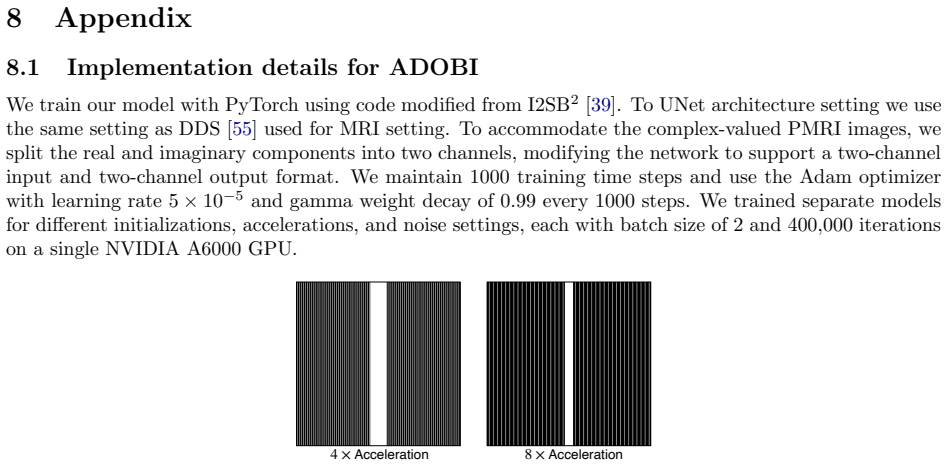
A. Sriram, J. Zbontar, T. Murrell, A. Defazio, C. L. Zitnick, N. Yakubova, F. Knoll, and P. M. Johnson, “End-to-end variational networks for accelerated MRI reconstruction,” arXiv, vol. 2004.06688, 2020. 15 8 Appendix 8.1 Implementation details for ADOBI We train our model wit...
2004 arXiv
Reviewed August 12, 2026 · model on record in the stance chip above.
Discussion (0). Continue with ORCID to comment.