Nonlinear Static Screening of Positive Charges in an Electron Gas: Contact Hartree Energy
Pith reviewed 2026-06-26 06:07 UTC · model grok-4.3
The pith
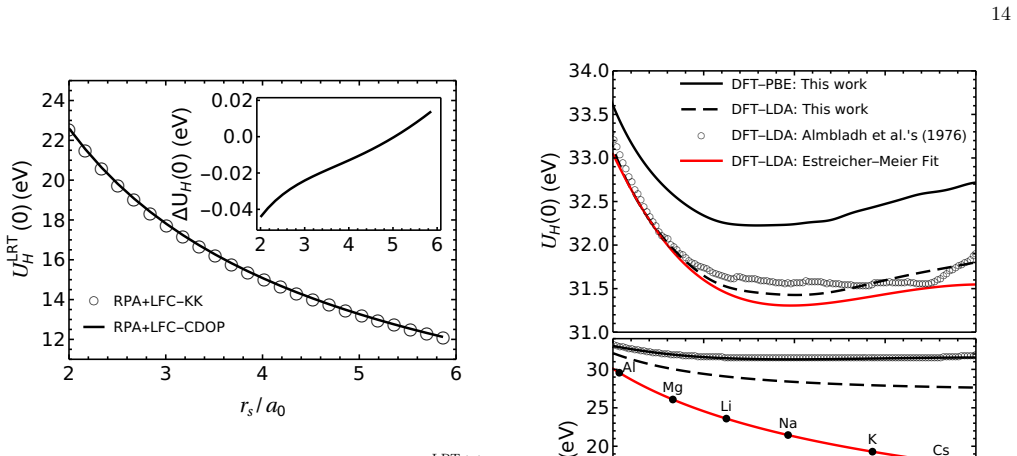
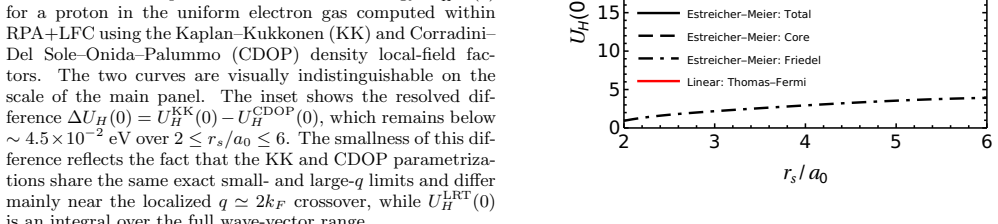
The Estreicher-Meier LDA parametrization reproduces the contact Hartree energy for a proton in jellium, matching direct LDA calculations and Almbladh et al. results.
A machine-rendered reading of the paper's core claim, the machinery that carries it, and where it could break.
Core claim
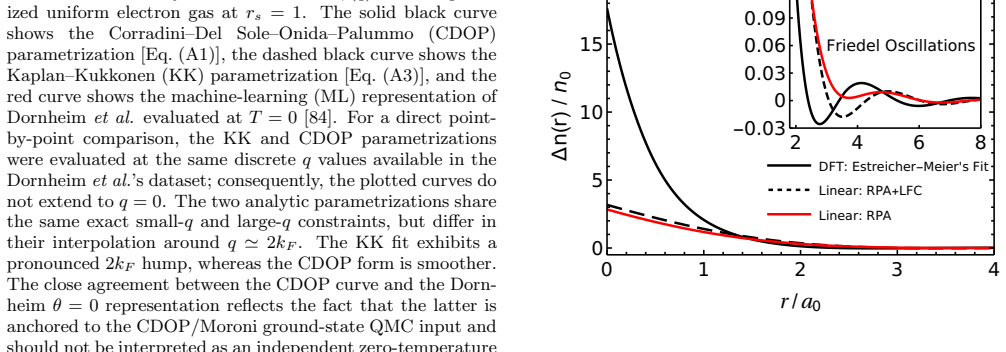
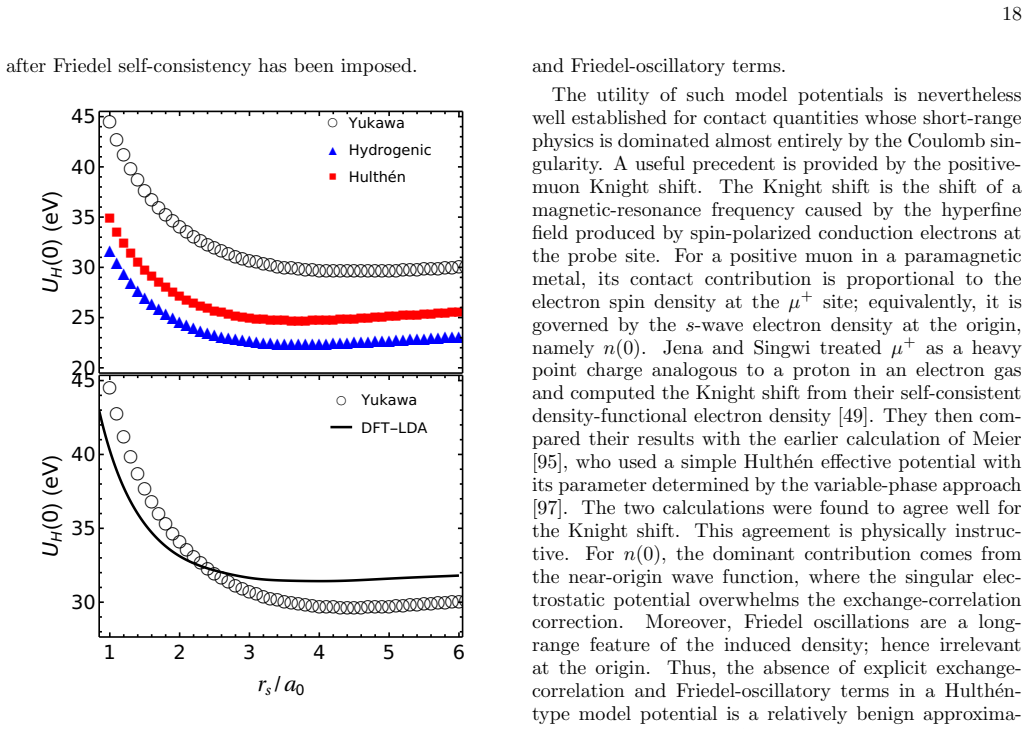
The Estreicher--Meier local-density-approximation parametrization reproduces the contact Hartree energy from direct LDA calculations and the self-consistent results of Almbladh et al. This agreement validates the unified formulation of the contact Hartree energy as a nonlocal radial moment of the induced density, separates the hydrogenic density profile from non-negligible Friedel oscillations, and supplies a compact nonlinear reference value against which linear-response models can be tested.
What carries the argument
The contact Hartree energy U_H(0), defined as a radial moment of the full induced density around the proton impurity.
If this is right
- The unified U_H(0) expression applies equally to linear-response dielectric functions and nonlinear DFT.
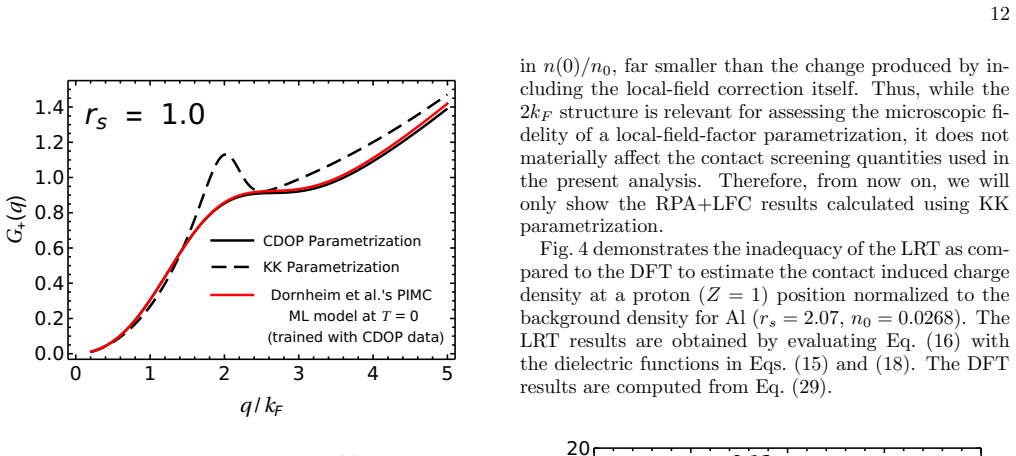
- Corradini-Del Sole-Onida-Palummo and Kaplan-Kukkonen local-field factors produce indistinguishable contact screening values.
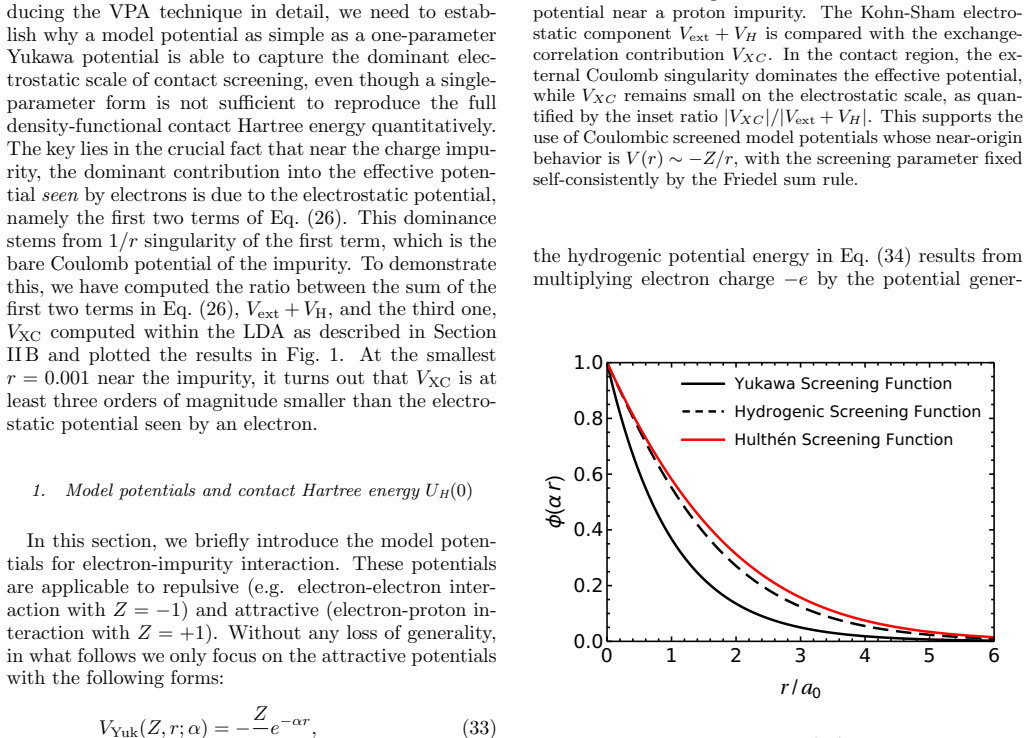
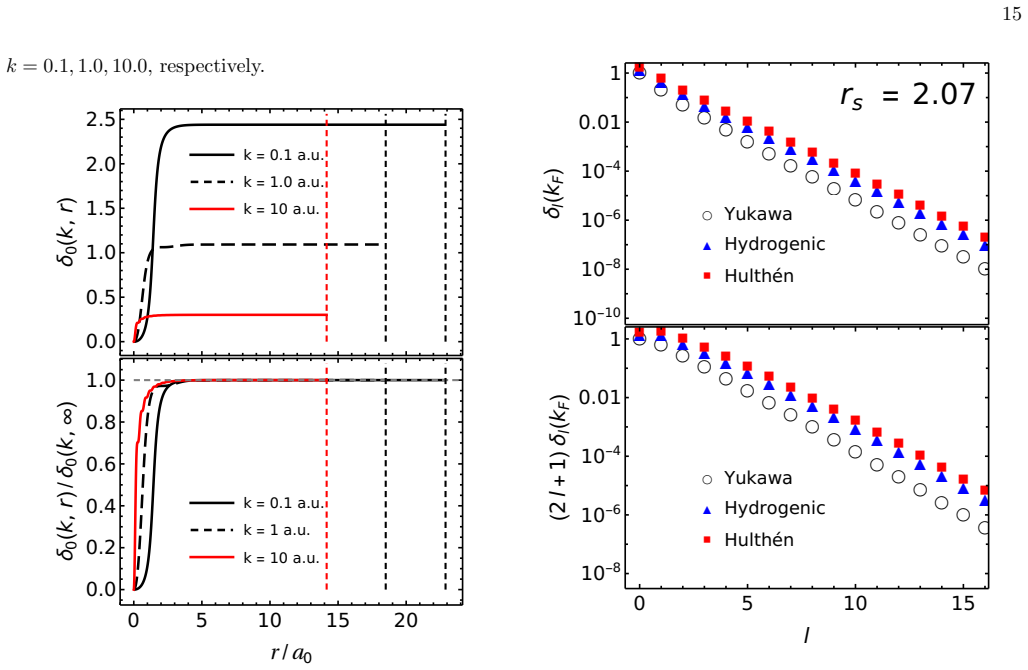
- Yukawa, hydrogenic, and Hulthén potentials constrained by the Friedel sum rule cannot reproduce the nonlinear DFT contact Hartree energy.
- The benchmark cleanly separates the hydrogenic density component from Friedel oscillations.
Where Pith is reading between the lines
- The one-center nonlinear benchmark supplies the reference needed before treating two-center screening problems such as low-energy fusion.
- Band-structure and core-electron effects in real metals may shift the near-field screening relative to the jellium prediction.
- The variable-phase scattering representation of screened potentials offers a phase-shift view that could be calibrated directly against the DFT contact energy.
Load-bearing premise
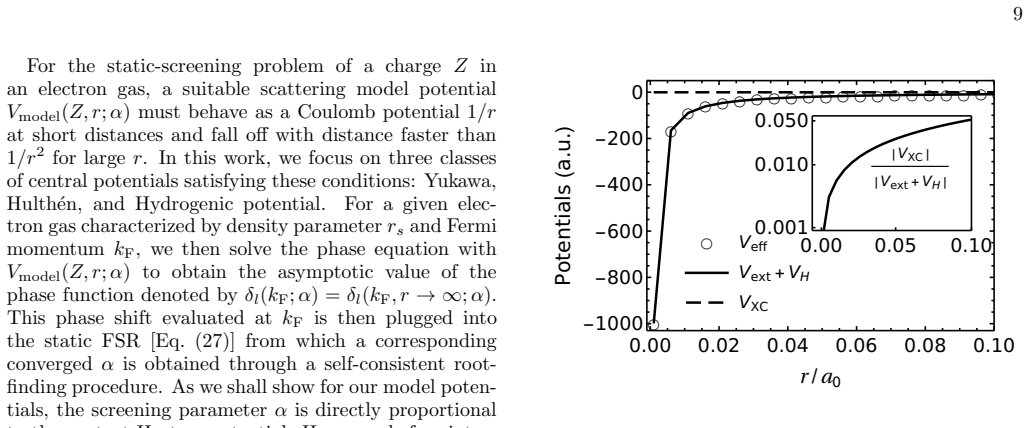
The homogeneous electron gas model together with the chosen exchange-correlation functional accurately describes the nonlinear induced density close to the proton.
What would settle it
A direct computation or measurement of the induced density or contact Hartree energy near a proton embedded in a real crystalline metal that deviates by more than a few percent from the jellium LDA benchmark.
Figures
read the original abstract
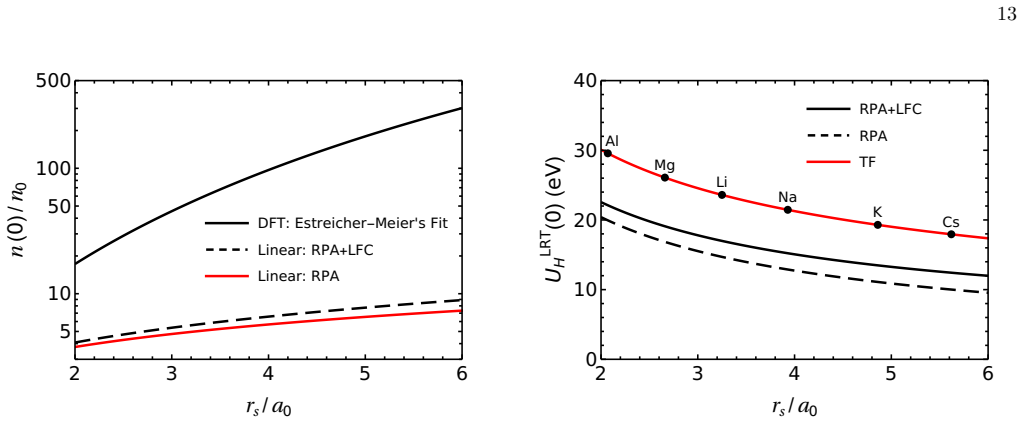
Electron screening of positive charges in metals is most strongly nonlinear in the static near-field regime. We revisit screening of a static single protonic charge in a homogeneous electron gas, focusing on the induced density and the contact Hartree energy $U_{\text{H}}(0)$. Although evaluated at the impurity position, $U_{\text{H}}(0)$ is not purely local: our formulation makes it explicit as a nonlocal quantity set by a radial moment of the full induced density, applicable to both linear-response and nonlinear density-functional-theory (DFT) descriptions. We compare Thomas--Fermi, Lindhard/random-phase-approximation, and local-field-corrected dielectric models with nonlinear DFT benchmarks. The Estreicher--Meier local-density-approximation (LDA) parametrization reproduces the contact Hartree energy from our direct LDA calculations and the self-consistent results of Almbladh \emph{et al.} [\href{https://doi.org/10.1103/PhysRevB.14.2250}{Phys. Rev. B \textbf{14}, 2250 (1976)}]. This validates the unified $U_{\text{H}}(0)$ implementation, separates the hydrogenic density profile from non-negligible Friedel oscillations, and provides a compact nonlinear reference for linear-response theory. Testing modern local-field factors, the Corradini--Del Sole--Onida--Palummo and Kaplan--Kukkonen parametrizations yield indistinguishable contact screening despite differing near $q\simeq 2k_F$. We also analyze Yukawa, hydrogenic, and Hulth\'en screened Coulomb potentials via a variable-phase scattering formulation constrained by the Friedel sum rule; these give a useful phase-shift representation of static screening but cannot alone reproduce the nonlinear DFT contact Hartree energy. The results establish a one-center nonlinear screening benchmark for proton impurities in jellium and clarify the baseline needed before treating two-center screening relevant to low-energy fusion in condensed matter.
Editorial analysis
A structured set of objections, weighed in public.
Referee Report
Summary. The manuscript claims that a unified, nonlocal definition of the contact Hartree energy U_H(0) as the radial moment 4π ∫ n_ind(r) r dr of the induced density allows consistent comparison of linear-response dielectric models (Thomas-Fermi, Lindhard/RPA, local-field corrected) with nonlinear LDA-DFT calculations for a static proton in jellium. It reports that the Estreicher-Meier LDA parametrization reproduces U_H(0) from the authors' direct LDA runs and from Almbladh et al. (1976), separates the hydrogenic profile from Friedel oscillations, finds that Corradini-Del Sole-Onida-Palummo and Kaplan-Kukkonen local-field factors give indistinguishable contact screening, and shows that Yukawa/hydrogenic/Hulthén potentials constrained by the Friedel sum rule cannot alone recover the nonlinear DFT value. The work positions the results as a one-center benchmark for jellium screening.
Significance. If the reported numerical agreement holds, the paper supplies a reproducible, explicitly nonlocal benchmark for nonlinear static screening of a point charge in jellium that cleanly separates local and oscillatory contributions. Credit is due for the direct, side-by-side comparison against the Almbladh et al. self-consistent results and for testing modern local-field factors on the same observable. The formulation is useful as a reference before extending to two-center problems; the stress-test concern about transferability to real metals with band structure does not land because the manuscript confines its claims to the jellium model.
minor comments (2)
- The abstract states that the Estreicher-Meier parametrization 'reproduces' the contact energy from direct LDA and Almbladh et al.; the main text should tabulate the numerical U_H(0) values (with any stated convergence tolerances) so that the degree of agreement is immediately verifiable.
- Notation for the induced density n_ind(r) and the moment definition of U_H(0) is introduced in the abstract; a short dedicated subsection or equation block early in the methods would improve readability for readers comparing linear-response and DFT routes.
Simulated Author's Rebuttal
We thank the referee for the careful reading of the manuscript and the positive recommendation to accept.
Circularity Check
No significant circularity identified
full rationale
The paper defines U_H(0) explicitly as the nonlocal radial moment 4π ∫ n_ind(r) r dr of the full induced density, independent of any model. It then performs consistency checks by comparing this quantity across Thomas-Fermi, Lindhard, local-field-corrected dielectrics, direct LDA calculations, the Estreicher-Meier parametrization, and the external 1976 Almbladh et al. benchmark. No load-bearing step reduces a prediction to a fitted input, self-citation, or definitional equivalence; the reproduction is an external validation inside the jellium LDA framework. The derivation chain is self-contained against independent benchmarks.
Axiom & Free-Parameter Ledger
axioms (2)
- domain assumption Homogeneous electron gas (jellium) model accurately represents screening near a proton impurity
- standard math Friedel sum rule constrains the phase shifts of screened potentials
Reference graph
Works this paper leans on
-
[1]
resonant states
as they argued that the interaction of these shallow bound states with the ionic cores of the lattice or finite quasiparticle lifetime broadening would destabilize them, and therefore, these jellium-based bound states should be viewed more as resonant states. A direct computa- tional evidence of the existence of such “resonant states” rather than “bound s...
1998
-
[2]
Radial grid and Kohn–Sham equation The radial equation for the reduced wavefunction uℓ(r) =rR ℓ(r) is solved on a logarithmic gridr i = exi,x i ∈[lnr min,lnr max], withN= 4000 points, rmin = 10 −4 a0 andr max = 25a 0. Substitutingu ℓ(r) = r1/2ϕℓ(x) yields a Schr¨ odinger-like equation in the uni- form variablex, ϕ′′ ℓ (x) =Q ℓ(x)ϕℓ(x), Qℓ(x) = ℓ+ 1 2 2 + ...
-
[3]
(D1) is matched atR match = 20a 0 to the asymptotic form uℓ(r) r→∞ − − − →kr[cosδℓ(k)jℓ(kr)−sinδ ℓ(k)nℓ(kr)],(D2) wherej ℓ andn ℓ are spherical Bessel and Neumann func- tions
Phase shifts and the displaced density For each angular momentumℓand momentumk∈ [0, kF], the outward Numerov integration of Eq. (D1) is matched atR match = 20a 0 to the asymptotic form uℓ(r) r→∞ − − − →kr[cosδℓ(k)jℓ(kr)−sinδ ℓ(k)nℓ(kr)],(D2) wherej ℓ andn ℓ are spherical Bessel and Neumann func- tions. The phase shiftδ ℓ(k) and an overall normalization co...
-
[4]
[39, 49], the screened proton supports a shallow 1sbound state in the jellium description
Bound states Forr s ≳1.9, consistent with Refs. [39, 49], the screened proton supports a shallow 1sbound state in the jellium description. The bound-state energy and wave- function are located by outward/inward Numerov shoot- ing, using bisection on the log-derivative mismatch at the classical turning point. Formally, a true bound state is included as a d...
-
[5]
Self-consistency cycle At each iteration, the induced Hartree potential is ob- tained by direct integration, VH(r) = 4π r Z r 0 ∆n(r′)r′2dr′ + 4π Z ∞ r ∆n(r′)r′dr′, (D12) and the exchange–correlation potential is evaluated in the local-density approximation. The imple- mentation supports the Perdew–Zunger [125] and Hedin–Lundqvist [126] parametrizations a...
-
[6]
Friedel, XIV
J. Friedel, XIV. The distribution of electrons round im- purities in monovalent metals, The London, Edinburgh, and Dublin Philosophical Magazine and Journal of Sci- ence43, 153 (1952)
1952
-
[7]
Lindhard, ON THE PROPERTIES OF A GAS OF CHARGED PARTICLES, Kgl
J. Lindhard, ON THE PROPERTIES OF A GAS OF CHARGED PARTICLES, Kgl. Danske Videnskab. Sel- skab Mat.-fys. Medd.Vol: 28, No. 8(1954)
1954
-
[8]
Heeger, Localized moments and nonmoments in met- als: The kondo effect (Academic Press, 1970) pp
A. Heeger, Localized moments and nonmoments in met- als: The kondo effect (Academic Press, 1970) pp. 283– 411
1970
-
[9]
Fukai, Atomistic States of Hydrogen in Metals, in The Metal-Hydrogen System: Basic Bulk Properties, edited by Y
Y. Fukai, Atomistic States of Hydrogen in Metals, in The Metal-Hydrogen System: Basic Bulk Properties, edited by Y. Fukai (Springer, Berlin, Heidelberg, 2005) pp. 147–302
2005
-
[10]
Jena, Materials for Hydrogen Storage: Past, Present, and Future, The Journal of Physical Chemistry Letters 2, 206 (2011)
P. Jena, Materials for Hydrogen Storage: Past, Present, and Future, The Journal of Physical Chemistry Letters 2, 206 (2011)
2011
-
[11]
M. U. Rahman, M. F. Elsadek, R. Roopashree, and A. Kashyap, Advancing hydrogen storage and explor- ing the potential of perovskite hydrides and metal hy- drides, Reviews in Inorganic Chemistry 10.1515/revic- 2025-0006 (2025)
-
[12]
Pundt and R
A. Pundt and R. Kirchheim, Hydrogen in metals: Mi- crostructural aspects, Annual Review of Materials Re- search36, 555 (2006)
2006
-
[13]
A. C. Hewson,The Kondo Problem to Heavy Fermions, Cambridge Studies in Magnetism (Cambridge Univer- sity Press, 1993)
1993
-
[14]
W. D. Knight, Nuclear magnetic resonance shift in met- als, Phys. Rev.76, 1259 (1949)
1949
-
[15]
Tuomisto and I
F. Tuomisto and I. Makkonen, Defect identification in semiconductors with positron annihilation: Experiment and theory, Rev. Mod. Phys.85, 1583 (2013)
2013
-
[16]
Siklitskaya, T
A. Siklitskaya, T. Bednarek, J. Pogrebetsky, and A. Kubas, An overview of physical and chemical long- 27 range phenomena governed by friedel oscillations: a bridge between physics and chemistry, Mater. Chem. Front.9, 541 (2025)
2025
-
[17]
Echenique, F
P. Echenique, F. Flores, and R. Ritchie, Dynamic screening of ions in condensed matter (Academic Press,
-
[18]
Echenique, F
P. Echenique, F. Garc´ ıa de Abajo, V. Ponce, and M. Uranga, Dynamic screening of ions in solids, Nuclear Instruments and Methods in Physics Research Section B: Beam Interactions with Materials and Atoms96, 583 (1995), the Interaction of Swift Particles and Electro- magnetic Fields with Matter
1995
-
[19]
Fano, Penetration of protons, alpha particles, and mesons, Annual Review of Nuclear and Particle Science 13, 1 (1963)
U. Fano, Penetration of protons, alpha particles, and mesons, Annual Review of Nuclear and Particle Science 13, 1 (1963)
1963
-
[20]
INOKUTI, Inelastic collisions of fast charged parti- cles with atoms and molecules—the bethe theory revis- ited, Rev
M. INOKUTI, Inelastic collisions of fast charged parti- cles with atoms and molecules—the bethe theory revis- ited, Rev. Mod. Phys.43, 297 (1971)
1971
-
[21]
N. R. Arista and A. F. Lifschitz, Non-linear approach to the energy loss of ions in solids, inTheory of the Interaction of Swift Ions with Matter. Part 1, Advances in Quantum Chemistry, Vol. 45 (Academic Press, 2004) pp. 47–77
2004
-
[22]
P. Sigmund, Six decades of atomic collisions in solids, Nuclear Instruments and Methods in Physics Research Section B: Beam Interactions with Materials and Atoms 406, 391 (2017), the 27th International Conference on Atomic Collisions in Solids
2017
-
[23]
International Atomic Energy Agency, IAEA Stopping Power Database,https://nds.iaea.org/stopping (2026), version 2026-01
2026
-
[24]
C. C. Montanari, P. Dimitriou, L. Marian, A. M. P. Mendez, J. P. Peralta, and F. Bivort-Haiek, The IAEA electronic stopping power database: Modernization, re- view, and analysis of the existing experimental data, Nuclear Instruments and Methods in Physics Research Section B: Beam Interactions with Materials and Atoms 551, 165336 (2024)
2024
-
[25]
Bowen, G
C. Bowen, G. Sugiyama, and B. J. Alder, Static dielec- tric response of the electron gas, Physical Review B50, 14838 (1994)
1994
-
[26]
Giuliani and G
G. Giuliani and G. Vignale,Quantum Theory of the Electron Liquid(Cambridge University Press, 2005)
2005
-
[27]
Utsumi and S
K. Utsumi and S. Ichimaru, Dielectric formulation of strongly coupled electron liquids at metallic densities. II. Exchange effects and static properties, Physical Re- view B22, 5203 (1980)
1980
-
[28]
C. F. Richardson and N. W. Ashcroft, Dynamical local- field factors and effective interactions in the three- dimensional electron liquid, Physical Review B50, 8170 (1994)
1994
-
[29]
Corradini, R
M. Corradini, R. Del Sole, G. Onida, and M. Palummo, Analytical expressions for the local-field fac- tor$G(q)$and the exchange-correlation kernel ${K} {\mathrm{xc}}(r)$of the homogeneous electron gas, Physical Review B57, 14569 (1998)
1998
-
[30]
Qian and G
Z. Qian and G. Vignale, Dynamical exchange- correlation potentials for an electron liquid, Physical Review B65, 235121 (2002)
2002
-
[31]
Ruzsinszky, N
A. Ruzsinszky, N. K. Nepal, J. M. Pitarke, and J. P. Perdew, Constraint-based wave vector and frequency dependent exchange-correlation kernel of the uniform electron gas, Physical Review B101, 245135 (2020)
2020
-
[32]
N. K. Nepal, S. Adhikari, B. Neupane, S. Ruan, S. Ne- upane, and A. Ruzsinszky, Understanding plasmon dis- persion in nearly free electron metals: Relevance of ex- act constraints for exchange-correlation kernels within time-dependent density functional theory, Physical Re- view B101, 195137 (2020)
2020
-
[33]
A. D. Kaplan, N. K. Nepal, A. Ruzsinszky, P. Bal- lone, and J. P. Perdew, First-principles wave-vector- and frequency-dependent exchange-correlation kernel for jel- lium at all densities, Physical Review B105, 035123 (2022)
2022
-
[34]
A. W. Overhauser, Exchange Potentials in a Nonuni- form Electron Gas, Physical Review B2, 874 (1970)
1970
-
[35]
Hellal, J.-G
S. Hellal, J.-G. Gasser, and A. Issolah, Static local-field correction from Monte Carlo studies of the homogeneous electron gas, Physical Review B68, 094204 (2003)
2003
-
[36]
G. E. Simion and G. F. Giuliani, Many-body local fields theory of quasiparticle properties in a three-dimensional electron liquid, Physical Review B77, 035131 (2008)
2008
-
[37]
Chen and K
K. Chen and K. Haule, A combined variational and diagrammatic quantum Monte Carlo approach to the many-electron problem, Nature Communications10, 3725 (2019)
2019
-
[38]
C. A. Kukkonen and K. Chen, Quantitative electron- electron interaction using local field factors from quan- tum monte carlo calculations, Phys. Rev. B104, 195142 (2021)
2021
-
[39]
A. D. Kaplan and C. A. Kukkonen, QMC-consistent static spin and density local field factors for the uniform electron gas, Physical Review B107, L201120 (2023)
2023
-
[40]
Loos and P
P.-F. Loos and P. M. W. Gill, The uniform electron gas, WIREs Computational Molecular Science6, 410 (2016)
2016
-
[41]
Hohenberg and W
P. Hohenberg and W. Kohn, Inhomogeneous Electron Gas, Physical Review136, B864 (1964)
1964
-
[42]
Kohn and L
W. Kohn and L. J. Sham, Self-Consistent Equations Including Exchange and Correlation Effects, Physical Review140, A1133 (1965)
1965
-
[43]
Z. D. Popovic and M. J. Stott, Nonlinear, Self- Consistent Theory of Proton Screening in Metals Ap- plied to Hydrogen in Al and Mg, Physical Review Let- ters33, 1164 (1974)
1974
-
[44]
C. O. Almbladh, U. von Barth, Z. D. Popovic, and M. J. Stott, Screening of a proton in an electron gas, Physical Review B14, 2250 (1976)
1976
-
[45]
Sj¨ olander and M
A. Sj¨ olander and M. J. Stott, Electron Distribution around Mobile and Fixed Point Charges in Metals, Physical Review B5, 2109 (1972)
1972
-
[46]
A. K. Gupta, P. Jena, and K. S. Singwi, Nonlinear electron-density distribution around point defects in simple metals. I. Formulation, Physical Review B18, 2712 (1978)
1978
-
[47]
Heinrich and G
A. Heinrich and G. Paasch, Electron Density Distribu- tion at Point Defects. Application of the Quadratic Re- sponse Theory, physica status solidi (b)102, 521 (1980)
1980
-
[48]
von Barth, C.-O
U. von Barth, C.-O. Almbladh, and P.-S. Svendsen, Second-order perturbation theory as applied to impu- rities in the electron gas, Historiel¨ ararnas F¨ orenings ˚Arsskrift (1996)
1996
-
[49]
S. A. Mikhailov, Second-order response of a uniform three-dimensional electron gas to a longitudinal electric field, Annalen der Physik524, 182 (2012)
2012
-
[50]
S. A. Mikhailov, Nonlinear Electromagnetic Response of a Uniform Electron Gas, Physical Review Letters113, 027405 (2014). 28
2014
-
[51]
Z. D. Popovic, M. J. Stott, J. P. Carbotte, and G. R. Piercy, Theory of the heat of solution of hydrogen in Al and Mg using nonlinear screening, Physical Review B 13, 590 (1976)
1976
-
[52]
Zaremba, J
E. Zaremba, J. H. Rose, L. M. Sander, and H. B. Shore, Self-consistent screening of a proton in jellium, Journal of Physics F: Metal Physics7, 1763 (1977)
1977
-
[53]
J. K. Nørskov, Electronic structure of H and He in metal vacancies, Solid State Communications24, 691 (1977)
1977
-
[54]
Jena and K
P. Jena and K. S. Singwi, Electronic structure of hy- drogen in simple metals, Physical Review B17, 3518 (1978)
1978
-
[55]
G. W. Bryant and G. D. Mahan, Atoms in jellium, Phys. Rev. B17, 1744 (1978)
1978
-
[56]
G. W. Bryant, Impurities in jellium, Phys. Rev. B19, 2864 (1979)
1979
-
[57]
P. Jena, F. Y. Fradin, and D. E. Ellis, Models of elec- tronic structure of hydrogen in metals: Pd-h, Phys. Rev. B20, 3543 (1979)
1979
-
[58]
D. S. Larsen and J. K. Norskov, Calculated energies and geometries for hydrogen impurities in al and mg, Journal of Physics F: Metal Physics9, 1975 (1979)
1975
-
[59]
M. D. Whitmore, J. P. Carbotte, and R. C. Shukla, Non-linear self-consistent screening applied to metallic hydrogen, Canadian Journal of Physics57, 1185 (1979)
1979
-
[60]
M. J. Stott and E. Zaremba, Quasiatoms: An approach to atoms in nonuniform electronic systems, Phys. Rev. B22, 1564 (1980)
1980
-
[61]
M. J. Puska, R. M. Nieminen, and M. Manninen, Atoms embedded in an electron gas: Immersion energies, Phys- ical Review B24, 3037 (1981)
1981
-
[62]
M. J. Puska and R. M. Nieminen, Atoms embedded in an electron gas: Phase shifts and cross sections, Phys. Rev. B27, 6121 (1983)
1983
-
[63]
Estreicher and P
S. Estreicher and P. F. Meier, Energy profiles for light impurities in simple metals, Phys. Rev. B27, 642 (1983)
1983
-
[64]
B. I. Craig, The electronic structure of a hydrogen impu- rity in aluminium iii. the energy and the metal-impurity interaction, physica status solidi (b)115, 53 (1983)
1983
-
[65]
C. A. Sholl and P. V. Smith, Electron density of states of interstitial impurities in transition metals: H in pd, Journal of Physics F: Metal Physics7, 799 (1977)
1977
-
[66]
J. K. Nørskov, Electron structure of single and inter- acting hydrogen impurities in free-electron-like metals, Physical Review B20, 446 (1979)
1979
-
[67]
C. A. Sholl and P. V. Smith, The energy and electron density of states of h in transition metals. iv. improve- ments of the theory, Journal of Physics F: Metal Physics 10, 811 (1980)
1980
-
[68]
B. M. Klein and W. E. Pickett, Muffin-tin Green’s- function theory of hydrogen defects in aluminum, Phys- ical Review B29, 1597 (1984)
1984
-
[69]
B. M. Klein and W. E. Pickett, Theoretical studies of hydrogen impurities in palladium and hydrogen va- cancies in PdH using the muffin tin Green’s function method, Journal of the Less Common Metals103, 185 (1984)
1984
-
[70]
R. P. Gupta, The nature of the bound state induced by an interstitial hydrogen in aluminium, Journal of the Less Common Metals88, 299 (1982)
1982
-
[71]
Arponen and E
J. Arponen and E. Pajanne, Electron liquid in collective description. IV. Proton in an electron gas, Journal of Physics C: Solid State Physics12, 3013 (1979)
1979
-
[72]
Kallio, P
A. Kallio, P. Pietil¨ ainen, and L. Lantto, Hypernetted Chain Theory of Charged Impurity, Physica Scripta25, 943 (1982)
1982
-
[73]
Pietil¨ ainen and A
P. Pietil¨ ainen and A. Kallio, Hypernetted-chain theory of charged impurity with mixture formalism, Phys. Rev. B27, 224 (1983)
1983
-
[74]
Gondzik and H
J. Gondzik and H. Stachowiak, Screening of positive particles in jellium, Journal of Physics C: Solid State Physics18, 5399 (1985)
1985
-
[75]
Sugiyama, L
G. Sugiyama, L. Terray, and B. J. Alder, Quantum Monte Carlo study of a proton in an electron gas, Jour- nal of Statistical Physics52, 1221 (1988)
1988
-
[76]
Takada, R
Y. Takada, R. Maezono, and K. Yoshizawa, Emergence of a Kondo singlet state with Kondo temperature well beyond 1000 K in a proton-embedded electron gas, Physical Review B92, 155140 (2015)
2015
-
[77]
Takada, On-top density in the nonlinear metal- lic screening and its implication on the exchange- correlation energy functional, The European Physical Journal B91, 189 (2018)
Y. Takada, On-top density in the nonlinear metal- lic screening and its implication on the exchange- correlation energy functional, The European Physical Journal B91, 189 (2018)
2018
-
[78]
A. I. Duff and J. F. Annett, Variational QMC study of a hydrogen atom in jellium with comparison to LSDA and self-interaction corrected LSDA solutions, Physical Review B76, 115113 (2007)
2007
-
[79]
JENA, 6 - electronic structure of point defects in metals, inElectronic Structure and Properties, Treatise on Materials Science & Technology, Vol
P. JENA, 6 - electronic structure of point defects in metals, inElectronic Structure and Properties, Treatise on Materials Science & Technology, Vol. 21, edited by F. Y. FRADIN (Elsevier, 1981) pp. 351–425
1981
-
[80]
C. B. S. P. Jena, ed.,Electronic structure and properties of hydrogen in metals(Springer New York, NY, 1983)
1983
discussion (0)
Sign in with ORCID, Apple, or X to comment. Anyone can read and Pith papers without signing in.