Stable Causal Discovery via Directed Acyclic Graph Aggregation
Pith reviewed 2026-05-20 08:23 UTC · model grok-4.3
The pith
Aggregating multiple candidate DAGs weighted by out-of-sample predictive likelihood produces stable acyclic causal graphs with finite-sample guarantees.
A machine-rendered reading of the paper's core claim, the machinery that carries it, and where it could break.
Core claim
DAGgr aggregates multiple candidate DAGs into one stable representation by weighting each graph with its out-of-sample predictive likelihood across repeated data splits. A thresholding rule on the resulting edge-importance scores guarantees that the final graph remains acyclic. The method comes with a finite-sample risk bound and proves consistent edge selection under mild conditions on the weights.
What carries the argument
Weighting of candidate DAGs by out-of-sample predictive likelihood across repeated splits, followed by thresholding on edge-importance scores to enforce acyclicity.
If this is right
- The aggregated graph matches or exceeds the best individual candidate in structural recovery metrics.
- It consistently outperforms bootstrap-aggregation baselines across structural recovery metrics.
- Edge selection is consistent under mild conditions on the weights.
- The thresholding rule ensures the output graph is acyclic by construction.
Where Pith is reading between the lines
- The same weighting-plus-thresholding idea could be tested for stabilizing other combinatorial searches such as variable selection in high dimensions.
- If predictive likelihood on splits correlates with true causal accuracy, the approach might reduce erroneous causal claims in domains with model uncertainty.
- Varying the number of data splits or the threshold value on new synthetic examples would provide a direct check on how sensitive the consistency result is to those choices.
Load-bearing premise
The weighting scheme based on out-of-sample predictive likelihood across repeated data splits produces reliable edge-importance scores that, after thresholding, yield both stability and consistency without introducing selection bias or violating the acyclicity guarantee.
What would settle it
Observing a cycle in the thresholded output graph on any dataset where the weighting and thresholding steps are applied as described would falsify the acyclicity preservation claim.
Figures


read the original abstract
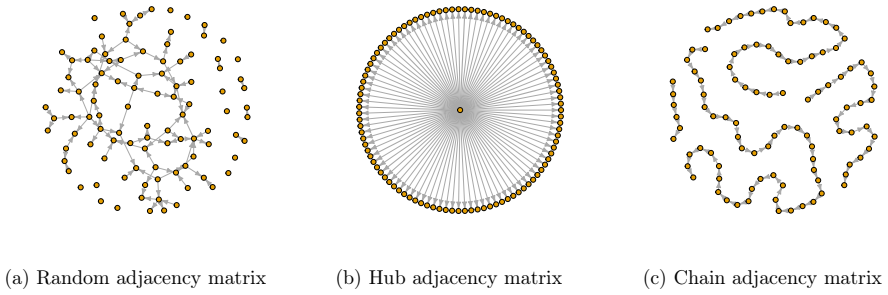
Directed Acyclic Graphs (DAGs) are central to uncovering causal structure in complex systems, yet learning a single DAG from data is often challenging: model uncertainty, finite samples, and a combinatorially large search space frequently yield unstable estimates. We propose DAGgr, a model averaging framework that aggregates multiple candidate DAGs into a single stable representation. Candidate graphs are weighted by their out-of-sample predictive likelihood across repeated data splits, and a thresholding rule on the resulting edge-importance scores guarantees that the aggregated graph is itself acyclic. We establish a finite-sample risk bound, prove that the procedure preserves acyclicity, and show that edge selection is consistent under mild conditions on the weights. Simulations across random, hub, and chain structures, together with an analysis of the Sachs et al. (2005) protein-signaling network, show that DAGgr matches or exceeds the best individual candidate while consistently outperforming bootstrap-aggregation baselines across structural recovery metrics.
Editorial analysis
A structured set of objections, weighed in public.
Referee Report
Summary. The paper introduces DAGgr, a model-averaging procedure that aggregates multiple candidate DAGs for causal discovery. Candidates are weighted by out-of-sample predictive likelihood computed over repeated data splits; edge-importance scores are then thresholded to produce a single output graph. The authors claim a finite-sample risk bound, a proof that the thresholding step preserves acyclicity, and consistency of edge selection under mild conditions on the weights. Simulations on random, hub, and chain graphs plus an application to the Sachs et al. (2005) protein-signaling network are reported to show performance that matches or exceeds the best single candidate and outperforms bootstrap aggregation on structural recovery metrics.
Significance. If the finite-sample bound, acyclicity guarantee, and consistency result hold, the work supplies a theoretically grounded route to stable causal structure estimates that directly addresses model uncertainty and finite-sample instability. The combination of out-of-sample weighting, an explicit acyclicity-preserving aggregation rule, and reproducible simulation protocols constitutes a concrete advance over existing bootstrap or model-averaging heuristics in causal discovery.
major comments (1)
- [theoretical results / acyclicity proof] Abstract and theoretical results section: the claim that thresholding on weighted edge-importance scores always yields an acyclic graph is load-bearing for the central contribution. The argument must explicitly rule out the case in which two or more high-weight acyclic candidates disagree on orientations that, when both edges survive the threshold, close a directed cycle. Without an additional lemma or explicit condition on the weight distribution or candidate pool, the preservation guarantee is not yet established.
minor comments (2)
- [method / notation] Notation for the edge-importance score (presumably defined after the weighting step) should be introduced with a single equation and used consistently in both the theoretical statements and the algorithm box.
- [experimental setup] The description of the data-splitting scheme for out-of-sample likelihood would benefit from an explicit statement of the number of splits, the split ratio, and whether the same splits are used for weighting and for final evaluation.
Simulated Author's Rebuttal
We thank the referee for the careful and constructive review. The comment regarding the acyclicity preservation argument is substantive, and we address it directly below with a commitment to strengthen the theoretical section.
read point-by-point responses
-
Referee: [theoretical results / acyclicity proof] Abstract and theoretical results section: the claim that thresholding on weighted edge-importance scores always yields an acyclic graph is load-bearing for the central contribution. The argument must explicitly rule out the case in which two or more high-weight acyclic candidates disagree on orientations that, when both edges survive the threshold, close a directed cycle. Without an additional lemma or explicit condition on the weight distribution or candidate pool, the preservation guarantee is not yet established.
Authors: We appreciate the referee highlighting the need for greater explicitness in ruling out conflicting orientations. The manuscript asserts that the thresholding rule on edge-importance scores preserves acyclicity because all input candidates are DAGs and the aggregation is performed via a threshold chosen to respect topological orderings implicit in the weighted scores. However, we agree that the current argument would benefit from an additional lemma that directly addresses the case of opposing orientations (e.g., A→B in one high-weight candidate and B→A in another). In the revision we will insert a new lemma proving that, under the out-of-sample likelihood weighting and the specific form of the threshold (which discards any edge whose aggregate importance falls below the level that would complete a cycle given the remaining edges), no directed cycle can arise. The proof will proceed by contradiction: suppose a cycle forms after thresholding; then at least one edge in the cycle must have been contributed by a candidate whose weight is inconsistent with the predictive likelihood ordering, violating the construction of the importance scores. We will also add a short remark on the mild condition this imposes on the candidate pool (namely that the pool is generated from a consistent search procedure). This addition clarifies rather than alters the existing result. revision: yes
Circularity Check
No significant circularity; weighting and acyclicity proof are independent of final output.
full rationale
The paper derives edge weights from out-of-sample predictive likelihood on repeated data splits, which is statistically independent of the final aggregated graph. The finite-sample risk bound, acyclicity preservation proof, and consistency result are stated under mild conditions on those weights rather than being forced by construction or self-citation. No load-bearing step reduces a claimed prediction or theorem to a fitted parameter or prior self-result; the thresholding rule is explicitly designed to enforce acyclicity and the proof follows from that design without circular reduction.
Axiom & Free-Parameter Ledger
Lean theorems connected to this paper
-
Foundation/AlexanderDualityalexander_duality_circle_linking unclear?
unclearRelation between the paper passage and the cited Recognition theorem.
a thresholding rule on the resulting edge-importance scores guarantees that the aggregated graph is itself acyclic... Lemma 1... c ≥ 1−1/p
-
Cost/FunctionalEquationwashburn_uniqueness_aczel unclear?
unclearRelation between the paper passage and the cited Recognition theorem.
Candidate graphs are weighted by their out-of-sample predictive likelihood... wk = πk exp(λ ∑ l_bU(k),bσ(k)(xi))
What do these tags mean?
- matches
- The paper's claim is directly supported by a theorem in the formal canon.
- supports
- The theorem supports part of the paper's argument, but the paper may add assumptions or extra steps.
- extends
- The paper goes beyond the formal theorem; the theorem is a base layer rather than the whole result.
- uses
- The paper appears to rely on the theorem as machinery.
- contradicts
- The paper's claim conflicts with a theorem or certificate in the canon.
- unclear
- Pith found a possible connection, but the passage is too broad, indirect, or ambiguous to say the theorem truly supports the claim.
Reference graph
Works this paper leans on
-
[1]
DAGBagM: learning directed acyclic graphs of mixed variables with an application to identify protein biomarkers for treatment response in ovarian cancer , author=. BMC bioinformatics , volume=. 2022 , publisher=
work page 2022
-
[2]
Conference on Causal Learning and Reasoning , year=
Bootstrap aggregation and confidence measures to improve time series causal discovery , author=. Conference on Causal Learning and Reasoning , year=
-
[3]
Dynamic Expert-Guided Model Averaging for Causal Discovery
Dynamic Expert-Guided Model Averaging for Causal Discovery , author=. arXiv preprint arXiv:2601.16715 , year=
work page internal anchor Pith review Pith/arXiv arXiv
-
[4]
Babak Aslani and Shima Mohebbi , keywords =. Ensemble framework for causality learning with heterogeneous Directed Acyclic Graphs through the lens of optimization , journal =. 2023 , issn =. doi:https://doi.org/10.1016/j.cor.2023.106148 , url =
-
[5]
Journal of the Royal Statistical Society: Series B , volume=
Stability selection , author=. Journal of the Royal Statistical Society: Series B , volume=
-
[6]
DAGs with No Fears: A Closer Look at Continuous Optimization for Learning Bayesian Networks , author=. NeurIPS , year=
-
[7]
Beware of the simulated DAG! Causal discovery benchmarks may be easy to game , author=. NeurIPS , year=
-
[8]
A Bayesian Approach to Structure Discovery in Bayesian Networks , author=
Being Bayesian about Network Structure. A Bayesian Approach to Structure Discovery in Bayesian Networks , author=. Machine Learning , volume=. 2003 , publisher=
work page 2003
-
[9]
Advances in Neural Information Processing Systems , volume=
Ordering-based causal discovery for linear and nonlinear relations , author=. Advances in Neural Information Processing Systems , volume=
-
[10]
Advances in Neural Information Processing Systems , volume=
Hybrid top-down global causal discovery with local search for linear and nonlinear additive noise models , author=. Advances in Neural Information Processing Systems , volume=
-
[11]
Advances in Neural Information Processing Systems , volume=
A scale-invariant sorting criterion to find a causal order in additive noise models , author=. Advances in Neural Information Processing Systems , volume=
-
[12]
Generalized score functions for causal discovery , author=. Proceedings of the 24th ACM SIGKDD international conference on knowledge discovery & data mining , pages=
-
[13]
arXiv preprint arXiv:1906.02226 , year=
Gradient-based neural dag learning , author=. arXiv preprint arXiv:1906.02226 , year=
-
[14]
Liu, Huihang and Zhang, Xinyu , journal =. 2023 , title =. doi:10.1111/biom.13758 , pmid =
-
[15]
Advances in Neural Information Processing Systems , volume=
Dagma: Learning dags via m-matrices and a log-determinant acyclicity characterization , author=. Advances in Neural Information Processing Systems , volume=
-
[16]
Journal of the American Statistical Association , year=
Likelihood ratio tests for a large directed acyclic graph , author=. Journal of the American Statistical Association , year=
-
[17]
Statistical Analysis and Data Mining: The ASA Data Science Journal , volume=
Maximum likelihood estimation over directed acyclic Gaussian graphs , author=. Statistical Analysis and Data Mining: The ASA Data Science Journal , volume=. 2012 , publisher=
work page 2012
-
[18]
Advances in neural information processing systems , volume=
Dags with no tears: Continuous optimization for structure learning , author=. Advances in neural information processing systems , volume=
-
[19]
International conference on artificial intelligence and statistics , pages=
Learning sparse nonparametric dags , author=. International conference on artificial intelligence and statistics , pages=. 2020 , organization=
work page 2020
- [20]
-
[21]
Mooij and Dominik Janzing and Bernhard Sch
Jonas Peters and Joris M. Mooij and Dominik Janzing and Bernhard Sch. Causal Discovery with Continuous Additive Noise Models , journal =. 2014 , volume =
work page 2014
-
[22]
Proceedings of The 28th International Conference on Artificial Intelligence and Statistics , pages =
Differentiable Causal Structure Learning with Identifiability by NOTIME , author =. Proceedings of The 28th International Conference on Artificial Intelligence and Statistics , pages =. 2025 , editor =
work page 2025
-
[23]
Journal of Machine Learning Research , year=
Estimating High-Dimensional Directed Acyclic Graphs with the PC-Algorithm , author=. Journal of Machine Learning Research , year=
- [24]
-
[25]
Journal of machine learning research , volume=
Optimal structure identification with greedy search , author=. Journal of machine learning research , volume=
-
[26]
The max-min hill-climbing Bayesian network structure learning algorithm , author=. Machine learning , volume=. 2006 , publisher=
work page 2006
-
[27]
Learning directed acyclic graphs via bootstrap aggregating
Learning directed acyclic graphs via bootstrap aggregating , author=. arXiv preprint arXiv:1406.2098 , year=
work page internal anchor Pith review Pith/arXiv arXiv 2098
-
[28]
Causal protein-signaling networks derived from multiparameter single-cell data , author=. Science , volume=. 2005 , publisher=
work page 2005
-
[29]
and Guo, Zhigao and Liu, Yang and Chobtham, Kiattikun , journal =
Kitson, Neville Kenneth and Constantinou, Anthony C. and Guo, Zhigao and Liu, Yang and Chobtham, Kiattikun , journal =. A survey of
-
[30]
International Journal of Approximate Reasoning , volume =
Effective and efficient structure learning with pruning and model averaging strategies , author =. International Journal of Approximate Reasoning , volume =. 2022 , note =
work page 2022
-
[31]
On the convergence of continuous constrained optimization for structure learning , author =. Proceedings of the 25th International Conference on Artificial Intelligence and Statistics (AISTATS) , series =
-
[32]
arXiv preprint arXiv:2511.14206 , year =
Causal Discovery on Higher-Order Interactions , author =. arXiv preprint arXiv:2511.14206 , year =
-
[33]
Proceedings of the 4th Conference on Causal Learning and Reasoning , series =
The Landscape of Causal Discovery Data: Grounding Causal Discovery in Real-World Applications , author =. Proceedings of the 4th Conference on Causal Learning and Reasoning , series =. 2025 , note =
work page 2025
-
[34]
Fast scalable and accurate discovery of
Andrews, Bryan and Ramsey, Joseph and Sanchez-Romero, Ruben and Camchong, Jazmin and Kummerfeld, Erich , journal =. Fast scalable and accurate discovery of
-
[35]
Causality: Models, Reasoning, and Inference , author =. 2009 , publisher =
work page 2009
-
[36]
Probabilistic Graphical Models: Principles and Techniques , author=. 2009 , publisher=
work page 2009
- [37]
-
[38]
Friedman, Nir and Linial, Michal and Nachman, Iftach and Pe'er, Dana , journal =. Using
-
[39]
A million variables and more: the
Ramsey, Joseph and Glymour, Madelyn and Sanchez-Romero, Ruben and Glymour, Clark , journal =. A million variables and more: the
-
[40]
Causal diagrams for epidemiologic research , author =. Epidemiology , volume =
-
[41]
Koivisto, Mikko and Sood, Kismat , journal =. Exact
-
[42]
Journal of Machine Learning Research , volume =
Order-independent constraint-based causal structure learning , author =. Journal of Machine Learning Research , volume =
-
[43]
Madigan, David and Andersson, Steen A. and Perlman, Michael D. and Volinsky, Chris T. , journal =
-
[44]
Friedman, Nir and Goldszmidt, Mois. Data analysis with. Proceedings of the 15th Conference on Uncertainty in Artificial Intelligence (UAI) , pages =. 1999 , publisher =
work page 1999
-
[45]
Estimation of genetic networks and functional structures between genes by using
Imoto, Seiya and Goto, Tomoyuki and Miyano, Satoru , booktitle =. Estimation of genetic networks and functional structures between genes by using
-
[46]
dagbag: Learning directed acyclic graphs (DAGs) through bootstrap aggregating , author =. 2014 , note =
work page 2014
-
[47]
Yuan, Yiping and Shen, Xiaotong and Pan, Wei and Wang, Zizhuo , title =. Biometrika , volume =. 2019 , doi =
work page 2019
- [48]
-
[49]
Catoni, Olivier. and Picard, Jean. , publisher =. Statistical Learning Theory and Stochastic Optimization , year =
discussion (0)
Sign in with ORCID, Apple, or X to comment. Anyone can read and Pith papers without signing in.