REVIEW 1 major objections 5 minor 236 references
The HII Regions' Molecular Law of Star Formation
T0 review · 1 major / 5 minor · reviewed 2026-08-15 · deepseek-v4-flash
Pith's one-line read The star formation law steepens to slope 1.85 at HII-region scales.
desk verdict A careful 100 pc resolved measurement of the molecular star formation law, but the steep n≈1.85 slope rests on a diffuse-subtraction assumption that the paper does not independently validate. read the letter →
The pith
A machine-rendered reading of the paper's core claim, the machinery that carries it, and where it could break.
The reading
What carries the argument
The central objects are the surface-density quantities $\Sigma_{\rm SFR}$, from dust-corrected Hα combined with JWST 21 µm emission, and $\Sigma_{\rm mol}$, from CO total-intensity maps converted with a disk-weight-dependent $\alpha_{\rm CO}$. The mechanism that carries the argument is annular background subtraction: for each 60 pc aperture, the diffuse galaxy emission is estimated as the mode of pixel values in a surrounding 60–100 pc annulus after $\sigma$-clipping, and this diffuse component is removed from both the SFR and molecular gas tracers. Removing that component changes the fitted slope from $n \simeq 1.35$ to $n \simeq 1.85$, and the paper argues the diffuse 21 µm light is heat from old stars, not current star formation, because it tracks stellar mass rather than region luminosity. Supporting machinery includes a fixed 60 pc free-fall radius used to derive efficiencies per free-fall time, and a disk-weight-dependent CO-to-H$_2$ conversion that removes galaxy-to-galaxy offsets without steepening the within-galaxy relations.
What would settle it
A decisive check would be to measure SFR in the same 353 regions with a tracer that is insensitive to dust heated by old stars—for example, radio free-free emission or a recombination line ratio with a much deeper extinction correction—and to refit $\Sigma_{\rm SFR}$ versus $\Sigma_{\rm mol}$; if the slope returned to near $n \simeq 1$ instead of $1.85$, the diffuse-light subtraction would be implicated. A second, complementary test would be to run the paper's exact annular-mode background recipe on simulated galaxy images with a known input star formation law and see whether the recovered slope is biased.
Extended reading notes
Core claim
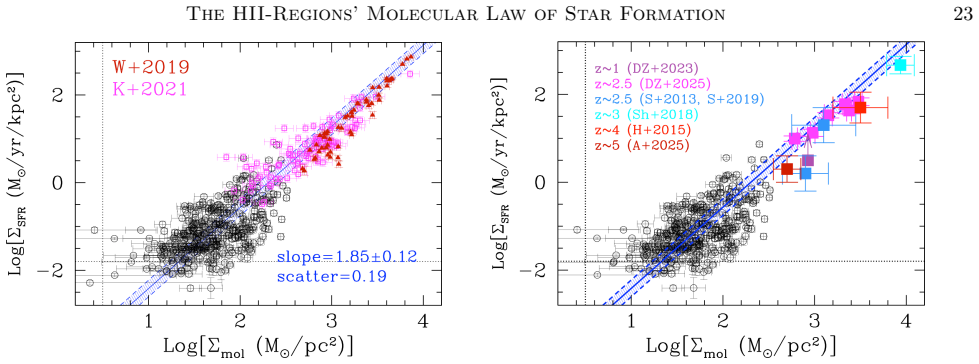
On the paper's own terms, the central discovery is a resolved molecular star formation law for HII regions: for the 353 regions above the censoring limits, $\log \Sigma_{\rm SFR} = (1.85 \pm 0.12)\,\log \Sigma_{\rm mol} - (4.27 \pm 0.26)$, with a scatter of 0.18 dex in the LINMIX fit. This is significantly steeper than the $n \sim 0.9$–$1.3$ slopes typical of kiloparsec-scale galaxy regions and is close to the $n \sim 1.6$–$2$ slopes of Milky Way molecular clouds. The relation remains steep at 500 pc scales, with slope $1.88 \pm 0.20$, and the paper interprets the steepness as the signature of current star-forming regions isolated from the diffuse emission of the underlying galaxy. It also finds that the diffuse 21 µm emission correlates with stellar mass surface density rather than with current star formation, and argues that leaving that diffuse component in the photometry flattens the measured slope to $1.35 \pm 0.07$. The paper extends the relation to lower and higher gas surface densities by adding local starbursts and high-redshift clumps, concluding that all these systems form a single star formation sequence over three orders of magnitude in $\Sigma_{\rm mol}$.
Load-bearing premise
The load-bearing premise is that the diffuse 21 µm and Hα light inside each 60 pc aperture belongs to the galaxy's old stellar population, not to the region's current star formation, and that this diffuse component can be measured as the mode of pixel values in the surrounding 60–100 pc annulus; the paper's own no-subtraction fit gives a shallower slope of $1.35 \pm 0.07$, so if this decomposition is wrong the headline steepening weakens.
Editorial extensions
If this is right
- If the slope is truly $n \simeq 1.85$, the molecular gas depletion time decreases with activity, $\tau_{\rm dep} \propto \Sigma_{\rm SFR}^{-0.5}$ or steeper, meaning that more intensely star-forming regions consume their gas faster.
- The efficiency per free-fall time stays low on average, about 1%, but increases by roughly a factor of 3.5 from faint to bright regions, so star formation feedback does not need to be finely tuned to hold efficiencies down.
- Kiloparsec-scale laws with $n \sim 1$ appear to be partly a mixing artifact: if diffuse galaxy light is not removed, the resolved law flattens toward the old galaxy-wide value, so the true small-scale law may be steep everywhere.
- Local HII regions, high-redshift star-forming clumps, and starbursts join into one sequence over three orders of magnitude in $\Sigma_{\rm mol}$, giving a common calibration for interpreting unresolved high-redshift measurements.
- Physical star formation models must reproduce both a steep slope and a large scatter at fixed region size; models adding a power-law tail to the gas density probability distribution are the ones the paper identifies as capable of bracketing the data.
Reading between the lines
- A natural extension the authors do not pursue: applying the same annular diffuse-light subtraction to existing kiloparsec-resolution surveys would probably steepen their measured slopes toward $n \sim 1.5$–$1.8$, changing published molecular depletion times.
- If the steep law is universal, then unresolved high-redshift galaxy stacks that mix diffuse and compact emission may be fitting a flatter effective slope; resolved ALMA-scale observations of individual clumps at $z \sim 2$–$4$ would provide a direct test.
- The slope could be tracer-dependent: using a high-density gas tracer such as HCN instead of CO might yield a shallower relation, since the paper's $\Sigma_{\rm mol}$ includes lower-density gas that is not directly forming stars.
- A testable consequence for simulations: the same 60–100 pc annular background recipe applied to mock galaxy images should recover the input star formation law; if it artificially steepens it, the observational slope is partly a measurement effect.
Signed reviews
Editorial analysis
A structured set of objections, weighed in public.
Referee Report
Summary. The paper presents a new measurement of the resolved molecular star formation law at ~100 pc scales in three nearby galaxies (NGC 628, NGC 5194, NGC 5236), combining HST Hα, JWST MIRI 21 µm and NIRCam imaging, and CO maps. After subtracting a local diffuse background via an annulus-mode estimator, the authors find a logarithmic slope n = 1.85 ± 0.12 between Σ_SFR and Σ_mol for 353 HII regions, consistent across three regression algorithms, and a similar slope (n = 1.88 ± 0.20) at 500 pc scales. They argue that the diffuse 21 µm emission correlates with stellar mass rather than current star formation, and that the steep slope connects local HII regions to starbursts and high-redshift star-forming clumps in a single sequence.
Significance. If the measurement is robust, this paper provides a resolved molecular star formation law at ~100 pc scales that is significantly steeper than the canonical kpc-scale law and closer to Milky Way cloud values, with implications for star formation efficiencies and for the interpretation of high-redshift observations. The authors have been careful in several respects: three independent fitting algorithms agree, the 500 pc re-analysis reproduces the slope, and alternative α_CO prescriptions are tested in Appendix G, showing that the steep slope is not an artifact of the adopted CO-to-H2 conversion. The main caveat is the sensitivity of the headline slope to the diffuse-emission subtraction, which is the central point I raise below.
major comments (1)
- [5.2, 3.1] The headline slope n = 1.85 is conditional on the diffuse-emission subtraction: Section 5.2 reports that without subtracting the diffuse component, the LINMIX fit yields n = 1.35 ± 0.07, so the steepening is entirely attributed to the subtraction. The robustness test in Section 3.1 only increases the outer annulus radius by a factor of two, which changes SFRs by ~0.03 dex; this tests the annulus size but does not test whether the annulus mode correctly measures only the underlying galaxy's diffuse emission, as opposed to extended emission from the same star-forming complex. The physical argument in Section 3.2 and Figure 3, that diffuse L(21) correlates with stellar mass, is plausible but model-dependent; any smooth component tracing the disk could correlate with the stellar mass map, including light from young populations outside the central peak. If the annulus subtraction removes 21 µm or Hα from young stars in the region's periphery, faint regions lose a larger fraction of their flux, which would artificially steepen the fitted slope. The 500 pc re-analysis in Appendix F uses the same subtraction procedure, so it does not independently break this degeneracy. I recommend that the authors either (a) add an independent diffuse-subtraction test, such as using a different background estimator or a stellar-population-based model for the diffuse component, or (b) explicitly frame the steep slope as conditional on the subtraction and provide a quantitative estimate of the systematic uncertainty in n from plausible variations in the subtraction approach.
minor comments (5)
- [Title] The title on the first page reads 'The HII Regions' Molecular Law of Star F ormation' with an erroneous space in 'F ormation'.
- [Acknowledgments] In the acknowledgments, 'The dara were obtained' should read 'The data were obtained'.
- [Figure 3] The right panel of Figure 3 would benefit from an axis label including units for the diffuse 21 µm surface density; currently only the stellar mass axis has explicit units in the caption.
- [Table 3] The reported scatter differs substantially among the three algorithms (0.18 for LINMIX versus 0.30 and 0.27 for the others); a brief explanation of this difference would help readers interpret the reliability of the scatter estimates.
- [3.2] In the sentence 'The solid lines in the left panel of Figure 3 show the possible range of ratios permitted by a range of star formation histories using the models in Calzetti et al. (2025, briefly described in Appendix B)', the phrasing could be clarified to indicate that these lines are model predictions rather than fits to the data.
Circularity Check
No significant circularity: the slope is an observed regression; self-cited SFR calibration and diffuse-subtraction choices are not fitted to force the result.
full rationale
The central claim (Table 3: Log(Sigma_SFR)=1.85 Log(Sigma_mol)-4.27) is an observed regression between two independently measured surface densities: Sigma_SFR from Halpha+21um photometry and Sigma_mol from CO maps. The SFR calibration is adopted from the authors' prior work (Section 4.1: 'We adopt the calibration by Calzetti et al. (2025) for this work: SFR(Halpha+21)=5.45e-42[L(Halpha)+(0.077+/-0.022)L(21)]'), but it is not fitted to the present data and does not force the slope; the paper shows that replacing 0.077 with the Belfiore et al. (2023) value 0.031 changes the slope by only 25% of the diffuse-subtraction effect. The diffuse-subtraction choice is openly tested: Section 5.2 reports a no-subtraction slope of 1.35+/-0.07, and the steep slope is recovered at 500 pc (Appendix F) and with constant alpha_CO within individual galaxies (Appendix G). The only passage explicitly invoking circularity is Section 5.3, where the authors reject using the Wong et al. (2019) radius-linewidth relation to derive tau_ff because R~Sigma_mol^0.9 would nearly cancel the tau_ff dependence; they instead adopt a fixed 60 pc radius. The epsilon_ff and tau_dep analysis additionally uses forward modeling to account for covariance, and the high-z/starburst comparison is a comparison, not a derivation. The completeness estimate in Section 3.1 uses the derived steep trend, but it is a post-hoc consistency check and does not feed back into the fit. The self-citations (Calzetti et al. 2024, 2025) supply the calibration and photometric method, not the fitted slope, so they are not load-bearing. Score 2 reflects this minor reliance on prior self-cited calibration, not circularity.
Assumptions & free parameters
free parameters (4)
- SFR calibration coefficient c21 (HII regions) =
0.077 +/- 0.022
- CO-to-H2 conversion normalization and exponent =
2.9, gamma=0.5
- Fit censoring limits =
Log(Sigma_SFR) > -1.8, Log(Sigma_mol) > 0.5
- Aperture radius for physical quantities =
60 pc (120 pc diameter)
assumptions (5)
- domain assumption The SFR calibration SFR(Halpha+21micron) = 5.45e-42 [L(Halpha) + (0.077 +/- 0.022) L(21)] (Calzetti et al. 2025) applies to all HII regions at 60 pc radius.
- domain assumption The annular background subtraction (mode of pixels in 60-100 pc annulus after sigma-clipping) isolates the HII region emission from the galaxy's diffuse light in Halpha, Paalpha, and 21 micron.
- domain assumption The CO-to-H2 conversion factor of Bolatto et al. (2013), alpha_CO = 2.9 exp(0.4Z) (Sigma_tot/100)^-gamma with gamma=0.5 for Sigma_tot>100 M_sun pc^-2, applies at 120 pc scales.
- domain assumption The CO(2-1) to CO(1-0) ratio is fixed at R21/10 = 0.65 for all regions.
- domain assumption The free-fall time is calculated for a spherical region of radius R = 60 pc, equal to the photometric aperture, for all regions.
Cite this review
Pith. "Pith review of The HII Regions' Molecular Law of Star Formation." pith.science (2026). https://pith.science/paper/DN6HEDZ4
@misc{pith2026260800918,
  author       = {Pith},
  title        = {Pith review of: The HII Regions' Molecular Law of Star Formation},
  year         = {2026},
  howpublished = {\url{https://pith.science/paper/DN6HEDZ4}},
  note         = {Machine review of arXiv:2608.00918}
}
read the original abstract
We combine imaging data from the HST, JWST, and ground-based millimeter facilities to investigate the correlation between star formation rate (SFR) and molecular gas at the ~100 pc scale of HII regions in three nearby galaxies: NGC628, NGC5194 and NGC5236. The JWST 21 micron maps of the three galaxies offer a unique insight into the dust-absorbed SFR at high resolution. We find that the relation between the surface densities of SFR and molecular gas has a slope of ~1.85, in log-log scale, significantly steeper than previous results for nearby galaxies but closer to the trends found for molecular clouds in the Milky Way. The steep relation also holds on larger, ~500 pc, scales, and results from the high-resolution imaging that cleanly isolates the star-forming region emission from the underlying galaxy's diffuse contribution. The diffuse emission at 21 micron is, in fact, found to correlate with the galaxy's stellar mass. Comparisons with physical models of star formation are inconclusive; they overlap with the locus of the 100 pc data, but have difficulties in reproducing the data scatter. Possible exceptions are models that add a power law tail to the gas density probability distribution, due to the large range of free parameters allowed. We find that local HII regions, high redshift star-forming clumps, and low and high redshift starburst galaxies form a single sequence of star formation over three orders of magnitude in gas surface density.
Figures


Figures from the paper (14 more)




Reference graph
Works this paper leans on
-
[1]
2025, A&A, 702, A206, doi: 10.1051/0004-6361/202556140
Accard, C., B´ ethermin, M., Boquien, M., et al. 2025, A&A, 702, A206, doi: 10.1051/0004-6361/202556140
-
[2]
2012, ApJ, 756, 4, doi: 10.1088/0004-637X/756/1/4
Ackermann, M., Ajello, M., Allafort, A., et al. 2012, ApJ, 756, 4, doi: 10.1088/0004-637X/756/1/4
-
[3]
Akritas, M. G., & Bershady, M. A. 1996, ApJ, 470, 706, doi: 10.1086/177901 Andr´ e, P., Men’shchikov, A., Bontemps, S., et al. 2010, A&A, 518, L102, doi: 10.1051/0004-6361/201014666
doi:10.1086/177901 1996
-
[4]
2013, A&A, 549, A135, doi: 10.1051/0004-6361/201220658
Lombardi, M. 2013, A&A, 549, A135, doi: 10.1051/0004-6361/201220658
-
[5]
Asplund, M., Grevesse, N., Sauval, A. J., & Scott, P. 2009, ARA&A, 47, 481, doi: 10.1146/annurev.astro.46.060407.145222
arXiv 2009
-
[6]
2007, in Protostars and Planets V, ed
Vazquez-Semadeni, E. 2007, in Protostars and Planets V, ed. B. Reipurth, D. Jewitt, & K. Keil, 63, doi: 10.48550/arXiv.astro-ph/0603357
-
[8]
2024, MNRAS, 534, 1043, doi: 10.1093/mnras/stae2036
Ballesteros-Paredes, J., Zamora-Avil´ es, M., Rom´ an-Z´ u˜ niga, C., et al. 2024, MNRAS, 534, 1043, doi: 10.1093/mnras/stae2036
-
[9]
Belfiore, F., Leroy, A. K., Williams, T. G., et al. 2023, A&A, 678, A129, doi: 10.1051/0004-6361/202347175
Show all 236 references
-
[10]
Bending, T. J. R., Dobbs, C. L., & Bate, M. R. 2020, MNRAS, 495, 1672, doi: 10.1093/mnras/staa1293
2020 doi
-
[11]
2008, AJ, 136, 2846, doi: 10.1088/0004-6256/136/6/2846
Bigiel, F., Leroy, A., Walter, F., et al. 2008, AJ, 136, 2846, doi: 10.1088/0004-6256/136/6/2846
2008 doi
-
[12]
K., Walter, F., et al
Bigiel, F., Leroy, A. K., Walter, F., et al. 2011, ApJL, 730, L13, doi: 10.1088/2041-8205/730/2/L13
2011 doi
-
[13]
P., Chandar, R., Dopita, M
Blair, W. P., Chandar, R., Dopita, M. A., et al. 2014, ApJ, 788, 55, doi: 10.1088/0004-637X/788/1/55
2014 doi
-
[14]
C., Savage, B
Bohlin, R. C., Savage, B. D., & Drake, J. F. 1978, ApJ, 224, 132, doi: 10.1086/156357
1978 doi
-
[15]
D., Wolfire, M., & Leroy, A
Bolatto, A. D., Wolfire, M., & Leroy, A. K. 2013, ARA&A, 51, 207, doi: 10.1146/annurev-astro-082812-140944
2013 doi
-
[16]
2014, A&A, 571, A72, doi: 10.1051/0004-6361/201424441
Boquien, M., Buat, V., & Perret, V. 2014, A&A, 571, A72, doi: 10.1051/0004-6361/201424441
2014 doi
-
[17]
2016, A&A, 591, A6, doi: 10.1051/0004-6361/201527759
Boquien, M., Kennicutt, R., Calzetti, D., et al. 2016, A&A, 591, A6, doi: 10.1051/0004-6361/201527759
2016 doi
-
[18]
A., et al
Bresolin, F., Kudritzki, R.-P., Urbaneja, M. A., et al. 2016, ApJ, 830, 64, doi: 10.3847/0004-637X/830/2/64
2016 doi
-
[19]
1996, A&A, 306, 61
Buat, V., & Xu, C. 1996, A&A, 306, 61
1996
-
[20]
2018, ApJ, 863, 118, doi: 10.3847/1538-4357/aad002
Burkhart, B. 2018, ApJ, 863, 118, doi: 10.3847/1538-4357/aad002
2018 doi
-
[21]
2019, ApJ, 879, 129, doi: 10.3847/1538-4357/ab25ed
Burkhart, B., & Mocz, P. 2019, ApJ, 879, 129, doi: 10.3847/1538-4357/ab25ed
2019 doi
-
[22]
2022, doi: 10.5281/zenodo.7487203
Bushouse, H., Eisenhamer, J., Dencheva, N., et al. 2022, doi: 10.5281/zenodo.7487203
2022 doi
-
[23]
D., Calzetti, D., Draine, B
Calapa, M. D., Calzetti, D., Draine, B. T., et al. 2014, ApJ, 784, 130, doi: 10.1088/0004-637X/784/2/130
2014 doi
-
[24]
2013, Star Formation Rate Indicators, ed
Calzetti, D. 2013, Star Formation Rate Indicators, ed. J. Falc´ on-Barroso & J. H. Knapen, 419
2013
-
[25]
C., et al
Calzetti, D., Armus, L., Bohlin, R. C., et al. 2000, ApJ, 533, 682, doi: 10.1086/308692
2000 doi
-
[26]
2012, ApJ, 752, 98, doi: 10.1088/0004-637X/752/2/98 The HII-Regions’ Molecular Law of Star Formation39
Calzetti, D., Liu, G., & Koda, J. 2012, ApJ, 752, 98, doi: 10.1088/0004-637X/752/2/98 The HII-Regions’ Molecular Law of Star Formation39
2012 doi
-
[27]
C., Bianchi, L., et al
Calzetti, D., Kennicutt, Jr., R. C., Bianchi, L., et al. 2005, ApJ, 633, 871, doi: 10.1086/466518
2005 doi
-
[28]
C., Engelbracht, C
Calzetti, D., Kennicutt, R. C., Engelbracht, C. W., et al. 2007, ApJ, 666, 870, doi: 10.1086/520082
2007 doi
-
[29]
J., Shivaei, I., et al
Calzetti, D., Battisti, A. J., Shivaei, I., et al. 2021, ApJ, 913, 37, doi: 10.3847/1538-4357/abf118
2021 doi
-
[30]
T., et al
Calzetti, D., Adamo, A., Linden, S. T., et al. 2024, ApJ, 971, 118, doi: 10.3847/1538-4357/ad53c0
2024 doi
-
[31]
C., Adamo, A., et al
Calzetti, D., Kennicutt, R. C., Adamo, A., et al. 2025, ApJ, 991, 198, doi: 10.3847/1538-4357/adfbe0
2025 doi
-
[32]
A., Clayton, G
Cardelli, J. A., Clayton, G. C., & Mathis, J. S. 1989, ApJ, 345, 245, doi: 10.1086/167900 Cervi˜ no, M., Valls-Gabaud, D., Luridiana, V., &
1989 doi
-
[33]
Mas-Hesse, J. M. 2002, A&A, 381, 51, doi: 10.1051/0004-6361:20011266
2002 doi
-
[34]
Chevance, M., Kruijssen, J. M. D., Krumholz, M. R., et al. 2022, MNRAS, 509, 272, doi: 10.1093/mnras/stab2938
2022 doi
-
[35]
M., Chastenet, J., et al
Chiang, I.-D., Sandstrom, K. M., Chastenet, J., et al. 2024, ApJ, 964, 18, doi: 10.3847/1538-4357/ad23ed
2024 doi
-
[36]
E., Schinnerer, E., et al
Colombo, D., Meidt, S. E., Schinnerer, E., et al. 2014, ApJ, 784, 4, doi: 10.1088/0004-637X/784/1/4
2014 doi
-
[37]
2025, A&A, 700, A57, doi: 10.1051/0004-6361/202555408
Corbelli, E., Elmegreen, B., Ellison, S., & Bianchi, S. 2025, A&A, 700, A57, doi: 10.1051/0004-6361/202555408
2025 doi
-
[38]
P., Turner, J
Crosthwaite, L. P., Turner, J. L., Buchholz, L., Ho, P. T. P., & Martin, R. N. 2002, AJ, 123, 1892, doi: 10.1086/339479 Da Rio, N., Gouliermis, D. A., & Gennaro, M. 2010, ApJ, 723, 166, doi: 10.1088/0004-637X/723/1/166
2002 doi
-
[39]
2010, ApJL, 714, L118, doi: 10.1088/2041-8205/714/1/L118
Daddi, E., Elbaz, D., Walter, F., et al. 2010, ApJL, 714, L118, doi: 10.1088/2041-8205/714/1/L118
2010 doi
-
[40]
A., Boquien, M., Turner, J
Dale, D. A., Boquien, M., Turner, J. A., et al. 2023, AJ, 165, 260, doi: 10.3847/1538-3881/accffe
2023 doi
-
[42]
2025, A&A, 693, A17, doi: 10.1051/0004-6361/202451832
Dessauges-Zavadsky, M., Marques-Chaves, R., Schaerer, D., et al. 2025, A&A, 693, A17, doi: 10.1051/0004-6361/202451832
2025 doi
-
[43]
2023, MNRAS, 519, 6222, doi: 10.1093/mnras/stad113
Dessauges-Zavadsky, M., Richard, J., Combes, F., et al. 2023, MNRAS, 519, 6222, doi: 10.1093/mnras/stad113
2023 doi
-
[44]
2011, ApJL, 737, L20, doi: 10.1088/2041-8205/737/1/L20 —
Dib, S. 2011, ApJL, 737, L20, doi: 10.1088/2041-8205/737/1/L20 —. 2023, ApJ, 959, 88, doi: 10.3847/1538-4357/ad09bc
2011 doi
-
[45]
2017, MNRAS, 469, 1521, doi: 10.1093/mnras/stx934
Dib, S., Hony, S., & Blanc, G. 2017, MNRAS, 469, 1521, doi: 10.1093/mnras/stx934
2017 doi
-
[47]
2020, A&A, 642, A177, doi: 10.1051/0004-6361/202038849
Dib, S., Bontemps, S., Schneider, N., et al. 2020, A&A, 642, A177, doi: 10.1051/0004-6361/202038849
2020 doi
-
[49]
A., Groves, B
Dopita, M. A., Groves, B. A., Sutherland, R. S., & Kewley, L. J. 2003, ApJ, 583, 727, doi: 10.1086/345448
2003 doi
-
[50]
A., Blair, W
Dopita, M. A., Blair, W. P., Long, K. S., et al. 2010, ApJ, 710, 964, doi: 10.1088/0004-637X/710/2/964
2010 doi
-
[51]
Draine, B. T. 2011, ApJ, 732, 100, doi: 10.1088/0004-637X/732/2/100
2011 doi
- [52]
-
[53]
T., Li, A., Hensley, B
Draine, B. T., Li, A., Hensley, B. S., et al. 2021, ApJ, 917, 3, doi: 10.3847/1538-4357/abff51
2021 doi
-
[54]
T., Dale, D
Draine, B. T., Dale, D. A., Bendo, G., et al. 2007, ApJ, 663, 866, doi: 10.1086/518306
2007 doi
-
[55]
S., et al
Duarte-Cabral, A., Colombo, D., Urquhart, J. S., et al. 2021, The SEDIGISM survey: molecular clouds in the inner Galaxy, OUP, doi: 10.1093/mnras/staa2480
2021 doi
-
[56]
2004, PASJ, 56, L45, doi: 10.1093/pasj/56.6.L45
Egusa, F., Sofue, Y., & Nakanishi, H. 2004, PASJ, 56, L45, doi: 10.1093/pasj/56.6.L45
2004 doi
-
[57]
J., Soler, J
Elia, D., Evans, II, N. J., Soler, J. D., et al. 2025, ApJ, 980, 216, doi: 10.3847/1538-4357/adaeb2
2025 doi
-
[58]
Elmegreen, B. G. 1994, ApJL, 425, L73, doi: 10.1086/187313
1994 doi
-
[59]
Elmegreen, B. G. 1997, in Revista Mexicana de Astronomia y Astrofisica Conference Series, Vol. 6, Revista Mexicana de Astronomia y Astrofisica Conference Series, ed. J. Franco, R. Terlevich, & A. Serrano, 165 —. 2002, ApJ, 577, 206, doi: 10.1086/342177 —. 2015, ApJL, 814, L30,...
1997 doi
- [60]
-
[61]
G., Calzetti, D., Adamo, A., et al
Elmegreen, B. G., Calzetti, D., Adamo, A., et al. 2025, ApJ, 986, 13, doi: 10.3847/1538-4357/adcee6
2025 doi
-
[62]
J., Heiderman, A., & Vutisalchavakul, N
Evans, II, N. J., Heiderman, A., & Vutisalchavakul, N. 2014, ApJ, 782, 114, doi: 10.1088/0004-637X/782/2/114
2014 doi
-
[63]
J., Dunham, M
Evans, II, N. J., Dunham, M. M., Jørgensen, J. K., et al. 2009, ApJS, 181, 321, doi: 10.1088/0067-0049/181/2/321 Faucher-Gigu` ere, C.-A., Quataert, E., & Hopkins, P. F. 2013, MNRAS, 433, 1970, doi: 10.1093/mnras/stt866
2009 doi
-
[64]
2015, MNRAS, 450, 4035, doi: 10.1093/mnras/stv941
Federrath, C. 2015, MNRAS, 450, 4035, doi: 10.1093/mnras/stv941
2015 doi
-
[65]
Federrath, C., & Klessen, R. S. 2012, ApJ, 761, 156, doi: 10.1088/0004-637X/761/2/156
2012 doi
-
[66]
Feldmann, R., & Gnedin, N. Y. 2011, ApJL, 727, L12, doi: 10.1088/2041-8205/727/1/L12 40Calzetti et al
2011 doi
-
[67]
Y., & Kravtsov, A
Feldmann, R., Gnedin, N. Y., & Kravtsov, A. V. 2011, ApJ, 732, 115, doi: 10.1088/0004-637X/732/2/115
2011 doi
-
[68]
Hunter, D. A. 1996, AJ, 111, 2265, doi: 10.1086/117961
1996 doi
-
[69]
L., & Krumholz, M
Fumagalli, M., da Silva, R. L., & Krumholz, M. R. 2011, ApJL, 741, L26, doi: 10.1088/2041-8205/741/2/L26 Gaia Collaboration, Brown, A. G. A., Vallenari, A., et al. 2021, A&A, 649, A1, doi: 10.1051/0004-6361/202039657
2011 doi
-
[70]
Galliano, F., Galametz, M., & Jones, A. P. 2018, ARA&A, 56, 673, doi: 10.1146/annurev-astro-081817-051900
2018 doi
-
[71]
Gao, Y., & Solomon, P. M. 2004, ApJ, 606, 271, doi: 10.1086/382999
2004 doi
-
[72]
J., Gracia-Carpio, J., et al
Genzel, R., Tacconi, L. J., Gracia-Carpio, J., et al. 2010, MNRAS, 407, 2091, doi: 10.1111/j.1365-2966.2010.16969.x
2010
-
[73]
J., Lutz, D., et al
Genzel, R., Tacconi, L. J., Lutz, D., et al. 2015, ApJ, 800, 20, doi: 10.1088/0004-637X/800/1/20
2015 doi
-
[74]
2000, A&AS, 141, 371, doi: 10.1051/aas:2000126 G´ omez, G
Girardi, L., Bressan, A., Bertelli, G., & Chiosi, C. 2000, A&AS, 141, 371, doi: 10.1051/aas:2000126 G´ omez, G. C., & V´ azquez-Semadeni, E. 2014, ApJ, 791, 124, doi: 10.1088/0004-637X/791/2/124
2000 doi
-
[75]
2012, The DrizzlePac Handbook
Gonzaga, S., Hack, W., Fruchter, A., & Mack, J. 2012, The DrizzlePac Handbook
2012
-
[76]
D., Clayton, G
Gordon, K. D., Clayton, G. C., Decleir, M., et al. 2023, ApJ, 950, 86, doi: 10.3847/1538-4357/accb59
2023 doi
-
[77]
2016, Astronomy and Computing, 16, 41, doi: 10.1016/j.ascom.2016.04.001
Greenfield, P., & Miller, T. 2016, Astronomy and Computing, 16, 41, doi: 10.1016/j.ascom.2016.04.001
2016 doi
-
[78]
2024, ApJ, 971, 115, doi: 10.3847/1538-4357/ad54b4 —
Gregg, B., Calzetti, D., Adamo, A., et al. 2024, ApJ, 971, 115, doi: 10.3847/1538-4357/ad54b4 —. 2025, arXiv e-prints, arXiv:2511.06481. https://arxiv.org/abs/2511.06481
2024
-
[79]
Read, J. I. 2017, MNRAS, 466, 1093, doi: 10.1093/mnras/stw3133 Grudi´ c, M. Y., Guszejnov, D., Offner, S. S. R., et al. 2022, MNRAS, 512, 216, doi: 10.1093/mnras/stac526 Grudi´ c, M. Y., Hopkins, P. F., Faucher-Gigu` ere, C.-A., et al. 2018, MNRAS, 475, 3511, doi: 10.1093/mnra...
2017 doi
-
[80]
A., Pipher, J
Gutermuth, R. A., Pipher, J. L., Megeath, S. T., et al. 2011, ApJ, 739, 84, doi: 10.1088/0004-637X/739/2/84
2011 doi
-
[81]
C., Kim, C.-G., et al
Hassan, S., Ostriker, E. C., Kim, C.-G., et al. 2024, ApJ, 975, 151, doi: 10.3847/1538-4357/ad73a4
2024 doi
-
[82]
A., et al
He, Q.-R., Kim, W.-J., Fuller, G. A., et al. 2026, arXiv e-prints, arXiv:2601.13616, doi: 10.48550/arXiv.2601.13616
2026 doi
-
[83]
2010, ApJ, 723, 1019, doi: 10.1088/0004-637X/723/2/1019
Heyer, M. 2010, ApJ, 723, 1019, doi: 10.1088/0004-637X/723/2/1019
2010 doi
-
[84]
2011, ApJL, 743, L29, doi: 10.1088/2041-8205/743/2/L29 —
Hennebelle, P., & Chabrier, G. 2011, ApJL, 743, L29, doi: 10.1088/2041-8205/743/2/L29 —. 2013, ApJ, 770, 150, doi: 10.1088/0004-637X/770/2/150
2011 doi
-
[85]
2018, MNRAS, 473, 826, doi: 10.1093/mnras/stx2397
Hernandez, S., Larsen, S., Trager, S., Kaper, L., & Groot, P. 2018, MNRAS, 473, 826, doi: 10.1093/mnras/stx2397
2018 doi
-
[86]
S., et al
Heyer, M., Gutermuth, R., Urquhart, J. S., et al. 2016, A&A, 588, A29, doi: 10.1051/0004-6361/201527681
2016 doi
-
[87]
Heyer, M., Krawczyk, C., Duval, J., & Jackson, J. M. 2009, ApJ, 699, 1092, doi: 10.1088/0004-637X/699/2/1092
2009 doi
-
[88]
2022, ApJ, 930, 170, doi: 10.3847/1538-4357/ac67ea
Heyer, M., Gregg, B., Calzetti, D., et al. 2022, ApJ, 930, 170, doi: 10.3847/1538-4357/ac67ea
2022 doi
-
[89]
H., Carpenter, J
Heyer, M. H., Carpenter, J. M., & Snell, R. L. 2001, ApJ, 551, 852, doi: 10.1086/320218
2001 doi
-
[90]
A., Riechers, D., Decarli, R., et al
Hodge, J. A., Riechers, D., Decarli, R., et al. 2015, ApJL, 798, L18, doi: 10.1088/2041-8205/798/1/L18
2015 doi
-
[91]
A., Galliano, F., et al
Hony, S., Gouliermis, D. A., Galliano, F., et al. 2015, MNRAS, 448, 1847, doi: 10.1093/mnras/stv107
2015 doi
-
[92]
G., & Walterbos, R
Hoopes, C. G., & Walterbos, R. A. M. 2003, ApJ, 586, 902, doi: 10.1086/367954
2003 doi
-
[93]
G., Walterbos, R
Hoopes, C. G., Walterbos, R. A. M., & Greenwalt, B. E. 1996, AJ, 112, 1429, doi: 10.1086/118111
1996 doi
-
[94]
F., Kereˇ s, D., O˜ norbe, J., et al
Hopkins, P. F., Kereˇ s, D., O˜ norbe, J., et al. 2014, MNRAS, 445, 581, doi: 10.1093/mnras/stu1738
2014 doi
-
[96]
W., Lu, J
Hosek, Jr., M. W., Lu, J. R., Anderson, J., et al. 2019, ApJ, 870, 44, doi: 10.3847/1538-4357/aaef90
2019 doi
-
[97]
R., Pokhrel, R., & Gutermuth, R
Hu, Z., Krumholz, M. R., Pokhrel, R., & Gutermuth, R. A. 2022, MNRAS, 511, 1431, doi: 10.1093/mnras/stac174
2022 doi
-
[98]
K., Hirashita, H., & Kamaya, H
Inoue, A. K., Hirashita, H., & Kamaya, H. 2001, ApJ, 555, 613, doi: 10.1086/321499
2001 doi
-
[99]
Israel, F. P. 2020, A&A, 635, A131, doi: 10.1051/0004-6361/201834198
2020 doi
-
[100]
A., & Mandel, E
Joye, W. A., & Mandel, E. 2003, in Astronomical Society of the Pacific Conference Series, Vol. 295, Astronomical Data Analysis Software and Systems XII, ed. H. E
2003
-
[101]
2009, A&A, 508, L35, doi: 10.1051/0004-6361/200913605
Kainulainen, J., Beuther, H., Henning, T., & Plume, R. 2009, A&A, 508, L35, doi: 10.1051/0004-6361/200913605
2009 doi
-
[102]
Kelly, B. C. 2007, ApJ, 665, 1489, doi: 10.1086/519947
2007 doi
-
[103]
C., & Evans, N
Kennicutt, R. C., & Evans, N. J. 2012, ARA&A, 50, 531, doi: 10.1146/annurev-astro-081811-125610
2012 doi
-
[104]
Kennicutt, Jr., R. C. 1988, ApJ, 334, 144, doi: 10.1086/166825 —. 1989, ApJ, 344, 685, doi: 10.1086/167834 —. 1998a, ApJ, 498, 541, doi: 10.1086/305588 The HII-Regions’ Molecular Law of Star Formation41 —. 1998b, ARA&A, 36, 189, doi: 10.1146/annurev.astro.36.1.189
1988 doi
-
[105]
C., & De Los Reyes, M
Kennicutt, Jr., R. C., & De Los Reyes, M. A. C. 2021, ApJ, 908, 61, doi: 10.3847/1538-4357/abd3a2
2021 doi
-
[106]
C., Lee, J
Kennicutt, Jr., R. C., Lee, J. C., Funes, J. G., et al. 2008, ApJS, 178, 247, doi: 10.1086/590058
2008 doi
-
[107]
C., Calzetti, D., Walter, F., et al
Kennicutt, Jr., R. C., Calzetti, D., Walter, F., et al. 2007, ApJ, 671, 333, doi: 10.1086/522300
2007 doi
-
[108]
D., Murray, N., et al
Khullar, S., Matzner, C. D., Murray, N., et al. 2024, ApJ, 973, 40, doi: 10.3847/1538-4357/ad6311
2024 doi
-
[109]
Kim, C.-G., Kim, W.-T., & Ostriker, E. C. 2011, ApJ, 743, 25, doi: 10.1088/0004-637X/743/1/25
2011 doi
-
[110]
Kim, J., Chevance, M., Kruijssen, J. M. D., et al. 2022, MNRAS, 516, 3006, doi: 10.1093/mnras/stac2339
2022 doi
-
[111]
Kim, J.-G., Kim, W.-T., & Ostriker, E. C. 2018, ApJ, 859, 68, doi: 10.3847/1538-4357/aabe27
2018 doi
-
[112]
Kim, W.-T., & Ostriker, E. C. 2007, ApJ, 660, 1232, doi: 10.1086/513176
2007 doi
-
[113]
S., & Glover, S
Klessen, R. S., & Glover, S. C. O. 2016, Saas-Fee Advanced Course, 43, 85, doi: 10.1007/978-3-662-47890-5 2
2016 doi
-
[114]
2025, ApJ, 993, 13, doi: 10.3847/1538-4357/ae018c
Knutas, A., Adamo, A., Pedrini, A., et al. 2025, ApJ, 993, 13, doi: 10.3847/1538-4357/ae018c
2025 doi
-
[115]
2025, ApJ, 986, 29, doi: 10.3847/1538-4357/add1dc
Koda, J., Egusa, F., Hirota, A., et al. 2025, ApJ, 986, 29, doi: 10.3847/1538-4357/add1dc
2025 doi
-
[116]
2012, ApJ, 761, 41, doi: 10.1088/0004-637X/761/1/41
Koda, J., Scoville, N., Hasegawa, T., et al. 2012, ApJ, 761, 41, doi: 10.1088/0004-637X/761/1/41
2012 doi
-
[117]
2020, ApJL, 890, L10, doi: 10.3847/2041-8213/ab70b7
Koda, J., Sawada, T., Sakamoto, K., et al. 2020, ApJL, 890, L10, doi: 10.3847/2041-8213/ab70b7
2020 doi
-
[118]
Kreckel, K., Faesi, C., Kruijssen, J. M. D., et al. 2018, ApJL, 863, L21, doi: 10.3847/2041-8213/aad77d
2018 doi
-
[119]
2001, MNRAS, 322, 231, doi: 10.1046/j.1365-8711.2001.04022.x
Kroupa, P. 2001, MNRAS, 322, 231, doi: 10.1046/j.1365-8711.2001.04022.x
2001
-
[120]
Kruijssen, J. M. D., & Longmore, S. N. 2014, MNRAS, 439, 3239, doi: 10.1093/mnras/stu098
2014 doi
-
[121]
Kruijssen, J. M. D., Schruba, A., Chevance, M., et al. 2019, Nature, 569, 519, doi: 10.1038/s41586-019-1194-3
2019 doi
-
[122]
R., Burkhart, B., Forbes, J
Krumholz, M. R., Burkhart, B., Forbes, J. C., & Crocker, R. M. 2018, MNRAS, 477, 2716, doi: 10.1093/mnras/sty852
2018 doi
-
[123]
R., Dekel, A., & McKee, C
Krumholz, M. R., Dekel, A., & McKee, C. F. 2012, ApJ, 745, 69, doi: 10.1088/0004-637X/745/1/69
2012 doi
-
[124]
R., & Matzner, C
Krumholz, M. R., & Matzner, C. D. 2009, ApJ, 703, 1352, doi: 10.1088/0004-637X/703/2/1352
2009 doi
-
[125]
R., & McKee, C
Krumholz, M. R., & McKee, C. F. 2005, ApJ, 630, 250, doi: 10.1086/431734 —. 2020, MNRAS, 494, 624, doi: 10.1093/mnras/staa659
2005 doi
-
[126]
R., McKee, C
Krumholz, M. R., McKee, C. F., & Bland-Hawthorn, J. 2019, ARA&A, 57, 227, doi: 10.1146/annurev-astro-091918-104430
2019 doi
-
[127]
2012, ApJL, 750, L44, doi: 10.1088/2041-8205/750/2/L44
Kudryavtseva, N., Brandner, W., Gennaro, M., et al. 2012, ApJL, 750, L44, doi: 10.1088/2041-8205/750/2/L44
2012 doi
-
[128]
J., & James, B
Kumari, N., Irwin, M. J., & James, B. L. 2020, A&A, 634, A24, doi: 10.1051/0004-6361/201732467
2020 doi
-
[129]
Lada, C. J. 1987, in IAU Symposium, Vol. 115, Star Forming Regions, ed. M. Peimbert & J. Jugaku, 1
1987
-
[130]
J., Lewis, J
Lada, C. J., Lewis, J. A., Lombardi, M., & Alves, J. 2017, A&A, 606, A100, doi: 10.1051/0004-6361/201731221
2017 doi
-
[131]
J., Lombardi, M., Roman-Zuniga, C., Forbrich, J., & Alves, J
Lada, C. J., Lombardi, M., Roman-Zuniga, C., Forbrich, J., & Alves, J. F. 2013, ApJ, 778, 133, doi: 10.1088/0004-637X/778/2/133
2013 doi
-
[132]
Larson, R. B. 1981, MNRAS, 194, 809, doi: 10.1093/mnras/194.4.809
1981 doi
-
[133]
J., Miville-Deschˆ enes, M.-A., & Murray, N
Lee, E. J., Miville-Deschˆ enes, M.-A., & Murray, N. W. 2016, ApJ, 833, 229, doi: 10.3847/1538-4357/833/2/229
2016 doi
-
[134]
D., et al
Leitherer, C., Schaerer, D., Goldader, J. D., et al. 1999, ApJS, 123, 3, doi: 10.1086/313233
1999 doi
-
[135]
K., Walter, F., Brinks, E., et al
Leroy, A. K., Walter, F., Brinks, E., et al. 2008, AJ, 136, 2782, doi: 10.1088/0004-6256/136/6/2782
2008 doi
-
[136]
K., Walter, F., Sandstrom, K., et al
Leroy, A. K., Walter, F., Sandstrom, K., et al. 2013, AJ, 146, 19, doi: 10.1088/0004-6256/146/2/19
2013 doi
-
[137]
K., Hughes, A., Schruba, A., et al
Leroy, A. K., Hughes, A., Schruba, A., et al. 2016, ApJ, 831, 16, doi: 10.3847/0004-637X/831/1/16
2016 doi
-
[138]
K., Schinnerer, E., Hughes, A., et al
Leroy, A. K., Schinnerer, E., Hughes, A., et al. 2021a, ApJS, 257, 43, doi: 10.3847/1538-4365/ac17f3
-
[139]
K., Hughes, A., Liu, D., et al
Leroy, A. K., Hughes, A., Liu, D., et al. 2021b, ApJS, 255, 19, doi: 10.3847/1538-4365/abec80
-
[140]
K., Sandstrom, K., Rosolowsky, E., et al
Leroy, A. K., Sandstrom, K., Rosolowsky, E., et al. 2023, ApJL, 944, L9, doi: 10.3847/2041-8213/acaf85
2023 doi
-
[141]
K., Sun, J., Meidt, S., et al
Leroy, A. K., Sun, J., Meidt, S., et al. 2025, ApJ, 985, 14, doi: 10.3847/1538-4357/adbcab
2025 doi
-
[142]
C., Bolatto, A
Levy, R. C., Bolatto, A. D., S´ anchez, S. F., et al. 2019, ApJ, 882, 84, doi: 10.3847/1538-4357/ab2ed4
2019 doi
-
[143]
S., Leurini, S., et al
Li, G.-X., Urquhart, J. S., Leurini, S., et al. 2016, A&A, 591, A5, doi: 10.1051/0004-6361/201527468
2016 doi
-
[144]
Li, Y., Mac Low, M.-M., & Klessen, R. S. 2006, ApJ, 639, 879, doi: 10.1086/499350
2006 doi
-
[145]
F., Calzetti, D., et al
Li, Y., Crocker, A. F., Calzetti, D., et al. 2013, ApJ, 768, 180, doi: 10.1088/0004-637X/768/2/180
2013 doi
-
[146]
C., et al
Liu, G., Calzetti, D., Kennicutt, Jr., R. C., et al. 2013, ApJ, 772, 27, doi: 10.1088/0004-637X/772/1/27
2013 doi
-
[147]
2011, ApJ, 735, 63, doi: 10.1088/0004-637X/735/1/63
Liu, G., Koda, J., Calzetti, D., Fukuhara, M., & Momose, R. 2011, ApJ, 735, 63, doi: 10.1088/0004-637X/735/1/63
2011 doi
-
[148]
Liu, L., Gao, Y., & Greve, T. R. 2015, ApJ, 805, 31, doi: 10.1088/0004-637X/805/1/31
2015 doi
-
[149]
Lombardi, M., Alves, J., & Lada, C. J. 2015, A&A, 576, L1, doi: 10.1051/0004-6361/201525650
2015 doi
-
[150]
J., & Alves, J
Lombardi, M., Lada, C. J., & Alves, J. 2010, A&A, 512, A67, doi: 10.1051/0004-6361/200912670 42Calzetti et al. Mac Low, M.-M., & Klessen, R. S. 2004, Reviews of Modern Physics, 76, 125, doi: 10.1103/RevModPhys.76.125
2010 doi
-
[151]
L., & Kennicutt, Jr., R
Martin, C. L., & Kennicutt, Jr., R. C. 2001, ApJ, 555, 301, doi: 10.1086/321452 Mart´ ınez-Garc´ ıa, E. E., Bruzual, G., Magris C., G., & Gonz´ alez-L´ opezlira, R. A. 2018, MNRAS, 474, 1862, doi: 10.1093/mnras/stx2801
2001 doi
-
[152]
2018, A&A, 619, A166, doi: 10.1051/0004-6361/201833406
Mattern, M., Kauffmann, J., Csengeri, T., et al. 2018, A&A, 619, A166, doi: 10.1051/0004-6361/201833406
2018 doi
-
[153]
E., Schinnerer, E., van de Ven, G., et al
Meidt, S. E., Schinnerer, E., van de Ven, G., et al. 2014, ApJ, 788, 144, doi: 10.1088/0004-637X/788/2/144
2014 doi
-
[154]
E., Glover, S
Meidt, S. E., Glover, S. C. O., Klessen, R. S., et al. 2025, A&A, 700, A123, doi: 10.1051/0004-6361/202453564
2025 doi
-
[155]
2022, MNRAS, 516, 2420, doi: 10.1093/mnras/stac2189
Messa, M., Dessauges-Zavadsky, M., Richard, J., et al. 2022, MNRAS, 516, 2420, doi: 10.1093/mnras/stac2189
2022 doi
-
[156]
2010, A&A, 518, L100, doi: 10.1051/0004-6361/201014659
Molinari, S., Swinyard, B., Bally, J., et al. 2010, A&A, 518, L100, doi: 10.1051/0004-6361/201014659
2010 doi
-
[157]
C., et al
Momose, R., Koda, J., Kennicutt, Jr., R. C., et al. 2013, ApJL, 772, L13, doi: 10.1088/2041-8205/772/1/L13
2013 doi
-
[158]
2017, ApJ, 837, 137, doi: 10.3847/1538-4357/aa6115
Morokuma-Matsui, K., & Muraoka, K. 2017, ApJ, 837, 137, doi: 10.3847/1538-4357/aa6115
2017 doi
-
[159]
C., Dame, T
Myers, P. C., Dame, T. M., Thaddeus, P., et al. 1986, ApJ, 301, 398, doi: 10.1086/163909
1986 doi
-
[160]
2012, MNRAS, 421, 3127, doi: 10.1111/j.1365-2966.2012.20536.x
Hernquist, L. 2012, MNRAS, 421, 3127, doi: 10.1111/j.1365-2966.2012.20536.x
2012
-
[161]
Nguyen-Luong, Q., Nguyen, H. V. V., Motte, F., et al. 2016, ApJ, 833, 23, doi: 10.3847/0004-637X/833/1/23
2016 doi
-
[162]
Rahman, M., & Evans, II, N. J. 2017, ApJ, 841, 109, doi: 10.3847/1538-4357/aa704a
2017 doi
-
[163]
S., Meurer, G
Oey, M. S., Meurer, G. R., Yelda, S., et al. 2007, ApJ, 661, 801, doi: 10.1086/517867
2007 doi
-
[164]
2010, ApJL, 722, L127, doi: 10.1088/2041-8205/722/2/L127
Onodera, S., Kuno, N., Tosaki, T., et al. 2010, ApJL, 722, L127, doi: 10.1088/2041-8205/722/2/L127
2010 doi
-
[165]
E., Hayward, C
Orr, M. E., Hayward, C. C., Hopkins, P. F., et al. 2018, MNRAS, 478, 3653, doi: 10.1093/mnras/sty1241
2018 doi
-
[166]
E., & Ferland, G
Osterbrock, D. E., & Ferland, G. J. 2006, Astrophysics of gaseous nebulae and active galactic nuclei
2006
-
[167]
C., & Kim, C.-G
Ostriker, E. C., & Kim, C.-G. 2022, ApJ, 936, 137, doi: 10.3847/1538-4357/ac7de2
2022 doi
-
[168]
C., McKee, C
Ostriker, E. C., McKee, C. F., & Leroy, A. K. 2010, ApJ, 721, 975, doi: 10.1088/0004-637X/721/2/975
2010 doi
-
[169]
2014, in Protostars and Planets VI, ed
Padoan, P., Federrath, C., Chabrier, G., et al. 2014, in Protostars and Planets VI, ed. H. Beuther, R. S. Klessen, C. P. Dullemond, & T. Henning, 77–100, doi: 10.2458/azu uapress 9780816531240-ch004
2014 doi
-
[170]
2011, ApJ, 730, 40, doi: 10.1088/0004-637X/730/1/40
Padoan, P., & Nordlund, ˚A. 2011, ApJ, 730, 40, doi: 10.1088/0004-637X/730/1/40
2011 doi
-
[171]
2023, ApJ, 955, 145, doi: 10.3847/1538-4357/ace164
Park, G., Lee, M.-Y., Bialy, S., et al. 2023, ApJ, 955, 145, doi: 10.3847/1538-4357/ace164
2023 doi
-
[172]
K., Barnes, A
Pathak, D., Leroy, A. K., Barnes, A. T., et al. 2025, arXiv e-prints, arXiv:2509.22789, doi: 10.48550/arXiv.2509.22789
2025 doi
-
[173]
Patra, N. N. 2019, MNRAS, 484, 81, doi: 10.1093/mnras/sty3493
2019 doi
-
[174]
2025, ApJ, 992, 96, doi: 10.3847/1538-4357/ae0182
Pedrini, A., Adamo, A., Bik, A., et al. 2025, ApJ, 992, 96, doi: 10.3847/1538-4357/ae0182
2025 doi
-
[175]
W., Oey, M
Pellegrini, E. W., Oey, M. S., Winkler, P. F., et al. 2012, ApJ, 755, 40, doi: 10.1088/0004-637X/755/1/40
2012 doi
-
[176]
A., Betti, S
Pokhrel, R., Gutermuth, R. A., Betti, S. K., et al. 2020, ApJ, 896, 60, doi: 10.3847/1538-4357/ab92a2
2020 doi
-
[177]
A., Krumholz, M
Pokhrel, R., Gutermuth, R. A., Krumholz, M. R., et al. 2021, ApJL, 912, L19, doi: 10.3847/2041-8213/abf564
2021 doi
-
[178]
S., et al
Polak, B., Mac Low, M.-M., Klessen, R. S., et al. 2024, A&A, 690, A94, doi: 10.1051/0004-6361/202348840
2024 doi
-
[179]
Flannery, B. P. 1992, Numerical recipes in FORTRAN. The art of scientific computing
1992
-
[180]
D., Speck, A
Preston, M. D., Speck, A. K., Dillon, S., & Sargent, B. 2025, ApJ, 979, 242, doi: 10.3847/1538-4357/ada0bb
2025 doi
-
[181]
E., Schinnerer, E., et al
Querejeta, M., Meidt, S. E., Schinnerer, E., et al. 2015, ApJS, 219, 5, doi: 10.1088/0067-0049/219/1/5
2015 doi
-
[182]
E., Cao, Y., et al
Querejeta, M., Meidt, S. E., Cao, Y., et al. 2025, A&A, 701, A183, doi: 10.1051/0004-6361/202556175
2025 doi
-
[183]
D., Wong, T., et al
Rahman, N., Bolatto, A. D., Wong, T., et al. 2011, ApJ, 730, 72, doi: 10.1088/0004-637X/730/2/72
2011 doi
-
[184]
Ranaivoharimina, N., Randriamampandry, T., Wang, J., Men´ endez-Delmestre, K., & Gon¸ calves, T. S. 2024, ApJ, 977, 66, doi: 10.3847/1538-4357/ad85d5
2024 doi
-
[185]
R., Zavagno, A., et al
Rawat, V., Samal, M. R., Zavagno, A., et al. 2025, MNRAS, 540, 2377, doi: 10.1093/mnras/staf807
2025 doi
-
[186]
D., Luna, A., & Carrasco, L
Retes-Romero, R., Mayya, Y. D., Luna, A., & Carrasco, L. 2017, ApJ, 839, 113, doi: 10.3847/1538-4357/aa6afc
2017 doi
-
[187]
Reynolds, R. J. 1984, ApJ, 282, 191, doi: 10.1086/162190 —. 1990, ApJL, 349, L17, doi: 10.1086/185640
1984 doi
-
[188]
M., et al
Roman-Duval, J., Heyer, M., Brunt, C. M., et al. 2016, ApJ, 818, 144, doi: 10.3847/0004-637X/818/2/144
2016 doi
-
[189]
2006, PASP, 118, 590, doi: 10.1086/502982
Rosolowsky, E., & Leroy, A. 2006, PASP, 118, 590, doi: 10.1086/502982
2006 doi
-
[190]
K., et al
Rosolowsky, E., Hughes, A., Leroy, A. K., et al. 2021, MNRAS, 502, 1218, doi: 10.1093/mnras/stab085
2021 doi
-
[191]
2011, MNRAS, 415, 61, doi: 10.1111/j.1365-2966.2011.18823.x
Saintonge, A., Kauffmann, G., Wang, J., et al. 2011, MNRAS, 415, 61, doi: 10.1111/j.1365-2966.2011.18823.x
2011
-
[192]
M., Federrath, C., & Kewley, L
Salim, D. M., Federrath, C., & Kewley, L. J. 2015, ApJL, 806, L36, doi: 10.1088/2041-8205/806/2/L36
2015 doi
-
[193]
M., Leroy, A
Sandstrom, K. M., Leroy, A. K., Walter, F., et al. 2013, ApJ, 777, 5, doi: 10.1088/0004-637X/777/1/5 The HII-Regions’ Molecular Law of Star Formation43
2013 doi
-
[194]
E., Pety, J., et al
Schinnerer, E., Meidt, S. E., Pety, J., et al. 2013, ApJ, 779, 42, doi: 10.1088/0004-637X/779/1/42
2013 doi
-
[195]
F., & Finkbeiner, D
Schlafly, E. F., & Finkbeiner, D. P. 2011, ApJ, 737, 103, doi: 10.1088/0004-637X/737/2/103
2011 doi
-
[196]
1959, ApJ, 129, 243, doi: 10.1086/146614 —
Schmidt, M. 1959, ApJ, 129, 243, doi: 10.1086/146614 —. 1963, ApJ, 137, 758, doi: 10.1086/147553
1959 doi
-
[197]
Schneider, F. R. N., Sana, H., Evans, C. J., et al. 2018a, Science, 359, 69, doi: 10.1126/science.aan0106
-
[198]
Schneider, F. R. N., Ram´ ırez-Agudelo, O. H., Tramper, F., et al. 2018b, A&A, 618, A73, doi: 10.1051/0004-6361/201833433
-
[199]
2012, A&A, 540, L11, doi: 10.1051/0004-6361/201118566
Schneider, N., Csengeri, T., Hennemann, M., et al. 2012, A&A, 540, L11, doi: 10.1051/0004-6361/201118566
2012 doi
-
[200]
2016, A&A, 587, A74, doi: 10.1051/0004-6361/201527144
Schneider, N., Bontemps, S., Motte, F., et al. 2016, A&A, 587, A74, doi: 10.1051/0004-6361/201527144
2016 doi
-
[201]
2022, A&A, 666, A165, doi: 10.1051/0004-6361/202039610
Schneider, N., Ossenkopf-Okada, V., Clarke, S., et al. 2022, A&A, 666, A165, doi: 10.1051/0004-6361/202039610
2022 doi
-
[202]
2025, A&A, 699, A354, doi: 10.1051/0004-6361/202555308
Schneider, N., Ossenkopf-Okada, V., R¨ ollig, M., et al. 2025, A&A, 699, A354, doi: 10.1051/0004-6361/202555308
2025 doi
-
[203]
C., Li, R., et al
Shangguan, J., Ho, L. C., Li, R., et al. 2019, ApJ, 870, 104, doi: 10.3847/1538-4357/aaf21a
2019 doi
-
[204]
M., & Dye, S
Sharda, P., Federrath, C., da Cunha, E., Swinbank, A. M., & Dye, S. 2018, MNRAS, 477, 4380, doi: 10.1093/mnras/sty886
2018 doi
-
[205]
E., Baker, A
Sharon, C. E., Baker, A. J., Harris, A. I., & Thomson, A. P. 2013, ApJ, 765, 6, doi: 10.1088/0004-637X/765/1/6
2013 doi
-
[206]
E., Tagore, A
Sharon, C. E., Tagore, A. S., Baker, A. J., et al. 2019, ApJ, 879, 52, doi: 10.3847/1538-4357/ab22b9
2019 doi
-
[207]
C., & Klessen, R
Shetty, R., Clark, P. C., & Klessen, R. S. 2014a, MNRAS, 442, 2208, doi: 10.1093/mnras/stu919
-
[208]
C., & Bigiel, F
Shetty, R., Kelly, B. C., & Bigiel, F. 2013, MNRAS, 430, 288, doi: 10.1093/mnras/sts617
2013 doi
-
[209]
C., Rahman, N., et al
Shetty, R., Kelly, B. C., Rahman, N., et al. 2014b, MNRAS, 437, L61, doi: 10.1093/mnrasl/slt156
-
[210]
2016, MNRAS, 460, 67, doi: 10.1093/mnras/stw930
Shetty, R., Roman-Duval, J., Hony, S., et al. 2016, MNRAS, 460, 67, doi: 10.1093/mnras/stw930
2016 doi
- [211]
-
[212]
C., Tress, R
Sormani, M. C., Tress, R. G., Glover, S. C. O., et al. 2020, MNRAS, 497, 5024, doi: 10.1093/mnras/staa1999
2020 doi
-
[213]
Silverman, J. D. 2014, ApJS, 214, 15, doi: 10.1088/0067-0049/214/2/15
2014 doi
-
[214]
2019, ApJS, 240, 9, doi: 10.3847/1538-4365/aaf1c8
Su, Y., Yang, J., Zhang, S., et al. 2019, ApJS, 240, 9, doi: 10.3847/1538-4365/aaf1c8
2019 doi
-
[215]
Sun, B., Calzetti, D., & Battisti, A. J. 2025, ApJ, 994, 145, doi: 10.3847/1538-4357/ae0f1a
2025 doi
-
[216]
K., Ostriker, E
Sun, J., Leroy, A. K., Ostriker, E. C., et al. 2023, ApJL, 945, L19, doi: 10.3847/2041-8213/acbd9c
2023 doi
-
[217]
J., Genzel, R., & Sternberg, A
Tacconi, L. J., Genzel, R., & Sternberg, A. 2020, ARA&A, 58, 157, doi: 10.1146/annurev-astro-082812-141034
2020 doi
-
[218]
J., Genzel, R., Saintonge, A., et al
Tacconi, L. J., Genzel, R., Saintonge, A., et al. 2018, ApJ, 853, 179, doi: 10.3847/1538-4357/aaa4b4
2018 doi
-
[219]
A., Braun, R., & Walterbos, R
Thilker, D. A., Braun, R., & Walterbos, R. A. M. 2000, AJ, 120, 3070, doi: 10.1086/316852
2000 doi
-
[220]
A., Saha, A., et al
Thim, F., Tammann, G. A., Saha, A., et al. 2003, ApJ, 590, 256, doi: 10.1086/374888
2003 doi
-
[221]
1986, in Society of Photo-Optical Instrumentation Engineers (SPIE) Conference Series, Vol
Tody, D. 1986, in Society of Photo-Optical Instrumentation Engineers (SPIE) Conference Series, Vol. 627, Instrumentation in astronomy VI, ed. D. L. Crawford, 733, doi: 10.1117/12.968154
1986 doi
-
[222]
1993, in Astronomical Society of the Pacific Conference Series, Vol
Tody, D. 1993, in Astronomical Society of the Pacific Conference Series, Vol. 52, Astronomical Data Analysis Software and Systems II, ed. R. J. Hanisch, R. J. V. Brissenden, & J. Barnes, 173
1993
-
[223]
2002, ApJ, 574, 740, doi: 10.1086/341002
Tremaine, S., Gebhardt, K., Bender, R., et al. 2002, ApJ, 574, 740, doi: 10.1086/341002
2002 doi
-
[224]
K., et al
Utomo, D., Sun, J., Leroy, A. K., et al. 2018, ApJL, 861, L18, doi: 10.3847/2041-8213/aacf8f V´ azquez-Semadeni, E., G´ omez, G. C., Jappsen, A.-K.,
2018 doi
-
[225]
Ballesteros-Paredes, J., & Klessen, R. S. 2009, ApJ, 707, 1023, doi: 10.1088/0004-637X/707/2/1023 V´ azquez-Semadeni, E., Gonz´ alez-Samaniego, A., & Col´ ın, P. 2017, MNRAS, 467, 1313, doi: 10.1093/mnras/stw3229
2009 doi
-
[226]
S., & Walterbos, R
Voges, E. S., & Walterbos, R. A. M. 2006, ApJL, 644, L29, doi: 10.1086/505575
2006 doi
-
[227]
J., Matsuura, M., et al
Volk, K., Hrivnak, B. J., Matsuura, M., et al. 2011, ApJ, 735, 127, doi: 10.1088/0004-637X/735/2/127
2011 doi
-
[228]
E., Mihos, J
Watkins, A. E., Mihos, J. C., Harding, P., & Garner, R. 2024, MNRAS, 530, 4560, doi: 10.1093/mnras/stae1153
2024 doi
-
[229]
2006, MNRAS, 365, 1333, doi: 10.1111/j.1365-2966.2005.09824.x
Weidner, C., & Kroupa, P. 2006, MNRAS, 365, 1333, doi: 10.1111/j.1365-2966.2005.09824.x
2006
-
[230]
R., Johnson, L
Weisz, D. R., Johnson, L. C., Foreman-Mackey, D., et al. 2015, ApJ, 806, 198, doi: 10.1088/0004-637X/806/2/198
2015 doi
-
[231]
J., Smith, R
Whitworth, D. J., Smith, R. J., Tress, R., et al. 2022, MNRAS, 510, 4146, doi: 10.1093/mnras/stab3622
2022 doi
-
[232]
2015, ApJ, 809, 87, doi: 10.1088/0004-637X/809/1/87
Willis, S., Guzman, A., Marengo, M., et al. 2015, ApJ, 809, 87, doi: 10.1088/0004-637X/809/1/87
2015 doi
-
[233]
D., Elmegreen, B
Wilson, C. D., Elmegreen, B. G., Bemis, A., & Brunetti, N. 2019, ApJ, 882, 5, doi: 10.3847/1538-4357/ab31f3
2019 doi
-
[234]
2002, ApJ, 569, 157, doi: 10.1086/339287
Wong, T., & Blitz, L. 2002, ApJ, 569, 157, doi: 10.1086/339287
2002 doi
-
[235]
2019, ApJ, 885, 50, doi: 10.3847/1538-4357/ab46ba
Wong, T., Hughes, A., Tokuda, K., et al. 2019, ApJ, 885, 50, doi: 10.3847/1538-4357/ab46ba
2019 doi
-
[236]
Wyse, R. F. G., & Silk, J. 1989, ApJ, 339, 700, doi: 10.1086/167329
1989 doi
-
[237]
2017, MNRAS, 466, 3217, doi: 10.1093/mnras/stw3308
Zhang, K., Yan, R., Bundy, K., et al. 2017, MNRAS, 466, 3217, doi: 10.1093/mnras/stw3308
2017 doi
-
[238]
W., & Dib, S
Zhou, J. W., & Dib, S. 2025, MNRAS, 544, 4014, doi: 10.1093/mnras/staf1911 44Calzetti et al
2025 doi
-
[239]
2017, MNRAS, 471, 3494, doi: 10.1093/mnras/stx1580
Zhu, H., Tian, W., Li, A., & Zhang, M. 2017, MNRAS, 471, 3494, doi: 10.1093/mnras/stx1580
2017 doi
-
[240]
2009, MNRAS, 400, 1181, doi: 10.1111/j.1365-2966.2009.15528.x
Zibetti, S., Charlot, S., & Rix, H.-W. 2009, MNRAS, 400, 1181, doi: 10.1111/j.1365-2966.2009.15528.x
2009
-
[241]
Zuckerman, B., & Evans, II, N. J. 1974, ApJL, 192, L149, doi: 10.1086/181613
1974 doi
Reviewed August 15, 2026 · model on record in the stance chip above.
Discussion (0). Continue with ORCID to comment.