REVIEW 4 major objections 4 minor 26 references
Inconsistent Surface Registration via Optimization of Mapping Distortions
T0 review · 4 major / 4 minor · reviewed 2026-08-14 · deepseek-v4-flash
Pith's one-line read Partial surfaces with unknown overlap can be registered in one pass by minimizing a single variational energy that couples intensity matching with quasiconformal distortion control.
desk verdict A useful quasiconformal pipeline for partial-overlap registration, but the central claim that the algorithm discovers the true overlap is not backed by the objective or the experiments. read the letter →
The pith
A machine-rendered reading of the paper's core claim, the machinery that carries it, and where it could break.
The reading
What carries the argument
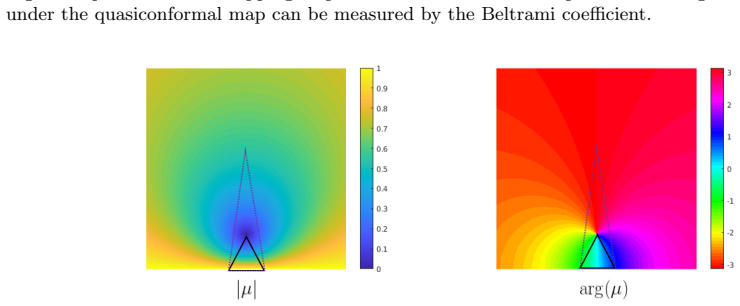
The machinery is the Beltrami coefficient $\mu(f)$ from quasiconformal theory, a complex-valued field that encodes infinitesimal angle distortion, together with the singular values $\sigma_1(Df),\sigma_2(Df)$ encoding scale distortion. The paper splits the energy by introducing an auxiliary field $\nu$, and alternates: for fixed $f$, smooth $\nu$ by gradient descent with thresholding $|\mu|<1$; for fixed $\nu$, reconstruct $f$ by solving the Beltrami equation with a linear elliptic solver and enforce singular-value bounds by projection. This lets the algorithm evolve the boundary freely rather than fixing it in advance.
What would settle it
Run the algorithm on a synthetic pair where the true correspondence consists of two separated patches with matching intensities; if the recovered overlap collapses to one patch, shrinks to empty, or the fidelity term cannot detect the second patch, the maximality assumption is violated and the model's fidelity term is not measuring the true registration error.
Extended reading notes
Core claim
The central claim is that the optimal corresponding subregions and the optimal bijection between them can be recovered together by minimizing the relaxed energy (11), in which the fidelity term integrates intensity mismatch over $f(X_1)\cap X_2$ and the regularization separates into a term tying the map's Beltrami coefficient $\mu(f)$ to an auxiliary field $\nu$ and a smoothing term on $\nu$. The authors show that the bijectivity constraint reduces to thresholding $|\mu|<1$, and the scale constraint reduces to projecting each differential $Df$ onto matrices with singular values between $K_2$ and $K_1$ via an explicit singular-value formula. They then obtain the corresponding regions as $\Omega_2^* = f^*(X_1)\cap X_2$ and $\Omega_1^*=(f^*)^{-1}(\Omega_2^*)$.
Load-bearing premise
The method assumes the true corresponding region is exactly the intersection of the deformed whole source surface with the target surface, so that one connected overlap captures all meaningful correspondence.
Editorial extensions
If this is right
- The overlap region need not be prescribed: it is recovered as $f^*(X_1)\cap X_2$ after optimization.
- Bijectivity is maintained by thresholding the Beltrami coefficient, so fold-free registration is obtained without complicated injectivity constraints.
- The same pipeline handles large, non-rigid deformations on disk-type and genus-one surfaces after conformal flattening.
- The per-triangle projection and per-vertex intensity updates parallelize, so the algorithm is practical on meshes with thousands of vertices.
- In cases with no true overlap, the fidelity term alone would vanish, but the landmark and regularization terms keep the iteration from collapsing to the trivial empty solution.
Reading between the lines
- A natural extension is to drop or relax the maximality property so that multiple disconnected corresponding regions are allowed; this would require a different fidelity term than $\int_{f(X_1)\cap X_2}$.
- The dependence on Demons-style displacement updates suggests the method inherits sensitivity to intensity noise at high-gradient regions, so a multiscale or robust cost could stabilize convergence.
- One testable extension is to replace curvature with learned or semantic descriptors and check whether the same energy recovers partial correspondences without manual landmarks.
- The free-boundary deformation algorithm itself could be reused outside registration, for example in shape deformation with controlled area and angle distortion.
Signed reviews
Editorial analysis
A structured set of objections, weighed in public.
Referee Report
Summary. The paper addresses the inconsistent surface registration (ISR) problem, in which only subsets of two surfaces are in correspondence and the regions as well as the mapping between them must be found simultaneously. The authors propose a variational model whose fidelity term measures intensity mismatch on the current overlap f(X1)∩X2 and whose regularization controls distortion through the Beltrami coefficient and the singular values of the differential. A splitting algorithm (Algorithm 3) alternates among a projection onto singular-value bounds, Demons-style intensity matching, and geometric smoothing via thresholding of the Beltrami coefficient. The paper claims that bijectivity is easily enforced by thresholding the Beltrami coefficient and demonstrates the method on synthetic images, tooth surfaces, human faces, and vertebrae bones.
Significance. If the claims are substantiated, the paper would provide a practical method for partial surface registration without a pre-specified overlap, combining quasiconformal regularization with free-boundary deformation. The paper is generally clearly written, includes a public implementation, and presents experiments on several surface types, which are assets. However, the central technical claims are not fully established: the relaxed fidelity term does not reward overlap area, the bijectivity enforcement is heuristic, and the projection step lacks convergence guarantees. These gaps are load-bearing because the paper's main contribution is the simultaneous discovery of corresponding regions and a bijective, low-distortion mapping.
major comments (4)
- [Section 4.1, Eq. (7)] The relaxation in Eq. (7) makes E_fid an unnormalized integral over f(X1)∩X2, so the fidelity term alone is minimized by an empty intersection, as the authors themselves note. The regularization and landmark terms are not shown to prevent convergence to a small arbitrary overlap; none of the experiments (e.g., Figures 5, 9, 13, 17, 21, 25) report the area or Dice overlap of the recovered corresponding regions against ground truth, so the claim that Algorithm 3 simultaneously finds the optimal corresponding regions is not quantitatively supported.
- [Section 5.3, Eq. (18) and Section 5.4, Eq. (21)] Thresholding the Beltrami coefficient to zero wherever |μ|≥1 yields a coefficient with L∞ norm <1, but the paper does not prove that the map reconstructed by the Linear Beltrami Solver is globally bijective or that its Beltrami coefficient obeys the bound; the experiments do not report the final |μ|∞ or any fold counts of the output maps. Since the abstract lists bijectivity enforcement as a key feature, a theoretical or at least numerical verification is needed.
- [Section 5.1, Algorithm 1] The iterative projection onto S is not shown to converge to a map whose differential satisfies σ2≥K2 and σ1≤K1. Each Poisson solve (15) only approximates the target differential in a least-squares sense, and no fixed-point argument or convergence test (e.g., reporting max σ1 and min σ2 after each iteration) is provided; this gap affects Algorithms 2 and 3 because S is part of the admissible set A.
- [Section 5.4, Algorithm 3] The Demons displacement V(j) is defined only on the current intersection g_{N1,j}(X1)∩X2 (Eq. (20)), but the algorithm then applies V(j) to the whole map g to form \tilde g without specifying how V is extended to all of X1. As a result, the update step is ambiguous, and points outside the current intersection receive no intensity force, so the overlap has no expansion mechanism beyond landmark pull and smoothness. This reinforces the degeneracy described in the first major comment and also hampers reproducibility.
minor comments (4)
- [Section 1] The final paragraph states that experimental results are shown in Section 5, but the experiments actually appear in Section 6; Section 5 contains the algorithms.
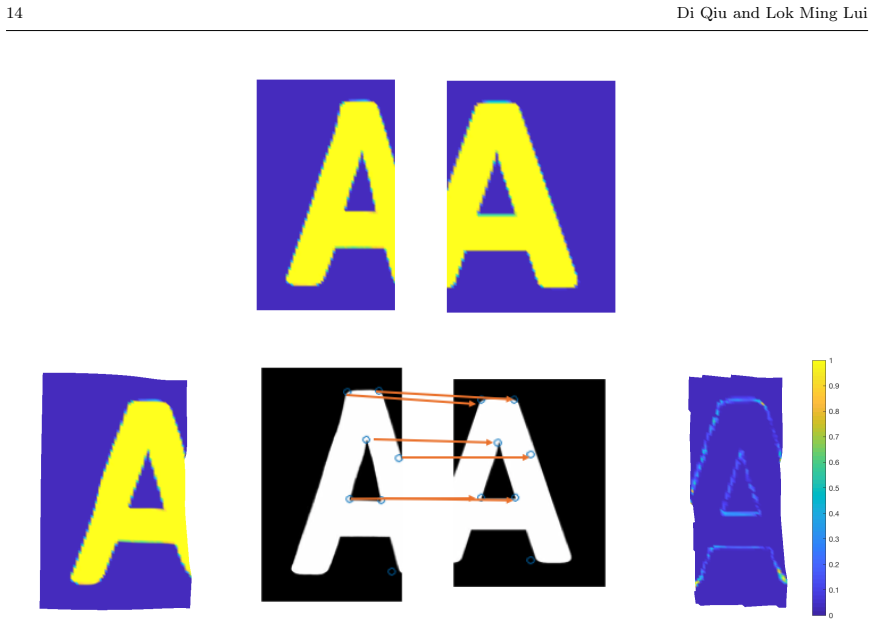
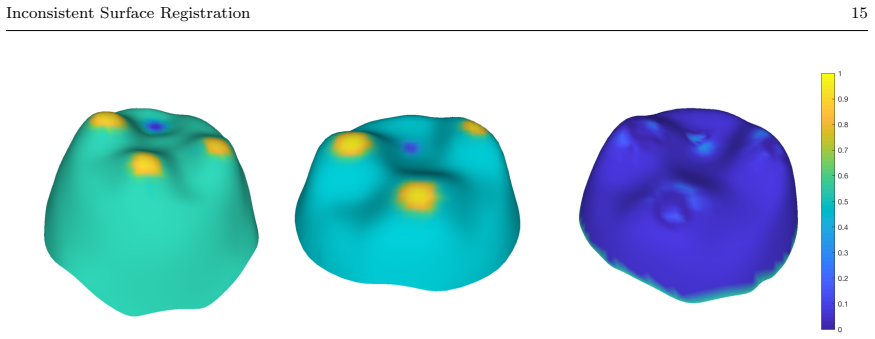
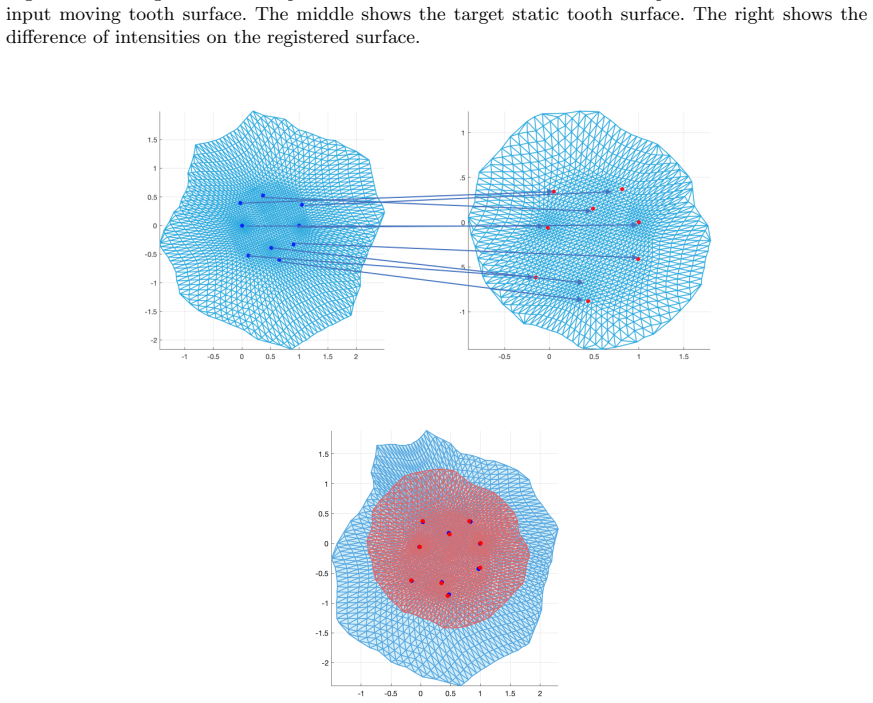
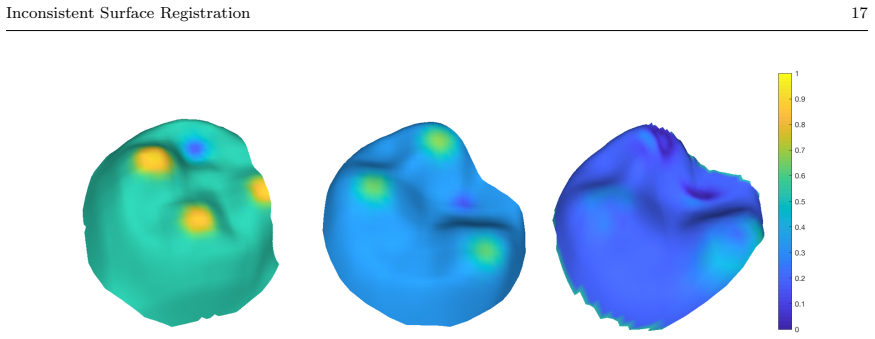
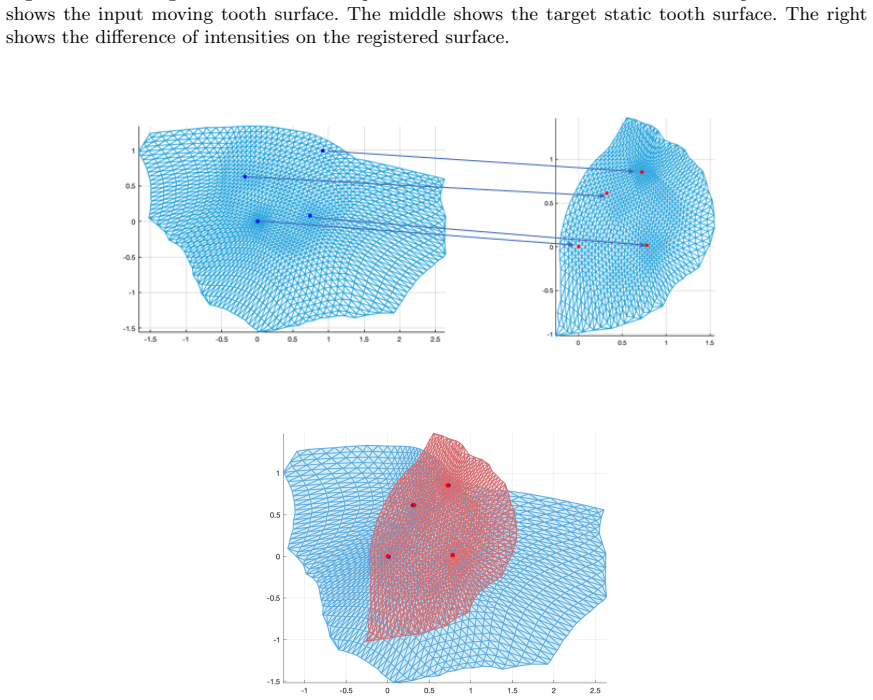
- [Figure 18 caption] The caption says both 'The right shows the target static surface' and 'The right shows the difference of intensities on the registered surface'; these cannot both be correct and the caption should be corrected.
- [Section 4, Eq. (7)] The symbol f is used both for the registration map restricted to Ω1 and for its extension to all of X1; introducing a separate notation would reduce confusion.
- [Abstract and Section 5.4] The claim that 'Bijectivity of the mapping is easily enforced' is stronger than what the thresholding step actually demonstrates; please qualify it as a heuristic or as local bijectivity in the abstract.
Circularity Check
No significant circularity: the ISR model and Algorithm 3 are built from stated maximality and quasiconformal assumptions, and the output mapping is not forced by the inputs by construction.
full rationale
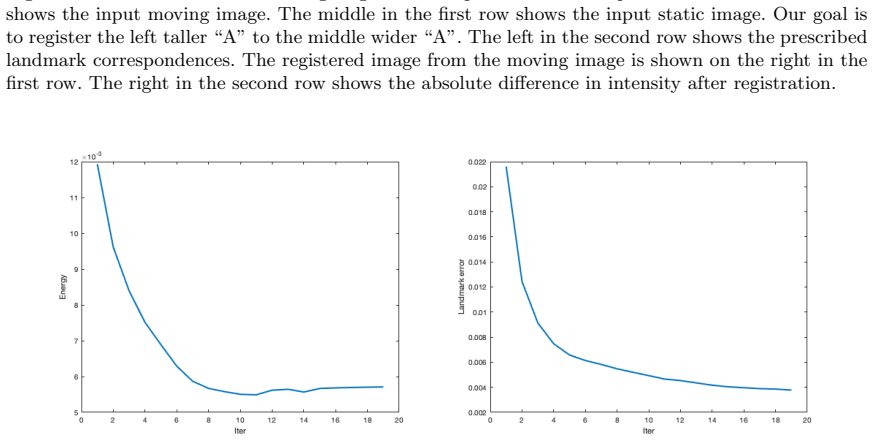
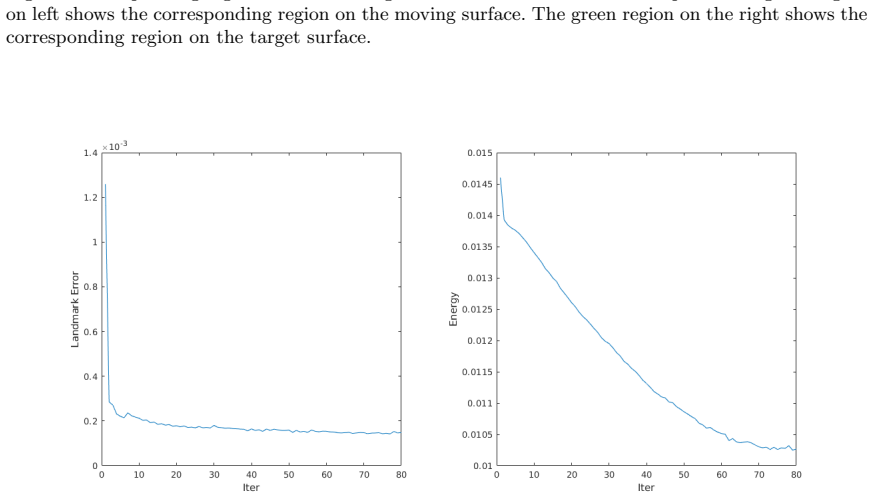
The paper does not fit a parameter to data and then present that fit as a prediction; its output is a deformation map obtained by alternating minimization of the relaxed energy (11). The reduction in Eq. (7) uses the maximality property (1), which is stated as a ground-truth modeling assumption about the unknown registration, not as a consequence of the algorithm. Writing the fidelity term as an integral over f(X1) intersect X2 is therefore a modeling choice, not a circular identification of the output with the input. The corresponding regions are recovered as Omega2* = f*(X1) intersect X2 only after the map is computed, but this is the announced reformulation of the problem rather than a secretly fitted quantity. The self-citations for the Linear Beltrami Solver ([14,19]) point to a concrete numerical solver for the Beltrami equation; the paper's central claim does not reduce to those references, and the solver is used as a tool rather than as evidence for the ISR result. The energy and landmark-error plots in Section 6 demonstrate decrease of the paper's own objective; although this is limited evidence of correctness, it is not circular reasoning. The skeptic's concern that the unnormalized fidelity integral may admit a small-overlap degenerate minimum is a correctness and robustness issue about the objective, not an instance where a prediction is equivalent to its input by construction. No circular step can be exhibited from the text.
Assumptions & free parameters
free parameters (7)
- K1 (upper singular value bound) =
per-example values: 1.2, 1.3, 1.4, 2, 5
- K2 (lower singular value bound) =
per-example values: 0.2, 0.4, 0.5, 0.8
- alpha (splitting fidelity weight) =
per-example values: 0.01, 0.06, 0.1
- beta (smoothing weight) =
per-example values: 0.01, 0.1, 0.11
- tau (Demons regularization parameter) =
not specified
- Gaussian filter width for Demons displacement =
not specified
- Iteration counts N, N1, M1, M2 =
varying per example, e.g., N=20-80, N1=1-5, M1=1, M2=3-10
assumptions (7)
- standard math Measurable Riemann mapping theorem and Schauder estimates for quasiconformal maps
- domain assumption Surfaces admit global conformal parameterizations with bounded distortion
- ad hoc to paper Maximality property f(Omega1)=Omega2=f(S1) intersect S2 (Eq. 1)
- ad hoc to paper Setting mu=0 wherever |mu|>=1 yields an admissible bijective map in B
- domain assumption Landmark correspondences are sufficiently many and accurate to avoid the trivial empty intersection solution
- domain assumption Demons displacement field after Gaussian filtering remains a valid update for a diffeomorphic map
- ad hoc to paper Iterative projection onto S converges to a map whose differential has singular values in [K2,K1]
Cite this review
Pith. "Pith review of Inconsistent Surface Registration via Optimization of Mapping Distortions." pith.science (2026). https://pith.science/paper/DNGLEN5S
@misc{pith2026190809098,
  author       = {Pith},
  title        = {Pith review of: Inconsistent Surface Registration via Optimization of Mapping Distortions},
  year         = {2026},
  howpublished = {\url{https://pith.science/paper/DNGLEN5S}},
  note         = {Machine review of arXiv:1908.09098}
}
read the original abstract
We address the problem of registering two surfaces, of which a natural bijection between them does not exist. More precisely, only a partial subset of the source surface is assumed to be in correspondence with a subset of the target surface. We call such a problem an {\it inconsistent surface registration (ISR)} problem. This problem is challenging as the corresponding regions on each surface and a meaningful bijection between them have to be simultaneously determined. In this paper, we propose a variational model to solve the ISR problem by minimizing mapping distortions. Mapping distortions are described by the Beltrami coefficient as well as the differential of the mapping. Registration is then guided by feature landmarks and/or intensities, such as curvatures, defined on each surface. The key idea of the approach is to control angle and scale distortions via quasiconformal theory as well as minimizing landmark and/or intensity mismatch. A splitting method is proposed to iteratively search for the optimal corresponding regions as well as the optimal bijection between them. Bijectivity of the mapping is easily enforced by a thresholding of the Beltrami coefficient. We test the proposed method on both synthetic and real examples. Experimental results demonstrate the efficacy of our proposed model.
Figures


Figures from the paper (24 more)





Reference graph
Works this paper leans on
-
[1]
https://www.facebase.org/facial_norms/notes/6262
Fidentis database. https://www.facebase.org/facial_norms/notes/6262. Accessed: 2018-10-01 19, 22
work page 2018
-
[2]
In: 2007 IEEE Conference on Computer Vision and Pattern Recognition, pp
Amberg, B., Romdhani, S., Vetter, T.: Optimal step nonrigid icp algorithms for surface registration. In: 2007 IEEE Conference on Computer Vision and Pattern Recognition, pp. 1–8. IEEE (2007) 3
work page 2007
-
[3]
Princeton University Press (2008) 3, 4, 5
Astala, K., Iwaniec, T., Martin, G.: Elliptic Partial Differential Equations and Quasiconformal Mappings in the Plane (PMS-48). Princeton University Press (2008) 3, 4, 5
work page 2008
-
[4]
Proceedings of the National Academy of Sciences 103(5), 1168–1172 (2006) 3
Bronstein, A.M., Bronstein, M.M., Kimmel, R.: Generalized multidimensional scaling: a framework for isometry- invariant partial surface matching. Proceedings of the National Academy of Sciences 103(5), 1168–1172 (2006) 3
work page 2006
-
[5]
SIAM Journal on Imaging Sciences 8(1), 67–94 (2015) 3
Choi, P.T., Lam, K.C., Lui, L.M.: Flash: Fast landmark aligned spherical harmonic parameterization for genus-0 closed brain surfaces. SIAM Journal on Imaging Sciences 8(1), 67–94 (2015) 3
work page 2015
-
[6]
In: Computer graphics forum, vol
Desbrun, M., Meyer, M., Alliez, P.: Intrinsic parameterizations of surface meshes. In: Computer graphics forum, vol. 21, pp. 209–218. Wiley Online Library (2002) 2
work page 2002
-
[7]
In: Proceedings of the 2003 Eurographics/ACM SIGGRAPH symposium on Geometry processing, pp
Gu, X., Yau, S.T.: Global conformal surface parameterization. In: Proceedings of the 2003 Eurographics/ACM SIGGRAPH symposium on Geometry processing, pp. 127–137. Eurographics Association (2003) 2, 22
work page 2003
-
[8]
In: ACM transactions on Graphics (TOG), vol
Igarashi, T., Moscovich, T., Hughes, J.F.: As-rigid-as-possible shape manipulation. In: ACM transactions on Graphics (TOG), vol. 24, pp. 1134–1141. ACM (2005) 3
work page 2005
Show all 26 references
-
[9]
ACM Transactions on Graphics (TOG) 34(6), 191 (2015) 3
Kovalsky, S.Z., Aigerman, N., Basri, R., Lipman, Y.: Large-scale bounded distortion mappings. ACM Transactions on Graphics (TOG) 34(6), 191 (2015) 3
2015
-
[10]
SIAM Journal on Imaging Sciences 7(4), 2364–2392 (2014) 3, 7
Lam, K.C., Lui, L.M.: Landmark-and intensity-based registration with large deformations via quasi-conformal maps. SIAM Journal on Imaging Sciences 7(4), 2364–2392 (2014) 3, 7
2014
-
[11]
In: ACM transactions on graphics (TOG), vol
L´ evy, B., Petitjean, S., Ray, N., Maillot, J.: Least squares conformal maps for automatic texture atlas generation. In: ACM transactions on graphics (TOG), vol. 21, pp. 362–371. ACM (2002) 2, 13, 16, 19, 22
2002
-
[12]
In: Computer graphics forum, vol
Li, H., Sumner, R.W., Pauly, M.: Global correspondence optimization for non-rigid registration of depth scans. In: Computer graphics forum, vol. 27, pp. 1421–1430. Wiley Online Library (2008) 3
2008
-
[13]
ACM Transactions on Graphics (TOG) 31(4), 108 (2012) 3
Lipman, Y.: Bounded distortion mapping spaces for triangular meshes. ACM Transactions on Graphics (TOG) 31(4), 108 (2012) 3
2012
-
[14]
SIAM Journal on Imaging Sciences 6(4), 1880–1902 (2013) 9
Lui, L.M., Lam, K.C., Wong, T.W., Gu, X.: Texture map and video compression using beltrami representation. SIAM Journal on Imaging Sciences 6(4), 1880–1902 (2013) 9
2013
-
[15]
SIAM Journal on Imaging Sciences 7(1), 337–365 (2014) 3, 22
Lui, L.M., Wen, C.: Geometric registration of high-genus surfaces. SIAM Journal on Imaging Sciences 7(1), 337–365 (2014) 3, 22
2014
-
[16]
In: SIGGRAPH ASIA 2016 Courses, p
Ovsjanikov, M., Corman, E., Bronstein, M., Rodol` a, E., Ben-Chen, M., Guibas, L., Chazal, F., Bronstein, A.: Computing and processing correspondences with functional maps. In: SIGGRAPH ASIA 2016 Courses, p. 9. ACM (2016) 3
2016
-
[17]
In: International Conference on Medical Image Computing and Computer-Assisted Intervention, pp
Pennec, X., Cachier, P., Ayache, N.: Understanding the demons algorithm: 3d non-rigid registration by gradient descent. In: International Conference on Medical Image Computing and Computer-Assisted Intervention, pp. 597–605. Springer (1999) 11
1999
-
[18]
Experimental mathematics 2(1), 15–36 (1993) 2
Pinkall, U., Polthier, K.: Computing discrete minimal surfaces and their conjugates. Experimental mathematics 2(1), 15–36 (1993) 2
1993
-
[19]
arXiv preprint arXiv:1804.03936 (2018) 7, 9
Qiu, D., Lam, K.C., Lui, L.M.: Computing quasiconformal folds. arXiv preprint arXiv:1804.03936 (2018) 7, 9
2018 arXiv
-
[20]
ACM Transactions on Graphics (TOG) 36(2), 16 (2017) 3
Rabinovich, M., Poranne, R., Panozzo, D., Sorkine-Hornung, O.: Scalable locally injective mappings. ACM Transactions on Graphics (TOG) 36(2), 16 (2017) 3
2017
-
[21]
In: Com- puter Graphics Forum, vol
Rodol` a, E., Cosmo, L., Bronstein, M.M., Torsello, A., Cremers, D.: Partial functional correspondence. In: Com- puter Graphics Forum, vol. 36, pp. 222–236. Wiley Online Library (2017) 3
2017
-
[22]
In: 3dim, vol
Rusinkiewicz, S., Levoy, M.: Efficient variants of the icp algorithm. In: 3dim, vol. 1, pp. 145–152 (2001) 3
2001
-
[23]
In: EUROGRAPHICS05 STAR–STATE OF THE ART REPORT
Sorkine, O.: Laplacian mesh processing. In: EUROGRAPHICS05 STAR–STATE OF THE ART REPORT. Citeseer (2005) 10
2005
-
[24]
In: Symposium on Geometry processing, vol
Sorkine, O., Alexa, M.: As-rigid-as-possible surface modeling. In: Symposium on Geometry processing, vol. 4 (2007) 3
2007
-
[25]
Medical image analysis 2(3), 243–260 (1998) 11, 12
Thirion, J.P.: Image matching as a diffusion process: an analogy with maxwell’s demons. Medical image analysis 2(3), 243–260 (1998) 11, 12
1998
-
[26]
Physics in Medicine & Biology 50(12), 2887 (2005) 11
Wang, H., Dong, L., O’Daniel, J., Mohan, R., Garden, A.S., Ang, K.K., Kuban, D.A., Bonnen, M., Chang, J.Y., Cheung, R.: Validation of an accelerated demons algorithm for deformable image registration in radiation therapy. Physics in Medicine & Biology 50(12), 2887 (2005) 11
2005
Reviewed August 14, 2026 · model on record in the stance chip above.
Discussion (0). Continue with ORCID to comment.