REVIEW 4 major objections 6 minor 47 references
ANCHOR: Agentic Noise Creation Framework for Human Simulation and Denoising Recommendation
T0 review · 4 major / 6 minor · reviewed 2026-08-04 · deepseek-v4-flash
Pith's one-line read The paper claims that creating labeled noise through LLM-simulated user behavior lets a learned recognizer filter real noise from implicit feedback better than heuristic denoising methods.
desk verdict The Creation-Recognition idea is genuinely new, but the paper never shows that a recognizer trained on synthetic unobserved interactions can detect real noise inside observed interactions—that gap is load-bearing. read the letter →
The pith
A machine-rendered reading of the paper's core claim, the machinery that carries it, and where it could break.
The reading
What carries the argument
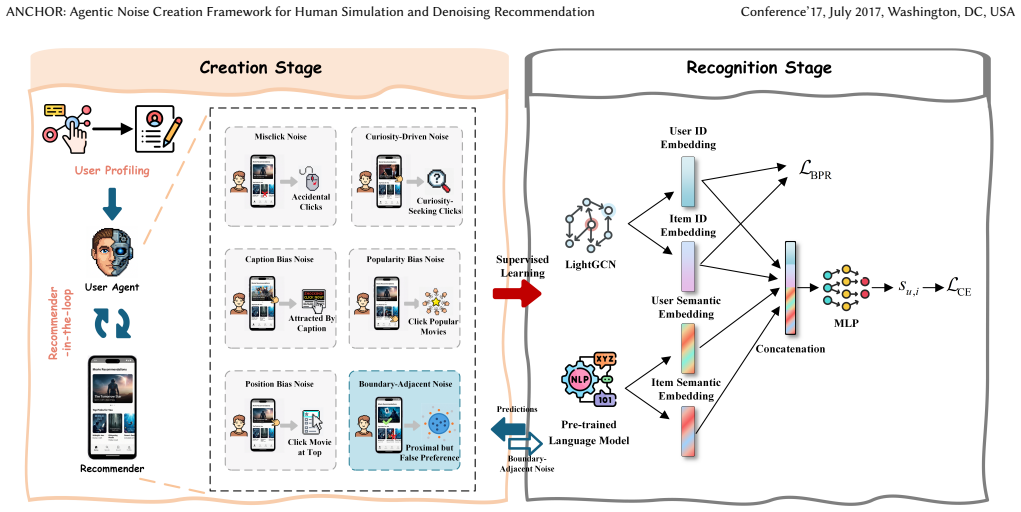
The load-bearing object is the synthetic noise set, produced by five LLM-prompted behavior simulators (misclick, curiosity, caption bias, popularity bias, position bias) within a recommender-in-the-loop interaction environment, plus a creator-recognizer iterative refinement loop for boundary-adjacent noise. This labeled set converts noise identification into binary classification: a recognizer trained with cross-entropy plus a BPR auxiliary loss, then thresholded to delete estimated noisy interactions. The work it does is to replace heuristic assumptions about what noise looks like with direct supervision on simulated examples.
What would settle it
Compute the recognizer's predictions on a held-out set of real interactions whose noisy or clean status is known (for example, from a logged user survey, a known misclick log, or a manually labeled audit) and measure precision and recall; if the recognizer performs near chance or systematically mislabels hard examples, the synthetic-to-real transfer fails. A cheaper probe is to compare the feature distributions of synthetic noise versus real flagged interactions; a large divergence would undermine the approximation claim.
Extended reading notes
Core claim
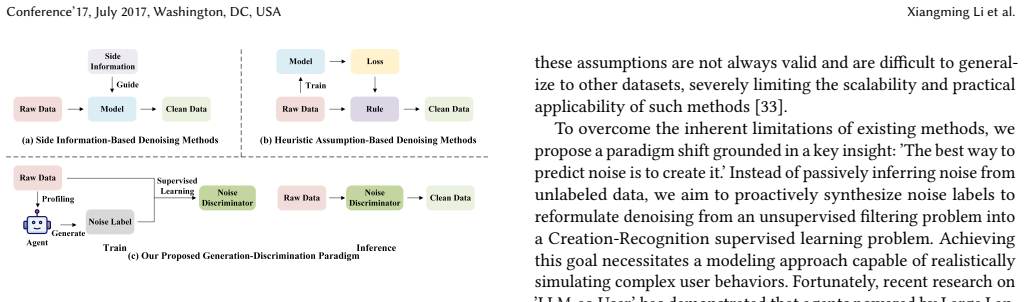
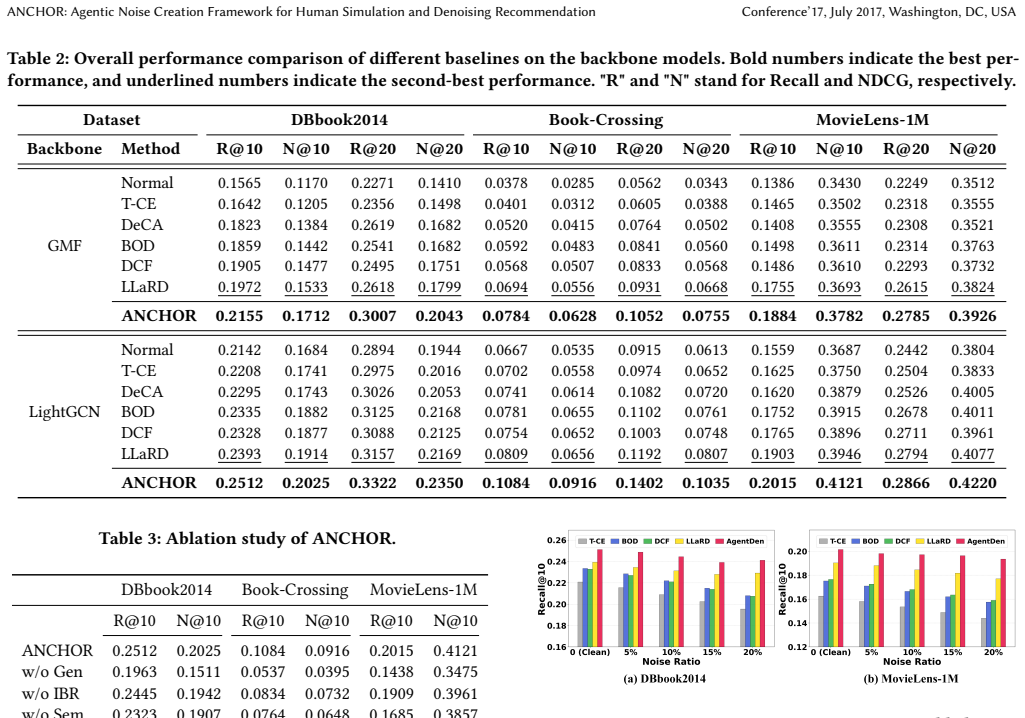
The central claim is that the best way to predict noise is to create it. Instead of inferring which interactions are noisy from heuristics like high training loss, ANCHOR constructs a synthetic noisy interaction set by simulating user behavior with LLM agents in a recommender-in-the-loop setting, then uses this set to train a parametric noise recognizer that combines collaborative ID embeddings and semantic text embeddings. The recognizer is applied to real data to filter noise, and boundary-adjacent hard noise generated by a creator-recognizer feedback loop is used to sharpen the decision boundary. The paper reports consistent improvements over five baselines on DBbook2014, Book-Crossing, a
Load-bearing premise
The whole approach hangs on the assumption that the LLM-simulated noisy interactions are close enough in distribution to real-world noise that a recognizer trained on them will flag real noise; the paper gives no direct evidence for this equivalence.
Editorial extensions
If this is right
- If synthetic noise approximates real noise, denoising becomes a transferable supervised task, and the trained recognizer can be reused without re-prompting LLMs at deployment.
- Boundary-adjacent noise can serve as hard-negative or boundary-sensitive signals for downstream recommenders, not just as data to be removed.
- Because the noise simulation is extensible through new prompts, new noise types can be added as they are discovered without redesigning the loss function or heuristics.
- The reported gains on two different backbone models suggest the approach is model-agnostic and could wrap other recommender architectures.
Reading between the lines
- A direct test of the core premise would be measuring whether the recognizer's flagged noise matches ground-truth noise from logs with known misclicks or manually labeled audits; the paper does not provide such a test.
- The recognizer's confidence threshold is a free parameter; operational gains likely depend on choosing it well, and the paper does not report how the threshold should be selected in practice.
- Because the recognizer trains only on simulated users' original interactions plus synthetic noise, its transfer to unseen users rests on the assumption that collaborative and semantic features generalize beyond the simulated population.
- The five noise mechanisms are author-chosen; real-world implicit feedback may contain other noise sources (bots, multi-account behavior, temporal drift) that would require additional simulation mechanisms.
Signed reviews
Editorial analysis
A structured set of objections, weighed in public.
Referee Report
Summary. The paper proposes a new paradigm for recommendation denoising: instead of inferring noise from unlabeled data via heuristics, it proactively creates labeled noisy interactions using LLM-based user simulators, then trains a supervised noise recognizer on those labels and applies it to the original interaction matrix. This paradigm is instantiated in ANCHOR, which simulates five types of out-of-preference noise (misclick, curiosity, caption bias, popularity bias, position bias) using a recommender-in-the-loop agentic framework, augments them with boundary-adjacent hard noise via an iterative creator-recognizer refinement, and trains a semantic-collaborative recognizer (LightGCN embeddings plus text encodings plus an MLP classifier). The recognizer is then used to identify and remove noisy interactions from the real data, and the cleaned data are used to train downstream recommender backbones. Experiments on DBbook2014, Book-Crossing, and MovieLens-1M with GMF and LightGCN backbones report consistent improvements over five denoising baselines, with ablations and hyperparameter analyses.
Significance. The proposed Creation-Recognition paradigm is conceptually appealing and, if the synthetic noise recognizer genuinely transfers to real noise, would constitute a meaningful shift from heuristic denoising to supervised denoising. The paper is clearly written, the framework is modular, and the Appendix provides detailed prompts that make the pipeline reproducible. The empirical gains in Table 2 are consistent across datasets and backbones, and the ablation study shows that each component contributes. However, the central claim that the trained recognizer identifies real noisy interactions is not directly validated. The synthetic noise is generated from candidate items that the user has never interacted with, while at deployment the recognizer is asked to flag observed interactions. This domain mismatch is the load-bearing issue of the paper and is currently only asserted, not demonstrated. Without direct evidence of transfer, the reported downstream improvements could be explained by other mechanisms, such as hard-negative sampling or semantic regularization.
major comments (4)
- [4.1.2 / Eq. (14)] The synthetic positive class is structurally disjoint from the inference domain. The generated noisy items are required to satisfy i∈C_u and i∉I_u (§4.1.2), and the recognizer training set D_disc labels these as 'noisy' (1) while labeling the original interactions of sampled users as 'clean' (0). At deployment, however, the recognizer scores observed interactions in D, i.e., items that do belong to I_u. Thus the classifier never sees a positive example from the target domain during training; it can learn a trivial shortcut such as 'not in user history ⇒ noisy' that has no discriminative power on D. The paper states that Ñ is 'designed to approximate' N (Section 3), but provides no distributional comparison and no ground-truth evaluation. Consequently, the gains in Table 2 cannot be attributed to identifying real noise; they may stem from hard-negative effects or regularization. Please ad
- [5.5 / RQ4] The robustness experiment does not measure whether the recognizer actually identifies the injected noisy interactions. The experiment injects adversarial noise at 5–20% and reports recommendation metrics, not detection metrics. The stated RQ4 is 'How effectively does ANCHOR identify and remove noisy interactions?' but no identification accuracy is reported. Moreover, if the injected noise is generated in the same way as the training noise, the evaluation would be circular and would overstate transfer to real noise. Please report direct detection results against the injected noise with known labels (AUC, recall@k, false-positive rate), and ideally use held-out noise generated by genuinely different mechanisms.
- [4.3 / Eq. (14)] The recognizer training labels all original interactions of simulated users as clean (label 0). This assumption contradicts the paper's own premise that real implicit feedback D contains noise (Section 3). Any real noisy interaction belonging to a simulated user is systematically mislabeled as clean, which could train the recognizer to suppress exactly the signal it is meant to detect at deployment. The paper does not quantify or discuss this bias. Please address this, e.g., by using a conservative clean set, contrasting with a variant that leaves out ambiguous interactions, or analyzing sensitivity to this labeling assumption.
- [5.3 / Table 3] The 'w/o Gen' ablation replaces the generated out-of-preference noise with random negative sampling. This shows that having any synthetic positives is helpful, but it does not test whether the five simulation mechanisms approximate real noise; any positive/negative contrast would likely improve the recognizer in a purely architectural sense. This is a useful sanity check, but it does not support the central transfer claim. The paper needs a separate experiment that varies the realism of the synthetic noise (e.g., comparing behavior-grounded simulation against random negatives while holding the recognizer architecture constant) and evaluates recognition on real or realistically injected noise.
minor comments (6)
- [Section 5.3, text after Table 3] The text refers to 'w/o ABR' but the table and the earlier bullet list use 'w/o IBR'. Please make the terminology consistent.
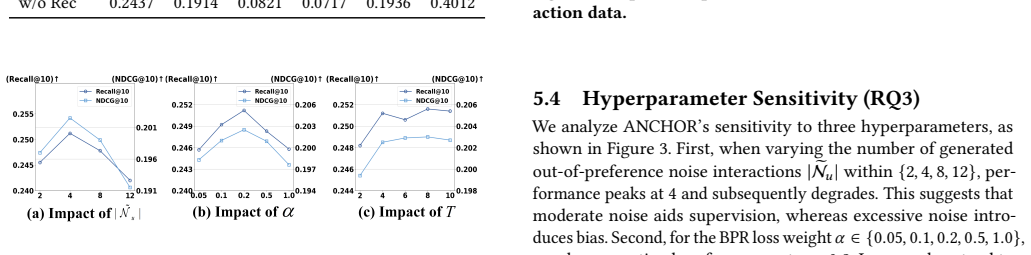
- [Section 5.4] The hyperparameter sensitivity analysis does not describe how the hyperparameters were selected or on which split. If the optimal values (|Ñ_u|=4, α=0.2, T=4) were chosen by looking at the test metrics reported in Figure 3, the reported performance may be optimistic. Please state the validation procedure.
- [Section 5.5] The sentence 'Figures 4 reports the results' has a grammatical error. Also, the two panels of Figure 4 are not clearly labeled; please clarify which dataset is shown in which panel.
- [Section 5.2] The paper reports point estimates without standard deviations or significance tests. Given that the improvements over LLaRD are sometimes small (e.g., Table 2, LightGCN on MovieLens-1M: 0.2015 vs. 0.1903 R@10), please report multiple runs and statistical significance.
- [Section 4.2] The mechanism by which boundary-adjacent noise is used downstream is described only at a high level ('boundary-sensitive supervisory signals' and 'hard negative signals'). It is not clear whether these detected interactions are removed from the training set, added as negatives, or used in some other way in the final recommender training. Please make the experimental protocol explicit.
- [Section 5.4] The sampled user subset size |Ũ|=1,000 is fixed, but no sensitivity analysis is reported for this important parameter. Please include it or justify the choice.
Circularity Check
No significant circularity: the recognizer is trained on synthetic labels and applied to real data; the train/serve domain gap is a validity risk, not a circular reduction.
full rationale
The paper's derivation chain is empirical rather than definitional: ANCHOR generates synthetic noise Ñ via LLM prompting (Sec 4.1.2), constructs a supervised training set Ddisc (Eq. 14), trains a recognizer with a BCE+BPR objective (Eqs. 16-18), and then applies the recognizer to D to form bN (Sec. 3). None of these steps makes the predicted noise set equal to the training labels by construction: the recognizer's output is not arithmetically forced to equal Ñ or D, and Ñ is not defined in terms of the target noise set N. The synthetic positives are generated from LLM behavior prompts, not by fitting the recognizer to the real interactions it later cleans. The only self-citation ([37]) appears in the introduction as a routine related-work reference and is not used to justify the central transferability claim, so it is not load-bearing. The most serious weakness is a train/serve domain mismatch: Section 4.1.2 requires all generated noisy items to satisfy i∈C_u and i∉I_u, while the target noise set N is a subset of the observed interaction set D. Consequently, the recognizer's positive training class is disjoint from the deployment domain, and the label-0 class includes (for users in Ũ) the very interactions the recognizer is supposed to flag as noisy. This is a real construct-validity and generalization concern, and RQ4 does not directly validate recognition of real noise because it measures downstream accuracy after injecting artificial noise rather than recognition performance. However, an unsupported or even likely-broken transfer claim is not the same as a circular reduction: the paper does not fit a parameter to the target quantity and then rename that fit as a prediction, nor does it invoke a self-citation chain to forbid alternatives. Under the strict definition of circularity used here, no step in the claimed derivation reduces to its own input by construction, so the appropriate finding is no significant circularity.
Assumptions & free parameters
free parameters (5)
- α (BPR loss weight) =
0.2
- |Ñ_u| (generated noise per user) =
4
- T (adversarial refinement iterations) =
4
- τ (noise threshold)
- |Ũ| (simulated user subset size) =
1,000
assumptions (5)
- domain assumption LLM agents can faithfully simulate human-like non-preference-driven user behaviors
- ad hoc to paper The five modeled behaviors (misclick, curiosity, caption bias, popularity bias, position bias) cover the major sources of real-world noise
- ad hoc to paper The LightGCN top-K ranked list C_u approximates the real exposure set for users
- ad hoc to paper Original interactions of simulated users are clean (label 0)
- domain assumption A recognizer trained on a subset of 1,000 users transfers to the full user population
Cite this review
Pith. "Pith review of ANCHOR: Agentic Noise Creation Framework for Human Simulation and Denoising Recommendation." pith.science (2026). https://pith.science/paper/DNLPE5RN
@misc{pith2026260605621,
  author       = {Pith},
  title        = {Pith review of: ANCHOR: Agentic Noise Creation Framework for Human Simulation and Denoising Recommendation},
  year         = {2026},
  howpublished = {\url{https://pith.science/paper/DNLPE5RN}},
  note         = {Machine review of arXiv:2606.05621}
}
read the original abstract
Distilling accurate user preferences from noisy implicit feedback remains a fundamental bottleneck in recommendation systems, highlighting the need for recommendation denoising. However, real-world data lack explicit noise annotations, forcing existing methods to rely on unsupervised side information or handcrafted heuristics. These approaches often incur high external costs, generalize poorly, or depend on unreliable priors, causing noise misidentification and corrupting true user preference representations. To address these limitations, we propose a paradigm-level reformulation of recommendation denoising. Instead of indirectly inferring noisy interactions through heuristics, our Creation-Recognition paradigm proactively creates labeled noisy interactions and trains a dedicated recognizer to identify them, transforming denoising from heuristic filtering into supervised learning. Based on this paradigm, we present ANCHOR, an agent-based framework inspired by recent LLM-as-User research. ANCHOR simulates user behaviors to generate realistic noise labels and enables supervised denoising through two stages: noise creation and noise recognition. In the noise creation stage, ANCHOR adopts a recommender-in-the-loop agentic architecture to synthesize both diverse out-of-preference noise and informative boundary-adjacent noise. For out-of-preference noise, it implements five extensible simulation mechanisms to approximate major sources of noisy implicit feedback. For boundary-adjacent noise, an adversarial boundary refinement mechanism generates ambiguous interactions that challenge the recognizer and target the decision boundary. In the noise recognition stage, ANCHOR leverages the generated labels to train a reusable parametric recognizer that integrates collaborative signals and semantic representations to detect noise patterns in real interaction data.
Figures
Figures from the paper (1 more)
Reference graph
Works this paper leans on
-
[1]
Lisa P Argyle, Ethan C Busby, Nancy Fulda, Joshua R Gubler, Christopher Rytting, and David Wingate. 2023. Out of one, many: Using language models to simulate human samples.Political Analysis31, 3 (2023), 337–351
2023
-
[2]
Georg Buscher, Ludger Van Elst, and Andreas Dengel. 2009. Segment-level display time as implicit feedback: a comparison to eye tracking. InProceedings of the 32nd international ACM SIGIR conference on Research and development in information retrieval. 67–74
2009
-
[3]
Yixin Cao, Xiang Wang, Xiangnan He, Zikun Hu, and Tat-Seng Chua. 2019. Unifying knowledge graph learning and recommendation: Towards a better understanding of user preferences. InThe world wide web conference. 151–161
2019
-
[4]
Nick Craswell, Onno Zoeter, Michael Taylor, and Bill Ramsey. 2008. An ex- perimental comparison of click position-bias models. InProceedings of the 2008 international conference on web search and data mining. 87–94
2008
-
[5]
Jingtao Ding, Guanghui Yu, Xiangnan He, Fuli Feng, Yong Li, and Depeng Jin
-
[6]
Xin Dong, Lei Yu, Zhonghuo Wu, Yuxia Sun, Lingfeng Yuan, and Fangxi Zhang
-
[7]
Xin Fu. 2010. Towards a model of implicit feedback for web search.Journal of the American Society for Information Science and Technology61, 1 (2010), 30–49
2010
-
[8]
Yunjun Gao, Yuntao Du, Yujia Hu, Lu Chen, Xinjun Zhu, Ziquan Fang, and Baihua Zheng. 2022. Self-guided learning to denoise for robust recommendation. InProceedings of the 45th international ACM SIGIR conference on research and development in information retrieval. 1412–1422
2022
Show all 47 references
-
[9]
Yongqiang Han, Hao Wang, Kefan Wang, Likang Wu, Zhi Li, Wei Guo, Yong Liu, Defu Lian, and Enhong Chen. 2024. Efficient noise-decoupling for multi-behavior sequential recommendation. InProceedings of the ACM Web Conference 2024. 3297–3306
2024
-
[10]
Xiangnan He and Tat-Seng Chua. 2017. Neural factorization machines for sparse predictive analytics. InProceedings of the 40th International ACM SIGIR conference on Research and Development in Information Retrieval. 355–364
2017
-
[11]
Xiangnan He, Kuan Deng, Xiang Wang, Yan Li, Yongdong Zhang, and Meng Wang. 2020. Lightgcn: Simplifying and powering graph convolution network for recommendation. InProceedings of the 43rd International ACM SIGIR conference on research and development in Information Retrieval. 639–648
2020
-
[12]
Zhuangzhuang He, Yifan Wang, Yonghui Yang, Peijie Sun, Le Wu, Haoyue Bai, Jinqi Gong, Richang Hong, and Min Zhang. 2024. Double correction frame- work for denoising recommendation. InProceedings of the 30th ACM SIGKDD Conference on Knowledge Discovery and Data Mining. 1062–1072
2024
-
[13]
Katja Hofmann, Fritz Behr, and Filip Radlinski. 2012. On caption bias in inter- leaving experiments. InProceedings of the 21st ACM international conference on Information and knowledge management. 115–124
2012
-
[14]
Zhiyuan Hu, Yue Feng, Anh Tuan Luu, Bryan Hooi, and Aldo Lipani. 2023. Unlocking the potential of user feedback: Leveraging large language model as user simulators to enhance dialogue system. InProceedings of the 32nd ACM International Conference on Information and Knowledge M...
2023
-
[15]
Zheng Hu, Zhe Li, Ziyun Jiao, Satoshi Nakagawa, Jiawen Deng, Shimin Cai, Tao Zhou, and Fuji Ren. 2025. Bridging the user-side knowledge gap in knowledge- aware recommendations with large language models. InProceedings of the AAAI Conference on Artificial Intelligence. 11799–11807
2025
-
[16]
Anastasiia Klimashevskaia, Dietmar Jannach, Mehdi Elahi, and Christoph Trat- tner. 2024. A survey on popularity bias in recommender systems.User Modeling and User-Adapted Interaction34, 5 (2024), 1777–1834
2024
-
[17]
Tommaso Di Noia, Vito Claudio Ostuni, Paolo Tomeo, and Eugenio Di Sciascio
-
[18]
Yuhan Quan, Jingtao Ding, Chen Gao, Lingling Yi, Depeng Jin, and Yong Li. 2023. Robust preference-guided denoising for graph based social recommendation. In Proceedings of the ACM web conference 2023. 1097–1108
2023
-
[19]
Krishan Rana, Jesse Haviland, Sourav Garg, Jad Abou-Chakra, Ian Reid, and Niko Suenderhauf. 2023. Sayplan: Grounding large language models using 3d scene graphs for scalable robot task planning.arXiv preprint arXiv:2307.06135(2023)
2023 arXiv
-
[20]
Xubin Ren, Lianghao Xia, Jiashu Zhao, Dawei Yin, and Chao Huang. 2023. Disen- tangled contrastive collaborative filtering. InProceedings of the 46th international ACM SIGIR conference on research and development in information retrieval. 1137– 1146
2023
-
[21]
Steffen Rendle, Christoph Freudenthaler, Zeno Gantner, and Lars Schmidt-Thieme
-
[22]
Usha Ruby, Vamsidhar Yendapalli, et al. 2020. Binary cross entropy with deep learning technique for image classification.Int. J. Adv. Trends Comput. Sci. Eng9, 10 (2020)
2020
-
[23]
Youchen Sun, Zhu Sun, Yingpeng Du, Jie Zhang, and Yew Soon Ong. 2025. Model- agnostic social network refinement with diffusion models for robust social rec- ommendation. InProceedings of the ACM on Web Conference 2025. 370–378
2025
-
[24]
Yatong Sun, Bin Wang, Zhu Sun, and Xiaochun Yang. 2021. Does Every Data In- stance Matter? Enhancing Sequential Recommendation by Eliminating Unreliable Data.. InIJCAI. 1579–1585
2021
-
[25]
Gu Tang, Xiaoying Gan, Jinghe Wang, Bin Lu, Lyuwen Wu, Luoyi Fu, and Chenghu Zhou. 2024. EditKG: Editing knowledge graph for recommendation. InProceedings of the 47th International ACM SIGIR Conference on Research and Development in Information Retrieval. 112–122
2024
-
[26]
Lei Wang, Jingsen Zhang, Hao Yang, Zhi-Yuan Chen, Jiakai Tang, Zeyu Zhang, Xu Chen, Yankai Lin, Hao Sun, Ruihua Song, et al. 2025. User behavior simulation with large language model-based agents.ACM Transactions on Information Systems43, 2 (2025), 1–37
2025
-
[27]
Shuyao Wang, Zhi Zheng, Yongduo Sui, and Hui Xiong. 2025. Unleashing the Power of Large Language Model for Denoising Recommendation. InProceedings of the ACM on Web Conference 2025. 252–263
2025
-
[28]
Wenjie Wang, Fuli Feng, Xiangnan He, Liqiang Nie, and Tat-Seng Chua. 2021. Denoising implicit feedback for recommendation. InProceedings of the 14th ACM international conference on web search and data mining. 373–381
2021
-
[29]
Wenhui Wang, Furu Wei, Li Dong, Hangbo Bao, Nan Yang, and Ming Zhou
-
[30]
Yancheng Wang, Ziyan Jiang, Zheng Chen, Fan Yang, Yingxue Zhou, Eunah Cho, Xing Fan, Yanbin Lu, Xiaojiang Huang, and Yingzhen Yang. 2024. Recmind: Large language model powered agent for recommendation. InFindings of the Association for Computational Linguistics: NAACL 2024. 4351–4364
2024
-
[31]
Yu Wang, Xin Xin, Zaiqiao Meng, Joemon M Jose, Fuli Feng, and Xiangnan He. 2022. Learning robust recommenders through cross-model agreement. In Proceedings of the ACM web conference 2022. 2015–2025
2022
-
[32]
Zongwei Wang, Min Gao, Wentao Li, Junliang Yu, Linxin Guo, and Hongzhi Yin
-
[33]
Zongwei Wang, Min Gao, Junliang Yu, Yupeng Hou, Shazia Sadiq, and Hongzhi Yin. 2025. RuleAgent: Discovering Rules for Recommendation Denoising with Autonomous Language Agents.arXiv preprint arXiv:2503.23374(2025)
2025 arXiv
-
[34]
Zhefan Wang, Yuanqing Yu, Wendi Zheng, Weizhi Ma, and Min Zhang. 2024. Macrec: A multi-agent collaboration framework for recommendation. InProceed- ings of the 47th International ACM SIGIR Conference on Research and Development in Information Retrieval. 2760–2764
2024
-
[35]
Xin Xin, Xiangyuan Liu, Hanbing Wang, Pengjie Ren, Zhumin Chen, Jiahuan Lei, Xinlei Shi, Hengliang Luo, Joemon M Jose, Maarten de Rijke, et al . 2023. Improving implicit feedback-based recommendation through multi-behavior alignment. InProceedings of the 46th international ACM...
2023
-
[36]
An Zhang, Yuxin Chen, Leheng Sheng, Xiang Wang, and Tat-Seng Chua. 2024. On generative agents in recommendation. InProceedings of the 47th international ANCHOR: Agentic Noise Creation Framework for Human Simulation and Denoising Recommendation Conference’17, July 2017, Washing...
2024
-
[37]
Shuai Zhang, Hua Chu, Jianan Li, Yangtao Zhou, Shirong Wang, and Qiaofei Sun. 2025. DeMBR: Denoising Model with Memory Pruning and Semantic Guidance for Multi-Behavior Recommendation. InProceedings of the Eighteenth ACM International Conference on Web Search and Data Mining. 521–529
2025
-
[38]
Yu Zhang, Shutong Qiao, Jiaqi Zhang, Tzu-Heng Lin, Chen Gao, and Yong Li
-
[39]
Qian Zhao, Shuo Chang, F Maxwell Harper, and Joseph A Konstan. 2016. Gaze prediction for recommender systems. InProceedings of the 10th ACM Conference on Recommender Systems. 131–138
2016
-
[40]
near-miss
Xinjun Zhu, Yuntao Du, Yuren Mao, Lu Chen, Yujia Hu, and Yunjun Gao. 2023. Knowledge-refined denoising network for robust recommendation. InProceedings of the 46th International ACM SIGIR Conference on Research and Development in Information Retrieval. 362–371. A Appendix A.1 ...
2023
-
[2012]
BPR: Bayesian personalized ranking from implicit feedback.arXiv preprint arXiv:1205.2618(2012)
2012 arXiv
-
[2016]
Sprank: Semantic path-based ranking for top-n recommendations using linked open data.ACM Transactions on Intelligent Systems and Technology (TIST) 8, 1 (2016), 1–34
2016
-
[2017]
InProceedings of the AAAI Conference on artificial intelligence, Vol
A hybrid collaborative filtering model with deep structure for recommender systems. InProceedings of the AAAI Conference on artificial intelligence, Vol. 31
-
[2019]
IEEE transactions on knowledge and data engineering33, 2 (2019), 667–681
Sampler design for bayesian personalized ranking by leveraging view data. IEEE transactions on knowledge and data engineering33, 2 (2019), 667–681
2019
-
[2020]
Minilm: Deep self-attention distillation for task-agnostic compression of pre-trained transformers.Advances in neural information processing systems33 (2020), 5776–5788
2020
-
[2023]
InProceedings of the 29th ACM SIGKDD conference on knowledge discovery and data mining
Efficient bi-level optimization for recommendation denoising. InProceedings of the 29th ACM SIGKDD conference on knowledge discovery and data mining. 2502–2511
-
[2025]
A survey of large language model empowered agents for recommenda- tion and search: Towards next-generation information retrieval.arXiv preprint arXiv:2503.05659(2025)
2025 arXiv
Reviewed August 4, 2026 · model on record in the stance chip above.
Discussion (0). Continue with ORCID to comment.