REVIEW 2 major objections 6 minor 14 references
On the relationship between the semiclassical and standard pseudodifferential algebras
T0 review · 2 major / 6 minor · reviewed 2026-08-05 · deepseek-v4-flash
Pith's one-line read The paper claims that for an elliptic pseudodifferential operator A of positive order with real principal symbol, the spectral family A - lambda/h^m is fully elliptic in a joint semiclassical-classical algebra and hence invertible for small
desk verdict Useful geometric clarification of the semiclassical/standard dictionary, but Definition 1.6 has a real typo that must be fixed before the main proof is sound. read the letter →
The pith
A machine-rendered reading of the paper's core claim, the machinery that carries it, and where it could break.
The reading
What carries the argument
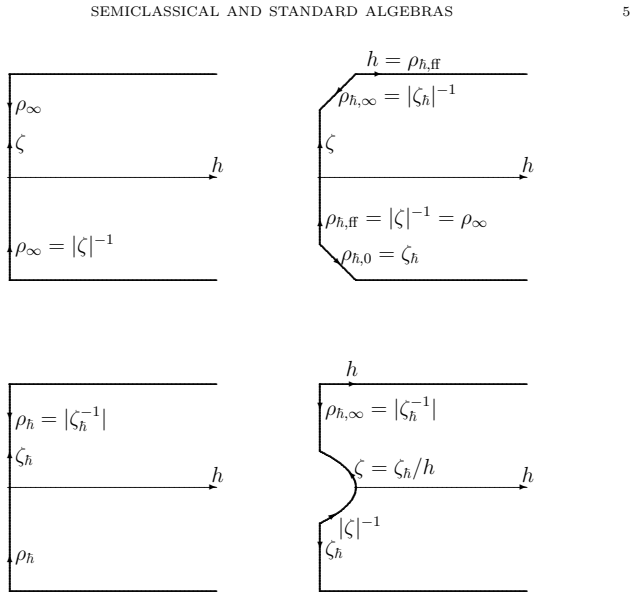
The key object is the joint semiclassical-classical symbol space S^{m,l,k}_infty on the blow-up of the parameter-dependent, fiber-compactified cotangent bundle at the corner {h=0, ρ_infty=0}. The blow-up replaces the corner by a front face and yields three boundary hypersurfaces—semiclassical fiber infinity, the front face, and the parameter boundary—with defining functions ρ_hbar,∞, ρ_hbar,ff, ρ_hbar,0 satisfying ρ_infty = ρ_hbar,∞ ρ_hbar,ff and h = ρ_hbar,0 ρ_hbar,ff. The symbol estimates are that all boundary-tangent vector fields applied to the symbol stay bounded by products of these defining functions raised to the three orders. This class is closed under composition and adjunction, so
What would settle it
Compute, for a simple non-polynomial elliptic symbol of order m>0 on the torus, the second-order symbol of the resolvent of A - lambda/h^m and compare it with the claimed joint orders (-m,-m,-m); a failure to satisfy the conormal bounds, or a parametrix remainder that does not gain smoothing at both the front face and semiclassical fiber infinity, would falsify the theorem.
Extended reading notes
Core claim
The central discovery is that the natural home for a family like A - lambda/h^m is neither the standard parameter-dependent class nor the semiclassical class, but the joint algebra Psi^{m,l,k}_{infty,hbar} of conormal symbols on the blown-up space [T^*R^n x [0,1); ∂T^*R^n x {0}]. On this space the frequency boundary function factors as ρ_infty = ρ_hbar,∞ ρ_hbar,ff and the semiclassical parameter as h = ρ_hbar,0 ρ_hbar,ff, so a symbol can have independent orders at the three resulting boundary faces. The main theorem states that for A ∈ Psi^{m,0}_infty with m>0, elliptic with real principal symbol, and λ in a compact subset of C avoiding R, the operator A - λ/h^m lies in Psi^{m,m,m}_infty,hba
Load-bearing premise
The load-bearing premise is that the new combined symbol classes actually form an algebra under the usual rules of pseudodifferential calculus—composing two such operators, taking adjoints, and summing asymptotic series stays inside the class with the stated order gains; if that closure fails, the parametrix and invertibility conclusions fail.
Editorial extensions
If this is right
- Every elliptic pseudodifferential operator of positive order gains the same large-spectral-parameter resolvent estimates that were previously available only for differential operators.
- The inverse is simultaneously in Psi^{-m,0}_infty and Psi^{0,-m}_infty, which translates into a sharp trade-off between Sobolev regularity and h-decay when the operator acts on fixed, non-semiclassical function spaces.
- Complex powers and more general functions of a self-adjoint operator can be built by contour integration of this resolvent family, since the integrand is a uniform standard pseudodifferential family.
- The same parametrix and full-ellipticity argument works on bounded-geometry manifolds and in scattering-type algebras, because only the conormal blow-up structure is used.
- The geometric identity between blowing up the corner of the standard family cotangent bundle and second-microlocalizing at the zero section of the semiclassical cotangent bundle explains why those second-microlocal constructions required extra care.
Reading between the lines
- Beyond the paper, the corner blow-up suggests an iterative pattern: blowing up further corners, for instance at finite frequencies, would produce higher-order or multi-parameter joint algebras with the same two-factor relations among boundary defining functions.
- Beyond the paper, one could test whether the regularity-versus-decay interpolation in the resolvent estimates is saturated for a genuinely non-polynomial elliptic symbol, not just for the Laplacian, by computing explicit resolvent kernels to leading order.
- Beyond the paper, for non-self-adjoint operators with complex principal symbol elliptic only on a closed cone, one could ask whether full ellipticity of the normal operator alone, rather than self-adjointness, suffices for large-h bounds.
Editorial analysis
A structured set of objections, weighed in public.
Referee Report
Summary. The paper introduces a joint semiclassical-classical pseudodifferential algebra Ψ^{m,l,k}_{∞,ℏ} defined on the blow-up of the parameter-dependent, fiber-compactified cotangent bundle at the corner {h=0, ρ∞=0}. It establishes inclusion relations between this algebra, the standard parameter-dependent class Ψ^{m,k}_∞, and the semiclassical class Ψ^{m,k}_ℏ, and uses the framework to prove Theorem 1.1: for an elliptic A∈Ψ^{m,0}_∞ with real principal symbol and λ in a compact subset of C\R, the spectral family A−λ/h^m is in Ψ^{m,m,m}_{∞,ℏ}, is elliptic there, and is invertible for h sufficiently small, with inverse in Ψ^{-m,-m,-m}_{∞,ℏ}=Ψ^{-m,0}_∞∩Ψ^{0,-m}_∞. The proof proceeds by identifying the spectral family in the joint algebra, proving ellipticity and full ellipticity, and applying a parametrix construction.
Significance. If the ellipticity definition is corrected as detailed below, the paper gives a clean geometric explanation of the semiclassical/standard relationship and yields large-parameter resolvent estimates for non-polynomial pseudodifferential spectral families, a case not covered by Shubin's large-parameter class. The blow-up identities ρ∞=ρℏ,∞ρℏ,ff and h=ρℏ,0ρℏ,ff are elegant, and the inclusions (1.3)–(1.5) are useful. The paper is appropriately modest in scope, treating the model case of second microlocalization at the zero section, and it gives credit to prior work. However, the load-bearing ellipticity definition contains a concrete error that must be fixed before the main theorem is supported.
major comments (2)
- [Definition 1.6] Definition 1.6 defines ellipticity for A∈Ψ^{m,l,k}_{∞,ℏ} by the lower bound ρ∞^{-m}h^{-k}=ρℏ,∞^{-m}ρℏ,ff^{-m-k}ρℏ,0^{-k}, which is independent of l. For the central spectral family A−λ/h^m∈Ψ^{m,m,m}_{∞,ℏ}, this demands ρℏ,∞^{-m}ρℏ,ff^{-2m}ρℏ,0^{-m}. Near the front face with ρℏ,0 bounded away from 0, the principal symbol h^{-m}(a_m(z,ζℏ)−λ) is of size ρℏ,ff^{-m}ρℏ,0^{-m} (from the λ term), much weaker than ρℏ,ff^{-2m} as ρℏ,ff→0. The same mismatch occurs in the Laplacian example in §1. Thus the ellipticity step of Theorem 1.1 is not supported by the definition as written. The intended bound is evidently ρℏ,∞^{-m}ρℏ,ff^{-l}ρℏ,0^{-k}, which reduces to Definition 1.3 when l=m+k. Please correct Definition 1.6 and recheck all subsequent uses.
- [Definition 1.4 / after Definition 1.6] Immediately after Definition 1.4 the paper states that Ψ^{m,l,k}_{∞,ℏ} 'is easily seen to form a tri-filtered ∗-algebra', and after Definition 1.6 it invokes a 'standard symbolic construction' producing a parametrix in Ψ^{-m,-l,-k} with remainders in Ψ^{-∞,-∞,0}. These properties are load-bearing for Proposition 1.8 and Theorem 1.1, but no proof or reference is supplied. Given that the joint algebra is a new object, please provide a proof or a precise citation for the closure under composition/adjunction and for the parametrix statement, or state explicitly that these are standard in the bounded-geometry/parameter-dependent calculus.
minor comments (6)
- [After Definition 1.5] The notation Ψ^{m,k,l}_{∞,ℏ} should be Ψ^{m,l,k}_{∞,ℏ}.
- [Definition 1.7] The phrase 'We say that A ∈ Ψ^{m,l,k}_{∞,ℏ} if fully elliptic' should read 'is fully elliptic'.
- [Figure 1 caption] Typo: 'cotangent bubdle' should be 'cotangent bundle'.
- [After Definition 1.4] The notation 'Ψ_{ℏ,∞}' is undefined; presumably it should be Ψ^{m,l,k}_{∞,ℏ}.
- [Theorem 1.1] The equality Ψ^{-m,-m,-m}_{∞,ℏ}=Ψ^{-m,0}_∞∩Ψ^{0,-m}_∞ follows from (1.4) but deserves a one-line explanation; as written it is abrupt.
- [Proof of Theorem 1.1] The proof is very terse ('completely analogous arguments as for the Laplacian'). After the correction of Definition 1.6, the ellipticity and full-ellipticity checks for the general symbol a_m should be written out explicitly.
Circularity Check
No significant circularity: the paper's main theorem follows from its own symbol-class definitions and standard symbolic calculus; self-citations are contextual rather than load-bearing.
full rationale
Theorem 1.1 is derived within the paper from its own definitions. The inclusion A − λ/h^m ∈ Ψ^{m,m,m}_{∞,ℏ} is a direct consequence of the boundary-defining-function identities ρ∞ = ρ_{ℏ,∞}ρ_{ℏ,ff} and h = ρ_{ℏ,0}ρ_{ℏ,ff}, combined with the order arithmetic in Definition 1.2 and the identifications (1.3)–(1.5). The ellipticity assertion is made on the principal symbol a_m(z, ζℏ) − λ, with λ in a compact set disjoint from R; full ellipticity is checked via the invertibility of the normal operator. The resulting parametrix and small-h invertibility come from the standard symbolic construction and Proposition 1.8's iteration/asymptotic-summation argument. No fitted parameter is renamed as a prediction, and no external uniqueness theorem is invoked to force the choice of algebra. The self-citations are contextual: [13] is described as a more complicated prior approach to second microlocalization, and the paper explicitly says it covers only the model case of [13]; [2,3,9] are subsequent applications. None of these citations supplies a load-bearing premise for Theorem 1.1. A separate correctness concern exists: Definition 1.6's ellipticity lower bound is written as ρ^{-m}_∞ h^{-k} = ρ^{-m}_{ℏ,∞}ρ^{-m-k}_{ℏ,ff}ρ^{-k}_{ℏ,0}, which is the natural bound for the standard class (l = m + k) rather than for general (m, l, k); for the spectral family in Ψ^{m,m,m}, the literal bound would demand more front-face decay than the actual symbol gives. This is a mismatch between a written definition and its application, potentially a typo, but it is not a circularity: the derivation chain does not reduce to its own input. The paper's proof is self-contained modulo standard pseudodifferential calculus, so the circularity score is 0.
Assumptions & free parameters
assumptions (6)
- standard math Standard Hormander pseudodifferential calculus on R^n: oscillatory integrals, symbolic composition, adjoints, asymptotic summation for the uniform classes Psi^m_infinity.
- standard math Melrose's fiber compactification of the cotangent bundle with boundary defining function rho_infinity = <zeta>^{-1}, and equivalence of the conormal/tangent-vector-field estimates with standard symbol estimates.
- domain assumption All symbol classes are strengthened to be conormal in h at h = 0 via (hD_h)^gamma estimates in (1.1), and the h = 1 boundary is discarded.
- domain assumption The joint classes form a tri-filtered *-algebra: membership in Psi^{m,l,k}_{infinity,hbar} is characterized by finite-order vanishing, and left/right reduction, adjoint and composition formulae hold with the expected order gains.
- domain assumption Ellipticity of a symbol in the joint class implies existence of a parametrix with remainders in Psi^{-infinity,-infinity,0}_{infinity,hbar}, i.e. uniformly bounded families, via the standard symbolic construction.
- domain assumption Transfer to compact manifolds and bounded geometry settings by localization, adding smooth kernels uniformly bounded in h (and h-rapidly decaying in the semiclassical case).
Cite this review
Pith. "Pith review of On the relationship between the semiclassical and standard pseudodifferential algebras." pith.science (2026). https://pith.science/paper/DO2KS24K
@misc{pith2026250820081,
  author       = {Pith},
  title        = {Pith review of: On the relationship between the semiclassical and standard pseudodifferential algebras},
  year         = {2026},
  howpublished = {\url{https://pith.science/paper/DO2KS24K}},
  note         = {Machine review of arXiv:2508.20081}
}
read the original abstract
In this short paper we discuss the precise relationship between the semiclassical and standard pseudodifferential algebras and explore implications such as for large spectral parameter elliptic estimates, even in the case of pseudodifferential spectral familes. We also explain the connection between second microlocalization and this relationship.
Figures
Reference graph
Works this paper leans on
-
[1]
Jean-Michel Bony, Second microlocalization and propagation of singularities for semilinear hyperbolic equations, Hyperbolic equations and related topics (Katata/Kyoto, 1984), Aca- demic Press, Boston, MA, 1986, pp. 11–49. MR 925240 (89e:35099)
work page 1984
-
[2]
Nguyen Viet Dang, Andr´ as Vasy, and Micha l Wrochna,Dirac operators and local invariants on perturbations of minkowski space , Preprint, arXiv:arXiv:2412.12714 (2024)
work page Pith review arXiv 2024
-
[3]
Nguyen Viet Dang and Micha l Wrochna,Complex powers of the wave operator and the spectral action on Lorentzian scattering spaces , J. Eur. Math. Soc. 27 (2025), no. 3, 971–1054. 12 ANDRAS V ASY
work page 2025
-
[4]
Richard B. Melrose, Spectral and scattering theory for the Laplacian on asymptotically Eu- clidian spaces, Spectral and scattering theory (Sanda, 1992), Lecture Notes in Pure and Appl. Math., vol. 161, Dekker, New York, 1994, pp. 85–130. MR 1291640
work page 1992
-
[5]
Cesare Parenti, Operatori pseudo-differenziali in Rn e applicazioni , Ann. Mat. Pura Appl. (4) 93 (1972), 359–389. MR 0437917 (55 #10838)
work page 1972
-
[6]
M. A. Shubin, Pseudodifferential operators and spectral theory , second ed., Springer-Verlag, Berlin, 2001, Translated from the 1978 Russian original by Stig I. Andersson. MR 1852334
work page 2001
-
[7]
M. A. ˇSubin, Pseudodifferential operators in Rn, Dokl. Akad. Nauk SSSR 196 (1971), 316–
work page 1971
-
[8]
Andr´ as Vasy,A minicourse on microlocal analysis for wave propagation , Asymptotic analysis in general relativity, London Math. Soc. Lecture Note Ser., vol. 443, Cambridge Univ. Press, Cambridge, 2018, pp. 219–374. MR 3792086
work page 2018
Show all 14 references
-
[9]
Andr´ as Vasy,Essential self-adjointness of the wave operator and the limiting absorption principle on Lorentzian scattering spaces , J. Spectr. Theory 10 (2020), no. 2, 439–461. MR 4107521
2020
-
[10]
Partial Differential Equations 46 (2021), no
, Limiting absorption principle on Riemannian scattering (asymptotically conic) spaces, a Lagrangian approach, Comm. Partial Differential Equations 46 (2021), no. 5, 780–
2021
-
[11]
, Resolvent near zero energy on Riemannian scattering (asymptotically conic) spaces , Pure Appl. Anal. 3 (2021), no. 1, 1–74. MR 4265357
2021
-
[12]
Partial Differential Equations 46 (2021), no
, Resolvent near zero energy on Riemannian scattering (asymptotically conic) spaces, a Lagrangian approach , Comm. Partial Differential Equations 46 (2021), no. 5, 823–863. MR 4265462
2021
-
[13]
Andr´ as Vasy and Jared Wunsch, Semiclassical second microlocal propagation of regularity and integrable systems , J. Anal. Math. 108 (2009), 119–157. MR 2544756 Department of Mathematics, Stanford University, Stanford, CA 94305-2125, U.S.A. Email address : andras@math.stanford.edu
2009
-
[319]
MR 0273463 (42 #8341)
Reviewed August 5, 2026 · model on record in the stance chip above.
Discussion (0). Continue with ORCID to comment.