REVIEW 2 major objections 2 minor 28 references
Excitation of non-modal perturbations in hypersonic boundary layers by free stream forcing. Part II: asymptotic theory and key mechanisms
T0 review · 2 major / 2 minor · reviewed 2026-06-26 · grok-4.3
Pith's one-line read A slow-down convection mechanism amplifies perturbation streamwise vorticity by O(√R) near the nose of hypersonic blunt bodies, with lift-up then driving streamwise velocity growth to O(R).
desk verdict The asymptotic analysis isolates a nose-region slow-down convection mechanism giving O(√R) vorticity amplification and downstream lift-up to O(R) velocity, plus a reduced model that matches the SF-HLNS numerics. read the letter →
The pith
A machine-rendered reading of the paper's core claim, the machinery that carries it, and where it could break.
The reading
What carries the argument
The slow-down convection mechanism in the nose region together with the downstream lift-up mechanism, which together supply the reduced model for non-modal perturbation evolution.
What would settle it
A high-Reynolds-number simulation or measurement that shows the streamwise vorticity amplification from post-shock to stagnation-point boundary layer deviates substantially from the predicted factor of order √R, or that the downstream velocity growth fails to reach order R, would falsify the central claim.
Extended reading notes
Core claim
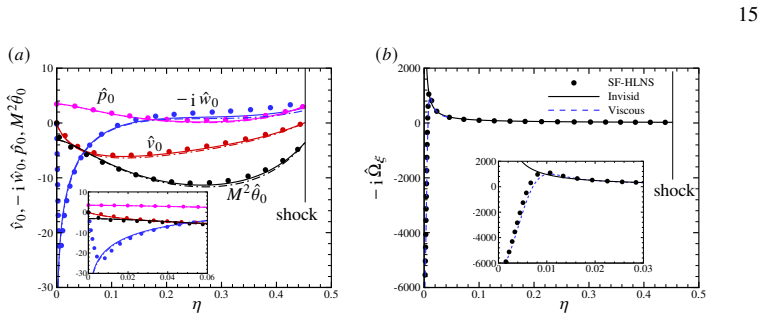
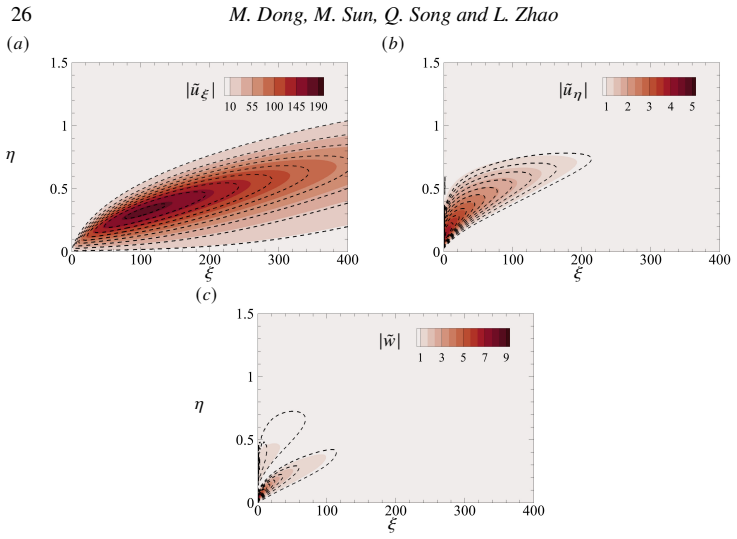
The central claim is that a distinct slow-down convection mechanism in the nose region amplifies the perturbation streamwise vorticity from the post-shock position to the boundary layer around the stagnation point by a factor of O(√R), where R is the Reynolds number based on nose radius. Downstream, the lift-up mechanism further leads to a transient growth of the perturbation streamwise velocity up to an amplitude of O(R). Based on these mechanisms, a reduced model is developed to predict the downstream evolution of the non-modal perturbations initiated by receptivity, whose predictions agree well with SF-HLNS calculations.
Load-bearing premise
The high-Reynolds-number asymptotic analysis is valid and the identified mechanisms dominate the receptivity process without significant interference from higher-order terms.
Editorial extensions
If this is right
- The reduced model directly supplies predictions for how wall temperature and nose radius alter non-modal receptivity efficiency.
- The asymptotic model reproduces the downstream evolution seen in the full SF-HLNS computations over the examined parameter range.
- Non-modal perturbations enter the boundary layer through the identified nose-region receptivity and then grow via the two successive mechanisms.
- The same mechanisms allow systematic exploration of receptivity efficiency without repeated full-field numerical solutions.
Reading between the lines
- The scaling with nose radius suggests that sharper noses could suppress initial non-modal amplitudes in practical hypersonic designs.
- The reduced model offers a fast way to scan the influence of free-stream disturbance spectra on later boundary-layer transition.
- The same asymptotic splitting might be tested on other blunt-body geometries or on flows with mild three-dimensionality to check generality.
Signed reviews
Editorial analysis
A structured set of objections, weighed in public.
Referee Report
Summary. The manuscript develops a high-Reynolds-number asymptotic analysis for the receptivity of non-modal perturbations in hypersonic blunt-body boundary layers. It identifies a slow-down convection mechanism in the nose region that amplifies perturbation streamwise vorticity by a factor of O(√R) from the post-shock position to the stagnation-point boundary layer, after which the lift-up mechanism produces transient growth of streamwise velocity to O(R). A reduced model based on these mechanisms is constructed to predict downstream evolution, with predictions reported to agree well with SF-HLNS calculations from the companion paper.
Significance. If the asymptotic scalings and reduced model hold without significant contamination from higher-order effects, the work supplies mechanistic insight into non-modal receptivity and a practical reduced-order tool for exploring parameter dependence (wall temperature, nose radius) that will be used in Part III. Explicit agreement with independent numerical results from the companion SF-HLNS framework is a positive feature.
major comments (2)
- [asymptotic development (throughout, as invoked in abstract)] The central claim of clean O(√R) vorticity amplification by the slow-down convection mechanism (and subsequent O(R) velocity growth) requires that leading-order balances dominate near the curved shock and entropy layer. The manuscript supplies no explicit error estimates, remainder bounds, or numerical checks of asymptotic convergence with increasing R to quantify the neglected higher-order terms.
- [reduced model construction and comparison] The reduced model is stated to agree with SF-HLNS results, yet the text provides no derivation details, matching procedure, or verification that the asymptotic matching is free of post-hoc adjustments; this leaves the support for the mechanisms unverifiable from the given exposition.
minor comments (2)
- [abstract] Notation for the Reynolds number R (based on nose radius) should be introduced with an explicit definition at first use.
- [abstract] The abstract refers to 'Part III' for further parameter studies; a brief forward reference clarifying the division of scope between parts would aid readers.
Simulated Author's Rebuttal
We thank the referee for the constructive comments and positive assessment of the work's significance. We address the major comments point by point below, indicating revisions that will be made to the manuscript.
read point-by-point responses
-
Referee: [asymptotic development (throughout, as invoked in abstract)] The central claim of clean O(√R) vorticity amplification by the slow-down convection mechanism (and subsequent O(R) velocity growth) requires that leading-order balances dominate near the curved shock and entropy layer. The manuscript supplies no explicit error estimates, remainder bounds, or numerical checks of asymptotic convergence with increasing R to quantify the neglected higher-order terms.
Authors: We agree that the manuscript would benefit from explicit discussion of the neglected higher-order terms. The asymptotic analysis proceeds via systematic expansion of the linearized equations in the high-Reynolds-number limit, with the O(√R) vorticity amplification arising from the leading-order slow-down convection balance near the curved shock and the O(R) velocity growth from the subsequent lift-up mechanism; these scalings are independent of adjustable parameters. While the agreement with SF-HLNS computations provides supporting evidence, we will revise the manuscript to include a dedicated paragraph on the expected magnitude of remainder terms and, using available data from the companion paper, illustrate the approach to the asymptotic regime with increasing Reynolds number. revision: yes
-
Referee: [reduced model construction and comparison] The reduced model is stated to agree with SF-HLNS results, yet the text provides no derivation details, matching procedure, or verification that the asymptotic matching is free of post-hoc adjustments; this leaves the support for the mechanisms unverifiable from the given exposition.
Authors: The reduced model is obtained by retaining only the identified leading-order mechanisms (slow-down convection of vorticity in the nose region followed by lift-up of streamwise velocity) and solving the resulting simplified evolution equations downstream of the stagnation point. Initialization uses the O(√R)-amplified vorticity from the asymptotic solution at the edge of the stagnation-point boundary layer, with no free parameters introduced to match the SF-HLNS data. We acknowledge that the current text omits these steps and will expand the revised manuscript with the explicit derivation of the reduced equations, the precise matching conditions, and additional verification that the comparison contains no post-hoc adjustments. revision: yes
Circularity Check
Asymptotic derivation self-contained; reduced model validated against independent numerical benchmark
full rationale
The paper derives the slow-down convection and lift-up mechanisms via high-Reynolds-number asymptotic analysis of the governing equations, then builds a reduced model directly from those balances. Predictions from this model are compared to SF-HLNS results from the companion paper, which numerically solves the full linearized Navier-Stokes equations rather than being constructed from the same asymptotic reductions. No equation or claim reduces by construction to a fitted parameter, self-referential definition, or unverified self-citation chain; the numerical benchmark lies outside the asymptotic assumptions and supplies falsifiable external evidence.
Assumptions & free parameters
assumptions (1)
- domain assumption High-Reynolds-number limit permits a consistent asymptotic expansion that isolates leading-order mechanisms in the nose and boundary-layer regions
Cite this review
Pith. "Pith review of Excitation of non-modal perturbations in hypersonic boundary layers by free stream forcing. Part II: asymptotic theory and key mechanisms." pith.science (2026). https://pith.science/paper/DOGOETSB
@misc{pith2026260626976,
  author       = {Pith},
  title        = {Pith review of: Excitation of non-modal perturbations in hypersonic boundary layers by free stream forcing. Part II: asymptotic theory and key mechanisms},
  year         = {2026},
  howpublished = {\url{https://pith.science/paper/DOGOETSB}},
  note         = {Machine review of arXiv:2606.26976}
}
read the original abstract
Recently, Zhao & Dong (J. Fluid Mech. 2025, vol. 1013: A44) developed a high-efficiency, high-accuracy numerical framework, the shock-fitting harmonic linearised Navier-Stokes (SF-HLNS) approach, which enables a systematic study of the receptivity of non-modal perturbations in hypersonic blunt-body boundary layers over a wide parameter range. In this Part II, we employ a high-Reynolds-number asymptotic analysis to elucidate the physical mechanism of the receptivity process. A distinct slow-down convection mechanism is identified in the nose region, amplifying the perturbation streamwise vorticity from the post-shock position to the boundary layer around the stagnation point by a factor of O(\sqrt{R}), where R is the Reynolds number based on nose radius. Downstream, the lift-up mechanism further leads to a transient growth of the perturbation streamwise velocity up to an amplitude of O(R). Based on these mechanisms, a reduced model is developed to predict the downstream evolution of the non-modal perturbations initiated by receptivity, whose predictions agree well with SF-HLNS calculations. This model can also be used to investigate the effects of wall temperature and nose radius on non-modal receptivity efficiency, as will be detailed in Part III of this work series.
Figures


Figures from the paper (7 more)



Reference graph
Works this paper leans on
-
[1]
& Henningson, D
Andersson, P ., Berggren, M. & Henningson, D. S.1999 Optimal disturbances and bypass transition in boundary layers.Phys. Fluids11, 134–150. Borovoy , V . Y , Radchenko, V . N, Aleksandrov , S. V & Mosharov , V . E2022 Laminar-turbulent transition reversal on a blunted plate with various leading-edge shapes.AIAA J.60(1), 497–507
1999
-
[2]
Brandt, L.2014 The lift-up effect: The linear mechanism behind transition and turbulence in shear flows. Eur. J. Mech. (B/Fluids)47, 80–96
2014
-
[3]
& Wu, X.2013 On continuous spectra of the Orr-Sommerfeld/Squire equations and entrainment of free-stream vortical disturbances.J
Dong, M. & Wu, X.2013 On continuous spectra of the Orr-Sommerfeld/Squire equations and entrainment of free-stream vortical disturbances.J. Fluid Mech.732, 616–659
2013
-
[4]
& Zhao, L.2021 An asymptotic theory of the roughness impact on inviscid Mack modes in supersonic/hypersonic boundary layers.J
Dong, M. & Zhao, L.2021 An asymptotic theory of the roughness impact on inviscid Mack modes in supersonic/hypersonic boundary layers.J. Fluid Mech.913, A22
2021
-
[5]
& Wu, X.2007 Transition beneath vortical disturbances.Annu
Durbin, P . & Wu, X.2007 Transition beneath vortical disturbances.Annu. Rev. Fluid Mech39(1), 107–128. Fedorov , A. V .2011 Transition and stability of high-speed boundary layers.Annu. Rev. Fluid Mech.43(1), 79–95
2007
-
[6]
& Wen, C
Guo, P ., Hao, J. & Wen, C. Y .2025 Transition reversal over a blunt plate at Mach 5.J. Fluid Mech.1005, A5
2025
-
[7]
Herbert, T.1997 Parabolized stability equations.Annu. Rev. Fluid Mech.29(1), 245–283
1997
-
[8]
S., Kennedy , R
Jewell, J. S., Kennedy , R. E., Laurence, S. J. & Kimmel, R. L.2018 Transition on a variable bluntness 7-degree cone at high Reynolds number. In2018 AIAA Aerospace Sciences Meeting, pp. AIAA Paper 2018–1822. Kissimmee, Florida, U.S.A.: AIAA. Kennedy , R. E., Jewell, J. S., Paredes, P . & Laurence, S. J.2022 Characterization of instability mechanisms on sh...
2018
Show all 28 references
-
[9]
Fluid Mech.98, 243–251
Landahl, M.1980 A note on an algebraic instability of inviscid parallel shear flows.J. Fluid Mech.98, 243–251
1980
-
[10]
& Goldstein, M.1999 Effect of free-stream turbulence and other vortical disturbances on a laminar boundary layer.J
Leib, S., Wundrow, D. & Goldstein, M.1999 Effect of free-stream turbulence and other vortical disturbances on a laminar boundary layer.J. Fluid Mech.380, 169–203
1999
-
[11]
I.1990 Influence of the entropy layer on the stability of a supersonic shock layer and transition of the laminar boundary layer to turbulence.J
Lysenko, V . I.1990 Influence of the entropy layer on the stability of a supersonic shock layer and transition of the laminar boundary layer to turbulence.J. Appl. Mech. Tech. Phys.31(6), 868–873
1990
-
[12]
13(3), 278–289
Mack, L.1975 Linear stability theory and the problem of supersonic boundary-layer transition.AIAA J. 13(3), 278–289
1975
-
[13]
& Wu, X.2017 Nonlinear unsteady streaks engendered by the interaction of free-stream vorticity with a compressible boundary layer.J
Marensi, E., Ricco, P . & Wu, X.2017 Nonlinear unsteady streaks engendered by the interaction of free-stream vorticity with a compressible boundary layer.J. Fluid Mech.817, 80–121
2017
-
[14]
& Alfredsson, P
Matsubara, M. & Alfredsson, P . H.2001 Disturbance growth in boundary layers subjected to free-stream turbulence.J. Fluid Mech.430, 149–168
2001
-
[15]
Paredes, P ., Choudhari, M. M. & Li, F.2020 Mechanism for frustum transition over blunt cones at hypersonic speeds.J. Fluid Mech.894, A22
2020
-
[16]
M., Li, F., Jewell, J
Paredes, P ., Choudhari, M. M., Li, F., Jewell, J. S. & Kimmel, R. L.2019 Nonmodal growth of traveling waves on blunt cones at hypersonic speeds.AIAA J.57(11), 4738–4749
2019
-
[17]
& Fu, S.2014 Competition of the multiple g ¨ortler modes in hypersonic boundary layer flows.Sci
Ren, J. & Fu, S.2014 Competition of the multiple g ¨ortler modes in hypersonic boundary layer flows.Sci. China Phys. Mech. Astron.57(6), 1178–1193
2014
-
[18]
& Wu, X.2011 Evolution and instability of unsteady nonlinear streaks generated by free-stream vortical disturbances.J
Ricco, P ., Luo, J. & Wu, X.2011 Evolution and instability of unsteady nonlinear streaks generated by free-stream vortical disturbances.J. Fluid Mech.677, 1–38
2011
-
[19]
& Wu, X.2007 Response of a compressible laminar boundary layer to free-stream vortical disturbances.J
Ricco, P . & Wu, X.2007 Response of a compressible laminar boundary layer to free-stream vortical disturbances.J. Fluid Mech.587, 97–138
2007
-
[20]
& Zhao, L.2025 Prediction of bypass transition in hypersonic blunt-plate boundary layers subject to noisy conditions.arXiv preprint arXiv:2511.09004
Song, Q., Dong, M. & Zhao, L.2025 Prediction of bypass transition in hypersonic blunt-plate boundary layers subject to noisy conditions.arXiv preprint arXiv:2511.09004
2025
-
[21]
In 16th Fluid and Plasmadynamics Conference, pp
Stetson, K.1983 Nosetip bluntness effects on cone frustum boundary layer transition in hypersonic flow. In 16th Fluid and Plasmadynamics Conference, pp. AIAA Paper 1983–1763. Danvers, Massachusett, U.S.A.: AIAA. W an, B., Luo, J. & Su, C.2018 Response of a hypersonic blunt con...
1983
-
[22]
& Marensi, E.2024 Excitation and stability of nonlinear compressible g ¨ortler vortices and streaks induced by free-stream vortical disturbances.J
Xu, D., Ricco, P . & Marensi, E.2024 Excitation and stability of nonlinear compressible g ¨ortler vortices and streaks induced by free-stream vortical disturbances.J. Fluid Mech.1000, A93
2024
-
[23]
& Zhang, Y .2018 Receptivity of secondary instability modes in streaky boundary layers.Phys
Zhang, A., Dong, M. & Zhang, Y .2018 Receptivity of secondary instability modes in streaky boundary layers.Phys. Fluids30(11), 114102
2018
-
[24]
& Dong, M.2025 Excitation of non-modal perturbations in hypersonic boundary layers by free stream forcing: shock-fitting harmonic linearised Navier–Stokes approach.J
Zhao, L. & Dong, M.2025 Excitation of non-modal perturbations in hypersonic boundary layers by free stream forcing: shock-fitting harmonic linearised Navier–Stokes approach.J. Fluid Mech.1013, A44
2025
-
[25]
& Luo, J.2016 Improved algorithm for solving nonlinear parabolized stability equations.Chin
Zhao, L., Zhang, C., Liu, J. & Luo, J.2016 Improved algorithm for solving nonlinear parabolized stability equations.Chin. Phys. B25(8), 084701
2016
-
[26]
& Sandburg, R.2020 Bypass transition in boundary layers subject to strong pressure gradient and curvature effects.J
Zhao, Y . & Sandburg, R.2020 Bypass transition in boundary layers subject to strong pressure gradient and curvature effects.J. Fluid Mech.888, A4
2020
-
[27]
& Ma, Y .2006 Boundary-layer receptivity of Mach 7.99 flow over a blunt cone to free-stream acoustic waves.J
Zhong, X. & Ma, Y .2006 Boundary-layer receptivity of Mach 7.99 flow over a blunt cone to free-stream acoustic waves.J. Fluid Mech.556, 55–103
2006
-
[28]
& W ang, X.2012 Direct numerical simulation on the receptivity, instability and transition of hypersonic boundary layers.Annu
Zhong, X. & W ang, X.2012 Direct numerical simulation on the receptivity, instability and transition of hypersonic boundary layers.Annu. Rev. Fluid Mech.44(1), 527–561
2012
Reviewed June 26, 2026 · model on record in the stance chip above.
Discussion (0). Continue with ORCID to comment.