REVIEW 2 major objections 4 minor 51 references
Optical spectrum of distant OH/IR star V1648 Aql (IRAS 19386+0155)
T0 review · 2 major / 4 minor · reviewed 2026-08-14 · deepseek-v4-flash
Pith's one-line read A high-resolution optical spectrum places V1648 Aql among oxygen-rich post-AGB stars.
desk verdict A careful single-object study that confirms V1648 Aql as a post-AGB star; the distance is soft but honestly hedged, and the paper deserves refereeing. read the letter →
The pith
A machine-rendered reading of the paper's core claim, the machinery that carries it, and where it could break.
The reading
What carries the argument
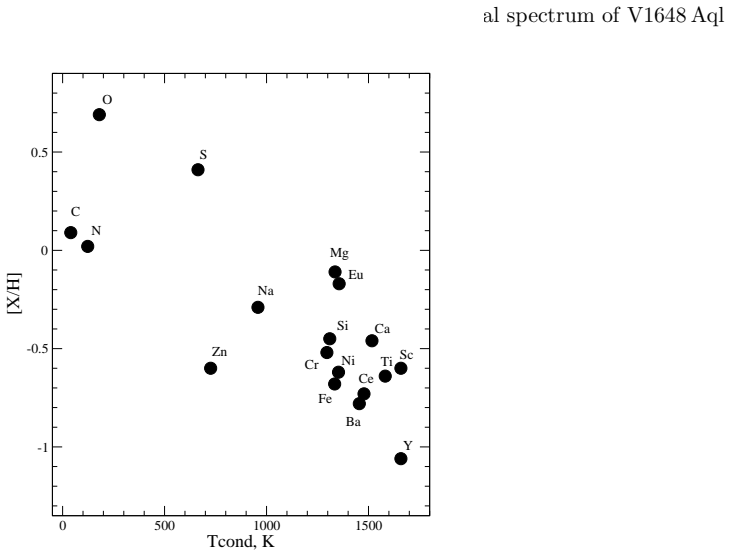
The argument is carried by three linked spectroscopic tools. The Na I D-line profile is decomposed into atmospheric, circumstellar, and interstellar components, with the interstellar component anchored to the mean velocity of twenty diffuse interstellar bands. The equivalent width of the OI 7774 triplet feeds an empirical luminosity calibration that gives $M_V \approx -5^{\mathrm{m}}$, and the DIB strengths are converted to interstellar reddening through an adopted calibration. A plane-parallel LTE model-atmosphere analysis supplies the fundamental parameters and the abundances of 18 elements, and a condensation-temperature plot is used to identify selective depletion. These pieces together, rather than any single line, establish the post-AGB classification.
What would settle it
Measure an independent distance to V1648 Aql, for example from a future high-precision parallax or from resolved circumstellar structure: if the distance falls well outside the 1.8 to 5 kpc window implied by $M_V \approx -5^{\mathrm{m}}$, then the OI 7774 calibration is wrong for this star and the post-AGB classification would rest on the abundance pattern alone.
Extended reading notes
Core claim
On the paper's own terms, V1648 Aql is a post-AGB star. The spectrum resolves three Na I D components at $V_r = +9.2$, $-3.4$, and $-12.8$ km s$^{-1}$, assigned respectively to the stellar atmosphere, an expanding circumstellar envelope, and the interstellar medium; the interstellar assignment is reinforced by twenty diffuse interstellar bands whose mean velocity is $-12.5$ km s$^{-1}$. The OI 7774 triplet equivalent width implies $M_V \approx -5^{\mathrm{m}}$, consistent with post-AGB luminosity, and the resulting distance estimate is $d \ge 1.8$ kpc. With $T_{\mathrm{eff}} = 6800$ K and $\log g = 1.2$, the LTE model-atmosphere analysis gives $\mathrm{[O/Fe]} \approx +1.36$, no $s$-process excess in Y, Ba, or Ce, and a pattern of moderate selective depletion; the authors take this combination as confirming the post-AGB status.
Load-bearing premise
The load-bearing premise is the empirical OI 7774 triplet luminosity calibration: if that relation is biased for this star, the inferred $M_V \approx -5^{\mathrm{m}}$ and the $d \ge 1.8$ kpc lower limit both lose their footing.
Editorial extensions
If this is right
- V1648 Aql should be counted among oxygen-rich post-AGB stars; the absence of $s$-process enhancement indicates an inefficient third dredge-up during its AGB phase.
- The measured circumstellar expansion velocity of about 13.6 km s$^{-1}$, from the shift of the Na I component, provides a kinematic input for models of post-AGB envelope expansion and mass loss.
- The oxygen-rich pattern with $\mathrm{O/C} > 1$ and no detected lithium points to an initial mass below roughly 4 solar masses, placing the star among low-mass post-AGB objects.
- The close agreement between optical metal-line velocities and OH maser velocities establishes a systemic velocity that can tie future radio and optical kinematic studies of IRAS 19386+0155.
Reading between the lines
- A consequence the paper leaves implicit is that the gas-phase oxygen excess and $\mathrm{O/C} > 1$ should be accompanied by oxygen-rich dust; mid-infrared spectroscopy looking for silicate emission would test whether the dust and gas compositions are consistent.
- A testable extension is time-resolved monitoring of the weak metal emissions and the H$\alpha$ core: if a binary companion exists, as the anomalous spectral energy distribution hints, their velocities should vary periodically rather than remain fixed.
- An independent distance measurement, from future astrometry or resolved envelope structure, would convert the luminosity argument into a direct test: $M_V \approx -5^{\mathrm{m}}$ predicts a distance window of roughly 1.8 to 5 kpc given the adopted reddening.
Signed reviews
Editorial analysis
A structured set of objections, weighed in public.
Referee Report
Summary. The paper presents a high-resolution (R ≥ 60,000) optical spectrum of the OH/IR star V1648 Aql (IRAS 19386+0155), obtained with the 6-m BTA telescope. The authors measure a heliocentric radial velocity of V_r = 10.18 ± 0.05 km/s from 349 metal absorption lines, identify a multicomponent Na I D-line profile with atmospheric, circumstellar, and interstellar components, measure velocities of 20 diffuse interstellar bands, and detect weak low-excitation metal emissions. Using the OI 7774 triplet equivalent width (1.42 Å) and an interstellar reddening E(B−V) = 0.68 from DIBs, they estimate a luminosity M_V ≈ −5 mag and a distance lower limit d ≥ 1.8 kpc. Model-atmosphere LTE analysis yields T_eff = 6800 ± 100 K, log g = 1.2 ± 0.2, ξ_t = 8.3 ± 0.5 km/s, and abundances of 18 elements, showing O-rich composition ([O/Fe] = +1.36), no s-process excess, and moderate selective depletion. The authors conclude that these parameters confirm the post-AGB status of V1648 Aql.
Significance. If the conclusions hold, this paper provides the first detailed kinematic and chemical-abundance study of an optically faint, high-latitude OH/IR star, adding a useful comparison object to the small sample of well-studied post-AGB stars. The strengths of the work include the high spectral resolution, explicit radial-velocity error estimates, the consistent decomposition of the Na I profile into three components, the matching DIB and interstellar Na velocities, and the identification of weak metal emissions. The abundance analysis is thorough in terms of line selection and error reporting from line scatter, and it uses standard model-atmosphere techniques. However, the quantitative luminosity and distance estimates rest on empirical calibrations and reddening assumptions that are acknowledged in the text as uncertain, and these feed directly into the post-AGB classification claim.
major comments (2)
- [Section 3.1.3 (Luminosity and distance)]
- [Section 3.2, Table 4 (Chemical composition)]
minor comments (4)
- [Section 4 (Conclusions) vs Section 3.1.2]
- [Table 3]
- [Table 4]
- [Abstract and Section 4]
Circularity Check
No significant circularity: the post-AGB conclusion rests on independent external calibrations and multiple measured diagnostics; the acknowledged OI 7774 calibration uncertainty is an accuracy caveat, not a circular step.
full rationale
The paper's central claim that V1648 Aql is a post-AGB star is supported by a chain of independent observations and external calibrations, not by a parameter fitted to the target quantity. The luminosity M_V ≈ -5m is obtained by measuring the OI 7774 triplet equivalent width (Wλ=1.42 Å) and applying the external MV↔Wλ(7774) calibration of Takeda et al. [30]; the reddening E(B-V)=0.68 is derived from DIB equivalent widths using the external calibration of Kos and Zwitter [26]; the model atmosphere parameters are adopted from Pereira et al. [13] and checked against Fe I/Fe II and Ti I/Ti II ionization balance. The post-AGB classification is corroborated by several independent diagnostics: the OH maser detection and variability from the literature, the three-component Na I D-line profile with a circumstellar expansion velocity typical of post-AGB stars, the oxygen-rich abundance pattern with [O/Fe]=+1.36, the absence of s-process heavy-element excess, and the Hα profile shape. None of these steps defines post-AGB status in terms of a fitted parameter, and none reduces by construction to an input. The paper itself explicitly flags the luminosity estimate as 'not quite accurate' due to the star's brightness trend and possible oxygen overabundance, and admits that 'the distance to V1648 Aql has not so far been determined precisely' — these are honest accuracy caveats, not circular reasoning. The self-citations (e.g., to the HD 56126 atlas [17] and comparison stars [19,25,49,51]) are used for line identification, comparison, and literature context, but the load-bearing measurements and the conclusion do not depend on an unverified self-citation chain. Therefore no circular step is present.
Assumptions & free parameters
free parameters (6)
- Effective temperature T_eff =
6800 K
- Surface gravity log g =
1.2 dex
- Microturbulent velocity xi_t =
8.3 km/s
- Interstellar color excess E(B-V) =
0.68 mag
- Absolute magnitude M_V =
about -5 mag
- Distance lower limit d =
1.8 kpc
assumptions (5)
- domain assumption Local thermodynamic equilibrium (LTE) holds in the line-forming region
- domain assumption Plane-parallel, stationary model atmospheres adequately describe the photosphere
- domain assumption The calibration E(B-V) to W_lambda(DIBs) is valid for this line of sight
- domain assumption The M_V to W_lambda(OI 7774) calibration applies to V1648 Aql
- domain assumption The radial velocity of metal absorptions represents the stellar systemic velocity
Cite this review
Pith. "Pith review of Optical spectrum of distant OH/IR star V1648 Aql (IRAS 19386+0155)." pith.science (2026). https://pith.science/paper/DOZ3BOBX
@misc{pith2026190804986,
  author       = {Pith},
  title        = {Pith review of: Optical spectrum of distant OH/IR star V1648 Aql (IRAS 19386+0155)},
  year         = {2026},
  howpublished = {\url{https://pith.science/paper/DOZ3BOBX}},
  note         = {Machine review of arXiv:1908.04986}
}
abstract
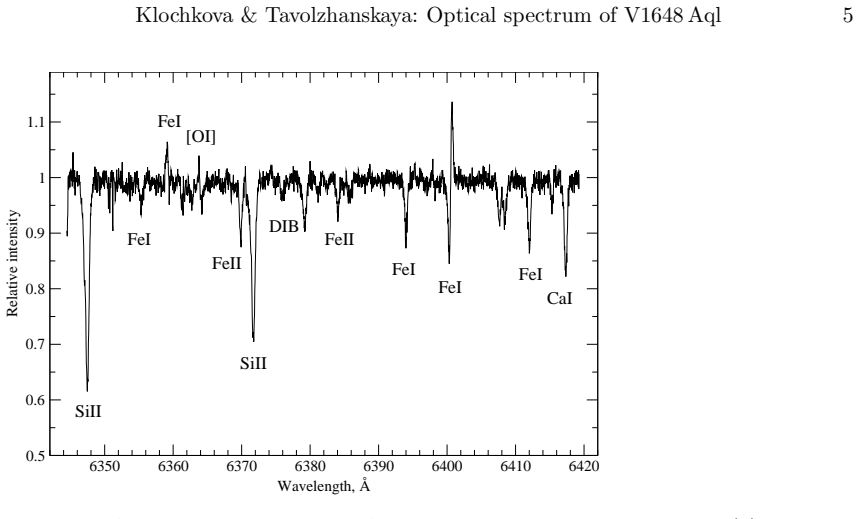
An optical spectrum of the star V1648 Aql (=IRAS 19386+0155) was obtained at the 6-meter telescope with a spectral resolution of R$\ge$60\,000. Heliocentric radial velocity measured from numerous metallic absorptions is equal to V$_r$=$10.18\pm0.05$ km s$^{-1}$ (V$_{\rm LSR}$=18.1 km s$^{-1}$). We determined the atmospheric, circumstellar, and interstellar components in the profile of the NaI D~lines at V$_r$=9.2, $-3.4$, and $-12.8$ km s$^{-1}$ respectively. The averaged over twenty identified DIBs velocity V$_r$(DIBs)=$-12.5\pm0.2$ km~s$^{-1}$ coincides with the interstellar NaI component. Weak emissions with an intensity of about 10% of the local continuum level were detected in the spectrum; they are identified as low-excitation metal lines. Their averaged position, V$_r$=$8.44\pm0.28$ km s$^{-1}$, may point to the presence of a weak velocity gradient in the upper layers of the stellar atmosphere. Based on the spectroscopic data and taking into account the interstellar and circumstellar reddening, we estimated the star's luminosity M$_V\approx-5^{\rm m}$ and also obtained the lower estimate of distance d$\ge1.8$ kpc. Using the model atmosphere method, we determined the fundamental parameters and chemical abundances in the atmosphere approving the status of a post-AGB star for V1648 Aql.
Figures


Figures from the paper (1 more)
Reference graph
Works this paper leans on
- [1]
-
[2]
B.M. Lews, J. Eder, and Y. Terzian, Astrophys. J. 362, 634 (1990). Klochkova & Tavolzhanskaya: Optical spectrum of V1648 Aql 1 5
work page 1990
- [3]
- [4]
-
[5]
T.Bl¨ ocker, Astron and Astrophys.297, 727 (1995)
work page 1995
- [6]
-
[7]
M. Di Criscienzo, P. Ventura, D.A Garc ` ıa-Hern` andez, etal., Mon. Not. R. Astron. Soc. 462, 395 (2016)
work page 2016
-
[8]
N. Liu, R. Gallino, S. Bisterzo, et al., Astrophys. J. 865, 112 (2018)
work page 2018
Show all 51 references
-
[9]
Suarez, P
O. Suarez, P. Garc ´ ıa-Lario, A. Manchado, et al., Astron and Astrophys. 458, 173 (2006)
2006
-
[10]
Arkhipova, N.P
V.P. Arkhipova, N.P. Ikonnikova, G.V. Komissarova, Ast ron. Let. 36, 269 (2010)
2010
-
[11]
Hrivnak, W
B.J. Hrivnak, W. Lu, K.A. Nault, Astron. J. 149, 184 (2015)
2015
-
[12]
Hrivnak, S
H.J. Hrivnak, S. Kwok, K.M. Volk, Astrophys. J. 331, 832 (1988)
1988
-
[13]
Pereira, S
C.B. Pereira, S. Lorenz-Martins, and M. Machado, Astron and Astrophys. 422, 637 (2004)
2004
-
[14]
Panchuk, V.G
V.E. Panchuk, V.G. Klochkova, and M.V. Yushkin, Astron. Rep. 61, 820 (2017)
2017
-
[15]
Yushkin, V.G
M.V. Yushkin, V.G. Klochkova, Preprint No. 206, SAO RAS ( Special Astrophysical Observatory RAS, 2004)
2004
-
[16]
Galazutdinov, Preprint No
G.A. Galazutdinov, Preprint No. 92, SAO RAS (Special Ast rophysical Observatory RAS, 1992)
1992
-
[17]
Klochkova, E.L
V.G. Klochkova, E.L. Chentsov, N.S. Tavolganskaya, M.V . Shapovalov, Astrophys. Bull. 62, 162 (2007)
2007
-
[18]
Molina, S
R.E. Molina, S. Giridhar, C.B. Pereira, et al., Revista M ex. Astron. Astrofis, 50, 293 (2014)
2014
-
[19]
Klochkova, Mon
V.G. Klochkova, Mon. Not. R. Astron. Soc. 272, 710, (1995)
1995
-
[20]
Klochkova, V.E
V.G. Klochkova, V.E. Panchuk, Astron. Rep. 56, 104 (2012)
2012
-
[21]
Klochkova, V.E
V.G. Klochkova, V.E. Panchuk, N.S. Tavolzhanskaya, Ast ron. Rep. 62, 623 (2018)
2018
-
[22]
Jenniskens and F.X
P. Jenniskens and F.X. D´ esert, Astron and Astrophys. Su ppl. 106, 39 (1994)
1994
-
[23]
Luna, N.L.J
R. Luna, N.L.J. Cox, M.A. Satorre, et al., Astron and Astr ophys. 480, 133 (2008)
2008
-
[24]
Bakker, E.F
E. Bakker, E.F. van Dishoeck, L.B.F.M. Waters, T. Schoen maker, Astron and Astrophys. 323, 469 (1997)
1997
-
[25]
Klochkova, Astrophys
V.G. Klochkova, Astrophys. Bull. 69, 279 (2014)
2014
-
[26]
J. Kos, T. Zwitter, Astrophys. J. 774, 72 (2013)
2013
-
[27]
Molina, Revista Mex
R.E. Molina, Revista Mex. Astron. Astrofis, 54, 397 (2018)
2018
-
[28]
Klochkova, M.V
V.G. Klochkova, M.V. Yushkin, E.L. Chentsov, V.E. Panch uk, Astron. Rep. 46, 139 (2002). 16 Klochkova & Tavolzhanskaya: Optical spectrum of V1648 Aq l
2002
-
[29]
Klochkova, E.L
V.G. Klochkova, E.L. Chentsov, V.E. Panchuk, Astrophys . Bull. 74, 41 (2019)
2019
-
[30]
Takeda, G
Y. Takeda, G. Jeong, and I. Han, Publ. Astron. Soc. Japan 70, id.8 (2018)
2018
-
[31]
Bl¨ ocker, Astron and Astrophys
T. Bl¨ ocker, Astron and Astrophys. 299, 755 (1995)
1995
-
[32]
Kovtyukh, N.I
V.V. Kovtyukh, N.I. Gorlova, S.I. Belik, Mon. Not. R. Ast ron. Soc. 423, 3268 (2012)
2012
-
[33]
Vickers, D.J
S.B. Vickers, D.J. Frew, O.A. Parker, I.S. Bojicic, Mon. Not. R. Astron. Soc. 447, 1673 (2015)
2015
-
[34]
Piskunov, F
N.E. Piskunov, F. Kupka, T.A. Ryabchikova, et al., Astro n and Astrophys. Suppl. 112, 525 (1995)
1995
-
[35]
Kupka, N.E
F. Kupka, N.E. Piskunov, T.A. Ryabchikova, et al., Astro n and Astrophys. Suppl. 138, 119 (1999)
1999
-
[36]
Tsymbal, ASP Conf
V.V. Tsymbal, ASP Conf. Ser. 108, 198 (1996)
1996
-
[37]
Lodders, in: Principles and Perspectives in Cosmochemistry (Springer-Verlag, Berlin, Heidelberg, 2010), p
K. Lodders, in: Principles and Perspectives in Cosmochemistry (Springer-Verlag, Berlin, Heidelberg, 2010), p. 379 (Astrophysics and Space S cience Proc.)
2010
-
[38]
Sahin, D
T. Sahin, D. Lambert, V.G. Klochkova, N.S. Tavolganskay a, Mon. Not. R. Astron. Soc. 410, 612, (2011)
2011
-
[39]
Garc ` ıa-Hernandez, O
D.A. Garc ` ıa-Hernandez, O. Zamora, A. Yag¨ ue, et al., As tron and Astrophys. 555, id.L3 (2013)
2013
-
[40]
Ventura and F
P. Ventura and F. D‘Antona, Astron and Astrophys. 439, 1075 (2005)
2005
-
[41]
Venn, Astrophys
K. Venn, Astrophys. J. 414, 316 (1993)
1993
-
[42]
K. Lind, M. Asplund, P.S. Barklem, A.K. Belyaev, Astron a nd Astrophys. 528, A103 (2011)
2011
-
[43]
Wheeler, C
J.C. Wheeler, C. Sneden, J.W.Jr. Truran, Ann. Rev. Astro n. Astrophys. 27, 279 (1989)
1989
-
[44]
Sumangala Rao, S
S. Sumangala Rao, S. Giridhar, D.L. Lambert, Mon. Not. R. Astron. Soc. 419, 1254, (2012)
2012
-
[45]
Sneden, R.G
C. Sneden, R.G. Cratton, D.A. Crocker, Astron and Astrop hys. 246, 354 (1991)
1991
-
[46]
Mishenina, V.V
T.V. Mishenina, V.V. Kovtyukh, C.Soubiran, et al., Astr on and Astrophys. 396, 189 (2002)
2002
-
[47]
Takeda, H
Y. Takeda, H. Taguchi, K. Yoshioka, et al., Publ. Astron. Soc. Japan 59, 1127 (2007)
2007
-
[48]
Molina, C.B
R.E. Molina, C.B. Pereira, A. Arellano Ferro, astro-ph- SR. 1901.058 (2019)
2019
-
[49]
Klochkova, Bull
V.G. Klochkova, Bull. Spec. Astrophys.Observ. 44, 5 (1997)
1997
-
[50]
van Winckel, M
H. van Winckel, M. Reyniers, Astron and Astrophys. 354, 135 (2000)
2000
-
[51]
Klochkova, V.E
V.G. Klochkova, V.E. Panchuk, Astron. Rep. 60, 344 (2016)
2016
Reviewed August 14, 2026 · model on record in the stance chip above.
Discussion (0). Continue with ORCID to comment.