REVIEW 3 major objections 4 minor 12 references
Bordered Legendrian Rational Symplectic Field Theory
T0 review · 3 major / 4 minor · reviewed 2026-08-15 · deepseek-v4-flash
Pith's one-line read The paper claims that the commutative Legendrian Rational Symplectic Field Theory algebra of a simple Legendrian knot is the pushout of two bordered differential graded algebras obtained by cutting its front projection along a vertical…
desk verdict The paper builds a genuinely new bordered LSFT and a plausible pushout theorem, but the universal property as stated is not proven: it silently needs the target DGA to be commutative. read the letter →
The pith
A machine-rendered reading of the paper's core claim, the machinery that carries it, and where it could break.
The reading
What carries the argument
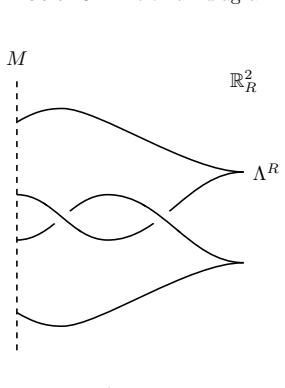
The load-bearing object is a family of commutative DGAs generated by geometric symbols attached to the cut. $A^L_{SFT}$ and $A^R_{SFT}$ are generated by $p_i, q_i$ for crossings and cusps in the half-diagram, by $\alpha_{ij}$ recording half-disks whose boundary interval on the dividing line runs from $i$ to $j$, by $\beta_{ij}$ recording strands that pair dividing-line points, and by $t, t^{-1}$. The middle algebra $A^M_{SFT}$ is generated by $\alpha^L_{ij}, \alpha^R_{ij}, \beta^L_{ij}, \beta^R_{ij}$, with Hamiltonian $h_M = \sum_{i<j} \alpha^L_{ij}\alpha^R_{ij}$. In every case the differential is the sum of an SFT bracket $\{h,\cdot\}$ and a string differential $\delta_{str}$; the bracket satisfies a Jacobi identity, $\delta_{str}$ is a derivation of the bracket, and the two quadratic terms cancel to give $d^2=0$. The maps $\ell, r, L, R$ are defined by counting admissible disks and half-disks with corners at crossings and boundary intervals on $M$; commutativity of the square is checked generator by generator.
What would settle it
Work in the trefoil example of Section 6 and let $Q$ be a noncommutative DGA with maps $f$ and $g$ agreeing on the middle algebra but with two left generators $\alpha$ and $\alpha'$ whose images in the commutative quotient commute, while $f(\alpha)f(\alpha') \neq f(\alpha')f(\alpha)$ in $Q$. The alleged universal map $h$ would assign both orders of the product to the same element of $A^{comm}_{SFT}(\Lambda)$, forcing the two values to be equal; a computation where they differ would contradict the pushout property.
Extended reading notes
Core claim
The central discovery is a Seifert-van Kampen statement for commutative Legendrian SFT. Cutting a simple Legendrian front $\Lambda$ along a vertical line $M$, one obtains $A^M_{SFT}(M)$, $A^L_{SFT}(\Lambda_L)$ and $A^R_{SFT}(\Lambda_R)$, and the paper proves that $A^{comm}_{SFT}(\Lambda)$ is their pushout: any pair of DGA maps from the left and right bordered algebras that agree on the middle algebra factors through $A^{comm}_{SFT}(\Lambda)$. This means the full LSFT invariant, whose differential counts disks with arbitrarily many positive punctures, can be assembled from counts that live in the half-diagrams and on the dividing line. The proof constructs explicit gluing maps $\ell, r, L, R$ by counting admissible disks and half-disks, and it shows that the bordered differential, written as SFT bracket with a Hamiltonian plus a string differential, squares to zero.
Load-bearing premise
The pushout theorem assumes the target algebra is commutative: the universal map is defined on the commutative quotient of the LSFT algebra, and the proof does not show it descends when the target is not commutative.
Editorial extensions
If this is right
- For a simple front, $A^{comm}_{SFT}(\Lambda)$ is determined by the left and right half-diagrams together with the pairing data on the dividing line; no count of disks crossing the whole front is needed.
- The bordered construction specializes to the bordered Chekanov-Eliashberg algebra: setting all $\beta$ and $\alpha^{R}$ generators to zero and deleting the $t^{\pm1}$ terms recovers the commutative quotient of the earlier pushout theorem.
- The two-sided LR algebra satisfies its own pushout theorem (Theorem 5.55), so adjacent bordered pieces can be glued one after another to compute the invariant of a knot assembled from tangle diagrams.
- The universal property packages LSFT as a local-to-global invariant: DGA-valued invariants of the halves that agree on the middle algebra factor uniquely through $A^{comm}_{SFT}(\Lambda)$.
- The example calculations give a checkable blueprint: the trefoil computation shows how the middle, left, and right algebras and their maps are meant to fit together in practice.
Reading between the lines
- The theorem is best read as a pushout in the category of commutative DGAs; for a noncommutative target the construction would need the extra assumption that the two side images commute.
- The same gluing pattern suggests a general local-to-global principle for SFT-type invariants: whenever bordered algebras can be defined for a cut, the commutative invariant is determined by a pushout, making cutting-and-gluing the default computational strategy.
- The noncommutative case might be recovered by a homotopy pushout or a curved structure, since the paper notes that the noncommutative maps are not morphisms in general.
- Comparing the pushout output to a direct full-front computation of $A^{comm}_{SFT}$ for the trefoil would validate the gluing and reveal any hidden dependence on the choice of dividing line.
Signed reviews
Editorial analysis
A structured set of objections, weighed in public.
Referee Report
Summary. The paper constructs bordered versions of Legendrian Rational Symplectic Field Theory (LSFT) for a simple Legendrian front cut into left and right halves by a vertical dividing line. It defines a commutative middle DGA A^M_SFT, left and right DGAs A^L_SFT and A^R_SFT, and proves that their differentials square to zero. It then defines DGA maps ℓ, r, L, R among these algebras and claims in Theorem 5.1 that the resulting square is a pushout whose apex is the commutative LSFT algebra A^comm_SFT. A two-sided variant is sketched in Section 5.8, and Section 6 works through the full example of the Legendrian trefoil, including explicit formulas for the algebras, differentials, and gluing maps.
Significance. If the main theorem is correct, it gives a Seifert–van Kampen type decomposition for the commutative LSFT algebra, extending Sivek's bordered Chekanov–Eliashberg theory to the rational/multi-puncture setting. The paper is constructive and explicit: the algebraic definitions are laid out in detail, the proofs of (d^M)^2=0 and (d^L)^2=0 are largely written out, and the trefoil example is fully computed, with code made available. These are real strengths. However, the universal property of the claimed pushout is stated for an arbitrary DGA target without a commutativity assumption, and the chain-map theorem for the maps L and R is justified by figure-based cancellation arguments rather than a complete algebraic pairing. Both issues are load-bearing for the central claim.
major comments (3)
- [Section 5.7, proof of Theorem 5.1] The universal property is claimed for 'another DGA Q' with no commutativity hypothesis. But A^comm_SFT is the quotient of the free algebra by all commutators, so a DGA map h:A^comm_SFT→Q forces the images of all generators to commute in Q. In particular, if x=L(s) and y=R(t), the relation xy=yx in A^comm_SFT would force f(s)g(t)=g(t)f(s) in Q, which is not automatic for an arbitrary associative DGA. The theorem is therefore not established as stated. The intended statement is presumably the pushout in the category of commutative DGAs, in which case Q should be required to be commutative and this should be stated explicitly. As written, the quantifier over Q makes the central pushout assertion unsupported.
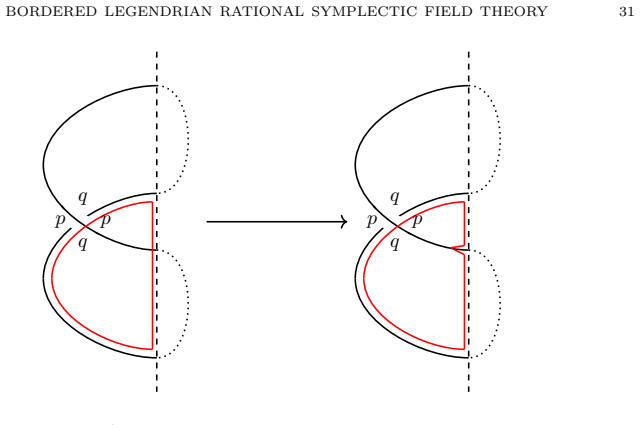
- [Section 5.5.1, Theorem 5.47] The proof that L and R are chain maps is only sketched at the points where it matters most. For x=α_ij the argument says that the relevant terms 'come in pairs which cancel, as depicted in Figure 20', and for x=β_ij it says that exceptional disks 'precisely cancel' (Figures 21, 22). Since d, d^L, and d^R are defined by sums over disks and string insertions, the equality d∘L=L∘d^L requires an explicit, globally defined involution on the set of contributing terms, including all boundary and dividing-line cases. This is not merely a presentational matter: Theorem 5.47 is used directly in the proof of the pushout property, so the central claim depends on this missing detail.
- [Section 5.4, Lemma 5.41] Lemma 5.41 asserts h_L→h_L=δ^L_str(h_L), which is used in the proof of Theorem 5.36 to prove (d^L)^2=0. The proof says that 'boundary' terms are 'depicted in Figure 17, and are seen to cancel pairwise', but no precise pairing is given. Because this lemma is another load-bearing point for the left algebra being a DGA, the argument should be expanded into an explicit enumeration of the cancellations, or at least a clearly stated bijection between summands.
minor comments (4)
- [Section 5.8, Theorem 5.55] The two-sided pushout theorem is stated as a theorem but its proof is delegated to the sentence that the earlier proofs 'may be easily adapted'; please include a proof or explicitly label the statement as a sketch.
- [Section 5.3.2, Definition 5.23] The set W is described as 'the set of elements of A^L_SFT which are representable as broken closed strings', but it is formally a set of words; this distinction should be made precise.
- [Section 4, proof of Proposition 4.8] The proof of well-definedness of the string differential refers to 'Figure 3.8 in [9]' and 'Figure 3.13 in [9]' without reproducing or explaining the relevant arguments; since the numbering is from another paper, a short self-contained statement would help.
- [Section 5.7] In the proof of Theorem 5.1, the case in which a generator of A^comm_SFT has representations both as L(s) and R(t) is handled for α and β generators, but the corresponding verification for t and t^{-1} is not written out; this should be made explicit.
Circularity Check
No significant circularity: the bordered LSFT construction is a new object compared against the independently defined LSFT algebra.
full rationale
The paper defines new DGAs A^M_SFT, A^L_SFT, and A^R_SFT from tangle data and then proves a comparison theorem relating their pushout to Ng's commutative LSFT algebra. The target A^comm_SFT is not used to define the bordered algebras: the left, right, and middle differentials are specified by explicit generators, SFT brackets, Hamiltonians, and string differentials on the half-diagram, and the chain maps L, R, ℓ, and r are defined by counting admissible disks and half-disks. No parameter is fitted to A^comm_SFT and then renamed as a prediction; the only citations to prior work (Chekanov, Ng, Sivek) are used for the standard Chekanov-Eliashberg DGA, LSFT, and bordered CE constructions rather than as a self-citation chain. The proof of Theorem 5.1 has a real gap for arbitrary (noncommutative) test DGAs Q: extending h to A^comm_SFT by products is only well-defined if the images of A^L_SFT and A^R_SFT commute in Q, which is not assumed or proved; this affects correctness of the universal property as stated, but it is not a circularity because the claimed result is not assumed as an input. Independent example computations in Section 6 test the construction against explicit DGAs, further showing that the derivation chain is not circular. Overall, no load-bearing step reduces by definition to its own inputs, so a score of 0 is appropriate.
Assumptions & free parameters
assumptions (5)
- standard math Chekanov-Eliashberg DGA d^2=0 and invariance (Chekanov [3], Thms 2.3/2.6 in paper)
- domain assumption Resolution of front projections gives Lagrangian projections (Ng [8], Thm 2.10)
- domain assumption Properties of Ng's LSFT: quantum master equation, string differential, SFT bracket, commutativity (Ng [9] Props 4.8,4.10, Thms 4.16,4.17)
- domain assumption Sivek's bordered Chekanov-Eliashberg DGA and its pushout theorem (Sivek [11], Thm 3.1)
- domain assumption Simple front projections suffice for any Legendrian knot via Reidemeister moves (Section 2.4.1)
Cite this review
Pith. "Pith review of Bordered Legendrian Rational Symplectic Field Theory." pith.science (2026). https://pith.science/paper/DPIGREOQ
@misc{pith2026250907921,
  author       = {Pith},
  title        = {Pith review of: Bordered Legendrian Rational Symplectic Field Theory},
  year         = {2026},
  howpublished = {\url{https://pith.science/paper/DPIGREOQ}},
  note         = {Machine review of arXiv:2509.07921}
}
abstract
Given a Legendrian knot $\Lambda \subset \mathbb{R}^3$ and a vertical line dividing the front projection of $\Lambda$ into two halves, we construct a differential graded algebra associated to each half-knot. We then show that one may obtain the commutative algebra from Legendrian Rational Symplectic Field Theory as a pushout of the two bordered algebras. This construction extends the bordered Chekanov-Eliashberg differential graded algebra by incorporating disks with multiple positive punctures into the differential.
Figures


Figures from the paper (21 more)





Reference graph
Works this paper leans on
-
[1]
Fr´ ed´ eric Bourgeois, Tobias Ekholm, and Yakov Eliashberg. Effect of Legendrian surgery. Geometry & Topology, 16(1):301–389, 2012
work page 2012
-
[2]
String topology.arXiv preprint math/9911159, 1999
Moira Chas and Dennis Sullivan. String topology.arXiv preprint math/9911159, 1999
arXiv 1999
-
[3]
Differential algebra of Legendrian links.Inventiones mathematicae, 150(3):441–483, 2002
Yuri Chekanov. Differential algebra of Legendrian links.Inventiones mathematicae, 150(3):441–483, 2002
work page 2002
-
[4]
The role of string topology in symplectic field theory
Kai Cieliebak and Janko Latschev. The role of string topology in symplectic field theory. New perspectives and challenges in symplectic field theory, 49:113–146, 2009
work page 2009
-
[5]
Introduction to Symplectic Field Theory
Yakov Eliashberg, Alexander Givental, and Helmut Hofer. Introduction to Symplectic Field Theory. InVisions in Mathematics: GAFA 2000 Special Volume, Part II, pages 560–673. Springer, 2000
work page 2000
-
[6]
Legendrian contact homology inR 3.Surveys in Differential Geometry, 25(1):103–161, 2022
John Etnyre and Lenhard Ng. Legendrian contact homology inR 3.Surveys in Differential Geometry, 25(1):103–161, 2022
work page 2022
-
[7]
Bordered Heegaard Floer homology
Robert Lipshitz, Peter Ozsv´ ath, and Dylan Thurston. Bordered Heegaard Floer homology. Memoirs of the American Mathematical Society, 254(1216), 2018
work page 2018
-
[8]
Computable Legendrian invariants.Topology, 42(1):55–82, 2003
Lenhard Ng. Computable Legendrian invariants.Topology, 42(1):55–82, 2003
work page 2003
Show all 12 references
-
[9]
Rational symplectic field theory for Legendrian knots.Inventiones mathemati- cae, 182(3):451–512, 2010
Lenhard Ng. Rational symplectic field theory for Legendrian knots.Inventiones mathemati- cae, 182(3):451–512, 2010
2010
-
[10]
AnL ∞ structure for Legendrian contact homology.arXiv preprint arXiv:2311.14614, 2023
Lenhard Ng. AnL ∞ structure for Legendrian contact homology.arXiv preprint arXiv:2311.14614, 2023
2023 arXiv
-
[11]
A bordered Chekanov–Eliashberg algebra.Journal of Topology, 4(1):73–104, 2011
Steven Sivek. A bordered Chekanov–Eliashberg algebra.Journal of Topology, 4(1):73–104, 2011
2011
-
[12]
On the isotopy of Legendrian knots.Annals of Global Analysis and Ge- ometry, 10(3):195–207, 1992
Jacek Swiatkowski. On the isotopy of Legendrian knots.Annals of Global Analysis and Ge- ometry, 10(3):195–207, 1992
1992
Reviewed August 15, 2026 · model on record in the stance chip above.
Discussion (0). Continue with ORCID to comment.