REVIEW 3 major objections 4 minor 150 references
Towards Unbreaking the Universe: MINERVA Measurements of Color Gradients in Massive Quiescent Galaxies Can Help Ease Too-Early Star Formation Tensions
T0 review · 3 major / 4 minor · reviewed 2026-08-02 · deepseek-v4-flash
Pith's one-line read Ultra-massive quiescent galaxies at z>3 have redder cores and bluer outskirts, and when those color gradients are read as age gradients, the galaxies' 'too-early' assembly histories fall in line with extreme-value statistics until z~10-11.
desk verdict Useful, honest color-gradient measurements whose headline EVS tension-easing is a clearly labeled limiting case—sends cleanly to peer review, but the claim should not outrun the conditional. read the letter →
The pith
A machine-rendered reading of the paper's core claim, the machinery that carries it, and where it could break.
The reading
What carries the argument
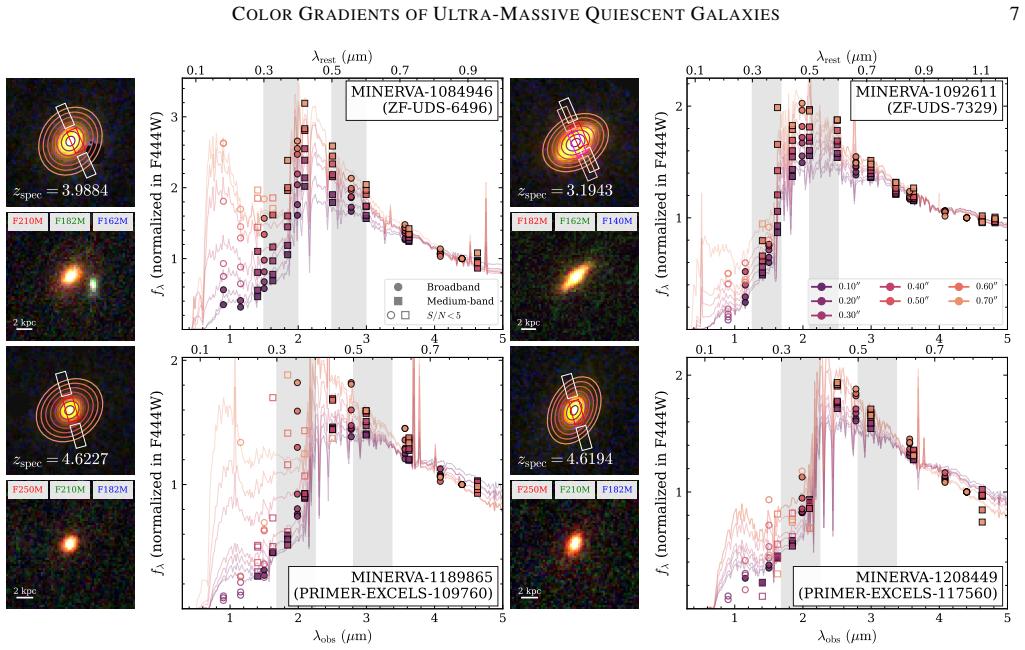
The load-bearing apparatus is spatially resolved photometry: seven elliptical annuli (0.1'' wide) measured in 16–24 NIRCam filters, including MINERVA medium bands that bracket the Balmer/4000 Å break. Rest-frame colors are derived by SED interpolation, and stellar populations are fit with Bayesian SED modeling using non-parametric star-formation histories. Crucially, the fiducial fit imposes narrow priors on dust attenuation and stellar metallicity (anchored to global fits that include MIRI photometry), so any color gradient is forced to express itself as a mass-weighted age gradient. The comparison metric is extreme-value statistics: the predicted maximum stellar mass of the most massive ga
What would settle it
Take JWST/NIRSpec IFU spectra of the galaxy with the strongest gradient (the −0.126 mag/kpc object at z≈4) and map the 4000 Å/Balmer break strengths, stellar metallicities, and dust attenuation as functions of radius. If the bluer outskirts are produced by lower metallicity or lower dust rather than younger ages, the inferred age gradient vanishes and the assembly histories would again exceed the EVS 3σ limit at z≳8. No IFU observation today would directly contradict the existence of the color gradient, but it would settle whether the gradient is age-driven.
Extended reading notes
Core claim
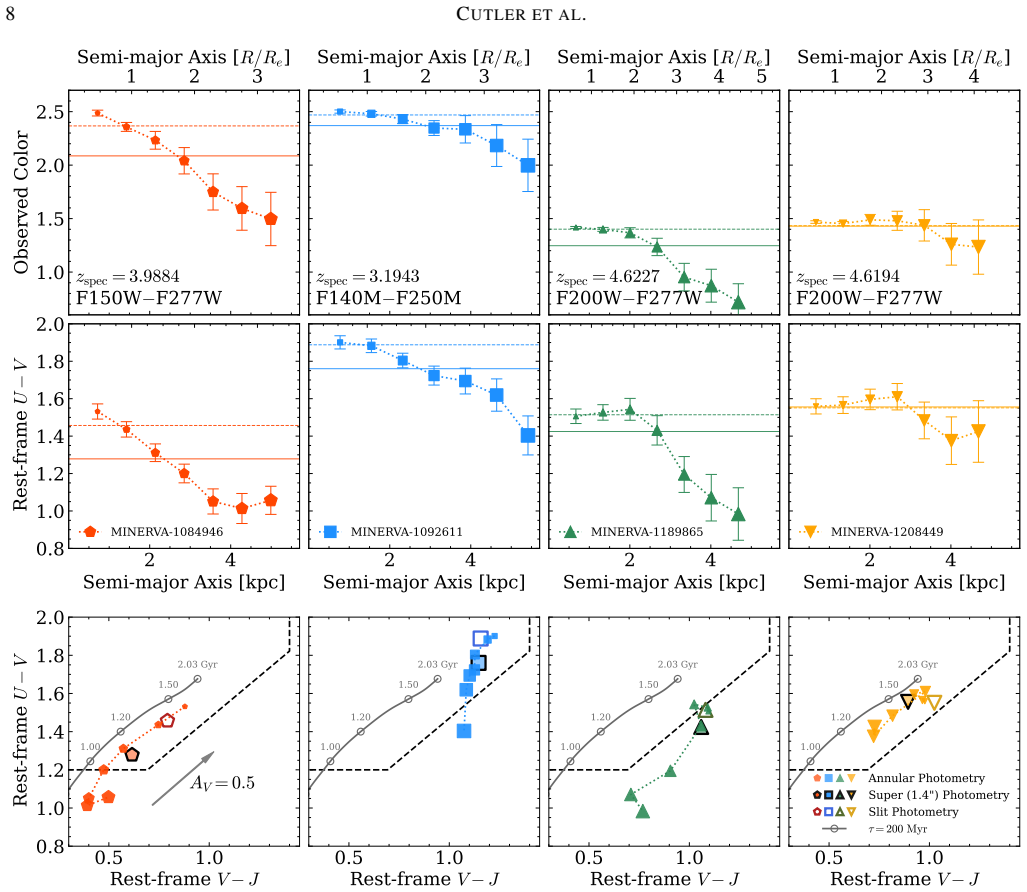
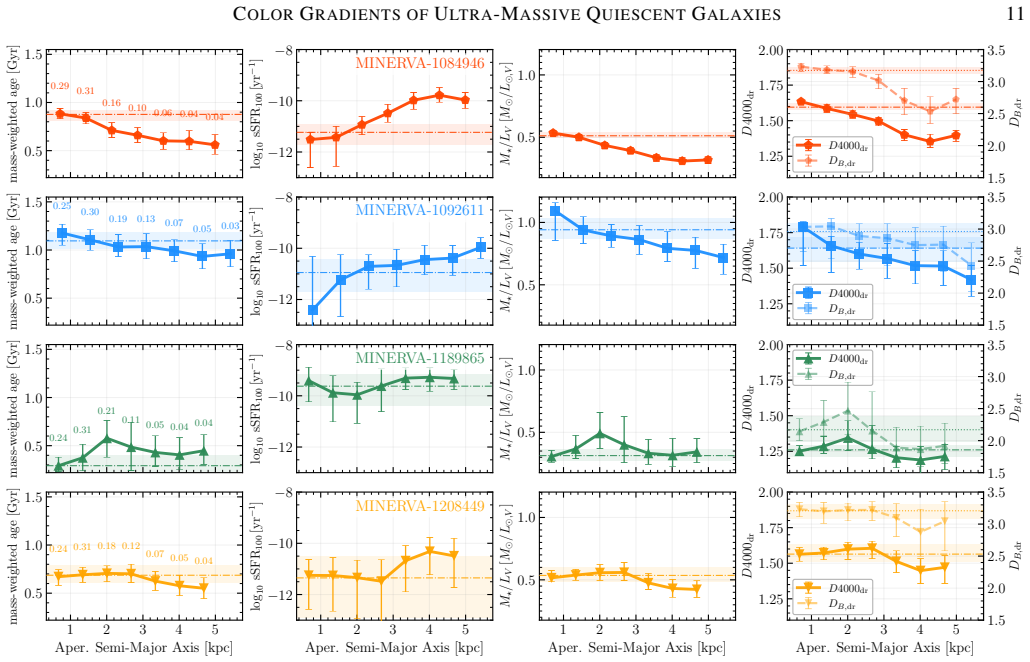
Using resolved photometry in elliptical annuli out to ~4 effective radii, the paper measures rest-frame U−V color gradients in four log(M*/M☉)>11 quiescent galaxies at z>3. Three show negative gradients, most steeply −0.126±0.030 mag kpc^-1 in one galaxy. Modeling the resolved SEDs with non-parametric star-formation histories and deliberately flat dust and metallicity gradients, the paper infers negative age gradients in two galaxies, a flat/positive gradient in a possible post-starburst, and finds that the summed assembly histories exceed the 3σ extreme-value-statistics limit only at z≳10–11 rather than z≳8 as in slit-based analysis. The paper's claim is thus that resolved color information
Load-bearing premise
The tension-easing result rests on the deliberate assumption that dust and metallicity are radially flat, so that every measured color gradient is interpreted as an age gradient; if real dust or metallicity gradients contribute instead, the inferred age gradients shrink and the relief from extreme-value-statistics tension weakens or disappears.
Editorial extensions
If this is right
- Slit-based masses and ages for z>3 quiescent galaxies can be biased: for the strongest gradient, resolved sums give stellar mass 0.1 dex lower than slit-scaled photometry, and mass-weighted age younger by >3σ in one galaxy.
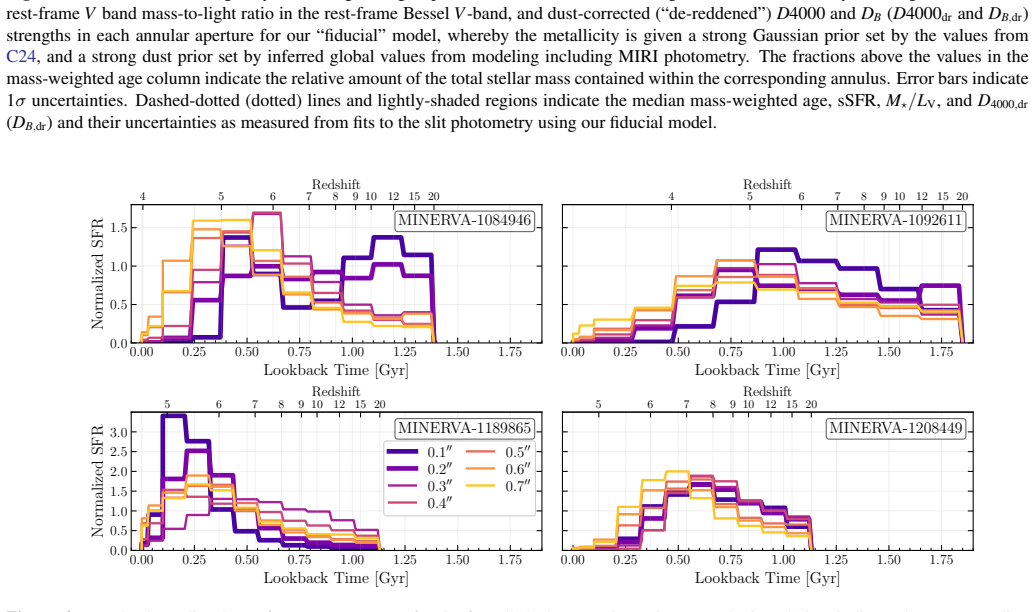
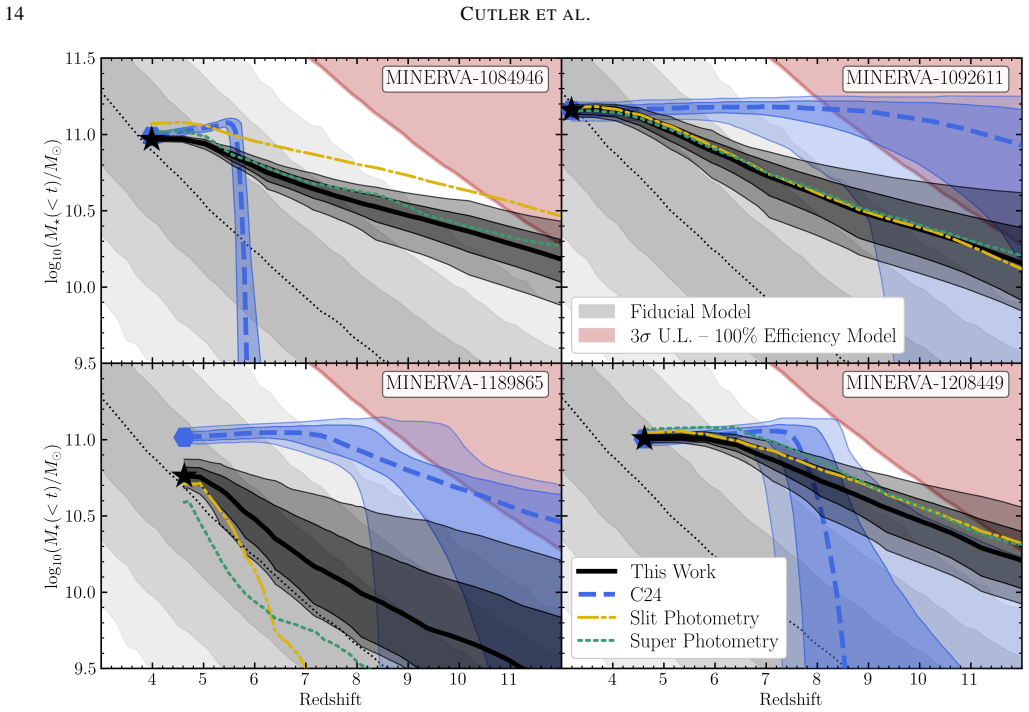
- Under the maximal age-gradient assumption, the summed assembly histories of all four galaxies fall within the 3σ EVS envelope out to z~9.5 (median histories exceed it only at z≳10–11), lowering the tension with ΛCDM.
- Modeling choices matter as much as photometry: non-parametric SFHs that forbid star formation before z=20 and rest-near-IR/MIRI coverage systematically shift assembly histories, so tension claims need to specify these choices.
- The sample includes a galaxy with a young center and old outskirts (a post-starburst candidate), showing that gradients can be positive or negative and fixed apertures cannot capture them.
- New 'universe-breaking' candidates should be examined for color/age gradients before being compared to extreme-value statistics.
Reading between the lines
- If age gradients of this size are typical at z>3, the cosmic stellar-mass density in quiescent galaxies may be partially overestimated by unresolved surveys; checking a larger sample with the same annulus method would shift high-redshift mass functions downward.
- IFU spectroscopy of these four galaxies is the direct test: if the U−V gradients turn out to be dust- or metallicity-driven, the EVS tension would return at z≳8, and the paper's resolution would fail; if they are age-driven, the tension weakens further than the paper's conservative case.
- The central post-starburst in MINERVA-1189865 raises a caution for interpreting 'formation redshift' from single-aperture SFHs: an unresolved spectrum of a galaxy with a young core and old outskirts would read as a different formation epoch than the radially resolved one.
- The same annulus technique could be applied to the larger samples of massive quiescent galaxies that next-generation wide-field surveys will deliver, providing a cheap screening test before expensive IFU follow-up.
Signed reviews
Editorial analysis
A structured set of objections, weighed in public.
Referee Report
Summary. The paper measures resolved, annulus-by-annulus colors and SEDs of four z>3, log(M*/Msun)>11 quiescent galaxies from Carnall et al. (2024), using MINERVA JWST medium-band imaging plus archival broadband and MIRI data. The authors report negative observed and rest-frame color gradients in three of the four galaxies, with the strongest rest-frame U−V gradient of −0.126 ± 0.030 mag/kpc in MINERVA-1084946. They then fit the annular photometry with EAzY and PROSPECTOR, adopting a fiducial model in which dust and metallicity gradients are fixed by narrow priors, so that color gradients are forced to be age gradients. Under this assumption they find negative age gradients in two galaxies and derive resolved stellar mass assembly histories that show less tension with the Lovell et al. (2022) extreme-value-statistics (EVS) bounds than the original slit-based C24 analysis. The paper explicitly labels this an extreme limiting case and calls for IFU spectroscopy to break the age–dust–metallicity degeneracy.
Significance. The empirical color-gradient measurements are a valuable new dataset: the annular photometry is carefully constructed, with covariances measured from 10,000 empty apertures, PSF-matched point-source checks, and conservative error floors. If the measured negative gradients are confirmed, they show that single-slit spectroscopy can bias global stellar masses and ages for the very galaxies used in 'universe-breaking' claims. The EVS-tension-easing result, however, is conditional on the fiducial priors that force flat dust and metallicity gradients; the paper's own alternative fits show that plausible dust or metallicity gradients would reduce or erase the inferred age gradients. The central scientific contribution is therefore the resolved color information, not the demonstration that the EVS tension is eased. The manuscript is honest about this framing in Section 3.3, but the abstract and title emphasize the tension-easing interpretation, which needs to be more carefully qualified.
major comments (3)
- [§3.3, Table A1, Fig. 5] The 'lessened tension with EVS' claim is computed only for the fiducial PROSPECTOR model with narrow Gaussian priors on dust2 (σ=0.046) and metallicity (σ≈0.05–0.08), which by construction converts color gradients into age gradients. The paper's own alternative fits in §4.3 find that with a uniform A_V prior PROSPECTOR prefers a moderate age gradient plus a strong dust gradient, and with free metallicity it finds >1 dex metallicity gradients. If either alternative is physical, the inferred age gradients shrink and the EVS relief may disappear, potentially restoring the C24 tension at z≳8. Because the headline result depends on this, the manuscript should quantify the EVS bounds under the alternative (free dust/free metallicity) fits, or explicitly state that no EVS statement can be made outside the maximal-age-gradient assumption. As written, the central claim is not robust to the paper'
- [Appendix B, §5.1] The z=20 SFH cutoff is another load-bearing prior for the early-time assembly histories: removing it raises the mass assembly histories at z≳8, which would push the curves back toward or above the EVS 3σ limits. Appendix B shows the Bayes factor is only ~1.5, i.e., weak evidence. Yet the main-text claim 'we find lessened tensions with extreme value statistics models out to z∼9.5' does not include this sensitivity. A robustness figure showing the EVS comparison with zmax=∞ (or with a lower zmax) would be needed to support the general statement; currently the reader cannot tell how much of the tension relief comes from this prior.
- [§4.2, Fig. 2] For MINERVA-1092611, the observed F140M−F250M gradient is consistent with flat (−0.054±0.065 mag/kpc globally), yet the EAzY rest-frame U−V gradient is reported as −0.084±0.017 mag/kpc. The explanation that EAzY leverages multiple filters is plausible, but this is a case where the rest-frame color is derived with template fitting rather than a direct filter measurement. Given that this galaxy is one of the two that C24 identified as in strongest EVS tension, the rest-frame gradient (and the resulting age gradient) needs a robustness check, e.g., showing the gradient derived from a direct rest-frame-band interpolation or from an independent template set, before it is used to argue for reduced tension.
minor comments (4)
- [Abstract vs §4.2] The abstract and Section 6 quote the strongest rest-frame gradient as −0.126±0.030 mag/kpc, but Section 4.2 reports −0.131±0.018 mag/kpc for the same quantity. Please harmonize the values and specify which measurement (EAzY rest-frame or other) is being quoted.
- [§3.1] The text says the annular photometry extends to 0.7'' (~4 R_e), but Section 3.1 states the outermost annulus reaches 3.2–4.4 R_e depending on galaxy. The abstract's ~4 R_e is an approximation; the spread should be acknowledged.
- [Figure 2] In the bottom-row UVJ diagrams, the 'slit photometry' open points and the 'super photometry' black-outlined points are difficult to distinguish for some galaxies because of symbol overlap. Consider using distinct marker shapes with a legend for each galaxy.
- [§4.3, Table 2] The statement that slit photometry overestimates mass and age for MINERVA-1084946 is supported by Table 2, but for MINERVA-1208449 the annular and slit masses also differ by ~0.05 dex despite the flat color gradient. The text should explicitly note that differences in SED modeling codes/priors, not only gradients, contribute to these offsets.
Circularity Check
Tension-easing claim is a by-construction consequence of the imposed flat dust/metallicity priors; the color-gradient measurements themselves are not circular.
-
fitted input called prediction
[Section 3.3 (PROSPECTOR: Stellar Population Modeling); Table A1; Figures 3–5]
"We therefore chose to adopt the extreme “limiting” case of modeling the observed color gradients as a gradient in mass-weighted age by imposing narrow priors on the dust and metallicity parameters (see Table A1). These “fiducial” priors are designed to test whether such maximized age gradients could help resolve the tensions our galaxies’ SFHs pose to theoretical models."
The fiducial PROSPECTOR model pins dust2 to a truncated Gaussian with σ=0.046 and metallicity to a narrow Gaussian with σ≈0.045–0.075 from C24 for every annulus (Table A1). With dust and metallicity gradients thus forced to be nearly flat, any radial color change in the rest-UV/NIR photometry is necessarily mapped into the mass-weighted age parameter. The “age gradients” in Figures 3–4 are therefore not independent inferences from the photometry but a re-parameterization of the observed color gradients under the imposed priors. The assembly histories and the EVS-tension reduction in Figure 5 inherit this by-construction mapping. The paper is transparent about the assumption, but the headline “lessened tensions” is nonetheless an artifact of the maximal-age prior choice, not a test of that
-
self definitional
[Section 3.3; Appendix A (Fig. A1)]
"We first constrain the stellar metallicity in each annulus with a narrow Gaussian prior based on the C24 best-fit metallicities and uncertainties... Thus, by construction we implicitly assume no strong metallicity gradients in these galaxies."
The phrase “by construction” makes explicit that flat dust/metallicity gradients are an input, not a result. The age gradient is defined as the residual after subtracting the assumed-flat dust and metallicity gradients from the observed color gradient. Consequently, the “maximal age gradient” interpretation and the resulting EVS easing are not empirical predictions that could confirm or refute the age-gradient hypothesis; they are the same data viewed through the adopted priors. The paper’s own free-AV and free-metallicity fits confirm the degeneracy (a sharp dust decrease or >1 dex metallicity jumps instead of age gradients), showing that the fiducial age-gradient result is selected by the priors rather than required by the photometry.
full rationale
The empirical measurements of negative rest-frame color gradients are not circular: the photometry, annuli, PSF controls, and EAzY rest-frame colors are independent of the EVS analysis. The circularity enters only when the observed color gradients are converted into age gradients under the fiducial PROSPECTOR model, which imposes narrow Gaussian priors on dust2 and metallicity (Table A1). With dust and metallicity gradients pinned to ~zero by construction, any radial color change must be attributed to age; the resulting “lessened tension” with EVS models (Fig. 5, Sec. 5.1) is therefore a conditional consequence of the “limiting case” assumption, not a discovery that color gradients actually ease the tension. The paper is unusually honest about this, repeatedly labeling the results as a test of “maximal age gradients” and calling for IFU spectroscopy to break the degeneracy. It also shows that some tension reduction survives when AV is left free, and that the z=20 SFH cutoff (Appendix B, Bayes factor ~1.5) independently affects early assembly. For those reasons the circularity is partial (score 5) rather than total: the central empirical content (color gradients and their potential to bias slit-based masses/ages) stands on its own, but the headline “lessened tensions” is substantially constructed by the flat-gradient priors.
Assumptions & free parameters
free parameters (8)
- dust2 prior mean (MINERVA-1084946) =
0.101
- dust2 prior mean (MINERVA-1092611) =
0.534
- dust2 prior mean (MINERVA-1189865) =
0.700
- dust2 prior mean (MINERVA-1208449) =
0.295
- log(Z/Zsun) prior mean (MINERVA-1084946) =
0.32
- log(Z/Zsun) prior mean (MINERVA-1092611) =
0.35
- log(Z/Zsun) prior mean (MINERVA-1189865) =
-0.41
- log(Z/Zsun) prior mean (MINERVA-1208449) =
0.35
assumptions (6)
- standard math WMAP9 cosmology and Chabrier IMF
- domain assumption FSPS+MIST stellar population models provide a valid continuum basis for z>3 quiescent galaxies
- ad hoc to paper No star formation before z=20 in the fiducial SFH model
- ad hoc to paper C24 spectroscopic metallicities are representative of the whole galaxy; no strong metallicity gradients
- ad hoc to paper The global dust attenuation from super+MIRI photometry applies radially with negligible gradient
- domain assumption Empty-aperture noise covariance matrix correctly models correlated noise between annuli
Cite this review
Pith. "Pith review of Towards Unbreaking the Universe: MINERVA Measurements of Color Gradients in Massive Quiescent Galaxies Can Help Ease Too-Early Star Formation Tensions." pith.science (2026). https://pith.science/paper/DQV7XLNH
@misc{pith2026260602698,
  author       = {Pith},
  title        = {Pith review of: Towards Unbreaking the Universe: MINERVA Measurements of Color Gradients in Massive Quiescent Galaxies Can Help Ease Too-Early Star Formation Tensions},
  year         = {2026},
  howpublished = {\url{https://pith.science/paper/DQV7XLNH}},
  note         = {Machine review of arXiv:2606.02698}
}
abstract
The discovery of a population of massive, ancient quiescent galaxies within the first 2 Gyr of the Universe's history has led to significant tensions with models of galaxy formation. However, these analyses are often based on slit spectroscopy, which typically captures only the center-most region of these galaxies and, crucially, assumes these cores are representative of the entire galaxy. To illustrate the varying stellar populations present throughout these galaxies, we present an analysis of color gradients in four $z>3$, $\log(M_\star/M_\odot)>11$ quiescent galaxies which previous works have argued are in tension with models. Using medium-band photometry from MINERVA JWST observations, we measure resolved photometry in a series of elliptical annuli out to $0.7^{\prime\prime}$ ($\sim4~R_e$). We find negative color gradients in three galaxies, and for the most extreme color gradient ($\Delta(U-V)/\Delta R=-0.126\pm0.030~{\rm mag~kpc^{-1}}$), we find the stellar mass is 0.1 dex lower when compared to photometry measured within NIRSpec slits. In the limiting case where these color gradients are entirely driven by age, we find lessened tensions with extreme value statistics models out to $z\sim9.5$, though different stellar population modeling choices also contribute significantly. Ultimately, these findings highlight the need for integral field unit spectroscopy. Spatially-resolved spectra can provide the evidence needed to break the age-dust-metallicity degeneracy, and reliably separate the effects of the observed color gradients from the effects of different physical modeling assumptions on the formation histories of these galaxies.
Figures
Figures from the paper (2 more)
Reference graph
Works this paper leans on
-
[1]
Acharyya, A., Watson, P. J., Vulcani, B., et al. 2025, arXiv e-prints, arXiv:2508.05335, doi: 10.48550/arXiv.2508.05335
-
[2]
Akhshik, M., Whitaker, K. E., Leja, J., et al. 2023, ApJ, 943, 179, doi: 10.3847/1538-4357/aca677
-
[3]
2024, ApJ, 976, 224, doi: 10.3847/1538-4357/ad7396
Alberts, S., Lyu, J., Shivaei, I., et al. 2024, ApJ, 976, 224, doi: 10.3847/1538-4357/ad7396
-
[4]
Antwi-Danso, J., Muzzin, A., Robbins, L., et al. 2025, arXiv e-prints, arXiv:2512.03154, doi: 10.48550/arXiv.2512.03154 Astropy Collaboration, Robitaille, T. P., Tollerud, E. J., et al. 2013, A&A, 558, A33, doi: 10.1051/0004-6361/201322068 Astropy Collaboration, Price-Whelan, A. M., Sip˝ocz, B. M., et al. 2018, AJ, 156, 123, doi: 10.3847/1538-3881/aabc4f ...
-
[5]
M., Lim, S., D’Eugenio, F., et al
Baker, W. M., Lim, S., D’Eugenio, F., et al. 2025, MNRAS, 539, 557, doi: 10.1093/mnras/staf475
-
[6]
2016, extinction v0.3.0, Zenodo, doi: 10.5281/zenodo.804967
Barbary, K. 2016, extinction v0.3.0, Zenodo, doi: 10.5281/zenodo.804967
-
[7]
2016, JOSS, 1, 58, doi: 10.21105/joss.00058
Barbary, K. 2016, JOSS, 1, 58, doi: 10.21105/joss.00058
-
[8]
Bell, E. F., & de Jong, R. S. 2001, ApJ, 550, 212, doi: 10.1086/319728
doi:10.1086/319728 2001
Show all 150 references
-
[9]
B., & Ellis, R
Belli, S., Newman, A. B., & Ellis, R. S. 2019, ApJ, 874, 17, doi: 10.3847/1538-4357/ab07af
2019 doi
-
[10]
L., et al
Belli, S., Park, M., Davies, R. L., et al. 2024, Nature, 630, 54, doi: 10.1038/s41586-024-07412-1
2024 doi
-
[11]
G., Tal, T., et al
Bezanson, R., van Dokkum, P. G., Tal, T., et al. 2009, ApJ, 697, 1290, doi: 10.1088/0004-637X/697/2/1290
2009 doi
-
[12]
2016, A&A, 596, A63, doi: 10.1051/0004-6361/201629080
Boucaud, A., Bocchio, M., Abergel, A., et al. 2016, A&A, 596, A63, doi: 10.1051/0004-6361/201629080
2016 doi
-
[13]
2025, astropy/photutils: 2.3.0, 2.3.0 Zenodo, doi: 10.5281/zenodo.17129028
Bradley, L., Sip˝ocz, B., Robitaille, T., et al. 2025, astropy/photutils: 2.3.0, 2.3.0 Zenodo, doi: 10.5281/zenodo.17129028
2025 doi
-
[14]
2023, grizli, v1.9.11 Zenodo, doi: 10.5281/zenodo.8370018
Brammer, G. 2023, grizli, v1.9.11 Zenodo, doi: 10.5281/zenodo.8370018
2023 doi
-
[15]
B., van Dokkum, P
Brammer, G. B., van Dokkum, P. G., & Coppi, P. 2008, ApJ, 686, 1503, doi: 10.1086/591786 Bruzual A., G. 1983, ApJ, 273, 105, doi: 10.1086/161352
2008 doi
-
[16]
C., McLure, R
Carnall, A. C., McLure, R. J., Dunlop, J. S., & Davé, R. 2018, MNRAS, 480, 4379, doi: 10.1093/mnras/sty2169
2018 doi
-
[17]
C., McLure, R
Carnall, A. C., McLure, R. J., Dunlop, J. S., et al. 2019, MNRAS, 490, 417, doi: 10.1093/mnras/stz2544
2019 doi
-
[18]
C., McLeod, D
Carnall, A. C., McLeod, D. J., McLure, R. J., et al. 2023a, MNRAS, 520, 3974, doi: 10.1093/mnras/stad369
-
[19]
C., McLure, R
Carnall, A. C., McLure, R. J., Dunlop, J. S., et al. 2023b, Nature, 619, 716, doi: 10.1038/s41586-023-06158-6
-
[20]
C., Cullen, F., McLure, R
Carnall, A. C., Cullen, F., McLure, R. J., et al. 2024, MNRAS, 534, 325, doi: 10.1093/mnras/stae2092
2024 doi
-
[21]
2003, PASP, 115, 763, doi: 10.1086/376392
Chabrier, G. 2003, PASP, 115, 763, doi: 10.1086/376392
2003 doi
- [22]
-
[23]
M., Kriek, M., Beverage, A
Cheng, C. M., Kriek, M., Beverage, A. G., et al. 2024, MNRAS, 532, 3604, doi: 10.1093/mnras/stae1739
2024 doi
- [24]
-
[25]
G., Glazebrook, K., Nanayakkara, T., et al
Chittenden, H. G., Glazebrook, K., Nanayakkara, T., et al. 2026, MNRAS, 547, stag474, doi: 10.1093/mnras/stag474
2026 doi
-
[26]
2016, ApJ, 823, 102, doi: 10.3847/0004-637X/823/2/102
Choi, J., Dotter, A., Conroy, C., et al. 2016, ApJ, 823, 102, doi: 10.3847/0004-637X/823/2/102
2016 doi
-
[27]
G., Whitaker, K
Clausen, M., Momcheva, I. G., Whitaker, K. E., et al. 2025, ApJ, 993, 106, doi: 10.3847/1538-4357/ae03aa
2025 doi
-
[28]
Cochrane, R. K. 2025, MNRAS, 544, 1530, doi: 10.1093/mnras/staf1568
2025 doi
-
[29]
2013, ARA&A, 51, 393, doi: 10.1146/annurev-astro-082812-141017
Conroy, C. 2013, ARA&A, 51, 393, doi: 10.1146/annurev-astro-082812-141017
2013 doi
-
[30]
Conroy, C., & Gunn, J. E. 2010, ApJ, 712, 833, doi: 10.1088/0004-637X/712/2/833
2010 doi
-
[31]
E., & White, M
Conroy, C., Gunn, J. E., & White, M. 2009, ApJ, 699, 486, doi: 10.1088/0004-637X/699/1/486
2009 doi
-
[32]
P., Zaritsky, D., et al
Conroy, C., Naidu, R. P., Zaritsky, D., et al. 2019, ApJ, 887, 237, doi: 10.3847/1538-4357/ab5710
2019 doi
-
[33]
Conroy, C., White, M., & Gunn, J. E. 2010, ApJ, 708, 58, doi: 10.1088/0004-637X/708/1/58
2010 doi
-
[34]
E., Giavalisco, M., Ji, Z., & Cheng, Y
Cutler, S. E., Giavalisco, M., Ji, Z., & Cheng, Y . 2023, ApJ, 945, 97, doi: 10.3847/1538-4357/acb5e9
2023 doi
-
[35]
E., Whitaker, K
Cutler, S. E., Whitaker, K. E., Weaver, J. R., et al. 2024, ApJL, 967, L23, doi: 10.3847/2041-8213/ad464c de Graaff, A., Setton, D. J., Brammer, G., et al. 2025, Nature Astronomy, 9, 280, doi: 10.1038/s41550-024-02424-3
2024 doi
-
[36]
2014, MNRAS, 438, 1870, doi: 10.1093/mnras/stt2331 D’Eugenio, F., van der Wel, A., Wu (柏锋), P.-F., et al
Dekel, A., & Burkert, A. 2014, MNRAS, 438, 1870, doi: 10.1093/mnras/stt2331 D’Eugenio, F., van der Wel, A., Wu (柏锋), P.-F., et al. 2020, MNRAS, 497, 389, doi: 10.1093/mnras/staa1937 D’Eugenio, F., Pérez-González, P. G., Maiolino, R., et al. 2024, Nature Astronomy, 8, 1443, doi...
2014 doi
-
[37]
2016, ApJS, 222, 8, doi: 10.3847/0067-0049/222/1/8
Dotter, A. 2016, ApJS, 222, 8, doi: 10.3847/0067-0049/222/1/8
2016 doi
-
[38]
S., et al
Drlica-Wagner, A., Sevilla-Noarbe, I., Rykoff, E. S., et al. 2018, ApJS, 235, 33, doi: 10.3847/1538-4365/aab4f5
2018 doi
-
[39]
J., Li, Q., et al
Duan, Q., Conselice, C. J., Li, Q., et al. 2025, MNRAS, 540, 774, doi: 10.1093/mnras/staf638
2025 doi
-
[40]
S., Abraham, R
Dunlop, J. S., Abraham, R. G., Ashby, M. L. N., et al. 2021, PRIMER: Public Release IMaging for Extragalactic Research„ JWST Proposal. Cycle 1, ID. #1837
2021
-
[41]
2014, python-fsps: Python bindings to FSPS (v0.1.1), v0.1.1 Zenodo, doi: 10.5281/zenodo.12157
Foreman-Mackey, D., Sick, J., & Johnson, B. 2014, python-fsps: Python bindings to FSPS (v0.1.1), v0.1.1 Zenodo, doi: 10.5281/zenodo.12157
2014 doi
-
[42]
C., Annunziatella, M., et al
Forrest, B., Marsan, Z. C., Annunziatella, M., et al. 2020, ApJ, 903, 47, doi: 10.3847/1538-4357/abb819 Fortuné, S., Remus, R.-S., Kimmig, L. C., Burkert, A., & Dolag, K. 2025, A&A, 704, A185, doi: 10.1051/0004-6361/202554805 COLORGRADIENTS OFULTRA-MASSIVEQUIESCENTGALAXIES21
2020 doi
-
[43]
2017, Nature, 544, 71, doi: 10.1038/nature21680
Glazebrook, K., Schreiber, C., Labbé, I., et al. 2017, Nature, 544, 71, doi: 10.1038/nature21680
2017 doi
-
[44]
2024, Nature, 628, 277, doi: 10.1038/s41586-024-07191-9
Glazebrook, K., Nanayakkara, T., Schreiber, C., et al. 2024, Nature, 628, 277, doi: 10.1038/s41586-024-07191-9
2024 doi
-
[45]
2012, The DrizzlePac Handbook (Baltimore, MD: STScI)
Gonzaga, S., Hack, W., Fruchter, A., & Mack, J. 2012, The DrizzlePac Handbook (Baltimore, MD: STScI)
2012
-
[46]
E., Janish, R., Ma, C.-P., et al
Greene, J. E., Janish, R., Ma, C.-P., et al. 2015, ApJ, 807, 11, doi: 10.1088/0004-637X/807/1/11
2015 doi
-
[47]
Adams, J. J. 2012, ApJ, 750, 32, doi: 10.1088/0004-637X/750/1/32
2012 doi
-
[48]
A., Kocevski, D
Grogin, N. A., Kocevski, D. D., Faber, S. M., et al. 2011, ApJS, 197, 35, doi: 10.1088/0067-0049/197/2/35
2011 doi
-
[49]
2011, ApJ, 735, 18, doi: 10.1088/0004-637X/735/1/18
Guo, Y ., Giavalisco, M., Cassata, P., et al. 2011, ApJ, 735, 18, doi: 10.1088/0004-637X/735/1/18
2011 doi
-
[50]
L., Whitaker, K
Hamadouche, M. L., Whitaker, K. E., Valentino, F., et al. 2026, arXiv e-prints, arXiv:2602.02485, doi: 10.48550/arXiv.2602.02485
2026 doi
-
[51]
2011, MNRAS, 418, L20, doi: 10.1111/j.1745-3933.2011.01134.x
Harrison, I., & Coles, P. 2011, MNRAS, 418, L20, doi: 10.1111/j.1745-3933.2011.01134.x
2011
-
[52]
J., Adams, N
Harvey, T., Conselice, C. J., Adams, N. J., et al. 2025, ApJ, 978, 89, doi: 10.3847/1538-4357/ad8c29
2025 doi
-
[53]
2013, ApJS, 208, 19, doi: 10.1088/0067-0049/208/2/19
Hinshaw, G., Larson, D., Komatsu, E., et al. 2013, ApJS, 208, 19, doi: 10.1088/0067-0049/208/2/19
2013 doi
-
[54]
Hunter, J. D. 2007, CSE, 9, 90, doi: 10.1109/MCSE.2007.55
2007 doi
-
[55]
2005, A&A, 439, 863, doi: 10.1051/0004-6361:20041961
Ilbert, O., Tresse, L., Zucca, E., et al. 2005, A&A, 439, 863, doi: 10.1051/0004-6361:20041961
2005 doi
-
[56]
B., Mobasher, B., et al
Jafariyazani, M., Newman, A. B., Mobasher, B., et al. 2020, ApJL, 897, L42, doi: 10.3847/2041-8213/aba11c
2020 doi
-
[57]
K., Carnall, A
Jespersen, C. K., Carnall, A. C., & Lovell, C. C. 2025, ApJL, 988, L19, doi: 10.3847/2041-8213/adeb7c
2025 doi
-
[58]
D., Leja, J., Conroy, C., & Speagle, J
Johnson, B. D., Leja, J., Conroy, C., & Speagle, J. S. 2021, ApJS, 254, 22, doi: 10.3847/1538-4365/abef67
2021 doi
-
[59]
2025, ApJL, 978, L39, doi: 10.3847/2041-8213/ada150
Ju, M., Wang, X., Jones, T., et al. 2025, ApJL, 978, L39, doi: 10.3847/2041-8213/ada150
2025 doi
-
[60]
2026, ApJ, 997, 29, doi: 10.3847/1538-4357/ae0a18
Kawinwanichakij, L., Glazebrook, K., Nanayakkara, T., et al. 2026, ApJ, 997, 29, doi: 10.3847/1538-4357/ae0a18
2026 doi
-
[61]
Kepner, J. V . 1999, ApJ, 520, 59, doi: 10.1086/307419
1999 doi
-
[62]
1999, ApJ, 527, 573, doi: 10.1086/308092
Kobayashi, C., & Arimoto, N. 1999, ApJ, 527, 573, doi: 10.1086/308092
1999 doi
-
[63]
M., Faber, S
Koekemoer, A. M., Faber, S. M., Ferguson, H. C., et al. 2011, ApJS, 197, 36, doi: 10.1088/0067-0049/197/2/36
2011 doi
-
[64]
2013, ApJL, 775, L16, doi: 10.1088/2041-8205/775/1/L16
Kriek, M., & Conroy, C. 2013, ApJL, 775, L16, doi: 10.1088/2041-8205/775/1/L16
2013 doi
-
[65]
G., Price, S
Kriek, M., Beverage, A. G., Price, S. H., et al. 2024, ApJ, 966, 36, doi: 10.3847/1538-4357/ad2df9
2024 doi
-
[66]
Kron, R. G. 1980, ApJS, 43, 305, doi: 10.1086/190669 Labbé, I., Franx, M., Rudnick, G., et al. 2003, AJ, 125, 1107, doi: 10.1086/346140
1980 doi
-
[67]
C., Johnson, B
Leja, J., Carnall, A. C., Johnson, B. D., Conroy, C., & Speagle, J. S. 2019a, ApJ, 876, 3, doi: 10.3847/1538-4357/ab133c
-
[68]
2019b, ApJL, 880, L9, doi: 10.3847/2041-8213/ab2f8c
Leja, J., Tacchella, S., & Conroy, C. 2019b, ApJL, 880, L9, doi: 10.3847/2041-8213/ab2f8c
- [69]
-
[70]
2024, Research in Astronomy and Astrophysics, 24, 015009, doi: 10.1088/1674-4527/ad0864
Lin, H., Gong, Y ., Yue, B., & Chen, X. 2024, Research in Astronomy and Astrophysics, 24, 015009, doi: 10.1088/1674-4527/ad0864
2024 doi
-
[71]
2019, ApJ, 872, 50, doi: 10.3847/1538-4357/aafa84
Lin, L., Hsieh, B.-C., Pan, H.-A., et al. 2019, ApJ, 872, 50, doi: 10.3847/1538-4357/aafa84
2019 doi
-
[72]
2022, ApJL, 937, L30, doi: 10.3847/2041-8213/ac927f
Liu, B., & Bromm, V . 2022, ApJL, 937, L30, doi: 10.3847/2041-8213/ac927f
2022 doi
-
[73]
C., Harrison, I., Harikane, Y ., Tacchella, S., & Wilkins, S
Lovell, C. C., Harrison, I., Harikane, Y ., Tacchella, S., & Wilkins, S. M. 2022, Monthly Notices of the Royal Astronomical Society, 518, 2511, doi: 10.1093/mnras/stac3224
2022 doi
-
[74]
2026, arXiv e-prints, arXiv:2604.19942, doi: 10.48550/arXiv.2604.19942 M Evans, N
Lu, S., Daddi, E., Maraston, C., et al. 2026, arXiv e-prints, arXiv:2604.19942, doi: 10.48550/arXiv.2604.19942 M Evans, N. H., & Peacock, B. 2001, Measurement Science and Technology, 12, 117, doi: 10.1088/0957-0233/12/1/702
-
[75]
2023, A&A, 672, A71, doi: 10.1051/0004-6361/202345851
Maio, U., & Viel, M. 2023, A&A, 672, A71, doi: 10.1051/0004-6361/202345851
2023 doi
-
[76]
C., Marchesini, D., Brammer, G
Marsan, Z. C., Marchesini, D., Brammer, G. B., et al. 2015, ApJ, 801, 133, doi: 10.1088/0004-637X/801/2/133
2015 doi
-
[77]
2026, A&A, 705, A236, doi: 10.1051/0004-6361/202555974
Martorano, M., van der Wel, A., Gebek, A., et al. 2026, A&A, 705, A236, doi: 10.1051/0004-6361/202555974
2026 doi
-
[78]
V ., et al
McConachie, I., de Graaff, A., Maseda, M. V ., et al. 2025, arXiv e-prints, arXiv:2510.25024, doi: 10.48550/arXiv.2510.25024
2025 doi
-
[79]
B., van Dokkum, P., & Mowla, L
Miller, T. B., van Dokkum, P., & Mowla, L. 2023, ApJ, 945, 155, doi: 10.3847/1538-4357/acbc74
2023 doi
-
[80]
C., et al
Mobasher, B., Dahlen, T., Ferguson, H. C., et al. 2015, ApJ, 808, 101, doi: 10.1088/0004-637X/808/1/101
2015 doi
- [81]
-
[82]
H., & Ostriker, J
Naab, T., Johansson, P. H., & Ostriker, J. P. 2009, ApJL, 699, L178, doi: 10.1088/0004-637X/699/2/L178
2009 doi
-
[83]
2024, Scientific Reports, 14, 3724, doi: 10.1038/s41598-024-52585-4
Nanayakkara, T., Glazebrook, K., Jacobs, C., et al. 2024, Scientific Reports, 14, 3724, doi: 10.1038/s41598-024-52585-4
2024 doi
-
[84]
2025, ApJ, 981, 78, doi: 10.3847/1538-4357/ada6ac
Nanayakkara, T., Glazebrook, K., Schreiber, C., et al. 2025, ApJ, 981, 78, doi: 10.3847/1538-4357/ada6ac
2025 doi
-
[85]
J., van Dokkum, P
Nelson, E. J., van Dokkum, P. G., Förster Schreiber, N. M., et al. 2016, ApJ, 828, 27, doi: 10.3847/0004-637X/828/1/27
2016 doi
-
[86]
J., Tadaki, K.-i., Tacconi, L
Nelson, E. J., Tadaki, K.-i., Tacconi, L. J., et al. 2019, ApJ, 870, 130, doi: 10.3847/1538-4357/aaf38a
2019 doi
-
[87]
2024, A&A, 681, A94, doi: 10.1051/0004-6361/202346769
Nersesian, A., van der Wel, A., Gallazzi, A., et al. 2024, A&A, 681, A94, doi: 10.1051/0004-6361/202346769
2024 doi
-
[88]
R., et al
Nersesian, A., van der Wel, A., Gallazzi, A. R., et al. 2025, A&A, 695, A86, doi: 10.1051/0004-6361/202452662
2025 doi
-
[89]
B., Ellis, R
Newman, A. B., Ellis, R. S., Bundy, K., & Treu, T. 2012, ApJ, 746, 162, doi: 10.1088/0004-637X/746/2/162 22 CUTLER ET AL
2012 doi
-
[90]
2022, MNRAS, 512, 3566, doi: 10.1093/mnras/stac668
Noirot, G., Sawicki, M., Abraham, R., et al. 2022, MNRAS, 512, 3566, doi: 10.1093/mnras/stac668
2022 doi
-
[91]
Oke, J. B. 1974, ApJS, 27, 21, doi: 10.1086/190287
1974 doi
-
[92]
2015, MNRAS, 447, 786, doi: 10.1093/mnras/stu2447
Pacifici, C., da Cunha, E., Charlot, S., et al. 2015, MNRAS, 447, 786, doi: 10.1093/mnras/stu2447
2015 doi
-
[93]
2023, ApJL, 953, L4, doi: 10.3847/2041-8213/acea7a
Padmanabhan, H., & Loeb, A. 2023, ApJL, 953, L4, doi: 10.3847/2041-8213/acea7a
2023 doi
-
[94]
Papovich, C., Dickinson, M., & Ferguson, H. C. 2001, ApJ, 559, 620, doi: 10.1086/322412
2001 doi
-
[95]
W., Yang, G., et al
Papovich, C., Cole, J. W., Yang, G., et al. 2023, ApJL, 949, L18, doi: 10.3847/2041-8213/acc948
2023 doi
-
[96]
2023, MNRAS, 526, L63, doi: 10.1093/mnrasl/slad107
Parashari, P., & Laha, R. 2023, MNRAS, 526, L63, doi: 10.1093/mnrasl/slad107
2023 doi
-
[97]
2023, ApJ, 953, 119, doi: 10.3847/1538-4357/acd54a
Park, M., Belli, S., Conroy, C., et al. 2023, ApJ, 953, 119, doi: 10.3847/1538-4357/acd54a
2023 doi
-
[98]
2012, MNRAS, 422, 3285, doi: 10.1111/j.1365-2966.2012.20848.x
Pforr, J., Maraston, C., & Tonini, C. 2012, MNRAS, 422, 3285, doi: 10.1111/j.1365-2966.2012.20848.x
2012
-
[99]
2019, MNRAS, 490, 3196, doi: 10.1093/mnras/stz2338
Pillepich, A., Nelson, D., Springel, V ., et al. 2019, MNRAS, 490, 3196, doi: 10.1093/mnras/stz2338
2019 doi
-
[100]
J., Groves, B., et al
Poetrodjojo, H., D’Agostino, J. J., Groves, B., et al. 2019, MNRAS, 487, 79, doi: 10.1093/mnras/stz1241
2019 doi
- [101]
-
[102]
2023, MNRAS, 519, 1526, doi: 10.1093/mnras/stac3214 Puskás, D., Tacchella, S., Simmonds, C., et al
Popesso, P., Concas, A., Cresci, G., et al. 2023, MNRAS, 519, 1526, doi: 10.1093/mnras/stac3214 Puskás, D., Tacchella, S., Simmonds, C., et al. 2025, MNRAS, 540, 2146, doi: 10.1093/mnras/staf813
2023 doi
-
[103]
2007, AJ, 134, 1103, doi: 10.1086/520330
Quadri, R., Marchesini, D., van Dokkum, P., et al. 2007, AJ, 134, 1103, doi: 10.1086/520330
2007 doi
-
[104]
Remus, R.-S., & Kimmig, L. C. 2025, ApJ, 982, 30, doi: 10.3847/1538-4357/ad8b4b
2025 doi
-
[105]
2024, ApJ, 976, 193, doi: 10.3847/1538-4357/ad85d3
Roberts-Borsani, G., Treu, T., Shapley, A., et al. 2024, ApJ, 976, 193, doi: 10.3847/1538-4357/ad85d3
2024 doi
-
[106]
2015, MNRAS, 449, 49, doi: 10.1093/mnras/stv264
Rodriguez-Gomez, V ., Genel, S., V ogelsberger, M., et al. 2015, MNRAS, 449, 49, doi: 10.1093/mnras/stv264
2015 doi
-
[107]
2003, ApJ, 599, 847, doi: 10.1086/379628
Rudnick, G., Rix, H.-W., Franx, M., et al. 2003, ApJ, 599, 847, doi: 10.1086/379628
2003 doi
-
[108]
Salim, S., Boquien, M., & Lee, J. C. 2018, ApJ, 859, 11, doi: 10.3847/1538-4357/aabf3c
2018 doi
-
[109]
2020, ARA&A, 58, 529, doi: 10.1146/annurev-astro-032620-021933
Salim, S., & Narayanan, D. 2020, ARA&A, 58, 529, doi: 10.1146/annurev-astro-032620-021933
2020 doi
-
[110]
Sarrouh, G. T. E., Asada, Y ., Martis, N. S., et al. 2026, ApJS, 282, 3, doi: 10.3847/1538-4365/ae1611
2026 doi
-
[111]
F., & Finkbeiner, D
Schlafly, E. F., & Finkbeiner, D. P. 2011, ApJ, 737, 103, doi: 10.1088/0004-637X/737/2/103
2011 doi
-
[112]
J., Finkbeiner, D
Schlegel, D. J., Finkbeiner, D. P., & Davis, M. 1998, ApJ, 500, 525, doi: 10.1086/305772
1998 doi
-
[113]
2018, A&A, 618, A85, doi: 10.1051/0004-6361/201833070
Schreiber, C., Glazebrook, K., Nanayakkara, T., et al. 2018, A&A, 618, A85, doi: 10.1051/0004-6361/201833070
2018 doi
-
[114]
J., Bezanson, R., Suess, K
Setton, D. J., Bezanson, R., Suess, K. A., et al. 2020, ApJ, 905, 79, doi: 10.3847/1538-4357/abc265
2020 doi
-
[115]
C., Setton, D
Siegel, J. C., Setton, D. J., Greene, J. E., et al. 2025, ApJ, 985, 125, doi: 10.3847/1538-4357/adc7b7
2025 doi
-
[116]
E., Whitaker, K
Skelton, R. E., Whitaker, K. E., Momcheva, I. G., et al. 2014, ApJS, 214, 24, doi: 10.1088/0067-0049/214/2/24
2014 doi
-
[117]
G., et al
Slob, M., Kriek, M., Beverage, A. G., et al. 2024, ApJ, 973, 131, doi: 10.3847/1538-4357/ad65ff
2024 doi
-
[118]
Speagle, J. S. 2020, MNRAS, 493, 3132, doi: 10.1093/mnras/staa278
2020 doi
-
[119]
Williams, C. C. 2019, ApJ, 883, 81, doi: 10.3847/1538-4357/ab3804
2019 doi
-
[120]
L., Sneppen, A., Clausen, T., et al
Steinhardt, C. L., Sneppen, A., Clausen, T., et al. 2024, ApJ, 967, 172, doi: 10.3847/1538-4357/ad3afb
2024 doi
-
[121]
D., Carnall, A
Stevenson, S. D., Carnall, A. C., Leung, H.-H., et al. 2026, MNRAS, 545, staf2087, doi: 10.1093/mnras/staf2087
2026 doi
-
[122]
A., Kriek, M., Price, S
Suess, K. A., Kriek, M., Price, S. H., & Barro, G. 2019a, ApJ, 877, 103, doi: 10.3847/1538-4357/ab1bda
-
[123]
A., Kriek, M., Price, S
Suess, K. A., Kriek, M., Price, S. H., & Barro, G. 2019b, ApJL, 885, L22, doi: 10.3847/2041-8213/ab4db3
-
[124]
A., Kriek, M., Price, S
Suess, K. A., Kriek, M., Price, S. H., & Barro, G. 2020, ApJL, 899, L26, doi: 10.3847/2041-8213/abacc9
2020 doi
-
[125]
A., Kriek, M., Price, S
Suess, K. A., Kriek, M., Price, S. H., & Barro, G. 2021, ApJ, 915, 87, doi: 10.3847/1538-4357/abf1e4
2021 doi
-
[126]
A., Weaver, J
Suess, K. A., Weaver, J. R., Price, S. H., et al. 2024, ApJ, 976, 101, doi: 10.3847/1538-4357/ad75fe
2024 doi
-
[127]
C., et al
Sun, G., Faucher-Giguère, C.-A., Hayward, C. C., et al. 2023, ApJL, 955, L35, doi: 10.3847/2041-8213/acf85a
2023 doi
-
[128]
G., et al
Szomoru, D., Franx, M., van Dokkum, P. G., et al. 2013, ApJ, 763, 73, doi: 10.1088/0004-637X/763/2/73
2013 doi
-
[129]
M., et al
Tacchella, S., Dekel, A., Carollo, C. M., et al. 2016, MNRAS, 458, 242, doi: 10.1093/mnras/stw303
2016 doi
-
[130]
M., Förster Schreiber, N
Tacchella, S., Carollo, C. M., Förster Schreiber, N. M., et al. 2018, ApJ, 859, 56, doi: 10.3847/1538-4357/aabf8b
2018 doi
-
[131]
2019, MNRAS, 487, 5416, doi: 10.1093/mnras/stz1657
Tacchella, S., Diemer, B., Hernquist, L., et al. 2019, MNRAS, 487, 5416, doi: 10.1093/mnras/stz1657
2019 doi
-
[132]
M., et al
Tacchella, S., Conroy, C., Faber, S. M., et al. 2022, ApJ, 926, 134, doi: 10.3847/1538-4357/ac449b
2022 doi
-
[133]
R., Cardone, V
Tortora, C., Napolitano, N. R., Cardone, V . F., et al. 2010, MNRAS, 407, 144, doi: 10.1111/j.1365-2966.2010.16938.x
2010
-
[134]
Trussler, J. A. A., Conselice, C. J., Adams, N., et al. 2025, MNRAS, 537, 3662, doi: 10.1093/mnras/staf213
2025 doi
-
[135]
2025, MNRAS, 537, 1826, doi: 10.1093/mnras/staf128 Urbano Stawinski, S
Turner, C., Tacchella, S., D’Eugenio, F., et al. 2025, MNRAS, 537, 1826, doi: 10.1093/mnras/staf128 Urbano Stawinski, S. M., Cooper, M. C., Forrest, B., et al. 2024, The Open Journal of Astrophysics, 7, 46, doi: 10.33232/001c.120087 van der Walt, S., Colbert, S. C., & Varoquau...
2025 doi
-
[136]
E., et al
Virtanen, P., Gommers, R., Oliphant, T. E., et al. 2020, Nature Methods, 17, 261, doi: 10.1038/s41592-019-0686-2
2020 doi
-
[137]
2024a, ApJ, 963, 74, doi: 10.3847/1538-4357/ad187c
Wang, B., Leja, J., Atek, H., et al. 2024a, ApJ, 963, 74, doi: 10.3847/1538-4357/ad187c
-
[138]
2024b, ApJS, 270, 12, doi: 10.3847/1538-4365/ad0846
Wang, B., Leja, J., Labbé, I., et al. 2024b, ApJS, 270, 12, doi: 10.3847/1538-4365/ad0846
-
[139]
R., Cutler, S
Weaver, J. R., Cutler, S. E., Pan, R., et al. 2024, ApJS, 270, 7, doi: 10.3847/1538-4365/ad07e0
2024 doi
-
[140]
E., Kriek, M., van Dokkum, P
Whitaker, K. E., Kriek, M., van Dokkum, P. G., et al. 2012, ApJ, 745, 179, doi: 10.1088/0004-637X/745/2/179
2012 doi
-
[141]
E., Labbé, I., van Dokkum, P
Whitaker, K. E., Labbé, I., van Dokkum, P. G., et al. 2011, ApJ, 735, 86, doi: 10.1088/0004-637X/735/2/86
2011 doi
-
[142]
E., van Dokkum, P
Whitaker, K. E., van Dokkum, P. G., Brammer, G., et al. 2013, ApJL, 770, L39, doi: 10.1088/2041-8205/770/2/L39
2013 doi
-
[143]
E., Ashas, M., Illingworth, G., et al
Whitaker, K. E., Ashas, M., Illingworth, G., et al. 2019, ApJS, 244, 16, doi: 10.3847/1538-4365/ab3853
2019 doi
-
[144]
M., Lovell, C
Wilkins, S. M., Lovell, C. C., Irodotou, D., et al. 2024, MNRAS, 527, 7965, doi: 10.1093/mnras/stad3558
2024 doi
-
[145]
J., Damjanov, I., Sawicki, M., et al
Williams, D. J., Damjanov, I., Sawicki, M., et al. 2025, ApJ, 989, 107, doi: 10.3847/1538-4357/ade9a8
2025 doi
-
[146]
J., Quadri, R
Williams, R. J., Quadri, R. F., Franx, M., van Dokkum, P., & Labbé, I. 2009, ApJ, 691, 1879, doi: 10.1088/0004-637X/691/2/1879
2009 doi
-
[147]
A., Elbaz, D., et al
Xiao, M., Oesch, P. A., Elbaz, D., et al. 2024, Nature, 635, 311, doi: 10.1038/s41586-024-08094-5
2024 doi
-
[148]
2017, MNRAS, 466, 3217, doi: 10.1093/mnras/stw3308
Zhang, K., Yan, R., Bundy, K., et al. 2017, MNRAS, 466, 3217, doi: 10.1093/mnras/stw3308
2017 doi
-
[149]
J., et al
Zhang, Y ., de Graaff, A., Setton, D. J., et al. 2026, ApJ, 997, 252, doi: 10.3847/1538-4357/ae24e1
2026 doi
-
[150]
2015, MNRAS, 450, 2327, doi: 10.1093/mnras/stv740
Zolotov, A., Dekel, A., Mandelker, N., et al. 2015, MNRAS, 450, 2327, doi: 10.1093/mnras/stv740
2015 doi
Reviewed August 2, 2026 · model on record in the stance chip above.
Discussion (0). Continue with ORCID to comment.