REVIEW 3 major objections 5 minor 12 references
Dengue model with early-life stage of vectors and age-structure within host
T0 review · 3 major / 5 minor · reviewed 2026-08-14 · deepseek-v4-flash
Pith's one-line read A single threshold number, $R_0$, governs whether dengue dies out in an age-structured human population with mosquito egg dynamics.
desk verdict Useful modeling combination, but the flagship global stability theorem overreaches; the rest is a competent extension that deserves a revision. read the letter →
The pith
A machine-rendered reading of the paper's core claim, the machinery that carries it, and where it could break.
The reading
What carries the argument
The engine is the pair of thresholds $R_0$ and $R_v$. The vector demographic number $R_v=f'(N_v^*)/\varphi$, with $\varphi=(\delta+\mu_e)\mu_v/\delta$ the proportion of eggs that survive to adulthood, determines whether mosquitoes persist and which of possibly many demographic steady states of the birth function $f(N_v)=N_v g(N_v)$ are stable. The basic reproductive number $R_0$ is a double integral over host age that weights transmission by host survival to each age and by the limiting host age distribution $p_\infty(a)$. The stability proofs chain the two together: $R_v$ fixes the vector background, and on that background $R_0$ decides whether the infection grows or decays.
What would settle it
Run System (3) numerically with parameters giving $R_0<1$ but a stable positive vector steady state; if the infected-host density $i_h(t,a)$ converges to a positive steady state from some initial condition, Theorem 3.4 is false. A simpler check is to track the ratio $B(t)/(I_v(t)/S_v(t))$ along transients and see whether it approaches $\mu_v/\beta_v$ as required by Eq. (9).
Extended reading notes
Core claim
The paper's central claim is that in a dengue model with age-structured human hosts and an early-life stage in mosquitoes, the infection threshold is still a single basic reproductive number, now given by $$R_0 = \frac{\beta_v}{\mu_v} \int_0^\infty \int_0^a p_\infty(a)\$\beta$(\tau)$e^{{-\int_\tau^a \gamma(h)\,dh}}$\,d\tau\,da.$$ This $R_0$ incorporates the age-specific contact rate $\beta(a)$, the age-specific recovery rate $\gamma(a)$, the limiting host age distribution $p_\infty(a)$, and the mosquito-to-human transmission efficiency. The paper proves that if $R_0<1$, the disease-free state is globally asymptotically stable, so infection disappears from every initial condition. If $R_0>1$ and the vector population has a stable positive demographic steady state, an endemic steady state exists. It also defines a vector demographic number $R_v=f'(N_v^*)/\varphi$, with $\varphi=(\delta+\mu_e)\mu_v/\delta$ the proportion of eggs that survive to adulthood, and shows that egg-stage control making $\varphi$ exceed the maximum of the per-capita egg-production function $g(N_v)$ eliminates the vector population regardless of $R_0$.
Load-bearing premise
The proof that $R_0<1$ forces infection to die out relies on an asserted limiting balance $B^*=(\mu_v/\beta_v)I_v^*/S_v^*$ between the force of infection and the infected-vector fraction; the paper does not derive this balance for limit inferior or limit superior values, and if it fails, the global stability conclusion is not established.
Editorial extensions
If this is right
- If $R_0<1$, dengue dies out from every starting condition, even when adult mosquitoes remain abundant and the demographic vector number $R_v$ is above one.
- If $R_0>1$, an endemic steady state exists only when the mosquito population has a stable positive demographic steady state, so vector persistence is a precondition for sustained transmission.
- Early-life-stage control that pushes $\varphi$ above the maximum of $g(N_v)$ eliminates mosquitoes and stops dengue independently of the value of $R_0$.
- Because $R_0$ depends on age-specific contact and recovery, control measures aimed at the highest-contact age groups can lower the threshold directly.
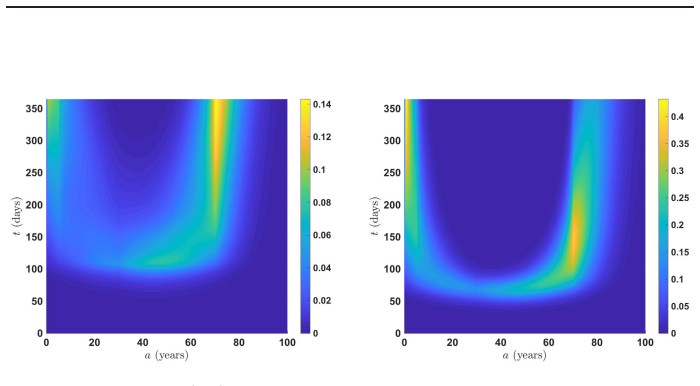
- Seasonal variation in vector parameters, as simulated in the paper, changes the age profile of infected hosts, so the timing of vector control may affect different age groups differently.
Reading between the lines
- A testable extension is to estimate $R_0$ from age-specific seroprevalence and vector survival data; the model would then predict which age groups dominate incident cases, which can be compared with surveillance records.
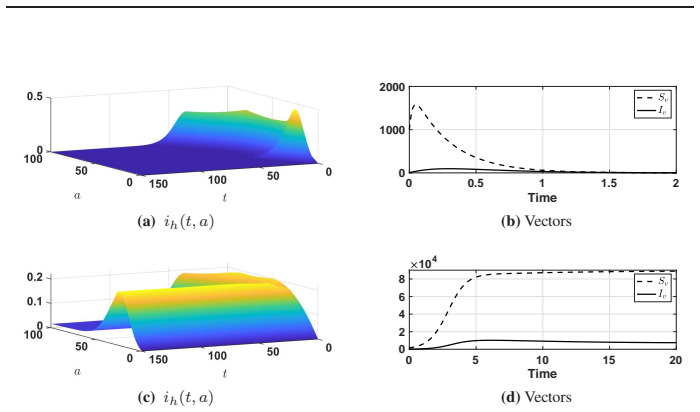
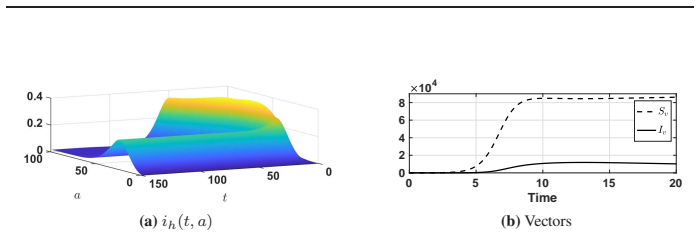
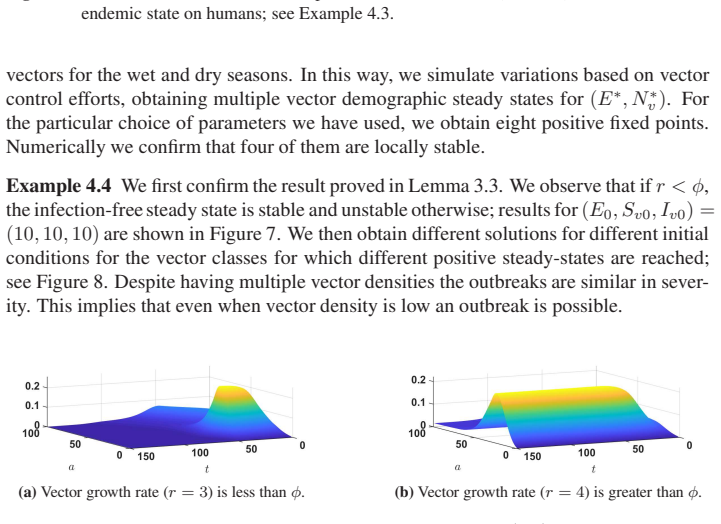
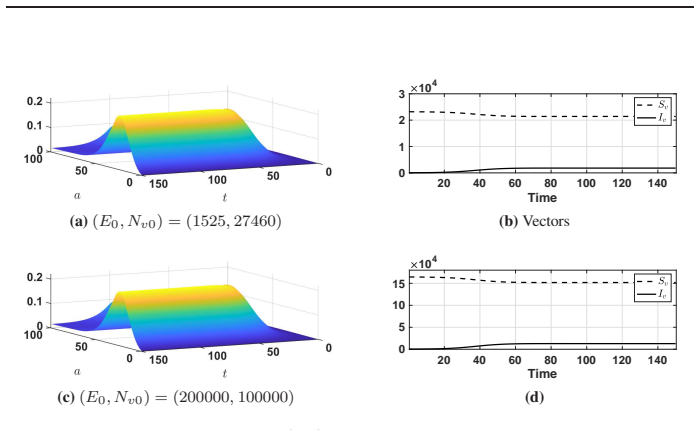
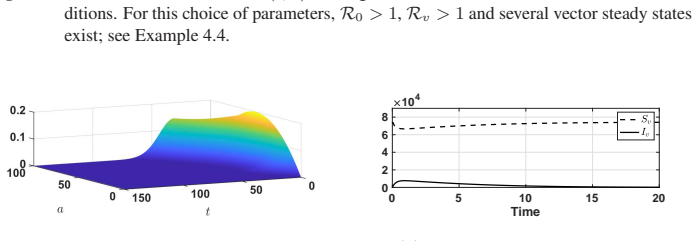
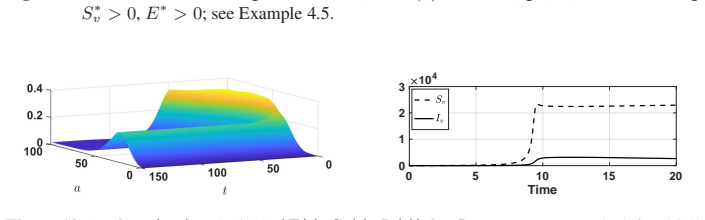
- The existence of multiple vector demographic steady states suggests possible bistability: for the same $R_0$, whether an outbreak takes off could depend on the initial mosquito density, a phenomenon the paper's simulations display but the theory only treats through local stability.
- Introducing periodic (seasonal) parameters in the same framework would likely convert steady endemic states into periodic outbreak orbits; the paper simulates this but does not analyze the stability of such orbits.
- A multi-serotype version with temporary cross-immunity or antibody-dependent enhancement could inherit the same age-structured $R_0$ structure, but that extension is not addressed here.
Signed reviews
Editorial analysis
A structured set of objections, weighed in public.
Referee Report
Summary. The paper constructs a dengue transmission model with an early-life vector stage (E) and adult vectors (Sv, Iv) coupled to an age-structured human host population (Sh, Ih, Rh). The early-life recruitment is modeled through a Kolmogorov-type function f(Nv)=Nv g(Nv), allowing multiple vector demographic steady states. The authors define a vector demographic number Rv and a basic reproductive number R0, prove local stability results for vector equilibria, and state global stability results for the infection-free state when R0<1 and existence/stability of an endemic state when R0>1. The paper closes with an upwind finite-difference scheme and numerical examples, including logistic growth, multiple vector steady states, and seasonality.
Significance. If the results were fully rigorous, the model would be a useful contribution to vector-borne epidemic modeling: the R0 formula in Eq. (7) explicitly incorporates host age structure through p∞(a), β(a), and γ(a), and the vector demographic threshold Rv is consistently derived from the early-life-stage submodel. The numerical section explores a genuinely relevant phenomenon, multiple vector equilibria, and the authors are explicit about the dependence of outcomes on initial vector densities. However, the central global-stability theorem is overstated in the presence of multiple stable vector demographic equilibria, and the proofs of Theorems 3.4 and 3.5 contain significant gaps. These issues are fixable but affect the paper's principal claims.
major comments (3)
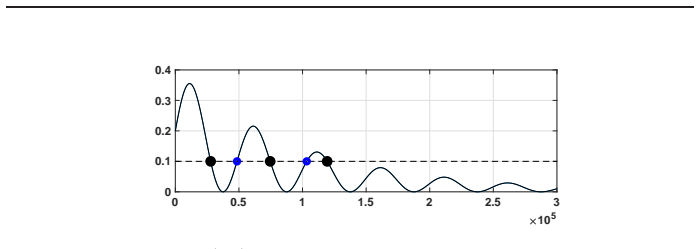
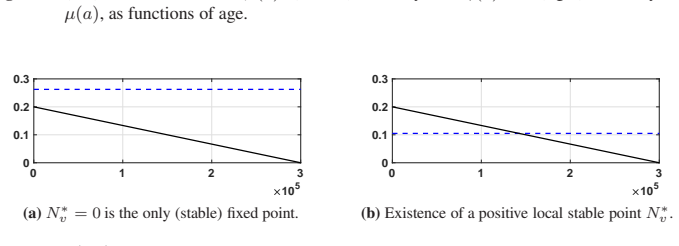
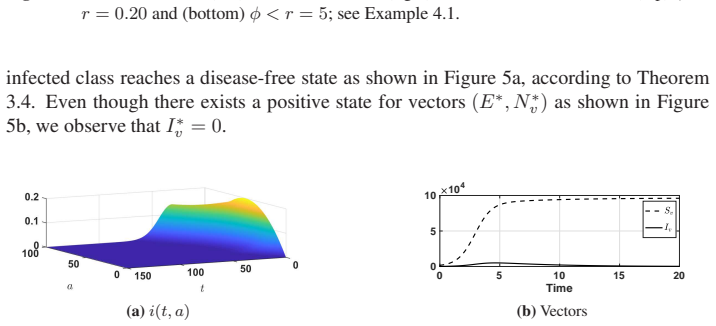
- [Theorem 3.4; Section 3.2; Section 4.2] Theorem 3.4 asserts that when R0<1 the disease-free solution of System (3) is globally asymptotically stable. The system, however, does not have a unique disease-free equilibrium. Lemma 3.1 and Remark 3.2 show that every root N_v of g(N_v)=φ with g'(N_v)<0 yields a locally stable vector demographic state, and Section 4.2 with Eq. (12) and Figure 1 exhibits four such stable roots. For each such N_v, the full system has a disease-free equilibrium (E*,S_v*,I_v*,s_h*,i_h*,r_h*)=((µ_v/δ)N_v,N_v,0,1,0,0), and R0 in Eq. (7) is independent of N_v. If R0<1 and two stable vector states coexist, there are at least two asymptotically stable disease-free equilibria, and a necessary condition for global asymptotic stability of an equilibrium is that it be the unique asymptotically stable equilibrium. Thus Theorem 3.4 as stated is false. The theorem should be qualified, for instance by assuming a unique globally stable vector demographic state, or restated as global attractivity of the set of disease-free equilibria.
- [Theorem 3.4 proof, Eq. (8) and Eq. (9)] The limiting argument in the proof of Theorem 3.4 is not justified. The proof defines limiting quantities B*, I_v*, S_v*, N_v*, then asserts Eq. (8) by replacing p(t,a) with p∞(a) and the ratio Iv(τ+t-a)/Nv(τ+t-a) with I_v*/N_v* inside the integral, and Eq. (9) by treating these limits as if they satisfied the equilibrium relation B*=(µ_v/β_v)I_v*/S_v*. A rigorous proof would need a lemma showing that any sequence t_n with B(t_n)→B* also gives convergence of the relevant shifted vector quantities to a steady state, together with a dominated-convergence argument. In addition, the characteristic formula preceding Eq. (8) is stated only for t>a, yet it is integrated over all a≥0; the contribution from the initial-data part (a≥t) is not controlled. Without these steps, the conclusion I_v*=0 is not established by the argument given.
- [Theorem 3.5] Theorem 3.5 claims that if R0>1 and a stable vector demographic state exists, then there exists one endemic non-uniform stable steady state. The proof establishes only that the fixed-point equation H(B)=B has a positive solution: it defines G(B)=H(B)/B, argues that G(0)=R0>1 and G(1)<1, and concludes existence. It does not analyze the eigenvalues of the full linearization at the constructed endemic state, nor does it otherwise show that this state is locally or globally stable. The assertion that G(B) is strictly decreasing is also stated without proof. The stability part of the theorem is therefore unsupported. Moreover, if multiple stable vector demographic states N exist, applying the argument separately to each N yields multiple candidate endemic states, so the uniqueness claim needs a more precise statement.
minor comments (5)
- [Section 2, System (1)] The boundary condition is written as Iv(t,0)=0, but it should be Ih(t,0)=0 for the infected host age class; as printed, the notation is inconsistent.
- [Section 4, numerical scheme] The update for (Sv)^{j+1} is printed as (Sv)^{j+1}=E^j+Δt[...], which is dimensionally inconsistent; it should read (Sv)^{j+1}=(Sv)^j+Δt[...].
- [Eq. (8)] The integral in Eq. (8) is missing the differential dτ in the displayed formula, which makes the expression harder to parse.
- [References] Reference [11] lacks complete bibliographic details for the proceedings volume and page range, and reference [9] contains a typo in the word 'Vertical'; these should be corrected in the final version.
- [Section 5, Discussion] The discussion states that 'the local and global asymptotic stability of the disease-free equilibrium was determined when R0<1', but in view of the multiple disease-free equilibria discussed in the major comments, the phrase 'the disease-free equilibrium' should be made precise regarding which equilibrium and under which uniqueness assumption.
Circularity Check
No circularity: R0 and Rv are derived from the model's linearization and fixed-point equations, with self-citations only providing modeling context.
full rationale
R0 and Rv are derived directly from the model equations: Rv from the characteristic equation Hv(psi)=1, namely Hv(0)=delta f'(N*_v)/((delta+mu_e) mu_v), and R0 from the eigenvalue condition G(psi)=1 with G(0) yielding Eq. (7). Both are closed-form expressions in the model parameters and the demographic steady state; neither is fitted to data or renamed from an external result. Theorem 3.4's proof uses the equilibrium balance (9), which follows algebraically from Eq. (3c), and combines it with the definition of R0; the argument does not import a conclusion from the self-citation. Citation [11] supplies the early-life-stage modeling template and some numerical parameter values, but it does not carry the stability derivations, so the self-citation is not load-bearing. The skeptic's concern about multiple stable vector demographic equilibria is a mathematical correctness issue about the scope of the global asymptotic stability statement, not a circularity: the claimed theorem does not reduce to its own inputs by definition or by construction. No circular steps are therefore identified.
Assumptions & free parameters
free parameters (1)
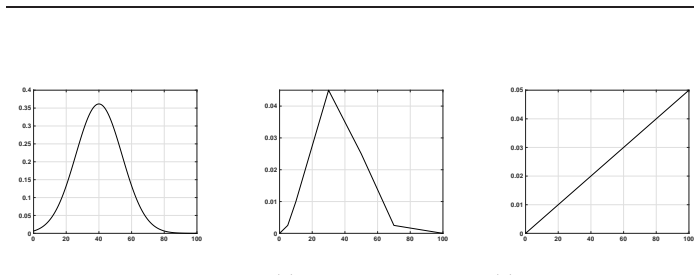
- Illustrative simulation parameters (r, Nmax, c1, c2, beta0, and shapes of beta(a), gamma(a), mu_h(a)) =
Not fully specified; selected by hand for scenarios
assumptions (4)
- domain assumption The host population converges to the stable age distribution n*(a) = Lambda F(a), so p(t,a) approaches p_inf(a) as t tends to infinity.
- domain assumption Egg production is Kolmogorov-type f(Nv) = Nv g(Nv) with g(0) > 0 and g(infinity) = 0, and the equation g(Nv) = phi has at least one positive solution for endemic states.
- domain assumption Proportional mixing holds: p(t,a) = c(a) n(t,a) / integral c(a) n(t,a) da, with age-specific contact rate c(a).
- standard math Existence and uniqueness of solutions to the PDE system (1) are taken for granted; the stability proofs are formal.
Cite this review
Pith. "Pith review of Dengue model with early-life stage of vectors and age-structure within host." pith.science (2026). https://pith.science/paper/DS2OISZF
@misc{pith2026190802434,
  author       = {Pith},
  title        = {Pith review of: Dengue model with early-life stage of vectors and age-structure within host},
  year         = {2026},
  howpublished = {\url{https://pith.science/paper/DS2OISZF}},
  note         = {Machine review of arXiv:1908.02434}
}
read the original abstract
We construct an epidemic model for the transmission of dengue fever with an early-life stage in the vector dynamics and age-structure within hosts. The early-life stage of the vector is modeled via a general function that supports multiple vector densities. The {\it basic reproductive number} and {\it vector demographic threshold} are computed to study the local and global stability of the infection-free state. A numerical framework is implemented and simulations are performed.
Figures
Figures from the paper (8 more)
Reference graph
Works this paper leans on
-
[1]
(2016) ”Some models for epidemics of vector-transmitted diseases”, Infect Dis Model , 1:79–87
Brauer, F.; Castillo-Chavez, C.; Mubayi, A.; Towers, S. (2016) ”Some models for epidemics of vector-transmitted diseases”, Infect Dis Model , 1:79–87
work page 2016
-
[2]
Available from: https:// www.cdc.gov/Dengue/
Center for Disease Control and Prevention , 2019. Available from: https:// www.cdc.gov/Dengue/
work page 2019
-
[3]
(1997) ”Analysis of a dengue disea se transmission model”, Math Biosci, 150:131–151
Esteva, L.; V argas, C. (1997) ”Analysis of a dengue disea se transmission model”, Math Biosci, 150:131–151
work page 1997
-
[4]
(1999) ”A model for dengue disease w ith variable human population”, J Math Biol , 38:220–240
Esteva, L; V argas, C. (1999) ”A model for dengue disease w ith variable human population”, J Math Biol , 38:220–240
work page 1999
-
[5]
(1997) ”Competitive e xclusion in a vector-host model for the dengue fever”, J Math Biol, 35:423–544
Feng, Z; V elasco-Hernández, J.X. (1997) ”Competitive e xclusion in a vector-host model for the dengue fever”, J Math Biol, 35:423–544
work page 1997
-
[6]
(1998) ”Resurgent vector-borne diseases a s a global health problem”, Emerging Infect
Gubler, D.J. (1998) ”Resurgent vector-borne diseases a s a global health problem”, Emerging Infect. Dis., 4:442–450
work page 1998
-
[7]
Harris, E.; Videa, E.; Prez, L.; Sandoval, E.; Tllez, Y .; Perez, M.L.; Delgado, M.A. (2000) ”Clinical, epidemiologic, and virologic featu res of dengue in the 1998 epidemic in Nicaragua”, Am. J. Trop. Med. Hyg., 63(1):5–11
work page 2000
-
[8]
(2014) ”Com- paring dengue and chikungunya emergence and endemic transm ission in A
Manore, C.A.; Hickmann, K.S.; Xu, S.; Wearing, H.J.; Hym an, J.M. (2014) ”Com- paring dengue and chikungunya emergence and endemic transm ission in A. aegypti and A. albopictus”, J Theor Biol , 356:174–191
work page 2014
Show all 12 references
-
[9]
V er- tical Transmission in a Two-Strain Model of Dengue Fever
Murillo, D; Holechek, S; Murillo, A; Sanchez, F.; Castil lo-Chavez, C. (2014) “V er- tical Transmission in a Two-Strain Model of Dengue Fever”, Letters in Biomathe- matics, 1(2):249–271
2014
-
[10]
C omparative estimation of parameters for dengue and chikungunya in Costa Rica from wee kly reported data
Sanchez, F; Barboza, L; Burton, D; Cintron, A. (2018) “C omparative estimation of parameters for dengue and chikungunya in Costa Rica from wee kly reported data”, Journal Ricerche di Matematica, 67(1):163–174
2018
-
[11]
Models for Dengue Transmission and Control
Sanchez, F.; Engman, M.; Harrington, L; Castillo-Chav ez, C. (2006) “Models for Dengue Transmission and Control”, Modeling The Dynamics of Human Diseases: Emerging Paradigms and Challenges . AMS Contemporary Mathematics Series. Gumel A. (Chief Editor), Castillo-Chavez, C., Cle...
2006
-
[12]
(2012) ” Change in host behavior and its impact on the transmission dynamics of dengue”, in International Sympo- sium on Mathematical and Computational Biology, (Eds
Sanchez, F.; Murillo, D.; Castillo-Chavez, C. (2012) ” Change in host behavior and its impact on the transmission dynamics of dengue”, in International Sympo- sium on Mathematical and Computational Biology, (Eds. R.P . Mondaini), BIOMA T 2011:191–203. 16
2012
Reviewed August 14, 2026 · model on record in the stance chip above.
Discussion (0). Continue with ORCID to comment.