REVIEW 3 major objections 4 minor 28 references
Two-Stage Distributed Beamforming Design in Cell-Free Massive MIMO ISAC Systems
T0 review · 3 major / 4 minor · reviewed 2026-08-10 · deepseek-v4-flash
Pith's one-line read A two-stage split of beamforming computation cuts cell-free ISAC fronthaul load while keeping performance close to centralized design.
desk verdict A genuinely useful distributed beamforming architecture for CF-ISAC, but the central 'comparable performance' claim leans on an unspecified centralized baseline that needs to be pinned down before the paper is fully verifiable. read the letter →
The pith
A machine-rendered reading of the paper's core claim, the machinery that carries it, and where it could break.
The reading
What carries the argument
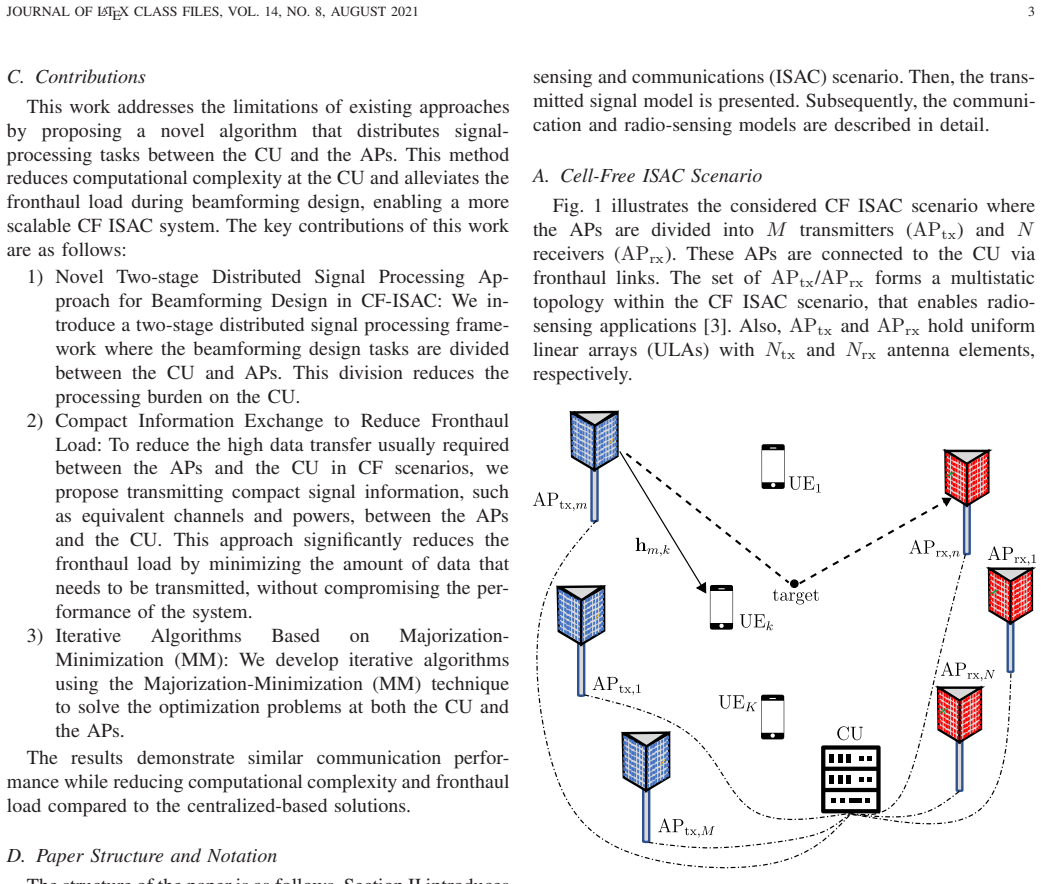
The engine is the two-stage precoder decomposition combined with null-space interference cancellation and majorization-minimization. Null-space projection turns the multi-user SINR objective into a sum of projected desired-signal powers that each access point can compute from its local channel, eliminating multi-user interference without exchanging full channel matrices. The remaining non-convex problems, one at each access point and one at the central unit, are replaced by convex surrogates built from a first-order Taylor lower bound and a linearized sensing constraint, and the two stages are iterated alternately. The compact scalars exchanged per iteration, namely the equivalent channels $z_{m,k}$ and $g_{m,k}$, the precoder powers $w_{m,k}$, and the central weights $\delta_{m,k}$ (with derived coefficients $\alpha_{m,k}$ and $\beta_{m,k}$), are what make the fronthaul count independent of $N_{\mathrm{tx}}$.
What would settle it
Pick a target angle that coincides with or lies very close to one of the user channel angles, compute the projected steering-vector gains $\|\mathbf{P}_{m,k}^H\mathbf{a}_{N_{\mathrm{tx}}}(\theta_m)\|^2$, and check whether any feasible precoder can meet the sensing threshold; if these gains are near zero, the optimization problem becomes infeasible and the claimed sensing performance cannot be delivered.
Extended reading notes
Core claim
The central discovery is that the joint beamforming problem decomposes with little loss: every precoding vector is written as $\mathbf{f}_{m,k}=\delta_{m,k}\mathbf{w}_{m,k}$, where $\mathbf{w}_{m,k}$ is computed locally at the $m$-th access point and $\delta_{m,k}$ is a scalar weight computed at the central unit. Inter-user interference is cancelled locally by projecting each local precoder into the null space of the other users' channels, so the access points optimize in parallel with no inter-access-point channel sharing. The two sides exchange only equivalent communication channels, equivalent sensing channels, and precoder powers, giving a total of $6N_{\mathrm{iter}}MK$ complex scalars over $N_{\mathrm{iter}}$ iterations, independent of the antenna count $N_{\mathrm{tx}}$; the centralized baseline exchanges $2N_{\mathrm{tx}}MK$ scalars. In the reported scenario the sum SINR stays close to the centralized solution across the tested sensing thresholds, and three iterations already reach roughly 98--99% of the final value.
Load-bearing premise
The design stands on the assumption that after each access point projects its sensing direction into the null space of its users' interference channels, the remaining energy pointed at the sensing target is still enough to satisfy the sensing SNR requirement.
Editorial extensions
If this is right
- Beamforming-design fronthaul becomes independent of the antenna count: the total exchange is $6N_{\mathrm{iter}}MK$ complex scalars versus $2N_{\mathrm{tx}}MK$ for the centralized approach.
- Central-unit computational complexity drops from $O(N_{\mathrm{tx}}^3M^3K^3\sqrt{N_{\mathrm{tx}}MK})$ to $O(M^3K^3\sqrt{MK})$, because the central unit optimizes only $MK$ scalar weights.
- A small number of exchange iterations is sufficient: about three iterations reach 99% of the converged sum SINR at $\Delta=30$ dB and about 98% at $\Delta=40$ dB.
- Increasing the sensing requirement $\Delta$ shifts power toward the target and lowers the communication sum SINR, and the distributed design tracks the centralized trade-off curve closely.
Reading between the lines
- Because the exchanged quantities depend only on $M$, $K$, and the iteration count, the same compact-exchange pattern should transfer to other distributed beamforming problems that summarize each access point through aggregate equivalent channels, not only cell-free ISAC.
- The method's practical limit is likely the null-space projection: if a target direction nearly coincides with a user channel direction, the projected sensing gain may be too small to meet the sensing constraint, so a safeguard that detects low projected gain and reconfigures user-to-AP assignments would be a natural extension.
- Extending to multiple targets would presumably require one sensing constraint per target and extra scalar sensing gains per iteration, trading some of the fronthaul saving for broader sensing coverage.
Editorial analysis
A structured set of objections, weighed in public.
Referee Report
Summary. The paper proposes a two-stage distributed beamforming design for cell-free massive MIMO integrated sensing and communication (ISAC) systems. The precoder at each access point is decomposed into a local precoder computed at the AP and a complex weight computed at the central unit, enabling a division of processing that reduces fronthaul exchange. Inter-user interference is explicitly zero-forced through null-space projection at each AP, and the resulting nonconvex optimization problems are solved via majorization-minimization, with convex surrogates solved by standard tools. Numerical results show convergence within a few iterations, a sensing-communication trade-off, and a fronthaul load independent of the number of transmit antennas, while claiming communication performance close to a centralized MM-based solution.
Significance. If the claims are correct, the paper offers a sensible scalability-oriented design for cell-free ISAC, with two concrete structurally valid advantages: the per-iteration fronthaul exchange scales as O(M K) rather than O(N_tx M K), and the CU complexity scales independently of N_tx. The MM surrogates are theoretically grounded by a proved subset relaxation (Proposition 1), and the algorithmic description is sufficiently detailed to be implemented. The main open questions concern the reproducibility and fairness of the performance comparison against an unspecified centralized baseline, and the feasibility of the sensing constraint after null-space projection in adversarial channel-target alignments.
major comments (3)
- [Section IV-F, Fig. 6] The central claim of 'comparable performance to centralized methods' is supported only by an unspecified baseline. Footnote 1 states that the centralized problem (18) is handled with the MM technique, but does not specify the surrogate function, the initialization, the number of iterations, or the convergence criteria. Since (18) is nonconvex, the quality of that baseline depends crucially on these choices, and the small gap reported in Fig. 6 could be an artifact of a poor local optimum. The paper needs to either rigorously specify the centralized algorithm (e.g., in an appendix) or soften the claim to 'close to the centralized MM benchmark' and provide the associated parameters.
- [Section V] The communication noise variance σ_k^2 is never specified in the numerical setup, although it appears directly in the SINR expression (9) and therefore determines the absolute values of the sum SINR in Figs. 4 and 6. Without this parameter, the reported SINR values cannot be reproduced by an independent implementation. Please state the value used (e.g., σ_k^2 = 1, 0 dB, or per-user noise power) and specify whether the same value is used for the centralized and distributed solutions.
- [Section IV-B, Figs. 5-6] The feasibility of the sensing constraint after null-space projection is not analyzed. When the target angle θ_m is aligned with the subspace spanned by the interference channels used to build P_{m,k}, the projected steering vector a_{m,k} = P_{m,k}^H a_{Ntx}(θ_m) can have a very small norm, making the sensing SNR constraint (19c) or (23c) infeasible for the reported Δ values. The paper does not discuss how infeasible random channel realizations are handled in the Monte Carlo averages, nor does it report the distribution of the projected steering-vector gains for the chosen θ_m. Please address this by either providing a feasibility analysis, reporting the number of discarded realizations, or selecting experimental angles that avoid adversarial alignments.
minor comments (4)
- [Equations (23c), (24c)] The steering vector is written as a_k^H(θ_m), but the projected steering vector was defined as a_{m,k} in (21). Use a_{m,k} consistently to avoid confusion with the array response a_{Ntx}(θ_m).
- [Algorithm 1] Typographical errors: 'distibuted' in the Algorithm 1 title and 'Distributted' in its caption should be corrected to 'distributed'.
- [Algorithm 1, step 4] The initialization g_{m,k} = (1/M) sqrt(Δ̃/K) seems inconsistent with its definition g_{m,k} = a_{m,k}^H w_{m,k} in Section IV-D, which is a channel-dependent quantity. Please clarify the rationale or the intended meaning of this initialization.
- [Section V] The paper does not specify the number of Monte Carlo realizations used for the mean curves in Figs. 4 and 6 beyond '100 random realizations' for Fig. 4; please state the number used for Fig. 6 as well.
Circularity Check
No significant circularity: the derivation is self-contained, and the only self-citation is re-proved in the paper.
full rationale
No circular step is present. The derivation chain is self-contained: the system model defines SINR in (9) and sSNR in (14) independently of the proposed algorithm; the factorization F_m = W_m Δ_m in (15) is a mathematical reparameterization, not an assumption of the conclusion. The null-space projection in (21)-(22) is a construction that cancels MUI, and the resulting optimization problems (23) and (26) are solved with MM surrogates whose feasibility guarantee is Proposition 1, proved in the paper itself; the citation to [13] for this relaxation is not load-bearing because the same proposition and proof are given in Section IV-D. The fronthaul comparison in Section IV-F is a direct algebraic count of exchanged scalars (6NiterMK versus 2NtxMK), not a fitted or predicted quantity. The centralized baseline is admittedly not detailed in footnote 1, which is a reproducibility limitation and a possible fairness concern for the comparison, but it is not a case where an output is equivalent to an input by construction: 'comparable performance' is an empirical claim against a self-constructed baseline, not a quantity forced by definition or by fitting. Therefore the paper does not exhibit self-definitional, fitted-input, or self-citation load-bearing circularity.
Assumptions & free parameters
free parameters (6)
- Communication noise variance sigma_k^2
- Number of channel paths L =
10
- Sensing channel variance sigma_m,n^2 =
-10 dB
- Sensing receiver noise variance sigma_n^2 =
-20 dB
- Per-AP power budget P_m =
1
- Number of algorithm iterations Niter =
3 (and 10 in Fig. 4)
assumptions (8)
- domain assumption Perfect CSI is available locally at each APtx.
- domain assumption Sensing channel gains alpha_m,n follow the Swerling I model and are independent across AP pairs.
- domain assumption Sensing channel between each APtx and APrx is a single LoS path via the target.
- domain assumption Each APtx can compute the null-space projection of its local channels without coordination.
- standard math The MM surrogate (24c) provides a feasible subset of the original sensing constraint, per Proposition 1.
- ad hoc to paper The alternating updates between APs and CU converge to a good stationary point within Niter iterations.
- domain assumption The interference channel matrix H_m,k has full row rank so that a non-trivial null space exists.
- ad hoc to paper The centralized baseline used for comparison is solved to its MM stationary point and is a fair performance reference.
Cite this review
Pith. "Pith review of Two-Stage Distributed Beamforming Design in Cell-Free Massive MIMO ISAC Systems." pith.science (2026). https://pith.science/paper/DSBJ5HKP
@misc{pith2026250110136,
  author       = {Pith},
  title        = {Pith review of: Two-Stage Distributed Beamforming Design in Cell-Free Massive MIMO ISAC Systems},
  year         = {2026},
  howpublished = {\url{https://pith.science/paper/DSBJ5HKP}},
  note         = {Machine review of arXiv:2501.10136}
}
read the original abstract
Integrating radio-sensing functionalities into future cell-free (CF) wireless networks promises efficient resource utilization and facilitates the seamless roll-out of applications such as public safety and smart infrastructure. While the beamforming design problem for the CF integrated sensing and communication (ISAC) paradigm has been addressed in the literature, existing methods rely on centralized signal processing, leading to fronthaul load and scalability issues. This paper presents a two-stage beamforming design for the CF ISAC paradigm, aiming to significantly reduce the fronthaul load by distributing the signal processing tasks between the central unit (CU) and the access points (APs). The design optimizes the sum signal-to-interference-plus-noise ratio (SINR) for communication users, subject to per-AP power constraints and signal-to-noise ratio (SNR) requirements for radio-sensing purposes. The resulting optimization problems are non-convex and challenging to solve. To address this, we employ a majorization-minimization (MM) approach, which decomposes the problem into simpler convex subproblems. The results show that the two-stage beamforming design achieves performance comparable to centralized methods while substantially reducing the fronthaul load, thus minimizing data transmission requirements over the fronthaul network. This advancement highlights the potential of the proposed method to enhance the efficiency and scalability of cell-free MIMO ISAC systems.
Figures


Figures from the paper (3 more)


Reference graph
Works this paper leans on
-
[21]
U. Demirhan and A. Alkhateeb, ”Cell-Free ISAC MIMO Syst ems: Joint Sensing and Communication Beamforming,” arXiv:2301 .11328, Feb. 2024. [Online]. Available: https://arxiv.org/abs/2 301.11328
work page 2024
- [25]
-
[1]
B. Paul, A. R. Chiriyath and D. W. Bliss, ”Survey of RF comm unications and sensing convergence research,” IEEE Access , vol. 5, pp. 252-270, Dec. 2017
work page 2017
-
[2]
F. Liu, C. Masouros, A. P . Petropulu, H. Griffiths and L. Ha nzo, ”Joint radar and communication design: applications, state-of-t he-art, and the road ahead,” IEEE Trans. Commun. , vol. 68, no. 6, pp. 3834-3862, Jun. 2020
work page 2020
- [3]
-
[4]
Y . Cui, F. Liu, X. Jing, and J. Mu, ”Integrating Sensing an d Communi- cations for Ubiquitous IoT: Applications, Trends, and Chal lenges,” IEEE Netw., vol. 35, no. 5, pp. 158-167, Oct. 2021
work page 2021
-
[5]
J. A. Zhang et al., ”Enabling Joint Communication and Rad ar Sensing in Mobile Networks—A Survey,” IEEE Commun. Surv. Tutor ., vol. 24, no. 1, pp. 306-345, Oct. 2021
work page 2021
-
[6]
F. Liu et al., ”Seventy Y ears of Radar and Communications : The road from separation to integration,” IEEE Signal Process. Mag. , vol. 40, no. 5, pp. 106-121, Jul. 2023
work page 2023
Show all 28 references
-
[7]
[Online]
3GPP , ”Feasibility Study on Integrated Sensing and Comm unication, TR 22.837 (Release 19),” 2023. [Online]. Available: https: //portal.3gpp.org/desktopmodules/Specifications/Spec ificationDetails. aspx?specificationId=4044
2023
-
[8]
[Online]
3GPP , ”Service requirements for Integrated Sensing and Communication, TS 22.137 (Release 19),” 2023. [Online]. Available: https://portal.3gpp.org/desktopmodules/Sp ecifications/ SpecificationDetails.aspx?specificationId=4198
2023
-
[9]
Giordani, M
M. Giordani, M. Polese, M. Mezzavilla, S. Rangan, and M. Z orzi, ”Toward 6G Networks: Use Cases and Technologies,” IEEE Commun. Mag., vol. 58, no. 3, pp. 55-61, Mar. 2020
2020
-
[10]
Liu et al
F. Liu et al. , ”Integrated Sensing and Communications: Toward Dual- Functional Wireless Networks for 6G and Beyond,” IEEE J. Sel. Areas Commun., vol. 40, no.6, pp.1728-1767, Jun. 2022
2022
-
[11]
F. Liu, C. Masouros, A. Li, H. Sun and L. Hanzo, ”MU-MIMO C ommu- nications With MIMO Radar: From Co-Existence to Joint Trans mission,” IEEE Trans. Wirel. Commun. , vol. 17, no. 4, pp. 2755-2770, Apr. 2018
2018
-
[12]
X. Liu, T. Huang, N. Shlezinger, Y . Liu, J. Zhou and Y . C. E ldar, ”Joint Transmit Beamforming for Multiuser MIMO Communicat ions and MIMO Radar,” IEEE Trans. Signal Process. , vol. 68, pp. 3929-3944, Jun. 2020
2020
-
[13]
Leyva, D
L. Leyva, D. Castanheira, A. Silva, and A. Gameiro, ”Hyb rid Beam- forming Design for Communication-Centric ISAC,” IEEE Sens. J. , vol. 24, no. 13, pp. 21179-21190, May. 2024
2024
-
[14]
Li and M
Y . Li and M. Jiang, ”Joint Transmit Beamforming and Rece ive Filters Design for Coordinated Two-Cell Interfering Dual-Functio nal Radar- Communication Networks,” IEEE Trans. V eh. Technol., vol. 71, no. 11, pp. 12362-12367, Nov. 2022
2022
-
[15]
L. Chen, X. Qin, Y . Chen and N. Zhao, ”Joint Waveform and C luster- ing Design for Coordinated Multi-Point DFRC Systems,” IEEE Trans. Commun., vol. 71, no. 3, pp. 1323-1335, Mar. 2023
2023
-
[16]
Cheng, Y
G. Cheng, Y . Fang, J. Xu and D. W. K. Ng, ”Optimal Coordina ted Transmit Beamforming for Networked Integrated Sensing and Commu- nications,” IEEE Trans. Wirel. Commun. , vol. 23, no. 8, pp. 8200-8214, Aug. 2024
2024
-
[17]
H. Q. Ngo, A. Ashikhmin, H. Y ang, E. G. Larsson, and T. L. M arzetta, ”Cell-Free Massive MIMO V ersus Small Cells,” IEEE Trans. Wirel. Commun., vol. 16, no. 3, pp. 1834-1850, Mar. 2017
2017
-
[18]
Behdad, ¨O
Z. Behdad, ¨O. T. Demir, K. W. Sung, E. Bj¨ ornson and C. Cavdar, ”Power Allocation for Joint Communication and Sensing in Cell-Fre e Massive MIMO,” GLOBECOM 2022 - 2022 IEEE Global Communications Con- ference, Rio de Janeiro, Brazil, Jan. 2023
2022
-
[19]
Behdad, ¨O
Z. Behdad, ¨O. T. Demir, K. W. Sung, E. Bj¨ ornson and C. Cavdar, ”Multi- Static Target Detection and Power Allocation for Integrate d Sensing and Communication in Cell-Free Massive MIMO,” IEEE Trans. Wirel. Commun., vol. 23, no. 9, pp. 11580-11596, Sept. 2024
2024
-
[20]
Cao and Q
Y . Cao and Q. -Y . Y u, ”Joint Resource Allocation for User -Centric Cell- Free Integrated Sensing and Communication Systems,” IEEE Commun. Lett., vol. 27, no. 9, pp. 2338-2342, Sept. 2023
2023
-
[22]
W. Mao, Y . Lu, J. Liu, B. Ai, Z. Zhong and Z. Ding, ”Beamfor ming Design in Cell-Free Massive MIMO Integrated Sensing and Com munica- tion Systems,” GLOBECOM 2023 - 2023 IEEE Global Communications Conference, Kuala Lumpur, Malaysia, 2023
2023
-
[23]
W. Mao, Y . Lu, C. -Y . Chi, B. Ai, Z. Zhong and Z. Ding, ”Communication-Sensing Region for Cell-Free Massive MIMO ISAC Systems,” IEEE Trans. Wirel. Commun. , early access, Apr. 2024
2024
-
[24]
S. Liu, R. Liu, M. Li, and Q. Liu, ”Cooperative Cell-Free ISAC Networks: Joint BS Mode Selection and Beamforming Design,” arXiv preprint: 2305.10800, 2024. [Online]. Avai lable: https://arxiv.org/abs/2305.10800
2024 arXiv
-
[26]
Ayach, S
O. Ayach, S. Rajagopal, S. Surra, Z. Piand and R. Heath, ” Spatially Sparse Precoding in millimeter wave MIMO systems,” IEEE Trans. Wireless Commun., V ol. 13, no. 3, p. 1499–1513, Mar. 2014
2014
-
[27]
M. A. Richards, J. Scheer, W. A. Holm, and W. L. Melvin, Pr inciples of modern radar. Citeseer, 2010, vol. 1
2010
-
[28]
CVX: Matlab software for discipli ned convex programming, version 2.1,
M. Grant and S. Boyd, “CVX: Matlab software for discipli ned convex programming, version 2.1,” http://cvxr.com/cvx, Mar. 201 4
Reviewed August 10, 2026 · model on record in the stance chip above.
Discussion (0). Continue with ORCID to comment.