REVIEW 2 major objections 6 minor 18 references
Sharp asymptotic stability of the incompressible porous media equation
T0 review · 2 major / 6 minor · reviewed 2026-08-15 · deepseek-v4-flash
Pith's one-line read Near a stably stratified density, the incompressible porous media equation is asymptotically stable in $H^k$ for every real $k>2$, with convergence to the measure-preserving stratification of the initial data at rate $t^{-k/2}$; the…
desk verdict Sharp k>2 stability for IPM is a genuine result, but Proposition 5.2's decay proof cites a false imported lemma; the gap is repairable and the theorem likely holds. read the letter →
The pith
A machine-rendered reading of the paper's core claim, the machinery that carries it, and where it could break.
The reading
What carries the argument
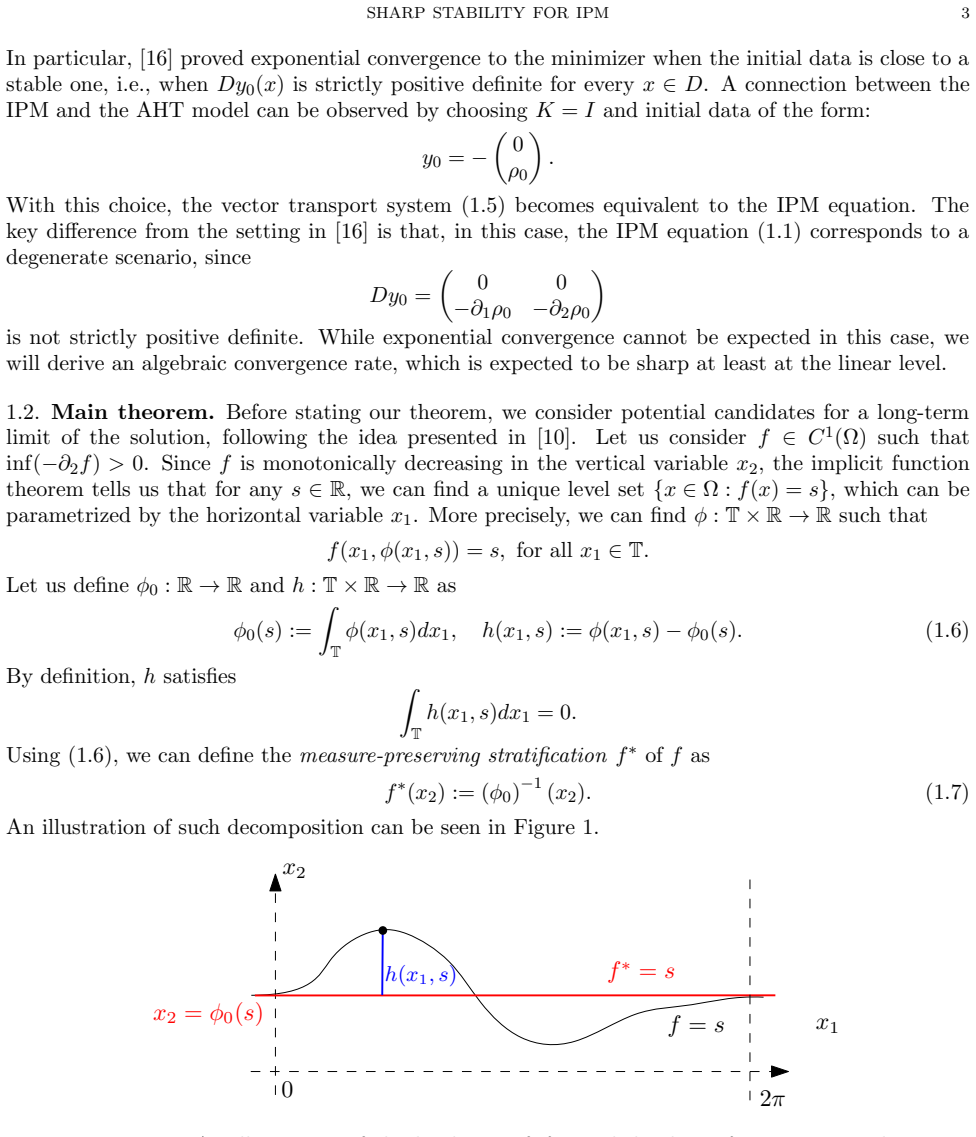
The central object is the potential energy $E(\rho(t))=\lim_{s\to\infty}\left(\int_{\{-s<\rho<s\}}\rho x_2\,dx - \int_{\{-s<\rho_0^*<s\}}\rho_0^* x_2\,dx\right)$, which stays nonnegative, satisfies $dE/dt=-\|u\|_{L^2}^2$, and is comparable to $\|\rho-\rho_0^*\|_{L^2}^2$; the measure-preserving stratification $\rho_0^*$ is its unique minimizer. Because $E$ is not coercive against $\|u\|_{L^2}$, the argument uses a level-set decomposition to prove the interpolation inequality $\|u\|_{L^2}^2 \ge C E^{k/(k-1)} \|u\|_{H^k}^{-2/(k-1)}$, which turns the energy identity into a differential inequality with polynomial decay $E(t)\le C\delta t^{-k}$. The second load-bearing ingredient is a family of commutator estimates for the transport term that lose no derivatives and control the evolution of $\|\theta\|_{H^k}$ and of second derivatives of $\theta$ using only $\|\nabla u_2\|_{L^\infty}$, uniformly in $k>2$.
What would settle it
The decisive check is to compare the inequality available at (2.31), $dE/dt \le -C E^{k/(k-1)} \|u\|_{H^k}^{-2/(k-1)}$, with the hypotheses of [17, Lemma 2.1]: the lemma as printed requires $f'\le -a(t)-\alpha f^n$, and with $a=0$ its conclusion would assert $f(t)\le 0$ for positive $f$, which is false. If the intended inequality can be rewritten as $dE/dt \le -C\|u\|_{H^k}^2 - C' E^{k/(k-1)}$ or another admissible form, the decay step is sound; otherwise the model solution of $f'=-C f^{k/(k-1)}$, which decays like $t^{-(k-1)}$ rather than $t^{-k}$, shows that the printed lemma alone cannot deliver the claimed rate.
Extended reading notes
Core claim
Theorem 1.1 asserts that if $\rho_s$ is a stratified density with $\inf(-\partial_2\rho_s)>0$ and $\partial_2\rho_s \in C^{k+1}$ for some $k>2$, and if $\|\rho_0-\rho_s\|_{H^k}\le \varepsilon$, then the IPM equation has a unique global solution with $\|\rho(t)-\rho_s\|_{H^k}\le C\varepsilon$ for all $t$, and $\|\rho(t)-\rho_0^*\|_{L^2}\le C\varepsilon t^{-k/2}$, where $\rho_0^*$ is the measure-preserving stratification of the initial density. The regularity condition $k>2$ is optimal because the stratified state is strongly ill-posed in $H^2$, and the algebraic rate is sharp because a solution of the linearized equation can be chosen whose $L^2$ norm decays no faster than $t^{-k/2-\epsilon}$.
Load-bearing premise
The load-bearing premise is that the ODE comparison lemma imported from [17] can be applied to $dE/dt \le -C E^{k/(k-1)} \|u\|_{H^k}^{-2/(k-1)}$ to yield $E(t)\le C\delta t^{-k}$, even though the lemma as printed assumes $f'\le -a(t)-\alpha f^n$ and gives no bound when $a=0$; if that comparison cannot be justified, the sharp rate and the bootstrap do not follow from the written argument.
Editorial extensions
If this is right
- For every $k>2$, a small $H^k$ perturbation of a stable stratified density exists globally and settles to the unique measure-preserving rearrangement of its initial data, with a quantitative $t^{-k/2}$ rate in $L^2$.
- The threshold $k>2$ is final: no stability result of this type can hold in $H^2$, in view of the known ill-posedness there, and perturbations in $H^{2-\epsilon}$ can grow.
- The nonlinear decay rate equals the linearized decay rate, so the nonlinearity does not degrade the sharp linear prediction.
- The corollary $\int_0^T \|\nabla u_2\|_{L^\infty}dt \le \sqrt{\delta}$ independent of $T$ supplies the smallness that closes the bootstrap, yielding global existence in addition to decay.
Reading between the lines
- Editorial inference: the same potential-energy comparison, with the interpolation exponent $k/(k-1)$, plausibly sets the optimal regularity threshold and algebraic rate for the damped 2D Boussinesq analogue mentioned in the paper, although the details are not worked out here.
- Editorial inference: replacing the imported ODE comparison step by a self-contained lemma for $f'\le -C f^{k/(k-1)} A(t)^{-1/(k-1)}$ with $\int_0^T A \le \delta$ would make the decay proof independent of the exact hypotheses of [17, Lemma 2.1] and would follow directly from (2.31) together with the time-averaged bound.
- Editorial inference: a numerical run of the IPM equation near $\rho_s=-x_2$ with $H^k$ data for $k$ just above 2 should show $\|\rho(t)-\rho_0^*\|_{L^2}\sim t^{-k/2}$; observing a slower power would locate the obstruction in the energy-decay step rather than in the commutator estimates.
Signed reviews
Editorial analysis
A structured set of objections, weighed in public.
Referee Report
Summary. The manuscript studies the incompressible porous media equation on the periodic strip T×R near a stably stratified steady state ρs satisfying (1.4). The main result, Theorem 1.1, asserts asymptotic stability in H^k for every real k>2: small H^k perturbations lead to global unique solutions with a uniform H^k bound, and the solution converges to the measure-preserving stratification ρ*_0 of the initial data at the rate ||ρ(t)-ρ*_0||_{L^2} ≤ Cε t^{-k/2}. Remarks 1.2-1.3 interpret the rate and the regularity threshold as sharp, using an explicit linear lower bound in Appendix A and the known H^2 ill-posedness. The proof combines a potential-energy functional E(t) with decay analysis in Section 5, anisotropic commutator estimates in Section 4, and a bootstrap argument in Section 6.
Significance. If the result is correct, it closes the regularity gap for this problem, improving the H^3 threshold of [17] to the H^{2+} endpoint and identifying the sharp algebraic decay rate. The two main ingredients—the non-coercive potential-energy inequality (2.31) and the commutator estimates valid for all real k>2—are genuine contributions, and the linear sharpness construction in Appendix A is explicit. The paper is clearly written and most estimates are presented in detail. However, the proof as written contains a gap in the central decay Proposition 5.2, caused by an invalid imported ODE lemma. The gap appears repairable by a direct Jensen argument, so the overall result is likely salvageable, but the manuscript in its current form does not establish the advertised rate.
major comments (2)
- [Section 2, Lemma 2.1, and Section 5, Proposition 5.2] Lemma 2.1 is false as printed: with a≡0 it asserts f(t)≤0 for every nonnegative solution of f'≤-α f^n, which is impossible for positive initial data. Moreover, the differential inequality actually derived in Proposition 5.2, namely E' ≤ -C E^{k/(k-1)} ||u||_{H^k}^{-2/(k-1)}, is not of the form f'≤-a-α f^n: the coefficient of E^{k/(k-1)} is time-dependent and involves a negative power of ||u||_{H^k}, not a constant α plus an additive -a(t). The application of Lemma 2.1 with a(t)=C||u(t)||^2_{H^k}, n=k/(k-1), α=1/(k-1) therefore does not yield E(t)≤Cδ/t^k. This gap is load-bearing because Proposition 5.2 supplies both (5.5) and (5.6), which are used in Proposition 5.3 and in the Section 6 bootstrap. The conclusion appears recoverable: setting G=E^{-1/(k-1)}, the inequality gives G' ≥ c ||u||_{H^k}^{-2/(k-1)}; integrating and applying Jensen's inequality with ∫_0^t ||u||^2_{H^k}≤δ yields G(t) ≥ c δ^{-1/(k-1)} t^{k/(k-1)}, hence E(t)≤Cδ/t^k. I recommend replacing the invalid lemma by a correct ODE comparison or integrating this Jensen argument directly, and removing the citations to Lemma 2.1 in Proposition 5.2.
- [Section 5, Proposition 5.3, equation (5.20)] The displayed estimate for g_2 has an algebraic slip in the power of δ. Since g_2 contains a factor ||θ||_{H^k} and (5.1) gives ||θ||_{H^k}≤√δ, the factor outside the first term on the right-hand side should be √δ, not δ. The resulting bound is C M^{1/2}δ^{3/2}/t^k, rather than C M^{1/2}δ^2/t^k. This does not destroy the contradiction argument because for δ≤1/M the final right-hand side can still be absorbed into Cδ/t^{k-1}, but the displayed chain of inequalities as written is not correct and should be fixed.
minor comments (6)
- [Section 2, Lemma 2.3] The statement of Lemma 2.3 writes ∫_T^t f(t)ds, which should read ∫_t^T f(s)ds; the proof makes the intended meaning clear.
- [Section 2, equation (2.2)] In the definition of |D_2|^k f, the Fourier transform variable is written as ξ_1; it should be ξ to match the notation used elsewhere.
- [Section 3, after (3.3)] "Threfore" should be "Therefore".
- [Section 2.3, proof of Lemma 2.5] "diffierentiating" should be "differentiating".
- [Section 4, proof of Lemma 4.1] "Soboelv" should be "Sobolev" in the two occurrences near equations (4.45)-(4.51).
- [Section 6, after (6.11)] When Proposition 5.2 is invoked, the constant in E(t)≤Cε^2/t^k should first be written as E(t)≤C M ε^2/t^k before absorbing M into the generic constant, since the a priori size in (6.4) is Mε^2.
Circularity Check
No circular reduction; the main rate step rests on a mis-stated and misapplied Lemma 2.1 imported from [17], which is a correctness gap rather than circularity.
full rationale
The claimed rate (1.9) is not produced by fitting a parameter or by defining the target into the assumptions. The potential-energy functional E is defined independently via the measure-preserving stratification (2.29), and the two-sided bound C^{-1}||ρ-ρ*_0||^2_{L2} ≤ E ≤ C||ρ-ρ*_0||^2_{L2} is proved in Proposition 2.6. The variational inequality (2.31) is derived from level-set geometry and Sobolev interpolation in the same proposition, and the high-regularity estimates in Section 4 are proved in the paper. No equation in these sections is equivalent, by construction, to the convergence rate it feeds. The H^2 ill-posedness benchmark [2] and the H^{2-ε} instability [15] are external results, not consequences of Theorem 1.1. What should be flagged is not circularity but missing support: Proposition 5.2 obtains E(t) ≤ Cδ/t^k by 'Applying Lemma 2.1' from [17], an unproved lemma whose printed hypotheses (f' ≤ -a - α f^n) are not satisfied by the displayed inequality E' ≤ -C E^{k/(k-1)} ||u||^{-2/(k-1)}_{H^k}, and which is false in the case a ≡ 0. Because (5.5)-(5.6) are used in Proposition 5.3, Corollary 5.4 and Section 6, this is a real gap in the printed proof. It does not make the theorem circular: the intended comparison (e.g., G = E^{-1/(k-1)} gives G' ≥ c ||u||^{-2/(k-1)}_{H^k}, and Jensen converts ∫||u||^2_{H^k} ≤ δ into E(t) ≤ Cδ/t^k) is a short independent argument, and no fitted quantity is renamed as a prediction. Score 2 reflects the self-cited, load-bearing nature of Lemma 2.1 without treating the gap as circular equivalence.
Assumptions & free parameters
assumptions (5)
- domain assumption Assumption (1.4): inf(-∂2ρ_s)>0 and ||∂2ρ_s||_{C^{k+1}}<∞
- domain assumption Assumption (2.8): lim_{|x2|→∞} sup_{x1} √|x2| |f-ρ_s| = 0
- standard math Lemma 2.1 ODE decay lemma from [17]
- standard math Kato-Ponce commutator estimate (4.1)
- domain assumption Local well-posedness in H^k from [8]
Cite this review
Pith. "Pith review of Sharp asymptotic stability of the incompressible porous media equation." pith.science (2026). https://pith.science/paper/DSTGQCJG
@misc{pith2026250505165,
  author       = {Pith},
  title        = {Pith review of: Sharp asymptotic stability of the incompressible porous media equation},
  year         = {2026},
  howpublished = {\url{https://pith.science/paper/DSTGQCJG}},
  note         = {Machine review of arXiv:2505.05165}
}
abstract
In this paper, we prove the asymptotic stability of the incompressible porous media (IPM) equation near a stable stratified density, for initial perturbations in the Sobolev space $H^k$ with any $2<k \in\mathbb{R}$. While it is known that such a steady state is unstable in $H^2$, our result establishes a sharp stability threshold in higher-order Sobolev spaces. The key ingredients of our proof are twofold. First, we extract long-time convergence from the decay of a potential energy functional$-$despite its non-coercive nature$-$thereby revealing a variational structure underlying the dynamics. Second, we derive refined commutator estimates to control the evolution of higher Sobolev norms throughout the full range of $k>2$.
Figures
Reference graph
Works this paper leans on
-
[17]
Jaemin Park, Stability analysis of the incompressible porous media equation and the Stokes transport system via energy structure, arXiv preprint arXiv:2403.14187 (2024)
arXiv 2024
- [1]
-
[2]
Roberta Bianchini, Diego C´ ordoba, and Luis Mart´ ınez-Zoroa,Non existence and strong ill-posedness in H 2 for the stable ipm equation , arXiv preprint arXiv:2410.01297 (2024)
arXiv 2024
-
[3]
Roberta Bianchini, Timoth´ ee Crin-Barat, and Marius Paicu, Relaxation approximation and asymptotic stability of stratified solutions to the IPM equation , Archive for Rational Mechanics and Analysis 248 (2024), no. 1, 2
work page 2024
-
[4]
Yann Brenier, Polar factorization and monotone rearrangement of vector-valued functions, Communications on pure and applied mathematics 44 (1991), no. 4, 375–417
work page 1991
-
[5]
, Optimal transport, convection, magnetic relaxation and generalized Boussinesq equations , Journal of non- linear science 19 (2009), 547–570
work page 2009
-
[6]
´Angel Castro, Diego C´ ordoba, and Daniel Lear, Global existence of quasi-stratified solutions for the confined IPM equation, Archive for Rational Mechanics and Analysis 232 (2019), 437–471
work page 2019
-
[7]
´Angel Castro, Diego C´ ordoba, and Daniel Lear,On the asymptotic stability of stratified solutions for the 2D Boussi- nesq equations with a velocity damping term , Math. Models Methods Appl. Sci. 29 (2019), no. 7, 1227–1277. MR3974167
work page 2019
Show all 18 references
-
[8]
Diego C´ ordoba, Francisco Gancedo, and Rafael Orive, Analytical behavior of two-dimensional incompressible flow in porous media, J. Math. Phys. 48 (2007), no. 6, 065206, 19. MR2337005
2007
-
[9]
Diego C´ ordoba and Luis Mart´ ınez-Zoroa,Finite time singularities of smooth solutions for the 2D incompressible porous media (IPM) equation with a smooth source , arXiv preprint arXiv:2410.22920 (2024)
2024 arXiv
-
[10]
Anne-Laure Dalibard, Julien Guillod, and Antoine Leblond, Long-time behavior of the Stokes-transport system in a channel, arXiv preprint arXiv:2306.00780 (2023)
2023 arXiv
-
[11]
Tarek M Elgindi, On the asymptotic stability of stationary solutions of the inviscid incompressible porous medium equation, Archive for Rational Mechanics and Analysis 225 (2017), 573–599
2017
-
[12]
Min Jun Jo and Junha Kim, Quantitative asymptotic stability of the quasi-linearly stratified densities in the IPM equation with the sharp decay rates , Journal of Functional Analysis (2024), 110401
2024
-
[13]
Pure Appl
Tosio Kato and Gustavo Ponce, Commutator estimates and the Euler and Navier-Stokes equations , Comm. Pure Appl. Math. 41 (1988), no. 7, 891–907. MR951744
1988
-
[14]
Alexander Kiselev and Naji A Sarsam, Finite time blow-up in a 1d model of the incompressible porous media equation, arXiv preprint arXiv:2412.16376 (2024)
2024 arXiv
-
[15]
Alexander Kiselev and Yao Yao, Small scale formations in the incompressible porous media equation , Arch. Ration. Mech. Anal. 247 (2023), no. 1, Paper No. 1, 25. MR4527834
2023
-
[16]
2, 671–704
Huy Q Nguyen and Toan T Nguyen, On global stability of optimal rearrangement maps , Archive for Rational Mechanics and Analysis 238 (2020), no. 2, 671–704
2020
-
[18]
Renhui Wan, Global well-posedness for the 2D Boussinesq equations with a velocity damping term , Discrete Contin. Dyn. Syst. 39 (2019), no. 5, 2709–2730. MR3927530 Istituto per le Applicazioni del Calcolo ”Mauro Picone”, 00185, Rome, Italy Email address: roberta.bianchini@cnr....
2019
Reviewed August 15, 2026 · model on record in the stance chip above.
Discussion (0). Continue with ORCID to comment.