REVIEW 3 major objections 5 minor 90 references
A jet-driven bipolar outflow in NGC 1125
T0 review · 3 major / 5 minor · reviewed 2026-08-07 · deepseek-v4-flash
Pith's one-line read High-resolution near-infrared spectroscopy of the Seyfert 2 galaxy NGC 1125 reveals a bipolar ionized-gas outflow whose alignment with the 8.4 GHz radio structure indicates it is driven by a low-luminosity radio jet.
desk verdict A well-observed case study of a likely jet-driven bipolar ionized outflow, but the quoted outflow energetics hang on an unmeasured electron density that could shift the headline numbers by an order of magnitude. read the letter →
The pith
A machine-rendered reading of the paper's core claim, the machinery that carries it, and where it could break.
The reading
What carries the argument
The central object is the broad kinematic component of the [Fe II] $\lambda 1.2570\,\mu$m and Pa$\beta$ emission lines, interpreted as the outflowing gas. The analysis machinery has three parts: (1) a two-Gaussian decomposition of each line profile into a narrow and a broad component; (2) a rotating-disc model fitted to the stellar, H$_2$, and narrow Pa$\beta$ velocity fields to define the galaxy plane and isolate non-circular motions; and (3) the bipolar mass-outflow-rate formula, which combines the broad Pa$\beta$ flux, distance, and an assumed electron density to give the ionized gas mass, together with flux-weighted velocities and radii to yield the outflow rate and power. The spatial coincidence of the broad component with the 8.4 GHz radio structure is the geometric link that turns the outflow into a jet-driven one.
What would settle it
Measure the electron density of the broad component from a density-sensitive line ratio (e.g., [Fe II] $\lambda 1.2570/\lambda 1.3209$); if the density is an order of magnitude above the assumed $500\,\mathrm{cm^{-3}}$, the derived mass outflow rate and kinetic power fall by the same factor, undercutting the feedback claim.
Extended reading notes
Core claim
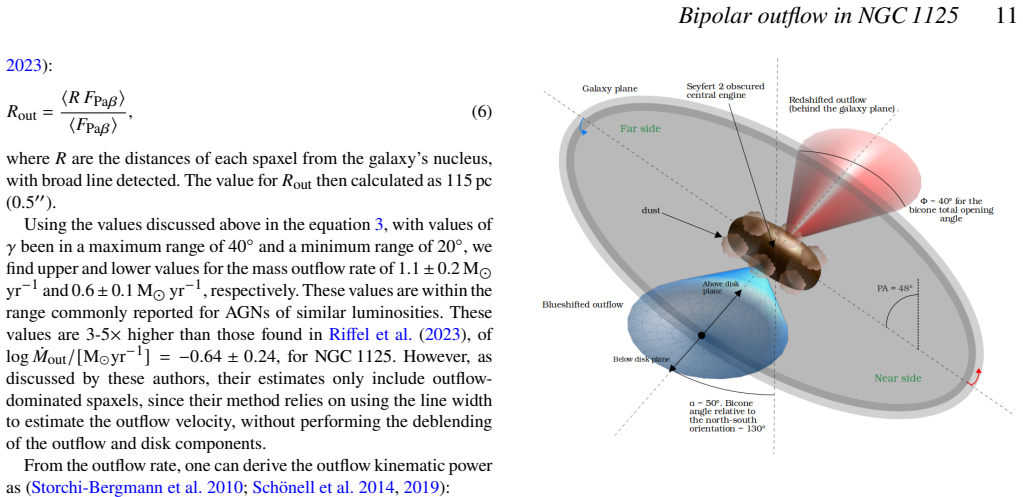
On the paper's own terms, the discovery is that the inner $\sim 300$ pc of NGC 1125 contains two distinct gas phases with different kinematics. The narrow component of [Fe II] $\lambda 1.2570\,\mu$m and Pa$\beta$ follows the galactic rotation, and the rotation-model residuals reveal only small red- and blueshifted excesses along the north-west/south-east axis. The broad component, with velocity dispersion $\approx 250\,\mathrm{km\,s^{-1}}$, is distributed perpendicular to the disk, with a redshifted spot to the north-west and a blueshifted spot to the south-east; it is co-spatial with the 8.4 GHz radio source, which is elongated at PA $\approx 130^\circ$. The authors interpret this broad component as a bipolar outflow in a bicone with an opening angle of $40^\circ$ and inclination to the line of sight between $20^\circ$ and $40^\circ$. Using the Pa$\beta$ broad flux, an adopted electron density of $500\,\mathrm{cm^{-3}}$, and the bipolar outflow formula, they obtain a mass outflow rate of $0.6$–$1.1\,M_\odot\,\mathrm{yr}^{-1}$ and a kinetic power of $3.9\times10^{40}$–$1.1\times10^{41}\,\mathrm{erg\,s^{-1}}$, or 0.07%–0.2% of the bolometric luminosity. The combination of spatial alignment, shock-dominated excitation (high line-ratio values in the diagnostic diagram), and elevated velocity dispersion at the interaction region is the basis for attributing the outflow to the jet.
Load-bearing premise
The outflow claim rests on assuming that the broad emission-line component is a distinct outflowing gas phase—rather than unresolved turbulence or a second disk component—and on adopted bicone inclinations of 20–40 degrees and an electron density of 500 cm$^{-3}$, none of which is measured directly from the data.
Editorial extensions
If this is right
- This object becomes a clear example of jet-driven feedback at low AGN luminosity, where outflow geometry, excitation, and radio structure are all self-consistent.
- The measured kinetic power (0.07%–0.2% of $L_\mathrm{bol}$) is well below the 0.5%–20% coupling efficiencies that simulations often associate with quenching star formation, so this outflow by itself is unlikely to shut down star formation in NGC 1125.
- The residual velocity excesses in the narrow component along the radio axis show that the outflow is currently pushing into the circumnuclear disk, providing a spatially resolved snapshot of jet–ISM interaction.
- The broad component's location in the high line-ratio region of the [Fe II]/Pa$\beta$ versus H$_2$/Br$\gamma$ diagnostic supports shocks as the excitation mechanism, implying that near-IR [Fe II] emission in Seyferts can trace jet-driven shocks rather than pure AGN photoionization.
Reading between the lines
- If the jet-driven interpretation holds, one would predict that very-long-baseline radio observations resolve a jet base at the outflow apex with the same position angle, a testable prediction beyond the ~0.44 arcsec resolution of the current data.
- Because the mass outflow rate scales inversely with the electron density, applying the higher densities ($10^3$–$10^4\,\mathrm{cm^{-3}}$) suggested by some alternative diagnostics would lower the derived outflow rate and power by roughly an order of magnitude, making the feedback energetically even weaker.
- The same two-component decomposition and residual-velocity analysis could be applied to the other galaxies in the volume-limited Seyfert sample to ask whether the jet–outflow co-spatiality seen in NGC 1125 is common among low-luminosity AGN or peculiar to this system.
- A search for molecular gas in the outflow (the H$_2$ broad component is very faint here) would help distinguish jet-driven from radiation-driven scenarios: a bright molecular outflow would imply a more massive, multiphase wind than the ionized gas alone suggests.
Editorial analysis
A structured set of objections, weighed in public.
Referee Report
Summary. The paper presents Gemini NIFS J- and K-band integral field observations of the Seyfert 2 galaxy NGC1125 at roughly 100 pc resolution. The emission lines Paβ and [Fe II] are decomposed into narrow and broad Gaussian components. The narrow component is interpreted as gas rotating in the galaxy disk, fitted with rotating-disc models; the broad component is perpendicular to the disk major axis, has high velocity dispersion (~250 km/s) and disturbed kinematics, and is spatially aligned with the 8.4 GHz radio structure. The authors interpret the broad component as a jet-driven bipolar ionized-gas outflow and derive a mass outflow rate of 0.6-1.1 Msun/yr and a kinetic power of 3.9e40-1.1e41 erg/s (0.07%-0.2% of the AGN bolometric luminosity), adopting an electron density of 500 cm^-3 and outflow inclination angles between 20 and 40 degrees.
Significance. If the result holds, the paper provides a valuable, well-resolved case study of AGN feedback by a low-luminosity radio jet on ~100 pc scales. The qualitative outflow detection is supported by several independent lines of evidence: the perpendicular orientation of the broad component, its high velocity dispersion, the residual velocity pattern after subtracting a rotating-disc model, the high-excitation (HLR) line ratios along the outflow axis, and the spatial alignment with the 8.4 GHz radio emission. The paper is a standard observational case study with careful data reduction and modelling, and it fits the scope of MNRAS. The quantitative outflow rates and powers are within the range commonly reported for AGNs, but they depend sensitively on unmeasured parameters, particularly the electron density, as detailed below.
major comments (3)
- [§5.2, Eq. (4)] The quoted central values Mdot=0.6-1.1 Msun/yr and Ekin=3.9e40-1.1e41 erg/s (0.07%-0.2% Lbol) are computed with an adopted electron density Ne=500 cm^-3, while the same section states that alternative diagnostics can give densities an order of magnitude higher and that the ionized gas mass is inversely proportional to Ne. Since the spectra contain both [Fe II] λ1.2570 and λ1.3209, whose ratio is the standard near-IR density diagnostic, the authors should measure Ne from their own data or at least propagate the systematic density range into the final numbers. With Ne=5000 cm^-3, the values would become roughly 0.06-0.11 Msun/yr and 0.007%-0.02% Lbol, which would materially change the interpretation and the comparison with earlier work.
- [§5.2, Table 1] The adopted outflow inclination range γ=20-40 deg is not directly measured, and its connection to the disc inclination is unclear. Table 1 gives disc inclinations θ≈46-56 deg relative to the sky plane; if the bicone is perpendicular to the disc, the cone axis should be near the disc polar axis and make an angle of order θ with the line of sight. The text says γ=40 deg is 'the angle between the galaxy disk and the line of sight', which needs a precise geometric definition, because vout enters linearly in Mdot and quadratically in Ekin (Eqs. 3, 5, 7). Please justify the adopted γ interval and show explicitly how the 40 deg opening angle is measured from the broad-component velocity field.
- [§4.3, §5.1] The jet-driven conclusion rests substantially on the co-spatiality of the broad component with the 8.4 GHz radio structure from Thean et al. (2000), but the radio beam size and the uncertainty on the positional alignment are not given. Without stating the radio resolution and quantifying the PA difference between the radio structure and the broad-component emission, the 'explicit relation' claimed in the abstract is not quantitatively supported. Please provide the radio beam parameters and a measure of the alignment uncertainty.
minor comments (5)
- [§5.2, Fig. 10] The text states the bipolar outflow opening angle is 40 deg, but the Fig. 10 caption says 'an ≈20° aperture'; please reconcile these values.
- [§6] The Conclusions bullet for the [Fe II] broad component says it is 'dominated by rotation', which contradicts the disturbed velocity field and outflow interpretation in §4.3 and Fig. 5; this appears to be a copy-paste error.
- [§2] The K-band velocity resolution is given as '45 ±km s−1', with the uncertainty value missing; please provide the full value.
- [§3] There are several typographical errors, including 'the theIFSCUBE package' and 'Fe,ii' in the Fig. 5 caption; a careful copyedit is needed.
- [§4.3, §5.2] The broad-component velocity dispersion is quoted as ≈250 km/s in §4.3 and the abstract but 240 km/s in the Ekin calculation of §5.2; please harmonize the value.
Circularity Check
No significant circularity: the outflow properties are measured from the independently fitted broad component and standard formulas, with geometry and density assumptions openly stated rather than fitted inputs recycled as predictions.
full rationale
The paper's central claims—a bipolar ionized-gas outflow, mass outflow rate 0.6–1.1 Msun/yr, kinetic power 3.9e40–1.1e41 erg/s, and a connection to the radio jet—are derived from observed broad-component flux and kinematics. The broad component is identified through a two-Gaussian decomposition, but its interpretation as an outflow is anchored by independent observables: its spatial distribution is perpendicular to the narrow disk component, its velocity field is disturbed, high sigma values reach ~250 km/s, residual velocity maps after rotating-disk subtraction show red/blue excesses, and the emission is co-spatial with the external 8.4 GHz radio structure of Thean et al. (2000). The mass outflow rate is computed from standard formulas (Eqs. 3 and 4, following Lutz et al. 2020 and Osterbrock & Ferland 2006) using the broad Pa-beta flux, an adopted electron density Ne = 500 cm^-3, and assumed inclination angles 20–40 deg. These adopted values are explicitly stated uncertainties, not parameters fitted to the target outflow rate, and the paper openly discusses that alternative density diagnostics can change Ne by an order of magnitude. The self-citations (e.g., Riffel et al. 2023 for the flux-weighted estimators, Schönell et al. 2019 for the power formula) supply standard estimators, not a uniqueness argument or a forbidden alternative. No equation in the paper reduces to its own input by construction, and no load-bearing conclusion depends solely on a self-citation chain. The main fragility of the quantitative claims is the unmeasured density assumption, which is a correctness/robustness concern, not circularity.
Assumptions & free parameters
free parameters (3)
- Electron density N_e =
500 cm^-3
- Outflow inclination gamma =
20 deg to 40 deg
- Bicone opening angle =
40 deg
assumptions (8)
- domain assumption Case B recombination at T_e = 10^4 K gives intrinsic Pa beta / Br gamma = 5.88
- domain assumption The Cardelli et al. (1989) Galactic extinction curve is applicable to the circumnuclear gas of NGC 1125
- domain assumption The Bertola et al. (1991) rotating-disc model describes gas on circular orbits in a plane
- domain assumption The broad Gaussian component of the emission lines traces outflowing ionized gas
- domain assumption The Lutz et al. (2020) formula Mdot_out = 3 M_out v_out / R_out describes a bipolar outflow
- domain assumption The Osterbrock & Ferland (2006) relation converts Pa beta flux and electron density into ionized gas mass
- domain assumption The 8.4 GHz radio structure (Thean et al. 2000) is a jet whose orientation is meaningful for the outflow
- domain assumption The Ichikawa et al. (2017) hard X-ray to bolometric luminosity relation is applicable
Cite this review
Pith. "Pith review of A jet-driven bipolar outflow in NGC 1125." pith.science (2026). https://pith.science/paper/DT5XB7U4
@misc{pith2026250209315,
  author       = {Pith},
  title        = {Pith review of: A jet-driven bipolar outflow in NGC 1125},
  year         = {2026},
  howpublished = {\url{https://pith.science/paper/DT5XB7U4}},
  note         = {Machine review of arXiv:2502.09315}
}
abstract
To study the role of the feedback from the Active Galactic Nuclei (AGNs) in the evolution of its host galaxy, we need observational constraints on 100 pc scales. We used the Gemini Near Infrared Integral Field Spectrograph in the J and K bands at a spatial resolution of 100 pc and spectral resolution of 45 km\,s$^{-1}$ to observe the central region of the Seyfert galaxy NGC1125. Emission-line flux distributions in ionized and molecular gas extends up to $\approx$ 300\,pc from the nucleus, where they are found to peak. The Pa$\beta$ and [Fe\,{\sc ii}]$\lambda$1.2570$\mu$m emission-lines show two components: a narrow and a broad. The narrow component is preferably extended from the north-east to the south-west, while the broad component is perpendicular to it. Their kinematics are also different, with the narrow component showing a rotation pattern, with low velocity dispersion values ($\sigma$ $\approx$ 140 km s$^{-1}$) and the broad component a disturbed velocity field and high values of $\sigma$ ($\approx$ 250 km s$^{-1}$). We interpreted the narrow component velocity fields as due to gas rotating in the galaxy plane and fitted rotation velocity models to it, plus an outflow component in the ionized gas. The broad component is interpreted as an outflow, with mass outflow rate in the range of 0.6 to 1.1 M$_{\sun}$ yr$^{-1}$, with an outflow power ranging from 3.9$\times$10$^{40}$ to 1.1$\times$10$^{41}$ erg\,s$^{-1}$, which represents 0.07\% and 0.2\% of the bolometric luminosity of the AGN. There is an explicit relation between the shock ionized outflow and the low-luminosity radio source.
Figures


Figures from the paper (7 more)


Reference graph
Works this paper leans on
-
[1]
write newline
" write newline "" before.all 'output.state := FUNCTION fin.entry write newline FUNCTION new.block output.state before.all = 'skip after.block 'output.state := if FUNCTION new.sentence output.state after.block = 'skip output.state before.all = 'skip after.sentence 'output.state := if if FUNCTION not #0 #1 if FUNCTION and 'skip pop #0 if FUNCTION or pop #1...
-
[2]
write newline
" write newline "" before.all 'output.state := FUNCTION fin.entry write newline FUNCTION new.block output.state before.all = 'skip after.block 'output.state := if FUNCTION new.sentence output.state after.block = 'skip output.state before.all = 'skip after.sentence 'output.state := if if FUNCTION not #0 #1 if FUNCTION and 'skip pop #0 if FUNCTION or pop #1...
-
[3]
Barbosa F. K. B., Storchi-Bergmann T., McGregor P., Vale T. B., Rogemar Riffel A., 2014, @doi [ ] 10.1093/mnras/stu1637 , https://ui.adsabs.harvard.edu/abs/2014MNRAS.445.2353B 445, 2353
-
[4]
Baron D., Netzer H., 2019, @doi [Monthly Notices of the Royal Astronomical Society] 10.1093/mnras/stz1070 , 486, 4290
-
[5]
Bertola F., Bettoni D., Danziger J., Sadler E., Sparke L., de Zeeuw T., 1991, @doi [ ] 10.1086/170058 , https://ui.adsabs.harvard.edu/abs/1991ApJ...373..369B 373, 369
doi:10.1086/170058 1991
-
[6]
Black J. H., van Dishoeck E. F., 1987, @doi [ ] 10.1086/165740 , https://ui.adsabs.harvard.edu/abs/1987ApJ...322..412B 322, 412
doi:10.1086/165740 1987
-
[7]
Cano-D \' az M., Maiolino R., Marconi A., Netzer H., Shemmer O., Cresci G., 2012, @doi [ ] 10.1051/0004-6361/201118358 , https://ui.adsabs.harvard.edu/abs/2012A&A...537L...8C 537, L8
-
[8]
Cappellari M., Emsellem E., 2004, @doi [ ] 10.1086/381875 , https://ui.adsabs.harvard.edu/abs/2004PASP..116..138C 116, 138
doi:10.1086/381875 2004
Show all 90 references
-
[9]
A., Clayton G
Cardelli J. A., Clayton G. C., Mathis J. S., 1989, @doi [ ] 10.1086/167900 , https://ui.adsabs.harvard.edu/abs/1989ApJ...345..245C 345, 245
1989 doi
- [10]
-
[11]
Cicone C., et al., 2014, @doi [ ] 10.1051/0004-6361/201322464 , https://ui.adsabs.harvard.edu/abs/2014A&A...562A..21C 562, A21
2014 doi
-
[12]
Colina L., et al., 2015, @doi [ ] 10.1051/0004-6361/201425567 , https://ui.adsabs.harvard.edu/abs/2015A&A...578A..48C 578, A48
2015 doi
-
[13]
G., et al., 2019, @doi [Monthly Notices of the Royal Astronomical Society] 10.1093/mnras/stz2453 , 489, 5653
Dahmer-Hahn L. G., et al., 2019, @doi [Monthly Notices of the Royal Astronomical Society] 10.1093/mnras/stz2453 , 489, 5653
2019 doi
-
[14]
I., Sternberg A., Lehnert M., Tacconi-Garman L
Davies R. I., Sternberg A., Lehnert M., Tacconi-Garman L. E., 2003, @doi [ ] 10.1086/378634 , https://ui.adsabs.harvard.edu/abs/2003ApJ...597..907D 597, 907
2003 doi
-
[15]
Davies R., et al., 2020, @doi [Monthly Notices of the Royal Astronomical Society] 10.1093/mnras/staa2413 , 498, 4150
2020 doi
-
[16]
Di Matteo T., Springel V., Hernquist L., 2005, @doi [ ] 10.1038/nature03335 , https://ui.adsabs.harvard.edu/abs/2005Natur.433..604D 433, 604
2005 doi
-
[17]
R., Riffel R
Diniz M. R., Riffel R. A., Storchi-Bergmann T., Winge C., 2015, @doi [ ] 10.1093/mnras/stv1694 , https://ui.adsabs.harvard.edu/abs/2015MNRAS.453.1727D 453, 1727
2015 doi
-
[18]
R., Riffel R
Diniz M. R., Riffel R. A., Storchi-Bergmann T., Riffel R., 2019, @doi [Monthly Notices of the Royal Astronomical Society] 10.1093/mnras/stz1329 , 487, 3958
2019 doi
-
[19]
L., Cardaci M
Dors O. L., Cardaci M. V., H \"a gele G. F., Krabbe \^A . C., 2014, @doi [ ] 10.1093/mnras/stu1218 , https://ui.adsabs.harvard.edu/abs/2014MNRAS.443.1291D 443, 1291
2014 doi
-
[20]
L., Maiolino R., Cardaci M
Dors O. L., Maiolino R., Cardaci M. V., H \"a gele G. F., Krabbe A. C., P \'e rez-Montero E., Armah M., 2020, @doi [ ] 10.1093/mnras/staa1781 , https://ui.adsabs.harvard.edu/abs/2020MNRAS.tmp.1925D
2020 doi
-
[21]
T., Woods D
Draine B. T., Woods D. T., 1990, @doi [ ] 10.1086/169358 , https://ui.adsabs.harvard.edu/abs/1990ApJ...363..464D 363, 464
1990 doi
-
[22]
Dubois Y., et al., 2014, @doi [ ] 10.1093/mnras/stu1227 , https://ui.adsabs.harvard.edu/abs/2014MNRAS.444.1453D 444, 1453
2014 doi
-
[23]
C., 2012, @doi [ ] 10.1146/annurev-astro-081811-125521 , https://ui.adsabs.harvard.edu/abs/2012ARA&A..50..455F 50, 455
Fabian A. C., 2012, @doi [ ] 10.1146/annurev-astro-081811-125521 , https://ui.adsabs.harvard.edu/abs/2012ARA&A..50..455F 50, 455
2012 doi
-
[24]
Ferrarese L., Ford H., 2005, @doi [ ] 10.1007/s11214-005-3947-6 , https://ui.adsabs.harvard.edu/abs/2005SSRv..116..523F 116, 523
2005 doi
-
[25]
Flewelling H., 2016, in American Astronomical Society Meeting Abstracts \#227. p. 144.25
2016
-
[26]
A., Ward M
Forbes D. A., Ward M. J., 1993, @doi [ ] 10.1086/173221 , https://ui.adsabs.harvard.edu/abs/1993ApJ...416..150F 416, 150
1993 doi
-
[27]
C., et al., 2018, @doi [ ] 10.1093/mnras/sty303 , https://ui.adsabs.harvard.edu/abs/2018MNRAS.476.2760F 476, 2760
Freitas I. C., et al., 2018, @doi [ ] 10.1093/mnras/sty303 , https://ui.adsabs.harvard.edu/abs/2018MNRAS.476.2760F 476, 2760
2018 doi
-
[28]
Gallagher R., Maiolino R., Belfiore F., Drory N., Riffel R., Riffel R., 2019, @doi [Monthly Notices of the Royal Astronomical Society] 10.1093/mnras/stz564 , 485, 3409
2019 doi
-
[30]
Girdhar A., et al., 2024b, @doi [ ] 10.1093/mnras/stad3453 , https://ui.adsabs.harvard.edu/abs/2024MNRAS.527.9322G 527, 9322
-
[31]
M., 2017, @doi [Nature Astronomy] 10.1038/s41550-017-0165 , https://ui.adsabs.harvard.edu/abs/2017NatAs...1E.165H 1, 0165
Harrison C. M., 2017, @doi [Nature Astronomy] 10.1038/s41550-017-0165 , https://ui.adsabs.harvard.edu/abs/2017NatAs...1E.165H 1, 0165
2017 doi
-
[32]
M., Ramos Almeida C., 2024, @doi [Galaxies] 10.3390/galaxies12020017 , https://ui.adsabs.harvard.edu/abs/2024Galax..12...17H 12, 17
Harrison C. M., Ramos Almeida C., 2024, @doi [Galaxies] 10.3390/galaxies12020017 , https://ui.adsabs.harvard.edu/abs/2024Galax..12...17H 12, 17
2024 doi
-
[33]
R., Tadhunter C
Holden L. R., Tadhunter C. N., 2023, @doi [ ] 10.1093/mnras/stad1677 , https://ui.adsabs.harvard.edu/abs/2023MNRAS.524..886H 524, 886
2023 doi
-
[34]
R., Tadhunter C
Holden L. R., Tadhunter C. N., Morganti R., Oosterloo T., 2023, @doi [ ] 10.1093/mnras/stad123 , https://ui.adsabs.harvard.edu/abs/2023MNRAS.520.1848H 520, 1848
2023 doi
-
[35]
F., 1989, @doi [ ] 10.1086/167595 , https://ui.adsabs.harvard.edu/abs/1989ApJ...342..306H 342, 306
Hollenbach D., McKee C. F., 1989, @doi [ ] 10.1086/167595 , https://ui.adsabs.harvard.edu/abs/1989ApJ...342..306H 342, 306
1989 doi
-
[37]
J., 2017, @doi [ ] 10.3847/1538-4357/835/1/74 , https://ui.adsabs.harvard.edu/abs/2017ApJ...835...74I 835, 74
Ichikawa K., Ricci C., Ueda Y., Matsuoka K., Toba Y., Kawamuro T., Trakhtenbrot B., Koss M. J., 2017, @doi [ ] 10.3847/1538-4357/835/1/74 , https://ui.adsabs.harvard.edu/abs/2017ApJ...835...74I 835, 74
2017 doi
-
[38]
H., Chester T., Cutri R., Schneider S
Jarrett T. H., Chester T., Cutri R., Schneider S. E., Huchra J. P., 2003, @doi [ ] 10.1086/345794 , https://ui.adsabs.harvard.edu/abs/2003AJ....125..525J 125, 525
2003 doi
-
[39]
Kakkad D., et al., 2018, @doi [ ] 10.1051/0004-6361/201832790 , https://ui.adsabs.harvard.edu/abs/2018A&A...618A...6K 618, A6
2018 doi
-
[40]
Kakkad D., et al., 2020, @doi [ ] 10.1051/0004-6361/202038551 , https://ui.adsabs.harvard.edu/abs/2020A&A...642A.147K 642, A147
2020 doi
-
[41]
C., 2013, @doi [ ] 10.1146/annurev-astro-082708-101811 , https://ui.adsabs.harvard.edu/abs/2013ARA&A..51..511K 51, 511
Kormendy J., Ho L. C., 2013, @doi [ ] 10.1146/annurev-astro-082708-101811 , https://ui.adsabs.harvard.edu/abs/2013ARA&A..51..511K 51, 511
2013 doi
-
[42]
E., Armus L., Knop R
Larkin J. E., Armus L., Knop R. A., Soifer B. T., Matthews K., 1998, @doi [ ] 10.1086/313063 , https://ui.adsabs.harvard.edu/abs/1998ApJS..114...59L 114, 59
1998 doi
-
[43]
L., Greene J
Liu G., Zakamska N. L., Greene J. E., Nesvadba N. P. H., Liu X., 2013, @doi [ ] 10.1093/mnras/stt1755 , https://ui.adsabs.harvard.edu/abs/2013MNRAS.436.2576L 436, 2576
2013 doi
-
[44]
Lutz D., et al., 2020, @doi [ ] 10.1051/0004-6361/201936803 , https://ui.adsabs.harvard.edu/abs/2020A&A...633A.134L 633, A134
2020 doi
-
[45]
Maiolino R., et al., 2017, @doi [ ] 10.1038/nature21677 , https://ui.adsabs.harvard.edu/abs/2017Natur.544..202M 544, 202
2017 doi
-
[46]
R., Hollenbach D
Maloney P. R., Hollenbach D. J., Tielens A. G. G. M., 1996, @doi [ ] 10.1086/177532 , https://ui.adsabs.harvard.edu/abs/1996ApJ...466..561M 466, 561
1996 doi
-
[47]
Mazzalay X., et al., 2014, @doi [ ] 10.1093/mnras/stt2319 , https://ui.adsabs.harvard.edu/abs/2014MNRAS.438.2036M 438, 2036
2014 doi
-
[48]
J., et al., 2003, in Iye M., Moorwood A
McGregor P. J., et al., 2003, in Iye M., Moorwood A. F. M., eds, Society of Photo-Optical Instrumentation Engineers (SPIE) Conference Series Vol. 4841, Instrument Design and Performance for Optical/Infrared Ground-based Telescopes. pp 1581--1591, @doi 10.1117/12.459448
2003 doi
-
[49]
Mouri H., Nishida M., Taniguchi Y., Kawara K., 1990, @doi [ ] 10.1086/169095 , https://ui.adsabs.harvard.edu/abs/1990ApJ...360...55M 360, 55
1990 doi
-
[50]
Mouri H., Kawara K., Taniguchi Y., 1993, @doi [ ] 10.1086/172419 , https://ui.adsabs.harvard.edu/abs/1993ApJ...406...52M 406, 52
1993 doi
-
[51]
S., Wilson A
Mulchaey J. S., Wilson A. S., Tsvetanov Z., 1996, @doi [ ] 10.1086/192261 , https://ui.adsabs.harvard.edu/abs/1996ApJS..102..309M 102, 309
1996 doi
-
[53]
Nandi P., et al., 2023b, @doi [ ] 10.3847/1538-4357/ad0c57 , https://ui.adsabs.harvard.edu/abs/2023ApJ...959..116N 959, 116
-
[54]
Oh K., et al., 2018, @doi [ ] 10.3847/1538-4365/aaa7fd , https://ui.adsabs.harvard.edu/abs/2018ApJS..235....4O 235, 4
2018 doi
-
[55]
E., Ferland G
Osterbrock D. E., Ferland G. J., 2006, Astrophysics of gaseous nebulae and active galactic nuclei
2006
-
[56]
K., Prieto M
Reunanen J., Kotilainen J. K., Prieto M. A., 2002, @doi [ ] 10.1046/j.1365-8711.2002.05181.x , https://ui.adsabs.harvard.edu/abs/2002MNRAS.331..154R 331, 154
2002
-
[57]
Revalski M., et al., 2022, @doi [The Astrophysical Journal] 10.3847/1538-4357/ac5f3d , 930, 14
2022 doi
-
[58]
J., Faucher-Gigu \`e re C.-A., 2018, @doi [ ] 10.1093/mnras/sty1285 , https://ui.adsabs.harvard.edu/abs/2018MNRAS.478.3100R 478, 3100
Richings A. J., Faucher-Gigu \`e re C.-A., 2018, @doi [ ] 10.1093/mnras/sty1285 , https://ui.adsabs.harvard.edu/abs/2018MNRAS.478.3100R 478, 3100
2018 doi
-
[60]
Rodríguez-Ardila, A
Riffel, R. Rodríguez-Ardila, A. Pastoriza, M. G. 2006, @doi [A&A] 10.1051/0004-6361:20065291 , 457, 61
2006 doi
-
[61]
A., Storchi-Bergmann T., Winge C., Barbosa F
Riffel R. A., Storchi-Bergmann T., Winge C., Barbosa F. K. B., 2006, @doi [ ] 10.1111/j.1365-2966.2006.11050.x , https://ui.adsabs.harvard.edu/abs/2006MNRAS.373....2R 373, 2
2006
-
[63]
A., Storchi-Bergmann T., Nagar N
Riffel R. A., Storchi-Bergmann T., Nagar N. M., 2010, @doi [ ] 10.1111/j.1365-2966.2010.16308.x , https://ui.adsabs.harvard.edu/abs/2010MNRAS.404..166R 404, 166
2010
-
[65]
S., Pastoriza M
Riffel R., Rodríguez-Ardila A., Aleman I., Brotherton M. S., Pastoriza M. G., Bonatto C., Dors O. L. J., 2013a, @doi [Monthly Notices of the Royal Astronomical Society] 10.1093/mnras/stt026 , 430, 2002
2002 doi
-
[66]
A., Storchi-Bergmann T., Winge C., 2013c, @doi [ ] 10.1093/mnras/stt045 , https://ui.adsabs.harvard.edu/abs/2013MNRAS.430.2249R 430, 2249
Riffel R. A., Storchi-Bergmann T., Winge C., 2013c, @doi [ ] 10.1093/mnras/stt045 , https://ui.adsabs.harvard.edu/abs/2013MNRAS.430.2249R 430, 2249
-
[67]
A., Vale T
Riffel R. A., Vale T. B., Storchi-Bergmann T., McGregor P. J., 2014, @doi [Monthly Notices of the Royal Astronomical Society] 10.1093/mnras/stu843 , 442, 656
2014 doi
-
[68]
A., Storchi-Bergmann T., Riffel R., Dahmer-Hahn L
Riffel R. A., Storchi-Bergmann T., Riffel R., Dahmer-Hahn L. G., Diniz M. R., Schönell A. J., Dametto N. Z., 2017, @doi [Monthly Notices of the Royal Astronomical Society] 10.1093/mnras/stx1308 , 470, 992
2017 doi
-
[69]
A., et al., 2018, @doi [ ] 10.1093/mnras/stx2857 , https://ui.adsabs.harvard.edu/abs/2018MNRAS.474.1373R 474, 1373
Riffel R. A., et al., 2018, @doi [ ] 10.1093/mnras/stx2857 , https://ui.adsabs.harvard.edu/abs/2018MNRAS.474.1373R 474, 1373
2018 doi
-
[70]
A., Storchi-Bergmann T., Zakamska N
Riffel R. A., Storchi-Bergmann T., Zakamska N. L., Riffel R., 2020, @doi [ ] 10.1093/mnras/staa1922 , https://ui.adsabs.harvard.edu/abs/2020MNRAS.496.4857R 496, 4857
2020 doi
-
[72]
A., Bianchin M., Riffel R., Storchi-Bergmann T., Schönell A
Riffel R. A., Bianchin M., Riffel R., Storchi-Bergmann T., Schönell A. J., Dahmer-Hahn L. G., Dametto N. Z., Diniz M. R., 2021a, @doi [Monthly Notices of the Royal Astronomical Society] 10.1093/mnras/stab788 , 503, 5161
-
[73]
A., et al., 2021c, @doi [Monthly Notices of the Royal Astronomical Society] 10.1093/mnras/stab998 , 504, 3265
Riffel R. A., et al., 2021c, @doi [Monthly Notices of the Royal Astronomical Society] 10.1093/mnras/stab998 , 504, 3265
-
[74]
Riffel R., et al., 2022, @doi [Monthly Notices of the Royal Astronomical Society] 10.1093/mnras/stac740 , 512, 3906
2022 doi
-
[75]
A., et al., 2023, @doi [ ] 10.1093/mnras/stad599 , https://ui.adsabs.harvard.edu/abs/2023MNRAS.521.1832R 521, 1832
Riffel R. A., et al., 2023, @doi [ ] 10.1093/mnras/stad599 , https://ui.adsabs.harvard.edu/abs/2023MNRAS.521.1832R 521, 1832
2023 doi
-
[76]
G., Viegas S., Sigut T
Rodr \' guez-Ardila A., Pastoriza M. G., Viegas S., Sigut T. A. A., Pradhan A. K., 2004, @doi [ ] 10.1051/0004-6361:20034285 , https://ui.adsabs.harvard.edu/abs/2004A&A...425..457R 425, 457
2004 doi
-
[77]
G., 2005, @doi [ ] 10.1111/j.1365-2966.2005.09638.x , https://ui.adsabs.harvard.edu/abs/2005MNRAS.364.1041R 364, 1041
Rodr \' guez-Ardila A., Riffel R., Pastoriza M. G., 2005, @doi [ ] 10.1111/j.1365-2966.2005.09638.x , https://ui.adsabs.harvard.edu/abs/2005MNRAS.364.1041R 364, 1041
2005
-
[78]
Rodríguez-Ardila A., et al., 2016, @doi [Monthly Notices of the Royal Astronomical Society] 10.1093/mnras/stw2642 , 465, 906
2016 doi
-
[79]
Rose M., Tadhunter C., Ramos Almeida C., Rodr \' guez Zaur \' n J., Santoro F., Spence R., 2018, @doi [ ] 10.1093/mnras/stx2590 , https://ui.adsabs.harvard.edu/abs/2018MNRAS.474..128R 474, 128
2018 doi
-
[80]
Ruschel-Dutra D., et al., 2021, @doi [Monthly Notices of the Royal Astronomical Society] 10.1093/mnras/stab2058 , 507, 74
2021 doi
-
[81]
Santoro F., Tadhunter C., Baron D., Morganti R., Holt J., 2020, @doi [ ] 10.1051/0004-6361/202039077 , https://ui.adsabs.harvard.edu/abs/2020A&A...644A..54S 644, A54
2020 doi
-
[82]
Schaye J., et al., 2015, @doi [ ] 10.1093/mnras/stu2058 , https://ui.adsabs.harvard.edu/abs/2015MNRAS.446..521S 446, 521
2015 doi
-
[83]
J., Riffel R
Sch \"o nell A. J., Riffel R. A., Storchi-Bergmann T., Winge C., 2014, @doi [ ] 10.1093/mnras/stu1685 , https://ui.adsabs.harvard.edu/abs/2014MNRAS.445..414S 445, 414
2014 doi
-
[84]
J., Storchi-Bergmann T., Riffel R
Sch \"o nell A. J., Storchi-Bergmann T., Riffel R. A., Riffel R., Bianchin M., Dahmer-Hahn L. G., Diniz M. R., Dametto N. Z., 2019, @doi [ ] 10.1093/mnras/stz523 , https://ui.adsabs.harvard.edu/abs/2019MNRAS.485.2054S 485, 2054
2019 doi
-
[85]
J., Storchi-Bergmann T., Riffel R
Schönell Astor J. J., Storchi-Bergmann T., Riffel R. A., Riffel R., 2016, @doi [Monthly Notices of the Royal Astronomical Society] 10.1093/mnras/stw2263 , 464, 1771
2016 doi
-
[86]
A., 2012, @doi [Research in Astronomy and Astrophysics] 10.1088/1674-4527/12/8/004 , https://ui.adsabs.harvard.edu/abs/2012RAA....12..917S 12, 917
Silk J., Mamon G. A., 2012, @doi [Research in Astronomy and Astrophysics] 10.1088/1674-4527/12/8/004 , https://ui.adsabs.harvard.edu/abs/2012RAA....12..917S 12, 917
2012 doi
-
[87]
A., Baker A
Simpson C., Forbes D. A., Baker A. C., Ward M. J., 1996, @doi [ ] 10.1093/mnras/283.3.777 , https://ui.adsabs.harvard.edu/abs/1996MNRAS.283..777S 283, 777
1996 doi
-
[88]
S., Hopkins P
Somerville R. S., Hopkins P. F., Cox T. J., Robertson B. E., Hernquist L., 2008, @doi [ ] 10.1111/j.1365-2966.2008.13805.x , https://ui.adsabs.harvard.edu/abs/2008MNRAS.391..481S 391, 481
2008
-
[89]
Sternberg A., Dalgarno A., 1989, @doi [ ] 10.1086/167193 , https://ui.adsabs.harvard.edu/abs/1989ApJ...338..197S 338, 197
1989 doi
-
[92]
Storchi-Bergmann T., Lopes R. D. S., McGregor P. J., Riffel R. A., Beck T., Martini P., 2010, @doi [ ] 10.1111/j.1365-2966.2009.15962.x , https://ui.adsabs.harvard.edu/abs/2010MNRAS.402..819S 402, 819
2010
-
[93]
J., Baum S
Thean A., Pedlar A., Kukula M. J., Baum S. A., O'Dea C. P., 2000, @doi [ ] 10.1046/j.1365-8711.2000.03401.x , https://ui.adsabs.harvard.edu/abs/2000MNRAS.314..573T 314, 573
2000
-
[94]
Theureau G., Bottinelli L., Coudreau-Durand N., Gouguenheim L., Hallet N., Loulergue M., Paturel G., Teerikorpi P., 1998, @doi [ ] 10.1051/aas:1998416 , https://ui.adsabs.harvard.edu/abs/1998A&AS..130..333T 130, 333
1998 doi
-
[95]
L., ed., Society of Photo-Optical Instrumentation Engineers (SPIE) Conference Series Vol
Tody D., 1986, in Crawford D. L., ed., Society of Photo-Optical Instrumentation Engineers (SPIE) Conference Series Vol. 627, Instrumentation in astronomy VI. p. 733, @doi 10.1117/12.968154
1986 doi
-
[96]
J., Brissenden R
Tody D., 1993, in Hanisch R. J., Brissenden R. J. V., Barnes J., eds, Astronomical Society of the Pacific Conference Series Vol. 52, Astronomical Data Analysis Software and Systems II. p. 173
1993
-
[97]
Weinberger R., et al., 2017, @doi [ ] 10.1093/mnras/stw2944 , https://ui.adsabs.harvard.edu/abs/2017MNRAS.465.3291W 465, 3291
2017 doi
-
[98]
A., Storchi-Bergmann T., 2009, @doi [ ] 10.1088/0067-0049/185/1/186 , https://ui.adsabs.harvard.edu/abs/2009ApJS..185..186W 185, 186
Winge C., Riffel R. A., Storchi-Bergmann T., 2009, @doi [ ] 10.1088/0067-0049/185/1/186 , https://ui.adsabs.harvard.edu/abs/2009ApJS..185..186W 185, 186
2009 doi
-
[99]
C., Allen R
van der Kruit P. C., Allen R. J., 1978, @doi [ ] 10.1146/annurev.aa.16.090178.000535 , https://ui.adsabs.harvard.edu/abs/1978ARA&A..16..103V 16, 103
1978
Reviewed August 7, 2026 · model on record in the stance chip above.
Discussion (0). Continue with ORCID to comment.