REVIEW 4 major objections 4 minor 180 references
The competing effects of recent and long-term star formation histories on oxygen, nitrogen, and stellar metallicities
T0 review · 4 major / 4 minor · reviewed 2026-08-15 · deepseek-v4-flash
Pith's one-line read The fundamental metallicity, nitrogen, and stellar-metallicity relations are one phenomenon: a galaxy's abundance pattern records its star-formation history, with the gravitational potential setting the clock.
desk verdict A credible first census of the FMR/FNR/FMR* family whose key high-Φe contrast rests on a single N/O calibrator and unquantified correlation/dispersion differences. read the letter →
The pith
A machine-rendered reading of the paper's core claim, the machinery that carries it, and where it could break.
The reading
What carries the argument
The load-bearing object is $\Phi_e = M_*/R_e$, a galaxy's stellar mass divided by its half-light radius, used as a proxy for gravitational-potential depth. Around this, the paper organises three abundance indicators measured at one effective radius—gas oxygen abundance (O/H), gas nitrogen-to-oxygen ratio (N/O) and light-weighted stellar metallicity ([Z/H], effectively iron abundance)—and compares their residual correlations with two star-formation-state parameters: $\Delta$SFR, the offset from the star-forming main sequence, and stellar age $t_e$. The analysis works by binning galaxies in $M_*$ or $\Phi_e$, computing Spearman correlations and dispersions before and after subtracting fitted third-parameter trends, and checking whether each abundance responds to SFR/age at low, intermediate and high potential. This binning is what exposes the different behaviour of the three relations at high $\Phi_e$.
What would settle it
Recompute the same bin-by-bin correlation and dispersion analysis using a different oxygen-abundance calibration, such as direct electron-temperature abundances or an independent strong-line recipe, and check whether the FNR still persists at high $\Phi_e$ while the FMR disappears; if the contrast vanishes, the SFH-potential interpretation loses its observational foundation.
Extended reading notes
Core claim
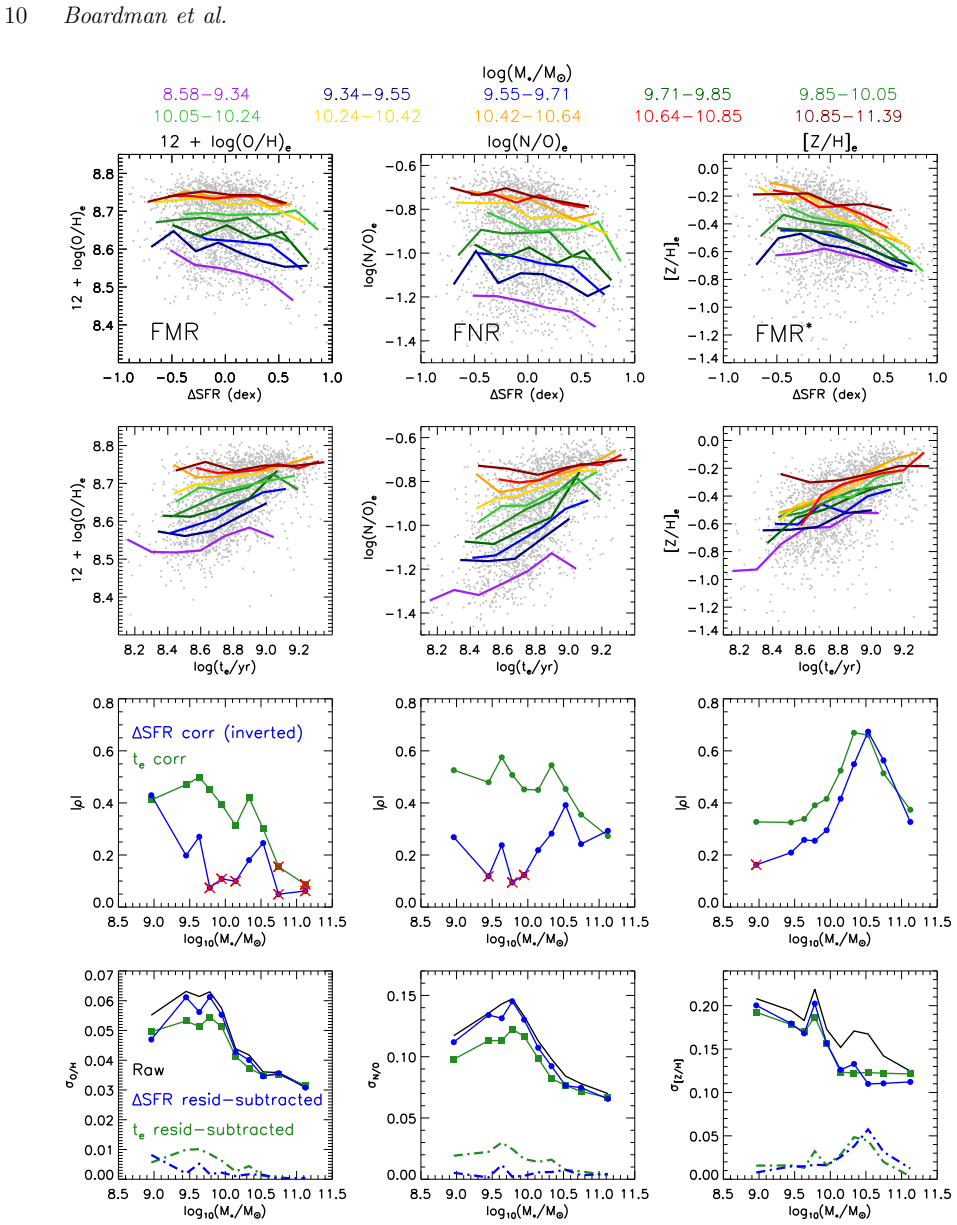
The central discovery is a hierarchy among the three abundance–SFR relations that changes with mass and potential. In the lowest-mass bin the classical gas FMR is the strongest of the three; at $\log M_*/M_\odot \sim 10.5$ and at the highest $\Phi_e$ it loses statistical significance, while the FNR and FMR* show their strongest residual trends there. Replacing $M_*$ with $\Phi_e$ tightens the gas relations substantially—$\Phi_e$ alone predicts gas O/H and N/O better than $M_*$ and SFR together—and replacing SFR with the light-weighted stellar age $t_e$ gives similar or stronger residual correlations. The paper reads this as evidence that abundances at 1 $R_e$ carry two separable pieces of information: recent inflow history, which mainly moves gas abundances and dominates in shallow potentials, and long-term star-formation history, which controls nitrogen enrichment and stellar metallicity and dominates in deep potentials. That reading unifies the FMR, FNR, FMR*, the $\Phi_e$-abundance relations, and the observed gas–stellar metallicity offset.
Load-bearing premise
The paper's central contrast depends on the assumption that its adopted recipes for turning measured emission lines into oxygen and nitrogen abundances remain accurate across the whole range of galaxy masses, sizes and star-formation rates.
Editorial extensions
If this is right
- The gas-only FMR is the weakest of the three relations and disappears at the highest $\Phi_e$, so chemical-evolution models should be benchmarked against the FNR and FMR* as well as, or instead of, the FMR.
- Because $\Phi_e$ predicts gas O/H and N/O better than $M_*$ and SFR combined, future comparisons between simulations and observations should prioritise reproducing $\Phi_e$-abundance relations.
- State-of-the-art simulations must first reproduce the observed size–SFR behaviour at fixed mass (including the half-mass-radius version shown here) before their metallicity predictions can be trusted.
- Replacing SFR with stellar age strengthens the gaseous FMR and FNR, implying that age-based formulations carry more information about the SFH link than SFR-based ones.
- High-redshift spectroscopic surveys should detect strong redshift evolution in the $\Phi_e$-based relations and in the N/O–O/H distribution, which would confirm or refute the unified interpretation.
Reading between the lines
- If the unification holds, the reported redshift evolution of the FMR beyond $z\sim2.5$ may be largely a consequence of galaxies being more compact at fixed mass at high redshift, rather than evidence for a separate high-redshift physics.
- The persistence of the FNR at high $\Phi_e$ suggests N/O could serve as a fossil tracer of early enrichment; a testable extension is whether galaxies at fixed $\Phi_e$ with high N/O also show older stellar populations or stronger metallicity gradients in resolved maps.
- The framework implies that control samples matched only on mass and redshift are insufficient for abundance studies; matching on size or potential should reduce scatter, though this is an extrapolation from the paper's correlational evidence.
- An obvious stress test is to recompute the binning analysis with alternative abundance calibrators, since the paper's central contrast depends on two fixed calibration recipes.
Signed reviews
Editorial analysis
A structured set of objections, weighed in public.
Referee Report
Summary. This paper uses MaNGA integral-field spectroscopy of 2070 star-forming galaxies to examine the three-way relations between galaxy stellar mass (or the gravitational-potential proxy Phi_e = M*/Re), star-formation rate (or stellar age), and three abundance measures: gas-phase O/H, gas-phase N/O, and stellar metallicity [Z/H]. The authors confirm the fundamental metallicity relation (FMR), the fundamental nitrogen relation (FNR), and the stellar metallicity equivalent (FMR*), as well as their Phi_e-based variants, and find that all relations persist when Phi_e replaces M*. Their central empirical result is that at high masses or high Phi_e, the gaseous FMR weakens or disappears while the FNR persists and the FMR* strengthens. They interpret this contrast as evidence that at low potential, SFR variations are driven by recent gas inflows that mainly affect gas abundances, while at high potential, SFR variations reflect broad differences in star-formation history shapes that become most visible in stellar abundances. The paper also investigates the gas-stellar metallicity offset and shows that it correlates with both SFR and stellar age at fixed mass or potential.
Significance. If the central claim holds, the paper provides a unified framework for understanding several chemical abundance scaling relations in star-forming galaxies, linking them to a single SFH-potential picture. The use of three independent abundance tracers, the explicit comparison of M* and Phi_e as independent variables, and the checks against alternative SFR measures (Section 2) are genuine strengths, as is the transparent discussion of the tension between simulations and observations regarding size-SFR behavior (Section 4.4). The results would also strengthen the case that Phi_e is a more fundamental driver of gas-phase abundances than M* alone. However, the load-bearing contrast between the behavior of the FMR and the FNR at high Phi_e rests on a single gas-abundance calibrator for each tracer, and the claimed differences in relation strengths are not quantified with statistical uncertainties. These issues temper the certainty of the interpretation, though they are addressable with additional analysis.
major comments (4)
- [Section 2, Figures 5-6]
- [Section 3.3, Figures 5-6]
- [Section 3.3, Figure 6]
- [Section 4.2, Figures 9-10]
minor comments (4)
- [Throughout]
- [Figure 2]
- [Section 2]
- [Section 3.3]
Circularity Check
No significant circularity: the abundance relations are measured residuals, not quantities defined by the fit, and the only overlapping-author citation (Boardman et al. 2024b) is an external, falsifiable prior analysis.
full rationale
The paper's central results are observational correlations between independently measured abundances and a residual SFR parameter ΔSFR. ΔSFR is defined as the offset from a straight-line fit to the star-forming sequence, but no abundance measure is constructed from that fit; the abundance–ΔSFR trends are measured Spearman correlations and dispersion changes after polynomial subtraction, and the polynomial subtraction is used only to characterize scatter, not to generate predicted abundances. The key contrast (FMR disappears at high Φe while FNR persists and FMR* strengthens) is read directly from binned data in Figures 5–6, not from a fitted model whose parameters include the claimed outcome. Measurements rest on external calibrators (Curti et al. 2020; Florido et al. 2022) and public MaNGA data; the single most relevant overlapping-author reference, Boardman et al. (2024b), is a separate published analysis of the same survey and is used for context (e.g., tightness of ΦZR and ΦNR), not as a uniqueness theorem or as an assumption that entails the present results. The calibrator-dependence concern raised by the skeptic is a systematic-error or correctness risk, not a circularity: swapping calibrators would change the data values but would not make any result true by definition. No fitted parameter is renamed as a prediction, no abundance ratio is equal to the SFS fit by construction, and no central premise is justified solely by a self-citation. Hence no circular step is identified.
Assumptions & free parameters
free parameters (1)
- Star-forming sequence linear fit coefficients =
not reported
assumptions (5)
- domain assumption Phi_e = M*/Re is treated as a proxy for gravitational potential depth.
- domain assumption The adopted gas abundance calibrators (Curti et al. 2020 RS32 for O/H, Florido et al. 2022 N2O2 for N/O) produce accurate relative abundances across the full M*, Phi_e, and SFR range.
- domain assumption Light-weighted stellar ages te from pipe3d at 1Re trace the relevant star-formation history shape.
- domain assumption The star-forming classification (BPT, EWHalpha > 14 Angstrom) and the b/a > 0.6 cut do not introduce selection effects that create the apparent Phi_e-dependent trends.
- domain assumption Pipe3d stellar [Z/H] is functionally equivalent to [Fe/H].
Cite this review
Pith. "Pith review of The competing effects of recent and long-term star formation histories on oxygen, nitrogen, and stellar metallicities." pith.science (2026). https://pith.science/paper/DTFGXOSQ
@misc{pith2026250507018,
  author       = {Pith},
  title        = {Pith review of: The competing effects of recent and long-term star formation histories on oxygen, nitrogen, and stellar metallicities},
  year         = {2026},
  howpublished = {\url{https://pith.science/paper/DTFGXOSQ}},
  note         = {Machine review of arXiv:2505.07018}
}
read the original abstract
The fundamental metallicity relation (FMR) - the three-way trend between galaxy stellar masses, star-formation rates (SFRs) and gaseous metallicities - remains amongst the most studied extragalactic relations. Furthermore, metallicity correlates particularly tightly with gravitational potential. Simulations support a shared origin for these relations relating to long-term gas inflow history variations; however, differences between simulated and observed galaxy samples make it unclear whether this holds for real galaxies. We use MaNGA integral field observations to probe these relations in star-forming galaxies at one effective radius. We confirm the FMR and equivalent relations for stellar metallicity (FMR*) and gaseous N/O (fundamental nitrogen relation, FNR). We find that all relations persist when considering gravitational potential in place of stellar mass and/or considering stellar ages in place of SFR, with the gaseous relations strengthened significantly by considering potential. The gaseous FMR disappears at high masses/potentials, while the FNR persists and the FMR* strengthens. Our results suggest a unified interpretation of galaxies' gaseous and stellar metallicities and their N/O abundances in terms of their formation histories. Deeper gravitational potentials correspond to earlier star-formation histories (SFHs) and faster gas consumption, producing tight potential-abundance relations for stars and gas. In weak potentials, galaxy SFR variations primarily result from recent gas inflows, mostly affecting gas abundances. In deeper potentials, SFR variations instead correspond to broad differences in SFH shapes resulting from differences in long-term gas consumption histories, which is most visible in stellar abundances. This unified interpretation could be confirmed with upcoming higher redshift spectroscopic surveys.
Figures


Figures from the paper (7 more)



Reference graph
Works this paper leans on
-
[1]
Abdurro'uf et al., 2022, @doi [ ] 10.3847/1538-4365/ac4414 , https://ui.adsabs.harvard.edu/abs/2022ApJS..259...35A 259, 35
-
[2]
Almaini O., et al., 2017, @doi [ ] 10.1093/mnras/stx1957 , https://ui.adsabs.harvard.edu/abs/2017MNRAS.472.1401A 472, 1401
-
[3]
Alonso S., Mesa V., Padilla N., Lambas D. G., 2012, @doi [ ] 10.1051/0004-6361/201117901 , https://ui.adsabs.harvard.edu/abs/2012A&A...539A..46A 539, A46
-
[4]
Andrews B. H., Martini P., 2013, @doi [ ] 10.1088/0004-637X/765/2/140 , https://ui.adsabs.harvard.edu/abs/2013ApJ...765..140A 765, 140
-
[5]
Asplund M., Grevesse N., Sauval A. J., Allende Prieto C., Kiselman D., 2004, @doi [ ] 10.1051/0004-6361:20034328 , https://ui.adsabs.harvard.edu/abs/2004A&A...417..751A 417, 751
-
[6]
Asplund M., Grevesse N., Sauval A. J., Scott P., 2009, @doi [ ] 10.1146/annurev.astro.46.060407.145222 , https://ui.adsabs.harvard.edu/abs/2009ARA&A..47..481A 47, 481
arXiv 2009
-
[7]
Baker W. M., Maiolino R., 2023, @doi [ ] 10.1093/mnras/stad802 , https://ui.adsabs.harvard.edu/abs/2023MNRAS.521.4173B 521, 4173
-
[8]
Baker W. M., et al., 2023, @doi [ ] 10.1093/mnras/stac3594 , https://ui.adsabs.harvard.edu/abs/2023MNRAS.519.1149B 519, 1149
Show all 180 references
-
[9]
A., Phillips M
Baldwin J. A., Phillips M. M., Terlevich R., 1981, @doi [ ] 10.1086/130766 , http://adsabs.harvard.edu/abs/1981PASP...93....5B 93, 5
1981 doi
-
[10]
M., et al., 2018, @doi [ ] 10.3847/1538-4357/aaaf6e , https://ui.adsabs.harvard.edu/abs/2018ApJ...856...64B 856, 64
Barone T. M., et al., 2018, @doi [ ] 10.3847/1538-4357/aaaf6e , https://ui.adsabs.harvard.edu/abs/2018ApJ...856...64B 856, 64
2018 doi
-
[11]
M., D'Eugenio F., Colless M., Scott N., 2020, @doi [ ] 10.3847/1538-4357/ab9951 , https://ui.adsabs.harvard.edu/abs/2020ApJ...898...62B 898, 62
Barone T. M., D'Eugenio F., Colless M., Scott N., 2020, @doi [ ] 10.3847/1538-4357/ab9951 , https://ui.adsabs.harvard.edu/abs/2020ApJ...898...62B 898, 62
2020 doi
-
[12]
K., S \'a nchez S
Barrera-Ballesteros J. K., S \'a nchez S. F., Heckman T., Blanc G. A., The MaNGA Team 2017, @doi [ ] 10.3847/1538-4357/aa7aa9 , https://ui.adsabs.harvard.edu/abs/2017ApJ...844...80B 844, 80
2017 doi
-
[13]
K., et al., 2018, @doi [ ] 10.3847/1538-4357/aa9b31 , https://ui.adsabs.harvard.edu/abs/2018ApJ...852...74B 852, 74
Barrera-Ballesteros J. K., et al., 2018, @doi [ ] 10.3847/1538-4357/aa9b31 , https://ui.adsabs.harvard.edu/abs/2018ApJ...852...74B 852, 74
2018 doi
-
[14]
Belfiore F., et al., 2019, @doi [ ] 10.3847/1538-3881/ab3e4e , https://ui.adsabs.harvard.edu/abs/2019AJ....158..160B 158, 160
2019 doi
-
[15]
R., Kazin E., Muna D., Weaver B
Blanton M. R., Kazin E., Muna D., Weaver B. A., Price-Whelan A., 2011, @doi [ ] 10.1088/0004-6256/142/1/31 , http://adsabs.harvard.edu/abs/2011AJ....142...31B 142, 31
2011 doi
-
[16]
R., et al., 2017, @doi [ ] 10.3847/1538-3881/aa7567 , http://adsabs.harvard.edu/abs/2017AJ....154...28B 154, 28
Blanton M. R., et al., 2017, @doi [ ] 10.3847/1538-3881/aa7567 , http://adsabs.harvard.edu/abs/2017AJ....154...28B 154, 28
2017 doi
-
[17]
F., Zasowski G., Newman J
Boardman N. F., Zasowski G., Newman J. A., Sanchez S. F., Schaefer A., Lian J., Bizyaev D., Drory N., 2021, @doi [ ] 10.1093/mnras/staa3785 , https://ui.adsabs.harvard.edu/abs/2021MNRAS.501..948B 501, 948
2021 doi
-
[18]
Boardman N., et al., 2022, @doi [ ] 10.1093/mnras/stac1475 , https://ui.adsabs.harvard.edu/abs/2022MNRAS.514.2298B 514, 2298
2022 doi
-
[19]
F., Riffel R., Riffel R
Boardman N., Wild V., Heckman T., Sanchez S. F., Riffel R., Riffel R. A., Zasowski G., 2023, @doi [ ] 10.1093/mnras/stad277 , https://ui.adsabs.harvard.edu/abs/2023MNRAS.520.4301B 520, 4301
2023 doi
-
[20]
Boardman N., Wild V., Rowlands K., Vale Asari N., Luo Y., 2024a, @doi [ ] 10.1093/mnras/stad3932 , https://ui.adsabs.harvard.edu/abs/2024MNRAS.52710788B 527, 10788
-
[21]
V., 2024b, @doi [ ] 10.1093/mnrasl/slae071 , https://ui.adsabs.harvard.edu/abs/2024MNRAS.534L...1B 534, L1
Boardman N., Wild V., Asari N. V., 2024b, @doi [ ] 10.1093/mnrasl/slae071 , https://ui.adsabs.harvard.edu/abs/2024MNRAS.534L...1B 534, L1
-
[22]
S., Maiolino R., Kennicutt R., Cresci G., Mannucci F., Marconi A., Cicone C., 2013, @doi [ ] 10.1093/mnras/stt817 , https://ui.adsabs.harvard.edu/abs/2013MNRAS.433.1425B 433, 1425
Bothwell M. S., Maiolino R., Kennicutt R., Cresci G., Mannucci F., Marconi A., Cicone C., 2013, @doi [ ] 10.1093/mnras/stt817 , https://ui.adsabs.harvard.edu/abs/2013MNRAS.433.1425B 433, 1425
2013 doi
-
[23]
S., Maiolino R., Cicone C., Peng Y., Wagg J., 2016, @doi [ ] 10.1051/0004-6361/201527918 , https://ui.adsabs.harvard.edu/abs/2016A&A...595A..48B 595, A48
Bothwell M. S., Maiolino R., Cicone C., Peng Y., Wagg J., 2016, @doi [ ] 10.1051/0004-6361/201527918 , https://ui.adsabs.harvard.edu/abs/2016A&A...595A..48B 595, A48
2016 doi
-
[24]
Brown T., Cortese L., Catinella B., Kilborn V., 2018, @doi [ ] 10.1093/mnras/stx2452 , https://ui.adsabs.harvard.edu/abs/2018MNRAS.473.1868B 473, 1868
2018 doi
-
[25]
Bundy K., et al., 2015, @doi [ ] 10.1088/0004-637X/798/1/7 , http://adsabs.harvard.edu/abs/2015ApJ...798....7B 798, 7
2015 doi
-
[26]
Calura F., Pipino A., Chiappini C., Matteucci F., Maiolino R., 2009, @doi [ ] 10.1051/0004-6361/200911756 , https://ui.adsabs.harvard.edu/abs/2009A&A...504..373C 504, 373
2009 doi
-
[27]
Cappellari M., et al., 2013, @doi [ ] 10.1093/mnras/stt644 , http://adsabs.harvard.edu/abs/2013MNRAS.432.1862C 432, 1862
2013 doi
-
[28]
A., Clayton G
Cardelli J. A., Clayton G. C., Mathis J. S., 1989, @doi [ ] 10.1086/167900 , https://ui.adsabs.harvard.edu/abs/1989ApJ...345..245C 345, 245
1989 doi
-
[29]
Chabrier G., 2003, @doi [ ] 10.1086/376392 , http://adsabs.harvard.edu/abs/2003PASP..115..763C 115, 763
2003 doi
-
[30]
Chen X., Lin Z., Kong X., Liang Z., Chen G., Zhang H.-X., 2022, @doi [ ] 10.3847/1538-4357/ac75b4 , https://ui.adsabs.harvard.edu/abs/2022ApJ...933..228C 933, 228
2022 doi
-
[31]
Cherinka B., et al., 2019, @doi [ ] 10.3847/1538-3881/ab2634 , https://ui.adsabs.harvard.edu/abs/2019AJ....158...74C 158, 74
2019 doi
-
[32]
K., 2005, @doi [ ] 10.1051/0004-6361:20042292 , https://ui.adsabs.harvard.edu/abs/2005A&A...437..429C 437, 429
Chiappini C., Matteucci F., Ballero S. K., 2005, @doi [ ] 10.1051/0004-6361:20042292 , https://ui.adsabs.harvard.edu/abs/2005A&A...437..429C 437, 429
2005 doi
-
[33]
Cirasuolo M., et al., 2020, @doi [The Messenger] 10.18727/0722-6691/5195 , https://ui.adsabs.harvard.edu/abs/2020Msngr.180...10C 180, 10
2020 doi
-
[34]
S., Devlin S
Cleveland W. S., Devlin S. J., 1988, @doi [Journal of the American Statistical Association] 10.1080/01621459.1988.10478639 , 83, 596
1988
-
[35]
Conroy C., 2013, @doi [ ] 10.1146/annurev-astro-082812-141017 , https://ui.adsabs.harvard.edu/abs/2013ARA&A..51..393C 51, 393
2013 doi
-
[37]
Cresci G., Mannucci F., Curti M., 2019, @doi [ ] 10.1051/0004-6361/201834637 , https://ui.adsabs.harvard.edu/abs/2019A&A...627A..42C 627, A42
2019 doi
-
[38]
Curti M., Mannucci F., Cresci G., Maiolino R., 2020, @doi [ ] 10.1093/mnras/stz2910 , https://ui.adsabs.harvard.edu/abs/2020MNRAS.491..944C 491, 944
2020 doi
-
[39]
Curti M., et al., 2023, @doi [ ] 10.1093/mnras/stac2737 , https://ui.adsabs.harvard.edu/abs/2023MNRAS.518..425C 518, 425
2023 doi
-
[40]
Curti M., et al., 2024, @doi [ ] 10.1051/0004-6361/202346698 , https://ui.adsabs.harvard.edu/abs/2024A&A...684A..75C 684, A75
2024 doi
-
[41]
M., 2018, @doi [ ] 10.1093/mnras/sty1424 , https://ui.adsabs.harvard.edu/abs/2018MNRAS.479.1807D 479, 1807
D'Eugenio F., Colless M., Groves B., Bian F., Barone T. M., 2018, @doi [ ] 10.1093/mnras/sty1424 , https://ui.adsabs.harvard.edu/abs/2018MNRAS.479.1807D 479, 1807
2018 doi
-
[42]
D., 2012, @doi [ ] 10.1111/j.1365-2966.2011.20148.x , https://ui.adsabs.harvard.edu/abs/2012MNRAS.421...98D 421, 98
Dav \'e R., Finlator K., Oppenheimer B. D., 2012, @doi [ ] 10.1111/j.1365-2966.2011.20148.x , https://ui.adsabs.harvard.edu/abs/2012MNRAS.421...98D 421, 98
2012
-
[43]
F., 2016, @doi [ ] 10.1093/mnras/stw1862 , https://ui.adsabs.harvard.edu/abs/2016MNRAS.462.3265D 462, 3265
Dav \'e R., Thompson R., Hopkins P. F., 2016, @doi [ ] 10.1093/mnras/stw1862 , https://ui.adsabs.harvard.edu/abs/2016MNRAS.462.3265D 462, 3265
2016 doi
-
[44]
H., Thompson R
Dav \'e R., Rafieferantsoa M. H., Thompson R. J., Hopkins P. F., 2017, @doi [ ] 10.1093/mnras/stx108 , https://ui.adsabs.harvard.edu/abs/2017MNRAS.467..115D 467, 115
2017 doi
-
[45]
E., Bower R
De Rossi M. E., Bower R. G., Font A. S., Schaye J., Theuns T., 2017, @doi [ ] 10.1093/mnras/stx2158 , https://ui.adsabs.harvard.edu/abs/2017MNRAS.472.3354D 472, 3354
2017 doi
- [46]
-
[47]
A., Kewley L
Dopita M. A., Kewley L. J., Sutherland R. S., Nicholls D. C., 2016, @doi [ ] 10.1007/s10509-016-2657-8 , http://adsabs.harvard.edu/abs/2016Ap
2016 doi
-
[48]
Drory N., et al., 2015, @doi [ ] 10.1088/0004-6256/149/2/77 , http://adsabs.harvard.edu/abs/2015AJ....149...77D 149, 77
2015 doi
-
[49]
M., Iglesias-P \'a ramo J., Moll \'a M., P \'e rez-Montero E., Kehrig C., Pilyugin L
Duarte Puertas S., Vilchez J. M., Iglesias-P \'a ramo J., Moll \'a M., P \'e rez-Montero E., Kehrig C., Pilyugin L. S., Zinchenko I. A., 2022, @doi [ ] 10.1051/0004-6361/202141571 , https://ui.adsabs.harvard.edu/abs/2022A&A...666A.186D 666, A186
2022 doi
-
[50]
G., Pagel B
Edmunds M. G., Pagel B. E. J., 1978, @doi [ ] 10.1093/mnras/185.1.77P , https://ui.adsabs.harvard.edu/abs/1978MNRAS.185P..77E 185, 77P
1978 doi
-
[51]
L., Patton D
Ellison S. L., Patton D. R., Simard L., McConnachie A. W., 2008a, @doi [ ] 10.1088/0004-6256/135/5/1877 , https://ui.adsabs.harvard.edu/abs/2008AJ....135.1877E 135, 1877
-
[52]
L., Patton D
Ellison S. L., Patton D. R., Simard L., McConnachie A. W., 2008b, @doi [ ] 10.1086/527296 , https://ui.adsabs.harvard.edu/abs/2008ApJ...672L.107E 672, L107
-
[53]
L., et al., 2016, @doi [ ] 10.3847/0004-637X/822/1/29 , https://ui.adsabs.harvard.edu/abs/2016ApJ...822...29F 822, 29
Faisst A. L., et al., 2016, @doi [ ] 10.3847/0004-637X/822/1/29 , https://ui.adsabs.harvard.edu/abs/2016ApJ...822...29F 822, 29
2016 doi
-
[54]
Fernandez J., Alonso S., Mesa V., Duplancic F., 2024, @doi [ ] 10.1051/0004-6361/202245215 , https://ui.adsabs.harvard.edu/abs/2024A&A...683A..32F 683, A32
2024 doi
-
[55]
L., Massa D., Gordon K
Fitzpatrick E. L., Massa D., Gordon K. D., Bohlin R., Clayton G. C., 2019, @doi [ ] 10.3847/1538-4357/ab4c3a , https://ui.adsabs.harvard.edu/abs/2019ApJ...886..108F 886, 108
2019 doi
-
[56]
Florido E., Zurita A., P \'e rez-Montero E., 2022, @doi [ ] 10.1093/mnras/stac919 , https://ui.adsabs.harvard.edu/abs/2022MNRAS.513.2006F 513, 2006
2022 doi
-
[57]
C., Krumholz M
Forbes J. C., Krumholz M. R., Burkert A., Dekel A., 2014, @doi [ ] 10.1093/mnras/stu1142 , https://ui.adsabs.harvard.edu/abs/2014MNRAS.443..168F 443, 168
2014 doi
-
[58]
Fraser-McKelvie A., Brown M. J. I., Pimbblet K., Dolley T., Bonne N. J., 2018, @doi [ ] 10.1093/mnras/stx2823 , https://ui.adsabs.harvard.edu/abs/2018MNRAS.474.1909F 474, 1909
2018 doi
-
[59]
Fraser-McKelvie A., Merrifield M., Arag \'o n-Salamanca A., 2019, @doi [ ] 10.1093/mnras/stz2493 , https://ui.adsabs.harvard.edu/abs/2019MNRAS.489.5030F 489, 5030
2019 doi
-
[60]
Fraser-McKelvie A., et al., 2022, @doi [ ] 10.1093/mnras/stab3430 , https://ui.adsabs.harvard.edu/abs/2022MNRAS.510..320F 510, 320
2022 doi
-
[61]
Gallazzi A., Charlot S., Brinchmann J., White S. D. M., Tremonti C. A., 2005, @doi [ ] 10.1111/j.1365-2966.2005.09321.x , https://ui.adsabs.harvard.edu/abs/2005MNRAS.362...41G 362, 41
2005
-
[63]
Garc \' a-Benito R., et al., 2017, @doi [ ] 10.1051/0004-6361/201731357 , https://ui.adsabs.harvard.edu/abs/2017A&A...608A..27G 608, A27
2017 doi
-
[64]
M., et al., 2024, @doi [ ] 10.1093/mnras/stae737 , https://ui.adsabs.harvard.edu/abs/2024MNRAS.529.3342G 529, 3342
Garcia A. M., et al., 2024, @doi [ ] 10.1093/mnras/stae737 , https://ui.adsabs.harvard.edu/abs/2024MNRAS.529.3342G 529, 3342
2024 doi
- [65]
-
[66]
J., et al., 2022, @doi [ ] 10.1093/mnras/stac2355 , https://ui.adsabs.harvard.edu/abs/2022MNRAS.516.1275G 516, 1275
Greener M. J., et al., 2022, @doi [ ] 10.1093/mnras/stac2355 , https://ui.adsabs.harvard.edu/abs/2022MNRAS.516.1275G 516, 1275
2022 doi
-
[67]
E., et al., 2006, @doi [ ] 10.1086/500975 , http://adsabs.harvard.edu/abs/2006AJ....131.2332G 131, 2332
Gunn J. E., et al., 2006, @doi [ ] 10.1086/500975 , http://adsabs.harvard.edu/abs/2006AJ....131.2332G 131, 2332
2006 doi
-
[68]
Hayden-Pawson C., et al., 2022, @doi [ ] 10.1093/mnras/stac584 , https://ui.adsabs.harvard.edu/abs/2022MNRAS.512.2867H 512, 2867
2022 doi
-
[69]
E., et al., 2023, @doi [Nature Astronomy] 10.1038/s41550-023-02078-7 , https://ui.adsabs.harvard.edu/abs/2023NatAs...7.1517H 7, 1517
Heintz K. E., et al., 2023, @doi [Nature Astronomy] 10.1038/s41550-023-02078-7 , https://ui.adsabs.harvard.edu/abs/2023NatAs...7.1517H 7, 1517
2023 doi
-
[70]
B., Sillero E., Rosas-Guevara Y., Pedrosa S
Jara-Ferreira F., Tissera P. B., Sillero E., Rosas-Guevara Y., Pedrosa S. E., De Rossi M. E., Theuns T., Bignone L., 2024, @doi [ ] 10.1093/mnras/stae708 , https://ui.adsabs.harvard.edu/abs/2024MNRAS.530.1369J 530, 1369
2024 doi
-
[71]
W., et al., 2021, @doi [ ] 10.1093/mnras/stab2718 , https://ui.adsabs.harvard.edu/abs/2021MNRAS.508.4484J 508, 4484
Johnson J. W., et al., 2021, @doi [ ] 10.1093/mnras/stab2718 , https://ui.adsabs.harvard.edu/abs/2021MNRAS.508.4484J 508, 4484
2021 doi
-
[72]
W., Weinberg D
Johnson J. W., Weinberg D. H., Vincenzo F., Bird J. C., Griffith E. J., 2023, @doi [ ] 10.1093/mnras/stad057 , https://ui.adsabs.harvard.edu/abs/2023MNRAS.520..782J 520, 782
2023 doi
-
[73]
S., Laporte N., Treu T., Harikane Y., 2020, @doi [ ] 10.3847/1538-4357/abb943 , https://ui.adsabs.harvard.edu/abs/2020ApJ...903..150J 903, 150
Jones T., Sanders R., Roberts-Borsani G., Ellis R. S., Laporte N., Treu T., Harikane Y., 2020, @doi [ ] 10.3847/1538-4357/abb943 , https://ui.adsabs.harvard.edu/abs/2020ApJ...903..150J 903, 150
2020 doi
-
[74]
D., Daddi E., 2016, @doi [ ] 10.3847/2041-8205/823/2/L24 , https://ui.adsabs.harvard.edu/abs/2016ApJ...823L..24K 823, L24
Kashino D., Renzini A., Silverman J. D., Daddi E., 2016, @doi [ ] 10.3847/2041-8205/823/2/L24 , https://ui.adsabs.harvard.edu/abs/2016ApJ...823L..24K 823, L24
2016 doi
-
[75]
Kauffmann G., et al., 2003, @doi [ ] 10.1111/j.1365-2966.2003.07154.x , http://adsabs.harvard.edu/abs/2003MNRAS.346.1055K 346, 1055
2003
-
[76]
J., Heisler C
Kewley L. J., Heisler C. A., Dopita M. A., Lumsden S., 2001, @doi [ ] 10.1086/318944 , http://adsabs.harvard.edu/abs/2001ApJS..132...37K 132, 37
2001 doi
-
[77]
K \"o ppen J., Hensler G., 2005, @doi [ ] 10.1051/0004-6361:20042266 , https://ui.adsabs.harvard.edu/abs/2005A&A...434..531K 434, 531
2005 doi
-
[78]
Lacerda E. A. D., et al., 2018, @doi [ ] 10.1093/mnras/stx3022 , https://ui.adsabs.harvard.edu/abs/2018MNRAS.474.3727L 474, 3727
2018 doi
-
[79]
Lagos C. d. P., et al., 2016, @doi [ ] 10.1093/mnras/stw717 , https://ui.adsabs.harvard.edu/abs/2016MNRAS.459.2632L 459, 2632
2016 doi
-
[80]
A., et al., 2010, @doi [ ] 10.1051/0004-6361/201014803 , https://ui.adsabs.harvard.edu/abs/2010A&A...521L..53L 521, L53
Lara-L \'o pez M. A., et al., 2010, @doi [ ] 10.1051/0004-6361/201014803 , https://ui.adsabs.harvard.edu/abs/2010A&A...521L..53L 521, L53
2010 doi
-
[81]
R., et al., 2015, @doi [ ] 10.1088/0004-6256/150/1/19 , http://adsabs.harvard.edu/abs/2015AJ....150...19L 150, 19
Law D. R., et al., 2015, @doi [ ] 10.1088/0004-6256/150/1/19 , http://adsabs.harvard.edu/abs/2015AJ....150...19L 150, 19
2015 doi
-
[82]
R., et al., 2016, @doi [ ] 10.3847/0004-6256/152/4/83 , https://ui.adsabs.harvard.edu/\#abs/2016AJ....152...83L 152, 83
Law D. R., et al., 2016, @doi [ ] 10.3847/0004-6256/152/4/83 , https://ui.adsabs.harvard.edu/\#abs/2016AJ....152...83L 152, 83
2016 doi
-
[83]
R., et al., 2021, @doi [ ] 10.3847/1538-3881/abcaa2 , https://ui.adsabs.harvard.edu/abs/2021AJ....161...52L 161, 52
Law D. R., et al., 2021, @doi [ ] 10.3847/1538-3881/abcaa2 , https://ui.adsabs.harvard.edu/abs/2021AJ....161...52L 161, 52
2021 doi
-
[84]
F., Serrano A., Torres-Peimbert S., 1979, , https://ui.adsabs.harvard.edu/abs/1979A&A....80..155L 500, 145
Lequeux J., Peimbert M., Rayo J. F., Serrano A., Torres-Peimbert S., 1979, , https://ui.adsabs.harvard.edu/abs/1979A&A....80..155L 500, 145
1979
-
[85]
H., 2024, @doi [ ] 10.1093/mnras/stae225 , https://ui.adsabs.harvard.edu/abs/2024MNRAS.528.4029L 528, 4029
Leung H.-H., Wild V., Papathomas M., Carnall A., Zheng Y., Boardman N., Wang C., Johansson P. H., 2024, @doi [ ] 10.1093/mnras/stae225 , https://ui.adsabs.harvard.edu/abs/2024MNRAS.528.4029L 528, 4029
2024 doi
-
[86]
J., et al., 2024, @doi [ ] 10.3847/1538-4357/ad250c , https://ui.adsabs.harvard.edu/abs/2024ApJ...964...59L 964, 59
Lewis Z. J., et al., 2024, @doi [ ] 10.3847/1538-4357/ad250c , https://ui.adsabs.harvard.edu/abs/2024ApJ...964...59L 964, 59
2024 doi
-
[87]
Li H., et al., 2018, @doi [ ] 10.1093/mnras/sty334 , http://adsabs.harvard.edu/abs/2018MNRAS.476.1765L 476, 1765
2018 doi
-
[88]
H., Li J
Lian J. H., Li J. R., Yan W., Kong X., 2015, @doi [ ] 10.1093/mnras/stu2184 , https://ui.adsabs.harvard.edu/abs/2015MNRAS.446.1449L 446, 1449
2015 doi
-
[89]
Lian J., Thomas D., Maraston C., Goddard D., Comparat J., Gonzalez-Perez V., Ventura P., 2018, @doi [ ] 10.1093/mnras/stx2829 , https://ui.adsabs.harvard.edu/abs/2018MNRAS.474.1143L 474, 1143
2018 doi
-
[90]
J., Carollo C
Lilly S. J., Carollo C. M., Pipino A., Renzini A., Peng Y., 2013, @doi [ ] 10.1088/0004-637X/772/2/119 , https://ui.adsabs.harvard.edu/abs/2013ApJ...772..119L 772, 119
2013 doi
-
[91]
J., D'Eugenio F., Piotrowska J
Looser T. J., D'Eugenio F., Piotrowska J. M., Belfiore F., Maiolino R., Cappellari M., Baker W. M., Tacchella S., 2024, @doi [ ] 10.1093/mnras/stae1581 , https://ui.adsabs.harvard.edu/abs/2024MNRAS.532.2832L 532, 2832
2024 doi
-
[92]
L \'o pez Fern \'a ndez R., et al., 2016, @doi [ ] 10.1093/mnras/stw260 , https://ui.adsabs.harvard.edu/abs/2016MNRAS.458..184L 458, 184
2016 doi
-
[93]
C., Sheng M.-J., Liao S., 2024a, @doi [ ] 10.1051/0004-6361/202450397 , https://ui.adsabs.harvard.edu/abs/2024A&A...689A.293M 689, A293
Ma H.-C., Du M., Ho L. C., Sheng M.-J., Liao S., 2024a, @doi [ ] 10.1051/0004-6361/202450397 , https://ui.adsabs.harvard.edu/abs/2024A&A...689A.293M 689, A293
-
[94]
Ma C., et al., 2024b, @doi [ ] 10.3847/2041-8213/ad675f , https://ui.adsabs.harvard.edu/abs/2024ApJ...971L..14M 971, L14
-
[95]
Maiolino R., Mannucci F., 2019, @doi [ ] 10.1007/s00159-018-0112-2 , https://ui.adsabs.harvard.edu/abs/2019A&ARv..27....3M 27, 3
2019 doi
-
[96]
Maiolino R., et al., 2008, @doi [ ] 10.1051/0004-6361:200809678 , https://ui.adsabs.harvard.edu/abs/2008A&A...488..463M 488, 463
2008 doi
-
[97]
Maiolino R., et al., 2020, @doi [The Messenger] 10.18727/0722-6691/5197 , https://ui.adsabs.harvard.edu/abs/2020Msngr.180...24M 180, 24
2020 doi
-
[98]
Mannucci F., Cresci G., Maiolino R., Marconi A., Gnerucci A., 2010, @doi [ ] 10.1111/j.1365-2966.2010.17291.x , https://ui.adsabs.harvard.edu/abs/2010MNRAS.408.2115M 408, 2115
2010
-
[99]
Maoz D., Sharon K., Gal-Yam A., 2010, @doi [ ] 10.1088/0004-637X/722/2/1879 , https://ui.adsabs.harvard.edu/abs/2010ApJ...722.1879M 722, 1879
2010 doi
-
[100]
Marinacci F., et al., 2018, @doi [ ] 10.1093/mnras/sty2206 , https://ui.adsabs.harvard.edu/abs/2018MNRAS.480.5113M 480, 5113
2018 doi
-
[101]
C., Feldmann R., 2024, @doi [ ] 10.3847/2041-8213/ad4cee , https://ui.adsabs.harvard.edu/abs/2024ApJ...967L..41M 967, L41
Marszewski A., Sun G., Faucher-Gigu \`e re C.-A., Hayward C. C., Feldmann R., 2024, @doi [ ] 10.3847/2041-8213/ad4cee , https://ui.adsabs.harvard.edu/abs/2024ApJ...967L..41M 967, L41
2024 doi
-
[102]
Matteucci F., 1986, @doi [ ] 10.1093/mnras/221.4.911 , https://ui.adsabs.harvard.edu/abs/1986MNRAS.221..911M 221, 911
1986 doi
-
[103]
Matthee J., Schaye J., 2018, @doi [ ] 10.1093/mnrasl/sly093 , https://ui.adsabs.harvard.edu/abs/2018MNRAS.479L..34M 479, L34
2018 doi
-
[104]
Matthee J., Schaye J., 2019, @doi [ ] 10.1093/mnras/stz030 , https://ui.adsabs.harvard.edu/abs/2019MNRAS.484..915M 484, 915
2019 doi
-
[105]
M., et al., 2015, @doi [ ] 10.1093/mnras/stv105 , https://ui.adsabs.harvard.edu/abs/2015MNRAS.448.3484M 448, 3484
McDermid R. M., et al., 2015, @doi [ ] 10.1093/mnras/stv105 , https://ui.adsabs.harvard.edu/abs/2015MNRAS.448.3484M 448, 3484
2015 doi
-
[106]
M., Gavil \'a n M., D \' az A
Moll \'a M., V \' lchez J. M., Gavil \'a n M., D \' az A. I., 2006, @doi [ ] 10.1111/j.1365-2966.2006.10892.x , https://ui.adsabs.harvard.edu/abs/2006MNRAS.372.1069M 372, 1069
2006
-
[107]
A., Peeples M
Mu \ n oz J. A., Peeples M. S., 2015, @doi [ ] 10.1093/mnras/stv048 , https://ui.adsabs.harvard.edu/abs/2015MNRAS.448.1430M 448, 1430
2015 doi
-
[108]
P., et al., 2018, @doi [ ] 10.1093/mnras/sty618 , https://ui.adsabs.harvard.edu/abs/2018MNRAS.477.1206N 477, 1206
Naiman J. P., et al., 2018, @doi [ ] 10.1093/mnras/sty618 , https://ui.adsabs.harvard.edu/abs/2018MNRAS.477.1206N 477, 1206
2018 doi
-
[109]
Nakajima K., Ouchi M., Isobe Y., Harikane Y., Zhang Y., Ono Y., Umeda H., Oguri M., 2023, @doi [ ] 10.3847/1538-4365/acd556 , https://ui.adsabs.harvard.edu/abs/2023ApJS..269...33N 269, 33
2023 doi
-
[110]
Nelson D., et al., 2018, @doi [ ] 10.1093/mnras/stx3040 , https://ui.adsabs.harvard.edu/abs/2018MNRAS.475..624N 475, 624
2018 doi
-
[111]
Nelson D., et al., 2019, @doi [ ] 10.1093/mnras/stz2306 , https://ui.adsabs.harvard.edu/abs/2019MNRAS.490.3234N 490, 3234
2019 doi
-
[112]
Nersesian A., et al., 2025, @doi [ ] 10.1051/0004-6361/202452662 , https://ui.adsabs.harvard.edu/abs/2025A&A...695A..86N 695, A86
2025 doi
-
[113]
C., Sutherland R
Nicholls D. C., Sutherland R. S., Dopita M. A., Kewley L. J., Groves B. A., 2017, @doi [ ] 10.1093/mnras/stw3235 , https://ui.adsabs.harvard.edu/abs/2017MNRAS.466.4403N 466, 4403
2017 doi
-
[114]
E., 1994, @doi [ ] 10.1086/173713 , https://ui.adsabs.harvard.edu/abs/1994ApJ...422..158O 422, 158
O'Donnell J. E., 1994, @doi [ ] 10.1086/173713 , https://ui.adsabs.harvard.edu/abs/1994ApJ...422..158O 422, 158
1994 doi
-
[115]
E., Pogge R
Osterbrock D. E., Pogge R. W., 1985, @doi [ ] 10.1086/163513 , https://ui.adsabs.harvard.edu/abs/1985ApJ...297..166O 297, 166
1985 doi
-
[116]
S., Somerville R
Peeples M. S., Somerville R. S., 2013, @doi [ ] 10.1093/mnras/sts158 , https://ui.adsabs.harvard.edu/abs/2013MNRAS.428.1766P 428, 1766
2013 doi
-
[117]
Peng Y., Maiolino R., Cochrane R., 2015, @doi [ ] 10.1038/nature14439 , https://ui.adsabs.harvard.edu/abs/2015Natur.521..192P 521, 192
2015 doi
-
[118]
P \'e rez-Montero E., et al., 2013, @doi [ ] 10.1051/0004-6361/201220070 , https://ui.adsabs.harvard.edu/abs/2013A&A...549A..25P 549, A25
2013 doi
-
[119]
P \'e rez-Montero E., et al., 2016, @doi [ ] 10.1051/0004-6361/201628601 , https://ui.adsabs.harvard.edu/abs/2016A\
2016 doi
-
[121]
Pillepich A., et al., 2018, @doi [ ] 10.1093/mnras/stx3112 , https://ui.adsabs.harvard.edu/abs/2018MNRAS.475..648P 475, 648
2018 doi
-
[122]
Pillepich A., et al., 2019, @doi [ ] 10.1093/mnras/stz2338 , https://ui.adsabs.harvard.edu/abs/2019MNRAS.490.3196P 490, 3196
2019 doi
-
[123]
S., V \' lchez J
Pilyugin L. S., V \' lchez J. M., Thuan T. X., 2010, @doi [ ] 10.1088/0004-637X/720/2/1738 , https://ui.adsabs.harvard.edu/abs/2010ApJ...720.1738P 720, 1738
2010 doi
-
[124]
Pistis F., et al., 2024, @doi [ ] 10.1051/0004-6361/202346943 , https://ui.adsabs.harvard.edu/abs/2024A&A...683A.203P 683, A203
2024 doi
-
[125]
C., Ly C., Brinchmann J., Dav \'e R., Dickinson M., Salzer J
Salim S., Lee J. C., Ly C., Brinchmann J., Dav \'e R., Dickinson M., Salzer J. J., Charlot S., 2014, @doi [ ] 10.1088/0004-637X/797/2/126 , https://ui.adsabs.harvard.edu/abs/2014ApJ...797..126S 797, 126
2014 doi
-
[126]
S \'a nchez Almeida J., Dalla Vecchia C., 2018, @doi [ ] 10.3847/1538-4357/aac086 , https://ui.adsabs.harvard.edu/abs/2018ApJ...859..109S 859, 109
2018 doi
-
[127]
F., 2020, @doi [ ] 10.3847/1538-4357/abba7c , https://ui.adsabs.harvard.edu/abs/2020ApJ...903...52S 903, 52
S \'a nchez-Menguiano L., S \'a nchez Almeida J., Mu \ n oz-Tu \ n \'o n C., S \'a nchez S. F., 2020, @doi [ ] 10.3847/1538-4357/abba7c , https://ui.adsabs.harvard.edu/abs/2020ApJ...903...52S 903, 52
2020 doi
-
[128]
F., Mu \ n oz-Tu \ n \'o n C., 2024a, @doi [ ] 10.1051/0004-6361/202346708 , https://ui.adsabs.harvard.edu/abs/2024A&A...681A.121S 681, A121
S \'a nchez-Menguiano L., S \'a nchez Almeida J., S \'a nchez S. F., Mu \ n oz-Tu \ n \'o n C., 2024a, @doi [ ] 10.1051/0004-6361/202346708 , https://ui.adsabs.harvard.edu/abs/2024A&A...681A.121S 681, A121
-
[129]
F., S \'a nchez Almeida J., Mu \ n oz-Tu \ n \'o n C., 2024b, @doi [ ] 10.1051/0004-6361/202348423 , https://ui.adsabs.harvard.edu/abs/2024A&A...682L..11S 682, L11
S \'a nchez-Menguiano L., S \'a nchez S. F., S \'a nchez Almeida J., Mu \ n oz-Tu \ n \'o n C., 2024b, @doi [ ] 10.1051/0004-6361/202348423 , https://ui.adsabs.harvard.edu/abs/2024A&A...682L..11S 682, L11
-
[130]
F., et al., 2013, @doi [ ] 10.1051/0004-6361/201220669 , https://ui.adsabs.harvard.edu/abs/2013A&A...554A..58S 554, A58
S \'a nchez S. F., et al., 2013, @doi [ ] 10.1051/0004-6361/201220669 , https://ui.adsabs.harvard.edu/abs/2013A&A...554A..58S 554, A58
2013 doi
-
[131]
F., et al., 2016a, , https://ui.adsabs.harvard.edu/abs/2016RMxAA..52...21S 52, 21
S \'a nchez S. F., et al., 2016a, , https://ui.adsabs.harvard.edu/abs/2016RMxAA..52...21S 52, 21
-
[132]
F., et al., 2016b, , https://ui.adsabs.harvard.edu/abs/2016RMxAA..52..171S 52, 171
S \'a nchez S. F., et al., 2016b, , https://ui.adsabs.harvard.edu/abs/2016RMxAA..52..171S 52, 171
-
[133]
F., et al., 2017, @doi [ ] 10.1093/mnras/stx808 , https://ui.adsabs.harvard.edu/abs/2017MNRAS.469.2121S 469, 2121
S \'a nchez S. F., et al., 2017, @doi [ ] 10.1093/mnras/stx808 , https://ui.adsabs.harvard.edu/abs/2017MNRAS.469.2121S 469, 2121
2017 doi
-
[134]
F., et al., 2019, @doi [ ] 10.1093/mnras/sty2730 , https://ui.adsabs.harvard.edu/abs/2019MNRAS.482.1557S 482, 1557
S \'a nchez S. F., et al., 2019, @doi [ ] 10.1093/mnras/sty2730 , https://ui.adsabs.harvard.edu/abs/2019MNRAS.482.1557S 482, 1557
2019 doi
-
[135]
F., et al., 2022, @doi [ ] 10.3847/1538-4365/ac7b8f , https://ui.adsabs.harvard.edu/abs/2022ApJS..262...36S 262, 36
S \'a nchez S. F., et al., 2022, @doi [ ] 10.3847/1538-4365/ac7b8f , https://ui.adsabs.harvard.edu/abs/2022ApJS..262...36S 262, 36
2022 doi
-
[136]
L., et al., 2018, @doi [ ] 10.3847/1538-4357/aabcbd , https://ui.adsabs.harvard.edu/abs/2018ApJ...858...99S 858, 99
Sanders R. L., et al., 2018, @doi [ ] 10.3847/1538-4357/aabcbd , https://ui.adsabs.harvard.edu/abs/2018ApJ...858...99S 858, 99
2018 doi
-
[137]
L., et al., 2022, @doi [ ] 10.3847/1538-4357/ac651a , https://ui.adsabs.harvard.edu/abs/2022ApJ...930..160S 930, 160
Schaefer A. L., et al., 2022, @doi [ ] 10.3847/1538-4357/ac651a , https://ui.adsabs.harvard.edu/abs/2022ApJ...930..160S 930, 160
2022 doi
-
[138]
Schaye J., et al., 2015, @doi [ ] 10.1093/mnras/stu2058 , https://ui.adsabs.harvard.edu/abs/2015MNRAS.446..521S 446, 521
2015 doi
-
[139]
J., Finkbeiner D
Schlegel D. J., Finkbeiner D. P., Davis M., 1998, @doi [ ] 10.1086/305772 , http://adsabs.harvard.edu/abs/1998ApJ...500..525S 500, 525
1998 doi
-
[140]
Schmidt M., 1963, @doi [ ] 10.1086/147553 , https://ui.adsabs.harvard.edu/abs/1963ApJ...137..758S 137, 758
1963 doi
-
[141]
Scholte D., et al., 2024, @doi [ ] 10.1093/mnras/stae2477 , https://ui.adsabs.harvard.edu/abs/2024MNRAS.535.2341S 535, 2341
2024 doi
-
[142]
Scott N., et al., 2009, @doi [ ] 10.1111/j.1365-2966.2009.15275.x , https://ui.adsabs.harvard.edu/abs/2009MNRAS.398.1835S 398, 1835
2009
-
[143]
Scott N., et al., 2017, @doi [ ] 10.1093/mnras/stx2166 , https://ui.adsabs.harvard.edu/abs/2017MNRAS.472.2833S 472, 2833
2017 doi
-
[144]
J., et al., 2022, @doi [ ] 10.3847/1538-4357/ac6096 , https://ui.adsabs.harvard.edu/abs/2022ApJ...931...51S 931, 51
Setton D. J., et al., 2022, @doi [ ] 10.3847/1538-4357/ac6096 , https://ui.adsabs.harvard.edu/abs/2022ApJ...931...51S 931, 51
2022 doi
-
[145]
L., Stark D
Sharma A., Masters K. L., Stark D. V., Garland J., Drory N., Fraser-McKelvie A., Weijmans A.-M., 2023, @doi [ ] 10.1093/mnras/stad2695 , https://ui.adsabs.harvard.edu/abs/2023MNRAS.526.1573S 526, 1573
2023 doi
-
[146]
T., Patton D
Simard L., Mendel J. T., Patton D. R., Ellison S. L., McConnachie A. W., 2011, @doi [ ] 10.1088/0067-0049/196/1/11 , http://adsabs.harvard.edu/abs/2011ApJS..196...11S 196, 11
2011 doi
-
[147]
A., et al., 2013, @doi [ ] 10.1088/0004-6256/146/2/32 , http://adsabs.harvard.edu/abs/2013AJ....146...32S 146, 32
Smee S. A., et al., 2013, @doi [ ] 10.1088/0004-6256/146/2/32 , http://adsabs.harvard.edu/abs/2013AJ....146...32S 146, 32
2013 doi
-
[148]
Spitoni E., Calura F., Mignoli M., Gilli R., Silva Aguirre V., Gallazzi A., 2020, @doi [ ] 10.1051/0004-6361/202037879 , https://ui.adsabs.harvard.edu/abs/2020A&A...642A.113S 642, A113
2020 doi
-
[149]
Springel V., et al., 2018, @doi [ ] 10.1093/mnras/stx3304 , https://ui.adsabs.harvard.edu/abs/2018MNRAS.475..676S 475, 676
2018 doi
-
[150]
M., et al., 2024, @doi [ ] 10.1093/mnras/stae1705 , https://ui.adsabs.harvard.edu/abs/2024MNRAS.532.3102S 532, 3102
Stanton T. M., et al., 2024, @doi [ ] 10.1093/mnras/stae1705 , https://ui.adsabs.harvard.edu/abs/2024MNRAS.532.3102S 532, 3102
2024 doi
-
[151]
L., Steidel C
Strom A. L., Steidel C. C., Rudie G. C., Trainor R. F., Pettini M., Reddy N. A., 2017, @doi [ ] 10.3847/1538-4357/836/2/164 , https://ui.adsabs.harvard.edu/abs/2017ApJ...836..164S 836, 164
2017 doi
-
[152]
G., Dalcanton J
Telford O. G., Dalcanton J. J., Skillman E. D., Conroy C., 2016, @doi [ ] 10.3847/0004-637X/827/1/35 , https://ui.adsabs.harvard.edu/abs/2016ApJ...827...35T 827, 35
2016 doi
-
[153]
X., Woosley S
Timmes F. X., Woosley S. E., Weaver T. A., 1995, @doi [ ] 10.1086/192172 , https://ui.adsabs.harvard.edu/abs/1995ApJS...98..617T 98, 617
1995 doi
-
[154]
Ting Y.-S., Rix H.-W., Conroy C., Ho A. Y. Q., Lin J., 2017, @doi [ ] 10.3847/2041-8213/aa921c , https://ui.adsabs.harvard.edu/abs/2017ApJ...849L...9T 849, L9
2017 doi
-
[155]
Ting Y.-S., Conroy C., Rix H.-W., Asplund M., 2018, @doi [ ] 10.3847/1538-4357/aac6c9 , https://ui.adsabs.harvard.edu/abs/2018ApJ...860..159T 860, 159
2018 doi
-
[156]
Torrey P., et al., 2018, @doi [ ] 10.1093/mnrasl/sly031 , https://ui.adsabs.harvard.edu/abs/2018MNRAS.477L..16T 477, L16
2018 doi
-
[157]
Torrey P., et al., 2019, @doi [ ] 10.1093/mnras/stz243 , https://ui.adsabs.harvard.edu/abs/2019MNRAS.484.5587T 484, 5587
2019 doi
-
[158]
K., Ginolfi M., 2022, @doi [ ] 10.1051/0004-6361/202140414 , https://ui.adsabs.harvard.edu/abs/2022A&A...657A..19T 657, A19
Tortora C., Hunt L. K., Ginolfi M., 2022, @doi [ ] 10.1051/0004-6361/202140414 , https://ui.adsabs.harvard.edu/abs/2022A&A...657A..19T 657, A19
2022 doi
-
[159]
A., et al., 2004, @doi [ ] 10.1086/423264 , https://ui.adsabs.harvard.edu/abs/2004ApJ...613..898T 613, 898
Tremonti C. A., et al., 2004, @doi [ ] 10.1086/423264 , https://ui.adsabs.harvard.edu/abs/2004ApJ...613..898T 613, 898
2004 doi
-
[160]
Trussler J., Maiolino R., Maraston C., Peng Y., Thomas D., Goddard D., Lian J., 2020, @doi [ ] 10.1093/mnras/stz3286 , https://ui.adsabs.harvard.edu/abs/2020MNRAS.491.5406T 491, 5406
2020 doi
-
[161]
S., Cid Fernandes R., Stasi \'n ska G., de Amorim A
Vale Asari N., Couto G. S., Cid Fernandes R., Stasi \'n ska G., de Amorim A. L., Ruschel-Dutra D., Werle A., Florido T. Z., 2019, @doi [ ] 10.1093/mnras/stz2470 , https://ui.adsabs.harvard.edu/abs/2019MNRAS.489.4721V 489, 4721
2019 doi
-
[162]
P., et al., 2022, @doi [ ] 10.1093/mnras/stac2304 , https://ui.adsabs.harvard.edu/abs/2022MNRAS.516.2971V 516, 2971
Vaughan S. P., et al., 2022, @doi [ ] 10.1093/mnras/stac2304 , https://ui.adsabs.harvard.edu/abs/2022MNRAS.516.2971V 516, 2971
2022 doi
-
[163]
E., 1987, @doi [ ] 10.1086/191166 , http://adsabs.harvard.edu/abs/1987ApJS...63..295V 63, 295
Veilleux S., Osterbrock D. E., 1987, @doi [ ] 10.1086/191166 , http://adsabs.harvard.edu/abs/1987ApJS...63..295V 63, 295
1987 doi
-
[164]
Vera M., Alonso S., Coldwell G., 2016, @doi [ ] 10.1051/0004-6361/201628750 , https://ui.adsabs.harvard.edu/abs/2016A&A...595A..63V 595, A63
2016 doi
-
[165]
Vincenzo F., Belfiore F., Maiolino R., Matteucci F., Ventura P., 2016, @doi [ ] 10.1093/mnras/stw532 , https://ui.adsabs.harvard.edu/abs/2016MNRAS.458.3466V 458, 3466
2016 doi
-
[166]
A., et al., 2017, @doi [ ] 10.3847/1538-3881/aa7ecc , http://adsabs.harvard.edu/abs/2017AJ....154...86W 154, 86
Wake D. A., et al., 2017, @doi [ ] 10.3847/1538-3881/aa7ecc , http://adsabs.harvard.edu/abs/2017AJ....154...86W 154, 86
2017 doi
-
[167]
J., et al., 2019, @doi [The Messenger] 10.18727/0722-6691/5118 , https://ui.adsabs.harvard.edu/abs/2019Msngr.175...12W 175, 12
Walcher C. J., et al., 2019, @doi [The Messenger] 10.18727/0722-6691/5118 , https://ui.adsabs.harvard.edu/abs/2019Msngr.175...12W 175, 12
2019 doi
-
[168]
R., 2019, @doi [ ] 10.1093/mnras/sty3264 , https://ui.adsabs.harvard.edu/abs/2019MNRAS.483.2382W 483, 2382
Werle A., Cid Fernandes R., Vale Asari N., Bruzual G., Charlot S., Gonzalez Delgado R., Herpich F. R., 2019, @doi [ ] 10.1093/mnras/sty3264 , https://ui.adsabs.harvard.edu/abs/2019MNRAS.483.2382W 483, 2382
2019 doi
-
[169]
B., et al., 2019, @doi [ ] 10.3847/1538-3881/ab44a2 , https://ui.adsabs.harvard.edu/abs/2019AJ....158..231W 158, 231
Westfall K. B., et al., 2019, @doi [ ] 10.3847/1538-3881/ab44a2 , https://ui.adsabs.harvard.edu/abs/2019AJ....158..231W 158, 231
2019 doi
-
[170]
Wild V., et al., 2020, @doi [ ] 10.1093/mnras/staa674 , https://ui.adsabs.harvard.edu/abs/2020MNRAS.494..529W 494, 529
2020 doi
-
[171]
Wuyts S., et al., 2011, @doi [ ] 10.1088/0004-637X/742/2/96 , https://ui.adsabs.harvard.edu/abs/2011ApJ...742...96W 742, 96
2011 doi
-
[172]
Yan R., et al., 2016a, @doi [ ] 10.3847/0004-6256/151/1/8 , http://adsabs.harvard.edu/abs/2016AJ....151....8Y 151, 8
-
[173]
Yan R., et al., 2016b, @doi [ ] 10.3847/0004-6256/152/6/197 , http://adsabs.harvard.edu/abs/2016AJ....152..197Y 152, 197
-
[174]
Yan R., et al., 2019, @doi [ ] 10.3847/1538-4357/ab3ebc , https://ui.adsabs.harvard.edu/abs/2019ApJ...883..175Y 883, 175
2019 doi
-
[175]
Yang N., Scholte D., Saintonge A., 2024, @doi [ ] 10.1093/mnras/stad3917 , https://ui.adsabs.harvard.edu/abs/2024MNRAS.52711043Y 527, 11043
2024 doi
-
[176]
I., Zaritsky D., Lin H., Tucker D., Hashimoto Y., Shectman S
Zabludoff A. I., Zaritsky D., Lin H., Tucker D., Hashimoto Y., Shectman S. A., Oemler A., Kirshner R. P., 1996, @doi [ ] 10.1086/177495 , https://ui.adsabs.harvard.edu/abs/1996ApJ...466..104Z 466, 104
1996 doi
-
[177]
J., Dima G
Zahid H. J., Dima G. I., Kudritzki R.-P., Kewley L. J., Geller M. J., Hwang H. S., Silverman J. D., Kashino D., 2014, @doi [ ] 10.1088/0004-637X/791/2/130 , https://ui.adsabs.harvard.edu/abs/2014ApJ...791..130Z 791, 130
2014 doi
-
[178]
J., De Rossi M
Zenocratti L. J., De Rossi M. E., Theuns T., Lara-L \'o pez M. A., 2022, @doi [ ] 10.1093/mnras/stac906 , https://ui.adsabs.harvard.edu/abs/2022MNRAS.512.6164Z 512, 6164
2022 doi
-
[179]
Zhou Y., et al., 2022, @doi [ ] 10.1093/mnras/stac2016 , https://ui.adsabs.harvard.edu/abs/2022MNRAS.515.5081Z 515, 5081
2022 doi
-
[180]
Zhuang Z., et al., 2024, @doi [ ] 10.3847/1538-4357/ad5ff8 , https://ui.adsabs.harvard.edu/abs/2024ApJ...972..182Z 972, 182
2024 doi
-
[181]
A., V \' lchez J
Zinchenko I. A., V \' lchez J. M., 2024, @doi [ ] 10.1051/0004-6361/202450273 , https://ui.adsabs.harvard.edu/abs/2024A&A...690A..13Z 690, A13
2024 doi
-
[182]
S., et al., 2019, @doi [The Messenger] 10.18727/0722-6691/5117 , https://ui.adsabs.harvard.edu/abs/2019Msngr.175....3D 175, 3
de Jong R. S., et al., 2019, @doi [The Messenger] 10.18727/0722-6691/5117 , https://ui.adsabs.harvard.edu/abs/2019Msngr.175....3D 175, 3
2019 doi
-
[183]
van der Wel A., et al., 2014, @doi [ ] 10.1088/0004-637X/788/1/28 , https://ui.adsabs.harvard.edu/abs/2014ApJ...788...28V 788, 28
2014 doi
Reviewed August 15, 2026 · model on record in the stance chip above.
Discussion (0). Continue with ORCID to comment.