REVIEW 2 major objections 6 minor 52 references
DNCASR: End-to-End Training for Speaker-Attributed ASR
T0 review · 2 major / 6 minor · reviewed 2026-08-07 · deepseek-v4-flash
Pith's one-line read DNCASR shows that linking the ASR decoder's hidden features into a neural clustering decoder, followed by two-stage joint fine-tuning, reduces speaker-attributed word error by 9.0% relative on AMI Eval.
desk verdict A sensible linked-decoder extension to your parallel SOT+DNC system with clean synthetic support, but the AMI headline needs per-meeting baseline numbers before I'd trust the 9%. read the letter →
The pith
A machine-rendered reading of the paper's core claim, the machinery that carries it, and where it could break.
The reading
What carries the argument
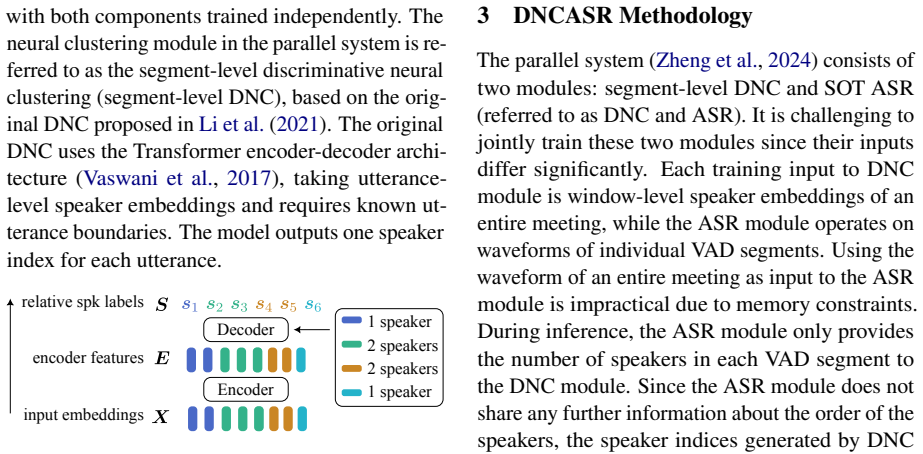
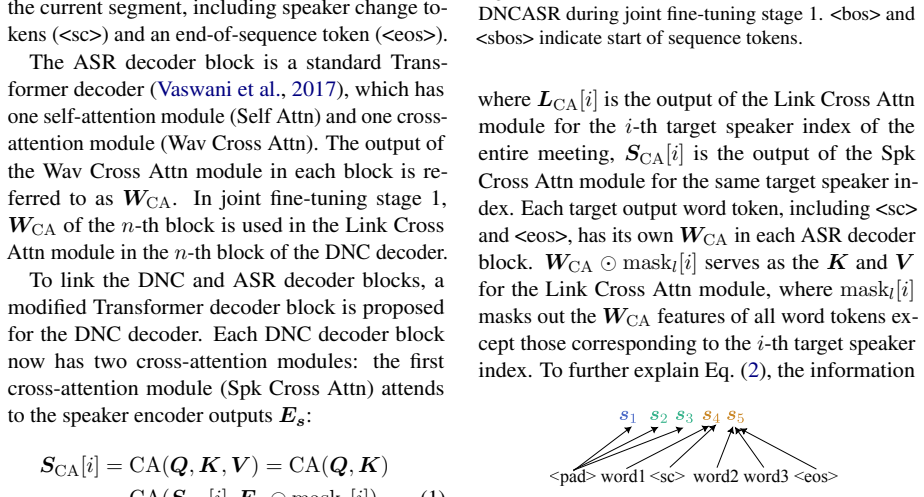
The load-bearing mechanism is the Link Cross Attention (LCA), an extra cross-attention module inserted into each block of the clustering decoder. It lets each speaker-index prediction attend to the WCA features, meaning the key/value outputs of the ASR decoder's cross-attention over the waveform encoder, for exactly the word tokens belonging to that speaker's turn, masked to exclude other turns and padded with a learnable embedding for past segments in the first stage. The two-stage training schedule is the second half of the machinery: stage 1 aligns indices to words segment by segment while both decoders train, and stage 2 freezes the ASR and gives the clustering decoder the whole meeting's stored WCA features in one pass. The LCA is the only systematic difference between DNCASR and the parallel system, and Constrained Diaconis Augmentation is a regularizer that controls how far augmented speaker embeddings rotate, preventing over-augmentation.
What would settle it
Run a controlled ablation of the trained DNCASR (S2+CDA) model in which the Link Cross Attention is masked off but ASR outputs are held fixed; if the AMI Eval cpWER stays at roughly 31.5% instead of worsening by about the 9% relative gain attributed to the link, the central claim fails.
Extended reading notes
Core claim
The paper's central claim is that the mismatch between separately trained modules in speaker-attributed ASR can be repaired by a single architectural bridge: the ASR decoder's Wave Cross Attention output (WCA) is fed, block by block, into the clustering decoder through a second cross-attention module, Link Cross Attention. During a first joint fine-tuning stage the clustering decoder sees the ASR hidden features of the current segment; during a second stage, with the ASR frozen, it sees pre-computed WCA features for all speaker turns in the whole meeting. This lets the neural clustering module align its speaker indices with the actual word order in the ASR output, rather than inferring the order only from a count of speaker-change tokens. The paper reports that this alignment drives the cpWER reductions, especially in overlapping speech, and introduces a Constrained Diaconis Augmentation that limits embedding rotation angles to improve stability.
Load-bearing premise
The load-bearing premise is that the re-implemented parallel system uses the same ASR and speaker-embedding modules and a comparable training budget as DNCASR, so the entire reported cpWER gain can be attributed to the Link Cross Attention rather than to an under-tuned baseline.
Editorial extensions
If this is right
- The system can produce speaker-attributed transcriptions for entire meetings without relying on a non-neural clustering algorithm at inference.
- Most of the improvement is in overlapping speech: cpWER on multi-talker segments drops 14.7% and 10.4% relative on AMI Dev and Eval over the parallel system.
- Using a larger self-supervised waveform encoder yields more than 10% relative cpWER reduction on both sets, so the link benefits from better ASR representations.
- Substituting oracle word sequences lowers Eval cpWER from 31.5% to 17.4%, indicating that ASR word accuracy is a strong bottleneck for speaker attribution.
- A signed-rank comparison across the 34 AMI Dev and Eval meetings favours the second-stage fine-tuning with Constrained Diaconis Augmentation over the first stage at p-values below 1e-6.
Reading between the lines
- A natural next test is an online or streaming variant, since stage 2 currently needs stored WCA features for the whole meeting before the clustering decoder runs.
- The oracle-word results place a clear upper bound: if ASR word errors were eliminated, Eval cpWER would fall from 31.5% to 17.4%, so better recognition is a direct lever on speaker-attributed accuracy even without changing the clustering link.
- Because the largest gains occur on multi-talker segments, datasets with heavier overlap than AMI would be the most discriminating test of the link's advantage.
- Jointly training the VAD and speaker-embedding extractor with the rest of the system is the obvious next step and may remove the remaining non-neural components.
Editorial analysis
A structured set of objections, weighed in public.
Referee Report
Summary. The paper proposes DNCASR, an end-to-end trainable speaker-attributed ASR system that combines a segment-level discriminative neural clustering (DNC) decoder with a serialized-output-training (SOT) ASR decoder. A Link Cross Attention module lets the DNC decoder attend to ASR decoder hidden features (WCA) for each speaker turn; Stage 1 jointly fine-tunes both decoders under a single loss, Stage 2 fine-tunes only the DNC decoder on precomputed features for the full meeting, and Constrained Diaconis Augmentation (CDA) regulates the rotation of speaker embeddings. The paper evaluates on simulated LibriSpeech meetings and on AMI-MDM, reporting DER, WER, and cpWER. The headline result is that the best DNCASR (S2+CDA) achieves 30.7/31.5 cpWER versus 34.8/34.6 for the parallel baseline on AMI Dev/Eval, a relative reduction of 11.8% and 9.0% respectively.
Significance. If the result holds, DNCASR is a useful contribution to speaker-attributed ASR: it gives a practical recipe for injecting ASR hidden representations into a neural clustering module for whole-meeting speaker indexing, with a transparent two-stage training procedure. The synthetic experiments in Section 5.1 freeze the ASR module and re-implement the parallel baseline, which is a genuine controlled comparison; the oracle-word experiments in Tables 2 and 5 isolate speaker-assignment errors; Appendix G provides per-meeting cpWER for the DNCASR systems; and the internal S2-versus-S1 comparison is supported by a Wilcoxon signed-rank test in Table 6. The main weakness is that the AMI headline comparison to the parallel baseline lacks the same statistical and control-baseline support, so the real-data claim is not yet fully substantiated.
major comments (2)
- [§5.2, Tables 4 and 6, Appendix G] The headline claim that DNCASR (S2+CDA) outperforms the parallel system on AMI rests only on aggregate Dev/Eval cpWER values. Table 6 reports a Wilcoxon signed-rank test, but that test compares DNCASR (S2) and (S2+CDA) with DNCASR (S1), not with the parallel baseline. Appendix G lists per-meeting cpWER for DNCASR S1/S2/S2+CDA but not for the parallel system, so the 11.8% Dev and 9.0% Eval relative reductions cannot be checked for outlier-driven effects or pairwise significance. Please report per-meeting cpWER for the parallel baseline, a paired significance test of S2+CDA against that baseline, and confidence intervals or a bootstrap analysis for the aggregate differences.
- [§5.2, Table 3] The AMI comparison is confounded with ASR fine-tuning. DNCASR (S1) jointly fine-tunes the ASR decoder, and Table 3 shows its WER is 24.9/26.6 on Dev/Eval, whereas the parallel baseline has 25.8/26.6; the Dev difference is 0.9 absolute WER. This means part of the cpWER improvement in Table 4 may come from improved word recognition rather than from the Link Cross Attention itself. The synthetic experiments in Table 1 freeze the ASR and thereby control for this, but the AMI claim does not have the same control. Please add an ablation that removes the link from DNCASR under the same ASR fine-tuning recipe, or provide a parallel baseline that is fine-tuned on the same data without the link, and report the comparison at matched ASR performance.
minor comments (6)
- [§3.1, Eq. (1)] The notation in Eq. (1) is confusing: "CA(Q,K,V) = CA(Q,K)" appears redundant, and the mask is written as both "masks[i]" and "mask_s[i]" in nearby text. Please standardize the notation.
- [Appendix C] Appendix C says that length scheduling plays a crucial role in DNC pre-training, but it does not describe the schedule itself. Please specify the initial length, the final length, and the rate or step at which the length increases.
- [Figure 4] The phrase "between each pairs of decoder block" should read "between each pair of decoder blocks."
- [Section 7] There is a typo in the Limitations section: "multi-taker datasets" should be "multi-talker datasets."
- [References] The Carletta et al. reference has a garbled author string: "Mccowan Wilfried Post Dennis Reidsma" should be split into the individual authors or otherwise cleaned.
- [Appendix E.1] The word "Surprisingly" in Appendix E.1 is informal; please replace it with a neutral description and quantify the variability across the 20 meetings, since only aggregate cpWER is reported.
Circularity Check
No significant circularity: the claimed cpWER improvement is an empirical benchmark comparison, not a construction-level reduction.
full rationale
The paper's central claim is that the linked-decoder DNCASR system outperforms a parallel DNC+ASR system on cpWER. This claim is supported by direct evaluations on held-out AMI Dev/Eval sets and on synthetic meetings. Nothing in the derivation defines the predicted cpWER in terms of the training objective or of the baseline: the joint loss is a sum of cross-entropy losses for speaker indices and word tokens, while cpWER is computed with the external MeetEval tool under minimum-permutation scoring. The synthetic experiments freeze the ASR and re-implement the parallel baseline, providing a controlled comparison in which the only difference is the Link Cross Attention and the use of ASR hidden features; this is a genuine ablation, not a fitted-input re-prediction. The AMI comparison relies in part on pretraining results from the same authors' prior work (Zheng et al. 2024), but this is a normal comparison to a published baseline rather than a self-referential justification: the baseline numbers are independent measurements, and the paper also compares against a cascaded system. The absence of per-meeting parallel-baseline cpWER scores and the lack of a significance test against that baseline are evidence-quality concerns, not circularity. No uniqueness theorem, ansatz, or definitional equivalence is imported from the authors' prior work to force the conclusion. The paper is self-contained in the sense that the reported improvement is an empirical result that could in principle be contradicted by other measurements.
Assumptions & free parameters
free parameters (5)
- CDA rotation scale =
random 0 to 10
- Speaker embedding window size/stride =
1.5s / 0.5s
- Decoder architecture (layers/heads/hidden/FFN) =
6/4/256/2048
- Learning rate =
5e-4
- Training epochs per stage =
ASR 60; DNC 250; stage1 10; stage2 5+3
assumptions (5)
- domain assumption The frozen WavLM-base-plus encoder provides speech features sufficient for both word recognition and speaker-turn alignment.
- domain assumption Frozen ECAPA-TDNN window-level speaker embeddings are sufficient to discriminate speakers for clustering.
- domain assumption The AMI-MDM force-aligned VAD segments are accurate and equivalent across all compared systems.
- domain assumption Serialized output training with <sc> tokens allows the ASR decoder to produce speaker-turn-aligned hidden features.
- ad hoc to paper Aligning <sc> and <eos> features to the left speaker turn is a reasonable inductive bias for the link.
Cite this review
Pith. "Pith review of DNCASR: End-to-End Training for Speaker-Attributed ASR." pith.science (2026). https://pith.science/paper/DTHZNXHM
@misc{pith2026250601916,
  author       = {Pith},
  title        = {Pith review of: DNCASR: End-to-End Training for Speaker-Attributed ASR},
  year         = {2026},
  howpublished = {\url{https://pith.science/paper/DTHZNXHM}},
  note         = {Machine review of arXiv:2506.01916}
}
read the original abstract
This paper introduces DNCASR, a novel end-to-end trainable system designed for joint neural speaker clustering and automatic speech recognition (ASR), enabling speaker-attributed transcription of long multi-party meetings. DNCASR uses two separate encoders to independently encode global speaker characteristics and local waveform information, along with two linked decoders to generate speaker-attributed transcriptions. The use of linked decoders allows the entire system to be jointly trained under a unified loss function. By employing a serialised training approach, DNCASR effectively addresses overlapping speech in real-world meetings, where the link improves the prediction of speaker indices in overlapping segments. Experiments on the AMI-MDM meeting corpus demonstrate that the jointly trained DNCASR outperforms a parallel system that does not have links between the speaker and ASR decoders. Using cpWER to measure the speaker-attributed word error rate, DNCASR achieves a 9.0% relative reduction on the AMI-MDM Eval set.
Figures


Figures from the paper (5 more)


Reference graph
Works this paper leans on
-
[1]
online" 'onlinestring :=
ENTRY address archivePrefix author booktitle chapter edition editor eid eprint eprinttype howpublished institution journal key month note number organization pages publisher school series title type volume year doi pubmed url lastchecked label extra.label sort.label short.list INTEGERS output.state before.all mid.sentence after.sentence after.block STRING...
-
[2]
write newline
" write newline "" before.all 'output.state := FUNCTION n.dashify 't := "" t empty not t #1 #1 substring "-" = t #1 #2 substring "--" = not "--" * t #2 global.max substring 't := t #1 #1 substring "-" = "-" * t #2 global.max substring 't := while if t #1 #1 substring * t #2 global.max substring 't := if while FUNCTION word.in bbl.in capitalize " " * FUNCT...
-
[3]
Xavier Anguera, Chuck Wooters, and Javier Hernando. 2007. Acoustic beamforming for speaker diarization of meetings. IEEE Transactions on Audio, Speech, and Language Processing, 15(7):2011--2022
work page 2007
-
[4]
Jean Carletta, Simone Ashby, Sebastien Bourban, Mike Flynn, Thomas Hain, Jaroslav Kadlec, Vasilis Karaiskos, Wessel Kraaij, Melissa Kronenthal, Guillaume Lathoud, Mike Lincoln, Agnes Lisowska, and Mccowan Wilfried Post Dennis Reidsma. 2006. The Ami meeting corpus : A pre-announcement. In In Proceedings of the Second International Workshop on Machine Learn...
work page 2006
-
[5]
Xuankai Chang, Wangyou Zhang, Yanmin Qian, Jonathan Le Roux, and Shinji Watanabe. 2020. End-to-end multi-speaker speech recognition with transformer. In Proc. ICASSP , Barcelona, Spain
work page 2020
-
[6]
Sanyuan Chen, Chengyi Wang, Zhengyang Chen, Yu Wu, Shujie Liu, Zhuo Chen, Jinyu Li, Naoyuki Kanda, Takuya Yoshioka, Xiong Xiao, Jian Wu, Long Zhou, Shuo Ren, Yanmin Qian, Yao Qian, Jian Wu, Michael Zeng, Xiangzhan Yu, and Furu Wei. 2022. https://doi.org/10.1109/JSTSP.2022.3188113 WavLM : Large-scale self-supervised pre-training for full stack speech proce...
arXiv 2022
-
[7]
Scott Shaobing Chen and P S Gopalakrishnan. 1998. Speaker, environment and channel change detection and clustering via the bayesian information criterion. In Proceedings DARPA Broadcast News Transcription and Understanding Workshop
work page 1998
-
[8]
Zhuo Chen, Takuya Yoshioka, Liang Lu, Tianyan Zhou, Zhong Meng, Yi Luo, Jian Wu, Xiong Xiao, and Jinyu Li. 2020. Continuous speech separation: Dataset and analysis. In Proc. ICASSP , Barcelona, Spain
work page 2020
Show all 52 references
-
[9]
Joon Son Chung, Arsha Nagrani, and Andrew Zisserman. 2018. https://doi.org/10.21437/Interspeech.2018-1929 VoxCeleb2 : Deep speaker recognition . In Proc. Interspeech , Hyderabad, India
2018 doi
-
[10]
Samuele Cornell, Jee-weon Jung, Shinji Watanabe, and Stefano Squartini. 2024. One model to rule them all? Towards end-to-end joint speaker diarization and speech recognition. In Proc. ICASSP , Seoul, Korea
2024
-
[11]
Samuele Cornell, Matthew Wiesner, Shinji Watanabe, Desh Raj, Xuankai Chang, Paola Garcia, Matthew Maciejewski, Yoshiki Masuyama, Zhong-Qiu Wang, Stefano Squartini, et al. 2023. The CHiME -7 DASR challenge: Distant meeting transcription with multiple devices in diverse scenario...
2023
-
[12]
Nauman Dawalatabad, Mirco Ravanelli, Fran c ois Grondin, Jenthe Thienpondt, Brecht Desplanques, and Hwidong Na. 2021. https://doi.org/10.21437/Interspeech.2021-941 ECAPA-TDNN embeddings for speaker diarization . In Proc. Interspeech , Brno, Czech Republic
2021 doi
-
[13]
Kenny, R \'e da Dehak, Pierre Dumouchel, and Pierre Ouellet
Najim Dehak, Patrick J. Kenny, R \'e da Dehak, Pierre Dumouchel, and Pierre Ouellet. 2011. Front-end factor analysis for speaker verification. IEEE Transactions on Audio, Speech, and Language Processing, 19(4):788--798
2011
-
[14]
Persi Diaconis and Mehrdad Shahshahani. 1987. The subgroup algorithm for generating uniform random variables . Probability in the Engineering and Informational Sciences, 1:15--32
1987
-
[15]
Yusuke Fujita, Naoyuki Kanda, Shota Horiguchi, Kenji Nagamatsu, and Shinji Watanabe. 2019. End-to-end neural speaker diarization with permutation-free objectives. In Interspeech, Brighton, UK
2019
-
[16]
Shota Horiguchi, Yusuke Fujita, Shinji Watanabe, Yawen Xue, and Paola Garcia. 2022. Encoder-decoder based attractors for end-to-end neural diarization. IEEE/ACM Transactions on Audio, Speech, and Language Processing, 30:1493--1507
2022
-
[17]
Naoyuki Kanda, Yashesh Gaur, Xiaofei Wang, Zhong Meng, Zhuo Chen, Tianyan Zhou, and Takuya Yoshioka. 2020 a . Joint speaker counting, speech recognition, and speaker identification for overlapped speech of any number of speakers. In Proc. Interspeech , Shanghai, China
2020
-
[18]
Naoyuki Kanda, Yashesh Gaur, Xiaofei Wang, Zhong Meng, and Takuya Yoshioka. 2020 b . Serialized output training for end-to-end overlapped speech recognition. In Proc. Interspeech , Shanghai, China
2020
-
[19]
Naoyuki Kanda, Xiong Xiao, Yashesh Gaur, Xiaofei Wang, Zhong Meng, Zhuo Chen, and Takuya Yoshioka. 2022. Transcribe-to-diarize: Neural speaker diarization for unlimited number of speakers using end-to-end speaker-attributed ASR . In Proc. ICASSP , Singapore
2022
-
[20]
Keisuke Kinoshita, Marc Delcroix, and Naohiro Tawara. 2021. Integrating end-to-end neural and clustering-based diarization: Getting the best of both worlds. In Proc. ICASSP , Toronto, Canada
2021
-
[21]
Nithin Rao Koluguri, Taejin Park, and Boris Ginsburg. 2022. Titanet: Neural model for speaker representation with 1d depth-wise separable convolutions and global context. In Proc. ICASSP , Singapore
2022
-
[22]
Federico Landini, Mireia Diez, Themos Stafylakis, and Luk \'a s Burget. 2024. https://doi.org/10.1109/TASLP.2024.3422818 DiaPer : End-to-End neural diarization with perceiver-based attractors . IEEE/ACM Transactions on Audio, Speech, and Language Processing, 32:3450--3465
2024
-
[23]
Kreyssig, Chao Zhang, and Philip C
Qiujia Li, Florian L. Kreyssig, Chao Zhang, and Philip C. Woodland. 2021. Discriminative neural clustering for speaker diarisation. In Proc. SLT , Shenzhen, China
2021
-
[24]
Liang Lu, Naoyuki Kanda, Jinyu Li, and Yifan Gong. 2021 a . Streaming end-to-end multi-talker speech recognition. IEEE Signal Processing Letters, 28:803--807
2021
-
[25]
Liang Lu, Naoyuki Kanda, Jinyu Li, and Yifan Gong. 2021 b . https://arxiv.org/abs/2104.02109 Streaming multi-talker speech recognition with joint speaker identification . In Proc. Interspeech , Brno, Czech Republic
2021 arXiv
-
[26]
Arsha Nagrani, Joon Son Chung, Weidi Xie, and Andrew Zisserman. 2020. https://doi.org/10.1016/j.csl.2019.101027 Voxceleb: Large-scale speaker verification in the wild . Computer Speech & Language, 60:101027
2020
-
[27]
Huazhong Ning, Ming Liu, Hao Tang, and Thomas S. Huang. 2006. A spectral clustering approach to speaker diarization. In Interspeech 2006, Pittsburgh, USA
2006
-
[28]
Vassil Panayotov, Guoguo Chen, Daniel Povey, and Sanjeev Khudanpur. 2015. https://doi.org/10.1109/ICASSP.2015.7178964 Librispeech: An ASR corpus based on public domain audio books . In Proc. ICASSP , Brisbane, Australia
2015
-
[29]
Han, Shinji Watanabe, and Shrikanth Narayanan
Tae Jin Park, Naoyuki Kanda, Dimitrios Dimitriadis, Kyu J. Han, Shinji Watanabe, and Shrikanth Narayanan. 2021. https://arxiv.org/abs/2101.09624 A review of speaker diarization: Recent advances with deep learning . Computer Speech & Language
2021 arXiv
-
[30]
Sainath, Ralf Schl \"u ter, and Shinji Watanabe
Rohit Prabhavalkar, Takaaki Hori, Tara N. Sainath, Ralf Schl \"u ter, and Shinji Watanabe. 2024. End-to-end speech recognition: A survey. IEEE/ACM Transactions on Audio, Speech, and Language Processing, 32:325--351
2024
-
[31]
Desh Raj, Pavel Denisov, Zhuo Chen, Hakan Erdogan, Zili Huang, Maokui He, Shinji Watanabe, Jun Du, Takuya Yoshioka, Yi Luo, Naoyuki Kanda, Jinyu Li, Scott Wisdom, and John R. Hershey. 2021. Integration of speech separation, diarization, and recognition for multi-speaker meetin...
2021
-
[32]
Desh Raj, Daniel Povey, and Sanjeev Khudanpur. 2023. SURT 2.0: Advances in transducer-based multi-talker speech recognition. IEEE/ACM Transactions on Audio, Speech, and Language Processing, 31:3800--3813
2023
-
[33]
Hiroshi Seki, Takaaki Hori, Shinji Watanabe, Jonathan Le Roux, and John R. Hershey. 2018. A purely end-to-end system for multi-speaker speech recognition. In Proc. ACL , Melbourne, Australia. Association for Computational Linguistics
2018
-
[34]
Gregory Sell, David Snyder, Alan McCree, Daniel Garcia-Romero , Jes \'u s Villalba, Matthew Maciejewski, Vimal Manohar, Najim Dehak, Daniel Povey, Shinji Watanabe, and Sanjeev Khudanpur. 2018. Diarization is hard: Some experiences and lessons learned for the JHU team in the in...
2018
-
[35]
Laurent El Shafey, Hagen Soltau, and Izhak Shafran. 2019. Joint speech recognition and speaker diarization via sequence transduction. In Proc. Interspeech , Graz, Austria
2019
-
[36]
Ilya Sklyar, Anna Piunova, and Yulan Liu. 2021. Streaming multi-speaker ASR with RNN-T . In Proc. ICASSP , Toronto, Canada
2021
-
[37]
Ilya Sklyar, Anna Piunova, Xianrui Zheng, and Yulan Liu. 2022. Multi-turn RNN-t for streaming recognition of multi-party speech. In Proc. ICASSP , Singapore
2022
-
[38]
David Snyder, Daniel Garcia-Romero , Gregory Sell, Daniel Povey, and Sanjeev Khudanpur. 2018. X-vectors: Robust DNN embeddings for speaker recognition. In Proc. ICASSP , Calgary, Canada
2018
-
[39]
Jongseo Sohn, Nam Soo Kim, and Wonyong Sung. 1999. A statistical model-based voice activity detection. IEEE Signal Processing Letters, 6(1):1--3
1999
-
[40]
G. W. Stewart. 1980. The efficient generation of random orthogonal matrices with an application to condition estimators. SIAM Journal on Numerical Analysis, 17(3)
1980
-
[41]
Guangzhi Sun, Chao Zhang, and Phil Woodland. 2021. https://doi.org/10.1016/j.neunet.2021.04.020 Combination of deep speaker embeddings for diarisation . Neural Networks, 141:372--384
2021 doi
-
[42]
Tranter and D.A
S.E. Tranter and D.A. Reynolds. 2006. An overview of automatic speaker diarization systems. IEEE Transactions on Audio, Speech, and Language Processing, 14(5):1557--1565
2006
-
[43]
Ashish Vaswani, Noam Shazeer, Niki Parmar, Jakob Uszkoreit, Llion Jones, Aidan N Gomez, ukasz Kaiser, and Illia Polosukhin. 2017. Attention is all you need. In Proc. NIPS , Long Beach, USA
2017
- [44]
-
[45]
L. Wang, C. Zhang, P. C. Woodland, M. J. F. Gales, P. Karanasou, P. Lanchantin, X. Liu, and Y. Qian. 2016. Improved DNN-based segmentation for multi-genre broadcast audio. In Proc. ICASSP , Shanghai, China
2016
-
[46]
Hershey, and Tomoki Hayashi
Shinji Watanabe, Takaaki Hori, Suyoun Kim, John R. Hershey, and Tomoki Hayashi. 2017. Hybrid CTC /attention architecture for end-to-end speech recognition. IEEE Journal of Selected Topics in Signal Processing, 11(8):1240--1253
2017
-
[47]
Frank Wilcoxon. 1945. https://arxiv.org/abs/3001968 Individual comparisons by ranking methods . Biometrics Bulletin, 1(6):80--83
1945
-
[48]
Thomas Wolf, Lysandre Debut, Victor Sanh, Julien Chaumond, Clement Delangue, Anthony Moi, Pierric Cistac, Tim Rault, R \'e mi Louf, Morgan Funtowicz, Joe Davison, Sam Shleifer, Patrick von Platen , Clara Ma, Yacine Jernite, Julien Plu, Canwen Xu, Teven Le Scao, Sylvain Gugger,...
2020
-
[49]
Steve Young, Gunnar Evermann, Mark Gales, Thomas Hain, Dan Kershaw, Xunying (Andrew) Liu, Gareth Moore, Julian Odell, Dave Ollason, Dan Povey, Anton Ragni, Valtcho Valtchev, Phil Woodland, and Chao Zhang. 2015. The HTK book. University of Cambridge
2015
-
[50]
Aonan Zhang, Quan Wang, Zhenyao Zhu, John Paisley, and Chong Wang. 2019. Fully supervised speaker diarization. In Proc. ICASSP , Brighton, UK
2019
-
[51]
Woodland
Xianrui Zheng, Guangzhi Sun, Chao Zhang, and Philip C. Woodland. 2024. SOT triggered neural clustering for speaker attributed ASR . In Proc. Interspeech , Kos Island, Greece
2024
-
[52]
Woodland
Xianrui Zheng, Chao Zhang, and Philip C. Woodland. 2022. Tandem multitask training of speaker diarisation and speech recognition for meeting transcription. In Proc. Interspeech , Incheon, Korea
2022
Reviewed August 7, 2026 · model on record in the stance chip above.
Discussion (0). Sign in to comment.