REVIEW 4 major objections 6 minor 70 references
NICER Spectral and Timing Analysis of 4U 1630$-$47 and its Heartbeat State
T0 review · 4 major / 6 minor · reviewed 2026-08-11 · deepseek-v4-flash
Pith's one-line read 4U 1630–47's heartbeat is driven by an inner-disk radiation-pressure instability, with phase-resolved flux tracking disk parameters and a one-second hard lag near the heartbeat frequency.
desk verdict Solid empirical paper with a new heartbeat detection and careful wind/reflection analysis; the disk-instability interpretation is plausible but not yet secured by the phase-resolved statistics, and a factor-10 frequency error needs fixing. read the letter →
The pith
A machine-rendered reading of the paper's core claim, the machinery that carries it, and where it could break.
The reading
What carries the argument
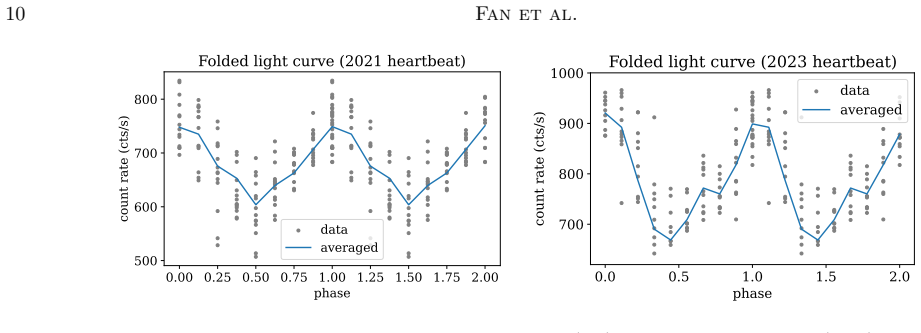
The load-bearing machinery is phase-resolved spectral fitting under a disk-plus-corona decomposition. Each ~2 s phase bin of the folded ~18–20 s heartbeat is fit with the model tbfeo × thcomp ⊗ diskbb, and in a cross-check with tbfeo × thcomp ⊗ kerrd, after which the Pearson correlation of the folded count rate with each spectral parameter is evaluated; this is what allows the paper to attribute the flux oscillation to the disk rather than the corona. The timing side is carried by Fourier analysis: energy-resolved power spectra modeled with Lorentzians to measure fractional rms, and lag and coherence spectra computed against a 2–3 keV reference band to find the ~1 s hard lag. The interpretive thread is the radiation-pressure-instability S-curve of the accretion disk, which connects the observed fast swings in disk parameters to the viscous timescale associated with the changing inner disk radius.
What would settle it
Take a future heartbeat observation of 4U 1630–47 with more cycles and higher count rate, phase-resolve with twice as many bins, and let both disk and coronal normalizations vary independently: if the disk–flux correlations weaken or the coronal parameters track flux at ≳3σ, the radiation-pressure-instability reading loses its main spectral support, and if the ~1 s hard lag is absent at the heartbeat frequency in a longer observation, the viscous-propagation interpretation is falsified.
Extended reading notes
Core claim
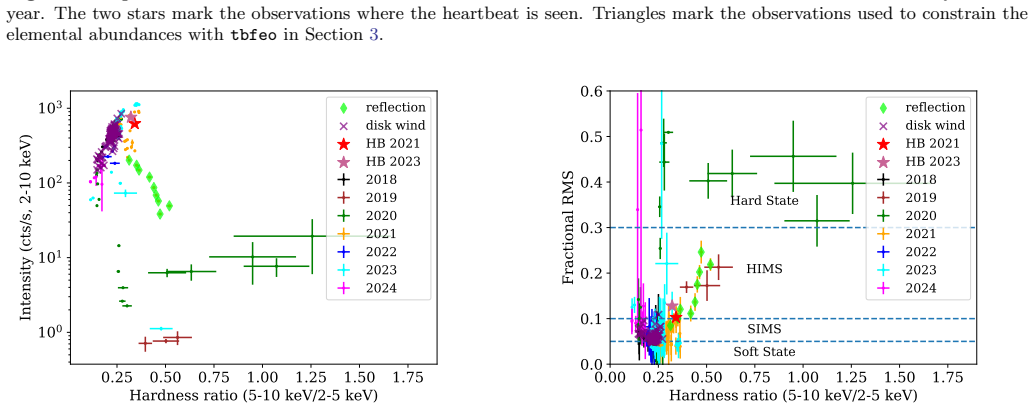
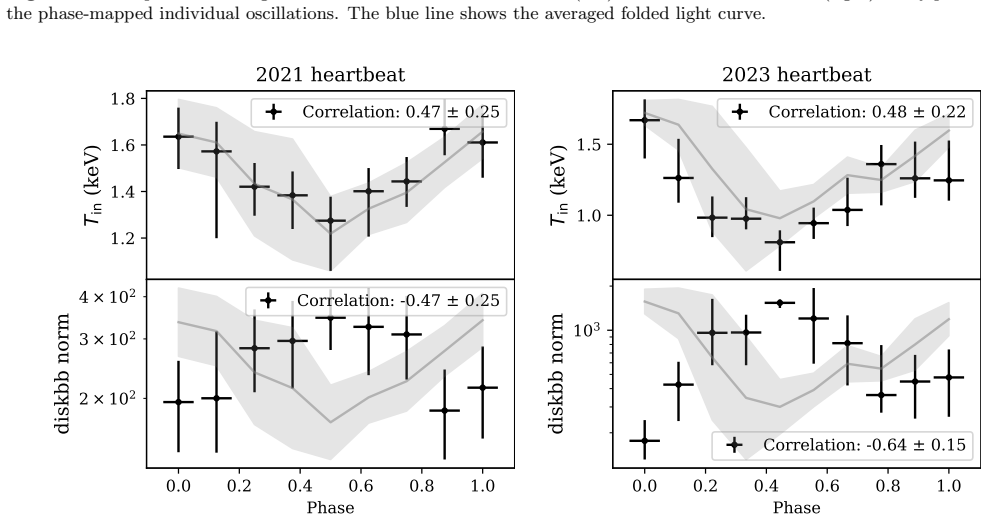
On the paper's own terms, the central discovery is that the heartbeat of 4U 1630–47 behaves like an inner-disk radiation-pressure instability: in both heartbeat observations, higher flux comes with higher inner-disk temperature, smaller inner radius (lower diskbb normalization, and in the kerrd cross-check a smaller $R_{\rm in}$ and higher $\dot M$), while the coronal photon index and covering fraction show no strong correlation with flux. The paper also finds a hard lag of roughly one second near the heartbeat frequency with coherence above about 0.8, and a fractional rms that grows with photon energy. Its interpretation combines these: the inner disk produces the oscillation, the fluctuation propagates outward on a viscous timescale, and Compton scattering by the corona magnifies it at higher energies, so the rms–energy trend does not require the corona itself to be the origin of the heartbeat. A supporting result from the same dataset is that relativistic reflection fits of nine intermediate-state spectra from the 2021 outburst give a stable inner radius near the innermost stable circular orbit, arguing against a truncated disk in those states.
Load-bearing premise
The heartbeat interpretation assumes the phase-binned spectral fits genuinely separate the disk and the corona, so the swings in disk temperature and radius are physical and the flat coronal parameters are not just a sensitivity limit of nine or ten phase bins.
Editorial extensions
If this is right
- If the heartbeat is an inner-disk radiation-pressure instability, then the two heartbeats observed in 2021 and 2023 can share one mechanism even though their time-averaged spectra and inner-disk temperatures differ markedly.
- The positive rms–energy trend in the heartbeat does not require a coronal origin; a disk-seeded oscillation that the corona Compton-scatters can explain it, consistent with the flat phase-resolved coronal parameters.
- The stable inner radius found in the intermediate states, if correct, weighs against truncated-disk models for 4U 1630–47 during the HIMS-to-SIMS transition.
- The ~1 s hard lag near the heartbeat frequency with high coherence implies that the seed and scattered photons are causally linked on a viscous timescale, not a light-travel (reverberation) timescale.
Reading between the lines
- The paper does not test this, but a higher-statistics heartbeat observation with more cycles and finer phase bins should either recover the same disk–flux correlation or reveal that the flat coronal parameters were a sensitivity limit; the latter would weaken the central claim.
- One could measure the hard lag as a function of heartbeat phase across many cycles: if it is viscous propagation, its magnitude should track the changing inner disk radius over the cycle, a measurement the paper does not attempt.
- The absence of wind absorption during the heartbeats, despite the wind's recurrence in other outbursts, suggests the wind and heartbeat are independent phenomena tied to different disk temperatures; future simultaneous wind-plus-heartbeat detections in this source would complicate that picture.
Signed reviews
Editorial analysis
A structured set of objections, weighed in public.
Referee Report
Summary. This paper presents a spectral and timing analysis of 251 NICER observations of the black hole X-ray binary 4U 1630–47 from 2018 to 2024. The authors fit the 2–10 keV spectra with an absorbed disk-blackbody plus Comptonization model, identify relativistic reflection features in nine spectra and disk wind absorption features in many spectra, and model them with relxillCp and XSTAR, respectively. They report two heartbeat-state observations, in 2021 and 2023, and perform phase-resolved spectral fitting with diskbb and kerrd, finding correlations between count rate and disk parameters but not coronal parameters. They also report a ~1 s hard lag and high coherence near the heartbeat frequency. On this basis they argue that the heartbeat is driven by an inner-disk radiation-pressure instability, with variability propagating through the disk and being Compton-scattered by the corona.
Significance. If the central interpretation is correct, this is a valuable empirical contribution to the debate on heartbeat mechanisms in black hole X-ray binaries. The paper has several strengths: it uses standard, reproducible NICER reduction and spectral-fitting tools; it provides a quantitative criterion for wind detection; it reports two independent heartbeat epochs with concordant behavior; and it cross-checks the phase-resolved result with two different thermal disk models (diskbb and kerrd). The timing analysis (lag and coherence) adds an independent constraint. However, as discussed below, the phase-resolved correlation analysis currently has limited statistical power to separate disk-driven from coronal-driven variability, and a model-degeneracy check is required before the radiation-pressure-instability conclusion is secure. The manuscript is therefore promising but needs revision.
major comments (4)
- [§4.1–4.2, Figs. 14–15] The central claim that the heartbeat is a disk-driven oscillation rests on the phase-resolved correlation analysis, but the statistical support is weaker than the narrative suggests. With only 9–10 phase bins, Pearson coefficients such as 0.47±0.25 (2021, Tin) and −0.64±0.15 (2023, diskbb norm) have large uncertainties, and the statement that coronal parameters show "no strong correlation" is a null result whose statistical power is not quantified. Please report the coronal correlation coefficients with uncertainties, a power estimate for detecting a coronal correlation of the same amplitude as the disk correlations, and an error-including correlation test (bootstrap or MCMC) for the disk parameters.
- [§4.1–4.2] The phase-resolved fits use tbfeo×thcomp⊗diskbb over 2–10 keV, where the seed disk temperature/normalization and the Comptonizing corona parameters are degenerate. The anti-correlated Tin/diskbb-norm changes and the kerrd Rin/Mdot swings could be produced by the model trading a flux-driven spectral shape change between the disk and corona components. To secure the interpretation, demonstrate that the phase-resolved correlations survive when coronal parameters are fixed at phase-averaged values, when parameter covariances are included in the correlation test, and/or when an alternative continuum model is used.
- [§5.2, Fig. 17] The ~1 s hard lag near the heartbeat frequency is reported from a narrow frequency range around 5 mHz, where the number of independent frequency bins is small. Please quantify the uncertainty on the lag estimates and the detection significance, and state how many independent bins fall in the yellow region. Without this, the lag could be a chance fluctuation at one of several frequency bins, and the claim that the lag is physically meaningful is not secured.
- [§3.3, Fig. 11] The stable and untruncated disk conclusion from relxillCp depends on fixing a*=0.998, inclination=64°, and kTe=50 keV. The paper mentions the spin/inner-radius degeneracy but does not quantify how Rin changes under plausible variations of the fixed parameters, nor how the phase-resolved Rin swings in Fig. 15 depend on the assumed mass and distance. A robustness test of these fixed assumptions would strengthen this secondary claim, which is highlighted in the abstract.
minor comments (6)
- [Conclusions] The text says the light curves oscillate "at a frequency around 0.05 Hz"; this should read "around 0.005 Hz" (or 5 mHz), consistent with the values quoted in §2.
- [Fig. 8] The model label in the top panel uses "tbfeo×thcomp×diskbb" with a multiplication sign, whereas the text uses "⊗" for the convolution; make this notation consistent.
- [Fig. 1] The x-axis label contains an unexplained "+5.85e4"; this offset should be removed or described in the caption.
- [Appendix A] The wind-detection criterion uses the 90% upper bound crossing zero; also report best-fit equivalent widths and uncertainties for the representative spectra so the reader can see how close the detections are to the threshold.
- [Figs. 14–15] Please ensure that the 90% parameter uncertainties are shown on each phase bin, since the significance of the phase trends is hard to assess otherwise.
- [§3.2] Because the XSTAR grid uses the averaged best-fit continuum as the seed, a brief statement on the sensitivity of the derived wind parameters to this choice would be useful.
Circularity Check
No significant circularity: results are empirical fits with standard external models; interpretations invoke external theory.
full rationale
The paper's central claims are empirical fits to NICER data using standard external spectral models (tbfeo, thcomp, diskbb, relxillCp, XSTAR, kerrd) and standard timing tools (stingray, Pearson correlations, Lorentzian PDS fits). The phase-resolved heartbeat result—count rate correlated with disk temperature, normalization, inner radius, and mass accretion rate but not coronal parameters—is a reported property of the fitted parameters, not a quantity forced by the model definitions. The thcomp and diskbb degeneracies could complicate interpretation, but they do not make the correlation an identity. The statement that the result is 'consistent with the scenario given by the inner disk radiation pressure instability' is an external theoretical comparison, not a derivation from the paper's inputs. The relxillCp untruncated-disk conclusion follows from fitting the inner radius with the spin fixed at 0.998; fixing a parameter is a stated assumption, not a circular reduction, and the fitted inner-radius values are not preset. Self-citations, such as König et al. (2025, in preparation) and Fan et al. (2024), are not load-bearing: removing them would not change the fitted results or the main argument. No fitted parameter is renamed as a prediction, and no invoked theorem is author-specific or uniqueness-based. Therefore no significant circularity is present.
Assumptions & free parameters
free parameters (5)
- Black hole spin a* =
0.998 (fixed)
- Disk inclination =
64 degrees (fixed)
- Corona temperature kTe =
50 keV (fixed)
- tbfeo column and abundances =
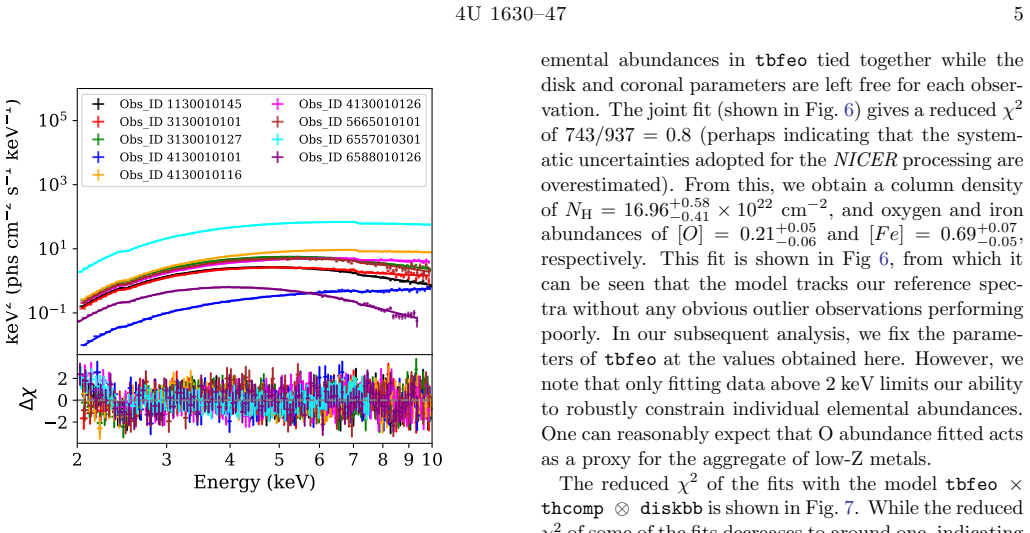
NH = 16.96e22 cm^-2, [O] = 0.21, [Fe] = 0.69
- Black hole mass and distance in kerrd fits =
10 Msun, 10 kpc (assumed)
assumptions (6)
- domain assumption The relxillCp reflection model, with spin 0.998 and inclination 64 degrees, correctly describes the disk reflection spectrum and maps Rin to ISCO units.
- domain assumption A single XSTAR grid computed from an averaged best-fit continuum describes the wind absorption in all wind spectra.
- domain assumption State boundaries (hard, HIMS, SIMS, soft) calibrated on other sources apply to 4U 1630-47 in the hardness-rms diagram.
- domain assumption The temperature-dependent color correction fcol proportional to T^1/4 applies, so the constant-Rin contours in Fig. 12 are valid.
- domain assumption The heartbeat is a stable periodic template for phase folding, with cycle starts at maximum count rate.
- domain assumption The 3C50 model correctly estimates the NICER background in the 2-10 keV band.
Cite this review
Pith. "Pith review of NICER Spectral and Timing Analysis of 4U 1630$-$47 and its Heartbeat State." pith.science (2026). https://pith.science/paper/DUADPTPB
@misc{pith2026241207621,
  author       = {Pith},
  title        = {Pith review of: NICER Spectral and Timing Analysis of 4U 1630$-$47 and its Heartbeat State},
  year         = {2026},
  howpublished = {\url{https://pith.science/paper/DUADPTPB}},
  note         = {Machine review of arXiv:2412.07621}
}
read the original abstract
We present a spectral and timing analysis of NICER observations of the black hole X-ray binary 4U 1630-47 from 2018 to 2024. We find relativistic reflection features in the hard and soft intermediate states, and disk wind absorption features in the soft intermediate state and soft state. We fit the reflection features with relxillCP and find a stable and untruncated disk in the intermediate states; we fit the wind features with XSTAR and find a stable, highly ionized wind with high column density across different outbursts. Specifically, the heartbeat state is seen in two observations in 2021 and 2023 respectively. Through the phase-resolved spectral fitting, we find the flux of the source to be correlated with the disk parameters while no strong correlation with the coronal parameters is observed, consistent with the scenario given by the inner disk radiation pressure instability. A hard lag on the time scale of 1 s and high coherence is observed near the characteristic frequency of the heartbeat, which can be explained by the viscous propagation of mass accretion fluctuations in the disk. The positive relationship between the heartbeat fractional rms and energy can possibly be explained by a disk-originated oscillation which is then magnified by the corona scattering.
Figures


Figures from the paper (13 more)




Reference graph
Works this paper leans on
-
[1]
2020, MNRAS, 497, 3896, doi: 10.1093/mnras/staa2168
Alabarta, K., Altamirano, D., M´ endez, M., et al. 2020, MNRAS, 497, 3896, doi: 10.1093/mnras/staa2168
-
[2]
Arnaud, K. A. 1996, in Astronomical Society of the Pacific Conference Series, Vol. 101, Astronomical Data Analysis Software and Systems V, ed. G. H. Jacoby & J. Barnes, 17
1996
-
[3]
2022, arXiv e-prints, arXiv:2209.07954, doi: 10.48550/arXiv.2209.07954
Bachetti, M., & Huppenkothen, D. 2022, arXiv e-prints, arXiv:2209.07954, doi: 10.48550/arXiv.2209.07954
-
[4]
R., van der Klis, M., & van Paradijs, J
Belloni, T., M´ endez, M., King, A. R., van der Klis, M., & van Paradijs, J. 1997, ApJL, 488, L109, doi: 10.1086/310944 4U 1630–47 17
doi:10.1086/310944 1997
-
[5]
Belloni, T. M. 2010, in Lecture Notes in Physics, Berlin Springer Verlag, ed. T. Belloni, Vol. 794, 53, doi: 10.1007/978-3-540-76937-8 3
-
[6]
Belloni, T. M., & Motta, S. E. 2016, in Astrophysics and Space Science Library, Vol. 440, Astrophysics of Black Holes: From Fundamental Aspects to Latest Developments, ed. C. Bambi, 61, doi: 10.1007/978-3-662-52859-4 2
-
[7]
Belloni, T. M., Motta, S. E., & Mu˜ noz-Darias, T. 2011, Bulletin of the Astronomical Society of India, 39, 409, doi: 10.48550/arXiv.1109.3388
-
[8]
2024, MNRAS, 528, 558, doi: 10.1093/mnras/stad3912
Bollemeijer, N., Uttley, P., Basak, A., et al. 2024, MNRAS, 528, 558, doi: 10.1093/mnras/stad3912
Show all 70 references
-
[9]
Buisson, D. J. K., Fabian, A. C., Barret, D., et al. 2019, MNRAS, 490, 1350, doi: 10.1093/mnras/stz2681
2019 doi
-
[10]
2015, MNRAS, 450, 3840, doi: 10.1093/mnras/stv687
Capitanio, F., Campana, R., De Cesare, G., & Ferrigno, C. 2015, MNRAS, 450, 3840, doi: 10.1093/mnras/stv687
2015 doi
-
[11]
2005, ApJ, 629, 403, doi: 10.1086/431174
Casella, P., Belloni, T., & Stella, L. 2005, ApJ, 629, 403, doi: 10.1086/431174
2005 doi
-
[12]
2015, MNRAS, 447, 3960, doi: 10.1093/mnras/stu2742
Choudhury, M., Bhatt, N., & Bhattacharyya, S. 2015, MNRAS, 447, 3960, doi: 10.1093/mnras/stu2742
2015 doi
-
[13]
W., Done, C., & Blaes, O
Davis, S. W., Done, C., & Blaes, O. M. 2006, ApJ, 647, 525, doi: 10.1086/505386 De Marco, B., Zdziarski, A. A., Ponti, G., et al. 2021, A&A, 654, A14, doi: 10.1051/0004-6361/202140567 D ´ ıaz Trigo, M., Migliari, S., Miller-Jones, J. C. A., &
2006 doi
-
[14]
2014, A&A, 571, A76, doi: 10.1051/0004-6361/201424554
Guainazzi, M. 2014, A&A, 571, A76, doi: 10.1051/0004-6361/201424554
2014 doi
-
[15]
2007, A&A Rv, 15, 1, doi: 10.1007/s00159-007-0006-1
Done, C., Gierli´ nski, M., & Kubota, A. 2007, A&A Rv, 15, 1, doi: 10.1007/s00159-007-0006-1
2007 doi
-
[16]
2003, ApJ, 597, 780, doi: 10.1086/378586
Ebisawa, K., ˙Zycki, P., Kubota, A., Mizuno, T., & Watarai, K.-y. 2003, ApJ, 597, 780, doi: 10.1086/378586
2003 doi
-
[17]
C., Parker, M
Fabian, A. C., Parker, M. L., Wilkins, D. R., et al. 2014, MNRAS, 439, 2307, doi: 10.1093/mnras/stu045
2014 doi
-
[18]
2024, ApJ, 969, 61, doi: 10.3847/1538-4357/ad49a1 Garc ´ ıa, J., Dauser, T., Lohfink, A., et al
Fan, N., Li, S., Zhan, R., et al. 2024, ApJ, 969, 61, doi: 10.3847/1538-4357/ad49a1 Garc ´ ıa, J., Dauser, T., Lohfink, A., et al. 2014, ApJ, 782, 76, doi: 10.1088/0004-637X/782/2/76
2024 doi
-
[19]
2019, MNRAS, 482, 2597, doi: 10.1093/mnras/sty2850
Migliari, S. 2019, MNRAS, 482, 2597, doi: 10.1093/mnras/sty2850
2019 doi
-
[20]
M., Uttley, P., & Klein-Wolt, M
Heil, L. M., Uttley, P., & Klein-Wolt, M. 2015, MNRAS, 448, 3339, doi: 10.1093/mnras/stv191
2015 doi
-
[21]
2005, Ap&SS, 300, 107, doi: 10.1007/s10509-005-1197-4
Homan, J., & Belloni, T. 2005, Ap&SS, 300, 107, doi: 10.1007/s10509-005-1197-4
2005 doi
-
[22]
2018, The Astrophysical Journal, 869, 183, doi: 10.3847/1538-4357/aaea5e
Hori, T., Ueda, Y., Done, C., Shidatsu, M., & Kubota, A. 2018, The Astrophysical Journal, 869, 183, doi: 10.3847/1538-4357/aaea5e
2018 doi
-
[23]
R., & Motta, S
Ingram, A. R., & Motta, S. E. 2019, NewAR, 85, 101524, doi: 10.1016/j.newar.2020.101524
2019
-
[24]
Jones, C., Forman, W., Tananbaum, H., & Turner, M. J. L. 1976, ApJL, 210, L9, doi: 10.1086/182291
1976 doi
-
[25]
2001, ApJS, 133, 221, doi: 10.1086/319184
Kallman, T., & Bautista, M. 2001, ApJS, 133, 221, doi: 10.1086/319184
2001 doi
-
[26]
E., Nandi, A., et al
Katoch, T., Baby, B. E., Nandi, A., et al. 2021, MNRAS, 501, 6123, doi: 10.1093/mnras/staa3756
2021 doi
-
[27]
L., Walton, D
King, A. L., Walton, D. J., Miller, J. M., et al. 2014, ApJL, 784, L2, doi: 10.1088/2041-8205/784/1/L2
2014 doi
-
[28]
2004, ApJ, 601, 428, doi: 10.1086/380433
Kubota, A., & Makishima, K. 2004, ApJ, 601, 428, doi: 10.1086/380433
2004 doi
-
[29]
1998, PASJ, 50, 667, doi: 10.1093/pasj/50.6.667
Kubota, A., Tanaka, Y., Makishima, K., et al. 1998, PASJ, 50, 667, doi: 10.1093/pasj/50.6.667
1998 doi
-
[30]
2007, in IAU
Kubota, A., Dotani, T., Cottam, J., et al. 2007, in IAU
2007
-
[31]
238, Black Holes from Stars to Galaxies – Across the Range of Masses, ed
Symposium, Vol. 238, Black Holes from Stars to Galaxies – Across the Range of Masses, ed. V. Karas & G. Matt, 23–28, doi: 10.1017/S1743921307004620
-
[32]
M., Agrawal, V
Kushwaha, A., Jayasurya, K. M., Agrawal, V. K., & Nandi, A. 2023, MNRAS, 524, L15, doi: 10.1093/mnrasl/slad070
2023 doi
-
[33]
R., Narayan, R., & McClintock, J
Li, L.-X., Zimmerman, E. R., Narayan, R., & McClintock, J. E. 2005, ApJS, 157, 335, doi: 10.1086/428089
2005 doi
-
[34]
P., & Eardley, D
Lightman, A. P., & Eardley, D. M. 1974, ApJL, 187, L1, doi: 10.1086/181377
1974 doi
-
[35]
2022, Astrophys
Liu, H., Fu, Y., Bambi, C., et al. 2022, Astrophys. J., 933, 122, doi: 10.3847/1538-4357/ac74b1
2022 doi
-
[36]
2023, ApJ, 950, 5, doi: 10.3847/1538-4357/acca17
Liu, H., Bambi, C., Jiang, J., et al. 2023, ApJ, 950, 5, doi: 10.3847/1538-4357/acca17
2023 doi
-
[37]
2022, MNRAS, 512, 2082, doi: 10.1093/mnras/stac616
Liu, Q., Liu, H., & Bambi, C. 2022, MNRAS, 512, 2082, doi: 10.1093/mnras/stac616
2022 doi
-
[38]
Lyubarskii, Y. E. 1997, MNRAS, 292, 679, doi: 10.1093/mnras/292.3.679
1997 doi
-
[39]
2021, Nature Astronomy, 5, 94, doi: 10.1038/s41550-020-1192-2
Ma, X., Tao, L., Zhang, S.-N., et al. 2021, Nature Astronomy, 5, 94, doi: 10.1038/s41550-020-1192-2
2021 doi
-
[40]
M., Fabian, A
Miller, J. M., Fabian, A. C., Kaastra, J., et al. 2015, ApJ, 814, 87, doi: 10.1088/0004-637X/814/2/87
2015 doi
-
[41]
M., Raymond, J., Fabian, A
Miller, J. M., Raymond, J., Fabian, A. C., et al. 2016, ApJL, 821, L9, doi: 10.3847/2041-8205/821/1/L9
2016 doi
-
[42]
1984, PASJ, 36, 741
Mitsuda, K., Inoue, H., Koyama, K., et al. 1984, PASJ, 36, 741
1984
-
[43]
A., & Lee, J
Neilsen, J., Remillard, R. A., & Lee, J. C. 2011, ApJ, 737, 69, doi: 10.1088/0004-637X/737/2/69 —. 2012, ApJ, 750, 71, doi: 10.1088/0004-637X/750/1/71
2011 doi
-
[44]
R., et al
Pahari, M., Bhattacharyya, S., Rao, A. R., et al. 2018, ApJ, 867, 86, doi: 10.3847/1538-4357/aae53b
2018 doi
-
[45]
2014, MNRAS, 442, 1767, doi: 10.1093/mnras/stu867
Coriat, M. 2014, MNRAS, 442, 1767, doi: 10.1093/mnras/stu867
2014 doi
-
[46]
Raj, A., & Nixon, C. J. 2021, ApJ, 909, 82, doi: 10.3847/1538-4357/abdc25
2021 doi
-
[47]
2024, ApJ, 964, 77, doi: 10.3847/1538-4357/ad226e 18 F an et al
Ratheesh, A., Dovˇ ciak, M., Krawczynski, H., et al. 2024, ApJ, 964, 77, doi: 10.3847/1538-4357/ad226e 18 F an et al
2024 doi
-
[48]
Rawat, D., Misra, R., Jain, P., & Yadav, J. S. 2022, MNRAS, 511, 1841, doi: 10.1093/mnras/stac154
2022 doi
-
[49]
A., Morgan, E
Remillard, R. A., Morgan, E. H., McClintock, J. E., Bailyn, C. D., & Orosz, J. A. 1999, ApJ, 522, 397, doi: 10.1086/307606
1999 doi
-
[50]
A., Loewenstein, M., Steiner, J
Remillard, R. A., Loewenstein, M., Steiner, J. F., et al. 2022, AJ, 163, 130, doi: 10.3847/1538-3881/ac4ae6
2022 doi
-
[51]
2014, ApJ, 789, 57, doi: 10.1088/0004-637X/789/1/57
Seifina, E., Titarchuk, L., & Shaposhnikov, N. 2014, ApJ, 789, 57, doi: 10.1088/0004-637X/789/1/57
2014 doi
-
[52]
1995, ApJ, 445, 780, doi: 10.1086/175740
Shimura, T., & Takahara, F. 1995, ApJ, 445, 780, doi: 10.1086/175740
1995 doi
-
[53]
R., & Choi, C
Sriram, K., Rao, A. R., & Choi, C. S. 2016, ApJ, 823, 67, doi: 10.3847/0004-637X/823/1/67
2016 doi
-
[54]
F., McClintock, J
Steiner, J. F., McClintock, J. E., Remillard, R. A., et al. 2010, ApJL, 718, L117, doi: 10.1088/2041-8205/718/2/L117
2010 doi
-
[55]
Stiele, H., & Kong, A. K. H. 2020, ApJ, 889, 142, doi: 10.3847/1538-4357/ab64ef
2020 doi
-
[56]
2001, Astrophysics and Space Science Supplement, 276, 201, doi: 10.1023/A:1011659800688
Swank, J. 2001, Astrophysics and Space Science Supplement, 276, 201, doi: 10.1023/A:1011659800688
2001 doi
-
[57]
P., Borozdin, K
Trudolyubov, S. P., Borozdin, K. N., & Priedhorsky, W. C. 2001, MNRAS, 322, 309, doi: 10.1046/j.1365-8711.2001.04073.x
2001
-
[58]
M., Kaastra, J., et al
Trueba, N., Miller, J. M., Kaastra, J., et al. 2019, ApJ, 886, 104, doi: 10.3847/1538-4357/ab4f70
2019 doi
-
[59]
2024, MNRAS, doi: 10.1093/mnras/stae2514
Uttley, P., & Malzac, J. 2024, MNRAS, doi: 10.1093/mnras/stae2514
2024 doi
-
[60]
2011, MNRAS, 414, L60, doi: 10.1111/j.1745-3933.2011.01056.x van der Klis, M
Uttley, P., Wilkinson, T., Cassatella, P., et al. 2011, MNRAS, 414, L60, doi: 10.1111/j.1745-3933.2011.01056.x van der Klis, M. 1995, in X-ray Binaries, ed. W. H. G
2011
-
[61]
A., Ferland, G
Verner, D. A., Ferland, G. J., Korista, K. T., & Yakovlev, D. G. 1996, ApJ, 465, 487, doi: 10.1086/177435
1996 doi
-
[62]
2021, ApJL, 910, L3, doi: 10.3847/2041-8213/abec79
Wang, J., Mastroserio, G., Kara, E., et al. 2021, ApJL, 910, L3, doi: 10.3847/2041-8213/abec79
2021 doi
-
[63]
A., et al
Wang, J., Kara, E., Garc ´ ıa, J. A., et al. 2024, ApJ, 963, 14, doi: 10.3847/1538-4357/ad1595
2024 doi
-
[64]
A., Steiner, J
Wang-Ji, J., Garc ´ ıa, J. A., Steiner, J. F., et al. 2018, ApJ, 855, 61, doi: 10.3847/1538-4357/aaa974
2018 doi
-
[65]
2000, The Astrophysical Journal, 542, 914, doi: 10.1086/317016
Wilms, J., Allen, A., & McCray, R. 2000, The Astrophysical Journal, 542, 914, doi: 10.1086/317016
2000 doi
-
[66]
2018, Monthly Notices of the Royal Astronomical Society, 474, 1214
Yan, S.-P., Ji, L., Liu, S.-M., et al. 2018, Monthly Notices of the Royal Astronomical Society, 474, 1214
2018
-
[67]
2022, ApJ, 937, 33, doi: 10.3847/1538-4357/ac84d6
Yang, Z.-x., Zhang, L., Huang, Y., et al. 2022, ApJ, 937, 33, doi: 10.3847/1538-4357/ac84d6
2022 doi
-
[68]
A., Szanecki, M., Poutanen, J., Gierli´ nski, M., & Biernacki, P
Zdziarski, A. A., Szanecki, M., Poutanen, J., Gierli´ nski, M., & Biernacki, P. 2020, MNRAS, 492, 5234, doi: 10.1093/mnras/staa159
2020 doi
-
[69]
2024, ApJ, 975, 22, doi: 10.3847/1538-4357/ad7b29
Zhang, Z., Bambi, C., Liu, H., et al. 2024, ApJ, 975, 22, doi: 10.3847/1538-4357/ad7b29
2024 doi
-
[70]
M., King, A
Zoghbi, A., Miller, J. M., King, A. L., et al. 2016, ApJ, 833, 165, doi: 10.3847/1538-4357/833/2/165 ˙Zycki, P. T., Done, C., & Smith, D. A. 1999, MNRAS, 309, 561, doi: 10.1046/j.1365-8711.1999.02885.x
2016
Reviewed August 11, 2026 · model on record in the stance chip above.
Discussion (0). Continue with ORCID to comment.