REVIEW 6 major objections 3 minor 1 cited by
Aligning Beam with Imbalanced Multi-modality: A Generative Federated Learning Approach
T0 review · 6 major / 3 minor · reviewed 2026-08-16 · deepseek-v4-flash
Pith's one-line read This paper claims that a generative federated learning method can repair label imbalance and missing sensor modalities in multi-modal beam selection by synthesizing training data from the global model's batch-normalization statistics…
desk verdict A competent incremental method paper that combines two known ideas and reports plausible gains, but the abstract's headline number is mismatched and the generative mechanism's core assumption is unvalidated, so the empirical claims need more support before being taken at face value. read the letter →
The pith
A machine-rendered reading of the paper's core claim, the machinery that carries it, and where it could break.
The reading
What carries the argument
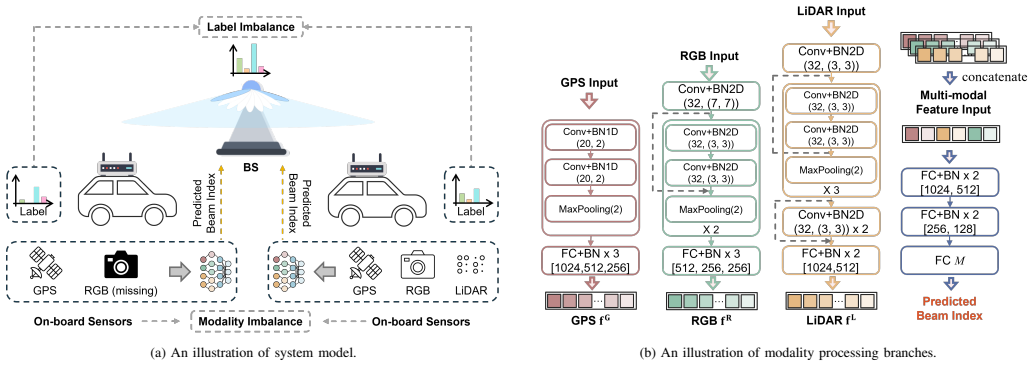
The central mechanism is the adaptive zero-shot multi-modal data (AMD) generator. It solves a minimization over synthetic inputs whose loss matches the activations' mean and variance to the batch-normalization running statistics of the global model, adds a hard cross-entropy label constraint and a soft label from an evaluation model, and uses a spectral-regularized variant of this loss when filling missing modalities against the integration branch. A binarization step maps generated LiDAR data back to the discrete voxel set {0,1,-1,-2}. The generator only runs when the global loss decline passes a threshold γ; it is what converts an imbalanced local dataset into a balanced mixed dataset without any client sharing raw data.
What would settle it
Take a global model trained only on one beam class, run the AMD generator to create samples for the missing classes, and compare those synthetic samples with held-out real samples from the same classes using a statistical distance or by measuring whether adding them to training improves a balanced test set; if the synthetic samples are statistically unlike the real ones or actually lower accuracy, the central claim fails.
Extended reading notes
Core claim
On its own terms, GFL4BS claims that the global model's batch-normalization running means and variances contain enough distribution information that synthetic inputs optimized to reproduce them, under hard- and soft-label constraints, can serve as realistic augmented data for both label balancing and missing-modality completion. This makes data generation zero-shot in the sense of requiring no access to any client's raw data. The paper backs this with simulations on a multi-modal beam-selection dataset: under severe label imbalance GFL4BS reaches 93.3% communication ratio and 74.3% Top-1 accuracy versus 88.0% ratio and 56.9% accuracy for the strongest baseline, and it preserves high accuracy under partial modality loss while transmitting about 25% of the model per round from sensor-poor vehicles.
Load-bearing premise
The method assumes that the global model's internal layer statistics faithfully encode what real sensor data looks like, so synthetic samples tuned to match those statistics are genuinely realistic; if the model has already been biased by imbalanced data, the generated data inherits that bias and can reinforce it.
Editorial extensions
If this is right
- If GFL4BS is correct, federated beam-selection models can retain high Top-1 accuracy under severe label imbalance without any raw data leaving the vehicle, since the synthetic data is derived only from the global model.
- Missing RGB or LiDAR features can be reconstructed well enough to recover most of the lost accuracy at partial loss levels, although whole-modality absence across many vehicles remains a hard case.
- The per-round communication cost drops for sensor-poor vehicles, which only upload the branches they own, and the synthetic augmentation shortens the number of rounds needed to converge.
- The same trigger mechanism generalizes across imbalance levels because the loss-decline threshold γ is insensitive to update step size.
Reading between the lines
- Implicit consequence: the generator's reliance on BN statistics suggests a direct test comparing real and synthetic samples from the same label with distributional metrics; if they diverge, the augmentation will inherit the global model's bias.
- One extension: the same BN-statistics-based generation could be repurposed as an inference-time sensor-completion front end, so vehicles with permanently missing LiDAR or RGB could still run the full model rather than only the GPS branch.
- Because the method's gains shrink when many vehicles lack entire modalities, a natural next step is to train a small generator on the integration branch's features to model cross-modality correlations before filling large-scale missing inputs.
Signed reviews
Editorial analysis
A structured set of objections, weighed in public.
Referee Report
Summary. The paper proposes GFL4BS, a generative federated learning framework for beam selection in V2X systems. It addresses label and modality imbalances by having each vehicle synthesize multi-modal training data with an AMD generator that matches the batch-normalization statistics of the global model under hard and soft label constraints (Eq. (5)), binarizes synthetic LiDAR, and then performs distributed local training with branch-wise aggregation at the BS. Experiments on the FLASH dataset compare GFL4BS with FedAvg, FLASH, and centralized learning under varying label imbalance and modality loss, reporting higher Top-1 accuracy and sum-rate ratios. The code is publicly available.
Significance. If the reported gains are robust, GFL4BS would be a useful contribution to privacy-preserving, sensing-aided beam alignment with heterogeneous sensors. The paper has concrete strengths: evaluation on a public dataset, a clear system model, and a communication-overhead analysis. However, the central mechanism is not yet convincingly validated: the generator relies on BN statistics of biased models, the reported gains rest on single-run point estimates, and key components lack ablations. The headline claim is also inconsistent with the table. These issues are fixable but require additional experiments and analysis.
major comments (6)
- [Abstract and §IV-C, Table I] The abstract states that GFL4BS achieves '16.2% higher accuracy than the current state-of-the-art under severe label imbalance conditions,' but the 16.2% figure in Table I is the Top-1 accuracy gap between GFL4BS and FLASH on the Original (ζ=78.9%) dataset, not the severe-imbalance row. In the High-imbalance (ζ=24.7%) row the absolute Top-1 accuracy gap is 74.3−56.9=17.4 points. Please correct the headline to match the table and state whether improvements are absolute percentage points or relative improvements.
- [§III-A, Eq. (5), and §IV] The data-generation mechanism is self-referential in a way that is not addressed. Eq. (5) optimizes synthetic inputs to match the BN running statistics of the global model, which is trained on the same imbalanced data, and the soft-label term H(˜c, ˆcp) uses Me, an evaluation model explicitly obtained by FedAvg in the same imbalanced scenario. If both models are biased toward majority classes, the generator may be pushed to synthesize minority-label samples in low-density or adversarial regions rather than in the true class-conditional distribution. The paper acknowledges in §III-A that low global-model accuracy can compromise generated data, but it provides no validation of synthetic data quality, such as visual inspection, feature-space comparison with real data, or an independent classifier. Please add such validation and, ideally, an ablated variant that replaces generated minority samples with real minority samples or simple oversampling to demonstrate that the gains come from distribution recovery rather than count balancing.
- [§IV-C, Table I and §IV-D, Fig. 3] All results are single-run point estimates; no standard deviations, confidence intervals, or multiple seeds are reported. Given the reported inter-vehicle variance (e.g., 99.2 for GFL4BS versus 249.1 for FedAvg in the High-imbalance Acc column), the Top-1 accuracy differences in Table I and Fig. 3 may not be statistically significant. Please report means and variances over at least three independent runs, or otherwise establish significance.
- [§III-A–§III-C, Algorithm 1] No ablation study isolates the contributions of the AMD generator, the soft-label term H(˜c, ˆcp), the BN-statistic matching, the binarization threshold τ, the trigger threshold γ, or the spectral-regularized loss. Without ablations, the causal claim that the generator and spectral-regularized loss 'enhance the expressiveness of synthetic data' is not supported. In particular, a comparison against simple class-balanced re-sampling of real data would clarify whether the generator adds value beyond rebalancing.
- [§III-A, Eq. (7)] The LiDAR binarization in Eq. (7) maps values to {0,1} by thresholding, but the text immediately states that this step 'embed[s] the receiver and transmitter positions as –2 and –1.' A binary threshold function cannot produce -2 and -1, so the description of how synthetic LiDAR preserves the original integer alphabet {0,1,−1,−2} is internally inconsistent. Please clarify the post-processing that assigns these values or revise Eq. (7).
- [Abstract and §III-A, Eq. (5)] The term 'spectral-regularized loss' is used to describe Eq. (5), but the expression contains no spectral-domain or spectral-norm regularization term; it is a BN-statistic matching loss plus two cross-entropy terms. As the spectral regularity is one of the two 'core innovations' in the abstract, either define the spectral regularization used or rename the loss to avoid an unsupported claim.
minor comments (3)
- [Algorithm 1, line 13] The update step cites Eq. (11a) twice for both the integration and extractor branches; the second citation should presumably be Eq. (11b).
- [Footnote 2 and §IV] The evaluation model Me is said to be 'obtained by FedAvg in current imbalanced scenario,' but no architectural details, training epochs, or sharing mechanism are given. Please specify how Me is constructed and used, since it directly influences the soft-label term in Eq. (5).
- [§IV-C] The dataset description would benefit from the number of participating vehicles, the local data split details, and a definition of the reported 'Var' column so that readers can interpret the variance numbers in Table I.
Circularity Check
No significant circularity: the headline result is an empirical comparison on held-out data, and the generative mechanism is anchored by true labels despite a self-referential bootstrapping risk.
full rationale
The paper's central claim is an empirical accuracy improvement measured on a held-out global test set, not a quantity that is fitted into the method and then reported as a prediction. The AMD generator in Eq. (5) follows the zero-shot BN-statistics matching idea from the external prior work [18], and it is constrained by hard labels with true ground truth, H(hatchard, hatcp). The evaluation model Me used for soft labels is obtained by FedAvg on the same imbalanced scenario (footnote 2), which creates a self-referential bootstrapping loop: the global model's BN statistics are derived from imbalanced training data, and Me carries the same imbalance. The paper itself acknowledges this risk: 'if the global model exhibits low accuracy, the quality of the generated data may be compromised.' However, this is a limitation or correctness risk, not circularity by construction. The synthetic data are not defined as the test outputs, the hard-label term injects independent label information, and the final accuracy is evaluated on real held-out data that were never used to fit the generator. The self-citations ([1], [9], [14], [16]) are contextual references to the authors' related sensing and beamforming work; they do not carry the load of the main claim. No equation in the paper reduces to its own input by definition, and no fitted parameter is renamed as a prediction. Therefore the derivation chain is self-contained with respect to the empirical evaluation, and the correct circularity finding is no significant circularity.
Assumptions & free parameters
free parameters (3)
- Data-generation trigger threshold gamma
- Binarization threshold tau
- Relative weights in generation loss
assumptions (4)
- domain assumption BN running statistics of the global model capture the distribution of real training data well enough to generate useful synthetic samples.
- domain assumption Hard labels collected locally plus soft labels from a FedAvg-trained evaluation model are sufficient to label synthetic multi-modal samples.
- ad hoc to paper Binarization of synthetic LiDAR with a fixed threshold preserves the semantic grid structure and remains useful for training.
- domain assumption The standard MIMO interference-plus-noise model in Eq. (1) is representative of 60 GHz V2X operation.
Cite this review
Pith. "Pith review of Aligning Beam with Imbalanced Multi-modality: A Generative Federated Learning Approach." pith.science (2026). https://pith.science/paper/DV4Y2GX7
@misc{pith2026250414835,
  author       = {Pith},
  title        = {Pith review of: Aligning Beam with Imbalanced Multi-modality: A Generative Federated Learning Approach},
  year         = {2026},
  howpublished = {\url{https://pith.science/paper/DV4Y2GX7}},
  note         = {Machine review of arXiv:2504.14835}
}
read the original abstract
As vehicle intelligence advances, multi-modal sensing-aided communication emerges as a key enabler for reliable Vehicle-to-Everything (V2X) connectivity through precise environmental characterization. As centralized learning may suffer from data privacy, model heterogeneity and communication overhead issues, federated learning (FL) has been introduced to support V2X. However, the practical deployment of FL faces critical challenges: model performance degradation from label imbalance across vehicles and training instability induced by modality disparities in sensor-equipped agents. To overcome these limitations, we propose a generative FL approach for beam selection (GFL4BS). Our solution features two core innovations: 1) An adaptive zero-shot multi-modal generator coupled with spectral-regularized loss functions to enhance the expressiveness of synthetic data compensating for both label scarcity and missing modalities; 2) A hybrid training paradigm integrating feature fusion with decentralized optimization to ensure training resilience while minimizing communication costs. Experimental evaluations demonstrate significant improvements over baselines achieving 16.2% higher accuracy than the current state-of-the-art under severe label imbalance conditions while maintaining over 70% successful rate even when two agents lack both LiDAR and RGB camera inputs.
Figures


Forward citations
Cited by 1 Pith paper
-
Multi-Modal Beamforming with Model Compression and Modality Generation for V2X Networks
A multi-modal transformer with module-aware pruning and a conditional VAE for missing-sensor reconstruction improves beam prediction accuracy on the DeepSense 6G dataset.
Reference graph
Works this paper leans on
-
[18]
Towards Fair Federated Learning with Zero-Shot Data Augmentation,
W. Hao, M. El-Khamy, J. Lee, J. Zhang, K. J. Liang, C. Chen, and L. Carin, “Towards Fair Federated Learning with Zero-Shot Data Augmentation,” in Proc. IEEE/CVF Conference on Computer Vision and Pattern Recognition Workshops (CVPRW) , Nashville, TN, USA, Jun. 2021, pp. 3305–3314
work page 2021
-
[1]
Integrated Sensing and Com- munications (ISAC) for Vehicular Communication Networks (VCN),
X. Cheng, D. Duan, S. Gao, and L. Yang, “Integrated Sensing and Com- munications (ISAC) for Vehicular Communication Networks (VCN),” IEEE Internet of Things Journal , vol. 9, no. 23, pp. 23 441–23 451, Dec. 2022
work page 2022
-
[2]
Bayesian Beamforming for Mobile Millimeter Wave Channel Tracking in the Presence of DOA Uncertainty,
Y . Yang, S. Dang, M. Wen, S. Mumtaz, and M. Guizani, “Bayesian Beamforming for Mobile Millimeter Wave Channel Tracking in the Presence of DOA Uncertainty,” IEEE Transactions on Communications, vol. 68, no. 12, pp. 7547–7562, Dec. 2020
work page 2020
-
[3]
Frame Structure and Protocol Design for Sensing-Assisted NR-V2X Communications,
Y . Li, F. Liu, Z. Du, W. Yuan, Q. Shi, and C. Masouros, “Frame Structure and Protocol Design for Sensing-Assisted NR-V2X Communications,” IEEE Transactions on Mobile Computing , vol. 23, no. 12, pp. 11 045– 11 060, Dec. 2024
work page 2024
-
[4]
C. Zhang, W. Xu, and M. Chen, “Hybrid zero-forcing beamform- ing/orthogonal beamforming with user selection for MIMO broadcast channels,” IEEE Communications Letters , vol. 13, no. 1, pp. 10–12, Jan. 2009
work page 2009
-
[5]
A Matrix-Inverse-Free Implementation of the MU-MIMO WMMSE Beamforming Algorithm,
L. Pellaco and J. Jald ´en, “A Matrix-Inverse-Free Implementation of the MU-MIMO WMMSE Beamforming Algorithm,” IEEE Transactions on Signal Processing, vol. 70, pp. 6360–6375, Oct. 2022
work page 2022
-
[6]
The Roadmap to 6G: AI Empowered Wireless Networks,
K. B. Letaief, W. Chen, Y . Shi, J. Zhang, and Y .-J. A. Zhang, “The Roadmap to 6G: AI Empowered Wireless Networks,” IEEE Communi- cations Magazine, vol. 57, no. 8, pp. 84–90, Aug. 2019
work page 2019
-
[7]
Improving Beam Alignment Accuracy in mmWave Communication Systems With Auxiliary Tasks,
S. Wang and S. Bi, “Improving Beam Alignment Accuracy in mmWave Communication Systems With Auxiliary Tasks,”IEEE Signal Processing Letters, vol. 30, pp. 992–996, Jul. 2023
work page 2023
Show all 20 references
-
[8]
Energy-Efficient and Intelligent ISAC in V2X Networks with Spiking Neural Networks-Driven DRL,
C. Shang, J. Yu, and D. T. Hoang, “Energy-Efficient and Intelligent ISAC in V2X Networks with Spiking Neural Networks-Driven DRL,” arXiv preprint arXiv:2501.01038 , Jan. 2025
2025 arXiv
-
[9]
Integrated Sensing and Communications Toward Proactive Beamforming in mmWave V2I via Multi-Modal Feature Fusion (MMFF),
H. Zhang, S. Gao, X. Cheng, and L. Yang, “Integrated Sensing and Communications Toward Proactive Beamforming in mmWave V2I via Multi-Modal Feature Fusion (MMFF),” IEEE Transactions on Wireless Communications, vol. 23, no. 11, pp. 15 721–15 735, Nov. 2024
2024
-
[10]
Multi-Modal Beamforming with Model Compression and Modality Generation for V2X Networks,
C. Shang, D. T. Hoang, and J. Yu, “Multi-Modal Beamforming with Model Compression and Modality Generation for V2X Networks,”arXiv preprint arXiv:2506.22469, Jul. 2025
2025 arXiv
-
[11]
FLASH: F ederated Learning for A utomated S election of H igh-band mmWave Sectors,
B. Salehi, J. Gu, D. Roy, and K. Chowdhury, “FLASH: F ederated Learning for A utomated S election of H igh-band mmWave Sectors,” in Proc. IEEE International Conference on Computer Communications (INFOCOM), London, United Kingdom, May. 2022, pp. 1719–1728
2022
-
[12]
FLASH- and-Prune: F ederated L earning for A utomated S election of H igh-Band mmWave Sectors using Model Pruning,
B. Salehi, D. Roy, J. Gu, C. Dick, and K. Chowdhury, “FLASH- and-Prune: F ederated L earning for A utomated S election of H igh-Band mmWave Sectors using Model Pruning,” IEEE Transactions on Mobile Computing, vol. 23, no. 12, pp. 11 655–11 669, Dec. 2024
2024
-
[13]
Omni-CNN: A Modality-Agnostic Neural Network for mmWave Beam Selection,
B. Salehi, D. Roy, T. Jian, C. Dick, S. Ioannidis, and K. Chowdhury, “Omni-CNN: A Modality-Agnostic Neural Network for mmWave Beam Selection,” IEEE Transactions on Vehicular Technology, vol. 73, no. 6, pp. 8169–8183, Jun. 2024
2024
-
[14]
Synesthesia of Machines (SoM)-Aided FDD Precoding with Sensing Heterogeneity: A Vertical Federated Learning Approach,
H. Zhang, S. Gao, W. Wen, and X. Cheng, “Synesthesia of Machines (SoM)-Aided FDD Precoding with Sensing Heterogeneity: A Vertical Federated Learning Approach,” in IEEE Proc. IEEE International Con- ference on Communications (ICC). , Montreal, Canada, Jun. 2025
2025
-
[15]
REFOL: Resource-Efficient Federated Online Learning for Traffic Flow Forecasting,
Q. Liu, S. Sun, Y . Liang, X. Xu, M. Liu, M. Bilal, Y . Wang, X. Li, and Y . Zheng, “REFOL: Resource-Efficient Federated Online Learning for Traffic Flow Forecasting,” IEEE Transactions on Intelligent Transporta- tion Systems, vol. 26, no. 2, pp. 2777–2792, Feb. 2025
2025
-
[16]
Intelligent Multi-Modal Sensing- Communication Integration: Synesthesia of Machines,
X. Cheng, H. Zhang, J. Zhang, S. Gao, S. Li, Z. Huang, L. Bai, Z. Yang, X. Zheng, and L. Yang, “Intelligent Multi-Modal Sensing- Communication Integration: Synesthesia of Machines,” IEEE Commu- nications Surveys & Tutorials , vol. 26, no. 1, pp. 258–301, Firstquarter 2024
2024
-
[17]
Federated Learning with Non IID Data,
Y . Zhao, M. Li, L. Lai, N. Suda, D. Civin, and V . Chandra, “Federated Learning with Non IID Data,” arXiv preprint arXiv:1806.00582 , Jul. 2018
2018 arXiv
-
[19]
Zeroq: A Novel Zero Shot Quantization Framework,
Y . Cai, Z. Yao, Z. Dong, A. Gholami, M. W. Mahoney, and K. Keutzer, “Zeroq: A Novel Zero Shot Quantization Framework,” in Proc. of the IEEE/CVF Conference on Computer Vision and Pattern Recognition (CVPR), Seattle, W A, USA, Jun. 2020, pp. 13 169–13 178
2020
-
[20]
Communication-Efficient Learning of Deep Networks from Decentralized Data,
H. B. McMahan, E. Moore, D. Ramage, S. Hampson, and B. A. y Arcas, “Communication-Efficient Learning of Deep Networks from Decentralized Data,” arXiv preprint arXiv:1602.05629 , Fed. 2016
2016 arXiv
Reviewed August 16, 2026 · model on record in the stance chip above.
Discussion (0). Continue with ORCID to comment.