REVIEW 4 minor 97 references
Extended Version: Security and Privacy Perceptions of Pakistani Facebook Matrimony Group Users
T0 review · 0 major / 4 minor · reviewed 2026-08-04 · deepseek-v4-flash
Pith's one-line read Privacy concerns, not just cultural tradition, shape how Pakistani users share and trust in Facebook matrimony groups.
desk verdict Solid qualitative study of an understudied population; sample limits are real but disclosed and the claims stay appropriately scoped. read the letter →
The pith
A machine-rendered reading of the paper's core claim, the machinery that carries it, and where it could break.
The reading
What carries the argument
The load-bearing mechanism is the qualitative interview corpus itself: 23 semi-structured interviews with users and admins of Pakistani Facebook matrimony groups, analyzed through iterative open coding and an affinity diagram. The conceptual engine is self-disclosure asymmetry—participants want detailed information from others but disclose minimally themselves—combined with the cultural signal of family involvement as a trust heuristic. The paper uses a quantifier scale (e.g., 'most,' 'about half') instead of percentages to represent how many participants voiced a theme, and it grounds each theme in concrete protective behaviors, such as progressive disclosure, cross-platform verification, a
What would settle it
A large-scale survey of Pakistani Facebook matrimony group members that found most members freely post full names, photos, salary, and phone numbers and report low privacy concerns would contradict the paper's central claim that elevated concerns drive limited sharing and mistrust.
Extended reading notes
Core claim
On the paper's own terms, the discovery is that Pakistani Facebook matrimony group users experience a persistent conflict between the pressure to present detailed, appealing profiles and the fear of being scammed, stalked, or socially judged. Most participants reported withholding name details, phone numbers, income, exact location, and photos—at least publicly—while simultaneously trusting profiles that are more detailed and family-endorsed. They treated anonymous or newly created profiles with suspicion, used LinkedIn, Instagram, and in-person meetings to verify matches, and expressed frustration that neither group admins nor Facebook provide adequate verification, moderation, or privacy c
Load-bearing premise
The load-bearing premise is that the 23 interviewees—recruited from two admin-approved private Facebook groups, one non-matrimony group, and the researchers' personal connections—adequately represent Pakistani Facebook matrimony group users; the authors themselves state in Section 3.3 that results may not generalize to the entire population.
Editorial extensions
If this is right
- If the central finding holds, platform-level verification (ID-based or badge-based) would directly address a trust deficit users currently patch with LinkedIn checks and in-person meetings.
- Restricting screenshots and image downloads, and offering anonymous but traceable contact, would remove specific frictions that currently make users withhold photos and phone numbers.
- Group admins, though expected to verify members and moderate abuse, lack the capacity in groups of tens of thousands; this points to automated moderation and platform-enforced rules rather than volunteer labor.
- The cultural trust premium on family involvement means users may be vulnerable to scammers who impersonate family members—a risk the paper itself notes.
- Stronger cybercrime enforcement and clear platform accountability would be required for the safety measures to hold, since legal protections are currently perceived as weak.
Reading between the lines
- The trust signal of family involvement is likely not unique to Pakistan; similar dynamics may appear in other family-oriented online matchmaking communities, which would make the design lessons portable.
- The paper's recommendations imply a trade-off the authors do not fully explore: identity verification and traceable anonymous chats could reduce abuse but also raise privacy costs for users who join these groups specifically to escape social judgment.
- A testable extension would be an A/B deployment of a verification-badge or no-screenshot feature in one large matrimony group, measuring changes in post detail, photo sharing, and reported scam incidents.
- Because participants were mostly recruited from private groups and personal networks, the findings are best treated as a map of possible concerns rather than prevalence estimates; a quantitative survey could turn these themes into measurable rates.
Editorial analysis
A structured set of objections, weighed in public.
Referee Report
Summary. This paper reports a qualitative study of security and privacy perceptions among 23 users of Pakistani Facebook matrimony groups, including both residents of Pakistan and members of the diaspora. Through semi-structured interviews, the authors investigate why users join these groups, what personal information they share or withhold, how they perceive risks and trust, and what protections they expect from group admins and the Facebook platform. The central finding is that participants experience elevated privacy and security concerns, leading them to limit sharing and to distrust potential partners, while still feeling culturally compelled to disclose personal details in public posts. The paper also derives participant-grounded recommendations for users, admins, platforms, and policymakers, and includes the interview guide, recruitment survey, codebook, and profile mockups in the appendix.
Significance. The paper addresses an understudied population and context: Facebook matrimony groups in Pakistan, where dating apps are restricted and cultural norms shape online matchmaking. Its strengths are largely methodological and transparency-related: the appendix contains the full recruitment survey, interview guide, codebook, and post mockups; the analysis uses iterative coding with inter-coder reliability above 0.82; and the authors explicitly report ethical constraints and limitations, including self-censorship, recall bias, social desirability bias, and non-systematic group selection. The use of a defined quantifier scale (Figure 2) improves the interpretability of qualitative claims. If the findings hold, they provide concrete, participant-voiced support for platform features such as screenshot/download restrictions, identity verification, and culturally specific trust signals, as well as for stricter admin moderation and legal clarity. The main limitation, sample representativeness, is acknowledged in Section 3.3 and the core claims are appropriately scoped to the participants rather than to the entire Pakistani population.
minor comments (4)
- [Section 3.3] Typo: 'Addtionally' should be 'Additionally' in the Limitations paragraph.
- [Section 4.4.2] In the paragraph on search filters, the quote 'There should be a filter so people can search profiles on age-based' is attributed to (P04), but the surrounding text introduces it as P14's recommendation. Please correct the participant identifier.
- [Figure 2 / Section 4] The quantifier scale is helpful, but a few result summaries (e.g., 'about half of the participants' in Section 4.4.1) do not give the corresponding count or position on the scale. Adding a parenthetical count would make the thematic weight more precise.
- [Section 5.1.1] The Discussion correctly notes that family involvement can be exploited by scammers, but this tension appears only after the Results sections. A one-sentence acknowledgment in Sections 4.3.1 or 4.3.2 would help readers interpret the trust-signal finding more critically and would align the Results with the later caveat.
Circularity Check
No circularity: qualitative interview study with no fitted parameters, derivational predictions, or load-bearing self-citations.
full rationale
This paper is a qualitative interview study. It makes no formal derivation, introduces no equations, and fits no parameters to data that are then renamed as predictions. The central findings—elevated privacy concerns, limited information sharing, mistrust—are inductively coded from 23 semi-structured interviews and supported by direct participant quotes (e.g., Section 4.2). The recommendations are explicitly grounded in participant suggestions (Section 4.4 and 5.2) rather than imposed by the authors' model. No self-citations appear in the reference list, and the cited related work is used for context, not as a load-bearing premise that forces the conclusions. The paper's own limitations section (Section 3.3) acknowledges selection bias, limited generalizability, and possible social desirability bias, but these are standard qualitative-method limitations about sample representativeness, not circular reasoning. There is no definitional equivalence between inputs and outputs, no fitted-input-called-prediction pattern, and no uniqueness theorem imported from the authors' prior work. The analysis therefore contains no significant circularity.
Assumptions & free parameters
assumptions (4)
- domain assumption Self-reported interview accounts are treated as valid evidence of user perceptions and behaviors.
- domain assumption The 23 recruited participants provide a meaningful and sufficient pool to identify recurring themes and patterns.
- domain assumption Inter-coder reliability (kappa >0.82) is an adequate proxy for the reliability of the qualitative coding.
- domain assumption Facebook matrimony groups are a distinct, coherent context worth studying separately from other online matchmaking platforms.
Cite this review
Pith. "Pith review of Extended Version: Security and Privacy Perceptions of Pakistani Facebook Matrimony Group Users." pith.science (2026). https://pith.science/paper/DV53UIP3
@misc{pith2026250908782,
  author       = {Pith},
  title        = {Pith review of: Extended Version: Security and Privacy Perceptions of Pakistani Facebook Matrimony Group Users},
  year         = {2026},
  howpublished = {\url{https://pith.science/paper/DV53UIP3}},
  note         = {Machine review of arXiv:2509.08782}
}
read the original abstract
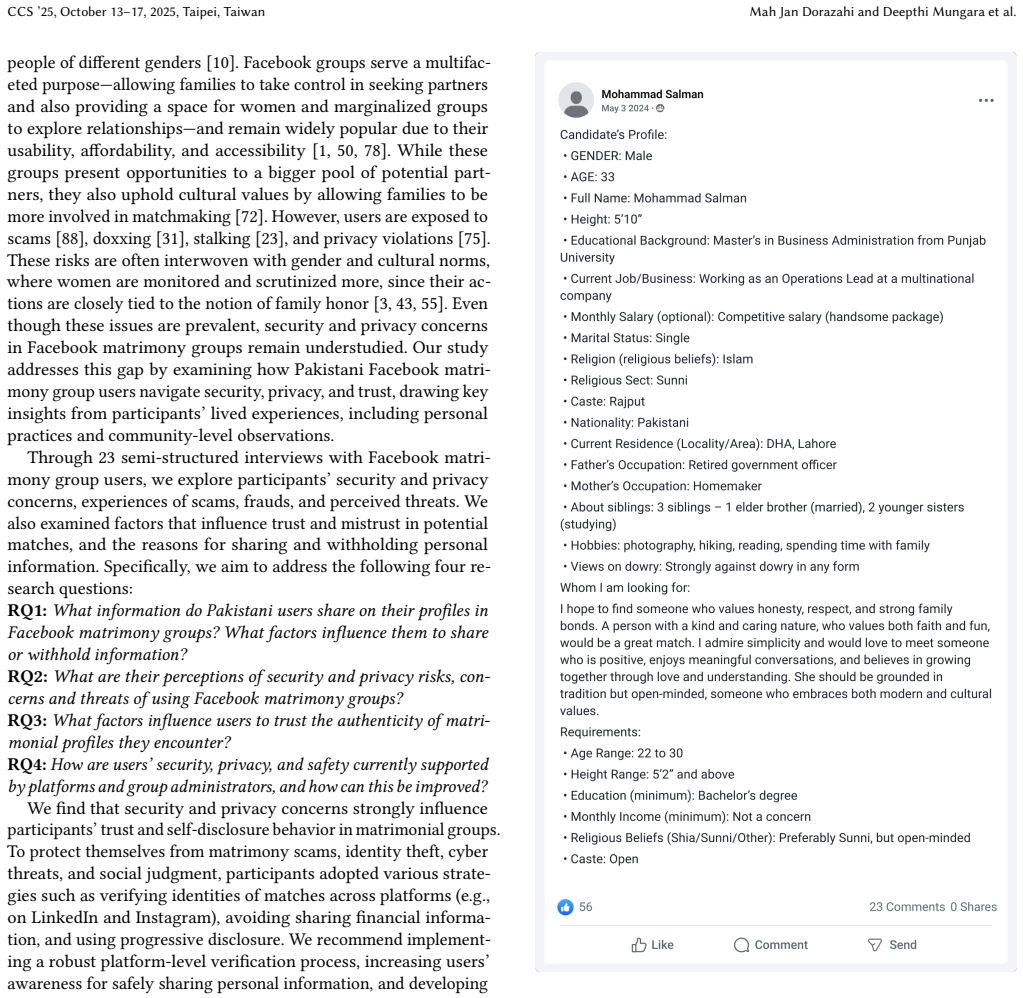
In Pakistan, where dating apps are subject to censorship, Facebook matrimony groups -- also referred to as marriage groups -- serve as alternative virtual spaces for members to search for potential life partners. To participate in these groups, members often share sensitive personal information such as photos, addresses, and phone numbers, which exposes them to risks such as fraud, blackmail, and identity theft. To better protect users of Facebook matrimony groups, we need to understand aspects related to user safety, such as how users perceive risks, what influences their trust in sharing personal information, and how they navigate security and privacy concerns when seeking potential partners online. In this study, through 23 semi-structured interviews, we explore how Pakistani users of Facebook matrimony groups perceive and navigate risks of sharing personal information, and how cultural norms and expectations influence their behavior in these groups. We find elevated privacy concerns among participants, leading them to share limited personal information and creating mistrust among potential partners. Many also expressed concerns about the authenticity of profiles and major security risks, such as identity theft, harassment, and social judgment. Our work highlights the challenges of safely navigating Facebook matrimony groups in Pakistan and offers recommendations for such as implementing stronger identity verification by group admins, enforcing stricter cybersecurity laws, clear platform guidelines to ensure accountability, and technical feature enhancements -- including restricting screenshots, picture downloads, and implementing anonymous chats -- to protect user data and build trust.
Figures


Reference graph
Works this paper leans on
-
[1]
Muhammad Hasnain Abbas Naqvi, Yushi Jiang, Miao Miao, and Mishal Hasnain Naqvi. 2020. The effect of social influence, trust, and entertainment value on social media use: Evidence from Pakistan.Cogent Business & Management7, 1 (2020), 1723825
2020
-
[2]
Alessandro Acquisti and Ralph Gross. 2006. Imagined Communities: Aware- ness, Information Sharing, and Privacy on the Facebook. InPrivacy Enhancing Technologies Workshop (PET 2006)(4258). Springer, 36–58
2006
-
[3]
Tanisha Afnan, Yixin Zou, Maryam Mustafa, Mustafa Naseem, and Florian Schaub
-
[4]
Maria Akhlaq. 2021. Cybercrime in Pakistan: A Study of the Law Dealing with Cybercrimes in Pakistan.PCL Student Journal of Law1 (2021), 31–66
2021
-
[5]
Wasim Akram, Tahira Bashir, Attiqa Mumraiz, and Humera Iqbal. 2024. Stereotyp- ical Perceptions, Self-Silencing, Psychological Distress, and Emotional Regulation among Unmarried Women in Pakistan.Journal of Asian Development Studies13, 2 (2024), 786–794
2024
-
[6]
Adel Al-Dawood. 2024. Building Trust and Preserving Privacy in Marital Match- making Technologies. (2024). https://conservancy.umn.edu/items/82e8a73d-04f4- 42dc-bffb-4733d321b8c9
2024
-
[7]
Adel Al-Dawood, Norah Abokhodair, Houda Elmimouni, and Svetlana Yarosh
-
[8]
Yeslam Al-Saggaf. 2013. Males’ trust and mistrust of females in Muslim matri- monial sites.Journal of Information, Communication and Ethics in Society11, 3 (2013), 174–192
2013
Show all 97 references
-
[9]
Imtiaz Ali. 2018. FIA arrests suspect behind online marriage scam targeting wid- ows, divorcees in Karachi. https://www.dawn.com/news/1451228. (14 December 2018). https://www.dawn.com/news/1451228 Accessed: 2025-04-15
2018
-
[10]
Tawfiq Ammari, Momina Nofal, Mustafa Naseem, and Maryam Mustafa. 2022. Moderation as empowerment: Creating and managing women-only digital safe spaces.Proceedings of the ACM on Human-Computer Interaction6, CSCW2 (2022), 1–36
2022
-
[11]
Anusuah and Balasubramania Raja
R. Anusuah and Balasubramania Raja. 2018. Facebook Use and Conflicts Among Young Married Couples.Journal of Emerging Technologies and Innovative Re- search (JETIR)5, 11 (2018), 154–160. https://www.researchgate.net/publication/ 330753346_Facebook_use_and_conflicts_among_young_...
2018
-
[12]
Jan Bailey, Louise Taylor, Paul Kingston, and Geoffrey Watts. 2021. Older adults and “scams”: Evidence from the mass observation archive.The Journal of Adult Protection23, 1 (2021), 57–69
2021
-
[13]
Michael Bailey, David Dittrich, Erin Kenneally, and Doug Maughan. 2012. The menlo report.IEEE Security & Privacy10, 2 (2012), 71–75
2012
-
[14]
Banfield-Nwachi. 2024. The price of love: How much does dating cost – and who pays the bill? (9 November 2024). https://www.theguardian.com/lifeandstyle/ 2024/nov/09/how-much-does-dating-cost-pay-bill-apps The Guardian
2024
-
[15]
Alexander Bilz, Lynsay A Shepherd, and Graham I Johnson. 2023. Tainted love: A systematic literature review of online romance scam research.Interacting with Computers35, 6 (2023), 773–788
2023
-
[16]
Amy Binns. 2013. Facebook’s ugly sisters: Anonymity and abuse on formspring and ask. fm.Media Education Research Journal(2013)
2013
-
[17]
Syed Asad Abbas Bokhari. 2023. A Quantitative Study on the Factors Influencing Implementation of Cybersecurity Laws and Regulations in Pakistan.Social Sciences12, 11 (2023), 629
2023
-
[18]
Norman M Bradburn, Lance J Rips, and Steven K Shevell. 1987. Answering autobiographical questions: The impact of memory and inference on surveys. Science236, 4798 (1987), 157–161
1987
-
[19]
Rosie Bradbury. 2022. Young people in Pakistan are using Facebook groups to seek dates after the government banned Tinder. (2022). https://www.businessinsider.com/pakistani-youth-use-facebook-groups- seek-dates-since-tinder-banned-2022-6 Accessed: 2025-04-14
2022
-
[20]
Tom Buchanan and Monica T Whitty. 2014. The online dating romance scam: causes and consequences of victimhood.Psychology, Crime & Law20, 3 (2014), 261–283
2014
-
[21]
Abraham P Buunk, Justin H Park, and Lesley A Duncan. 2010. Cultural variation in parental influence on mate choice.Cross-Cultural Research44, 1 (2010), 23–40
2010
-
[22]
Iftikhar Chaudhry. 2024. Fake Marriage Proposal Leads to Abduction. (August 2024). https://tribune.com.pk/story/2491846/fake-marriage-proposal-leads-to- abduction Accessed: 2025-04-15
2024
-
[23]
Ritesh Chugh and Marika Guggisberg. 2022. Stalking and Other Forms of Dating Violence: Lessons Learned from You in Relation to Cyber Safety.Journal of interpersonal violence37, 9-10 (2022), NP6760–NP6784
2022
-
[24]
Camille Cobb and Tadayoshi Kohno. 2017. How public is my private life? Privacy in online dating. InProceedings of the 26th International Conference on World Wide Web. 1231–1240
2017
-
[25]
Rebecca Cole. 2024. A qualitative investigation of the emotional, physiological, financial, and legal consequences of online romance scams in the United States. Journal of Economic Criminology6 (2024), 100108
2024
-
[26]
David Collier and James Mahoney. 1996. Insights and pitfalls: Selection bias in qualitative research.World politics49, 1 (1996), 56–91
1996
-
[27]
Mackenzie F Common. 2023. Beyond the usual suspects: a taxonomy of social media regulations in countries with human rights issues.International Review of Law, Computers & Technology37, 1 (2023), 1–28
2023
-
[28]
2023.The effect of the use of profile badges on social comparison at social media among men
Amber Deursen. 2023.The effect of the use of profile badges on social comparison at social media among men. B.S. thesis. University of Twente
2023
-
[29]
Anil Dhami, Neha Agarwal, Tamal Kanti Chakraborty, Brijendra Pratap Singh, and Jasmine Minj. 2013. Impact of trust, security and privacy concerns in social networking: An exploratory study to understand the pattern of information reve- lation in Facebook. In2013 3rd IEEE Inter...
2013
-
[30]
Jazlyn Dumas. 2021. The importance of a checkmark: an investigation into the perceptions of social media verification and its effects on consumer trust. (2021)
2021
-
[31]
Stine Eckert and Jade Metzger-Riftkin. 2020. Doxxing, privacy and gendered harassment. The shock and normalization of veillance cultures.M&K Medien & Kommunikationswissenschaft68, 3 (2020), 273–287
2020
-
[32]
Facebook. 2025. Your Privacy. https://www.facebook.com/help/238318146535333? helpref=hc_fnav. (2025). Accessed: 2025-04-14
2025
-
[33]
Facebook.com. 2025. Participate anonymously in a Facebook groupe. https: //www.facebook.com/help/832270967369626/. (2025). Accessed: 2025-04-12
2025
-
[34]
Zoya Gillani, Anjum Zia, and Rozeena Shaukat. 2024. Usage of Matrimonial Groups on Facebook: A Case of Pakistan.The Journal of Humanities & Social Sciences32, 2 (2024), 107–123
2024
-
[35]
This is not a nice safe space
Rosalie Gillett. 2023. “This is not a nice safe space”: investigating women’s safety work on Tinder.Feminist Media Studies23, 1 (2023), 199–215
2023
-
[36]
GoodSnooze. 2024. MacWhisper: AI-Powered Whisper Transcription. https: //goodsnooze.gumroad.com/l/macwhisper. (2024). Accessed: 2025-04-14
2024
-
[37]
D Guna Graciyal and Deepa Viswam. 2020. Virtual Relationships in Respect to Self Disclosure and Self Presentation: A Contextual Approach.Sambodhi (UGC Care Journal)(2020)
2020
-
[38]
Pamela Grimm. 2010. Social desirability bias.Wiley international encyclopedia of marketing(2010)
2010
-
[39]
Said Gulyamov and Sherzod Raimberdiyev. 2023. Personal data protection as a tool to fight cyber corruption.International Journal of Law and Policy1, 7 (2023), 1–35
2023
-
[40]
Jason Hiney, Tejas Dakve, Krzysztof Szczypiorski, and Kris Gaj. 2015. Using facebook for image steganography. In2015 10th international conference on avail- ability, reliability and security. IEEE, 442–447. Extended Version: Security and Privacy Perceptions of Pakistani Facebo...
2015
-
[41]
Nguyen Phong Hoang and Davar Pishva. 2014. Anonymous communication and its importance in social networking. In16th international conference on advanced communication technology. IEEE, 34–39
2014
-
[42]
Panagiotis Ilia, Iasonas Polakis, Elias Athanasopoulos, Federico Maggi, and Sotiris Ioannidis. 2015. Face/off: Preventing privacy leakage from photos in social networks. InProceedings of the 22nd ACM SIGSAC Conference on computer and communications security. 781–792
2015
-
[43]
Hannah Irfan. 2009. “Honor” and violence against women in Pakistan. In Marginalized communities and access to justice. Routledge-Cavendish, 172–194
2009
-
[44]
Shraddha Kamble. 2019. Issues and Effectiveness of Matrimonial Websites in Mate Selection.International Journal of Research and Analytical Reviews (IJRAR) 6, 2 (2019), 141–144
2019
-
[45]
Steven Kemp and Nieves Erades Pérez. 2023. Consumer fraud against older adults in digital society: Examining victimization and its impact.International Journal of Environmental Research and Public Health20, 7 (2023), 5404
2023
-
[46]
Javeria Khalid. 2022. How Facebook became Pakistan’s hottest matchmak- ing site. (2022). https://arbiterz.com/how-facebook-became-pakistans-hottest- matchmaking-site/ Accessed: 2025-04-14
2022
-
[47]
Naurin Farooq Khan, Naveed Ikram, Sumera Saleem, and Saad Zafar. 2023. Cyber- security and risky behaviors in a developing country context: a Pakistani per- spective.Security Journal36, 2 (2023), 373–405
2023
-
[48]
Umair Pervez Khan and Muhammad Waqar Anwar. 2020. Cybersecurity in Pakistan: Regulations, Gaps and a Way Forward.Cyberpolitik Journal5, 10 (December 2020), 205–218
2020
-
[49]
Leanne K Knobloch. 2008. Uncertainty reduction theory.Engaging theories in interpersonal communication(2008), 133–144
2008
-
[50]
S Rama Gokula Krishnan, Alan Godfrey, Shiny Vincent, and P Nadiya. 2024. A Study on Matrimonial Sites in India. https://doi.org/10.32388/OGKVX3. (2024)
2024 doi
-
[51]
Jacob Leon Kröger, Milagros Miceli, and Florian Müller. 2021. How data can be used against people: A classification of personal data misuses.A vailable at SSRN 3887097(2021)
2021
-
[52]
Udo Kuckartz, Stefan Rädiker, Udo Kuckartz, and Stefan Rädiker. 2019. Analyzing intercoder agreement.Analyzing qualitative data with MAXQDA: Text, audio, and video(2019), 267–282
2019
-
[53]
Saga Lannerhjelm and Aleksandra Tarka. 2024. Love, Trust, and Design: Exam- ining Profile Verification Badges. A comparative study on the design of profile verification badges on dating applications and its impact on users’ trust. (2024)
2024
-
[54]
Ahmar Mahboob and Nadra Huma Ahmar. 2008. Pakistani English: phonology. Africa, South and Southeast Asia4 (2008), 244
2008
-
[55]
Ansa Mahmood and Kim Ebensgaard Jensen. 2024. Women have no honour of their own: Conceptualizations of honor in Indian English and Pakistani English. International Journal of Language and Culture11, 1 (2024), 95–122
2024
-
[56]
Asma Seemi Malik, Anam Rafaqat, and Maryam Zafar. 2023. Marriage Pro- posal & Self-Perceived Experiences of Female for Standard or Ideal Beauty: An Exploratory Study of Pakistan.Journal of Arts & Social Sciences10, 1 (2023), 42–54
2023
-
[57]
Caitlin McLaughlin and Jessica Vitak. 2012. Norm evolution and violation on Facebook.New media & society14, 2 (2012), 299–315
2012
-
[58]
Ramdas Menon. 1989. Arranged marriages among South Asian immigrants. Sociology and Social Research73 (1989), 180–181
1989
-
[59]
Francois Mouton, Mercia M Malan, Louise Leenen, and Hein S Venter. 2014. Social engineering attack framework. In2014 Information Security for South Africa. IEEE, 1–9
2014
-
[60]
Single Muslim. 2000. Single Muslim Matrimonial Service. https://www. singlemuslim.com/. (2000). Accessed: 2025-04-14
2000
-
[61]
M Zaenul Muttaqin and Ninik Tri Ambarwati. 2020. Cyberbullying and woman oppression. In6th International Conference on Social and Political Sciences (ICOS- APS 2020). Atlantis Press, 545–553
2020
-
[62]
Muzz. 2015. Muzz Matrimonial Service. https://muzz.com/. (2015). Accessed: 2025-04-14
2015
-
[63]
Sheza Naveed, Hamza Naveed, Mobin Javed, and Maryam Mustafa. 2022. ” Ask this from the person who has private stuff”: Privacy Perceptions, Behaviours and Beliefs Beyond WEIRD. InProceedings of the 2022 CHI Conference on Human Factors in Computing Systems. 1–17
2022
-
[64]
Abiodun Odusote. 2021. Data Misuse, Data Theft and Data Protection in Nigeria: A Call for a More Robust and More Effective Legislation.Beijing L. Rev.12 (2021), 1284
2021
-
[65]
School of Marketing. 2024. Muzz’s Latest TV Campaign Sparks De- bate on Marriage Practices in Pakistan. (19 May 2024). https: //academy.schoolofmarketing.co.uk/muzzs-latest-tv-campaign-sparks- debate-on-marriage-practices-in-pakistan/
2024
-
[66]
2014.Ways of Knowing in HCI
Judith S Olson and Wendy A Kellogg. 2014.Ways of Knowing in HCI. Vol. 2. Springer
2014
-
[67]
HC Orlu-Orlu. 2017. A Discursive Analysis of the Use of Social Media in Building Relationships.Ebonyi State University Journal of Mass Communication4, 1 (2017), 257–271
2017
-
[68]
1998.Culture, Society & Sexuality
Richard Guy Parker, Peter Aggleton, et al . 1998.Culture, Society & Sexuality. Taylor & Francis Limited
1998
-
[69]
Cornelia Pechmann, Kelly EunJung Yoon, Denis Trapido, and Judith J Prochaska
-
[70]
Joe Phua and Sun Joo Ahn. 2016. Explicating the ‘like’on Facebook brand pages: The effect of intensity of Facebook use, number of overall ‘likes’, and number of friends’‘likes’ on consumers’ brand outcomes.Journal of Marketing Communica- tions22, 5 (2016), 544–559
2016
-
[71]
Antoinette Radford. 2023. Instagram and Facebook to get paid-for verification. https://www.bbc.com/news/technology-64697560. (2023). Accessed: 2025-07-29
2023
-
[72]
Self-Disclosure Asymmetry in Online Communities: A Challenge of Demo- graphic Diversity.Advances in Consumer Research45 (2017), 807–808
2017
-
[73]
Pradeep Kumar Roy and Shivam Chahar. 2020. Fake Profile Detection on Social Networking Websites: A Comprehensive Review.IEEE Transactions on Artificial Intelligence1, 3 (2020), 271–285. https://doi.org/10.1109/TAI.2021.3064901
2020
-
[74]
Privacy is not for me, it’s for those rich women
Nithya Sambasivan, Garen Checkley, Amna Batool, Nova Ahmed, David Nemer, Laura Sanely Gaytán-Lugo, Tara Matthews, Sunny Consolvo, and Elizabeth Churchill. 2018. " Privacy is not for me, it’s for those rich women": Performative Privacy Practices on Mobile Phones by Women in Sou...
2018
-
[75]
Oumaima Rguibi and Leila Bouasria. 2023. Towards a new relationship: The construction of the marital couple through Facebook groups and its energetic impact on the environment. InE3S Web of Conferences, Vol. 412. EDP Sciences, 01042
2023
-
[76]
Alexis Shore and Kelsey Prena. 2023. Platform rules as privacy tools: The influence of screenshot accountability and trust on privacy management.New Media & Society(2023), 14614448231188929
2023
-
[77]
I feel physically safe but not politically safe
Ananta Soneji, Vaughn Hamilton, Adam Doupé, Allison McDonald, and Elissa M Redmiles. 2024. " I feel physically safe but not politically safe": Understanding the Digital Threats and Safety Practices of{OnlyFans} Creators. In33rd USENIX Security Symposium (USENIX Security 24). 1–18
2024
-
[78]
Katharine Sarikakis and Lisa Winter. 2017. Social media users’ legal consciousness about privacy.Social Media + Society3, 1 (2017), 2056305117695325
2017
-
[79]
Sue Yeon Syn and Sanghee Oh. 2015. Why do social network site users share information on Facebook and Twitter?Journal of Information Science41, 5 (2015), 553–569
2015
-
[80]
Monika Taddicken. 2014. The ‘privacy paradox’in the social web: The impact of privacy concerns, individual characteristics, and the perceived social relevance on different forms of self-disclosure.Journal of computer-mediated communication 19, 2 (2014), 248–273
2014
-
[81]
statcounter. 2025. Social Media Stats in Pakistan. (2025). https://gs.statcounter. com/social-media-stats/all/pakistan Accessed: 2025-04-13
2025
-
[82]
Salams Team. 2015. Salams: A Matrimonial App. https://www.salams.app/. (2015). Launched in 2015 as Minder, Accessed: 2025-04-14
2015
-
[83]
Tribal. 2025. Tribal: What makes us unique. (2025). https://tribalapp.com.au/ Accessed: 2025-07-27
2025
-
[84]
Aziz Talbani and Parveen Hasanali. 2000. Adolescent females between tradition and modernity: Gender role socialization in South Asian immigrant culture. Journal of adolescence23, 5 (2000), 615–627
2000
-
[85]
Zhen Wang, Chunhui Yuan, and Xiaolong Li. 2023. Evolutionary analysis of the regulation of data abuse in digital platforms.Systems11, 4 (2023), 188
2023
-
[86]
Mudasir Ahmad Wani and Suraiya Jabin. 2017. A sneak into the Devil’s Colony- Fake Profiles in Online Social Networks.arXiv preprint arXiv:1705.09929(2017)
2017 arXiv
-
[87]
Zhen Wang, Marko Jusup, Rui-Wu Wang, Lei Shi, Yoh Iwasa, Yamir Moreno, and Jürgen Kurths. 2017. Onymity promotes cooperation in social dilemma experiments.Science advances3, 3 (2017), e1601444
2017
-
[88]
Monica T Whitty. 2015. Anatomy of the online dating romance scam.Security Journal28, 4 (2015), 443–455
2015
-
[89]
Monica T Whitty and Tom Buchanan. 2012. The online romance scam: A serious cybercrime.CyberPsychology, Behavior, and Social Networking15, 3 (2012), 181– 183
2012
-
[90]
Mark Warner, Andreas Gutmann, M Angela Sasse, and Ann Blandford. 2018. Privacy unraveling around explicit HIV status disclosure fields in the online geosocial hookup app Grindr.Proceedings of the ACM on human-computer inter- action2, CSCW (2018), 1–22
2018
-
[91]
Clara Wollburg. 2016. The History of Matchmaking and the Function of Interme- diaries in the Marriage Market.Semantic Scholar(2016)
2016
-
[92]
Wei-Jun Jean Yeung, Sonalde Desai, and Gavin W Jones. 2018. Families in Southeast and South Asia.Annual Review of Sociology44, 1 (2018), 469–495
2018
-
[93]
Michael Williams and Tami Moser. 2019. The art of coding and thematic ex- ploration in qualitative research.International management review15, 1 (2019), 45–55
2019
-
[94]
Rashida Zahoor and Naseem Razi. 2020. Cyber-crimes and cyber laws of Pakistan: An overview.Progressive Research Journal of Arts & Humanities (PRJAH)2, 2 (2020), 133–143. CCS ’25, October 13–17, 2025, Taipei, Taiwan Mah Jan Dorazahi and Deepthi Mungara et al. A Participant Recr...
2020
-
[96]
Muhammad Ahmar Zahid, Aas Muhammad, Muhammad Aurangzeb Khan Khak- wani, and Muhammad Ahmed Maqbool. 2024. Cybercrime and Criminal Law in Pakistan: Societal Impact, Major Threats, and Legislative Responses.Pakistan Journal of Criminal Justice4, 1 (2024), 223–245
2024
-
[2017]
Against Marrying a Stranger
“Against Marrying a Stranger” Marital Matchmaking Technologies in Saudi Arabia. InProceedings of the 2017 conference on designing interactive systems. 1013–1024
2017
-
[2022]
InEighteenth Symposium on Usable Privacy and Security (SOUPS 2022)
Aunties, Strangers, and the FBI: Online Privacy Concerns and Experiences of Muslim-American Women. InEighteenth Symposium on Usable Privacy and Security (SOUPS 2022). 387–406
2022
Reviewed August 4, 2026 · model on record in the stance chip above.
Discussion (0). Continue with ORCID to comment.