Free surfaces in turbulence -- A unified framework from water surfaces to elastic solids
Pith reviewed 2026-05-25 03:40 UTC · model grok-4.3
The pith
A linear theory of turbulent pressure fluctuations unifies the response of deformable surfaces from water to elastic solids, predicting whether the interface follows the flow or develops its own dynamics.
A machine-rendered reading of the paper's core claim, the machinery that carries it, and where it could break.
Core claim
A linear theory that excludes nonlinear wave-wave interactions describes the response of a deformable surface to pressure fluctuations from a turbulent flow. The theory predicts distinct regimes depending on whether intrinsic surface dynamics emerge or the interface remains enslaved by the flow. Fully nonlinear simulations of realistic air-water and rubber interfaces reproduce the predicted regimes without developing wave turbulence, and the same predictions match observations of the ocean surface.
What carries the argument
Linear response of a deformable surface to turbulent pressure fluctuations, which determines whether the interface is flow-enslaved or exhibits intrinsic dynamics.
If this is right
- The same linear framework applies to both fluid interfaces and elastic solid surfaces exposed to turbulence.
- Realistic conditions favor turbulence-induced waves over intrinsic wave-turbulence cascades.
- Surface statistics can be predicted directly from the statistics of turbulent pressure without solving the full nonlinear surface problem.
- Ocean-surface measurements can be interpreted within the enslaved or intrinsic regime depending on local flow and surface parameters.
Where Pith is reading between the lines
- The boundary between the two regimes may be mapped by varying surface tension, elasticity, or flow Reynolds number in controlled experiments.
- The framework could be tested on other deformable boundaries, such as thin films or biological membranes in flow.
- If the linear regime holds more generally, many existing wave-turbulence models may overstate the role of nonlinear cascades in realistic turbulent environments.
Load-bearing premise
Nonlinear wave-wave interactions can be neglected so that pressure fluctuations alone drive a linear surface response even when the simulations allow nonlinearity.
What would settle it
Detection of clear nonlinear wave-turbulence signatures, such as an energy cascade across scales, in either the simulations or ocean-surface data that the linear predictions cannot reproduce.
Figures


read the original abstract
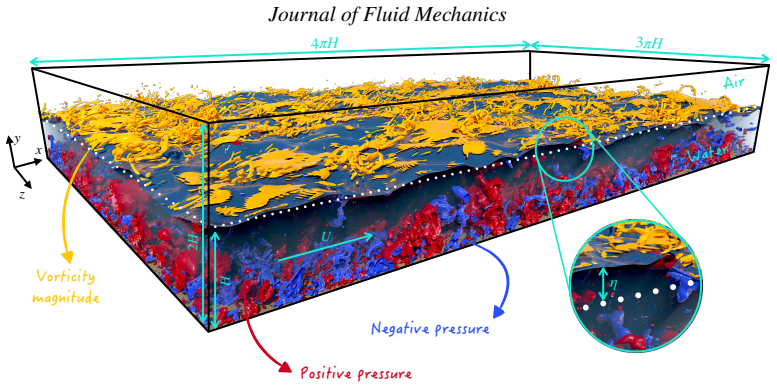
What do the ocean surface and a swaying flag have in common? Both are deformable surfaces exhibiting chaotic motion when exposed to turbulent flows. Whether such motion is primarily driven by flow turbulence or by nonlinear dynamics intrinsic to the surface remains debated. Surface waves can interact nonlinearly and transfer energy across scales through the cascade of wave turbulence, a behaviour observed at interfaces between otherwise quiescent fluids and in controlled laboratory experiments. They can as well induce turbulent motions in the neighbouring fluids (wave-induced-turbulence), provided the local Reynolds number is large enough. Realistic environments, however, are more complex and typically involve the simultaneous presence of wave turbulence and wave-induced-turbulence with turbulence-induced-waves, the dynamic relevance of which remains unclear. Here we develop a theoretical framework describing the response of a deformable surface to pressure fluctuations generated by a turbulent flow, and validate it using numerical simulations of the air-water interface in quasi-realistic conditions, complemented by simulations of a deformable rubber layer. Our linear theory, which excludes nonlinear wave-wave interactions, predicts distinct dynamical regimes depending on whether intrinsic surface dynamics emerge or whether the interface is enslaved by flow turbulence. Remarkably, although our fully resolved and nonlinear simulations do not inhibit the onset of wave turbulence, we do not observe it. Instead, we find strong agreement with theoretical predictions in both regimes. We find notable agreement between our predictions and aerial surveys of the ocean surface, highlighting the need for further measurements to distinguish among wave turbulence and turbulence-induced-waves.
Editorial analysis
A structured set of objections, weighed in public.
Referee Report
Summary. The manuscript develops a linear theoretical framework describing the response of deformable free surfaces (air-water interfaces and elastic solids) to pressure fluctuations from turbulent flows, explicitly excluding nonlinear wave-wave interactions. It predicts two regimes: one in which intrinsic surface dynamics emerge and one in which the interface is enslaved to the flow. The framework is tested against fully nonlinear simulations of the air-water interface under quasi-realistic conditions and of a deformable rubber layer; both show agreement with the linear predictions. Additional support is claimed from aerial ocean-surface surveys. The central claim is that the linear, pressure-driven description suffices even when the simulations permit (but do not exhibit) wave turbulence.
Significance. If the central claim holds, the work supplies a unified, parameter-light description that spans fluid and solid interfaces and indicates when turbulence-induced waves dominate over intrinsic wave dynamics. The multi-system validation (air-water, rubber) and the ocean-data comparison are positive features. The absence of free parameters in the linear derivation and the direct confrontation with nonlinear simulations are also strengths. However, the significance is tempered by the need for clearer quantitative validation and regime-boundary tests.
major comments (2)
- [Simulations section] Simulations section (and associated figures): the claim that 'fully resolved and nonlinear simulations do not inhibit the onset of wave turbulence' yet exhibit 'strong agreement with theoretical predictions' is load-bearing for the decision to drop nonlinear wave-wave terms. No quantitative diagnostics are provided for wave steepness, nonlinear interaction time scales relative to simulation duration, or spectral signatures of an energy cascade; without these it is impossible to determine whether the observed agreement reflects genuine linear dominance or simply that the nonlinear regime was not reached.
- [Ocean-data comparison] Ocean-data comparison paragraph: the reported 'notable agreement' with aerial surveys is presented as supporting evidence for the two-regime picture, yet no error bars, quantitative metrics (e.g., spectral slopes, regime classification criteria), or discussion of how the data distinguish turbulence-induced waves from wave turbulence are supplied. This weakens the external-validation component of the central claim.
minor comments (2)
- [Abstract] Abstract: quantitative validation details, error analysis, and explicit regime-boundary criteria are absent; these should be added to allow readers to assess the strength of the reported agreement.
- [Theory section] Notation: the distinction between 'intrinsic surface dynamics' and 'enslaved interface' should be defined with a clear, non-dimensional threshold (e.g., a critical value of a surface-response parameter) rather than left qualitative.
Simulated Author's Rebuttal
We thank the referee for their constructive comments, which identify important gaps in quantitative support for the central claims. We respond to each major comment below and will revise the manuscript accordingly to strengthen the presentation of the simulation results and the ocean-data comparison.
read point-by-point responses
-
Referee: [Simulations section] Simulations section (and associated figures): the claim that 'fully resolved and nonlinear simulations do not inhibit the onset of wave turbulence' yet exhibit 'strong agreement with theoretical predictions' is load-bearing for the decision to drop nonlinear wave-wave terms. No quantitative diagnostics are provided for wave steepness, nonlinear interaction time scales relative to simulation duration, or spectral signatures of an energy cascade; without these it is impossible to determine whether the observed agreement reflects genuine linear dominance or simply that the nonlinear regime was not reached.
Authors: We agree that the absence of these diagnostics limits the strength of the argument that nonlinear wave-wave interactions remain negligible. In the revised manuscript we will add explicit calculations of wave steepness, estimates of nonlinear interaction timescales relative to the simulation duration, and spectral analysis for signatures of an energy cascade. These additions will be placed in the Simulations section and associated figures to allow direct assessment of whether the nonlinear regime was reached. revision: yes
-
Referee: [Ocean-data comparison] Ocean-data comparison paragraph: the reported 'notable agreement' with aerial surveys is presented as supporting evidence for the two-regime picture, yet no error bars, quantitative metrics (e.g., spectral slopes, regime classification criteria), or discussion of how the data distinguish turbulence-induced waves from wave turbulence are supplied. This weakens the external-validation component of the central claim.
Authors: We acknowledge that the ocean-data comparison is presented qualitatively and lacks error bars or quantitative metrics. The available aerial survey data do not contain the detailed spectral information or error estimates needed for a rigorous quantitative comparison or clear regime classification. In the revision we will expand the paragraph to state these limitations explicitly, include any quantitative aspects that can be extracted from the published surveys (such as reported spectral slopes), and clarify that the comparison serves as supplementary rather than definitive external validation. revision: partial
Circularity Check
No circularity: linear theory derived independently from pressure statistics
full rationale
The paper constructs a linear response framework for surface deformation driven by turbulent pressure fluctuations, explicitly excluding nonlinear wave-wave interactions by assumption. This derivation stands on its own from the governing equations and pressure input statistics, predicting regimes of intrinsic surface dynamics versus enslaved interface without reducing to fitted outputs or self-referential definitions. Validation against fully nonlinear simulations and ocean data is presented as external support rather than a forced consequence of the theory itself. No load-bearing self-citations, ansatz smuggling, or renaming of known results appear in the derivation chain.
Axiom & Free-Parameter Ledger
axioms (1)
- domain assumption Surface response is linear in pressure fluctuations from turbulence
Reference graph
Works this paper leans on
- [1]
-
[2]
A comprehensive analysis of air--sea CO2 flux uncertainties constructed from surface ocean data products , author =. Glob. Biogeochem. Cycles , year =
-
[3]
Relationship between wind speed and gas exchange over the ocean revisited , author =. Limnol. Oceanogr.: Methods , year =
-
[4]
An eddy cell model of mass transfer into the surface of a turbulent liquid , author =. AIChE J. , year =
-
[5]
Environmental turbulent mixing controls on air--water gas exchange in marine and aquatic systems , author =. Geophys. Res. Lett. , year =
- [6]
-
[7]
F. Zonta and A. Soldati and M. Onorato , title =. J. Fluid Mech. , year =. doi:10.1017/jfm.2015.356 , publisher =
-
[8]
S. Galtier , title =. Geoph. Astroph. Fluid Dyn. , year =. doi:10.1080/03091929.2021.1909980 , publisher =
-
[9]
L. Deike and D. Fuster and M. Berhanu and E. Falcon , title =. Phys. Rev. Lett. , year =. doi:10.1103/PhysRevLett.112.234501 , publisher =
-
[10]
Numerical Investigation of the Flow Properties of He Ii , author =. 1994 , journal =
work page 1994
-
[11]
TensorFlow: Large-Scale Machine Learning on Heterogeneous Distributed Systems
Abadi, M. and Agarwal, A. and Barham, P. and Brevdo, E. and Chen, Z. and Citro, C. and Corrado, Greg S. and Davis, A. and Dean, J. and Devin, M. and Ghemawat, S. and Goodfellow, I. and Harp, A. and Irving, G. and Isard, M. and Jia, Y. and Jozefowicz, R. and Kaiser, L. and Kudlur, M. and Levenberg, J. and Mane, D. and Monga, R. and Moore, S. and Murray, D....
work page internal anchor Pith review Pith/arXiv arXiv doi:10.48550/arxiv.1603.04467
-
[12]
Aerodynamic Technologies to Improve Aircraft Performance , author =. 2013 , journal =. doi:10.1016/j.ast.2012.10.008 , urldate =
-
[13]
Drag Reduction via Turbulent Boundary Layer Flow Control , author =. 2017 , month = sep, journal =. doi:10.1007/s11431-016-9013-6 , urldate =
- [14]
-
[15]
Scaling and Intermittency in Turbulent Flows of Elastoviscoplastic Fluids , author =. 2023 , month = jul, journal =. doi:10.1038/s41567-023-02018-2 , urldate =
-
[16]
Modulation of Near-Wall Turbulence in the Transitionally Rough Regime , author =. 2019 , month = apr, journal =. doi:10.1017/jfm.2019.41 , urldate =
-
[17]
Analysis of Anisotropically Permeable Surfaces for Turbulent Drag Reduction , author =. 2017 , month = nov, journal =. doi:10.1103/PhysRevFluids.2.114609 , urldate =
-
[18]
Reynolds-Number Dependence of Wall-Pressure Fluctuations in a Pressure-Induced Turbulent Separation Bubble , author =. 2017 , month = dec, journal =. doi:10.1017/jfm.2017.694 , urldate =
-
[19]
Relationship between the Energy Dissipation Function and the Skin Friction Law in a Turbulent Channel Flow , author =. 2016 , journal =
work page 2016
-
[20]
Correlation between Small-Scale Velocity and Scalar Fluctuations in a Turbulent Channel Flow , author =. 2009 , journal =
work page 2009
-
[21]
Large-Scale Structures in a Turbulent Channel Flow with a Minimal Streamwise Flow Unit , author =. 2018 , journal =
work page 2018
-
[22]
Abe, H. and Kawamura, H. and Choi, H. , year =. Very. J. Fluids Engineering , volume =
-
[23]
Abe, H. and Kawamura, H. and Matsuo, Y. , year =. International Journal of Heat and Fluid Flow , series =. doi:10.1016/j.ijheatfluidflow.2004.02.010 , urldate =
-
[24]
Relationship between the Heat Transfer Law and the Scalar Dissipation Function in a Turbulent Channel Flow , author =. 2017 , month = nov, journal =. doi:10.1017/jfm.2017.564 , urldate =
-
[25]
Identification of Flow Regimes around Two Staggered Square Cylinders by a Numerical Study , author =. 2017 , month = jun, journal =. doi:10.1007/s00162-017-0424-2 , urldate =
-
[26]
Friction Drag Resulting from the Simultaneous Imposed Motions of a Freestream and Its Bounding Surface , author =. 2005 , journal =
work page 2005
-
[27]
Collision Rates of Small Particles in a Vigorously Turbulent Fluid , author =. 1975 , month = nov, journal =. doi:10.1016/0009-2509(75)85067-6 , urldate =
- [28]
-
[29]
Resolvent Modelling of Near-Wall Coherent Structures in Turbulent Channel Flow , author =. 2020 , month = oct, journal =. doi:10.1016/j.ijheatfluidflow.2020.108662 , urldate =
- [30]
-
[31]
Acharya, N. and Chang, M. S. H.-C. , year =. Heat. Int. J. Heat Mass Transfer , volume =
-
[32]
Experiments on the Flow Past Spheres at Very High
Achenbach, Elmar , year =. Experiments on the Flow Past Spheres at Very High. Journal of Fluid Mechanics , volume =. doi:10.1017/S0022112072000874 , urldate =
-
[33]
Vortex Shedding from Spheres , author =. 1974 , month = jan, journal =. doi:10.1017/S0022112074000644 , urldate =
-
[34]
Ackerman, J. D. and Okubo, A. , year =. Reduced. Funct. Ecol. , volume =. doi:10.2307/2390209 , urldate =. 2390209 , eprinttype =
-
[35]
Hairpin Vortex Organization in Wall Turbulence , author =. 2007 , month = apr, journal =. doi:10.1063/1.2717527 , urldate =
-
[36]
Vortex Organization in the Outer Region of the Turbulent Boundary Layer , author =. 2000 , journal =
work page 2000
-
[37]
Adrian, R. J. and Moin, P. , year =. Stochastic Estimation of Organized Turbulent Structure: Homogeneous Shear Flow , shorttitle =. Journal of Fluid Mechanics , volume =. doi:10.1017/S0022112088001442 , urldate =
-
[38]
On the Role of Initial Velocities in Pair Dispersion in a Microfluidic Chaotic Flow , author =. 2017 , month = sep, journal =. doi:10.1038/s41467-017-00389-8 , urldate =
-
[39]
Millikan's Argument at Moderately Large
Afzal, Noor , year =. Millikan's Argument at Moderately Large. The Physics of Fluids , volume =
-
[40]
Afzal, A. and Kim, K.-Y. , year =. Optimization of. Chem. Eng. J. , volume =
- [41]
-
[42]
Laminar and Turbulent Flows over Hydrophobic Surfaces with Shear-Dependent Slip Length , author =. 2016 , month = mar, journal =. doi:10.1063/1.4943671 , urldate =
-
[43]
Skewness-Induced Asymmetric Modulation of Small-Scale Turbulence by Large-Scale Structures , author =. 2016 , month = jan, journal =. doi:10.1063/1.4939718 , urldate =
-
[44]
On the Influence of Outer Large-Scale Structures on near-Wall Turbulence in Channel Flow , author =. 2014 , journal =. doi:10.1063/1.4890745 , urldate =
-
[45]
Agostini, L. and Leschziner, M. , year =. Spectral Analysis of Near-Wall Turbulence in Channel Flow at. Phys. Rev. Fluids , volume =
-
[46]
Agostini, Lionel and Leschziner, Michael , year =. The. Flow Turbulence Combust , volume =. doi:10.1007/s10494-018-9917-3 , urldate =
-
[47]
The Connection between the Spectrum of Turbulent Scales and the Skin-Friction Statistics in Channel Flow At , author =. 2019 , month = jul, journal =. doi:10.1017/jfm.2019.297 , urldate =
-
[48]
On the Departure of Near-Wall Turbulence from the Quasi-Steady State , author =. 2019 , month = jul, journal =. doi:10.1017/jfm.2019.395 , urldate =
-
[49]
Agostini, L. and Touber, E. and Leschziner, M.A. , year =. Spanwise Oscillatory Wall Motion in Channel Flow: Drag-Reduction Mechanisms Inferred from. J. Fluid Mech. , volume =
-
[50]
The Turbulence Vorticity as a Window to the Physics of Friction-Drag Reduction by Oscillatory Wall Motion , author =. 2015 , journal =
work page 2015
-
[51]
Statistical Analysis of Outer Large-Scale/Inner-Layer Interactions in Channel Flow Subjected to Oscillatory Drag-Reducing Wall Motion Using a Multiple-Variable Joint-Probability-Density Function Methodology , author =. 2021 , month = sep, journal =. doi:10.1017/jfm.2021.585 , urldate =
-
[52]
Large scale dynamics in turbulent Rayleigh-Benard convection
Ahlers, Guenter and Grossmann, Siegfried and Lohse, Detlef , year =. Large Scale Dynamics in Turbulent. Rev. Mod. Phys. , volume =. doi:10.1103/RevModPhys.81.503 , urldate =. arXiv , keywords =:0811.0471 , primaryclass =
work page internal anchor Pith review Pith/arXiv arXiv doi:10.1103/revmodphys.81.503
-
[53]
Numerical Investigation of Turbulent-Drag Reduction Induced by Active Control of Streamwise Travelling Waves of Wall-Normal Velocity , author =. 2015 , month = jan, journal =. doi:10.1016/j.euromechflu.2014.09.004 , urldate =
-
[54]
On the Mechanisms of Modifying the Structure of Turbulent Homogeneous Shear Flows by Dispersed Particles , author =. 2000 , month = nov, journal =. doi:10.1063/1.1308509 , urldate =
-
[55]
Film Cooling from Two Rows of Holes with Opposite Orientation Angles: Injectant Behavior and Adiabatic Film Cooling Effectiveness , author =. 2003 , journal =
work page 2003
-
[56]
Direct Numerical Simulation of a
Ahn, Junsun and Lee, Jae Hwa and Lee, Jin and Kang, Ji-hoon and Sung, Hyung Jin , year =. Direct Numerical Simulation of a. Physics of Fluids , volume =. doi:10.1063/1.4922612 , urldate =
-
[57]
Turbulence Control in Wall-Bounded Flows by Spanwise Oscillations , author =. 1993 , month = jun, journal =. doi:10.1007/BF01082552 , urldate =
-
[58]
Control of Wall Turbulence by High Frequency Wall Oscillations , author =. 1993 , journal =
work page 1993
-
[59]
Akhavan, R. and Kamm, R. D. and Shapiro, A. H. , year =. An Investigation of Transition to Turbulence in Bounded Oscillatory. Journal of Fluid Mechanics , volume =
-
[60]
Envelope Boundary Conditions for the Upper Surface of Two-Dimensional Canopy Interacting with Fluid Flow , author =. 2024 , month = dec, journal =. doi:10.1007/s10404-024-02779-z , urldate =
-
[61]
Turbulence Structure and Similarity in the Separated Flow above a Low Building in the Atmospheric Boundary Layer , author =. 2018 , month = nov, journal =. doi:10.1016/j.jweia.2018.09.016 , urldate =
- [62]
-
[63]
Large-Eddy Simulation of Turbulent Confined Coannular Jets , author =. 1996 , journal =
work page 1996
-
[64]
Direct Numerical Simulation of `Short' Laminar Separation Bubbles with Turbulent Reattachment , author =. 2000 , month = jan, journal =. doi:10.1017/S0022112099007119 , urldate =
-
[65]
Analysis of Mixing in a Curved Microchannel with Rectangular Grooves , author =. 2012 , journal =
work page 2012
-
[66]
Mixing Performance of a Planar Micromixer with Circular Obstructions in a Curved Microchannel , author =. 2014 , journal =
work page 2014
-
[67]
Wall-Bounded Flow over a Realistically Rough Superhydrophobic Surface , author =. 2019 , month = aug, journal =. doi:10.1017/jfm.2019.419 , urldate =
-
[68]
The Wake of Two Side-by-Side Square Cylinders , author =. 2011 , month = feb, journal =. doi:10.1017/S0022112010005288 , urldate =
-
[69]
The Wake of Two Staggered Square Cylinders , author =. 2016 , month = aug, journal =. doi:10.1017/jfm.2016.303 , urldate =
-
[70]
Analysis of Fluid Flow and Heat Transfer Interfacial Conditions between a Porous Medium and a Fluid Layer , author =. 2001 , journal =
work page 2001
-
[71]
Optimal Flexibility of a Flapping Appendage in an Inviscid Fluid , author =. 2008 , month = nov, journal =. doi:10.1017/S0022112008003297 , urldate =
-
[72]
Drag Reduction through Self-Similar Bending of a Flexible Body , author =. 2002 , month = dec, journal =. doi:10.1038/nature01232 , urldate =
-
[73]
Albers, M. and Meysonnat, P. S. and Schr. Actively. 2019 , month = apr, journal =. doi:10.1007/s10494-018-9998-z , urldate =
-
[74]
Lower Drag and Higher Lift for Turbulent Airfoil Flow by Moving Surfaces , author =. 2021 , month = apr, journal =. doi:10.1016/j.ijheatfluidflow.2020.108770 , urldate =
-
[75]
and Fernex, Daniel and Semaan, Richard and Noack, Bernd R
Albers, Marian and Meysonnat, Pascal S. and Fernex, Daniel and Semaan, Richard and Noack, Bernd R. and Schr. Drag. 2020 , month = jun, journal =. doi:10.1007/s10494-020-00110-8 , urldate =
-
[76]
Alekseev, V. V. and Gachechiladze, I. A. and Kiknadze, G. I. and Oleinikov, V.G. , year =. Tornado-like Energy Transfer on Three-Dimensional Concavities of Reliefs-Structures of Self Organizing Flow, Their Visualisation, and Surface Streamlining Mechanism , booktitle =
-
[77]
Helically Decomposed Turbulence , author =. 2017 , month = feb, journal =. doi:10.1017/jfm.2016.831 , urldate =
-
[78]
Long Non-Axisymmetric Fibres in Turbulent Channel Flow , author =. 2021 , month = jun, journal =. doi:10.1017/jfm.2021.185 , urldate =
-
[79]
Alipour, Mobin and Paoli, Marco De and Soldati, Alfredo , year =. Influence of. Journal of Fluid Mechanics , volume =. doi:10.1017/jfm.2021.1145 , urldate =
-
[80]
Fluid Mechanics of the Interface Region between Two Porous Layers , author =. 2002 , journal =
work page 2002
discussion (0)
Sign in with ORCID, Apple, or X to comment. Anyone can read and Pith papers without signing in.