REVIEW 1 major objections 5 minor 26 references
Lattice Paths and Pattern-Avoiding Uniquely Sorted Permutations
T0 review · 1 major / 5 minor · reviewed 2026-08-14 · deepseek-v4-flash
Pith's one-line read The paper proves nine conjectured enumeration formulas for pattern-avoiding uniquely sorted permutations of odd length, using bijections to Dyck, S-Motzkin, and Schröder paths.
desk verdict Nine conjectures settled by explicit bijections, but Theorem 7.1 rests on an under-derived functional equation that needs referee attention. read the letter →
The pith
A machine-rendered reading of the paper's core claim, the machinery that carries it, and where it could break.
The reading
What carries the argument
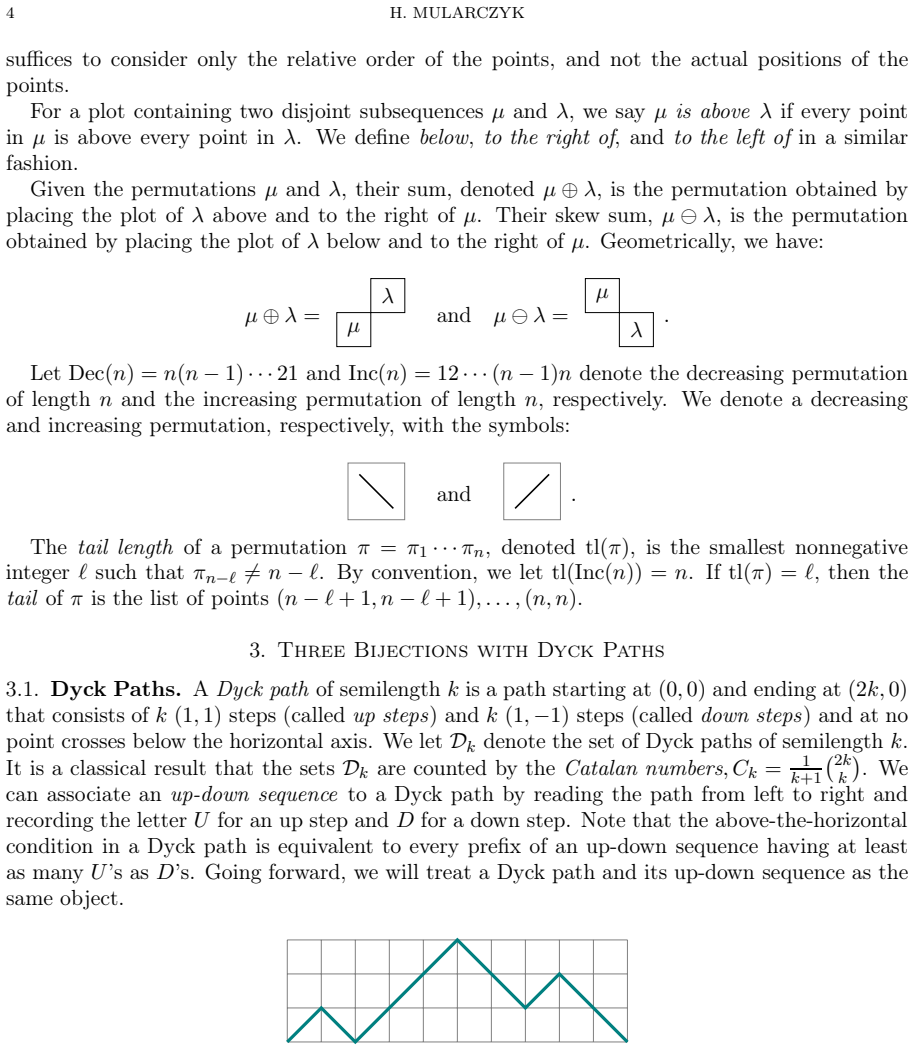
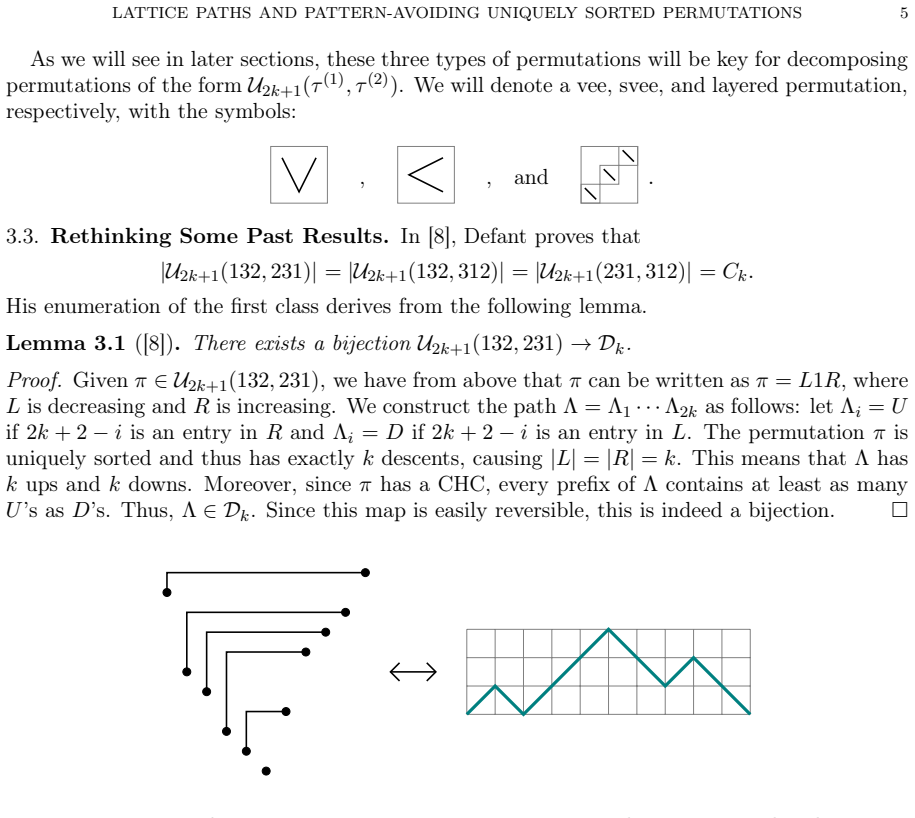
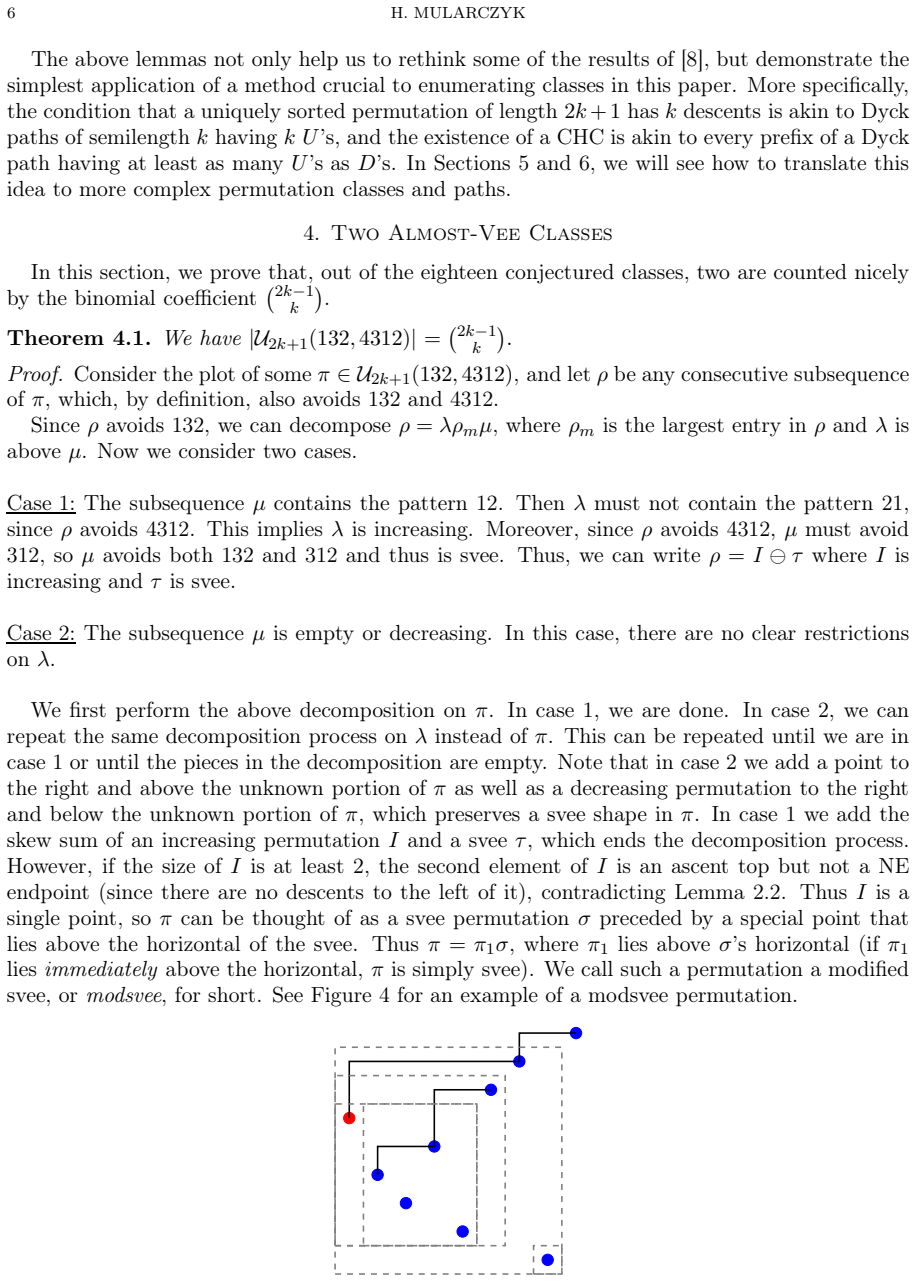
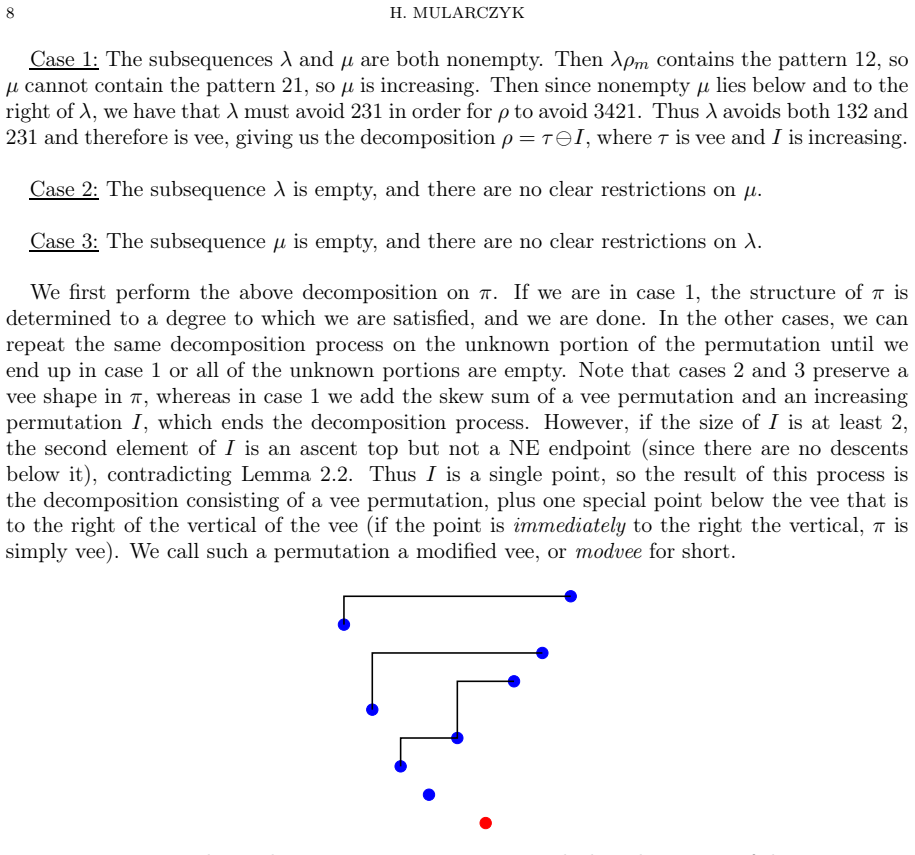
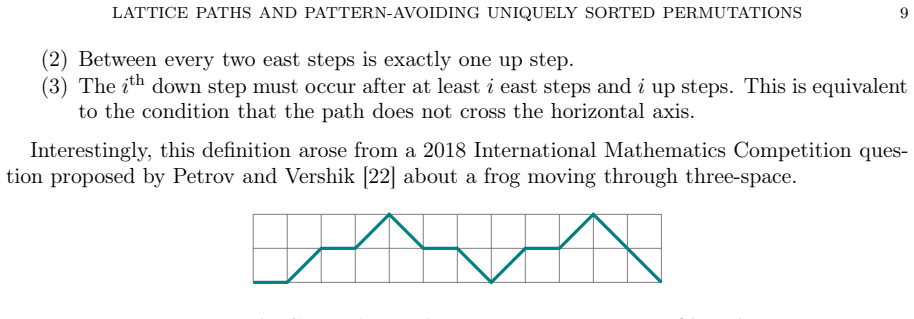
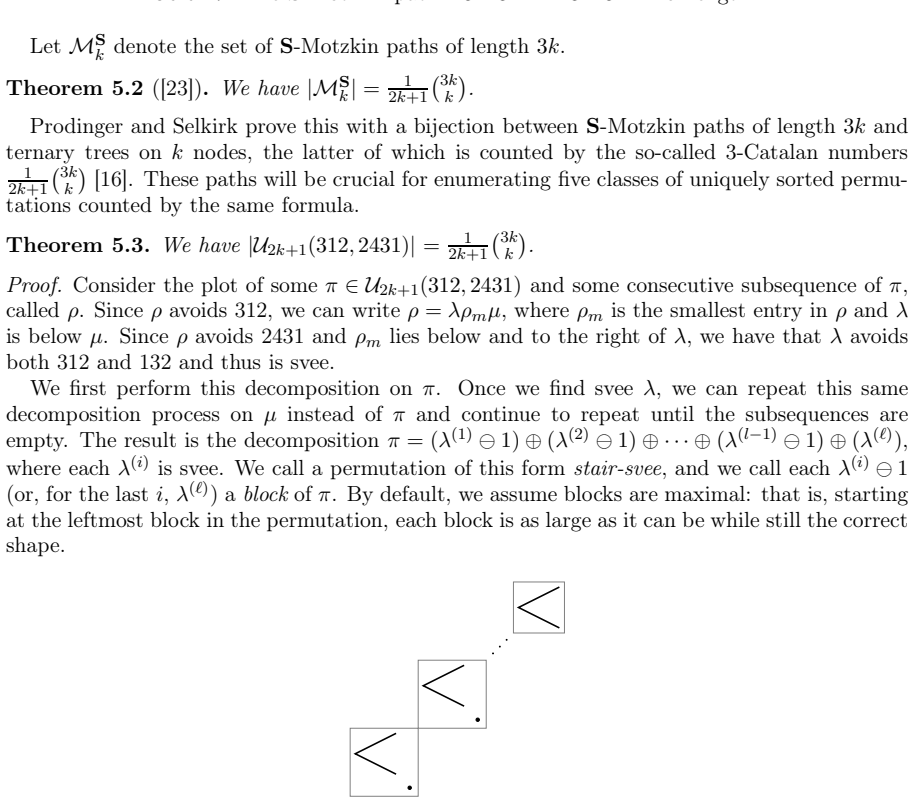
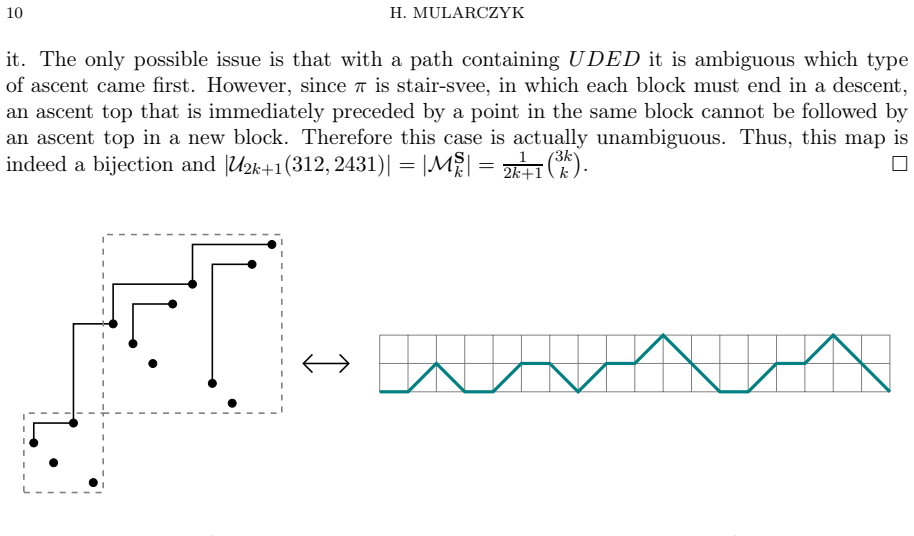
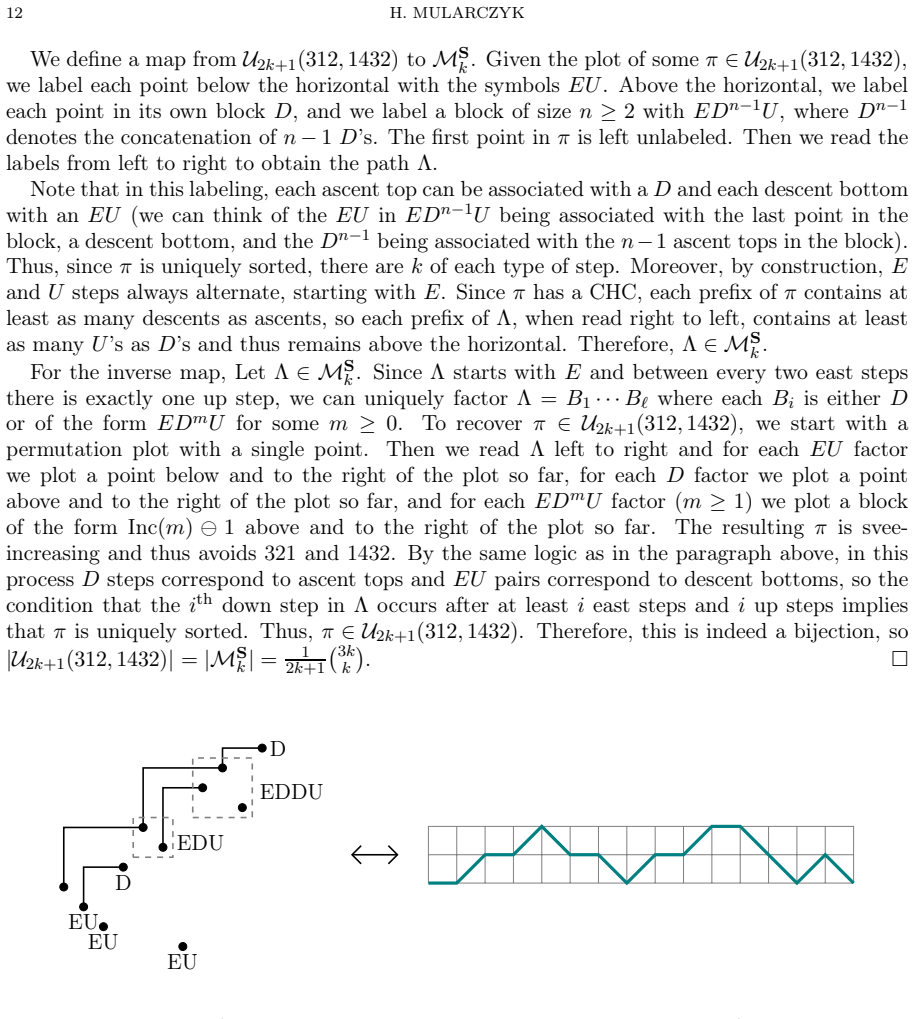
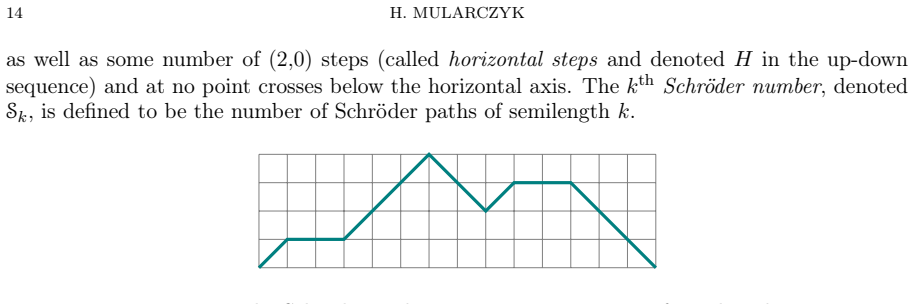
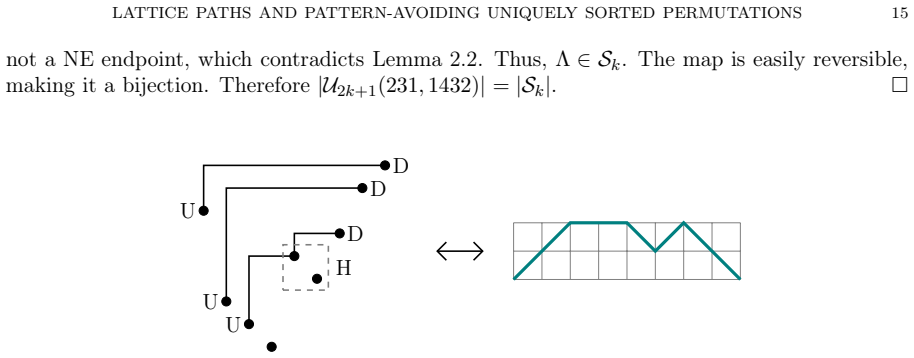
The central mechanism is the canonical hook configuration (CHC), a tuple of hooks in the permutation plot that records, for each descent top, the leftmost available northeast endpoint. A known theorem says a permutation is sorted exactly when it has a CHC; together with the characterization that uniquely sorted permutations are exactly sorted permutations with $k$ descents in length $2k+1$, this turns unique sortedness into a concrete geometric condition. For each pattern pair, the paper uses pattern avoidance to force the permutation into a restricted shape (vee, svee, layered, stair-svee, stair-layered, modsvee, vee-step), then reads ascent tops and descent bottoms in a prescribed order to produce a lattice path—a Dyck path, an S-Motzkin path (a Motzkin path with $k$ up, $k$ down, and $k$ east steps, starting with an east step and with exactly one up step between consecutive east steps), or a Schröder path without horizontal steps on the axis. The path's prefix conditions are exactly the CHC conditions, so the map is reversible and gives the stated count.
What would settle it
Enumerate the permutations in $U_{2k+1}(231,4312)$ by brute force for $k=1,2,3,4$ and compare the counts with the coefficients of $C(xC(x))$; a single mismatch at small $k$ would disprove Theorem 7.1. Alternatively, deriving the functional equation $\tilde{B}(x)=x+xC(x^2)\tilde{B}(x)^2$ directly from the Section 7 decomposition would remove the only unsupported step.
Extended reading notes
Core claim
The central claim is that for each of the nine pattern pairs marked with an asterisk in Table 1, the set $U_{2k+1}(\tau^{(1)},\tau^{(2)})$ of uniquely sorted permutations of length $2k+1$ avoiding one length-three and one length-four pattern is enumerated exactly by the stated sequence. The proofs are constructive: for each class, a canonical decomposition of the permutation plot is described, and the decomposition is matched invertibly to a Dyck path, an S-Motzkin path, a Schröder path without horizontal steps on the axis, or to a recursive decomposition governed by a functional equation. In particular, the paper proves $|U_{2k+1}(132,4312)|=|U_{2k+1}(132,3421)|=\binom{2k-1}{k}$, five classes have the 3-Catalan count $\frac{1}{2k+1}\binom{3k}{k}$, the class $U_{2k+1}(231,1432)$ is counted by the little Schröder numbers, and $\sum_{k\ge 0}|U_{2k+1}(231,4312)|x^k=C(xC(x))$, where $C(x)$ is the Catalan generating function.
Load-bearing premise
The count for the class $U_{2k+1}(231,4312)$ rests on a generating-function equation $\tilde{B}(x)=x+xC(x^2)\tilde{B}(x)^2$ that the paper quotes from a previous proof rather than deriving, and if that equation or the copied argument does not carry over, the enumeration in Theorem 7.1 is unsupported.
Editorial extensions
If this is right
- The nine pattern pairs marked with an asterisk in Table 1 now have proven enumeration formulas, so those rows of the conjecture table are settled.
- Five classes are placed in bijection with S-Motzkin paths, so their 3-Catalan counts identify them with ternary trees through a single path model.
- Inversion gives an explicit bijection between $U_{2k+1}(132,3421)$ and $U_{2k+1}(132,4312)$, showing both are counted by $\binom{2k-1}{k}$.
- The bijection between $U_{2k+1}(231,1432)$ and Schröder paths without horizontal steps on the axis proves the little Schröder count for that class.
- The generating function $B(x)=C(xC(x))$ for $U_{2k+1}(231,4312)$ places the class in the same enumerative family as previously counted uniquely sorted classes with the same generating function.
Reading between the lines
- For the nine still-open conjectures, the paper's own remarks suggest standard lattice-path bijections may fail because the relevant Motzkin model has the wrong length, so a generating-function approach may be more productive.
- The Section 4 inverse bijection hints that inversion symmetry between pattern pairs could yield further equinumerosities among uniquely sorted classes; testing this on other inverse pairs is a natural next step.
- The repeated 'descents become up steps, ascent tops become down steps' reading suggests a general dictionary between fertility conditions and path prefix conditions that could generate new path families for the remaining classes.
- Deriving the quoted functional equation for $U_{2k+1}(231,4312)$ from the decomposition would not only complete Theorem 7.1 but may provide a template for enumerating other classes of the form $U_{2k+1}(231,4xxx)$.
Signed reviews
Editorial analysis
A structured set of objections, weighed in public.
Referee Report
Summary. The paper studies uniquely sorted permutations (permutations with fertility 1 under West's stack-sorting map) that avoid one pattern of length 3 and one of length 4. It proves nine of Defant's conjectures by establishing bijections between these classes and lattice paths (Dyck paths, S-Motzkin paths, and a subclass of Schröder paths) and by a generating function argument. The enumerations include binomial coefficients, 3-Catalan numbers, little Schröder numbers, and coefficients of C(xC(x)).
Significance. If the gap in Section 7 is repaired, the paper settles nine conjectures in the enumeration of pattern-avoiding uniquely sorted permutations. The bijections in Sections 4-6 are largely explicit and reversible, and they introduce useful structural notions (modsvee, modvee, stair-svee, stair-layered, svee-increasing, vee-layered, vee-step). The generating-function route in Section 7 is the only part that is not fully carried out in the manuscript.
major comments (1)
- [7, proof of Theorem 7.1] The proof of Theorem 7.1 stops at the generating function for nice permutations, x^2 C(x^2) \tilde B(x), and then asserts the functional equation \tilde B(x) = x + x C(x^2) \tilde B(x)^2, saying that the rest of the proof is identical to that of Theorem 8.1 in Defant's article [8]. This equation is not derived for the class U_{2k+1}(231,4312), and Theorem 8.1 of [8] concerns the different class U_{2k+1}(231,4132). The author must show how non-nice permutations are recursively decomposed (for example, that a non-nice element can be split into a nice element and an arbitrary element) and must verify that the decomposition preserves 231 and 4312 avoidance and unique sortedness. As written, the enumeration of this class is unsupported, and Theorem 7.1 is one of the paper's nine central claims.
minor comments (5)
- [Lemma 3.3] The proof begins "Given π ∈ U_{2k+1}(132, 312)", but the statement is about U_{2k+1}(231,312); the class name should be corrected.
- [Theorem 5.4] The proof says "Consider some π ∈ U(312, 2431)", but the theorem is about U_{2k+1}(312,3421); also the final equality omits the subscript 2k+1 and should read |U_{2k+1}(312,3421)|.
- [Theorem 5.3] The inverse of the described bijection is only implicit in the sentence about recovering the type of ascent; a precise reconstruction of a stair-svee permutation from an S-Motzkin path would make the bijection easier to verify.
- [Section 7] The notation for the generating function \tilde B(x) alternates between "B~(x)" and "~B(x)", and the equality \tilde B(x) = x + x C(x^2) \tilde B(x)^2 is introduced without derivation; at minimum the notation should be made consistent.
- [Theorem 4.2] The preservation of the canonical hook configuration under the modvee/mod-svee inversion is argued in one sentence ("by the logic in the lemmas"); a few more details would make this central step easier to check.
Circularity Check
No significant circularity: the enumeration theorems are derived from explicit bijections and external lemmas, not from the target formulas.
full rationale
The paper's central claims are the nine asterisked enumeration theorems. Each is proven either by a direct decomposition-and-counting argument (Theorem 4.1), by an explicitly defined bijection with S-Motzkin paths or Schröder paths whose cardinalities are cited from independent sources (Theorems 5.3–5.6, 6.1), or by composing previously established bijections (Theorem 5.7). No parameter is fitted to data and then renamed a prediction; no class is defined in terms of its own enumeration; and no load-bearing step reduces, by the paper's own equations, to its target formula. The only potentially weak point, flagged by the skeptic, is Theorem 7.1: the paper derives the generating function for nice permutations as x^2 C(x^2) B~(x) and then states that 'the rest of the proof is identical to that of Theorem 8.1 in Defant's article [8]', asserting the functional equation B~(x) = x + x C(x^2) B~(x)^2 without deriving it in the present text. This is an omitted derivation and a dependence on an external proof, not a circular reduction: the asserted equation is not shown to be an input of the argument, nor is Defant's theorem a self-citation by the present author. Accordingly, the circularity burden is zero, and the appropriate finding is 'no significant circularity' with any concern about Theorem 7.1 treated as a correctness or completeness issue rather than circularity.
Assumptions & free parameters
assumptions (7)
- domain assumption A permutation π ∈ S_n is uniquely sorted if and only if it is sorted and has exactly (n−1)/2 descents.
- domain assumption A permutation is sorted if and only if it has a canonical hook configuration.
- domain assumption In any π ∈ U_{2k+1}, the set of descent bottoms and the set of NE endpoints of the CHC partition the points at positions 2 through 2k+1.
- standard math |U_{2k+1}(231,312)| = C_k, the k-th Catalan number.
- standard math The number of S-Motzkin paths of length 3k is (1/(2k+1)) binom(3k,k).
- domain assumption There is a bijection swu : U_{2k+1}(231) → U_{2k+1}(132) whose restriction maps Av(231,1423) onto Av(132,3412).
- domain assumption The functional equation \tilde{B}(x) = x + xC(x^2)\tilde{B}(x)^2 for the generating function of nice permutations in the class (231,4312) follows by the same derivation as Defant's Theorem 8.1 in [8].
Cite this review
Pith. "Pith review of Lattice Paths and Pattern-Avoiding Uniquely Sorted Permutations." pith.science (2026). https://pith.science/paper/DVM3FHJF
@misc{pith2026190804025,
  author       = {Pith},
  title        = {Pith review of: Lattice Paths and Pattern-Avoiding Uniquely Sorted Permutations},
  year         = {2026},
  howpublished = {\url{https://pith.science/paper/DVM3FHJF}},
  note         = {Machine review of arXiv:1908.04025}
}
read the original abstract
Defant, Engen, and Miller defined a permutation to be uniquely sorted if it has exactly one preimage under West's stack-sorting map. We enumerate classes of uniquely sorted permutations that avoid a pattern of length three and a pattern of length four by establishing bijections between these classes and various lattice paths. This allows us to prove nine conjectures of Defant.
Figures

Figures from the paper (15 more)






Reference graph
Works this paper leans on
-
[8]
Defant, Catalan intervals and uniquely sorted permut ations
C. Defant, Catalan intervals and uniquely sorted permut ations. J. Combin. Theory Ser. A , 174 (2020)
work page 2020
- [1]
-
[2]
Bóna, Combinatorics of permutations
M. Bóna, Combinatorics of permutations. CRC Press, 2012
work page 2012
-
[3]
Stack words and a bound for 3-stack sortable permutations
M. Bóna, Stack words and a bound for 3-stack sortable permutations. arXiv:1903.04113
work page Pith review arXiv 1903
-
[4]
Bóna, A survey of stack-sorting disciplines
M. Bóna, A survey of stack-sorting disciplines. Electron. J. Combin. , 9.2 (2003): 16
work page 2003
-
[5]
Bóna, Symmetry and unimodality in t-stack sortable permutations
M. Bóna, Symmetry and unimodality in t-stack sortable permutations. J. Combin. Theory Ser. A , 98.1 (2002), 201–209
work page 2002
-
[6]
Bousquet-Mélou, Multi-statistic enumeration of two -stack sortable permutations
M. Bousquet-Mélou, Multi-statistic enumeration of two -stack sortable permutations. Electron. J. Combin. , 5 (1998), #R21
work page 1998
-
[7]
Bousquet-Mélou, Sorted and/or sortable permutation s
M. Bousquet-Mélou, Sorted and/or sortable permutation s. Discrete Math. , 225 (2000), 25–50
work page 2000
Show all 26 references
-
[9]
Defant, Counting 3-stack-sortable permutations
C. Defant, Counting 3-stack-sortable permutations. J. Combin. Theory Ser. A. , 172 (2020)
2020
-
[10]
Defant, Descents in t-sorted permutations
C. Defant, Descents in t-sorted permutations. J. Comb. , to appear
-
[11]
Defant, Fertility numbers
C. Defant, Fertility numbers. J. Comb. , to appear
-
[12]
Defant, Fertility, strong fertility, and postorder Wilf equivalence
C. Defant, Fertility, strong fertility, and postorder Wilf equivalence. Australas. J. Combin. , 76 (2020), 149– 182
2020
-
[13]
Defant, Preimages under the stack-sorting algorith m
C. Defant, Preimages under the stack-sorting algorith m. Graphs Combin. , 33 (2017), 103–122
2017
-
[14]
Defant, M
C. Defant, M. Engen, and J. A. Miller, Stack-sorting, se t partitions, and Lassalle’s sequence. To appear in J. Combin. Theory Ser. A . 18 H. MULARCZYK
-
[15]
Goulden and J
I. Goulden and J. West, Raney paths and a combinatorial r elationship between rooted nonseparable planar maps and two-stack-sortable permutations, J. Combin. Theory Ser. A. , 75.2 (1996), 220–242
1996
-
[16]
R. L. Graham, D. E. Knuth, and O. Patashnik. Concrete Mathematics. Addison-Wesley, Reading, MA, 1999
1999
-
[17]
Kitaev, Patters in Permutations and Words, Springer -Verlag, Berlin, Heidelberg, 2011
S. Kitaev, Patters in Permutations and Words, Springer -Verlag, Berlin, Heidelberg, 2011
2011
-
[18]
D. E. Knuth, The Art of Computer Programming, volume 1, F undamental Algorithms. Addison-Wesley, Reading, Massachusetts, 1973
1973
-
[19]
Krattenthaler
C. Krattenthaler. Lattice Path Enumeration. Handbook of Enumerative Combinatorics, M. Bóna (ed.), Dis- crete Math. and Its Appl. , CRC Press, Boca Raton-London-New York, 2015, pp. 589–678
2015
-
[20]
Lassalle, Two integer sequences related to Catalan n umbers
M. Lassalle, Two integer sequences related to Catalan n umbers. J. Combin. Theory Ser. A , 119 (2012), 923–935
2012
-
[21]
Linton, N
S. Linton, N. Ruškuc, V. Vatter, Permutation Patterns, London Mathematical Society Lecture Note Series, Vol. 376. Cambridge University Press, 2010
2010
-
[22]
Petrov and A
F. Petrov and A. Vershik. International Mathematics Co mpetition: Day 2 Problem 8, 2018. http: //imc- math.ddns.net/pdf/imc2018-day2-questions.pdf
2018
-
[23]
Prodinger and S
H. Prodinger and S. J. Selkirk, A bijection between tern ary trees and a subclass of Motzkin paths. arXiv:1808.01907v2
-
[24]
West, Permutations with restricted subsequences an d stack-sortable permutations, Ph.D
J. West, Permutations with restricted subsequences an d stack-sortable permutations, Ph.D. Thesis, MIT, 1990
1990
-
[25]
Whitworth
W. Whitworth. Arrangements of m things of one sort and n things of another sort, under certain conditions of priority. Messenger Math. , 8:108–114, 1878
-
[26]
Zeilberger, A proof of Julian West’s conjecture that the number of two-stack-sortable permutations of length n is 2(3n)!/ ((n + 1)!(2n + 1)!)
D. Zeilberger, A proof of Julian West’s conjecture that the number of two-stack-sortable permutations of length n is 2(3n)!/ ((n + 1)!(2n + 1)!). Discrete Math. , 102 (1992), 85–93. Har v ard University, Cambridge, MA 02138 Email address : hmularczyk@college.harvard.edu
1992
Reviewed August 14, 2026 · model on record in the stance chip above.
Discussion (0). Continue with ORCID to comment.