REVIEW 2 major objections 3 minor 1 cited by
Prescribed Wall-Heat-Flux Control of Blockage and Impulse in a Rarefied Micro-Nozzle
T0 review · 2 major / 3 minor · reviewed 2026-05-20 · grok-4.3
Pith's one-line read Prescribed wall heating in a rarefied micro-nozzle raises specific impulse from 156 s to 201 s because thermal and pressure thrust gains outweigh the mass-flow penalty.
desk verdict Strong heating in these DSMC runs lifts specific impulse from 156 s to 201 s by adding thermal and pressure thrust that beats the mass-flow penalty, though the inlet-based heat-flux scaling may overstate the local effect. read the letter →
The pith
A machine-rendered reading of the paper's core claim, the machinery that carries it, and where it could break.
The reading
What carries the argument
The nondimensional wall heat flux Q_w/E, which parametrizes the coupled wall-bulk thermal response and drives the transition of the internal compression feature into a viscous-thermal compression zone.
What would settle it
An experiment that measures thrust and mass flow rate in a physical micro-nozzle under the same strong-heating wall-flux condition and obtains a specific impulse at or below 156 s would falsify the claim that thermal and pressure augmentation outweighs the mass-flow penalty.
Extended reading notes
Core claim
The central claim is that prescribed wall heat flux supplies an active control method for rarefied micro-nozzle flows through the coupled wall-bulk thermal response. With the nondimensional heat flux Q_w/E ranging from -10.5 percent to 97.3 percent, heating produces wall temperatures more than five times the inlet value while the bulk temperature rises more slowly. This contracts the mass-carrying core, increases blockage, and reduces mass flow, yet strong heating lifts specific impulse from 156 s to 201 s because thermal and pressure-thrust augmentation exceeds the mass-flow penalty. The original internal compression feature develops into a finite viscous-thermal compression zone whose heat
Load-bearing premise
The imposed heat flux scaled by inlet kinetic-energy flux accurately represents the coupled wall-bulk thermal response in the simulations across the full range without unaccounted real-world effects such as surface accommodation or radiation.
Editorial analysis
A structured set of objections, weighed in public.
Referee Report
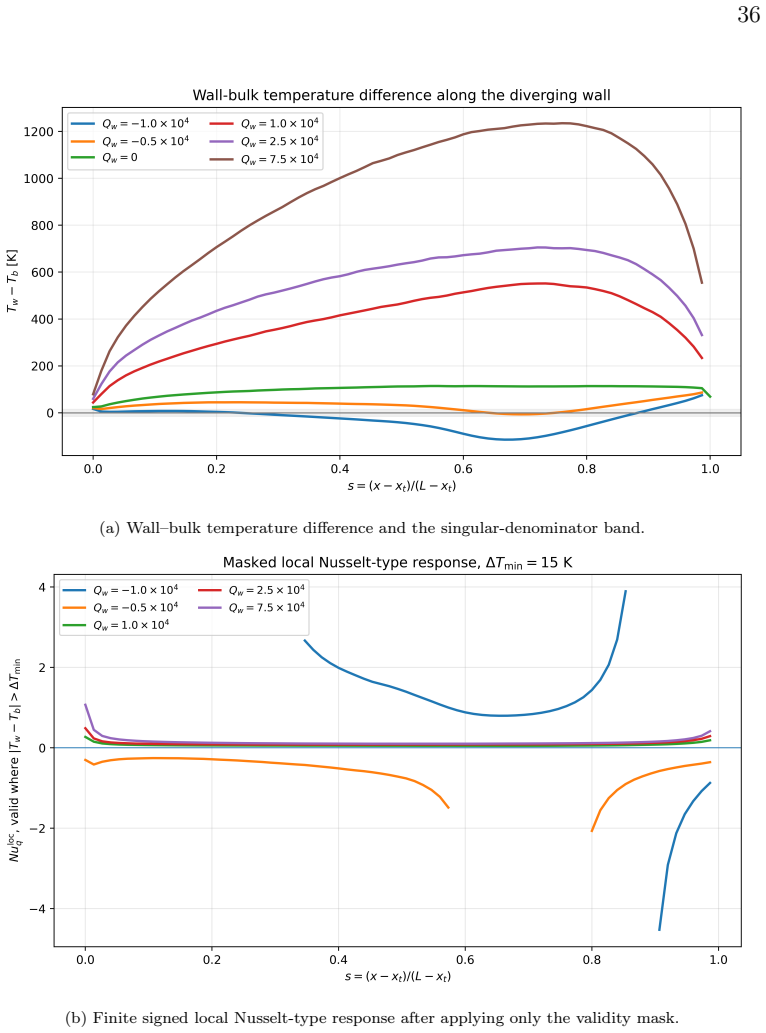
Summary. The manuscript employs direct simulation Monte Carlo (DSMC) to examine nitrogen flow through a converging-diverging micro-nozzle under prescribed wall heat flux applied to the diverging section. The heat flux is normalized by the inlet kinetic-energy flux E = 0.5 ρ_i U_i^3, producing Q_w/E values from -10.5% to 97.3%. Diagnostics include wall and bulk temperature profiles, Nusselt and Brinkman-type numbers, gradient-length Knudsen indicators, thrust decomposition, and POD of signed numerical schlieren. The central claim is that strong heating increases specific impulse from 156 s to 201 s because thermal and pressure-thrust gains exceed the mass-flow penalty arising from increased aerodynamic blockage, while the internal compression feature remains low-dimensional (first two POD modes capture >97% of fluctuation energy).
Significance. If the boundary-condition implementation and quantitative thrust results hold, the work demonstrates an active thermal-control mechanism for rarefied micro-nozzle performance that could inform micro-propulsion design. The observation that the compression-zone response is captured by only two POD modes supplies a concrete, low-dimensional characterization of parametric sensitivity. The explicit thrust decomposition and retention of singular Nusselt behavior for diagnosis are methodologically transparent strengths.
major comments (2)
- [Boundary-condition description and results on impulse] The normalization Q_w/E uses a single inlet value E = 0.5 ρ_i U_i^3 for the entire range -10.5% to 97.3%. Because the flow accelerates and density drops along the diverging wall, the local kinetic-energy flux rises; consequently the same numerical Q_w represents a progressively smaller fractional energy input downstream. This global scaling is central to the interpretation that thermal/pressure augmentation outweighs the reported mass-flow reduction to produce the Isp rise from 156 s to 201 s, yet no local energy-balance check or alternative normalization is presented.
- [Numerical methods and thrust-decomposition results] The quantitative headline result (Isp increasing from 156 s to 201 s) rests on the DSMC implementation of the heat-flux boundary condition and the subsequent thrust decomposition. The manuscript provides no grid-convergence data, validation against a known rarefied-nozzle case, or accommodation-coefficient sensitivity study, all of which are load-bearing for the claimed magnitude of the impulse shift.
minor comments (3)
- [Abstract] The abstract states that cooling cases produce locations where T_w - T_b changes sign, rendering the local Nusselt response singular, yet the precise definition of the film temperature used for the Nusselt number is not supplied.
- [Results] The range of Q_w/E is given as -10.5% to 97.3%, but the corresponding wall-temperature ratios (T_w up to >5× inlet temperature) are stated without an accompanying plot or table that directly links each Q_w/E value to the resulting T_w/T_i.
- [POD analysis] The POD analysis reports that the first two modes capture more than 97% of the fluctuation energy, but the manuscript does not indicate whether the POD was performed on the full domain or on a masked sub-region containing the compression zone.
Simulated Author's Rebuttal
We thank the referee for the thorough review and valuable comments on our work. We address the major comments point by point below, indicating the revisions we will make to strengthen the manuscript.
read point-by-point responses
-
Referee: The normalization Q_w/E uses a single inlet value E = 0.5 ρ_i U_i^3 for the entire range -10.5% to 97.3%. Because the flow accelerates and density drops along the diverging wall, the local kinetic-energy flux rises; consequently the same numerical Q_w represents a progressively smaller fractional energy input downstream. This global scaling is central to the interpretation that thermal/pressure augmentation outweighs the reported mass-flow reduction to produce the Isp rise from 156 s to 201 s, yet no local energy-balance check or alternative normalization is presented.
Authors: The inlet-based normalization was selected to maintain a uniform reference scale for the imposed heat flux relative to the fixed inlet conditions, facilitating consistent parametric comparison across the range of Q_w/E values. This choice emphasizes the overall energy input relative to the nozzle inlet rather than local variations. We agree that examining the local energy balance would be beneficial for interpreting the downstream effects. In the revised version, we will add a local energy-flux analysis along the wall to demonstrate that the thermal and pressure contributions remain dominant despite the flow acceleration. revision: partial
-
Referee: The quantitative headline result (Isp increasing from 156 s to 201 s) rests on the DSMC implementation of the heat-flux boundary condition and the subsequent thrust decomposition. The manuscript provides no grid-convergence data, validation against a known rarefied-nozzle case, or accommodation-coefficient sensitivity study, all of which are load-bearing for the claimed magnitude of the impulse shift.
Authors: We acknowledge the importance of verifying the numerical accuracy for the reported quantitative results. Although the methods section describes the DSMC setup, including the boundary condition implementation, we will enhance the manuscript by including explicit grid-convergence studies for the key quantities such as mass flow rate and thrust components. Additionally, we will provide validation results against a standard rarefied nozzle test case and perform a sensitivity analysis on the wall accommodation coefficient to confirm the robustness of the specific impulse increase from 156 s to 201 s. revision: yes
Circularity Check
No significant circularity; results from direct DSMC simulation
full rationale
The paper reports outcomes from DSMC simulations with externally imposed wall heat-flux boundary conditions normalized by the fixed inlet quantity E = 0.5 ρ_i U_i^3. The reported specific-impulse increase (156 s to 201 s), blockage evolution, and POD energy capture (>97 % in first two modes) are direct numerical outputs under these boundary conditions rather than quantities obtained by fitting parameters to the target data or by self-referential definitions. No equations or claims reduce the central results to their own inputs by construction, and the analysis employs standard post-processing diagnostics without load-bearing self-citation chains for the primary findings.
Assumptions & free parameters
free parameters (1)
- Q_w/E
assumptions (1)
- domain assumption DSMC with the selected collision model and boundary conditions accurately captures the coupled wall-bulk thermal response and mass-flux-weighted quantities in the rarefied regime.
Cite this review
Pith. "Pith review of Prescribed Wall-Heat-Flux Control of Blockage and Impulse in a Rarefied Micro-Nozzle." pith.science (2026). https://pith.science/paper/DWMJWION
@misc{pith2026260519286,
  author       = {Pith},
  title        = {Pith review of: Prescribed Wall-Heat-Flux Control of Blockage and Impulse in a Rarefied Micro-Nozzle},
  year         = {2026},
  howpublished = {\url{https://pith.science/paper/DWMJWION}},
  note         = {Machine review of arXiv:2605.19286}
}
abstract
Prescribed wall heat flux provides an active route for controlling rarefied micro-nozzle flows, but its effect is governed by the coupled wall--bulk thermal response rather than by the imposed flux alone. This work uses direct simulation Monte Carlo (DSMC) simulations to study nitrogen flow in a converging--diverging micro-nozzle with cooling, adiabatic, and heating applied on the diverging wall. The imposed heat flux is scaled by the inlet kinetic-energy flux, $E=0.5\rho_i U_i^3$, giving $Q_w/E$ from $-10.5\%$ to $97.3\%$; this range spans moderate cooling, weak-to-intermediate heating, and a near-unity thermal-forcing regime. Wall and mass-flux-weighted bulk temperature profiles, film-temperature-based Nusselt and local-viscosity Brinkman-type diagnostics, gradient-length Knudsen indicators, mass-flux thickness, thrust decomposition, and proper orthogonal decomposition (POD) of signed numerical schlieren are analyzed. The results show that heating creates strong wall--bulk stratification: the wall temperature exceeds five times the inlet value, while the bulk temperature responds more gradually. Cooling cases contain locations where $T_w-T_b$ changes sign, making the local Nusselt-type response singular; the raw singular behavior is retained for diagnosis and a validity mask is used only for comparative plotting. Heating contracts the effective mass-carrying core, increasing aerodynamic blockage and reducing mass flow rate. However, strong heating increases the specific impulse from $156$ s to $201$ s because thermal and pressure-thrust augmentation outweigh the mass-flow penalty. The internal compression feature evolves into a finite viscous--thermal compression zone, and its heat-flux-parametric response remains low-dimensional, with the first two POD modes capturing more than $97\%$ of the fluctuation energy.
Figures


Figures from the paper (11 more)




Lean theorems connected to this paper
-
IndisputableMonolith/Cost/FunctionalEquation.leanwashburn_uniqueness_aczel unclear?
unclearRelation between the paper passage and the cited Recognition theorem.
The imposed heat flux is scaled by the inlet kinetic-energy flux, E=0.5ρ_i U_i³, giving Q_w/E from −10.5% to 97.3%; ... strong heating increases the specific impulse from 156 s to 201 s because thermal and pressure-thrust augmentation outweigh the mass-flow penalty.
-
IndisputableMonolith/Foundation/RealityFromDistinction.leanreality_from_one_distinction unclear?
unclearRelation between the paper passage and the cited Recognition theorem.
POD of signed numerical schlieren ... first two POD modes capturing more than 97% of the fluctuation energy.
What do these tags mean?
- matches
- The paper's claim is directly supported by a theorem in the formal canon.
- supports
- The theorem supports part of the paper's argument, but the paper may add assumptions or extra steps.
- extends
- The paper goes beyond the formal theorem; the theorem is a base layer rather than the whole result.
- uses
- The paper appears to rely on the theorem as machinery.
- contradicts
- The paper's claim conflicts with a theorem or certificate in the canon.
- unclear
- Pith found a possible connection, but the passage is too broad, indirect, or ambiguous to say the theorem truly supports the claim.
Forward citations
Cited by 1 Pith paper
-
Gaussian kinetic representations of rarefied nonequilibrium flows
Log-density Gaussian phase-space fits recover shock nonequilibrium moments without moment supervision, and a Gaussian moment-field map compresses lid-driven cavity wall transport.
Reference graph
Works this paper leans on
-
[1]
Computers & Fluids 127, 78–101
A novel algorithm for implementing a specified wall heat flux in dsmc: Application to micro/nano flows and hypersonic flows. Computers & Fluids 127, 78–101. doi:10.1016/j.compfluid.2015. 12.008. Akhlaghi, H., Roohi, E., Stefanov, S.,
-
[2]
International Journal of Thermal Sciences 59, 111–125
A new iterative wall heat flux specifying technique in dsmc for heating/cooling simulations of mems/nems. International Journal of Thermal Sciences 59, 111–125. doi:10.1016/j.ijthermalsci.2012.04.002. Balaj, M., Roohi, E., Akhlaghi, H.,
-
[3]
International Journal of Heat and Mass Transfer 83, 69–74
Effects of shear work on non- equilibrium heat transfer characteristics of rarefied gas flows through mi- cro/nanochannels. International Journal of Heat and Mass Transfer 83, 69–74. doi:10.1016/j.ijheatmasstransfer.2014.11.087. Balaj, M., Roohi, E., Akhlaghi, H., Myong, R.S.,
-
[4]
International Journal of Heat and Mass Transfer 71, 633–638
Investigation of con- vective heat transfer through constant wall heat flux micro/nano channels using dsmc. International Journal of Heat and Mass Transfer 71, 633–638. doi:10.1016/j.ijheatmasstransfer.2013.12.053. Bird, G.A.,
-
[5]
ThePhysics of Fluids 13, 2676–2681
Directsimulationandtheboltzmannequation. ThePhysics of Fluids 13, 2676–2681. doi:10.1063/1.1692849. Darbandi, M., Roohi, E.,
-
[6]
Microflu- idics and Nanofluidics 10, 321–335
Study of subsonic–supersonic gas flow throughmicro/nanoscalenozzlesusingunstructureddsmcsolver. Microflu- idics and Nanofluidics 10, 321–335. doi:10.1007/s10404-010-0671-7. Groll, R., Frieler, T.,
-
[7]
Frontiers in Mechani- cal Engineering 9, 1217645
Validation of dsmc mass flow modeling for transsonic gas flows in micro-propulsion systems. Frontiers in Mechani- cal Engineering 9, 1217645. doi:10.3389/fmech.2023.1217645. Hao, P.F., Ding, Y.T., Yao, Z.H., He, F., Zhu, K.Q.,
-
[8]
Journal of Micromechanics and Microengineering 15, 2069–2073
Size effect on gas flow in micro nozzles. Journal of Micromechanics and Microengineering 15, 2069–2073. doi:10.1088/0960-1317/15/11/019. 54 Horisawa, H., Sawada, F., Onodera, K., Funaki, I.,
Show all 34 references
-
[9]
Vac- uum 83, 52–56
Numerical simula- tion of micro-nozzle and micro-nozzle-array flowfield characteristics. Vac- uum 83, 52–56. doi:10.1016/j.vacuum.2008.03.097. Ivanov, M.S., Markelov, G.N., Ketsdever, A.D., Wadsworth, D.C.,
2008 doi
-
[10]
Numerical study of cold gas micronozzle flows, in: 37th Aerospace Sciences Meeting and Exhibit, pp. 1–11. doi:10.2514/6.1999-166. Karniadakis, G.E., Beskok, A., Aluru, N.R.,
1999 doi
-
[11]
Physics of Fluids 33, 082007
Separation of a binary gas mixture outflowing into vacuum through a micronozzle. Physics of Fluids 33, 082007. doi:10.1063/5.0055879. Lijo, V., Setoguchi, T., Kim, H.D.,
-
[12]
Journal of Propulsion and Power 31, 754–757
Analysis of supersonic micronozzle flows. Journal of Propulsion and Power 31, 754–757. doi:10.2514/1. B35453. Lockerby, D.A., Reese, J.M., Emerson, D.R., Barber, R.W.,
-
[13]
Physical Review E 70, 017303
Velocity boundary condition at solid walls in rarefied gas calculations. Physical Review E 70, 017303. doi:10.1103/PhysRevE.70.017303. Louisos, W.F., Hitt, D.L.,
-
[14]
Journal of Spacecraft and Rockets 49, 51–58
Viscous effects on performance of three- dimensional supersonic micronozzles. Journal of Spacecraft and Rockets 49, 51–58. doi:10.2514/1.53026. Lu, L., Jin, P., Pang, G., Zhang, Z., Karniadakis, G.E.,
-
[15]
Vacuum 181, 109736
A novel hybrid dsmc-fokker planck algorithm implemented to rarefied gas flows. Vacuum 181, 109736. doi:10.1016/j. vacuum.2020.109736. Maxwell, J.C.,
2020 doi
-
[16]
Philosophical Transactions of the Royal Society of London 170, 231–256
On stresses in rarified gases arising from inequalities of temperature. Philosophical Transactions of the Royal Society of London 170, 231–256. doi:10.1098/rstl.1879.0067. 55 Peyvan, A., Kumar, V., Karniadakis, G.E.,
-
[17]
Journal of Compu- tational Physics 378, 686–707
Physics-informed neural networks: A deep learning framework for solving forward and inverse prob- lems involving nonlinear partial differential equations. Journal of Compu- tational Physics 378, 686–707. doi:10.1016/j.jcp.2018.10.045. Riabov, V.V.,
2018 doi
-
[18]
doi:10.2514/6
Shock interference in hypersonic rarefied-gas flows near a cylinder, in: AIAA 30th Fluid Dynamics Conference. doi:10.2514/6. 1999-3207. Roohi, E., Mahdavi, A., 2026a. Analysis of the rarefied flow at micro-step usingadeeponetsurrogatemodelwithaphysics-guidedzonallossfunction. ...
1999 doi
- [19]
-
[20]
AIAA Journal 9, 804–811
Electron-beam studies of viscous flow in supersonic noz- zles. AIAA Journal 9, 804–811. doi:10.2514/3.49904. Saadati, S.A., Roohi, E.,
-
[21]
Aerospace Science and Technology 46, 236–255
Detailed investigation of flow and thermal field in micro/nano nozzles using simplified bernoulli trial (sbt) collision scheme in dsmc. Aerospace Science and Technology 46, 236–255. doi:10. 1016/j.ast.2015.07.013. Sabouri, M., Darbandi, M.,
2015
-
[22]
Physics of Fluids 31, 042004
Numerical study of species separation in rarefied gas mixture flow through micronozzles using dsmc. Physics of Fluids 31, 042004. doi:10.1063/1.5083807. Sabouri, M., Zakeri, R., Ebrahimi, A.,
-
[23]
Physica Scripta 99, 085213
Improving computational effi- ciency in dsmc simulations of vacuum gas dynamics with a fixed number of particles per cell. Physica Scripta 99, 085213. doi:10.1088/1402-4896/ ad5a46. Schaaf, S.A., Chambré, P.L.,
-
[24]
Princeton Uni- versity Press
Flow of Rarefied Gases. Princeton Uni- versity Press. doi:10.1515/9781400885800. 56 Sharipov, F.,
-
[25]
Journal of Physical and Chemical Reference Data 40, 023101
Data on the velocity slip and temperature jump on a gas-solid interface. Journal of Physical and Chemical Reference Data 40, 023101. doi:10.1063/1.3580290. Sukesan, M.K., Shine, S.R.,
-
[26]
Journal of Micromechanics and Microengi- neering 31, 125001
Geometry effects on flow characteristics of micro-scale planar nozzles. Journal of Micromechanics and Microengi- neering 31, 125001. doi:10.1088/1361-6439/ac2bac. Tatsios, G., et al.,
-
[27]
Journal of Computational Physics 520, 113500
A dsmc-cfd coupling method using surrogate mod- elling for low-speed rarefied gas flows. Journal of Computational Physics 520, 113500. doi:10.1016/j.jcp.2024.113500. Tsien, H.S.,
2024 doi
-
[28]
Journal of the Aeronautical Sciences 13, 653–664
Superaerodynamics, mechanics of rarefied gases. Journal of the Aeronautical Sciences 13, 653–664. doi:10.2514/8.11476. Wagner, W.,
-
[29]
Journal of Statistical Physics 66, 1011–1044
A convergence proof for bird’s direct simulation monte carlo method for the boltzmann equation. Journal of Statistical Physics 66, 1011–1044. doi:10.1007/BF01055714. Wang, M.R., Li, Z.X.,
-
[30]
Microfluidics and Nanoflu- idics 1, 62–70
Numerical simulations on performance of mems- based nozzles at moderate or low temperatures. Microfluidics and Nanoflu- idics 1, 62–70. doi:10.1007/s10404-004-0008-5. Wu, L., Li, Q., Liu, H., Ubachs, W.,
-
[31]
Journal of Fluid Mechanics 901, A23
Extraction of the translational eucken factor from light scattering by molecular gas. Journal of Fluid Mechanics 901, A23. doi:10.1017/jfm.2020.568. Wu, L., White, C., Scanlon, T.J., Reese, J.M., Zhang, Y.,
2020 doi
-
[32]
Jour- nal of Fluid Mechanics 763, 24–50
A kinetic model of the boltzmann equation for non-vibrating polyatomic gases. Jour- nal of Fluid Mechanics 763, 24–50. doi:10.1017/jfm.2014.632. Xie, C.,
2014 doi
-
[33]
Physics of Fluids 19, 037102
Characteristics of micronozzle gas flows. Physics of Fluids 19, 037102. doi:10.1063/1.2709707. Zhang, S., Li, Y., Wang, X., Lu, S., Yu, Y., Yang, J.,
-
[34]
doi:10.3390/mi15010022
Reviewed May 20, 2026 · model on record in the stance chip above.
Discussion (0). Sign in to comment.