REVIEW 5 minor 20 references
Simplicial Dollar Game
T0 review · 0 major / 5 minor · reviewed 2026-08-14 · deepseek-v4-flash
Pith's one-line read Every high-degree chain wins the simplicial dollar game
desk verdict This is a genuine higher-dimensional generalization of the graph dollar game, and the main theorems—large-degree winnability and the forest/torsion-free characterization—are proven carefully from a new Hilbert-basis degree; it deserves a serious referee. read the letter →
The pith
A machine-rendered reading of the paper's core claim, the machinery that carries it, and where it could break.
The reading
What carries the argument
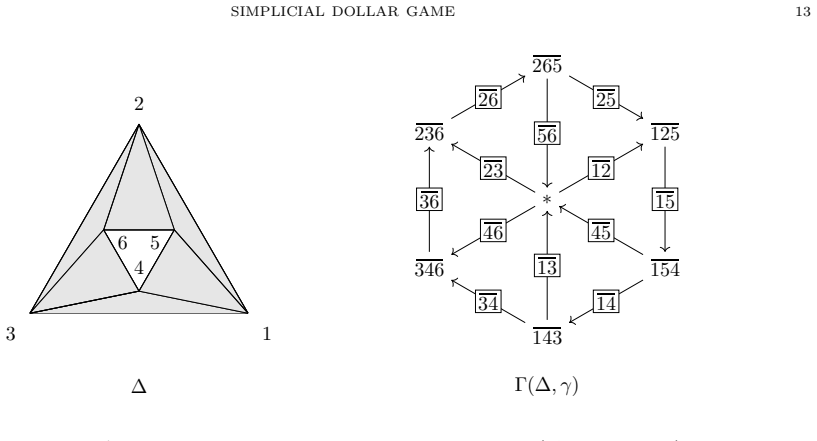
The load-bearing object is the Hilbert basis of the nonnegative kernel of the Laplacian. Concretely, $\mathcal H_i$ is the unique minimal set such that every nonnegative integer $i$-chain in $\ker L_i$ is a nonnegative integer combination of elements of $\mathcal H_i$, and the degree of a chain is the vector of inner products with these basis elements. A second mechanism is Lemma 10, which guarantees a strictly positive element in $\ker L_i$; that positivity forces the nonnegative kernel to span the whole kernel, so degree-zero chains can be identified with torsion classes of the critical group and Theorem 18 follows from a finite decomposition argument. For orientable pseudomanifolds, the Hilbert basis in codimension one is combinatorially explicit: it consists of the incidence vectors of simple directed cycles of the $\gamma$-incidence graph.
What would settle it
For any fixed simplicial complex and dimension $i$, compute the realizable degrees and test whether every chain of degree at least some $\delta$ is winnable; if no such $\delta$ exists, Theorem 18 fails, and independently, finding a complex where $\ker L_i$ contains no strictly positive integer vector would falsify Lemma 10, the step on which the theorem rests.
Extended reading notes
Core claim
The paper establishes that the graph-theoretic dichotomy 'large enough degree wins, and zero degree wins exactly on trees' survives in higher dimensions once degree is redefined. Two $i$-chains are linearly equivalent if they differ by an element in the image of $L_i$, and the degree of a chain is the vector of dot products with the elements of the Hilbert basis $\mathcal H_i$ of $\ker^+ L_i$, the monoid of nonnegative integer chains in the kernel of the Laplacian. This degree is invariant under firing moves and nonnegative on effective chains, while the naive sum of coefficients is neither. Theorem 18 states that for each $i$ there exists a realizable degree $\delta$ such that every chain of degree at least $\delta$ is winnable; Theorem 13 identifies degree-zero classes modulo firing with the torsion subgroup of the critical group $K_i(\Delta)$; and Corollary 34 shows that all $(i-1)$-chains of degree zero are winnable in $\Delta$ if and only if the $i$-skeleton is a spanning $i$-forest with $\widetilde H_{i-1}(\Delta)$ torsion-free.
Load-bearing premise
The load-bearing premise is Lemma 10, the assertion that in every dimension the Laplacian kernel contains a chain whose coefficients are all strictly positive, since without such a positive kernel element the identification of degree-zero classes with critical-group torsion, and hence the high-degree winnability theorem, would not follow.
Editorial extensions
If this is right
- If the theorem is right, a finite computation at one sufficiently large degree settles winnability for all larger degrees, because degree-zero classes form a finite torsion group.
- The tree characterization carries over: the complexes with universally winnable degree-zero chains are exactly the spanning forests torsion-free in codimension one, so winnability at degree zero detects a homological property.
- On orientable pseudomanifolds, the Hilbert basis is encoded by simple directed cycles in a gamma-incidence graph, making degree calculations combinatorial rather than algebraic.
- The set of minimal winning degrees is a finite antichain of vectors, replacing the single graph genus as the threshold invariant; the paper computes one such antichain for the hollow tetrahedron.
Reading between the lines
- When the Hilbert basis consists of 0-1 vectors, Corollary 20 upgrades the theorem to an exact threshold: winnability at a single degree forces winnability at all larger degrees, so the minimal winning set is particularly clean for such complexes.
- Because degree-zero classes are torsion of the critical group, tabulating critical-group torsion over families of complexes would automatically answer whether the zero-degree dollar game is universally winnable.
- The documented failure of the greedy algorithm and q-reduction in higher dimensions suggests that deciding winnability for unfixed dimension could be harder than in graphs, though the paper only poses this as an open question.
- The paper's open problem about minimal winning degrees for (d-2)-chains on the d-simplex could serve as a concrete benchmark for how the vector threshold grows with dimension.
Signed reviews
Editorial analysis
A structured set of objections, weighed in public.
Referee Report
Summary. The paper introduces a higher-dimensional analogue of the Baker--Norine dollar game on simplicial complexes, using Duval--Klivans--Martin's chip-firing theory. It defines a degree vector for i-chains via the Hilbert basis of the nonnegative kernel of the i-th up-down Laplacian. The main results are Theorem 18, stating that every i-chain of sufficiently large degree is winnable, and Corollary 34, characterizing when all (i-1)-chains of degree zero are winnable in terms of spanning i-forests and torsion-free (i-1)-homology, thereby generalizing the tree case for graphs. Additional contributions include the identification of degree-zero chains modulo firing with the torsion of the critical group (Theorem 13), a combinatorial description of the Hilbert basis in codimension one for orientable pseudomanifolds (Theorem 22), a generalization of the reduced Laplacian isomorphism (Theorem 30), and several worked examples including minimal winning degrees.
Significance. The paper gives a natural invariant notion of degree for simplicial chip-firing and establishes a higher-dimensional analogue of the classical winnability threshold. The proof strategy is clean: the degree is defined independently of winnability, the key technical Lemma 10 is proved directly, and Theorem 18 follows from Lemma 17 together with finiteness of the torsion of the critical group. The identification of degree-zero chains modulo firing with torsion (Theorem 13) and the pseudomanifold Hilbert-basis theorem (Theorem 22) are valuable structural results. The paper also provides explicit computations and examples showing that higher-dimensional behavior differs from graphs, which is informative. I find no circularity: external dependencies, such as Duval--Klivans--Martin's Theorem 33, are prior results by other authors, and the authors' own arguments are not used to prove the main theorems in a circular manner.
minor comments (5)
- [Section 4, opening paragraph] The displayed definition "C := {v in R^{f_i} : L_i v >= 0 and v >= 0}" is inconsistent with Definition 4, which correctly defines the degree using the Hilbert basis of ker_+ L_i. The cone C is never used afterward, and a reader could momentarily mistake it for the intended kernel; it should be removed or replaced.
- [Lemma 10 and Theorem 18] The phrase "for each integer i" should be restricted to i with 0 <= i <= dim(Delta), or the empty-face case should be handled explicitly, since the proof of Lemma 10 chooses a lexicographically smallest i-face and does not apply when Delta_i is empty.
- [Section 2.2, Polyhedral cones] The term "integrally generated" is used without definition; because the Hilbert basis property depends on it, a one-sentence definition would help the reader.
- [Examples 36 and 37] The Sage computations are reported but the input data are not included; for reproducibility, the authors might include a short appendix or reference to the code used.
- [Proof of Proposition 32] The phrase "unique maximal linearly independent subset" should be read as "unique basis of the column space" or "unique maximum-cardinality linearly independent subset"; the current wording is slightly ambiguous.
Circularity Check
No significant circularity: the degree invariant is defined independently of winnability, and Theorem 18 is proven from the cone decomposition and torsion identification without fitting or renaming.
full rationale
The derivation chain is self-contained. Definition 4 defines the i-th degree as the vector of dot products of a chain with the Hilbert basis of the nonnegative kernel ker+ L_i; this definition does not presuppose winnability. Proposition 6 proves degree invariance under firing by orthogonality of ker L_i to im L_i, and Corollary 7 (winnability implies degree at least 0) is a consequence, not an input. Lemma 10 is proven directly by a lexicographic maximality argument using the star of a face, with no dependence on the paper's conclusions. Corollary 12 follows from Lemma 10 and shows that the Z-span of ker+ L_i is all of ker L_i, so degree-zero chains are exactly (ker L_i)^⊥; Theorem 13 is then an explicit cokernel/torsion identification, not a restatement of the degree definition. Lemma 17 is a rational-polyhedral-cone decomposition with a bounded correction set P_i, and Theorem 18 uses only finiteness of torsion representatives and P_i to choose an existential dominating chain omega; the resulting degree delta = deg(omega) is not fitted to any winnability data. Later results, including Corollary 34, rely on Duval-Klivans-Martin's Theorem 33, which is an external result by other authors. The paper's self-citations (e.g., the Corry-Perkinson textbook and Perkinson et al.) are not load-bearing for the main theorems, and the unspecified cone C appearing just before Definition 4 is unused and appears to be a harmless typographical relic. No step reduces one of the paper's claims to its own inputs by construction.
Assumptions & free parameters
assumptions (7)
- standard math Finite simplicial complex Delta with fixed vertex order; chain boundary maps satisfy partial_i partial_{i+1} = 0 and L_i = partial_{i+1} partial_{i+1}^t is symmetric.
- standard math The cone ker_+ L_i = {v >= 0 : L_i v = 0} is a pointed rational polyhedral cone, so it has a unique and finite Hilbert basis.
- standard math Each rational polyhedral cone Q satisfies Q = Q_Z + Pi for a fundamental parallelepiped Pi, with Q intersect Z^n = Q_Z + (Pi intersect Z^n).
- domain assumption Theorem 33: |T(K_{i-1}(Delta))| = tau_i(Delta), from Duval, Klivans, and Martin [9, Theorem 8.1].
- domain assumption Proposition 29 from [8]: any two of the three conditions defining a spanning i-forest imply the third.
- domain assumption For orientable pseudomanifolds, H_d(Delta, partial Delta) is isomorphic to Z and H_{d-1}(Delta, partial Delta) is torsion-free.
- domain assumption Definition of X_i(Delta) introduced by Corry and Keenan in private communication.
Cite this review
Pith. "Pith review of Simplicial Dollar Game." pith.science (2026). https://pith.science/paper/DWTCTJNW
@misc{pith2026190809350,
  author       = {Pith},
  title        = {Pith review of: Simplicial Dollar Game},
  year         = {2026},
  howpublished = {\url{https://pith.science/paper/DWTCTJNW}},
  note         = {Machine review of arXiv:1908.09350}
}
read the original abstract
The dollar game is a chip-firing game introduced by Baker and Norine (2007) as a context in which to formulate and prove the Riemann-Roch theorem for graphs. A divisor on a graph is a formal integer sum of vertices. Each determines a dollar game, the goal of which is to transform the given divisor into one that is effective (nonnegative) using chip-firing moves. We use Duval, Klivans, and Martin's theory of chip-firing on simplicial complexes to generalize the dollar game and results related to the Riemann-Roch theorem for graphs to higher dimensions. In particular, we extend the notion of the degree of a divisor on a graph to a (multi)degree of a chain on a simplicial complex and use it to establish two main results. The first of these is Theorem 18, generalizing the fact that if a divisor on a graph has large enough degree (at least as large as the genus of the graph), it is winnable; and the second is Corollary 34, generalizing the fact that trees (graphs of genus 0) are exactly the graphs on which every divisor of degree 0, interpreted as an instance of the dollar game, is winnable.
Figures


Figures from the paper (4 more)


Reference graph
Works this paper leans on
-
[1]
Problems from the AIMS Chip-Firing Workshop , https://aimath.org/WWN/chipfiring/aim_chip-firing_problems.pdf, July 2013
work page 2013
-
[2]
Matthew Baker and Serguei Norine, Riemann-Roch and Abel-Jacobi theory on a finite graph , Adv. Math. 215 (2007), no. 2, 766–788
work page 2007
-
[3]
Matthew Baker and Farbod Shokrieh, Chip-firing games, potential theory on graphs, and spanning trees, J. Combin. Theory Ser. A 120 (2013), no. 1, 164–182
work page 2013
-
[4]
N. L. Biggs, Chip-firing and the critical group of a graph , J. Algebraic Combin. 9 (1999), no. 1, 25–45
work page 1999
-
[5]
Sarah Brauner, Forrest Glebe, and David Perkinson, Enumerating linear systems on graphs , https://arxiv.org/abs/1906.04768, 2019
work page Pith review arXiv 1906
-
[6]
Scott Corry and Liam Keenan, private communication, 2017
work page 2017
-
[7]
Scott Corry and David Perkinson, Divisors and Sandpiles , American Mathematical Society, Providence, RI, 2018, An introduction to chip-firing
work page 2018
-
[8]
Art M. Duval, Caroline J. Klivans, and Jeremy L. Martin, Critical groups of simplicial complexes , Ann. Comb. 17 (2013), no. 1, 53–70
work page 2013
Show all 20 references
-
[9]
Algebraic Combin
, Cuts and flows of cell complexes , J. Algebraic Combin. 41 (2015), no. 4, 969–999
2015
-
[10]
, Simplicial and cellular trees , Recent trends in combinatorics, IMA Vol. Math. Appl., vol. 159, Springer, [Cham], 2016, pp. 713–752
2016
-
[11]
131, Princeton Univer sity Press, Princeton, NJ, 1993, The William H
William Fulton, Introduction to Toric Varieties , Annals of Mathematics Studies, vol. 131, Princeton Univer sity Press, Princeton, NJ, 1993, The William H. Roever Lectures in Geome try
1993
-
[12]
Discrete Math
Johnny Guzm´ an and Caroline Klivans, Chip firing on general invertible matrices , SIAM J. Discrete Math. 30 (2016), no. 2, 1115–1127
2016
-
[13]
32 (1997), no
Martin Henk and Robert W eismantel, The height of minimal Hilbert bases , Results Math. 32 (1997), no. 3-4, 298–303
1997
-
[14]
David Hilbert, ¨Uber die Theorie der algebraischen Formen , Math. Ann. 36 (1890), no. 4, 473–534
-
[15]
Klivans, The Mathematics of Chip-Firing , Discrete Mathematics and its Applications (Boca Raton), C RC Press, Boca Raton, FL, 2019
Caroline J. Klivans, The Mathematics of Chip-Firing , Discrete Mathematics and its Applications (Boca Raton), C RC Press, Boca Raton, FL, 2019
2019
-
[16]
Massey, A Basic Course in Algebraic Topology , Graduate Texts in Mathematics, vol
William S. Massey, A Basic Course in Algebraic Topology , Graduate Texts in Mathematics, vol. 127, Springer-Verlag , New York, 1991
1991
-
[17]
Math., vol
David Perkinson, Jacob Perlman, and John Wilmes, Primer for the algebraic geometry of sandpiles , Tropical and non- Archimedean geometry, Contemp. Math., vol. 605, Amer. Math . Soc., Providence, RI, 2013, pp. 211–256
2013
-
[18]
Alexander Schrijver, Theory of Linear and Integer Programming , Wiley-Interscience Series in Discrete Mathematics, John Wiley & Sons, Ltd., Chichester, 1986, A Wiley-Interscience Publication
1986
-
[19]
Spanier, Algebraic Topology, Springer-Verlag, New York-Berlin, 1981, Corrected repri nt
Edwin H. Spanier, Algebraic Topology, Springer-Verlag, New York-Berlin, 1981, Corrected repri nt
1981
-
[20]
2), 2018, http://www.sagemath.org
The Sage Developers, Sagemath, the Sage Mathematics Software System (Version 8. 2), 2018, http://www.sagemath.org. UCSD, La Jolla, CA 92093 E-mail address : jvkim@ucsd.edu Reed College, Portland, OR 97202 E-mail address : davidp@reed.edu
2018
Reviewed August 14, 2026 · model on record in the stance chip above.
Discussion (0). Continue with ORCID to comment.